A Study of Structured Clinical Abstracts and the Semantic Classification of
Sentences
Grace Y. Chung and Enrico Coiera Centre for Health Informatics University of New South Wales
Sydney NSW 2052 Australia
{graceyc, e.coiera}@unsw.edu.au
Abstract
This paper describes experiments in classi-fying sentences of medical abstracts into a number of semantic classes given by section headings in structured abstracts. Using con-ditional random fields, we obtain F-scores ranging from 0.72 to 0.97. By using a small set of sentences that appear under the PAR -TICPANTSheading, we demonstrate that it is possible to recognize sentences that describe population characteristics of a study. We present a detailed study of the structure of abstracts of randomized clinical trials, and examine how sentences labeled underPAR -TICIPANTScould be used to summarize the population group.
1 Introduction
Medical practitioners are increasingly apply-ing evidence-based medicine (EBM) to support decision-making in patient treatments. The aim of EBM (Sackett, 1998) is to provide improved care leading to better outcomes through locating evidence for a clinical problem, evaluating the quality of the evidence, and then applying to a current problem at hand. However, the adoption of EBM is hampered by the overwhelming amount of information available, and insufficient time and skills on the clinician’s part to locate and synthesize the best evidence in the scientific literature.
MEDLINEabstracts about randomized clinical tri-als (RCTs) play a critical role in providing the best evidence for the latest interventions for any given
conditions. TheMEDLINEdatabase now has 16
mil-lion bibliographic entries, many of them include the abstract and more than 3 million of these were pub-lished in the last 5 years (Hunter, 2006).
To alleviate the information overload, some resources such as the Cochrane Collabo-ration (Cochrane, 2007), Evidence-Based
Medicine (EBM, 2007), the ACP Journal
Club (ACP, 2007) and BMJ Clinical
Evi-dence (BMJCE, 2007), employ human experts to summarize knowledge within RCTs through extensive searches and critical assessments.
In (Sim, 2000), RCT information is entered into electronic knowledge bases or “trial banks”, eas-ing the task for systematic revieweas-ing and critical appraisal. This project requires manual entry of descriptions about the design and execution (sub-jects, recruitment, treatment assignment, follow-up), and hence, only small numbers of RCTs have been archived thus far.
The goal of our research is to use natural language processing to extract the most important pieces of in-formation from RCTs for the purpose of automatic summarization, tailored towards the medical prac-titioner’s clinical question at hand. Ultimately, it is our vision that data mined from full text articles of RCTs not only aid clinicians’ assessments but re-searchers who are conducting meta-analyses.
Other researchers have recognized the potential utility of these heading (McKnight, 2003; Xu, 2006; Lin, 2006). It has also been recognized that scien-tific abstracts with such labels could be of impor-tance to text summarization, information retrieval and question answering (Lee, 2006; Zweigenbaum, 2003). We share similar goals to previous research; the section headings of these structured medical ab-stracts can be used as training data for building la-belers that can tag unstructured abstracts with dis-course structure. But also, there is a large number of heading names. Sentences that occur under these heading names form a labeled training set which could be used to build a classifier that recognizes similar sentences. Ultimately, we would like to build finer-grained classifiers that exploit these semantic labels.
In our work, we seek to demonstrate that infor-mation about patient characteristics can now be ex-tracted from structured and unstructured abstracts. We are motivated by the fact that patient character-istics is one of the fundamental factors most perti-nent to evaluation of relevance to a clinical question. The total number of subjects in a trial reflects on the quality of the RCT, and additional factors such as age, gender and other co-existing conditions, will be crucial for assessing whether an RCT is relevant to the medical practitioner’s immediate patient.
This paper is organized as follows. In Section 1 we will describe how the RCT abstracts were ob-tained, and we present a study of the discourse head-ings that occur in our document corpus. Section 3 will detail our sentence classification experiments. We first explore classification in which the abstracts are labeled under five subheadings, one of which de-scribes the patients or population group. We also perform classification using a combined two-stage scheme, bootstrapping from partially labeled data. Finally in Section 4, we consider how well thePAR
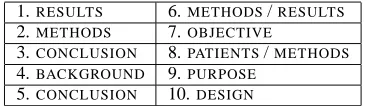
-1.RESULTS 6.METHODS/RESULTS 2.METHODS 7.OBJECTIVE
3.CONCLUSION 8.PATIENTS/METHODS 4.BACKGROUND 9.PURPOSE
5.CONCLUSION 10.DESIGN
Table 1: The most common headings in RCT ab-stracts.
TICIPANTSlabeled sentences capture sentences con-taining the total number of participants in a trial. In Section 5, we will give a detailed analysis of the la-beled sentences.
2 The Data
2.1 Corpus Creation
The current corpus is obtained by aMEDLINEsearch for RCTs. We did not constrain publications by their date. For the purpose of constraining the size of our corpus in these preliminary experiments, it was our intention to use RCTs pertaining to a fixed set of clinical conditions. Hence, we conducted a
MEDLINE search for RCTs with the following key-words: asthma, diabetes, breast cancer, prostate can-cer, erectile dysfunction, heart failure, cardiovascu-lar, angina. The resultant corpus contains 7535 ab-stracts of which 4268 are structured.
2.2 Structure of Medical Abstracts
Structured abstracts were introduced in 1987 (Ad-Hoc, 2005) to help clinical readers to quickly se-lect appropriate articles, and allow more precise in-formation retrieval. However, currently, the major-ity of medical abstracts remain unstructured. Previ-ous studies have concluded that while many scien-tific abstracts follow consistent patterns (e.g. Intro-duction, Problem, Method, Evaluation, Conclusion) many still contain missing sections or have differ-ing structures (Orasan, 2001; Swales, 1990; Meyer, 1990). Journals vary widely in their requirements for abstract structures.
We have conducted a study of the structured ab-stracts in our corpus. Of 4268 structured abab-stracts, we have found a total of 238 unique section head-ings. The most common ones are shown in Table 1. To investigate the numbers of variations in the ab-stract structure, we first manually map headings that
Class Example Heading Names Aim AIM,AIMS,AIM OF THE STUDY.. Setting SETTING,SETTINGS,STUDY SETTING.. Participants PARTICIPANTS,PATIENTS,SUBJECTS.. Setting/ PARTICIPANTS AND SETTINGS, Subjects SETTING/PATIENTS..
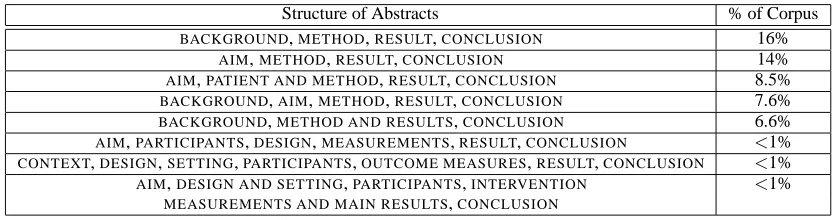
Structure of Abstracts % of Corpus BACKGROUND,METHOD,RESULT,CONCLUSION 16%
AIM,METHOD,RESULT,CONCLUSION 14% AIM,PATIENT AND METHOD,RESULT,CONCLUSION 8.5% BACKGROUND,AIM,METHOD,RESULT,CONCLUSION 7.6% BACKGROUND,METHOD AND RESULTS,CONCLUSION 6.6% AIM,PARTICIPANTS,DESIGN,MEASUREMENTS,RESULT,CONCLUSION <1% CONTEXT,DESIGN,SETTING,PARTICIPANTS,OUTCOME MEASURES,RESULT,CONCLUSION <1% AIM,DESIGN AND SETTING,PARTICIPANTS,INTERVENTION <1%
MEASUREMENTS AND MAIN RESULTS,CONCLUSION
Table 3: Examples of the patterns that occur in the section headings of structured RCT abstracts.
are essentially semantically equivalent to the same classes, resulting in 106 classes. Examples of these mappings are shown in Table 2. After the class mappings are applied, it turns out that there are still 400 different patterns in the combinations of section headings in these medical abstracts, with over 90% of these variations occurring less than 10 times. The most common section heading patterns are shown in Table 3. Some of the less common ones are also shown.
In studying the structure of these medical ab-stracts, we find that the variation in structural or-dering is large, and many of the heading names are unique, chosen at the discretion of the paper author. Some of the most frequent heading names are also compound headings such as: METHODS/RESULTS, RESULTS/CONCLUSION,PATIENTS/RESULTS,SUB
-JECTS AND SETTINGS.
3 Sentence Classification Experiments
3.1 Extracting Participant Sentences
In this work, we seek to build a classifier using train-ing data from the semantic labels already provided by structured abstracts. It is our intention ultimately to label both structured and unstructured abstracts with the semantic labels that are of interest for the purposes of information extraction and answering specific questions regarding the trial. In our ap-proach, we identify in our structured abstracts the ones with section headings about patient character-istics. These are collapsed under one semantic class and used as training data for a classifier.
From our 4268 structured abstracts, all the head-ing names are examined and are re-mapped by hand to one of five heading names: AIM,METHOD, PAR
-TICIPANTS, RESULTS, CONCLUSION. Most
head-ing names can be mapped to these general headhead-ings but the subset containing compound headings such asMETHOD/RESULT are discarded.
All the abstracts are segmented into sentences and tokenized via Metamap (Aronson, 2001). Some ab-stracts are discarded due to sentence segmentation errors. The remainder (3657 abstracts) forms the corpus that we will work with here. These abstracts are randomly divided into a training set and an initial test set, and for purposes of our experiments, they are further subdivided into abstracts with the PAR
-TICIPANTS label and those without. The exact size of our data sets are given in Table 4.
Although abstracts in Train Set A are generally structured as (AIM, METHOD, RESULTS, CONCLU
-SION), they contain sentences pertaining to patient or population group largely in the METHOD sec-tion. In the following, we will explore three ways for labeling sentences in the abstract including label-ing for sentences that describe the population group. The first employs a 5-class classifier, the second uses a two-stage approach and the third employs an ap-proach which uses partially labeled data.
3.2 Using Labeled Data Only
Using only abstracts from Train Set B, all sen-tences are mapped into one of 5 classes: AIM,PAR -TICIPANTS, METHOD, RESULTS, CONCLUSION.
Data Set Number of Number of Abstracts Sentences Total in Corpus 3657 45k
Total Train Set 3439 42k Train Set A (noPARTICIPANTS) 2643 32k Train Set B (w/PARTICIPANTS) 796 10k Test Set (w/PARTICIPANTS) 62 878
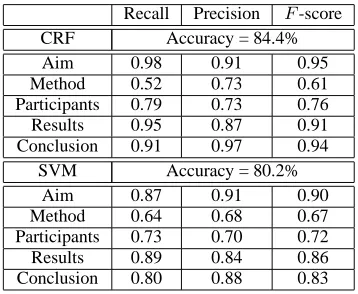
Recall Precision F-score CRF Accuracy = 84.4% Aim 0.98 0.91 0.95 Method 0.52 0.73 0.61 Participants 0.79 0.73 0.76 Results 0.95 0.87 0.91 Conclusion 0.91 0.97 0.94
SVM Accuracy = 80.2% Aim 0.87 0.91 0.90 Method 0.64 0.68 0.67 Participants 0.73 0.70 0.72 Results 0.89 0.84 0.86 Conclusion 0.80 0.88 0.83
Table 5: Classification of sentences in RCT abstracts into 5 semantic classes using CRFs and SVMs. The recall, precision andF-score are reported on our un-seen test set.
The PARTICIPANTS class subsume all headings that include mention of population characteristics. These include compound headings such as: SET
-TING/POPULATION, PATIENTS/DESIGN. Sentences associated with these compound headings often in-clude long sentences that describe the participant group as well as a second aspect of the study such as setting or design.
We build a 5-class classifier using linear-chain conditional random fields (CRFs).1 CRFs (Sutton,
2006) are undirected graphical models that are dis-criminatively trained to maximize the conditional probability of a set of output variables given a set of input variables. We simply use bag-of-words as fea-tures because past studies (McKnight, 2003), using n-gram-based features did not improve accuracies.2
As a baseline comparison, we have performed classification using a Support Vector Machine (SVM) classifier (Burges, 1998; Witten, 2005), with a radial basis functions (RBF) kernel. To help model the sequential ordering, a normalized integer for the sentence number in the abstract is included as a fea-ture.
Experimental results are shown in Table 5. CRFs clearly outperform SVMs in this classification task. This may in part be attributable to the explicit sequential modeling in the CRFs compared with
1We used the SimpleTagger command line interface of the Mallet software package (McCallum, 2002).
2
In other experiments, attempts to use stemming and re-moval of stop words also did not improve performance.
SVMs. While our training set (796 abstracts in Train set B) is substantially smaller than that reported in previous studies (McKnight, 2003; Lin, 2006; Xu, 2006), the F-score for AIM, RESULTS, CONCLU
-SIONare comparable to previous results. By far the
largest sources of classification error are the confu-sions between METHOD and PARTICIPANTS class. In training we have included into thePARTICIPANTS
class all sentences that come under compound headings, and therefore the PARTICIPANTS section can often encompass several sentences that contain detailed information regarding the intervention, and the type of study, as exemplified below.
Doppler echocardiography was performed in 21 GH de-ficient patients after 4 months placebo and 4 months GH therapy, in a double blind cross-over study. In an open design study, 13 patients were reinvestigated following 16 months and 9 patients following 38 months of GH therapy. Twenty-one age and sex-matched normal con-trol subjects were also investigated.
Nonetheless, information about the patient popula-tion is embedded within these sentences.
3.3 Using a Two-Stage Method
An alternative approach is to adopt a two-stage hi-erarchical strategy. First we build a classifier which performs a 4-way classification based on the labels
AIM,METHOD,RESULTS, CONCLUSION, and a
sec-ond stage binary classifier tags all theMETHOD sen-tences into eitherMETHODorPARTICIPANTS. There are two distinct advantages to this approach. (1) In our 5-class classifier, it is clear that METHOD and
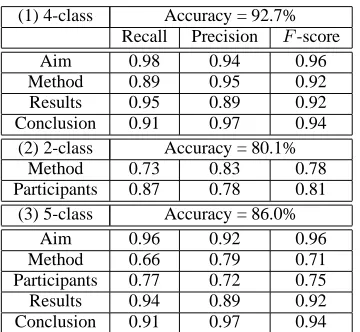
(1) 4-class Accuracy = 92.7% Recall Precision F-score Aim 0.98 0.94 0.96 Method 0.89 0.95 0.92 Results 0.95 0.89 0.92 Conclusion 0.91 0.97 0.94
(2) 2-class Accuracy = 80.1% Method 0.73 0.83 0.78 Participants 0.87 0.78 0.81
(3) 5-class Accuracy = 86.0% Aim 0.96 0.92 0.96 Method 0.66 0.79 0.71 Participants 0.77 0.72 0.75 Results 0.94 0.89 0.92 Conclusion 0.91 0.97 0.94
Table 6: (1) Classification using CRFs into 4 ma-jor semantic classes with combined Train Set A and B as training data. (2) Binary SVM classification of a subset of test set sentences. (3) Classification into 5 classes as described in Section 3.3. All results (recall, precision and F-score) are reported on the unseen test set.
the binary SVM classifier on the subset of test set sentences (253 sentences) that are either METHOD
orPARTICIPANTS in Table 6.
The two stage method here has yielded some gains in performance for each class except for PAR
-TICIPANTS. The gains are likely to have been due to increased training data particularly for the classes,
AIM,RESULTSandCONCLUSION.
3.4 Augmenting with Partially Labeled Data
We investigate a second method for leveraging the data available in Train Set A. We hypothesize that many sentences within theMETHODsection of Train Set A do in fact describe patient information and could be used as training data. We propose a boot-strapping method whereby some of the sentences in Train Set A are tagged by a binary SVM classifier and used as training data in the 5-class CRF classi-fier. The following describes each step:
1. A binary SVM classifier is trained on the sub-set of sentences in Train Set B labeled with
METHODandPARTICIPANTS.
2. The trained SVM classifier is used to label all the sentences in Train Set A that are originally labeled with theMETHODclass.
Recall Precision F-score 5-class Accuracy = 87.6%
Aim 0.99 0.95 0.97 Method 0.67 0.77 0.72 Participants 0.90 0.77 0.83 Results 0.91 0.92 0.92 Conclusion 0.90 0.97 0.93
Table 7: Classification into 5 classes as described in Section 3.4. All results (recall, precision and F -score) are reported on the unseen test set.
3. All the sentences in Train Set A are now labeled in terms of the 5 classes, and a score is avail-able from the SVM output is associated with those sentences labeled as either METHOD or
PARTICIPANTS. The abstracts that contain sen-tences scoring above a pre-determined thresh-old score are then pooled with sentences in Train Set B into a single training corpus. We tuned the threshold value by testing on a de-velopment set held out from Train Set B. As a result, 1217 sentences from Train Set A is com-bined with Train Set B.
4. The final training corpus is used to train a CRF tagger to label sentences into one of 5 classes.
The results of classification on the unseen test set are reported in Table 7. Overall accuracy for classifi-cation improves to 87.6% primarily because there is a marked improvement is observed for theF-scores of the PARTICIPANTS class. Our best results here are comparable to those previously reported on sim-ilar tasks on the class, AIM, RESULTS and CON
-CLUSION (Xu, 2006; Lin, 2006). The F-score for
METHOD is lower because introducing a PARTICI
-PANTSlabel has increased confusability.
4 Extraction of Number of Patients
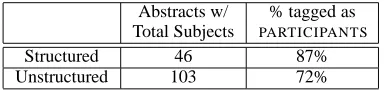
Abstracts w/ % tagged as Total Subjects PARTICIPANTS Structured 46 87% Unstructured 103 72%
Table 8: Extraction of the total number of subjects in a trial in a human annotated test set, as described in Section 4.2
4.1 Annotation
In a concurrent annotation effort to label RCT ab-stracts, human annotators manually tagged a sepa-rate test set of 204 abstracts with the total number of participants in each study. Of the 204 abstracts, 148 are unstructured and 56 are structured. None of these 204 abstracts are part of the training set, de-scribed in this paper.
4.2 Experiments
The abstracts from this annotated test set are pro-cessed by the classifier described in Section 3.4. For all the abstracts which mention the total number of participants in the RCT, we compute the frequency for which this is included in the sentences labeled as
PARTICIPANTS. Results are depicted in Table 8.
Upon subsequent examination of the test set, it is found that only 82% (46/56) of the structured ab-stracts and 70% (103/148) of unstructured abab-stracts contain information about total number of partici-pants in the trial. As seen in Table 8, in 87% of the 46 structured abstracts, and in 72% of the 103 un-structured abstracts, the total number of participants are mentioned in the labeled PARTICIPANTS
sen-tences. The extraction of the total number of partici-pants is significantly worse in unstructured abstracts which do not adhere to the strict discourse structures given by the headings of structured abstracts. In 13% (13/103) of the unstructured abstracts, the total number of participants appears in the first sentence, which is usually tagged as theAIM. It is evident that in the absence of structure, patient information can occur in any sentence in the abstract, or for that mat-ter, it may appear only in the body of the paper. Our method of training first on structured abstracts may be a strong limitation to extraction of information from unstructured abstracts.
Even for the structured abstracts in the test set, 9% (4/46) of the set of abstracts containing population
number actually mention the number in the AIMor
RESULTS section, rather than the METHOD orPAR -TICIPANTS. Only 12 abstracts contain explicit head-ings referring to participants, where the total number of subjects in the trial is mentioned under the corre-sponding heading.
In this task, we only consider that total number of subjects enrolled in a study, and have yet to account for additional population numbers such as the drop out rate, the follow-up rate, or the number of sub-jects in each arm of a study. These are often reported in an abstract without mentioning the total number of patients to begin with. The classifier will tag sen-tences that describe these asPARTICIPANTsentences nonetheless.
5 Analysis and Discussion
We will further analyze the potential for using sen-tences tagged as PARTICIPANTS as summaries of population characteristics for a trial. Table 9 gives some examples of sentences tagged by the classifier. Sentences that appear under PARTICIPANTS in structured abstracts are often concise descriptions of the population group with details about age, gender, and conditions, as seen in Example 1. Otherwise, they can also be extensive descriptions, providing selection criteria and some detail about method, as in Example 2.
Examples 3 and 4 show sentences from the test set of Section 4. Example 3 has been labeled as aPAR
-TICIPANTS sentence by the classifier. It describes patient characteristics, giving the population num-ber for each arm of the trial but does not reveal the total number of subjects. Example 3 appears under the headingMETHODS AND RESULTSin the original abstract. Example 4 is from an unstructured abstract, where information about the intervention and popu-lation and study design are interleaved in the same sentences but tagged by the classifier as PARTICI
-PANTS. Many sentences tagged as PARTICIPANTS
also do not give explicit information about popula-tion numbers but only provide descriptors for patient characteristics.
publica-1. Male smokers aged 50–69 years who had angina pectoris in the Rose chest pain questionnaire at baseline (n= 1795).
PMID: 9659191
2. The study included 809 patients under 70 years of age with stable angina pectoris. The mean age of the patients was 59 +/-7 years and 31% were women. Exclusion criteria were myocardial infarction within the previous 3 years and contraindications to beta-blockers and calcium antagonists. The patients were followed between 6 and 75 months (median 3.4 years and a total of 2887 patient years). PMID: 8682134
3. Subjects with Canadian Cardiovascular Society (CCS) class 3/4 angina and reversible perfusion defects were randomized to SCS (34) or PMR (34). PMID: 16554313
4. Sixty healthy women, half of whom had been using OCs for at least the previous 6 months, participated in the study. Approx-imately two thirds were smokers and were randomized to be tested after either a 12 hr nicotine deprivation or administration of nicotine gum. One third were nonsmokers. PMID: 11495215
Table 9: Examples of sentences labeled under PARTICIPANTS class, forming summaries of the population characteristics of a trial. Examples 1 and 2 are typical sentences under the PARTICIPANTS heading in the train set. Examples 3 and 4 are from the annotated test set. See Section 5 for more detailed explanation.
tions and structural characteristics of our abstracts may be broader than previous reports which filter for abstracts to a narrow time frame (Xu, 2006).
6 Related Work
In recent years, there has been a growth in research in information extraction and NLP in the medical domain particularly in the RCT literature. This is due in part to the emergence of lexical and seman-tic resources such as the Unified Medical Language System (UMLS) (Lindberg, 1993), and software such as MetaMap (Aronson, 2001), which trans-forms text into UMLS concepts, and SemRep (Rind-flesch, 2003), which identifies semantic proposi-tions.
There are a number of previous attempts to per-form text categorization on sentences in MEDLINE
abstracts into generic discourse level section head-ings. They all share the goal of assigning structure to unstructured abstracts for the purpose of sum-marization or question answering. All previous at-tempts have mapped the given headings to four or five generic classes, and performed text categoriza-tion on large sets of RCTs without any disease or condition-specific filtering. Studies have shown that results deteriorate when classifying sentences in un-structured abstracts (McKnight, 2003; Lin, 2006). In (McKnight, 2003), McKnight and Srinivisan used an SVM for tagging sentences into 4 classes. Using a corpus of 7k abstracts, they obtainF-scores from 0.82 to 0.89. Later papers in (Xu, 2006; Lin, 2006) have found that Hidden Markov Models (HMMs) based approaches more effectively model the se-quential ordering of sentences in abstracts. In (Xu,
2006), several machine learning methods, decision tree, maximum entropy and naive Bayes, are evalu-ated with an HMM-based algorithm. 3.8k abstracts from 2004 and 2005 were used as training data, and experiments yielded average precision of 0.94 and recall of 0.93.
One driving model for information extraction in RCTs is the PICO framework (Richardson, 1995). This is a task-based model for EBM formulated to assist EBM practitioners to articulate well-formed questions in order to find useful answers in clinical scenarios. PICO elements are Patient/Population, Intervention, Comparison and Outcome. This model has been adopted by researchers (Demner-Fushman, 2005; Niu, 2004) as a guideline for elements that can be automatically extracted from RCTs and patient records. However, doubts have been raised about the utility of PICO as a generic knowledge repre-sentation for computational approaches to answer-ing clinical questions (Huang, 2006).
In experiments reported in (Demner-Fushman, 2005), the PICO framework was used as a basis for extracting population, problem, intervention and comparison for the purpose of evaluating relevance of an abstract to a particular clinical question. In this work, the population statements were located via a set of hand-written rules that were based on extract-ing an actual numeric value for the population.
7 Conclusions
-SULTSandCONCLUSIONwere comparable to previ-ous studies, even with smaller training sets. We in-vestigated the use of text classification by leveraging the subset of abstracts with explicitly labeled PAR
-TICIPANTS sentences combining the use of CRFs
and SVMs, and exploiting partially labeled data. One main objective here is to label sentences that describe population characteristics in structured and unstructured abstracts. We found that unstructured abstracts differ substantially from structured ones, and alternative approaches will be necessary for extracting information from unstructured abstracts. Furthermore, critical details that are needed by a physician when evaluating a study such as exclusion criteria, drop out rate, follow up rate, etc, may only be listed in the full text of the study. Future work will address extracting information beyond the ab-stract.
8 Acknowledgment
The authors would like to acknowledge the anony-mous reviewers and the executive committee for their comments and suggestions, and Marianne Byrne, Brenda Anyango Omune and Wei Shin Yu for annotation of the abstracts. This project is funded by the Australian Research Council, grant number DP0666600.
References
ACP Journal Club. Available from: http://www.acpjp.org
Ad Hoc working group for Critical Appraisal of the Medical Literature 1987. A proposal for more informative abstracts of clinical articles. Annals of Int. Medicine 106:595–604.
A. R. Aronson. 2001. Effective mapping of biomedical text to the UMLS Metathesaurus: The MetaMap program. Ann.
Symp. of AMIA pp 17–21.
Clinical Evidence. BMJ Publishing Group. Available from:
http://www.clinicalevidence.com
C. Burges. 1998. A Tutorial on Support Vector Machines for Pattern Recognition Journal Data Mining and Knowledge
Discovery, 2(2), June.
The Cochrane Collaboration. Available from: http://www.cochrane.org
D. Demner-Fushman and J. Lin. 2005. Knowledge extraction for clinical question answering: Preliminary results. AAAI
Workshop on Question Answering in Restricted Domains.
Evidence Based Medicine. Available from: http://ebm.bmjjournals.com
X. Huang et al. 2006. Evaluation of PICO as a Knowledge Representation for Clinical Questions. Ann. Symp. of AMIA pp359–363.
L. Hunter and K. Bretonnel Cohen. 2006. Biomedical lan-guage processing: what’s beyond PubMed? Molecular Cell, 21:589-594.
J. Lin et al. 2006. Generative Content Models for Structural Analysis of Medical Abstracts. Workshop on Biomedical
Natural Language Processing BioNLP New York.
D. A. Lindberg et al. 1993. The Unified Medical Language System. Methods of Information in Medicine, 32(4):281– 291.
A. McCallum. 2002. MALLET: A Machine Learning for
Lan-guage Toolkit. http://mallet.cs.umass.edu.
L. McKnight and P. Srinivasan 2003. Categorization of Sen-tence Types in Medical Abstracts. Ann. Symp. of AMIA
pp440–444.
M. Lee et al. 2006. Beyond Information Retrieval–Medical Question Answering. Ann. Symp. of AMIA.
Y. Niu and G. Hirst. 2005. Analysis of semantic classes in medical text for question answering. Workshop on Question
Answering in Restricted Domains, Barcelona.
C. Orasan. 2001. Patterns in Scientific Abstracts. 2001 Corpus
Linguistics Conference.
W. S. Richardson et al. 1995. The well-built clinical ques-tion: a key to evidence-based decisions. ACP J Club, Nov-Dec;123(3):A12-3.
T. Rindflesch and M. Fiszman. 2003. The interaction of domain knowledge and linguistic structure in natural language pro-cessing: Interpreting hypernymic propositions in biomedical text. J. of Biomedical Informatics, 36(6):462–477, Dec.
D. L. Sackett et al.. 1998. Evidence Based Medicine: How to
Practice and Teach EBM. Churchill Livingstone, Edinburgh.
F. Salager-Meyer. 1990. Discourse Movements in Medical En-glish Abstracts and their linguistic exponents: A genre anal-ysis study. INTERFACE: J. of Applied Linguistics, 4(2):107– 124.
I. Sim et al. 2000. Electronic Trial Banks: A Complementary Method for Reporting Randomized Trials. Med Decis
Mak-ing, Oct-Dec;20(4):440-50.
C. Sutton and A McCallum. 2006. An introduction to condi-tional random fields for relacondi-tional learning. In Lise Getoor and Ben Taskar, editors, Introduction to Statistical
Rela-tional Learning. MIT Press. To appear.
J. Swales. 1990. Genre Analysis: English in Academic and
Research Settings. Cambridge University Press, Cambridge
University.
I. H. Witten and E. Frank. 2005. Data Mining: Practical
ma-chine learning tools and techniques, 2nd Ed, Morgan
Kauf-mann, San Francisco.
R. Xu et al. 2006. Combining Text Classification and Hidden Markov Modeling Techniques for Structuring Randomized Clinical Trial Abstracts. Ann. Symp. of AMIA.
P. Zweigenbaum. 2003. Question answering in biomedicine.