COGEX at RTE3
Marta Tatu and Dan Moldovan Language Computer Corporation
Richardson, Texas, 75080 United States
marta,[email protected]
Abstract
This paper reports on LCC’s participation at the Third PASCAL Recognizing Textual Entailment Challenge. First, we summarize our semantic logical-based approach which proved successful in the previous two chal-lenges. Then we highlight this year’s inno-vations which contributed to an overall accu-racy of 72.25% for the RTE 3 test data. The novelties include new resources, such as eX-tended WordNet KB which provides a large number of world knowledge axioms, event and temporal information provided by the TARSQI toolkit, logic form representations of events, negation, coreference and context, and new improvements of lexical chain ax-iom generation. Finally, the system’s perfor-mance and error analysis are discussed.
1 Introduction
Continuing a two-year tradition, the PASCAL Net-work organized the Third Recognizing Textual En-tailment Challenge1(RTE 3) to further the research on reasoning systems able to decide whether the meaning of one text (the entailed hypothesis,H) can
be inferred from another text (the entailing text,T).
Among this year’s challenges, approximately 15% of the (T, H) pairs contained long texts (more
de-tails in Section 5.1).
We approach thetextual entailmentproblem as a
logical implication between meanings(Fowler et al., 2005; Tatu et al., 2006). Our system transforms the 1www.pascal-network.org/Challenges/RTE3
two text snippets into three-layered semantically-rich logic form representations, generates an abun-dant set of lexical, syntactic, semantic, and world knowledge axioms and, iteratively, searches for a proof for the entailment between the text T and a
possibly relaxed version of the hypothesis H. A
pair is labeled as positive if the score of the found proof (reflectingH’s degree of relaxation) is above
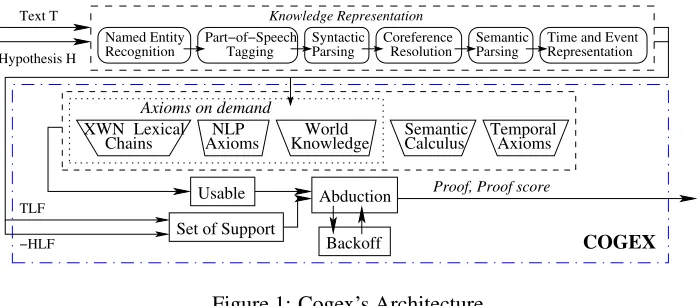
a threshold learned on the training data. Figure 1 summarizes our approach to RTE.
2 Cogex’s Innovations for RTE 3 2.1 EXtended WordNet Knowledge Base
eXtended WordNet Knowledge Base (XWN-KB) is the result of our ongoing research which captures and stores the rich world knowledge encoded in WordNet’s glosses into a knowledge base. In XWN-KB, the glosses have been transformed into a set of semantic relations using a semantic parser whose output has been verified by human annotators. Fig. 2 displays the semantic relations derived for Nobel laureate’s definition. Our system used this represen-tation for QA Dev pair 579 and QA Test pair 5822.
2.2 TARSQI Toolkit
The TARSQI project (Temporal Awareness and Rea-soning Systems for Question Interpretation)3 (Ver-hagen et al., 2005) builds a modular system which detects, resolves and normalizes time expressions (both absolute and relative times) - GUTime tagger; marks events and their grammatical features
NLP
Axioms KnowledgeWorld SemanticCalculus TemporalAxioms XWN Lexical
Chains
Axioms on demand
Named Entity
Recognition Part−of−SpeechTagging SyntacticParsing CoreferenceResolution SemanticParsing Time and EventRepresentation Text T
Hypothesis H
Usable
Set of Support
Abduction
Backoff
Proof, Proof score
−HLF TLF
Knowledge Representation
COGEX
Figure 1: Cogex’s Architecture
The Pet passport alone can be [used]e1:occurrenceto [enter]e2:occurrencethe UK, but it will not [suffice]e3:occurrenceto
[enter]e4:occurrence many countries. For instance Guatemala, like almost every country, [demands]e5:occurrencethat all
imported pets have a rabies vaccination, but will not [accept]e6:i actionthe Pet passport as proof of [said]e7:reporting
vacci-nation.
modality: (e1:can); tense: (e2:infinitive), (e3:future), (e4:infinitive), (e5:present), (e6:future), (e7:past); polarity:
(e3:negative), (e6:negative); slink: modal(e1, e2), modal(e5, e6), factive(e6, e7); tlink: before(e1, e2), before(e5, e6),
before(e4, e5), before(e6, e7), before(e2, e3), before(e2, e4)
Table 1: TARSQI’s Treatment of IE Dev pair 63’sT
ISA(Nobel_laureate,winner) THEME(Nobel_prize,winner)
Nobelist, Nobel_laureate; synsetId: 06822770
gloss: winner of a Nobel_prize
Figure 2: XWN-KB Treatment ofNobel laureate
Evita; identifies subordination constructions intro-ducing modality information - Slinket; adds tempo-ral relations between events and tempotempo-ral expres-sions - GUTenLINK; and computes temporal clo-sures - SputLink. We used the information provided by the TARSQI toolkit (Run #1) as an alternative to our event detection and temporal expression identifi-cation and normalization modules (Run #2). Table 1 shows TARSQI’s output for IE Dev pair 63’sT.
The following sections present innovations re-lated to the logic form knowledge representation.
2.3 Logic Representation of Events
For events, the logic representation of their describ-ing concept was augmented with a special predicate (event EV(e1)). When we made use of TARSQI’s output (Run #1), the event predicate was replaced by the class of the event (occurrence EV(e1), state EV(e1),reporting EV(e1), etc.).
2.4 Negation
Recently, the logic representation of sentences with negated concepts was altered to mark as negated the entire scope of the negation. For example, the logic form of IE Dev pair 90’sH:Kennon did not
partici-pate in the WWII, formerly equal toKennon NN(x1) & -participate VB(e1,x1,x4) & in IN(e1,x2) & WWII NN(x2) & conflict NE(x2) &
AGT SR(x1,e1), became Kennon NN(x1)
& WWII NN(x2) & conflict NE(x2) & -(exists e1 (participate VB(e1,x1,x3) & in IN(e1,x2) & AGT SR(x1,e1)))which is closer to the meaning of the English text snippet. For Run #1 (with TARSQI output), we only used the
polarityinformation attached to the identified events and negated the event’s predicate.
2.5 Coreference Resolution
Semantic Relation Axiom Templates
ISA n1(x1) -> n2(x1);v1(e1,x1,x2) -> v2(e1,x1,x2)
DERIVATION n(x1) -> v(e1,x1,x2) & AGENT SR(x1,e1);n(e1) -> v(e1,x1,x2) v(e1,x1,x2) -> n(x1);v(e1,x1,x2) -> n(e1)
CAUSE v1(e1,x1,x2) -> v2(e2,x2,x3) & CAUSE SR(e1,e2)
AGENT n1(x1) -> n2(x2) & AGENT SR(x1,x2)
PERTAIN a(x1,x2) -> n(x1)
Table 2: Semantic Relation - Axiom Template mapping
long texts. For example, for QA Dev pair 409, re-solving the pronoun he to George H.W. Bush is a step needed to correctly label the pair. But IE Dev pair 92 requires more advanced anaphora resolution which corefersthe teamandthe Kinston Indians.
3 Natural Language Axiom Improvements 3.1 XWN Lexical Chains
In order to take advantage of XWN-KB, we im-plemented few changes in our lexical chain ax-ioms generation module. The most significant re-finement is the one axiom-per-chain relation ap-proach. Previously, the system was generating one axiom for the entire lexical chain, but, given the di-versity of semantic relations which link the Word-Net concepts and the difficulty to reduce an entire semantically rich chain to one implication which captures its meaning, a remodeling of our axiom generation module was required. Therefore, for each relation in the best lexical chain found be-tween one ofT’s constituents and one ofH’s
con-stituents, an axiom is created. For each seman-tic relation, we created a set of axiom templates to be used during the axiom generation process. Several examples of axiom templates are shown in Table 2. Therefore, a lexical chain is broken down into several axioms whose relations are com-bined by the logic prover as it sees fit. For in-stance, the chain oil company#n#1 agent−→ sell#v#1 entailment
←− trade#v#1 is translated into the ax-iomsoil company NN(x1) -> sell VB(e1,x1,x2) & AGENT SR(x1,e1) and sell VB(e1,x1,x2) -> trade VB(e1,x1,x2) used to prove the entailment for IE Dev pair 196.
We also changed the subset of senses considered when lexical chains are built. Previously, this subset contained the first k (k = 3) senses for each
con-tent word. For this year’s challenge, we changed the
sense selection mechanism and we used the cluster of WordNet senses to which the fine-grained sense assigned by the Word Sense Disambiguation sys-tem corresponds. We used the coarse-grained sense inventory for WordNet 2.1 released for Task #7 in SemEval-20074. This clustering was created auto-matically with the aid of a methodology described in (Navigli, 2006). For example, the 10 WordNet senses for the nounbankare mapped into 3 clusters.
3.2 NLP Axioms
In addition to the syntactic re-writing rules which break down complex syntactic structures, including complex nominals and coordinating conjunctions, we added a new type of NLP axioms which links a named entity to its set of aliases. For IE Dev pair 35, the link between theCentral Intelligence Agency
mentioned inT andH’sCIAis very important.
We also added a deeper analysis of multi-word human named entities which marks last names
(Hawking), first (male/female) names (Stephen),
titles (Prime Minister) and names for human entities found in WordNet (Tony Blair). This fine classification has three goals: (1) to mark human entities with the gender information (used by the pronominal coreference module); (2) to prevent lexical chains to use first names of hu-man entities as their source or target (Elizabeth
as part of Elizabeth Alexandra Mary should not be mapped to {Elizabeth#1, Elizabeth II#1} or {Elizabeth#2, Elizabeth I#1} - QA Dev pair 407); (3) to create more precise NLP axioms for human entities denoting noun compounds. These axioms follow rules such astitle(x1) & last name(x2) & nn NNC(x3,x1,x2) -> last name(x3) & title(x3), title(x1) & first name(x2) & last name(x3) & nn NNC(x4,x1,x2,x3) -> nn NNC(x4,x2,x3), etc. For IR Dev pair 287, the
axiom Prime Minister NN(x6) & Giulio NN(x7) & Andreotti NN(x8) & nn NNC(x9,x6,x7,x8) &
human NE(x9) -> Andreotti NN(x9) expresses the equivalence between Prime Minister Giulio Andreotti and Andreotti. During the processing of the development set, the prover used 75 axioms of this type. During testing, 112 axioms proved to be useful in finding proofs.
4 Named Entity Check
Based on the guidelines for judging whetherT
en-tails or not H, hypotheses that introduce entities
which cannot be derived fromT are not entailed by
the text (the pair is labeled as NO). Therefore, we created a proof’s score adjustment module which deducts points for each pair whose H contains at
least onenamed entitynot-derivable from T. Once
the prover used the loaded axioms to derive all the possible information from the text, this named tity check is performed. We note that the named en-tity heuristic is not equivalent with the removal of a named entity predicate from the hypothesis in the relaxation stage which can also occur if the syntac-tic constraints in which the named entity parsyntac-ticipates are not satisfied. For instance, for IR Dev pair 387,
Puncheon Lama is a new entity introduced by the hypothesis without any connection to the text.
5 Experiments and Results 5.1 Experimental Data
The RTE 3 data set was derived with four NLP ap-plications in mind: Information Extraction (IE), In-formation Retrieval (IR), Question Answering (QA), and Multi-document Summarization (SUM). Statis-tics for this year’s dataset are shown in Table 3. On average, thelongtexts contain twice the number of words found in texts from pairs marked asshort.
5.2 Cogex’s Performance
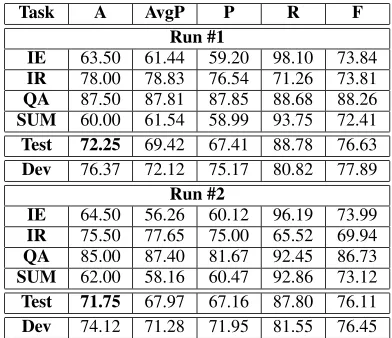
Table 4 details our submission results for Run #1 (TARSQI’s events, temporal expressions and event-event and event-event-time relations) and Run #2 (LCC’s event, temporal expressions and event-time rela-tions)5. The two runs do not differ significantly. The
5A,AvgP,P,RandFstand for accuracy, average precision,
precision, recall, and f-measure, respectively.
Dataset True False Overall
IE 105 (8) 95 (11) 200 (19)
IR 87 (23) 113 (31) 200 (54)
QA 106 (22) 94 (13) 200 (35)
SUM 112 (5) 88 (4) 200 (9)
Test 410 (58) 390 (59) 800 (117)
Development 412 (78) 388 (57) 800 (135)
Table 3: Data split betweentrue and falseclasses. The number of pairs with long text is shown in parenthesis.
Task A AvgP P R F
Run #1
IE 63.50 61.44 59.20 98.10 73.84
IR 78.00 78.83 76.54 71.26 73.81
QA 87.50 87.81 87.85 88.68 88.26
SUM 60.00 61.54 58.99 93.75 72.41
Test 72.25 69.42 67.41 88.78 76.63
Dev 76.37 72.12 75.17 80.82 77.89
Run #2
IE 64.50 56.26 60.12 96.19 73.99
IR 75.50 77.65 75.00 65.52 69.94
QA 85.00 87.40 81.67 92.45 86.73
SUM 62.00 58.16 60.47 92.86 73.12
Test 71.75 67.97 67.16 87.80 76.11
Dev 74.12 71.28 71.95 81.55 76.45
Table 4: Results for Run #1 and Run #2
extra information captured in the logic representa-tions used in Run #1 (as compared with Run #2) was not the focus of the entailment; the understand-ing it brunderstand-ings was not exercised durunderstand-ing the entailment recognition process. For the IR and QA tasks, Run #1 results are better when compared to Run #2’s. For these tasks, the performance of the system is much higher when compared with the results obtained for IE and SUM. Even tough the thresholds learned for these two tasks best separate the positive from the negative pairs on the development set, they prove to be fairly low for the test set. Almost all positive IE and SUM pairs are identified as such (very high re-call for both tasks), but a lot of negatives are also la-beled as positives (low precision, smaller accuracy).
5.3 Named Entity Heuristic Impact
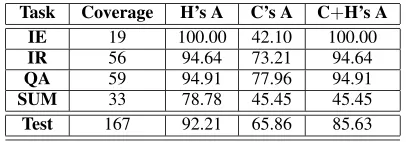
Table 5 details the interaction between the prover (Run #1) and the named entity heuristic6. The
6Coverageshows the number of pairs for which the
heuristic fires for 167 pairs, while only 154 of them are true negative entailments (92.21% accuracy). The prover’s accuracy for the same subset of pairs is 65.86%. The maximum overall improvement in accuracy that the heuristic can bring is 5.5%, but, because of the way the heuristic penalizes the proof scores, its overall improvement is 4.12%.
Task Coverage H’s A C’s A C+H’s A
IE 19 100.00 42.10 100.00
IR 56 94.64 73.21 94.64
QA 59 94.91 77.96 94.91
SUM 33 78.78 45.45 45.45
Test 167 92.21 65.86 85.63
Table 5: NE heuristic’s performance for Run #1
In theory, the named entity check should not fail. But, in practice, its performance is influenced by the knowledge that the prover collects and, if this infor-mation is not complete, then the heuristic fails. For example, for QA Dev pair 419,Hmentions number
three and because the prover cannot infer it as the cardinality of the elementary particles mentioned in
T, the heuristic fires incorrectly.
5.4 Error Analysis
Some of the sources of errors are:
Lexical chainsFor IR Test pair 377,black plague
can be derived from T’s plague only if we allow
lexical chains with more than 2 HYPONYMY
re-lations (plague#n#1 hyponymy−→ bubonic plague#n#1 hyponymy
−→ black plague#n#1). This restriction on lexical chains was added last year. However, in this year’s data this restriction was detrimental as shown in the above example.
Named entity heuristicSome of the errors intro-duced by the named entity heuristic are debatable. For example, IR Test pair 355’s hypothesis intro-duces the named entityGermanwhich cannot be de-rived from the text. Similarly, for QA Test pairs 495 and 496, the nameChristian Democratic Union can-not be inferred from the text’s mention ofChristian Democrat party. On the other hand, pairs for which the score adjustment introduced by the named entity heuristic did not change the label assigned by the prover include SUM Test pair 656 whose hypothesis
the scores it computes are adjusted according to the heuristic.
mentionsUSwithout it being derivable from the text (unless we consider the adjectivedomestic).
World Knowledge For SUM Test pair 744, the system fails to infer nearly half a million dollars
from $480,350. Similarly, the system failed to en-tail died in 1970 from the biographical markings “(1890-1970)” for QA Test pair 486.
High word overlap SUM pairs have a high de-gree of word-overlap between T andH and
detec-tion of the non-entailment requires careful process-ing. SUM Test pair 666’s text contains an extra ad-verbial phrase which changes the label of the pair.
Reports and Modality Even though reporting verbs (X said that Y) and modalities (X may Y, X tried to Y) should influence the validity of the state-ment they modify, most Y clauses are considered
true in the RTE data (SUM Dev pair 756, IR Dev pair 295, IE Dev pair 148 are just few examples). Therefore, our solutions for representing7or check-ing these modifiers8failed to bring any improvement on the development set and were not included in the processing of the test set.
But, for IE Test pair 172, T’s main verb is
qual-ified bythreatened which is not present inH. For
SUM Test pair 672,cited strong volume gainsdoes not entailmakes strong profits.
6 Conclusion
The XWN-KB is an invaluable resource for recog-nizing textual entailment. Its impact in RTE 3 was significant. However, we are still exploring ways of fully exploiting this resource. The use of the TARSQI toolkit did not impact the performance be-cause the temporal knowledge was not exercised in this year’s task. Contrary to our expectations, the representation of modality had a negative impact on the performance. This is perhaps due to incorrect representation. For our system, the introduction of long texts did not cause significant problems. The system is robust enough to handle longer texts.
7Our representation forX said Ywhich prevents the
entail-ment thatYis(X(x1) & report CTXT(c1,x1)) -> (Y(e1)) 8We attempted to penalize proofs which infer the second
Id Tag Pair Text and Hypothesis
D35 YES T: A leading human rights group on Wednesday identified Poland and Romania as the likely locations in eastern Europe of secret prisons where al-Qaeda suspects are interrogated by the Central Intelligence Agency.
H: CIA secret prisons were located in Eastern Europe.
D92 YES T: The Kinston Indians are a minor league baseball team in Kinston, North Carolina. The team, a Class A affiliate of the Cleveland Indians, plays in the Carolina League.
H: Kinston Indians participate in the Carolina League.
D191 YES T: Though Wilkins and his family settled quickly in Italy, it wasn’t a successful era for Milan, and Wilkins was allowed to leave in 1987 to join French outfit Paris Saint-Germain.
H: Wilkins departed Milan in 1987.
D196 YES T: Some large Russian oil companies, including Lukoil, Zarubezhneft, the state-owned oil company, and Alpha Eco, the trader, were implicated by the report. H: Zarubezhneft trades in oil.
D203 NO T: A decision to allow the exiled Italian royal family to return to Italy may be granted amid the discovery that the head of the family, Prince Vittorio Emmanuele, addressed the president of Italy properly. He has called President Ciampi “our president, the president of all Italians”.
H: Italian royal family returns home.
D287 YES T: Italy’s highest court has upheld a court verdict that partially cleared former Prime Minister Giulio Andreotti of having colluded with the Mafia. H: Andreotti is accused of Mafia collusion.
D387 NO T: Thus, China’s President repeatedly sent letters and envoys to the Dalai Lama and to the Tibetan Government asking that Tibet ”join” the Republic of China. H: Dalai Lama and the government of the People’s Republic of China are in dispute over Panchen Lama’s reincarnation.
D409 YES T: George H.W. Bush served this country not only as President but also as Vice President, Member of Congress, United Nations Ambassador, chief of the U.S. Liaison Office to the People’s Republic of China, Director of the Central Intelligence Agency and also, as a naval aviator in World War II. Coming back from the war, he married his sweetheart, Barbara Pierce of Rye, New York, and later that year made his first civilian adult decision when he made the appropriate choice of moving to Texas, where he lived the rest of his life.
H: The name of George H.W. Bush’s wife is Barbara.
D419 YES T: Discovery of the top quark, if confirmed, completes one set of subatomic building blocks whose existence is predicted by the prevailing theory, called the Standard Model, of the particles and forces that determine the fundamental nature of matter and energy. In the whimsical lexicon of modern physics, the elementary particles are called quarks, leptons and bosons.
H: Quarks, leptons, and bosons are the three elementary particles of physics according to the Standard Model.
D579 YES T: Salma Hayek drew a crowd in Veracruz, Mexico, at the July 8 premiere of ’Nobody Writes to the Colonel’, a movie based on a short novel by Nobel laureate Gabriel Garcia Marquez.
H: Gabriel Garcia Marquez is a Nobel prize winner.
D756 YES T: The contaminated pills included metal fragments ranging in size from “microdots” to portions of wire one-third of an inch long, the FDA said. H: The contaminated pills contained metal fragments.
T172 NO T: This year thousands of Hindu Holy Men, also known as sadhus, threatened to boycott festivals during their pilgrimage to the Ganges, where their rituals involve washing away their sins by bathing in the water.
H: Hindu Holy Men boycotted festivals during their pilgrimage to the Ganges.
T355 YES T: Before reconstruction began, the Reichstag was wrapped by the Bulgarian artist Christo and his wife Jeanne-Claude in 1995, attracting millions of visitors. H: Christo wraps German Reichstag.
T377 YES T: The U.S. enjoyed miraculously long immunity from the dreaded plague that used to sweep Europe. H: Black plague swept Europe.
T495 YES T: Former German Chancellor Helmut Kohl said Thursday he will not break pledges he made to campaign contributors by publicly disclosing their names even though his Christian Democrat party has directed him to reveal their identities.
H: The name of Helmut Kohl’s political party is the Christian Democratic Union.
T561 YES T: Pope John Paul II arrived Saturday in the birthplace of the Solidarity movement that he sparked with his first papal visit 20 years ago, offering Poles “the greeting of a fellow Pole who comes among you to fulfill the needs of his own heart.”
H: Pope John Paul II was born in Poland.
T565 NO T: On the domestic tobacco front, operating income rose by 12 per cent to Dollars 914m, with “slightly higher unit volume”. H: US tobacco income has risen.
T666 NO T: Boys and girls will be segregated during sex education in junior high school. H: Boys and girls will be segregated in junior high school.
T672 NO T: Philip Morris cited strong volume gains in Germany, Italy, France, Spain, central and eastern Europe, the Far East, Japan, Korea, Argentina and Brazil. H: Philip Morris makes strong profits also in Europe.
T725 YES T: After years of battling between oil companies, the Ecuadorian government decided to collaborate with indigenous groups. H: The Ecuadorian government collaborated with indigenous groups.
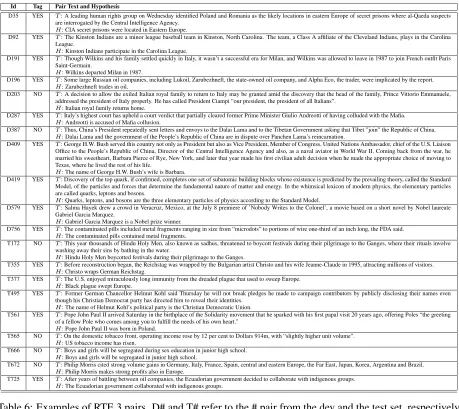
Table 6: Examples of RTE 3 pairs. D# and T# refer to the # pair from the dev and the test set, respectively
Acknowledgments
We would like to thank Iulia Nica for her helpful suggestions (including the named entity check) and Marc Verhagen and James Pustejovsky for present-ing us with TARSQI’s output for the RTE datasets.
References
A. Fowler, B. Hauser, D. Hodges, I. Niles, A. Novischi, and J. Stephan. 2005. Applying COGEX to Recog-nize Textual Entailment. In Proceedings of the PAS-CAL Challenges Workshop.
J. Hobbs. 1978. Resolving Pronoun References. Lingua, 44:311–338.
S. Lappin and H. Leass. 1994. An Algorithm for
Pronominal Anaphora Resolution. Computational Linguistics, 20(4):535–561.
R. Navigli. 2006. Meaningful Clustering of Senses Helps Boost Word Sense Disambiguation Perfor-mance. InProceedings of COLING-ACL 2006.
M. Tatu, B. Iles, J. Slavick, A. Novischi, and D. Moldovan. 2006. COGEX at the Second Rec-ognizing Textual Entailment Challenge. In Proceed-ings of the Second PASCAL Challenges Workshop on Recognising Textual Entailment, Venice, Italy.