Volume 5, No. 6, July-August 2014
International Journal of Advanced Research in Computer Science
RESEARCH PAPER
Available Online at www.ijarcs.info
Maximum Likelihood Technique using Cyclic Prefix based Estimation of Carrier
Frequency Offset in OFDM System
Shampal Singh PG student
Department of Electronics and Communication Punjab Institute of Technology (PTU Main Campus)
Kapurthala, India
Avtar Singh Buttar Associate Professor
Department of Electronics and Communication Punjab Institute of Technology (PTU Main Campus)
Kapurthala, India
Abstract:Orthogonal Frequency Division Multiplexing (OFDM) has proved it is ability to provide the required services and offer large data
rates with sufficient strength to Electromagnetic wave channel destruction The major drawback concern in the OFDM data transmission is loss of orthogonality of signal due to Carrier Frequency Offset (CFO), caused either due to mismatching of frequency of oscillator at transmitter side and receiver side or due to Doppler shift. CFO leads to create problems like Inter carrier interference (ICI) and Signal to N oise plus Interference Ratio decrease (SINR). As a result, the overall capacity of the system is reduced. The estimation of CFO is difficult problem. In this paper, Maximum Likelihood technique using Cyclic Prefix based estimation of CFO in OFDM system is proposed. CFO is estimated from the phase angle of convolutionally product of cyclic prefix and matching component of the OFDM symbol. Proposed estimation method can estimate the CFO without the use of pilot signal with high accuracy and less complexity in OFDM system.
Keywords:OFDM, orthogonality, Maximum likelihood, Cyclic Prefix, Inter Carrier Interference, Signal to Noise plus Interference Ratio
I. INTRODUCTION
In recent years, Orthogonal Frequency Division Multiplexing (OFDM) has gained much interest for its advantages over conventional single carrier systems, such as robustness in combating multi-path fading, high spectral efficiency, etc. [1]. OFDM has been adopted as the key modulation technique in digital audio broadcasting (DAB) [2], digital video broadcasting terrestrial TV (DVB-T) [3] and asymmetric digital subscriber lines (ADSL), 3G, 4G etc.
An OFDM system generally has high Peak-to-Average Power Ratio (PAPR) and is sensitive to Carrier Frequency Offset (CFO). To OFDM systems, the CFO estimation is also important when consider the frequency synchronization. To maintain the orthogonality of subcarriers, mitigate ICI and avoid the system performance degradation, CFO and timing errors must be estimated accurately. Many methods have been proposed to estimate CFO based on Frequency domain approach and time domain approach. In [4], Moose develop a maximum likelihood estimator involves repetition of data symbols and comparison of the phases of each of the subcarrier between the successive symbols. In [6], Schmidl use unique symbol which has a repetition within half a symbol period for CFO estimation, Morelli extended the Schmidl algorithm by considering a training symbol composed of CFO and channel estimation tasks rely on null subcarrier and nonzero pilot symbols that they inserted and hopped from block to block, this work designed a pilot symbol-assisted modulation for CFO and channel estimation. Tureli proposed the new carrier offset estimation technique for OFDM communications over a Frequency selective fading channel [7]. In this method they exploit the intrinsic structure information of OFDM signals to derive a carrier offset
estimator that offers the accuracy of a super resolution subspace method, ESPRIT without using reference symbols, pilot carriers. In [9], Yao developed a kurtosis based blind CFO estimator for OFDM system. This novel cost function is able to uniquely identify the CFO within the range of half subcarrier spacing, while lending itself to very low complexity algorithms. A CFO estimate can be obtained by minimizing the function called kurtosis function. In this work, a Maximum Likelihood technique using Cyclic Prefix based estimation of CFO is proposed. This algorithm exploit the use of CP i.e. the part of OFDM symbol for synchronization without the need of pilots.
This paper is organized as follows: Section II describes OFDM system, and then a proposed Maximum Likelihood technique using Cyclic Prefix CFO estimation describe in section III. Section IV presents System Model Description, Simulation results and discussions are provided in section V, and Section VI concludes the paper and gives the future scope of the work
II. OFDMSYSTEM
redundant data in front of each OFDM symbol termed as Cyclic Prefix.
Figure 1. Basic OFDM system model
The main idea about addition of cyclic prefix is to avoid Inter-symbol Interference (ISI) and maintaining the orthogonality between subcarriers of the OFDM signal. The total length of the OFDM symbol is Cyclic Prefix added plus OFDM symbol body. In the proposed technique analysis, assume that the signal is affected by Additive White Gaussian Noise (AWGN) channel only. However, performance of estimator is evaluated for both Random noise channel and AWGN channel [1] [5].
Consider at the receiver side of this OFDM symbol arrival time and carrier frequency is uncertain. Uncertain in carrier frequency gives rise a distortion of complex multiplication of received data i.e. difference in the oscillator‟s frequency in the transmitter and receiver as a small part of inter carrier spacing.
III. MAXIMUM LIKELIHOOD TECHNIQUE USING CYCLIC
PREFIX CFOESTIMATION
With perfect symbol synchronization, a CFO of Є results in a phase rotation of 2πn/N in the received, the phase difference between CP and the corresponding rear part of an OFDM symbol (spaced N samples apart) caused by CFO Є is 2πN Є/N =2π Є. Notice that the samples in the cyclic prefix and their copies, in rear part of OFDM symbol are pair wise correlated. Then, the CFO can be found from the phase angle of the product of CP and the matching part of the OFDM symbol:
(1) In order to reduce the noise effect, its average can be taken over the samples in a CP inter
-- (2)
It is obvious from the above equation CFO estimated in the range of | | < 0.5 integral CFO cannot be estimated by this technique.
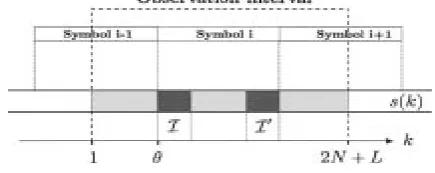
Figure 2. Structure of OFDM signal with cyclically extended symbols s (k), the Set I contain the cyclic prefix, i.e., the copies of the L data samples in I‟:
Assume that 2N+L consecutive Samples of r (k) received signal and these samples contain (N + L) complete sample of OFDM symbol as shown in Fig. 2. The position of this symbol within the observed block of samples, however, is unknown because the channel delay θ is unknown to the receiver. Define the index sets
(3)
The log likelihood function for θ and Є, Λ (θ, Є) is the logarithm of the probability density function (r| θ, Є) of the 2N + L observed samples in r given the arrival time and the carrier frequency offset θ and Є respectively.[2][8]
(4)
- (5)
Where angle is the argument of a complex number
ρ is the magnitude of the correlation coefficient between r(k) and r(k +N).
(6)
The maximization of the log likelihood function can be performed in two steps:
The maximum of the Frequency offset is obtained when angle cosine of term in (5) equals one. This gives the ML estimation of Є
-(7)
Where n is an integer.
Now the log likelihood function with respect to Є becomes
- (8)
And ML estimation of θ and Є becomes
(9)
(10)
Simulation of the proposed method is performed in Matlab.
IV. SIMULATION MODEL DESCRIPTION
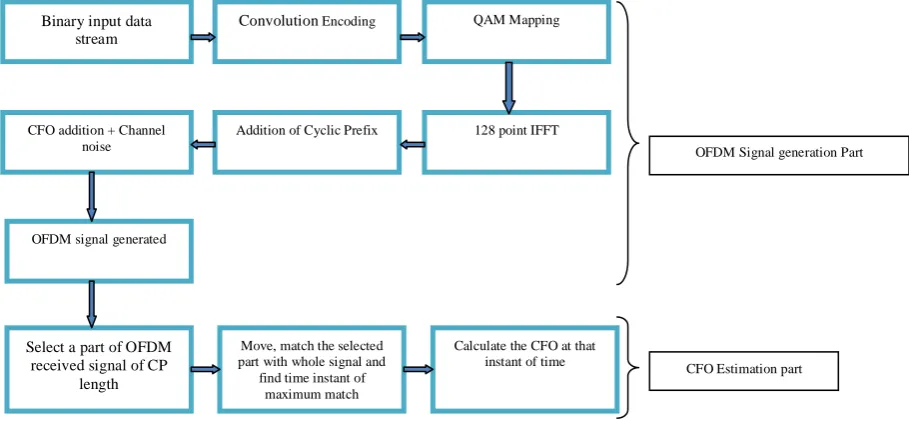
Figure 3. Block diagram of ML technique using CP based estimator
To calculate the CFO in the signal the redundant value of CP is used. A part of the signal of CP length is moved and matched with whole signal where when, maximum matching of the CP part is found within the OFDM symbol; the time of maximum matching is calculated by taking average. Then the value of CFO is calculated by taking the angle of convolution of the CP and conjugate of corresponding matching part at maximum matching time instant.
Fig. 3 shows the block diagram for the estimation of the CFO in the OFDM signal. To evaluate the performance of the proposed technique in simulation environment some system assumptions are taken and steps of algorithm is prepared are:
A. System Assumptions
This algorithm is deliberated to OFDM communication system in which a Carrier Frequency Offset is occur either due to mismatch of local oscillators or due to Doppler shift and this system of communication is dedicated to estimate the Carrier Frequency Offset (CFO) continuously. In addition we followed some assumptions:
a) The OFDM system is SISO communication system.
b) Input data is any random binary data stream
c) The data is modulated by QAM modulation scheme,
Cyclic Prefix addition, SNR Addition and OFDM signal generated.
d) The subcarriers of the OFDM signal are orthogonal to each other before the CFO occurs.
e) This OFDM signal is received at receiver with addition CFO without random noise or AWGN.
B. Steps of algorithm
1) Generation of Random signal data bits.
2) Perform Convolution Encoding, Reshaping, Interleaving, binary to decimal conversion, modulation – QAM-16 of the input data..
3) Generate OFDM Signal by adding Cyclic Prefix in the OFDM Symbol „CP‟.
4) Add AWGN/Random Noise with Frequency offset in
Signal
5) Perform Maximum Likelihood technique using cyclic
prefix for CFO estimation at receiver side.
6) CFO is calculated by calculating phase angle of the product of the CP with corresponding matching part in OFDM symbol.
7) Calculate the mean square error of the estimator for the different values of the SNR and CP length.
V. SIMULATION RESULTS AND DISCUSSION
In this section, the proposed technique is used to estimate the CFO in OFDM signal. Two cases are considering in this paper according to channel environment and analyze the performance of the estimator in both cases by calculating MSE shown in Fig. 4.
Figure 4. Block diagram for calculating MSE of the estimator
CASE 1: CFO ESTIMATION IN RANDOM NOISE CHANNEL
In this case CFO estimation and performance of the estimator are analyzed under the Effect of Random Noise channel In this experiment number of maximum matching of the CP with corresponding matching part of the OFDM symbols are
Binary input data stream
Convolution Encoding QAM Mapping
128 point IFFT Addition of Cyclic Prefix
OFDM signal generated
Select a part of OFDM received signal of CP
length
Calculate the CFO at that instant of time CFO addition + Channel
noise
Move, match the selected part with whole signal and
find time instant of maximum match
OFDM Signal generation Part
CFO Estimation part
MSE Estimated value
of CFO for each symbol time
Original value of CFO to be estimated
Error which is equal to the difference of
input
Square of the input values
found and time instant of maximum matching is calculated by the (9). Lower graph shows the Frequency Offset corresponding to the time instant of maximum matching of the CP with corresponding rear part in OFDM symbol which is calculated by (10).
Figure 5. Peak values (Top) gives the timing estimation indices. At these time instants (Bottom) give the Frequency offset estimation in Random Noise
channel.
The simulation graphs are shown in Fig. 5 for random noise channel. The upper graph shows the timing offset v/s time results, where time instant is calculated for the peak values of timing offset
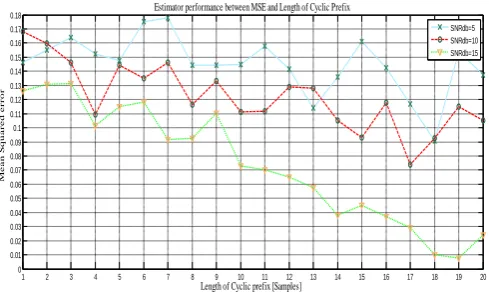
Figure 6. Performance of Frequency Estimators for the random noise channel (5, 10, and 15 dB) as the function of Mean square error and Cyclic
prefix Length (1 to 20 samples).
Fig. 6 shows the Mean Square Error of the estimator for the SNR values 5, 10 and 15 dB. Graph shows the variation of the MSE as the length of CP is increased. It is observed from the Figure that when SNR value is 5 dB, and CP length is taken 1 initially the value of MSE is 0.157 and the length of CP is increased the MSE is seen to decrease. For CP length of 20 samples, the MSE is 0.13.
For the SNR value of 10 dB, starting CP length of 1 sample, MSE is 0.155. When CP length is 20 samples the MSE is 0.082.
For the SNR value of 15 dB, starting CP length equal to 1 sample, MSE is 0.145 and when For CP length is increased to 20 samples, the value of MSE is reduced to 0.015. It is observed that for low value of SNR Mean Square Error decrease slowly but for high value of the SNR Mean Square Error decrease rapidly.
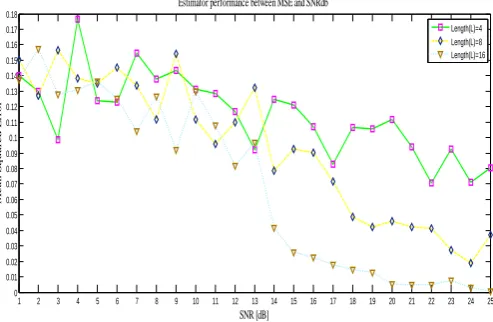
Figure 7. Performance of Frequency Estimators for the random noise channel (L=4, L=8 and L=16) as the function of Mean square error with SNR.
Fig. 7 shows the Mean Square Error values for the CP length (L) with values of L=4, L=8 and L=16. Graph shows the variation of MSE with increase in the SNR values. It is observed that when L is 4 samples and SNR equal to 1 dB, MSE value is .139 and with increase in L and SNR values the MSE is decreased slowly. For SNR value of 25 dB, MSE is 0.08.
For the CP length L of 8 samples and SNR equal to 1 dB, MSE value is .15 and when SNR is raised to 25 dB, MSE is 0.038.
For the CP length L of 16 samples and 1dB SNR, MSE value is 0.14 while for SNR value of 25 dB MSE comes out to be 0.002. It is observed from the graph that MSE decreases with increase in the SNR value.
It also observed for low values of the CP length it decrease slowly and for high value of CP length it decreases rapidly.
CASE 2: CFO ESTIMATION IN AWGN CHANNEL
In this case CFO estimation and performance of the estimator are analyzed under the Effect of AWGN channel.
Figure 8. Peak values (Top) gives the timing estimation indices. At these time instants (Bottom) give the Frequency offset estimation in AWGN
channel
The experiment performed for random noise channel is then repeated for AWGN channel. The corresponding estimation of CFO estimation graph is shown in Fig. 8. The upper graph shows the timing offset v/s time results, where time instant is calculated for the peak values of timing offset. In this
0.18 Estimator performance between MSE and Length of Cyclic Prefix
Length of Cyclic prefix [Samples]
Estimator performance between MSE and SNRdb
experiment value of maximum matching of the CP with corresponding rear part of the OFDM symbols are found and time instant of maximum matching is calculated by (9). Lower graph shows the Frequency Offset corresponding to the time instant of maximum matching of the CP with corresponding rear part in OFDM symbol which is calculated by (10). This is observed from these results that CFO estimation can be done in both Channels. These experiments are performed for analysis of the performance of the estimator in both channels. Performance of the estimator is analyzed in the form of Mean Square Error (MSE).
Figure 9. Performance of Frequency Estimators for the AWGN channel (5, 10, and 15 dB) as the function of Mean square error and Cyclic prefix Length
(1 to 20 samples).
Fig. 9 shows the Mean Square Error of the estimator for the SNR values 5, 10 and 15 dB. It shows the variation of the MSE with increase of CP length (1-20 Samples). It is observed that when SNR value is 5 dB, with initial CP length equal to 1 sample, MSE is 0.145 and as the length of CP is increased the value of MSE decreases slowly. And for CP length of 20 samples, the value of MSE is calculated to be 0.138.
For the SNR value of 10 dB, and starting length of 1 sample for Cyclic Prefix, MSE comes out to be 0.168 and when length of CP is increased from I sample to 20 samples, MSE is calculated to be 0.126.
For the SNR value of 15 dB and initial CP length equal to 1 sample, MSE value is 0.145 with increase in CP length to 20 samples, the MSE reduces to 0.024. Thus, it is observed that for low value of SNR, Mean Square Error decreases slowly but for high value of the SNR there is a rapid reduction in Mean Square Error.
Figure 10. Performance of Frequency Estimators for the AWGN channel (L=4, L=8, and L=16) as the function of Mean square error with SNR
Fig. 10 shows the Mean Square Error values for the CP length L=4, L=8 and L=16. Graph shows the variation of MSE as the SNR values are increased in AWGN channel. It is seen that when L is 4 and SNR 1 dB, the MSE value is .125 and when L and SNR values are increased the MSE is decreased. For SNR value 25 dB the MSE is 0.04.
For the CP length L of 8 samples, starting from SNR equal to 1 dB, the MSE value is .145 and for SNR value of 25 dB the MSE is 0.03.
For the CP length L is 16 samples, starting from SNR equal to 1 dB the MSE value is .140 and for SNR value 25 dB the MSE is 0.001. It is observed from the graph that MSE also decreases as we increase the SNR value. It also observed for low values of the CP length it decrease slowly and for high value of CP length it decreases rapidly. And estimator performs better in AWGN channel rather than Random Noise channel.
VI. CONCLUSION AND FUTURE SCOPE
The simulation result of the proposed method performed on Matlab tool on 16-QAM data to determine the frequency offset. The proposed method of estimation of frequency offset estimation is based on maximum likelihood method using cyclic prefix in OFDM system. From our simulation results it is observed that our method performance in the form of Mean Square Error for the different values of length of CP and at constant SNR and for the different SNR values at constant CP length which shows that the mean square error value of the estimator is decrease with increase the length of cyclic prefix and SNR value in dB and is better than the other estimation methods like Training Symbol based estimation and repeated sequence based estimation. The more training Symbols are used in training symbol based estimation results waste of energy to transmit extra symbols in the OFDM and by the use of repeated sequence the estimation is perform well but it consume lot of time for the estimation Frequency Offset and energy loss of the system. Proposed algorithm is driven under AWGN and random noise channels. And the algorithm performs well for both the channels conditions.
VII. REFERENCES
[1] A. Goldsmith, Wireless Communication. Cambridge University
Press, 2005.
[2] M. Morelli and U. Mengali, “An improved Frequency offset
Estimator for OFDM Applications”, IEEE Commun. Letters, Vol. 3, No. 3, March 1999.
[3] Mingqui Li and W. Zhang,” A Novel Method of Carrier
Frequency Offset Estimation for OFDM Systems”, IEEE
Trans. On Consumer Electronics, Vol. 49, No. 4, Nov. 2003.
[4] P. H. Moose, “A technique for orthogonal frequency division
multiplexing frequency offset correction,” IEEE Trans.
Commun., vol. 42, pp. 2908-2914, Oct. 1994.
[5] Richard van Nee and Ramjee Prasad,”OFDM for Wireless
Multimedia Communications”.
[6] T. Schmidl and D. Cox, “Robust frequency and timing
synchronization for OFDM”, IEEE Trans. Commun., vol. 45, no. 12, pp. 1613-1621, Dec. 1997
[7] U. Tureli, H. Liu, and M.D. Zoltowski , “OFDM blind carrier
offset estimation: ESPRIT,”IEEE tans. On Signal Processing, vol. 48,pp. 1459-1461, Sept.2000
[8] Xiaoli Ma, Mi-Kyung Oh, G.B. Giannakis, “Hopping Pilots for
Estimation of Frequency Offset and Mulitantenna Channels in
1 2 3 4 5 6 7 8 9 10 11 12 13 14 15 16 17 18 19 20
0.18 Estimator performance between MSE and Length of Cyclic Prefix
Length of Cyclic prefix [Samples]
Estimator performance between MSE and SNRdb
MIMO-OFDM “, IEEE Trans. On Communication, Vol. 53, No. 1, Jan. 2005.
[9] Y. Yao and G.B. Giannakis, “Blind Carrier Frequency Offset
Estimation in SISO, MIMO, and Multiuser OFDM Systems “, IEEE Trans. On Communication, Vol. 53, No. 1, Jan. 2005.
[10] G. Eason, B. Noble, and I. N. Sneddon, “On certain integrals of