Volume 3, No. 4, July- August 2012
International Journal of Advanced Research in Computer Science
RESEARCH PAPER
Available Online at www.ijarcs.info
ISSN No. 0976-5697
Performance Comparison of LEACH and LEACH-N Protocols BY MATLAB
Sunita Parashar1 & Poonam Sharma*2
1
Associate Professor, 2M.Tech Student Department of Computer Sc. & Engineering
H.C.T.M, Kaithal, Haryana (India) 1
Keywords: Routing protocol; energy efficient; LEACH; wireless sensor network
Abstract: In recent years, there has been a growing interest in wireless sensor networks. In Wireless Sensor Networks sensor nodes life time is the most critical parameter. Minimizing energy dissipation and maximizing network lifetime are important issues in the design of applications and protocols for sensor networks. LEACH includes the distributed cluster formation, local processing to reduce global communication, and randomized rotation of the cluster-heads. A wireless sensor network consists of hundreds or thousands of small energy-limited sensors that are densely deployed in the large geographical region. It has been demonstrated that Low-Energy Adaptive Clustering Hierarchy (LEACH) is an energy-efficient routing algorithm for Wireless Sensor Networks (WSN).
In this paper, we present a cluster head selection approach for LEACH. We state the principles of the LEACH and give the main flowchart and algorithms realizing LEACH. We improves the choice method of the cluster head, makes some nodes which have more residual energy as cluster heads in next round. We seek an energy-optimal enhancement to the network in such way that maximizes network lifetime while ensuring simultaneously full area coverage and sensor connectivity to cluster heads. We compare the live time of LEACH and LEACH-N Protocol.
I. INTRODUCTION
A wireless sensor network is composed by hundreds or thousands of small compact devices, called sensor nodes, equipped with sensors (e.g. acoustic, seismic or image), that are densely deployed in a large geographical area. These sensors measure ambient conditions in the environment surrounding them and then transform these data into electric signals which can be processed to reveal some characteristics about phenomena located in the area around these sensors. Therefore we get the information about the area which is far away. The applications may be environment control such as office building, robot control and guidance in automatic manufacturing environments, interactive toys, high security smart homes, and identification and personalization. Wireless sensor networks (WSNs) are the products which integrate sensor techniques, embedded techniques, and distributed information processing and communication techniques.
The appearance of the wireless sensor network is a revolution in information sensing and detection. Although there have been significant improvements in processor design and computing, advances in battery technology still lag behind, making energy resource considerations the fundamental challenge in wireless sensor networks. Consequently, there have been active research efforts on performance limits of wireless sensor networks. These performance limits include, among others, network capacity and network lifetime. Network capacity typically refers to the maximum amount of bit volume that can be successfully delivered to the base station (“sink node”) by all the nodes in the network, while network lifetime refers to the maximum time limit that nodes in the network remain alive until one or more nodes drain up their energy. In this dissertation consider an overarching problem that encompasses both performance metrics [1], [2],[3].
In particular, study the network capacity problem under a given network lifetime requirement. Specifically, for a wireless sensor network where each node is provisioned with an initial energy, if all nodes are required to live up to a certain lifetime criterion, what is the maximum amount of bit volume that can be generated by the entire network? At first glance, it appears desirable to maximize the sum of rates from all the nodes in the network, subject to the condition that each node can meet the network lifetime requirement. Mathematically, this problem can be formulated as a linear programming (LP) problem within which the objective function is defined as the sum of rates over all the nodes in the network and the constraints are; i. Flow balance is preserved at each node.
ii. The energy constraint at each node is met for the given network lifetime requirement. However, the solution to this problem shows that although the network capacity (i.e., the sum of bit rates over all nodes) is maximized, there exists a severe bias in rate allocation among the nodes. In particular, those nodes that consume the least amount of power on their data path toward the base station are allocated with much more bit rates than other nodes in the network. Consequently, the data collection behavior for the entire network only favors certain nodes that have this property, while other nodes will be unfavorably penalized with much smaller bit rate [1],[2],[3],[4].
A. Three types of nodes used in the wsn:
a. (i)Micro-sensor nodes (MSNs):- The MSNs can be application-specific sensor nodes (e.g., temperature sensor nodes (TSNs), pressure sensor nodes (PSNs), and video sensor nodes (VSNs)) and they constitute the lower tier of the network. They are deployed in groups (or clusters) at strategic locations for the surveillance or monitoring applications. The MSNs are small and low-cost. The objective of an MSN is very simple Once triggered by an event it starts to capture live information (e.g., video), which it sends directly to the local AFN. For each cluster of MSNs, there is one AFN, which is different from an MSN in terms of physical properties and functions. b. (ii)Aggregation and forwarding nodes
(AFNs):-Data aggregation (or “fusion”) for data flows from the local cluster of MSNs, and forwarding (or relaying) the aggregated information to the next hop AFN (toward the base-station). For data fusion, an AFN analyzes the content of each data stream (e.g., video) it receives, from which it composes a complete scene by exploiting the correlation among each individual data stream from the MSNs. An AFN also serves as a relay node for other AFNs to carry traffic toward the base-station. Although an AFN is expected to be provisioned with much more energy than an MSN, it also consumes energy at a substantially higher rate (due to wireless communication over large distances). Consequently, an AFN has a limited lifetime. Upon depletion of energy at an AFN, we expect that the coverage for the particular area under surveillance is lost, despite the fact that some of the MSNs within the cluster may still have remaining energy.
c. (iii) Base-station (BS):- The sink node for data streams from all the AFNs in the network. In this investigation, we assume that there is sufficient energy resource available at the base station and thus there is no energy constraint at the base-station. In summary, the main functions of the lower tier MSNs are data acquisition and compression while the upper-tier AFNs are used for data fusion and relaying information to the base-station[4],[10],[12],[22].
B. B. Leach:
LEACH (Low Energy Adaptive Clustering Hierarchy) is a self-organizing, adaptive clustering-based protocol that uses randomized rotation of cluster-heads to evenly distribute the energy load among the sensor nodes in the network. LEACH based on two basic assumptions:
a. Base station is fixed and located far away from the sensors.
b. All nodes in the network are homogeneous and energy constrained. The idea behind LEACH is to form clusters ofthe sensor nodes depending on the received signal strength and use local cluster heads as routers to route data to the base station. The key features of LEACH are:
a) Localized coordination and control for cluster set-up and operation.
b) Randomized rotation of the cluster “base stations” or “cluster-heads” and the corresponding clusters.
c) Local compression to reduce global communication.
In LEACH, the operation is separated into fixed length rounds, where each round starts with a setup phase followed by a steady-state phase [5],[7],[10]. The duration of a round is determined priori.
Although, LEACH has shown good features to sensor networks, such as clustering architecture, localized coordination and control, randomized rotation of cluster head, and local compression to reduce global communications (energy consumption minimization), it suffers from the following drawbacks:
i. It cannot be applied to the time-constrained application as it results in a long latency.
ii. The nodes on the route a hot spot to the sink could drain their power fast. This problem known as “hot spot” problem.
iii. The number of clusters may not be fixed evergy round due to the selection of k.
iv. It can not be applied to large sensor network.
C. Description of leach protocol:
Main techniques of LEACH protocol include algorithms for distributing cluster forming, adaptive Cluster forming, and cluster header position changing. The technique of distributing cluster forming ensures self-organization of most target nodes. The adaptive cluster forming and cluster header position changing algorithms ensure to share the energy dissipation fairly among all nodes and prolong the lifetime of the whole system in the end.
LEACH protocol provides a conception of round. LEACH protocol runs with many rounds. Each round contains two states:
a. Cluster setup state: - In cluster setup state, it forms cluster in self-adaptive mode.
b. Steady state:-In steady state, it transfers data. The time of second state is usually longer than the time of first state for saving the protocol payload [8],[11],[19].
Figure 1 shows the process.
Figure 2. Operation time of LEACH
D. Discussion of leach protocol:
Two ideas of LEACH protocol are given in this paper. Details will be presented in the following two sub-sections:-
b. Multi-hop communication among cluster heads, In the Cluster heads there is direct communication between CH & Base Station. The energy consumption between cluster head and sink are greater than energy consumption among cluster heads, so cluster head will exhaust energy soon. These communication can avoid the whole network from dying quickly and prolong the network lifetime by balancing the energy consumption among the network [10],[15],[16],[17],[18].
II. KEY ISSUES IN ROUTING PROTOCOL
Different from traditional networks, a typical sensor network has a great number of nodes, which are scattered over a region of interest. All the sensor nodes sense and gather information in a coordinated manner, and then pass the sensed information to the BS over the path determined by the routing protocol. The sensor nodes have much smaller memories, constrained energy supply, limited computer ability and more redundant information.
In order to design a good protocol for wireless sensor networks, it is important to improve the following parameters:
a. System lifetime: these networks should function as long as possible
b. Timely: it is important to receive the data from a sensor in a timely manner
c. Quality: protocols should be designed to be the optimum manner of aggregate data.
d. Autonomy: routing should be determined by a
distributed algorithm.
Because sensor nodes have irreplaceable batteries, it is essential that the network be energy efficient in order to maximize the life span of the network. Besides this, autonomy is an important issue for sometimes global information is hard or even impossible to achieve.
So, we mainly consider these two factors, the life time and autonomy in our paper [8], [11], [12], [13], [14].
A. Leach Algorithm:
LEACH is a protocol based on clustering hierarchy architecture. In this protocol, nodes are organized into different clusters and each cluster contains a cluster-head and each cluster-head aggregate data from its members before transmitting them to the base station. Sensors elect themselves to be local cluster-heads at any given time with a certain probability. In order to avoid cluster-heads dissipating too much energy, cluster-head election and network run periodically. LEACH is built on the following two assumptions:
a. The base station is fixed and is far from the sensors.
b. All nodes in the network are homogeneous and energy-constrained.
The operation of LEACH is broken up into rounds,
where each round begins with a set-up phase, when the clusters are organized, followed by a steady-state phase, when data transfers to the base station occur.
In set-up phase, cluster-heads are selected randomly and it ensures the high energy-consumption for data transmitting between cluster-heads and the base station is distributed among all nodes in the network evenly. As a node is elected to be cluster-head, it broadcasts an message
which contains the information qualifying for the cluster-head. The other non-cluster-head nodes decide which cluster to join according to the strength of the received signal and the cluster-head with the largest signal strength is the cluster-head to which it belongs. Then it transmits a message back to the cluster-head to inform that it will be a member of the cluster. Based on the number of nodes in the cluster, the cluster-head node creates a TDMA schedule telling each node when it can transmit.
In steady-state phase, cluster members gather data continuously and send these data to certain cluster-heads in certain slots. The cluster-head nodes fuse these data and forward them to the base station. Cluster-heads are elected again for the next rounds. [6], [15], [16], [17].
B. F.Leach N:
The WSN topological model of N-LEACH and LEACH was same basically, the difference between them was that N-LEACH algorithm took into account the difference of remaining energy after each round running, LEACH was assumed it was the same that energy consumption of nodes each round LEACH algorithm was operated by round, there were two phases in each round that cluster established and stable data transmission. Process of cluster established consists with two parts, Next Node formed and spanning tree built.
The Next Node of the first round was generated by base station, the Next Node of remaining rounds generated from the node which had largest residual energy in last round, Next Node elected periodically and cluster produced dynamically. The power control was carried out when the node sent data throughout the whole process. Since the initial energy of all nodes in the initial state was in the same round, the election of Next Node was in accordance with LEACH. The number of Next Node was determined based on area of the monitoring location, size and scale to the WSN. After the Next Node in the first round elected, each Next Node sent broadcast messages to all WSN, the node received broadcast signals and compared their strength, then chose to join the cluster, and informed the Next Node. The Next Node created TDMA schedule for all nodes in cluster, in accordance with schedule, cluster node sent data to the Next Node.
The Next Node integrated all received data, sent them to the base station. Cluster node sent its residual energy with the last frame data according to schedule to its Next Node. The Next Node compared the residual energy of each node and elected the largest one as the coming Next Node in second round. The Next Node broadcasted the ID of coming Next Node in the cluster, cluster node received ID and compared it with its ID; it would be Next Node of the second round if they were same. The Next Node election process of subsequent rounds was same as the second round; cluster creation and data transfer process after Next Node election were same as the first round[20],[21].
C. Cluster Formation Algorithm:
LEACH has two phases: the set-up and steady-state.
b.
c.
In the 2nd round, cluster head selection is done on the basis of minimum distance, maximum residual energy and minimum response time.
d. Now CH receives data from Non-CH nodes and aggregates them. And send to the BS. if the distance between the CH and the BS is more than here we used multi-hopping concept, acc to this if the distance between the CH and the BS is more than one CH send data to the other CH which is more closer to the BS[9],[10],[12],[16].
Formation of cluster:-calculate the distance between the cluster head and the sensor node which have shortest distance that node join that cluster.
e. Now energy dissipated is calculated and subtracted from the remaining energy of every node and if some nodes are having energy less than minimum than those nodes are deleted from the network and the life time close .and we get the output. Hence this round will be completed.
f. Otherwise, it repeated from the STEP 2 to STEP 5. The flow chart of LEACH protocol is shown in figure3.
Figure 3. Flow chart of LEACH protocol
III. SIMULATION PARAMETERS
a. Sensor nodes contain two kinds of nodes: sink nodes (no energy restriction) and common nodes (with energy restriction);
b. Nodes are randomly distributed in a area with in 100m×100m, and the efficient distance among nodes is 15m;
c. Total no of nodes is 100; d. No of rounds is 1000;
e. Suppose that every node knows its position and channels between sensor nodes are ideal, sending energy consumption is the same as receiving energy consumption, energy consumption in the each round is
10*0.000000000001 J, and initial energy of each node is 0.5J;
f. Energy consumption of cluster head and sink is 0.0013*0.000000000001J.
g. Probability of being cluster head equals 0.1;
h. Network with same number of nodes still may have different performance due to network structure. In our simulation, the network topology is randomly built each time [5],[12],[20].
IV. RESULT
In our result we compare the LEACH and LEACH-N protocol. The network size is 100*100 m2
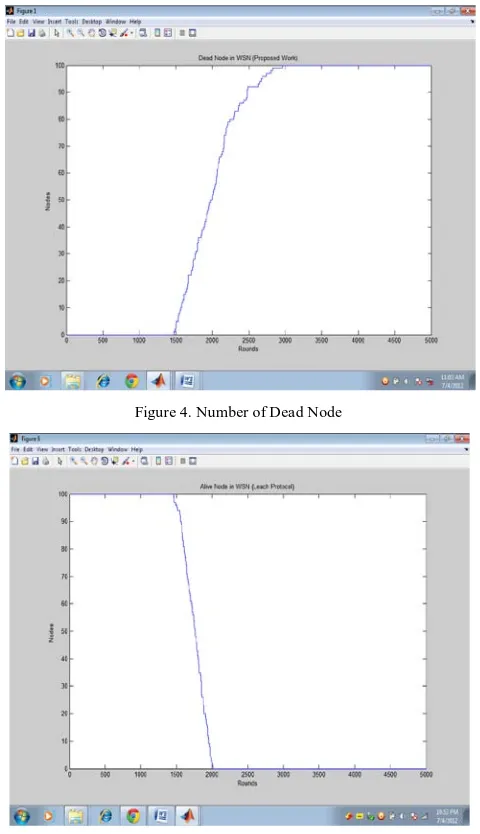
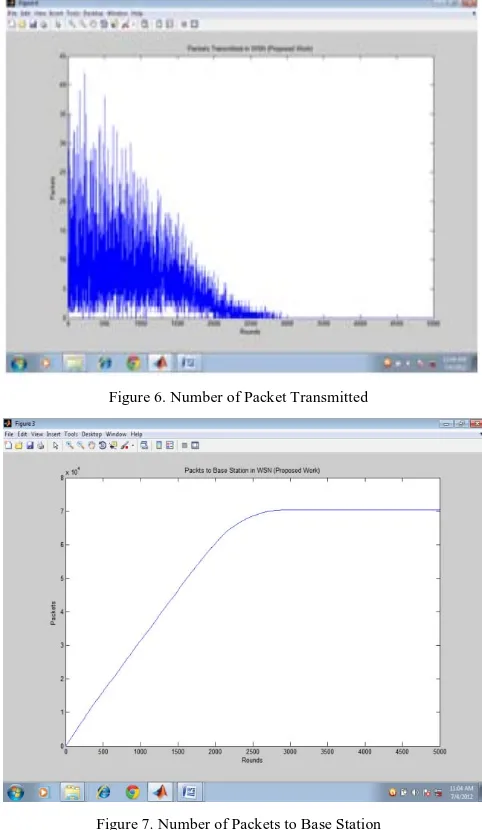
Fig 4 is the Rounds vs Node of LEACH, in which there are the total Dead nodes. Fig 5 is the Rounds vs. Node of LEACH, in which there are the total Alive nodes. Fig 6 is the Rounds vs. Packet graph of LEACH, in which there is the total packet transmitted to cluster head. Fig 7 is the Rounds vs. Packet graph of LEACH, in which there is the total packet transmitted to Bsae Station.
and 100 Sensor Nodes are randomly distributed in it. In our experiments, we use the well known tool: Mat Lab to model our protocol. We can draw different performance for LEACH and LEACH-N:
Figure 4. Number of Dead Node
Figure 6. Number of Packet Transmitted
Figure 7. Number of Packets to Base Station
In Fig.8, 9, 10,11 we compare the LEACH and LEACH-N. For the cluster head selection, we consider the minimum distance, maximum residual energy and the minimum response time.
Figure 8. Number of Dead Nodes in LEACH & LEACH-N
Figure 9. Number of Alive Nodes in LEACH & LEACH-N.
Figure10. Number of Packets Transmitted in LEACH & LEACH-N.
Figure11. Number of Packets to Base Station in LEACH & LEACH-N.
V. CONCLUSION AND FUTURE SCOPE
In this paper, we analyzed the methods of reducing energy dissipation used in clustering-based routing protocol LEACH and LECH-N. We proposed a multi-hop routing protocol with LEACH (Low Energy Adaptive Cluster Hierarchy) to minimize the energy consumption of sensor nodes. LEACH achieves better performance and has good robustness and adaptability too.
By minimum distance and more residual energy we select the cluster head. We analysis the network life time in terms of live nodes and packet transferred, ultimately we get the more life time of the networking in comparison with LEACH and LEACH-N. It is suitable for applications in the large-scale WSN. Such improvements consequently assure the improvement of the overall Wireless Sensor Network lifetime.
The future scope of this paper is that we can establish the Homogeneous network and we also establish that network which have maximum live time.
VI. REFERANCES
[1]. M. Dong, K. Yung, and W. Kaiser. Low Power Signal Processing Architectures for Network Microsensors. In Proceedings 1997 International Symposium on Low Power Electronics and Design, Aug. 1997, pages 173– 177
[2]. Chandrakasan, Amirtharajah, Cho, Goodman, Konduri, Kulik,Rabiner and Wang. Design Considerations for Distributed Microsensor Systems. In IEEE 1999 Custom Integrated Circuits Conference (CICC), May1999, pages 279–286.
[3]. Clare, Pottie, and Agre. Self-Organizing Distributed Sensor Networks. In SPIE Conference on Unattended Ground Sensor Technologies and Applications, Apr. 1999, pages 229–237.
[4]. Marcos, Diogenes. 2003. Survey on Wireless Sensor Network Devices. IEEE
[5]. L.V.Hosel, T. Nieber, Jian Wu, Prolonging the Lifetime of Wireless Sensor Networks by Cross-layer Design. In Proceedings IEEE Wireless Communications, December 2004, pages 80-86.
[6]. Wei Bo, Hu Han-ying, Fu Wen, A pseudo LEACH algorithm for wireless sensor networks. In proceeding IAENG, March,2007
[7]. Fan Xiangning,” Improvement on LEACH Protocol of Wireless Sensor Network”, 2007 International Conference on Sensor Technologies And Applications 0-7695-2988-7/07© 2007 IEEE.
[8]. Sohrabi K, Gao J, Ailawadhi V, Pottie GJ. Protocols for self organization of a wireless sensor network, IEEE Personal Comm.Mag. 2000,7(5):16−27.
[9]. Haiming Yang, Biplab Sikdar,” Optimal Cluster Head Selection in the LEACH Architecture”Performance,
Computing, and Communications Conference, 2007. IPCCC 2007, IEEE International 2.
[10]. Wei Bo Hu Han,” An Improved LEACH Protocol for Data Gathering and Aggregation in Wireless Sensor Networks”, 2008 International Conference on Computer and Electrical Engineering 978-0-7695-3504-3/08© 2008 IEEE.
[11]. Wei Wang,” Leach-H: An Improved Routing Protocol for Collaborative Sensing Networks”,978-1-4244-5668-0/09© 2009 IEEE.
[12]. Hu Junping,” A Time-based Cluster-Head Selection Algorithm for LEACH”, 978-1-4244-2703-1/08 ©2008 IEEE 978-1-4244-3709-2/10/$25.00 ©2010 IEEE.
[13]. Deng Zhixiang,” Three-layered Routing Protocol for WSN Based on LEACH Algorithm”.
[14]. Haosong Gou,” An Energy Balancing LEACH Algorithm for Wireless Sensor Networks”,2010 Seventh International Conference on Information Technology 978-0-7695-3984-3/10© 2010 IEEE.
[15]. Muhamnmad Omer Farooq,” MR-LEACH: Multi-hop Routing with Low Energy Adaptive Clustering Hierarchy”, 2010 Fourth International Conference on Sensor Technologies and Applications 978-0-7695-4096-2/10© 2010 IEEE.
[16]. Wu Xinhua,” Performance Comparison of LEACH and LEACH-C Protocols by NS2”,2010 Ninth International Symposium on Distributed Computing and Applications to Business, Engineering and Science 978-0-7695-4110-5/10© 2010 IEEE.
[17]. Li-Qing Guo,” Improvement On LEACH By Combining Adaptive Cluster Head Election And Two-Hop Transmission”, Proceedings of the Ninth International Conference on Machine Learning and Cybernetics 978-1-4244-6527 -9/10©2010 IEEE.
[18]. Mu Tong,” LEACH-B:An Improved LEACH Protocol for Wireless Sensor Network”, 978-1-4244-3709-2/10©2010 IEEE .
[19]. Bilal Abu Bakr,” A Quantitative Comparison of Energy Consumption and WSN Lifetime for LEACH and LEACH-SM”, 2011 31st International Conference on Distributed Computing Systems Workshops 1545-0678/11© 2011 IEEE.
[20]. Bilal Abu Bakr,” Extending Wireless Sensor Network Lifetime in the LEACH-SM Protocol by Spare Selection”,11 Fifth International Conference on Innovative Mobile and Internet Services in Ubiquitous Computing 978-0-7695-4372-7/11© 2011 IEEE.
[21]. Ye W, Heidenmann J, Estrin D. An energy-efficient MAC protocol for wireless sensor networks. In: Proc. of the IEEEINFOCOM.2002.http://www.isi.edu/div7/publicatio n_files /Ye02a.pdf.