Design and Implementation of A Wifi Based
Home Automation System
GopojuBalaraju
Department of ECE, KASIREDDY NARAYAN REDDY COLLEGE OF ENGINEEIRNG AND RESEARCH
Abdullapur (V), Hayathnagar (M), R.R (Dist). TS (Affiliated to JNTUH, Kukatpally)
P. NAGASPANDANA, Assistant professor
Department of ECE, KASIREDDY NARAYAN REDDY COLLEGE OF ENGINEEIRNG AND RESEARCH
Abdullapur (V), Hayathnagar (M), R.R (Dist). TS (Affiliated to JNTUH, Kukatpally)
Abstract—with advancement of Automation technology, life is
getting simpler and easier in all aspects. In today’s world Automatic systems are being preferred over manual system. With the rapid increase in the number of users of internet over the past decade has made Internet a part and parcel of life, and IoT is the latest and emerging internet technology. Internet of things is a growing network of everyday object-from industrial machine to consumer goods that can share information and complete tasks while you are busy with other activities. Wireless Home Automation system(WHAS) using IoT is a system that uses computers or mobile devices to control basic home functions and features automatically through internet from anywhere around the world, an automated home is sometimes called a smart home. It is meant to save the electric power and human energy. The home automation system differs from other system by allowing the user to operate the system from anywhere around the world through internet connection.
In this paper we present a Home Automation system(HAS) using Intel Galileo that employs the integration of cloud networking, wireless communication, to provide the user with remote control of various lights, fans, and appliances within their home and storing the data in the cloud. The system will automatically change on the basis of sensors’ data. This system is designed to be low cost and expandable allowing a variety of devices to be controlled
Key Words: Home automation System (HAS), Internet of Things (IoT), Cloud networking, Wi-Fi network, Intel Galileo Microcontroller
I. INTRODUCTION
A. Overview
Homes of the 21st century will become more and more self-controlled and automated due to the comfort it provides,
Many existing, well-established home automation systems are based on wired communication. This does not pose a problem until the syste m is planned well in advance and installed during the physical construction of the building. But for already existing buildings the imple mentation cost goes very high.
In contrast, Wireless systems can be of great help for automation systems. With the advance ment of wireless technologies such as Wi-Fi, cloud networks in the recent past, wireless systems are used every day and everywhere.
B. Advantages of Home automation systems
In recent years, wireless systems like Wi-Fi have become more and more common in home networking. Also in home and building automation systems, the use of wireless technologies gives several advantages that could not be achieved using a wired network only.
1) Reduced installation costs: First and foremost, installation costs are significantly reduced since no cabling is necessary. Wired solutions require cabling, where material as well as the professional laying of cables (e.g. into walls) is expensive. 2) System scalability and easy extension: Deploying a wireless network is especially advantageous when, due to new or changed requirements, extension of the network is necessary. In contrast to wired installations, in which cabling extension is tedious. This makes wireless installations a seminal investment.
International Journal of Research
Available at https://edupediapublications.org/journalsp-ISSN: 2348-6848 e-ISSN: 2348-795X Volume 03 Issue 14
October2016
4) Integration of mobile devices: With wireless networks, associating mobile devices such as PDAs and Smartphone’s with the automation system becomes possible everywhere and at any time, as a device's exact physical location is no longer crucial for a connection (as long as the device is in reach of the network).
For all these reasons, wireless technology is not only an attractive choice in renovation and refurbishment, but also for new installations.
II.
SYSTEM ANALYSISA. Problem Definition
Home automation systems face four main challenges, these are high cost of ownership, inflexibility, poor manageability, and difficulty in achieving security. The main objectives of this research is to design and implement a home automation system using IoT that is capable of controlling and automating most of the house appliances through an easy manageable web interface. The proposed syste m has a great flexibility by using Wi-Fi technology to interconnect its distributed sensors to home automation server. This will decrease the deployment cost and will increase the ability of upgrading, and system reconfiguration
B. Proposed System Feature
The proposed system is a distributed home automation system, consists of server, sensors. Server controls and monitors the various sensors, and can be easily configured to handle more hardware interface module (sensors). The Intel Galileo development board, with built in WiFi card port towhich the card is inserted, acts as web server. Automation System can be accessed from the web browser of any local PC in the same LAN using server IP, or remotely from any PC or mobile handheld device connected to the internet with appropriate web browser through server real IP (internet IP). WiFi technology is selected to be the network infrastructure that connects server and the sensors. WiFi is chosen to improve system security (by using secure WiFi connection), and to increase system mobility and scalability.
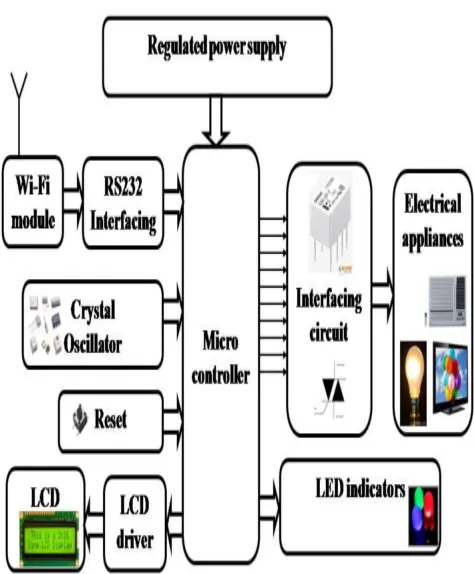
III. SYSTEM DESIGN AND IMPLEMENTATION A. Proposed Home Automation Syste m
Figure 1: Proposed model of Home automation system
IV.ARCHITECTURE OF MATCHING INSIDE ESP8266
International Journal of Research
Available at https://edupediapublications.org/journalsp-ISSN: 2348-6848 e-ISSN: 2348-795X Volume 03 Issue 14
October2016
Commands:
Design and System Architecture
Activity Diagram:
International Journal of Research
Available at https://edupediapublications.org/journalsp-ISSN: 2348-6848 e-ISSN: 2348-795X Volume 03 Issue 14
October2016
V. RESULTS
1. First of all connect the all connections for the project, It means power supply for controller, 230VAC for bulb.
2. After connect the all connections, Switch on the power supply. When you switch on the supply you can view the name of the project in LCD display “Load controlling using wifi”.
3. After that we can initialize the WIFI module with different commands which are noted in code.
4. After initializing it will provide a wifi
communication with name of “E-systems”
5. Now connect your mobile to that wifi network.
6. Now open the “Telnet” app and give the IP
num:192.168.4.1 and port num: 80, after entering it now press the ”Connect to server” button.
7. After connection now you can control you home appliances through your mobile by using WIFI. 8. When you press the*1 from application the device
one will on, *2 for device one off. As well as for second device.
VI. CONCLUSION
The goal of the paper was to design a system, which should be easy to implement, and short ranged. The project is imple mented through onboard Wi-Fi, which is inbuilt in the mobile phones having an Android as its system. Implementing the actuators for door systems for more security aspects can increase the future scope of this project.
VI. REFERENCES
1] Christian Reinisch ,“Wireless Communication in Home and Building Automation”, Master thesis, Vienniauniveristy of technlogy, Feb 2007. [2] http://wiki.smarthome.com/index.php?title=Home_Automation [3] A.J. Bernheim Brush, Bongshin Lee, Ratul Mahajan, Sharad Agarwal, Stefan Saroiu, and Colin Dixon, "Home Automation in the Wild: Challenges and Opportunities", CHI 2011, May 7–12, 2011, Vancouver, BC, Canada
[4] N. Sriskanthan, F. Tan, A. Karande,” Bluetooth based home automation system”, Microprocessors and Microsystems journal, issue 26 (2002) pages 281–289, Elsevier Science B.V., 2002
[5] Matthias Gauger,DanielMinder,Arno Wacker, Andreas Lachenmann,"Prototyping Sensor-Actuator Networks for Home Automation", REALWSN’08, April 1, 2008, Glasgow, United Kingdom.
[6] Malik Sikandar Hayat Khiyal, Aihab Khan, and ErumShehzadi, "SMS Based Wireless Home Appliance Control System (HACS) for
Automating Appliances and Security", Issues in Informing Science and Information Technology Volume 6, 2009
[7] D. Greaves, "Control Software for Home Automation, Design Aspects and Position Paper", The AutoHan project at the University of
Cambridge Computer Laboratory