Available online: http://edupediapublications.org/journals/index.php/IJR/ P a g e | 1314
Implementation of Data Aggregation Method to Overcome
Collusion Attacks in Wireless Sensor Networks
Alaa Sahl Jaafer & Abdali Abdulkareem Abdali
Department Of M. S.C.IS Osmania university, Hyderabad, India Foundation of Technical Education, Iraq
ABSTRACT
Aggregation of data from various sensor nodes is typically done by basic strategies, for example, averaging or, more advanced, iterative filtering techniques. In any case, such aggregation strategies are profoundly defenseless against malignant assaults where the aggressor knows about every single detected esteem and has capacity to change a portion of the readings. In this work, we create and assess algorithms that dispense with or limit the impact of changed readings. The fundamental thought is to consider adjusted data as anomalies and discover algorithms that viably recognize modified data as exceptions and expel them. Once the anomalies have been evacuated, utilize some standard system to assess a genuine esteem. As the execution of low power processors significantly enhances, future aggregator nodes will be equipped for performing more advanced data aggregation algorithms, accordingly making WSN less helpless. Iterative filtering algorithms hold extraordinary guarantee for such a reason. Such algorithms all the while total data from numerous sources and give put stock in appraisal of these sources, more often than not in a type of comparing weight factors allocated to data gave by each source. In this paper we exhibit that few
existing iterative filtering algorithms, while altogether more strong against agreement assaults than the basic averaging strategies, are all things considered susceptive to a novel advanced conspiracy assault we present. To address this security issue, limit esteem is expelled before registering an expected flag from the data focuses revealed by the sensors. In this manner, the proposed data aggregation algorithms works in two stages: expulsion of anomalies and algorithms of an expected genuine incentive from the rest of the sensor data. Broad assessments of the proposed algorithms demonstrate that they essentially beat every single existing strategy.
INTRODUCTION
A wireless sensor network (WSN)
Available online: http://edupediapublications.org/journals/index.php/IJR/ P a g e | 1315 improving the consistency and precision of
data and the region scope. Wireless sensor networks offer data about disconnected structures, boundless ecological changes, and so on. Wireless sensor network (WSN) is a network framework involved spatially appropriated gadgets utilizing wireless sensor nodes to screen physical or ecological circumstance, for example, sound, temperature, and movement.
FIGURE 1: An operating system of a WSN
Trust and reputation systems have a huge part in supporting operation of an extensive variety of conveyed systems, from wireless sensor networks and web based business framework to informal communities, by giving an appraisal of dependability of members in such dispersed systems. A reliability evaluation at any given minute speaks to a total of the conduct of the members up to that minute and must be vigorous within the sight of different sorts of deficiencies and vindictive conduct. There are various motivations for assailants to
control the weaken the execution of such a framework. The primary focus of noxious aggressors are aggregation algorithms of trust and notoriety systems. A sensor network is intended to play out an arrangement of highlevel data preparing undertakings, for example, detection,track, or classification. Measures of execution for these undertakings are very much characterized, including disclosure of false alerts or misses, order blunders, and track quality
As the computational energy of low power processors drastically increments, generally determined by requests of versatile registering, and as the cost of such innovation drops, WSNs will have the capacity to manage the cost of equipment which can actualize more modern data aggregation and put stock in evaluation algorithms; a case is the current rise of multi-center and multiprocessor systems in sensor nodes.
Available online: http://edupediapublications.org/journals/index.php/IJR/ P a g e | 1316 the aggregation procedure in the present
round of cycle their readings are given a lower weight.
In this work we demonstrate that this suspicion is not right and that the authorization based security display can't completely ensure client's protection under conspiring applications. We demonstrate that conniving applications can be developed on the present versatile stages and can utilize secret and in addition clear channels to total their consents. Plotting applications can in this manner by implication execute operations that those applications separately, in light of their authorizations, ought not have the capacity to execute. E.g., if the conspiring climate conjecture and contact coordinator applications convey, they will have the capacity to release client's close to home data to outsiders since their amassed consents permit it.
We additionally demonstrate that on the present portable stages that actualize the authorization based model clients are not made mindful of conceivable ramifications of utilization collusion–quite the contrary– users are certainly persuade that by affirming the establishment of every application freely, in light of its announced consents, they can restrict the harm that an application can cause. In spite of the fact that the presence of obvious and secret channels and consequently the possibility of use intrigue on any stage won't not be amazing, the ramifications of plot are perhaps most serious for versatile
platforms– these stages are intended for individual utilize and are intended to encourage the establishment of outsider applications.
Notwithstanding existing security items, that are utilized for the examination of utilization authorizations, dissect and report the consents autonomously for every individual application and in this way don't contemplate application plot. Given application agreement, those items don't effectively mirror the protection ramifications of the applications that the clients introduce. We take note of that application intrigue assaults on the consent based model are not an aftereffect of a software powerlessness and are not identified with a specific implementation– they are a result of the essential presumption on which the authorization based model depends: that applications can be freely limited in getting to assets and afterward securely made on a solitary stage.
Available online: http://edupediapublications.org/journals/index.php/IJR/ P a g e | 1317 We additionally demonstrate that the client
does not have to introduce two plotting malicious applications on his gadget for this assault to be fruitful.
A solitary malicious application with access to client's data will in any case have the capacity to release this data by passing it (over an incognito channel) to a content executed inside the telephone's program. We examine free applications from the Android market and demonstrate that the potential for application agreement is noteworthy: countless sets and individual applications can disregard client's protection utilizing secret correspondence channels.
At last, we show application arrangement on a Windows Phone 7 stage where we actualize a plain channel utilizing the Windows Media Library. To moderate these assaults, we talk about ways how plain and undercover channels can be either incompletely or completely shut. While unmistakable channels can be found and limited by utilizing corrupt examination, by lessening access to some APIs or by better sandboxing, other–mainly secret channels– cannot be obstructed without genuine debasement of framework execution.
This is not shocking since secret channels have for quite some time been known to be difficult to altogether anticipate on genuine systems. Given this, consents ought to be allowed and overseen under the presumption that applications can total their authorizations by plot over clandestine channels. This is, notwithstanding, not the
situation on current cell phone working systems, where before introducing an application the clients are demonstrated just the authorizations of to-be-introduced application–but they are not expressly made mindful of the collected consents of perhaps intriguing applications.
This makes it troublesome for the clients to comprehend the ramifications of introducing an application and normally prompts an underestimation of the related dangers. To address this issue, other than proposing methods for shutting undercover channels, we additionally propose a few basic measures that can be actualized by the working systems to enable clients and associations to point of confinement and better deal with the dangers related with introducing untrusted applications.
In synopsis, the commitments of this paper are the accompanying: (1) We demonstrate that the limitations, which are set on the operations of the applications in the authorization based security show, can be overwhelmed by conspiring applications. This permits intriguing applications to by implication, over unmistakable and clandestine channels, execute operations that those applications–based on their permissions–should not be permitted to execute. (2)
Available online: http://edupediapublications.org/journals/index.php/IJR/ P a g e | 1318 shut. (3) We depict a few reasonable
situations in which clients can progress toward becoming casualties of this assault. (4)
We consider free applications from the Android showcase and– in spite of the fact that in our investigation we don't recognize any conniving applications–we demonstrate that the capability of use intrigue is critical. (5) We make inferences on the security and utilization of the consent based security demonstrate.
LITERATURE REVIEW
Akhtar in [1], authors projected a replacement technique for intra cluster routing that\'s further energy economical than a celebrated routing protocol Multihop Router that performs multihop routing. They tested their arrange by simulating a network of thirty nodes in TOSSIM. whereas justifying the conception through results of the simulation had been thought of the parameters that include: vary of packets sent inside the network, energy consumed by the network, remaining energy of nodes at specific time and network amount of the network. By exploitation projected technique shows that that that they had hyperbolic the network amount and vary of packet sent inside the network. In [7], author explains the Multipath Power Sensitive Routing (MPSR) Protocol for Mobile specific Networks has been given. Providing multiple ways that is helpful in specific networks as a results of once one in each of the routes is disconnected, the availability
can simply use totally different on the market routes whereas not humanities the route discovery methodology over again.
The simulation was done
victimization the worldwide Mobile machine (GloMoSim) Library. The results of comprehensive simulation show that the performance of MPSR protocol is on degree increasing trend as quality can increase as compared to the Dynamic offer Routing and victimization this protocol is that the end-to-end packet delay does not increase significantly.
Zijian Wang in [2], they projected AN energy economical and collision aware (EECA) node-disjoint multipath routing algorithmic program. the foremost set up of EECA is to use the printed nature of wireless communication to avoid collisions between two discovered routes whereas not any overhead. to boot, EECA restricts the route discovery flooding and adjusts node transmit power with the assistance of node position information, resulting in energy efficiency and smart performance of
communication. They used NS-2.33
machine to gauge the projected theme in terms of the common packet delivery quantitative relation, the common end-to-end delay, the common residual energy and so the vary of nodes alive.
Available online: http://edupediapublications.org/journals/index.php/IJR/ P a g e | 1319 explains in [4] establish the challenges of
routing in intermittently connected detector networks And planned an on demand minimum latency routing algorithm(ODML) to search out minimum latency (ODML) to search out minimum latency routes.
They planned proactive minimum latency routing algorithms: optimum PML and quick—PML. The schemes planned during this paper will offer generic routing functionalities for many of the prevailing planning schemes. Curt Schurgers initial he projected in [10], optimum routing in device networks is unworkable and projected a smart guideline that advocates a regular resource utilization, which can be unreal by the energy chart. They projected kind of wise algorithms that ar affected by this concept. There DCE (Data Combining Entities) combining theme reduces the energy, whereas there spreading approaches aim at distributing the traffic in a
{very} very plenty of balanced
methodology. several techniques, that swear entirely on localized metrics, are projected and evaluated. And there result shows that they\'ll increase the network amount up to an extra ninetieth on the so much aspect the gains of their initial.
According to Bitar, N., Gringeri, S., & Xia, T. J. (2013), Server farm and cloud architectures keep on advancing to address the needs of expansive scale multi-occupant server farms and mists. These needs are based on seven measurements: adaptability in figuring, stockpiling, and data transfer
capacity, versatility in system
administrations, effectiveness in asset usage, nimbleness in administration creation, cost productivity, administration unwavering quality, and security. This article concentrates on the initial five measurements as they relate to systems administration. Vast server farms are focusing on backing for a huge number of servers, exabytes of capacity, terabits every second of activity, and countless occupants. In a server farm, server and capacity assets are interconnected with parcel switches and switches that accommodate the data transmission and multi-occupant virtual systems administration needs.
Server farms are interconnected over the wide zone system through directing and transport advances to give a pool of assets, known as the cloud. Fast optical interfaces and thick wavelength-division multiplexing optical transport are utilized to accommodate high-limit transport intra- and between datacenter. This article surveys different exchanging, directing, and optical
transport innovations, and their
appropriateness in tending to the systems administration needs of vast scale multi-occupant server farms.
Available online: http://edupediapublications.org/journals/index.php/IJR/ P a g e | 1320
includes components from network
registering, utility figuring and autonomic processing, into an inventive organization construction modeling.
This fast move towards the mists, has fuelled concerns on a discriminating issue for the accomplishment of data frameworks, correspondence and data security. From a security viewpoint, various unchartered dangers and difficulties have been acquainted from this migration with the mists, falling apart a great part of the viability of customary assurance systems. Subsequently the point of this paper is twofold; firstly to assess cloud security by distinguishing special security prerequisites and also to endeavor to present a practical arrangement that takes out these potential dangers.
This paper proposes presenting a Trusted Third Party, tasked with guaranteeing particular security qualities inside a cloud situation. The proposed arrangement calls upon cryptography, particularly Public Key Infrastructure working together with SSO and LDAP, to guarantee the validation, respectability and secrecy of included information and correspondences. The arrangement, shows a flat level of administration, accessible to all involved elements, that understands a security network, inside which fundamental trust is kept up.
According to Subashini, S., & Kavitha, V. (2011) Distributed cloud computing is an approach to expand the limit or include
abilities powerfully without putting resources into new framework, preparing new work force, or permitting new programming. It broadens Information Technology's (IT) existing capacities. In the most recent few years, distributed computing has developed from being a guaranteeing business idea to one of the quickly developing sections of the IT business. Anyway as more data on people and organizations are put in the cloud, concerns are starting to become about exactly how safe a domain it is.
Regardless of all the buildup encompassing the cloud, endeavor clients are still hesitant to send their business in the cloud. Security is one of the significant issues which decreases the development of distributed computing and inconveniences with information protection and information insurance keep on plagueing the business sector. The coming of a propelled model ought not arrange with the obliged usefulness and abilities show in the current model. Another model focusing at enhancing highlights of a current model must not chance or debilitate other vital highlights of the current model.
Available online: http://edupediapublications.org/journals/index.php/IJR/ P a g e | 1321 more particular to the distinctive security
issues that has radiated because of the way of the administration conveyance models of a distributed computing framework.
Houidi, I., Mechtri, M., Louati, W., & Zeghlache, D. (2011, July), research presents work-in-advancement on the cloud administration provisioning crosswise over different cloud suppliers. The work accept the development of Cloud Brokers in the middle of clients and cloud suppliers. The representatives part client demands and guarantee provisioning from different suppliers.
A careful part calculation is produced to proficiently part the cloud demands among the numerous cloud stages with the point of diminishing the expense for clients. This part is figured as a Mixed Integer Program and this is consolidated with Open Flow and NOX innovations that attain to stream based between cloud organizing. Another controller module is created and incorporated in NOX to arrange the Open Flow switches for between cloud way foundations.
According to Nurmi, D., Wolski, R., Grzegorczyk, C., Obertelli, G., Soman, S., Youseff, L., & Zagorodnov, D. (2009, May), Distributed computing frameworks on a very basic level give access to expansive pools of information and computational assets through a mixture of interfaces comparable in soul to existing lattice and HPC asset administration and programming frameworks. These sorts of frameworks
offer another programming focus for adaptable application designers and have picked up prevalence in the course of recent years. In any case, most distributed computing frameworks in operation today are restrictive, depend upon base that is undetectable to the exploration group, or are not unequivocally intended to be instrumented and changed by frameworks scientists.
NETWORK MODEL
Available online: http://edupediapublications.org/journals/index.php/IJR/ P a g e | 1322
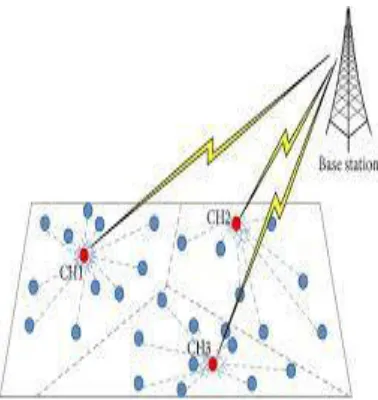
FIGURE 2: Network model of a WSN
We give an exhaustive exact assessment of adequacy and effectiveness of our proposed aggregation technique. The outcomes demonstrate that our technique gives both higher precision and preferable agreement resistance over the current strategies.
FIGURE 3: Cluster head communication
ADVERSARY MODEL
The past analysts developes the assault models by considering the way that they can't depend on cryptographic techniques forpreventing the assaults, since the enemy may separate cryptographic keys from the traded off nodes. The creators in, considers Byzantine assault show, where the promotion versary can trade off an arrangement of sensor nodes and embed any false data through the bargained nodes.
Following are a few suppositions made in this model a. Sensors are sent in an antagonistic unattended condition with some physically traded off nodes. b. At the point when a sensor node is traded off, all the data which is inside the node winds up noticeably open by the adversary.
Available online: http://edupediapublications.org/journals/index.php/IJR/ P a g e | 1323
COLLUSION ATTACK IN WIRELESS SENSOR NETWORK
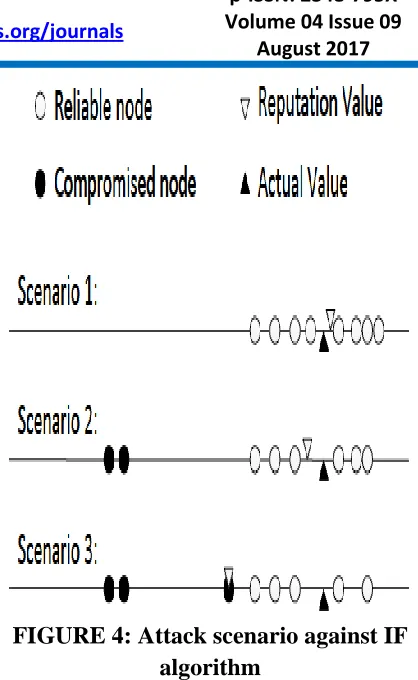
The majority of the IF algorithms possess straightforward suspicions about the underlying estimations of weights for sensors. In the event of our rival demonstrate, an aggressor can misguide the accumulation framework from side to side mindful scope of report information benchmarks. Expect that ten sensors report the estimations of temperature which are accumulated utilizing the IF algorithms arranged in with the complementary segregated capacity.
In situation 1, all sensors are solid and the consequence of the IF algorithms is near the genuine esteem. In situation 2, a foe bargains two sensor nodes, and modifies the readings of these qualities with the end goal that the straightforward normal of all sensor readings is skewed towards a lesser esteem. As these two sensor nodes report a lower esteem, IF algorithms punishes them and allots to them bring down weights, on the grounds that their esteems are a long way from the estimations of different sensors.
As such, the algorithms is strong against false information infusion in this situation in light of the fact that the traded off nodes separately adulterate the readings with no learning about the accumulation algorithms. The algorithms allots low weights to these two sensor nodes and thus their commitments diminish.
FIGURE 4: Attack scenario against IF algorithm
In situation 3, an enemy utilizes three traded off nodes keeping in mind the end goal to dispatch an intrigue assault. It tune in to the reports of sensors in the system and teaches the two bargained sensor nodes to report esteems a long way from the genuine estimation of the deliberate amount. It at that point figures the skewed estimation of the straightforward normal of all sensor readings and orders the third traded off sensor to report such skewed normal as its readings.
FRAMEWORK OVERVIEW
Available online: http://edupediapublications.org/journals/index.php/IJR/ P a g e | 1324 part of the principal emphasis of the IF
algorithms.
FIGURE 5: Framework overview of Data Aggregation Technique
The vast majority of the conventional factual estimation techniques for fluctuation include utilization of the example mean. Hence, proposing a hearty fluctuation estimation strategy on account of skewed example mean is a fundamental piece of our system.
ENHANCED ITERATIVE FILTERING ALGORITHM
In order to amend the functioning of IF algorithms against the aforementioned attack scenario, Keeping in mind the end goal to revise the working of IF algorithmss against the previously mentioned assault situation, our proposed approach give a powerful starting estimation of the dependability of
sensor nodes to be utilized as a part of the primary cycle of the IF algorithms. The greater part of the customary measurable estimation strategies for differences include utilization of the example mean. Thus, proposing a hearty change estimation technique on account of skewed specimen mean is basic piece of our methodology.
Figure 2: illustrates the stages of our robust IF framework and their interconnections.
1. Identification of another advanced and capable assault against IF based notoriety frameworks which uncover an extreme defenselessness in iterative sifting algorithmss;
Available online: http://edupediapublications.org/journals/index.php/IJR/ P a g e | 1325 3. Plan of an effective and hearty total
system propelled by the Maximum Likelihood Estimation (MLE), which uses a gauge of the commotion parameters ;
4. Upgraded IF plans ready to ensure against modern conspiracy assaults by giving an underlying evaluation of reliability of sensors utilizing inputs;
5. A novel agreement identification and renouncement strategy in light of an underlying estimation of the total esteems and in addition conveyance of contrasts of every sensor readings.
In the event that algorithms is powerful against the straightforward anomaly infusion by the traded off nodes. A foe utilizes three traded off nodes with a specific end goal to dispatch an intrigue assault. It tunes in to the reports of sensors in the system and teaches the two traded off sensor nodes to report esteems a long way from the genuine estimation of the deliberate amount.
It at that point figures the skewed estimation of the basic normal of all sensor readings and orders the third traded off sensor to report such skewed normal as its readings. At the end of the day, two traded off nodes misshape the basic normal of readings, while the third bargained node reports an esteem near such twisted normal therefore making such perusing appear to the IF algorithms as an exceptionally dependable perusing.
Accordingly, IF algorithms will meet to the qualities give by the third compromised
node, in light of the fact that in the main cycle of the algorithms the third bargained node will accomplish the most elevated impact, fundamentally command the weights of every single other sensor. Starting test vector in view of the IF technique give a hearty nature of the security framework.
Algorithmic strategy Input : X,n,m. Output : Reputation vector r.
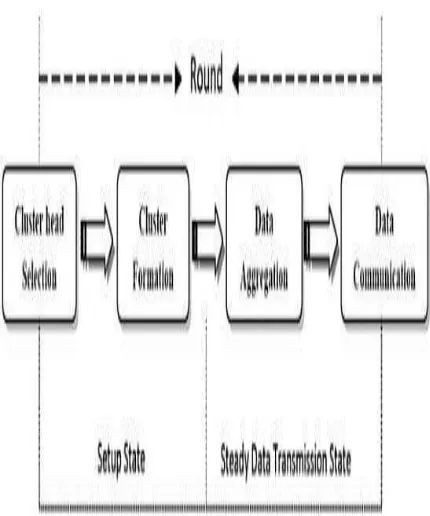
1. For each sensor Si (i=1… n) do, check energy level If (Esi > Esj) Si is selected as CH Else Si acts as normal Sensor nodes.
2. Calculate the initial reputation vector using MLE
3. Calculate Weight based on distance of reading to initial reputation vector. 4. Iterative filtering with initial weights. a.
l<-0 b. Compute r(l+1) c. Compute d d. Compute w(l+1) Where l is number of iteration
5.The nodes have less weight are considered as compromised. es = xs - r ; where es is error xs sensor reading and r is the estimated reputation vector.
6. Reapply step 2 to 4 to produce more accurate readings.
7. Stop.
EXPERIMENTAL RESULTS
Available online: http://edupediapublications.org/journals/index.php/IJR/ P a g e | 1326 For each analysis, we assess the precision in
view of Root Mean Squared mistake (RMS blunder) metric and proficiency in light of the quantity of cycles required for meeting of IF algorithms.
Apply dKVD-Reciprocal, dKVD-Affine, Zhou, Laureti and powerful collection way to deal with artificially created data. Albeit basically apply our powerful structure to all current IF approaches, in this paper examine the change which expansion of our underlying dependability evaluation strategy delivers on the strength of dKVD-Reciprocal and dKVD-Affine strategies.
The goal of our trials is to assess the vigor and productivity of our approach for evaluating the genuine estimations of flag in light of the sensor readings inthe nearness of issues and agreement assaults. For each analysis, we assess the precision in view of Root Mean Squared mistake (RMS blunder) metric and effectiveness in light of the quantity of cycles required for union of IF algorithms.
Apply dKVD-Reciprocal, dKVD-Affine, Zhou, Laureti and powerful collection way to deal with artificially created data. Albeit essentially apply our hearty structure to all current IF approaches, in this paper explore the change which expansion of our underlying dependability evaluation strategy delivers on the power of dKVD-Reciprocal and dKVD-Affine strategies.
Available online: http://edupediapublications.org/journals/index.php/IJR/ P a g e | 1327 The aftereffects of this trial demonstrate that
the proposed introductory notoriety for the IF algorithms enhance the proficiency of the algorithms as far as the quantity of cycles until the point that the procedure has united. As it were, by giving this underlying notoriety, the quantity of emphasess for IF algorithms diminishes roughly 9% for equal and around 8% for relative discriminant works in both one-sided and fair conditions. This can be clarified by the way that the new introductory notoriety is near the genuine estimation of flag and the IF algorithms needs less cycles to achieve its stationary point.
CONCLUSION
Compromised node give a false information accumulated data to the aggregator node so the aggregate data gathered by the node ought to not be right. This can be maintained a strategic distance from by executing the
iterative separating algorithms presented in the aggregator node for giving a security.
Trust and notoriety have been as of late proposed as a powerful security system for Wireless Sensor Networks Iterative Filtering (IF) algorithmss are an appealing alternative for WSNs on the grounds that they tackle the two issues information collection and information dependability evaluation utilizing a solitary iterative methodology keeping in mind the end goal to enhance the execution of IF algorithmss against the previously mentioned assault situation, give a strong introductory estimation of the reliability of sensor nodes to be utilized as a part of the principal emphasis of the IF algorithms.
Proposed a change for the IF algorithmss by giving an underlying guess of the reliability of sensor nodes which makes the algorithmss not just conspiracy
REFERENCES
[1] S. Ganeriwal, L. K. Balzano, and M. B. Srivastava, “Reputationbased framework for high integrity sensor networks,” ACM Trans. Sen. Netw., vol. 4, no. 3, pp. 15:1– 15:37, Jun. 2008.
[2] Y. Yang, X. Wang, S. Zhu, and G. Cao, “SDAP: a secure hop by hop data aggregation protocol for sensor networks,” in MobiHoc, 2006, pp. 356–367.
Available online: http://edupediapublications.org/journals/index.php/IJR/ P a g e | 1328 Sensor Network. Article 6 (August
2011.DOI = 10.1145/1993042.199)3048. [4]H.-S. Lim, Y.-S. Moon, and E. Bertino,
“Provenancebased trustworthiness
assessment in sensor networks,” in Proceedings of the Seventh International Workshop on Data Management for Sensor Networks, ser. DMSN ‟10,2010, pp. 2–7. [5] S. Roy, M. Conti, S. Setia, , and S. Jajodia, “Secure data aggregation in wireless sensor networks,” Information Forensics and Security, IEEE Transactions on, vol. 7, no. 3, pp. 1040–1052, 2012.
[6]H.-L. Shi, K. M. Hou, H. ying Zhou, and X. Liu, “Energy efficient and fault tolerant multicore wireless sensor network: E2MWSN,” in Wireless Communications,
Networking and Mobile Computing
(WiCOM), 2011 7th International
Conference on, 2011,pp. 1–4.
[7] B. Awerbuch, R. Curtmola, D. Holmer, C. Nitarotaru, and H. Rubens, “Mitigating byzantine attacks in ad hoc wireless networks,” Department of Computer Science, Johns Hopkins University, Tech, Tech. Rep., 2004.