Fingerprint Based Attendance System Using
Microcontroller and LabView
Devendra Kumar Yadav
1, Sumit Singh
2, Prof. Shashank Pujari
3, Pragyan Mishra
4UG Student, Dept. of ECE, Sambalpur University Institute of Information Technology, Odisha, India1 UG Student, Dept. of ECE, Sambalpur University Institute of Information Technology, Odisha , India2
Former Director, Sambalpur University Institute of Information Technology, Odisha ,
India
3PG Student, Dept. of MCA, Veer Surendra Sai University Technology, Odisha, India4
ABSTRACT: Fingerprint matching has been successfully used by law enforcement for more than a century. The technology is now finding lot of other applications such as identity management and access control. In this context, an automated fingerprint recognition system and identification of key challenges are described along with the research opportunities. The description is like a product design in this report implementing RTOS (Real time operating system) under the domain of embedded system. Fingerprint Recognition is a widely popular but a complex pattern recognition problem. It is very difficult to design accurate algorithms capable of extracting salient features and matching them in a robust way. In this paper, we have come with a novel approach to simplify the existing problems with a proper Embedded System Design
KEYWORDS: Microcontroller, Fingerprint, Biometric, Recognition, Embedded system.
I.INTRODUCTION
The skin on our palms and fingers exhibits a flow like patterns of ridges and valleys. The papillary ridges on the finger, called friction ridges, which help the hand to grasp objects and increase friction and improve the tactile sensing of the surface structure. These ridge patterns are now scientifically proved as unique for each person. The cuts and burns in a person’s finger may alter these patterns temporarily but they reappear after the injury heals.
Fingerprints are now used widely for identification and verification purpose. They are used for attendance purpose in organizations to avoid proxy for criminal identification like terrorist, murderer and violators and also in passports (a matter of national high importance) of person.
Here in this project we have tried to automate a classroom attendance procedure by using a fingerprint recognition module interfaced with 8051 microcontroller [28]. A fingerprint recognition system can be used for both verification and identification. In verification, the system compares an input fingerprint to the “enrolled” fingerprint of a specific user to determine if they are from the same finger (1:1 match). In identification, the system compares an input fingerprint with the prints of all enrolled users in the database to determine if the person is already known under a duplicate or false identity (1:N match)[27][29].
This report also involves the product based design of a physical fingerprint system and also layout of fingerprint matching algorithm. It uses various concepts of embedded system and has tried to make the hardware a marketable portable
II.LITERATURE REVIEW
Various fingerprint matching systems have been proposed which emphasizes on minutiae information, local ridges [1]; some studies are based on singularity point’s position, orientation [2], and relative distance detection, novel printing [2, 3, 4, 5] novel EESM-based fingerprint algorithm for indoor positioning [6].
[12] and multi-server [13] topology and cryptography fingerprint recognition systems. As mentioned in techniques such as DSP [14, 15, 16] and RF-card; field programmable gate array (FPGA) using neural networks [17]; keystroke dynamics [18]; FPC1011C sensor [19], Hidden Markov Models [20], Threshold Visual Cryptography [21] is used for identification purposes. Automatic Fingerprint Identification System (AFIS), in fingerprint recognition is also helpful to access control system of automobiles [22]. In another study, Delaunay Quadrangle method using topology code has been used for authentication [23]. Fingerprint authentications are also used in ATMs [24]. Some fingerprint matching systems are also based on model-based designs [25, 26].
III. TOP LEVEL SYSTEM DESCRIPTION
Figure.1 shows the block diagram of the Microcontroller based attendance system. This design combines the Microcontroller with the Fingerprint Module, display, and communication interfaces. This integration accelerates development while maintaining design flexibility and simplifies testing. Figure.1 shows the block diagram of the Microcontroller based system. The design combines the microcontroller with the Fingerprint Module, display, and communication interfaces. This integration accelerates development while maintaining design flexibility and simplifies testing.
Fig.1Top Level system Diagram The design includes following three modes:
Mode 1: The fingerprint module is connected with the PC using RS232 through serial communication. The Software called SFG Demo is then used for interfacing purpose. The fingerprint module is interfaced with the PC through the SFG Demo. By using SFG Demo software we are storing the fingerprint template of all the individuals with a unique id inside the fingerprint module.
Mode 2: Then we are connecting fingerprint module with microcontroller1, the use of microcontroller1 is to extract the data from fingerprint module .By using microcontroller1 we are receiving the enrollment id or unique id of specific person.
Mode 3: It mainly focuses on the working of the microcontroller2. The microcontroller1 transmits the unique ids to the microcontroller2. After receiving the unique ids, the microcontroller2 matches the unique id with the database or information of the student contained in it. Simultaneously, after finding a particular student’s match, it is sent to the PC through serial communication. Then in PC, software called LabVIEW is used for generating the text file with student’s roll number, name, date and time.
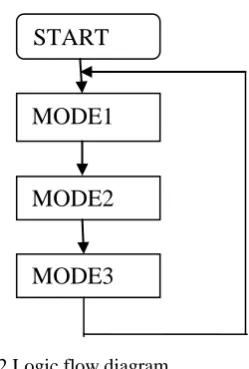
The logic flow design of the system is implemented using these three modes as shown in Fig 2. When the circuit is activated, the system performs following operation
.
Fig. 2 Logic flow diagram
IV.ARCHITECTURE OF MATCHING INSIDE FINGERPRINT MODULE (R305)
It is actually very difficult to devise a proper algorithm for matching of fingerprint and making the algorithm robust. This chapter discusses the current state of the art feature extraction techniques and gives a literary review of algorithm of matching the extraction.
Data Acquisition
Traditionally in law enforcement applications fingerprints were acquired off-line by transferring the inked impression of thumb on a paper. Recently, the automated fingerprint verification systems use live-scan digital images of fingerprint acquired from a fingerprint sensor or module. These sensors or module are based on optical, capacitance, ultrasonic and thermal and other imaging technologies.
The optical sensors are most popular and are fairly expensive. These sensors are based on FTIR (Frustrated Total Internal Reflection) technique. When a finger touches the sensor surface which actually is a side of a glass prism, in which one side of the prism is illuminated through a diffused light. While the fingerprint valleys that do not touch the sensor surface reflect the light, ridges that touch the surface absorb the light. The sensor exploits this differential property of light reflection to differentiate the ridges (which appear dark) from valleys.
START
MODE1
MODE2
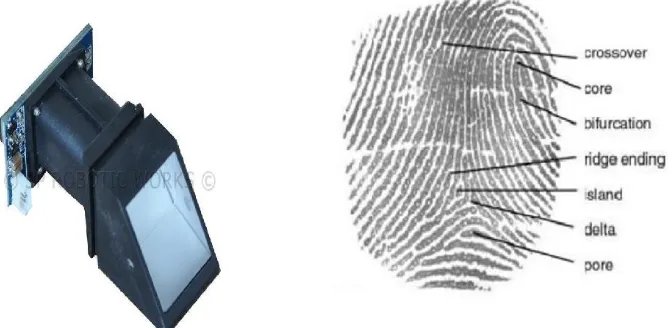
Fig. 4 R305 module and fingerprint recognition with various features
Like the optical sensor algorithm for data acquisition there are two other algorithms for data acquisition namely, capacitive sensor utilization method and ultra sound technology based sensors.
As in our project we have tried to use the first one that is optical sensors method. So we have not described the other two methods.
Image Pre-processing
The pre-processing steps try to compensate for the variations in lighting, contrast and other inconsistencies which are introduced by the sensor during acquisition process. There are many processes but presently some methods are very famous which the following are:
Gaussian Blur: A convolution operation which applied to the original fingerprint image to reduce image noise introduced by sensor during data acquisition.
Sliding window contrast adjustment: Sliding window contrast adjustment is used to compensate for any lighting inconsistencies within a fingerprint and to obtain contrast consistencies among different fingerprints.
Histogram based intensity level adjustment: This is a final step is to further enhance the ridges and valleys.
Feature extraction
The feature extraction technique for minutiae points (bifurcations and endings), pores and ridge contours is described in this section.
Minutiae Extraction:
Most of the minutiae extraction techniques trace the fingerprint skeleton to find different types of minutiae points. Orientation Estimation: A fingerprint image is an oriented texture pattern and a ridge orientation at a pixel (x, y) is the angle that the ridges within a small neighborhood centered at (x, y) form with the horizontal axis. Thus a fingerprint is divided into many blocks. An analysis of gray scale gradient within a block is done to estimate the representative ridge orientation within that block. Segmentation: During this stage the portions of the fingerprint image depicting the finger foreground is segmented. This further eliminates the spurious features from background and noisy region within a fingerprint.
Ridge Detection: An important property of the ridges in a fingerprint image is that the gray level values on ridges attain their local maxima along a direction normal to the local ridge orientation. The resulting ridge map often contains false ridges in the form of holes and speckles. The ridge map is cleaned using a connected component algorithm. Finally the ridges are thinned using standard thinning algorithm.
minutiae. False minutiae are generally found at the borders as the ridges end abruptly. These false minutiae at the border can be recognized by examining the number of foreground pixels in a region around minutia point. If number of foreground pixels is relatively small then the minutia point can be removed.
Fig. 3 Architecture of fingerprint matching algorithm
V. MODEL BASED DESIGN AND SIMULATION
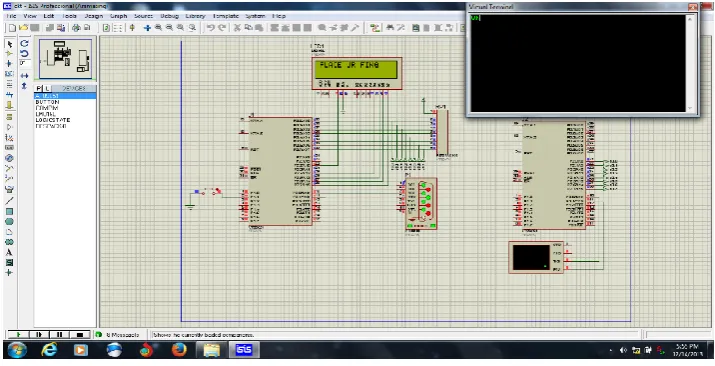
Model based design approach is an ideal approach for Embedded System Design. There are many system model tools available from various vendors. These tools facilitate the design of hardware and software before actual physical implementation of the system. Proteus tool is used for this project. The Proteus tool also provides virtual instruments like Oscilloscope, Logic analyzer to monitor the signals of the system. Step by step design process of building the microcontroller system by interfacing switch, LED, LCD, Serial Communication and Fingerprint Module and using the assembly language programming Proteus allows assembly code to be assembled and downloaded on the virtual 8051microcontroller. For C language coding Keil compiler is used. The generated hex code is used to configure and run the system.
Fig. 5 Schematic and Proteus Simulation Model
Fig. 6 Flow chart of the proposed sysytem
VI. LABVIEW DATABASE MODEL
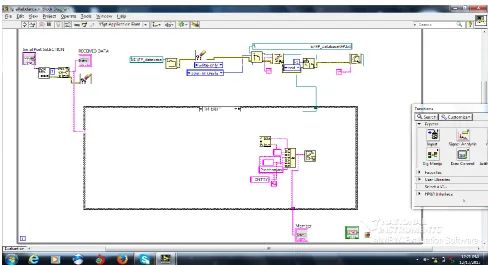
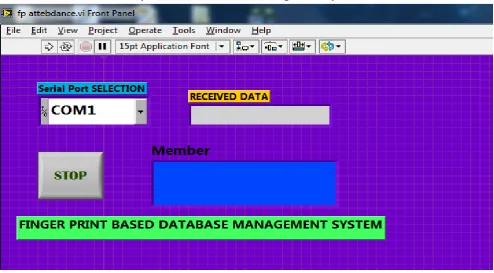
A LABVIEW database storage system is designed for storage of student attendance record with names of all the students with their corresponding roll numbers and also with date and time.
Fig. 8A front panel design of LabVIEW database storage system.
VII. RESULTS AND DISCUSSION
The attendance can save each student’s fingerprint, hence makes the system more robust. During enrolment the student’s fingerprints is assumed to be clean, not dry or damp, no scratches and not swollen.
TABLE I. PROBLEM WHILE TAKING ATTENDANCE Problems Fingerprint
Snapshot
Problems Fingerprint Snapshot
Finger Misplacement
Dirty Finger
Orientation Skin Problems
Students are required to place their fingerprint. After the enrolment stage, the data will be saved in the fingerprint scanner and the verification system takes place by comparing the capture fingerprint characteristic with the previously enrolled data. Table I shows the types of issue that might occur when taking attendance system acquiring fingerprint for attendance purposes. We considered all of these factors for the product which are user-friendliness, convenience, portability, and heating resistance.
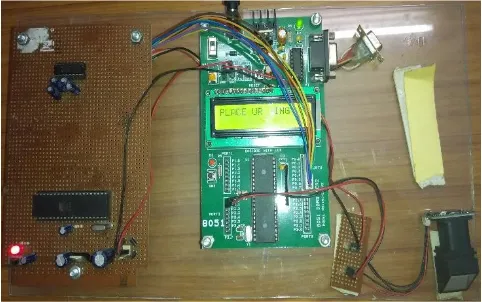
Fig. 9 Real time implementation of proposed model.
In the recent time, most organizations such as universities are using a sheet of paper to record the students’ attendance. Students need to sign on the attendance sheet as an evidence for them to show that they attended the classes. When the attendance sheet is passed around in the class, each student needs to scan the name on the attendances sheet. We estimate the time for each student to sign theattendance sheet is about 1 to 2 minutes. If the total numbers of students in class is 40 the required time to sign the attendance is about 40 to 80 minutes.
Similarly for the fixed attendance system placed near the entrance to the class, the registration time for each student is around 20 seconds to 30 seconds. If the total number of students in class is 40, then the required time is about 13 to 20 minutes. Therefore, the last student to register will miss the class around 20 minutes.
An experiment has been conducted to know the time taken in recording students’ attendance using our proposed Attendance System. We record the time taken altogether starting from switching on the power until the verification of last student in the class. The results prove that utilizing the proposed system is more efficient and faster than using Attendance Sheet or Fixed Fingerprint Reader. The time requires is around 10.21 seconds on average, while the time taken for each student to scan their finger is 4s. If a problem occurs which requires the students to use another fingerprint, the time taken is only 14 seconds. Therefore, the total time that was saved is around 56 seconds for each student.
Fig.1 shows the block diagram of the Microcontroller based attendance system. This design combines the Microcontroller with the Fingerprint Module, display, and communication interfaces. Fig. 2 gives a brief view of the various modes inside a finger print matching sensor. Fig. 3 gives the idea of Architecture of fingerprint matching through a descriptive flowchart. Fig. 4 gives us the R305 module and fingerprint recognition with various features out of which in this project we have used optical sensors.
VIII. CONCLUSIONS
This paper has presented the design and development of portable attendance system which is based on fingerprint identification. The system helped to reduce many issues such as, denying the possibilities of cheating in recording the attendance, helps to ease the lecturers to keep data of students’ attendance, the encryption technique adds more security so there will be no anonymous fingerprint which is able to tamper with the recorded data, and the portability saves time in taking attendance instead of queuing in a line. Future works will be making this system wireless and using IOT (internet of things) concept.
ACKNOWLEDGMENT
Authors wish to thank Sambalpur University Institute of Information Technology for the support in providing the development tools, KITs and laboratory infrastructure in carrying out this project.
REFERENCES
[1] K A. Nagaty,“An Energy-Based Fingerprint Matching System”,Consumer Communications and Networking Conference, 2004. CCNC 2004. First IEEE.
[2] C. Militello, V. Conti, F. Sorbello,S. Vitabile,“A Novel Embedded Fingerprints Authentication SystemBased on Singularity Points”,International Conference on Complex, Intelligent and Software Intensive Systems,0-7695-3109-1/08 $25.00 © 2008 IEEE.
[3] G. S. Ng1*, X. Tang, D. Shi11“Adjacent Orientation Vector Based Fingerprint Minutiae Matching System”, Proceedings of the 17th International Conference on Pattern Recognition (ICPR’04) 1051-4651/04 $ 20.00 IEEE
[4] Wang Yuan1 Yao Lixiu1 Zhou Fuqiang2,“A Real Time Fingerprint Recognition System Based OnNovel Fingerprint Matching Strategy”,1-4244-1135-1/07/$25.00 ©2007 IEEE.
[5] Bifari, E.N.; Elrefaei, L.A.“Automated Fingerprint Identification System Based on Weighted Feature Points Matching Algorithm”, 978-1-4799-3080-7114/$31.00 ©2014 IEEE
[6] Fan Wang, Zhengyong Huang, Hui Yu, Xiaohua Tian, Xinbing Wang, Jinwei Huang“EESM-based Fingerprint Algorithm for Wi-FiIndoor Positioning System”2013 2nd IEEE/CIC International Conference on Communications in China (ICCC): Wireless Networking and Applications (WNA),978-1-4673-2815-9/13/$31.00 ©2013 IEEE.
[7] Marcos Faundez-Zanuy & Joan Fabregas“Testing Report of a Fingerprint-Based Door-Opening System”,IEEE A&E SYSTEMS MAGAZINE. JUNE 2005.
[8] Pallav Guptat, Srivaths Ravi*, Anand Raghunathan*, Niraj K. Jhat“Efficient Fingerprint-based User Authentication for Embedded Systems”,DAC2005, June l3-17,2005, Anaheim, Califomia, USA. Copyright 2005 ACM 1-59593-05 8-2/05/0004 .
[9] Maitane Barrenechea1,Jon Altuna2,Miguel San Miguel2 “A Low-Cost FPGA-based Embedded Fingerprint Verification and Matching System”,250 - 261, DOI: 10.1109/WISES.2007.4408496,2007.
[10] Pablo David Gutiérrez, Miguel Lastra, Francisco Herrera, and José Manuel Benítez“A High Performance Fingerprint Matching System for Large Databases Based on GPU”,IEEE TRANSACTIONS ON INFORMATION FORENSICS AND SECURITY, VOL. 9, NO. 1, JANUARY 2014.
[11] Haiyun Xu, Raymond N. J. Veldhuis, Tom A. M. Kevenaar, and Ton A. H. M. Akkermans“A Fast Minutiae-Based Fingerprint Recognition System”,IEEE SYSTEMS JOURNAL, VOL. 3, NO. 4, DECEMBER 2009,1932-8184/$26.00 © 2009 IEEE.
[12] Radu F. Miron, Tiberiu S. Letia and Mihai Hulea “Two Server Topologies for a Distributed Fingerprint-BasedRecognition System” System Theory, Control, and Computing (ICSTCC), 2011 15th International Conference,2011.
[13] D. Bennet,Dr. S. Arumugaperumal“Fingerprint Based Multi-Server Authentication System”978-1-4244-8679-3/11/$26.00 ©2011 IEEE. [14] Lei Zhang, Mei Xie “Realization of a New-style Fingerprint Recognition System Based on DSP”,Proceedings of 2008 IEEE International
Symposium on IT in Medicine and Education,978-1-4244-2511-2/08/$25.00 ©2008 IEEE.
[15] Maddu Kamarajui , Penta Ani! Kumar2 “DSP based Embedded Fingerprint RecognitionSystem”,2013 13th International Cmiference on Hybrid Intelligent Systems (HIS) ,978-1-4799-2439-4/13/$31.00 ©2013 IEEE.
[16] Yanpeng Wang 1 Qing Li 2 Li Zhang 3“Design of Embedded Fingerprint Identification System Based on DSP”Anti-Counterfeiting, Security and Identification (ASID), 2011 IEEE International Conference ,978-1-61284-632-3/11/$26.00 ©2011 IEEE.
[17] P. Lorrentza , W. G. J. Howellsb,K.D. McDonald-Maierc“A Fingerprint Identification System using adaptive FPGA based Enhanced Probabilistic Convergent Network”,2009 NASA/ESA Conference on Adaptive Hardware and Systems,978-0-7695-3714-6/09 $25.00 © 2009 IEEE DOI 10.1109/AHS.2009.8.
[18] G.Vinoth Kumar,K.Prasanth ,S.Govinth Raj ,S.Sarathi ,“Fingerprint Based Authentication System with Keystroke Dynamics for Realistic User”© IEEE 2014 IEEE Conference Number - 33344 July 8, 2014, Coimbatore, India.,
[19] Fengling Wang1 , Yuanyi Zhang2“Study and Design of Intelligent Authentication System Based on Fingerprint Identification”2009 Second International Symposium on Knowledge Acquisition and Modeling,978-0-7695-3888-4/09 $25.00 © 2009 IEEE.
[20] Arash Azarnoush ,Kourosh Kiani “Improving the Performance of an HMM-based Fingerprint Recognition System”Computer Applications & Research (WSCAR), 2014 World Symposium,978-1-4799-2806-4/14/$31.00 ©2014 IEEE.
[21] Rajeswari Mukeshi, V.J.Subashini2 “Fingerprint Based Authentication System Using Threshold Visual Cryptographic Technique”IEEE-International Conference On Advances In Engineering, Science And Management (ICAESM -2012) March 30, 31, 2012.
[22] Zhaoxia Zhu; Fulong Chen“Fingerprint Recognition-Based Access Controlling System for Automobiles” 2011 4th International Congress on Image and Signal Processing,978-1-4244-9306-7/11/$26.00 ©2011 IEEE.
[24] H. Lasisi and A.A. Ajisafe “Development of stripe biometric based fingerprint Authentications systems in automated teller machines” 2012 2nd International Conference on Advances in Computational Tools for Engineering Applications (ACTEA),978-1-4673-2489-2/12/$31.00 ©2012 IEEE.
[25] Rosario Arjona and Iluminada Baturone“Model-based Design for Selecting FingerprintRecognition Algorithms for Embedded Systems”Electronics, Circuits and Systems (ICECS), 2012 19th IEEE International Conference,978-1-4673-1260-8/12/$31.00 ©2012 IEEE. [26] Xi Cheng, Sergey Tulyakov and Venu Govindaraju“Minutiae-based Matching State Model for Combinations in Fingerprint Matching
System”2013 IEEE Conference on Computer Vision and Pattern Recognition Workshops,978-0-7695-4990-3/13 $26.00 © 2013 IEEE. [27] Abhishek Rawat, Indian Institute of Technology, Kanpur. ”A hierarchical fingerprint matching system”, A thesis for b.tech m.tech dual
degree, published in 2009.
Prof. Shashank Pujari,Prangyadarshini Behera ,Devendrakumar Yadav,”HELIANTHUS - SMART SOLAR PANEL” International Journal of Communication Network Security ISSN: 2231 – 1882, Volume-2, Issue-1, 2013.
BIOGRAPHY
1. Devendra Kumar Yadav
UG Student, Dept. of ECE, Sambalpur University Institute Of Information Technology,Odisha, India. Area of interest – Embedded Systems and Wireless Sensor Area Network
2. Sumit Singh
UG Student, Dept. of ECE,Sambalpur University Institute Of Information Technology,Odisha, India. Area of interest-VLSI and Embedded System
3. Prof. Shashanka Shekhar Pujari
Former Director, Sambalpur University Institute Of Information Technology,Odisha, India Specialization in- FPGA based Embedded System design
Projects undertaken – 1)Successfully designed and developed ASIC GIST 9000 based on 1.2 micron Gate Array technology at VTI, California, USA with commercialization of over 100K chips till date and a patent obtained in 1989. 2)Successfully designed and developed FPGA based 3-D Camera Controller for a German client and FPGA based
4. Pragyan Mishra