Modelling and Controlling the Level of
Nonlinear Process via Diverse Control
Strategies
A.Thamemul Ansari
1, K.Thivakaran
2, K.Tharani Raja
3, H.Kala
4, S.Abirami
5,
UG Student, Dept. of ICE, Saranathan College of Engineering, Trichy, Tamilnadu, India1,2,3
Assistant Professor, Dept. of ICE, Saranathan College of Engineering, Trichy, Tamilnadu, India4, 5
ABSTRACT: In process industries, the level of the liquid must be controlled and it is a mandatory process. But controlling a non-linear process is a highly complicated and complex process. Many process industries employs conical tank because of its non-linear shape, because of its constantly changing cross section, with respect to height controlling. For each operating region, the linear portion of the nonlinear process is determined as first order plus dead time model (FOPD). Different controller scheme such as conventional PID controllers based on Ziegler-Nicholas (ZN-PID) method, Chien, Hrones and Reswich (CHR-PID) method, Tyres-Luyben (T-L-PID) method, Internal Model Control (IMC-PID) and Model Predictive Controller (MPC) method were proposed and their responses was compared. The main objective of the controller is to provide a minimum settling time, peak overshoot and rise time and to provide a minimum performance error. Among the various controllers, Model Predictive Control (MPC) satisfies the above criteria. The controller will be simulated using MATLAB SIMULINK.
KEYWORDS: Non-Linear process, MPC, IMC, Conical tank
I.INTRODUCTION
Conical tank are widely used in many process industries like Petroleum industries, Chemical Industries, concrete mixing, hydro chemical industries, food industries. The control of liquid level in the conical tank is a major problem in process industries. In many process industries, the liquid in the tank is to be pumped, stored in tanks and then pumped to another tank. The liquid in the tanks are processed by chemical and mixing treatment but the level of the fluid must be controlled and maintained at a constant value. Controlling of liquid level is an important and common process. In this paper, the level process in the tank is a conical shape, in which the level of the liquid is maintained at a desired value. Level of liquid can be controlled by controlling the inlet flow to the tank. In conical tank, the control variable is the level in a tank and the manipulated variable is the inflow to the tank. Controlling the level in the nonlinear process in the real time is very difficult, so that different controller is designed to control the level.
Many researchers have proposed many controllers for controlling the level of the tank. Conventional controls PID are used for controlling the level of the system, since conventional PID is simple and robustness. A common feedback loop components used for control system is a Proportional-Integral-derivative controller (PID). In this paper, a PID controller is implemented to track the set point in short time and reject the error, disturbance that occurs in the process. Open loop and closed loop ZN tuning methods are used for the process. The transfer functions of the process are determined by mathematical model method.
II.PROCESS DESCRIPTION
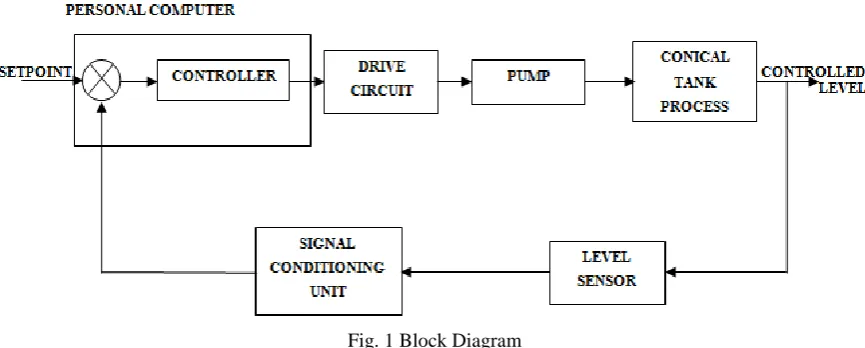
Fig. 1 Block Diagram
The Process used here is Conical Tank, which is highly nonlinear process. The control variable used is inflow rate, Level is the control variable used in conical tank. Level Sensor in the process used to sense the level in the conical tank, and sends the signal to the signal conditioning. Conical tank is interfaced with personal computer (PC) using DAQ Card. PC will act as controllers, which fed the signal to the drive circuit. The drive circuit consist of devices like SCR, TRIAC etc. The control action can be taken by using final control element; control variable used here is level, so that desired level is maintained.
III.MATHEMATICAL MODELLING
This is an analytical approach. The dynamic behaviour of a process is described by using basic laws from physics. In the Fig 2, let Fin represent the inflow rate to the conical tank, Fout be the outflow rate, H is the total height of the conical tank which is 70 cm and D be the top diameter of the tank which is 35.20 cm. The tank level process to be simulated is single-input single-output (SISO) tank system as shown in Fig 4.1. The user can adjust the inlet flow by adjusting the control signal, Fin. During the simulation, the level „h’ will be calculated at any instant of time. In the SISO tank system, the liquid will flow into the tank through inlet and the liquid will come out from the tank through outlet. Here, we want to maintain the level of the liquid in the tank at desired value, so that the measured output variable is the liquid level h.
Component Specification
Heightt, H 70cm
Steady state value,h 10cm
Bottom radius,r 2cm
Top radius, R 17.6cm
Fig. 2 Mathematical Modeling for Conical Tank
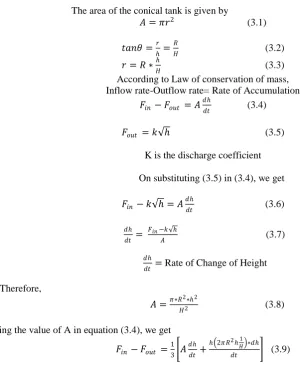
The area of the conical tank is given by
𝐴 = 𝜋𝑟2 (3.1)
𝑡𝑎𝑛𝜃 =𝑟
= 𝑅
𝐻 (3.2)
𝑟 = 𝑅 ∗
𝐻 (3.3)
According to Law of conservation of mass, Inflow rate-Outflow rate= Rate of Accumulation
𝐹𝑖𝑛− 𝐹𝑜𝑢𝑡 = 𝐴 𝑑
𝑑𝑡 (3.4)
𝐹𝑜𝑢𝑡 = 𝑘 (3.5)
K is the discharge coefficient
On substituting (3.5) in (3.4), we get
𝐹𝑖𝑛− 𝑘 = 𝐴 𝑑
𝑑𝑡 (3.6)
𝑑 𝑑𝑡 =
𝐹𝑖𝑛−𝑘
𝐴 (3.7)
𝑑
𝑑𝑡 = Rate of Change of Height
Therefore,
𝐴 =𝜋∗𝑅2∗2
𝐻2 (3.8)
Substituting the value of A in equation (3.4), we get
𝐹𝑖𝑛 − 𝐹𝑜𝑢𝑡 = 1 3 𝐴
𝑑 𝑑𝑡 +
2𝜋𝑅21
𝐻 ∗𝑑
𝑑𝑡 (3.9)
Applying the values for all parameters and taking laplace transform, the conical tank transfer function is obtained. Once the transfer function is obtained, then the controller can be designed for the process.
The transfer function obtained as first order process,
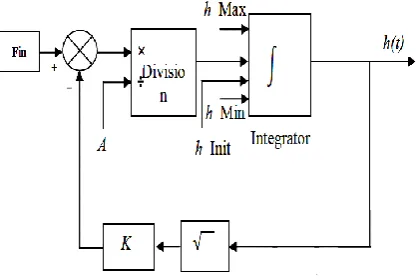
Fig. 3 Mathematical Model for SISO Tank System
Exact Mathematical model for a SISO Tank System is shown in the Fig 4.3, in which the flow rate 𝐹𝑖𝑛 is compared with the square root of the discharge coefficient. The result from the comparative is given to the divider where area A of the conical tank is divided and the final output is given to integrator and the result is feedback into the process.
IV.CONTROLLER DESIGN
4.1 Pid Controller:
In many control system a most widely used control loop feedback mechanism (controllers) is a Proportional-Integral-derivative (PID) controller. A PID controller calculates an error value based on the difference between a measured process variable and a desired set point. The controller attempts to minimize the error by adjusting the process control inputs (inflow). The PID controller is simple and robust and hence widely used in most of the process industries. Various closed loop tuning methods are:
Zeigler-Nichols Method.
Damped Oscillation Method.
Tyreus – Luyben Method.
Internal Model Control.
Model Predictive Control.
4.1. a Zeigler-Nichols Method:
In 1942, Zeigler-Nichols proposed a tuning method and it is a trial and error tuning method based on a sustained oscillations. This method is well known among various method and widely used method for tuning PID controllers. Other names of this method is on-line or continuous cycling or a ultimate gain tuning method. Among various tuning method Z-N performs well.
Z-N method has an advantage that it does not require the process model. Z-N have many disadvantages when compared to other methods.
Since, the trial and error procedure must perform, it consume time.
The open loop unstable process can‟t be controlled by this method.
As the process must provide ultimate gain, some process like first time and second time without dead time do not have ultimate gain.
4.1.b Internal Model Control:
IMC a model based control, which use a model of open loop process transfer function in such a way that the selection of the specified closed loop response yields a physically realisable controller. In a standard feedback control structure, IMC is easier to tune than other controllers. The internal model principle states that control can be achieved only if the control system encapsulates, either implicitly or explicitly some representation of the process to be controlled. Process model embedded in the controller.
performance can be obtained. Process model mismatch is common. The process model cannot simply be inverted to form the controller. It must be factored so that the resulting controller is stable and realizable. The open loop control strategy will not be able to maintain the output at set point. The closed loop oscillation technique developed by Ziegler and Nichols did not require a model of process. Direct synthesis was based the use of desired closed loop response and a process model to synthesize a control law.
4.1.c Damped Oscillation Method:
In many cases, plants are not allowed to undergo through sustained oscillations, as is the case for tuning using continuous cycling method. Damped oscillation method is preferred for these cases. Marginal stability problem can be solved by this method. The process is characterized by finding the gain at which the process has a damping ratio of ¼ and the frequency of oscillation at this point, then similar to the Ziegler-Nichols method these two parameters are used for finding the controller settings.
Define
Gd = Proportional gain at decay ratio of ¼ . Pd= Period of oscillation.
4.1.d Tyreus – Luyben Method:
Tyreus and Luyben method is used, when minor oscillation and robustness is required. Tyreus – Luyben provides more conservative controller settings. The Tyreus – Luyben is also like Zeigler – Nichols method but the final controller settings are different. Tuning parameters are determined based on ultimate gain and period.
4.1.e Model Predictive Controller:
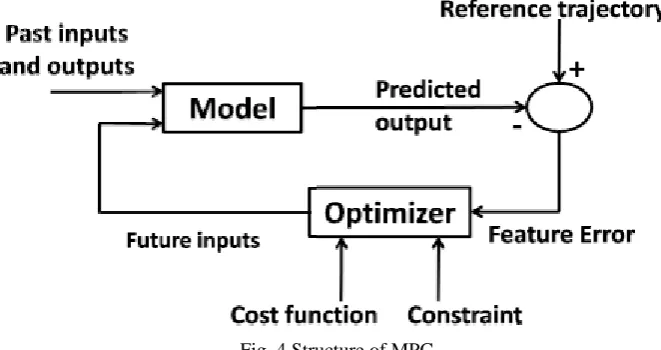
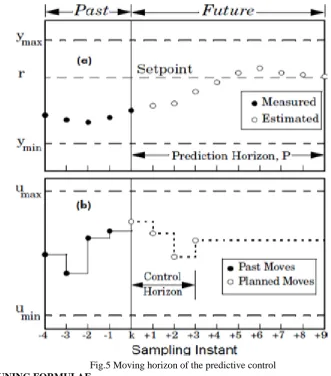
Model Predictive control is used to predict the future output of the plants, based on the current value and past value. This action is taken place in the optimiser, where the future tracking error is considered.
Fig. 4 Structure of MPC
The basic structure of the MPC is shown in which the model is used to calculate the past input and output of the plant and the future input is feedback into the model from the optimizer. The output of the model is the predicted output. The summer is used to calculate the error from the predicted output and the reference trajectory. This featured error is given to the optimizer where the cost function and the constraints are calculated.
Fig.5 Moving horizon of the predictive control
TABLE 1: TUNING FORMULAE
CONTROLLERS KP 𝝉p 𝝉d
ZEIGLER-NICHOLS 0.6KU PU/2 PU/8
DAMPED OSCILLATION
1.1Gd Pd/3.6 Pd/9
TYREUS-LUYBEN KU/3.2 2.2PU PU/6.3
IMC 2τ + d
2( λ + d)
𝜏+𝑑 2
λd 2τ + d 𝐾𝑢 = 𝑢𝑙𝑡𝑖𝑚𝑎𝑡𝑒 𝑔𝑎𝑖𝑛, 𝑃𝑢= 𝑢𝑙𝑡𝑖𝑚𝑎𝑡𝑒 𝑝𝑒𝑟𝑖𝑜𝑑 𝑜𝑓 𝑜𝑠𝑐𝑖𝑙𝑙𝑎𝑡𝑖𝑜𝑛
TABLE 2: RESULT AND COMPARSION:
Specification ZN-PID TL-PID DO-PID IMC-PID MPC
Rise Time 120 0 43 0 5
Settling Time 320 1600 420 85 10
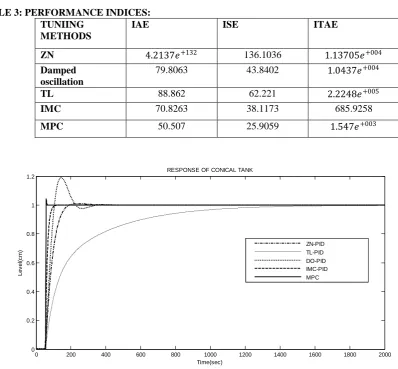
TABLE 3: PERFORMANCE INDICES: TUNIING
METHODS
IAE ISE ITAE
ZN 4.2137𝑒+132 136.1036 1.13705𝑒+004
Damped oscillation
79.8063 43.8402 1.0437𝑒+004
TL 88.862 62.221 2.2248𝑒+005
IMC 70.8263 38.1173 685.9258
MPC 50.507 25.9059 1.547𝑒+003
Fig. 6 Response of the conical tank.
V. RESULT
The conical tank system is identified as a non-linear system. The model of conical tank system is implemented. The mathematical model of conical tank level process is derived in terms of differential equation and an open loop response is obtained by performing step test in Matlab.Response for the process is compared with ZN-PID,TL-PID,DO-PID,IMC-PID and MPC Controller.Here the time domain specifications such as rise time, settling time and overshoot and the performance indices such as Integral Absolute Error (IAE), Integral Square Error(ISE), Integral Time Absolute Error (ITAE),based on the integral error for a step set point are considered for comparison as they are generally accepted as a good measure for system performance.
VI. CONCLUSION AND FUTURE ENHANCEMENTS
The non linear system used for analysis is a conical tank..For the identified model different control strategies such as ZN-PID,TL-PID, DO-PID,IMC-PID,MPC were implemented in MATLAB environment and the result is compared based on time domain specification and performance indices. It is evident from Table that MPC is outperforming well when compared with ZN-PID,TL-PID,DO-PID, IMC-PID in terms of rise time and settling time, where as MPC resulted with slight overshoot compared with DO-PID, ZN-PID
0 200 400 600 800 1000 1200 1400 1600 1800 2000
0 0.2 0.4 0.6 0.8 1 1.2
Time(sec)
L
e
v
e
l(
c
m
)
RESPONSE OF CONICAL TANK
Time domain specification shows that the MPC is performed better than the ZN-PID,TL-PID,DO-PID, IMC-PIDspecifically in settling time and rise time.MPC is also proved as the efficient controller among other conventional controllers.
Performance indices such as Integral Square Error (ISE), Integral Absolute Error (IAE) and Integral Time Absolute Error (ITAE) are also studied for different for controller such as MPC, ZN-PID,TL-PID,DO-PID, IMC-PID From Table 7.1 it is evident that MPC outperforming well compared with ZN-PID,TL-PID,DO-PID, IMC-PID in terms of ISE, IAE, and ITAE.
It is concluded that for a nonlinear conical tank system MPC controller gives better performance when compared with ZN-PID,TL-PID,DO-PID, IMC-PID. In future real time implementation can be carried out and different control schemes like ANFIS, Fuzzy controller, Adaptive Controller can be studied.
REFERENCES
[1] Sukanya R. Warier, SivanandamVenkatesh, “Design of Controllers based on MPC for a Conical Tank System”, IEEE-International Conference on Advances in engineering Science and Management (ICAESM -2012) ,pp. 309-313, March 2012.
[2] R.Valarmathi, P.R.Theerthagiri, S.Rakeshkumar, “Design and Analysis of Genetic Algorithm Based Controllers for Non Linear Liquid Tank System”, Department ofElectronics and Instrumentation Engineering SASTRA University,Tirumalaisamudram, Thanjavur, India, pp. 616-620,March 2012.
[3] S.Nithya, N.Sivakumaran , T.K.Radhakrishnan and N.Anantharaman, “Soft Computing Based Controllers Implementation for Non-linear Process in Real Time”, Proceedings of the World Congress on Engineering and Computer Science 2010 Vol II WCECS 2010,October 20-22, 2010, San Francisco, USA.
[5] H.Kala, P.Aravind, M.Valluvan, “Comparative Analysis of Different Controller for a Nonlinear Level Control Process”, IEEE International Conference on information and Communication Technologies, pp 819-822,April 2013.
[6] H.Kala, D.Deepakraj, P.Gopalakrishnan, P.Vengadesan, M. KarumbalIyyar “Performance Evaluation of Fuzzy Logic and PID Controller for Liquid Level Process”, International Journal of innovative research in electrical, electronics, instrumentation and control engineering, Vol.3,
Issue 3, pp. 1311-1314,March 2014.
[7] S.abirami, H.kala, P.b.nevetha, B.pradeepa, R.kiruthiga and P.sujithra. Article: Performance Comparison of Different Controllers for Flow Process. International Journal of Computer Applications 90(19):17-21, March 2014.
[8] S.Abirami, Zahirhussain.A.S, SaravanaMuthu.D, Aravindkumar. C. B, “Performance Comparison Of Different Controllers For A Level Process”, Journal of Engineering Research and Applications, Vol. 4, Issue 3( Version 1), March 2014, pp.341-344.
[9] George Stephanopolus, "Chemical Process Control", Prentice Hall India.
[10] I.B. Lee & S.W. Sung, "Limitations and countermeasures of PID controllers", Industrial and Engineering Chemistry Research, 35, 1996, pg.2596-2610.
[11] Skogestad, S,“Simple analytical rules for modelreduction and PID controllers tuning”Journal of Process Control. 13, pp. 291 -309,2003 [12] Dr.S.M.GiriRajkumar,Dr.K.Ramkumar,Sanjay Sarma O.V, “Real Time Application of Ants Colony Optimization”, International Journal
of Computer Applications (0975 – 8887), Volume 3 – No.8, June 2010.
[13] E. F. Camacho, Carlos Bordons, “Model Predictive Control,” 2nd edition, Springer, 2004.
[14] V. R. Ravi and T. Thyagarajan, “Application of Adaptive Control Technique to Interacting Non Linear Systems”, IEEE Conference Electronics Computer Technology (ICECT), no.2, pp 386 - 392, 2011
[15] Lennartljung, university of linkoping, Sweden, “System Identification Theory for the user”, P T R Prentice Hall ISBN 0-13-881640-9.
[16] B. Wayne Bequette, “Process Control Modeling, Design and Simulation”, Prentice Hall (2003), ISBN: 0-13-353640-8.
[17] Finn Haugen, 2010, “Comparing PI tuning methods in a Real benchmark temperature control System, Modelling, Identification and control”, 31: 79-91.
[18] Finn Haugen, “Comparing PI tuning methods in a Real benchmark temperature control System”, Modelling, Identification and control, Vol.31, No. 3, 2010, pp. 7991, ISSN1890- 1328.
[19] Marlin, T. E., "Process Control: Designing Processes and ControlSystems for Dynamic Performance". McGraw Hill, New York, 2000. [20] D. Marshiana and Dr.P.Thirusakthimurugan, “Design of Ziegler Nichols Tuning controller for a Non-linear System”, International
Conference on Computing and Control Engineering (ICCCE 2012), 12 & 13 April, 2012.
[21] Skogestad, S, Simple analytical rules for model reduction and PID controllers tuning, Journal of Process Control. 13, 2003, pp. 291 -309.