R E S E A R C H
Open Access
Enabling direct connectivity between
heterogeneous objects in the internet of things
through a network-service-oriented architecture
Eli De Poorter
*, Ingrid Moerman and Piet Demeester
Abstract
In a future internet of things, an increasing number of everyday objects are connected with each other. These objects can be very diverse in terms of the used network protocols and communication technologies, which leads to a wild growth of co-located networking technologies. Unfortunately, current consumer items are not designed to communicate with co-located devices that use different communication technologies. In addition, commercially available internet of things devices, such as sensor nodes, often use vendor-specific propriety network solutions. As a result, communication between these devices is only possible through the use of gateway nodes, resulting in inefficient use of the wireless medium. To remedy this situation, this paper discusses which features are required to integrate such a diverse number of heterogeneous objects into a single internet of things. In addition, the paper introduces the IDRA architecture, which is designed specifically to enable connectivity between heterogeneous resource-constrained objects. The IDRA architecture has the following advantages. (1) IDRA can connect co-located objects directly, without the need for complex translation gateways. (2) The architecture is clean slate, but supports backward compatibility with existing deployments. (3) Due to its low memory footprint, the architecture can be used in resource-constrained objects. Finally, the paper evaluates the performance of the IDRA architecture and discusses the feasibility of introducing IDRA in existing networks.
Keywords:Internet of things, Network architecture, Clean slate, Heterogeneity
I Introduction
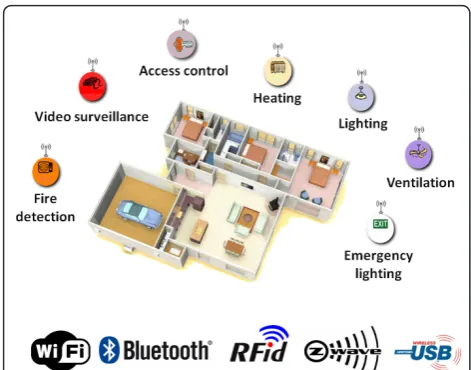
New communication technologies are introduced and deployed on a regular basis. Even, common everyday objects nowadays come equipped with (wireless) com-munication possibilities. As a result, many sources have described an ‘internet of things’ view of the future, in which every object is connected with every other object [1] (Figure 1). By connecting these different objects, intelligent next-generation applications such as wireless building automation applications [2] or e-health applica-tions [3,4] become possible.
However, as the number of communicating objects increases, so does the number of co-located communi-cation technologies. When multiple networks operate in the same geographical environment, co-located networks overhear transmissions from multiple networks. Most
often, overhearing these transmissions results in harmful interference and performance degradation, since the overheard transmissions cannot be interpreted by devices that are not part of the originating network. This is especially a problem in ‘last mile’ home and office networks. A typical example is the interference in the free license ISM band, which is used by a variety of communication technologies such as IEEE 802.1 (WiFi), car alarms, baby monitors, IEEE 802.15.1 (bluetooth), cordless DECT phones and IEEE 802.15.4 (zigbee) per-sonal body area networks.
Even when co-located devices use the same radio technology, direct communication between devices is not always supported. For example, existing sensor and actuator networks often use propriety network technolo-gies that are incompatible with technolotechnolo-gies from other vendors, even though the devices use the same radio chip. To enable communication between networks from different vendors, or between devices that use different * Correspondence: [email protected]
Department of Information Technology (INTEC), Ghent University - IBBT, Gaston Crommenlaan 8, Bus 201, 9050 Ghent, Belgium
network protocols, each network is connected to a dif-ferent vendor-specific translation gateway. This transla-tion gateway terminates the connectransla-tion from one network and sets up a new connection to a second net-work. However, translation gateways break the end-to-end communication paradigm and are inherently com-plex to design, manage and deploy [5,6]. In addition, forcing all communication through the gateway results in additional packet overhead, which in turn leads to increased interference, lower throughput and a lower network lifetime for battery-powered devices. To remedy this situation, this paper describes how the IDRA archi-tecture, which was previously implemented in [7], can be used to enable efficient direct connectivity between heterogeneous wired and wireless devices using different communication technologies.
The remainder of the paper is structured as follows. Section I gave an introduction on the vision of the inter-net of things and argued that current devices are typi-cally not able to efficiently connect with co-located devices that use different communication technologies. Section II discusses this topic further by giving a thor-ough overview of the requirements that should be solved to realize a more efficient internet of things. Related work is given in Section III where existing archi-tectures are listed and the advantages and disadvantages of each of these approaches are discussed. Section IV gives a high-level overview of the proposed IDRA archi-tecture and discusses how this archiarchi-tecture fits in the vision of an internet of things. Afterward, Section V describes how IDRA can be used to support two typical internet of things use cases: (1) supporting backward
compatibility with legacy networks and (2) bridging net-works using different communication technologies. In addition, the performance of the architecture is evalu-ated and the economic viability of introducing IDRA in existing networks is discussed. Finally, Section VI con-cludes the paper.
II Requirements of a future internet of things
Several sources already listed a large amount of chal-lenges that must be overcome to support an all-encom-passing connectivity between objects [8-10]. Amongst the listed internet of things requirements, the following four requirements can typically be found:providing net-work connectivity,supplying content,easily managing the networkandbeing extensible.
A Network connectivity
The first and foremost requirement of the internet of things is to provide connectivity between any type of object: from machine to machine, from person to machine or from machine to person. The involved objects differ in terms of bothcommunication technolo-giesand capabilities.
•Co-located devices that wish to exchange informa-tion often usedifferent communication technologies. Any architecture suitable for an internet of things must be able to efficiently support communication between devices, even if they use different protocol stacks, different radio frequencies, different commu-nication technologies and different packet types. In addition, many objects will be equipped withmultiple communication interfacessuch as a IEEE 802.15.1 bluetooth interface and a IEEE 802.11 WiFi interface.
•In addition, the devices will havedifferent hard-ware and softhard-ware capabilities. Internet of things devices range from high-end PC devices to low-end battery-powered embedded devices. Even networks that use only a single communication technology can consist of heterogeneous nodes. For example, networks used for wireless building automation or industry monitoring used both resource-constrained embedded devices and high-end controller PCs. Using the traditional OSI reference stack, this het-erogeneity is difficult to support: each communicat-ing device requires exactly the same protocol stack. However, the communication stack of the powerful devices should not be limited by the capabilities of the most restrictive objects.
B Content and context
The internet of things will also become increasingly content oriented [11]. Users expect to be able to retrieve
any content, from any device. This includes content that is part of the public domain (dictionaries, transportation information, etc), but also private content such as e-mails, personal media and home information such as the current home temperature. Some of the challenges that need to be overcome are the following.
•Location awareness is increasingly important. This includes awareness of the personal surroundings, the tracking and positioning of objects, as well as sup-port for user and object mobility. For example, in applications that require vehicle-to-vehicle commu-nication, all networked objects are mobile.
• The context associated with information is also increasingly important. Future devices require mechanisms to easily associate metadata with con-tent, such as the originating location, information about the producer of the content and the content description. This metadata should also be included at the network level. For example, by associating metadata with packets, the location of the packet destination can be added to packets to facilitate geo-graphic routing.
• Media, security and emergency content often has strict real-time requirements. As such, mechanisms are required that provide quality-of-service solutions that span several networks.
• Finally, mechanisms that control access to infor-mation, and that provide privacy, security and anon-ymity should be supported over several network layers and physical network boundaries.
C Network management
To be commercially viable, a future internet of things should be easy to set up and use even for non-network experts [9].
• Self-configuration [12,13] solutions are required that automatically set up and configure devices. This includes solutions for automatic address allocation and automatic detection of configuration inconsistencies.
• The internet of thing can be fully autonomous: in the absence of human intervention the network should be able to take its own decisions by detecting potential (network) problems and proposing solu-tions based on artificial intelligence algorithms.
• Finally, to ease network management, underlying network solutions should become more ‘invisible’. To be able to reuse network solutions in different contexts, underlying communication interfaces should be presented in an abstract and ubiquitous way. However, this abstraction should not hinder the
collection of detailed metadata (such as the radio frequency) that is associated with the used technology.
D Network extensibility
Finally, a sustainable internet of things architecture should not only be robust, but needs to cope with con-tinuously changing application requirements and chan-ging hardware capabilities.
•It should be easy to install new software so that new applications can be deployed on previously installed devices.
•Networks should become more‘service-like’, where network services can be added and reconfigured according to the applications needs.
• In addition, to support ongoing innovation, it should be possible to change any protocol character-istics such as the addressing schemes (for example from IPv4 to IPv6), the used packet types, the com-munication technology or the security mechanisms without making any changes to the network proto-cols themselves. Ideally, these changes should be possible at runtime, without breaking the active communication between devices.
III Related architectures
There is a need for new protocol architectures that inherently support these requirements, such as reconfi-gurability and support for heterogeneity, over all net-work layers [14]. This related net-work section gives a non-exhaustive overview of architectures that are designed to support direct network connectivity between heteroge-neous networks. Two main approaches are discussed: (1) incremental ‘evolutionary’architectures and (2) clean slate‘revolutionary’architectures.
A Evolutionary internet of things approaches
Advocates of an evolutionary approach to a future inter-net of things create new architectures by reusing as many components as possible from existing networking solutions. In their vision, the current internet should
An alternative evolutionary approach is the use of vir-tualized network components. Network virtualization [15] is used to present underlying network layers in a uniform way toward a high-level application. Different devices are connected by forming virtual networks on top of existing networks: logical links are created between distributed systems using native internet rout-ing and standard IP addresses. Well-known examples are Virtual Private Networks (VPN) [16] or peer-to-peer applications [17]. The FP7 4WARD project [18] consid-ers virtual networks to be a fundamental part of the design of future internet devices. The project includes virtualized network solutions for in-network manage-ment, generic connectivity and content-centric informa-tion objects [19]. Similarly, the MAGNET project [20,21] offers network virtualization at both layer 2 and layer 3, whereas the ITEA2 usenet project [22] focuses on network virtualization for machine-to-machine com-munication. One well-developed solution is VPAN [23], in which self-organizing and self-maintaining overlay networks are created that provide a shielded and trusted environment for networked applications that share a common context.
In the context of an internet of things, network virtua-lization can be viewed in two ways [24]. First, these techniques can be used as a tool for evaluating new dis-ruptive architectures on a large scale using existing net-works. Secondly, virtualization can be regarded as a fundamental part of next-generation architectures, whereby multiple ‘overlay’networks coexist by creating different logical networks for communication purposes [25]. However, for directly connecting heterogeneous networks (such as described in our vision of the internet of things), the use of virtualization techniques has the following disadvantages. (1) Network virtualization is not yet proven to be highly scalable, since setting up an overlay network is often difficult and time-consuming. (2) Virtualization techniques are often too complex and inefficient to be implemented on resource-constrained embedded devices. And (3) virtualization techniques are often too high in the protocol stack to efficiently bridge networks that use different communication technologies.
B Revolutionary internet of things approaches
Opponents of the evolutionary approach emphasize the need for a redesigned, clean slate architecture that inherently copes with next-generation network chal-lenges [14,26], sometimes even abandoning IP-based addressing in favor of different addressing schemes. Clean slate initiatives are not always meant to be used directly in new devices, but can be used to sketch a revolutionary new perspective, which can then be brought into existing networks. Several approaches have been proposed.
(i)Database centric architectureshide the heterogene-ity of underlying networks by only allowing access to network information using database operations. For example, the SENSEI project [27] solves the inaccessibil-ity of low-resource end devices by collecting all data from the end devices and making it available in a cen-trally accessible database. Unfortunately, this approach often results in significant network overhead.
(ii) Content-centric architecturesfocus on describing the information that is exchanged between networks. For example, the SemsorGrid4Env project [28] focuses on the development of a semantic middleware layer. At the network layer, network protocols are implemented semantically using a ‘descriptive language’ [29] that focuses on functionality rather than implementation. Unfortunately, support for directly connecting different networks at the lower network layers is still lacking.
(iii) Cloud computing approaches try to offload resource intensive tasks to more capable nodes. Typi-cally, cloud computing can offer infrastructure, plat-forms or software as a service to less-capable devices [30,31]. Since cloud computing is regarded as a high-layer service, this approach does not solve connectivity challenges.
(iv)Service-oriented architectures (SOAs) use loosely coupled software entities that implement a single soft-ware function. These softsoft-ware services are dynamically combined to form ad hoc applications. In regards to the internet of things, SOAs have two main disadvantages [32]: (1) SOAs focus mainly on higher layers rather than solving network issues and (2) the technologies used to realize service-oriented architectures, such as ML, SOAP, Web Services or BPEL, are often not suited for use in resource-constrained devices.
C The need for new architectures
As shown in the previous sections, several research pro-jects are currently involved with the design of new net-work architectures. However, an economically viable solution might still be a long way off:
• Though several research projects are currently involved with future inter-net research, most of these efforts focus on the design of a (high-speed) future internet backbones. These solutions are not suitable for use in resource-constrained environments.
• As cited in [36] ‘too many future internet propo-sals are just extensions of existing protocols or architectures’. As such, these proposals lack the innovation to cope with specific internet of things challenges.
• Finally, too many proposals remain ‘paperware’: there is a definite lack of implemented prototypes [14,37].
As such, more practical implementations are needed before a decision can be made regarding the feasibility of an all-encompassing internet of things solution. Espe-cially for resource-constrained devices, there is still room for several improvements. More specifically there exists not yet a simple architecture that
• enables optimized communication at a network and link level between co-located heterogeneous networks without the use of complex translation gateways;
• has been implemented and evaluated as a proto-type in a large-scale experimental setting;
• is compact enough to fit even on low-resource embedded devices;
•is fully clean slate, but is also backward compatible with legacy networks;
In the following section, we will discuss how our IDRA architecture fills this gap.
IV The IDRA architecture
IDRA [7] was originally developed to support next-gen-eration applications on wireless sensor networks. Wire-less sensor networks (WSNs) consist of resource-constrained embedded devices which are wirelessly con-nected to each other in an ad hoc fashion. Next-genera-tion applicaNext-genera-tions for WSN include topics such as wireless building automation, distributed wireless health monitor-ing, industrial process monitoring and disaster interven-tion. Each year, the WSN research community develops new and optimized hardware devices, communication technologies, network protocols and applications. To
cope with such a varying environment, IDRA has built-in solutions to support heterogeneous devices (in terms of hardware and communication technologies) and to sup-port evolving services and applications.
There are many similarities between the requirements of WSNs and those of a more general internet of things. This section gives a general overview of the IDRA archi-tecture and discusses which design choices can also be useful in the context of the internet of things.
A Network protocols as services
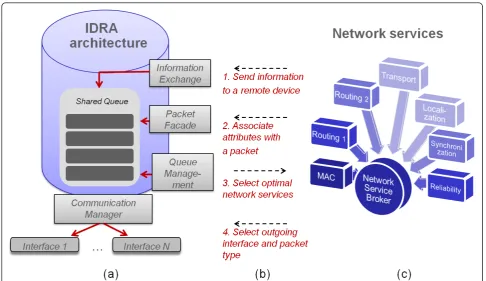
The OSI reference architecture [38] uses a layered pro-tocol stack whereby all network functionality is assigned to a specific protocol layer. For example, the routing layer includes functionality for providing reliability, for duplicate detection, for retransmissions, etc. In contrast, in IDRA it is possible to implement these different net-work functions (such as addressing, naming, CRC calcu-lation, routing, etc.) each in a simple, standardized, technology-independent component called a ‘network service’. Network services can implement either a full network protocol (such as routing) or a simple function (such as duplicate detection). Each component imple-ments the same interface and functions independent, without direct interaction with other components. New services can be added whenever there is a need for them. For example, a localization service can be added when an application is run that requires location infor-mation. This way, more advanced network services can be composed by combining elementary network services according to the needs of the network (Figure 2c). A default ‘call sequence’ is included that indicates the order in which the network services should be executed. By adding new network services or by changing the call sequence, the network behavior can be changed. Some examples of network services are:
•a localization service inspects the RSSI of received packets so that it can provide the network with accurate location information;
•a MAC service is responsible for controlling the timing and sending of packets;
•a topology service decides from which neighboring devices packets can be received;
•a synchronization service delivers a network-wide reference clock;
•a reliability service is responsible for the retrans-mission of packets;
•a management service collects and makes available network statistics such as the background noise level and the number of failed transmissions.
network layers can register themselves as network ser-vices. A transition toward a network-service-oriented architecture can occur gradually by standardizing a further decomposition of the protocol layer into multi-ple well-defined network services.
In the context of the internet of things, a network-ser-vice-oriented network architecture has the following advantages.
Pervasiveness
Separating network functionality into different services results in a lower memory footprint, since (1) network services are only added on a per-need base and (2) func-tionality is not duplicated in several protocol layers. As such, this approach is well suited for networks that con-tain resource-constrained devices.
Extensibility and maintenance
A second advantage of a service-oriented network archi-tecture is the ease with which the network copes with future developments. New applications are supported at a network level by plugging in the appropriate network services (for example: an advanced encryption service can be added to process all packets from an online banking application).
Transparency
Rather than directly interacting with a multitude of dif-ferent communication technologies, such as IEEE
802.15.4 (Zigbee), IEEE 802.15.1 (Bluetooth), IEEE 802.11 (Wi-Fi), LAN or UMTS, the communication manager from Figure 2a translates the communication capabilities of the underlying communication technology in terms of the services they can provide, such as aver-age reliability, energy cost, etc.
B Information driven network services
To limit the dependence of network services on specific technologies, network services are technology indepen-dent. Rather than creating technology-dependent pack-ets to exchange information, network services hand over to the IDRA system any information they wish to send (Figure 2b, interaction 1). Example information exchanges are a route request, a web page request or a packet acknowledgment. IDRA creates the actual packet, encapsulates the information in the payload and stores the resulting packet in a system-wide queue. IDRA can be configured to create or interpret any packet type (see Section VI-C). Thus, instead of packet-based sending, IDRA offersinformation-based communication.
Similarly, all interactions with the communication inter-faces are descriptive. For example, a MAC protocol can describe when and how each packet is allowed to be trans-mitted (e.g., the maximum tolerated background noise, the scheduled sending time, the radio frequency, etc) and how the communication interfaces should be configured
Figure 2Conceptual presentation of the IDRA architecture.aThe IDRA system is responsible for packet creation, packet storing and packet interactions.bInteractions between the network services and IDRA are mainly descriptive in nature.cNetwork services can be added
(listening frequency, power state, etc.). A conflict resolution scheme is used to detect conflicting settings and inform the MAC service of undesired behavior. As a result, multi-ple MAC services can reside on the same node, each with one or more associated communication interfaces.
Delegating all technology-related functions, such as packet creation, packet manipulation, packet sending and buffer provisioning, to the IDRA architecture has the following advantages.
Hardware heterogeneity
Tasks which are typically duplicated in several network layers (ie: packet creation, packet manipulation, packet sending and buffer provisioning) are delegated to the sys-tem, thus avoiding code redundancy. As a result, the overall code size is reduced, making it possible to support a large number of services even on resource-constrained devices. Ease of use
Since network services need to consider only ‘ informa-tion exchanges’, the development of network services is simplified.
Transparency
The same information exchange mechanism is used for all network services, independent of which packet type will be created and which communication interface will be used. The complexity of low-level operations (buffer management, packet construction, etc) are thus hidden from the network services. This way, network services are not technology dependent, which promotes reuse of network services in different contexts.
C Decoupling of protocol logic and packet representation
Since the network services do not create the packets, they have no knowledge about the header structure of
received packets. To retrieve information about created or received packets, network services interact with pack-ets through a‘packet facade’(Figure 2b, interaction 2). Through this packet facade, standardizedpacket attri-butes(metadata) can be added, updated or requested. This metadata can represent header fields such as‘ desti-nation’,‘quality-of-service’or‘time-to-live’, but can also be used to describe extra context information such as the packet origin or destination location, the packet owner or additional descriptive information about the packet.
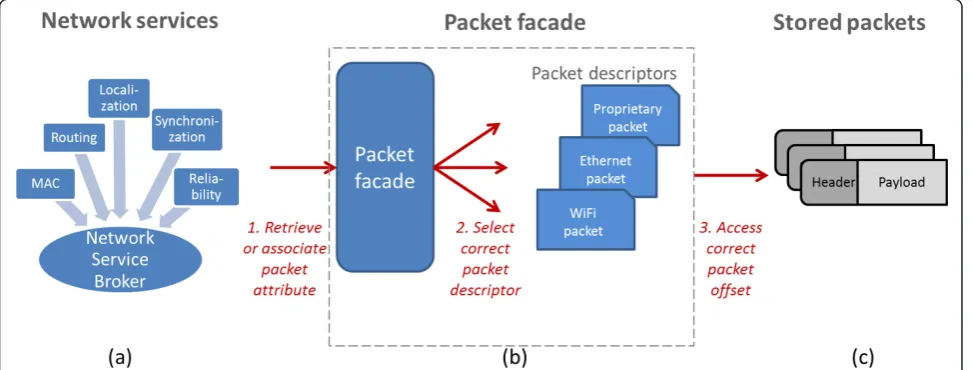
To interpret the structure of created or received pack-ets, the packet facade uses one or more‘packet descrip-tors’. These packet descriptors describe at which header offset each packet attributes should be stored (Figure 3). This way, any packet type can be generated or inter-preted, as long as the correct packet descriptor is avail-able. Packet attributes that do not have a fixed location in the packet header are stored sequentially in the pay-load in the form of type-length-value (TLV) elements. Since there is no direct interaction between network services and packet descriptors, the packet type can be changed without any changes to the used network ser-vices. Decoupling the protocol logic from the packet structure has several advantages.
Packet heterogeneity
Since any packet type can be interpreted as long as the correct packet descriptor is available, it is possible for multiple packet types to reside on a single node, trans-parent for the network services.
Legacy support
By providing the packet descriptors of legacy devices, IDRA services can interpret packets from legacy net-works and interact with legacy packet types.
Context awareness
Any type of context information can be associated with a packet in the form of a packet attribute. This pro-motes the development of new network services which rely on advanced packet information such as ownership or visibility rights. Metadata can also be used to facili-tate mobility solutions [39].
Hardware heterogeneity
Using a packet facade, network services do not need to strip the protocol headers from received packets to interact with packets. Thus, when non-essential network services are omitted from devices with low resources, the remaining network services can still interpret the received packets. In addition, packet attributes remain associated with a packet even if network protocols are omitted at intermediate nodes. Thus, when lightweight nodes are provided with simpler versions of the network services, these simpler services can inspect the packet attributes that were added by more advanced network services.
Future proof
Network services can be implemented independently from the representation of the packets. As a result, reuse of network services is promoted. To change the packet structure or support new packet structures, only the packet descriptor needs to be updated. All other network services remain unchanged.
D Queue management
Depending on the required network performance, differ-ent queuing systems can be used in IDRA. To reduce the memory footprint of the queues, the current imple-mentation of IDRA uses a single, system-wide queue for storing packets. Arriving packets are stored once in the shared queue and remain there until processing is fin-ished. This approach limits the number of copy actions of the packets. Network protocols can interact with any of the packets from the shared queue using the packet facade. Since network services are not responsible for queue management, the complexity and memory foot-print of the network services are reduced. The advan-tages of using a single, system-wide queue are the following.
Simplicity
In layered architectures, each network layer requires overprovisioning of its provided buffers to ensure that all packets can be stored. Using a shared queue approach, this overprovisioning is required only once. As a result, network services are simpler and have a small memory footprint.
Network management
Using a single queue ensures that the system can moni-tor all available packets. This eases the gathering of real-time network statistics.
QoS management
The shared queue has an associated QoS module. This QoS module has a global view on the number of pack-ets, their current processing state and their expected delay. The QoS module can drop packets and selects which packets are processed or transmitted first. Since the QoS module only interacts with the queue, it can provide basic, protocol-independent QoS which can transparently be combined with any IDRA network service.
E Network service broker
Network services can be dynamically added, removed or updated according to the needs of the network. Rather than having a strict execution order (such as in layered networks), network services are activated only when they are needed. Currently, IDRA implements a simple service broker. Each network service registers itself using ‘filters’which describe the function of the network service (e.g., routing, localization, etc). In addition, the filters specify for which types of packets the network services can be used (Figure 2b, interaction 3). For example, a QoS aware routing service can register itself for routing high-priority packets (’QoS attribute higher than 5’), a georouting service can be used for routing when location information is available (’location attri-bute is available’) and a multicast routing service regis-ters itself for routing packets to multicast addresses.
In high-end devices, intelligent service discovery mechanisms can be used to detect the capabilities of the network services, and to automatically select and config-ure the appropriate network services depending on the application requirements. For example, to support a‘fire alarm’ or‘emergency reporting’ service, the network broker can disable energy-efficient routing in favor of an optimized low-delay routing service. Or a key-distribu-tion service can be activated before a device is allowed to join an existing network. As such, a dynamic network service broker promotes a more flexible internet of things.
Self-configuration
Devices can change their own behavior by plugging in new network services when required. Intelligent configuring networks can use the service broker for self-adaptation and for automatic network upgrades.
Hardware heterogeneity
Devices with less capabilities can be configured to use simplified execution sequences which contain less net-work services. Alternatively, they can negotiate with neighboring nodes to use simplified versions of the required network services.
Legacy support
network services in a typical layered order (e.g., MAC, routing, transport, application). This way, network ser-vice-oriented devices can coexist with traditional layered devices.
F System-wide aggregation
Many information exchanges (such as status updates, low-priority monitoring information or delay-tolerant measurements) between different devices do not need to be transmitted immediately. In the IDRA system, net-work services can include information about the maxi-mum tolerated delay when handing over information exchanges to the IDRA system. Time sensitive para-meters are immediately encapsulated in a packet, but all other parameters are temporarily stored in a central repository. Whenever a packet is relayed through the node, all information parameters with the same ‘next hop’ or ‘destination’attribute are added to the packet. Delay-tolerant parameters can remain in the waiting space for up to a per-parameter predefined period of time. If no data have been relayed within the allowed waiting time, the system generates a new packet which combines all parameters that have the same destination. As a result, information exchanges from all network ser-vices using IDRA can be combined. To avoid high end-to-end delays, the current implementation only delays the parameters in the waiting space of the initial node: packets are not further delayed in intermediate nodes. Since the aggregation is part of the IDRA architecture, the aggregation approach can be changed or optimized depending on the network requirements, without any changes to the network services. The advantages of aggregation at an architectural level are the following. Reduced interference
By limiting the number of transmissions, the overall wireless interference decreases, resulting in more opti-mal use of wireless bandwidth.
Increased throughput
It has been shown that the use of small packets has a negative influence on the maximum throughput of transmission systems, in particular for wireless networks. By combining multiple information exchanges in a lar-ger packet when possible, the overall throughput increases.
Increased energy efficiency
Finally, for devices powered by small batteries or by energy scavenging, the use of a radio for transmitting packets results in a serious decrease in network lifetime. By limiting the number of transmissions, the time before battery replacement increases.
V Advanced IDRA use cases
The previous section gave a high-level overview of dif-ferent IDRA concepts and discussed their relevance in
the context of the internet of things. This next section describes in more detail on how IDRA can support two important internet of things use cases: (1) supporting backward compatibility with existing networks and (2) transparently bridging a diverse number of (co-located) wired and wireless communication technologies.
Backward compatibility
Before an all-encompassing internet of things exists, there will be a need for a transitional period, whereby internet of things devices transparently coexist with existing (legacy) networks. As an example, consider a scenario in which an existing corporate Wi-Fi mesh net-work is extended with new internet of things Wi-Fi devices that use a next-generation protocol stack. Most clean slate solutions solve this by setting up a new work that is fully separated from the existing legacy net-work (Figure 4). Communication between the legacy nodes and the state-of-the-art devices typically requires the development of a complex gateway device, in which all network protocols are translated. In contrast, when IDRA is used on the new devices, nodes can communi-cate directly with any existing Wi-Fi node resulting in an optimized network performance.
Heterogeneous networks
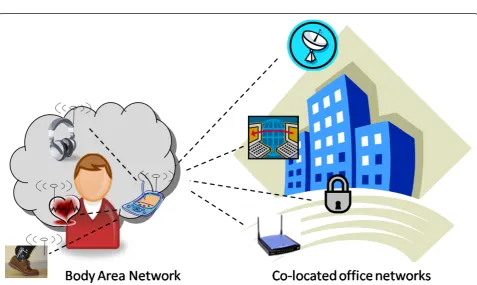
In the future, the internet of things will be accessible using a large number of communication technologies. As an example, consider an industry building where the following communication technologies are used: a wireless entrance and security system is installed, wire-less internet access is provided through Wi-Fi access points, the wireless company phone network uses DECT, a company LAN network is used for high-speed connections and finally an expensive UMTS connection is used to provide connectivity to remote parts of the industry terrain. When a resource-con-strained Body Area Network (BAN) is introduced to monitor the health of the employees, the BAN nodes should be able to connect directly to all existing co-located networks, without the use of a remote gateway (Figure 5). When using IDRA, it is not necessary to install a full protocol stack for each of these diverse communication technologies. As such, IDRA can implement ‘always best connected’ (ABC) solutions even on resource-constrained internet of things devices.
Figure 4The coverage of an existing legacy network is expanded by installing an additional next-generation backbone. (i) Using existing technology, all communication must pass through a translation gateway, resulting in suboptimal use of the network. (ii) A next-generation IDRA network can converge with existing networks and use direct communication paths, thus prolonging the operational lifetime of legacy networks.
A Connecting devices that use different packet types
In a heterogeneous environment, multiple packet types can transparently reside on the same node at the same time. The IDRA packet facade is able to interpret any incoming packet type, as long as the correct packet part descriptors are available. To this end, IDRA includes a packet identification service that indicates which packet descriptors should be used to interpret incoming pack-ets. To identifyincoming packets, one of the following identification services can be used.
• Networks that utilize multiple communication technologies can associate a packet type with each interface (e.g., an 802.11 packet type for the Wi-Fi interface, an 6LoWPAN packet type for the IEEE 802.15.4 interface, etc).
•Alternatively, in case multiple packet types can arrive on the same interface, a publicly available, standardized packet type can be added as a unique packet identification field to each outgoing packet.
•If the radio offers hardware address recognition features, the address of the sending node can be identified. In this case, the neighbor table is used to describe the expected packet type of each neighbor-ing node. This approach is not possible for networks that use non radio-compliant MAC headers or net-works that include address-free communication interfaces (such as USB interfaces).
•Finally, a last option is to compare incoming pack-ets with the descriptors of existing packet descrip-tors using bitmap operations.
This wide range of identification methods ensures that network designers can always choose the most optimal method for identifying incoming packets. The IDRA sys-tem automatically drops all packets that are not recog-nized by any of these packet identification services.
To select the correctoutgoingpacket type, a configur-able shared neighbor tconfigur-able is used. For each of its neigh-bors, an entry is available in the shared neighbor table that indicates the preferred packet type, routing protocol and MAC protocol. IDRA will automatically select the correct MAC protocol and sent the packet over the cor-rect radio interface. This shared neighbor table can be configured at run-time or at compile-time.
In heterogeneous networks, the outgoing packet type might be different from the incoming packet type. Packet conversionoccurs when an outgoing packet must be transmitted to a neighbor that is associated with a different packet type. When packet conversion is required, the packet facade is used to create a new packet of the correct type. Next, the packet facade extracts all packet attributes from the original packet (thus dismantling the original packet). Finally, the packet
facade is used to add all extracted packet attributes to the newly created packet. The conversion process is fully transparent for the network protocols: the network protocols cannot distinguish the new packet from the original packet.
B Connecting devices with different MAC protocols
IDRA can also support communication with (legacy) devices that use different MAC protocols. To this end, both the legacy and the new MAC service can be regis-tered to manage the same network interface. Using the shared neighbor table, the IDRA service broker will automatically use the correct MAC service when send-ing packets to the legacy nodes. Also, ussend-ing packet fil-ters incoming packets can be directed toward the correct MAC protocol based on their packet type or other packet attributes. Finally, IDRA includes several simple algorithms for resolving MAC conflicts that occur when multiple MAC protocols want to manage the same radio interface. For example, the radio will only be disabled when all MAC protocols have requested a low power radio state.
C Connecting devices which use different routing protocols
To cope with different routing protocols, the legacy routing protocol can be installed on the IDRA device as an additional routing service. The dynamic network ser-vice broker can be configured to use this routing proto-col for any packet that goes to (or comes from) a legacy device. In addition, by providing the correct packet descriptor, IDRA nodes can interpret legacy headers to retrieve the source and destination of each (legacy) packet. As such, IDRA devices can route legacy packets to their destination using a new state-of-the-art routing protocol, without changing the packet structure. This way, next-generation IDRA devices can be used to transparently route packets from legacy nodes.
D IDRA performance
According to [14,40], the development of actual proto-types is crucial to prove the merit of future protocol architectures. The concepts above have all been imple-mented in a proof-of-concept architecture that is avail-able at http://idraproject.net. The following performance metrics are important in the context of the internet of things.
Memory overhead
Processing overhead
The processing overhead of packet identification is neg-ligible when using fixed packet identifiers that are added to each packet. Packet conversion is more complex, but should only be supported in devices that border two dif-ferent networks. On a resource-constrained TMoteSky device [41] using a 8 MHz processor, the current packet conversion implementation requires a processing time of less than 1 ms.
Network services
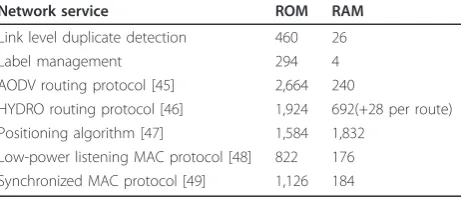
By delegating common tasks, such as buffer manage-ment, packet creation, QoS management and aggrega-tion, IDRA network services require up to a factor 2-10 less memory than traditional network protocols. Table 1 gives an overview of the memory requirement of several network services that are currently available [42]. Due to the extremely low memory requirements of IDRA net-work services, it is feasible to combine a multitude of network services, even on resource-constrained nodes. Feasibility
Finally, the architecture has been evaluated in the DEUS project [43] using a large-scale testbed of 200 TMoteSky nodes and two real-life network deployments (the arts center ‘Vooruit’ and a home for the elderly). Devices were installed that use different routing protocols (DYMO, HYDRO or AODV) [44]. Depending on their neighbors and the packet meta-data, the nodes automa-tically selected the appropriate routing protocol, thus enabling direct connectivity between these different devices. As a result, even on such a large scale, devices running IDRA are capable of efficient direct communi-cation by using packet conversion and a dynamic net-work service broker on each intermediate hop.
Converting existing layered network protocols to IDRA services typically requires two changes to existing implementations. (1) Whenever a legacy network proto-col generates a packet, the protoproto-col should hand over an information exchange to the IDRA architecture instead. (2) Whenever a network protocol interacts with a packet, this interaction should take the form of retrieving or updating a packet attribute through the packet facade. IDRA currently includes several network
services such as routing, MAC, topology control, dupli-cate detection, packet identification, packet ownership, quality-of-service and localization services, which can all be combined as required by the network. In addition, network negotiation, network detection and network management services are under development. IDRA is freely available online as an open-source project at http://idraproject.net.
E Business aspects
Apart from technical aspects, one of the main drivers behind innovation are marketable results. In regards to IDRA, we identified the following economic advantages.
•Due to its low memory and processing require-ments, IDRA can reduce the hardware costs of involved devices.
•Low-cost end devices can be included in IP net-works since IP packets can be generated and pro-cessed even without a full protocol stack.
• By activating the built-in aggregation service, increased wireless throughput can be provided and battery-powered devices have a longer functional lifetime.
•IDRA transparently supports an‘always best con-nected’strategy between different technologies at all network levels. Network cooperation can save the consumer money. For example: when watching videos on a cell phone, rather than using an expen-sive 3 G network, the cell phone can connect with a body area network (BAN) using the bluetooth con-nection. The BAN, in turn, can make a connection with a nearby Wi-Fi gateway to provide cheap inter-net access.
•The architecture supports the concept of dynami-cally plugging in new network services whenever required. This paves the road for pay-per update ser-vices and stimulates the development of companies supporting network services.
•Finally, IDRA can be used to deploy next-genera-tion networks while still supporting existing legacy networks.
These advantages can be exploited by business innova-tors even before the commercialization and roll-out of a large-scale internet of things.
VI Conclusions
Our everyday environment is equipped with an increas-ing number of communication technologies, from high-speed internet backbones to ‘last mile’access and cable replacement technologies such as WiFi, bluetooth or UMTS. This trend will likely not change, prompting the need for internet of things architectures that inherently Table 1 Memory requirements (in bytes) of the currently
available IDRA network services
Network service ROM RAM
Link level duplicate detection 460 26
Label management 294 4
AODV routing protocol [45] 2,664 240
HYDRO routing protocol [46] 1,924 692(+28 per route) Positioning algorithm [47] 1,584 1,832
cope with this diversity. This paper gave an overview of existing promising architectural approaches. However, at the moment, none of these offers a solution to enable efficient direct communication between co-located resource-constrained devices that use different commu-nication technologies.
This paper argues that this gap can be filled by the IDRA architecture. To motivate this, a broad overview of the IDRA architecture was given, and it was moti-vated how the discussed concepts fit within the vision of the internet of things. The following contributions of IDRA toward a future internet architecture were dis-cussed in greater detail. (1) IDRA is a clean slate archi-tecture, but is backward compatible with legacy networks. (2) The complexity of IDRA is low enough to implement even on resource-constrained devices. (3) IDRA enables direct communication between co-located networks without the use of complex translation gate-ways. In addition, (5) IDRA copes with changing net-work and application requirements by introducing a dynamic service broker responsible for selecting the most optimal network services. And finally, (4) IDRA has fully been implemented and evaluated, which proves the feasibility of the proposed concepts. As such, the IDRA architecture is a promising candidate to connect heterogeneous next-generation networks in a straight-forward way, while supporting many of the requirements of the internet of things at an architectural level.
VII Acknowledgments
This research is funded by the FWO G.0298.08 and G.0291.09 grants, by the IBBT MoCo project, the FP7 SPITFIRE project and by the Institute for the Promotion of Innovation through Science and Technology in Flanders (IWT-Vlaanderen) through the SymbioNets project.Several concepts from this publication are part of patent with application no. US 12/817,722 (patent pending, filing date June 17 2010).
Competing interests
The authors declare that they have no competing interests.
Received: 9 November 2010 Accepted: 15 August 2011 Published: 15 August 2011
References
1. The internet of things. ITU Internet Reports (2005)
2. P De Mil, T Allemeersch, I Moerman, P Demeester, W De Kimpe, Scalable low-power wsan solution for large-scale building automation, inA Communications, 2008. ICC‘08. IEEE International Conference on, pp. 3130–3135 (2008)
3. G Virone, A Wood, L Selavo, Q Cao, L Fang, T Doan, Z He, R Stoleru, S Lin, JA Stankovic, An advanced wireless sensor network for health monitoring, inTransdisciplinary Conference on Distributed Diagnosis and Home Healthcare (D2H2), (Arlington, 2006)
4. H Yan, Y Xu, M Gidlund, Experimental e-health applications in wireless sensor networks.1, 563–567 (2009)
5. A Dunkels, JP Vasseur, ip for smart objects. White paper (2008) 6. K Mayerm, W Fritsche, Ip-enabled wireless sensor networks and their
integration into the internet, inProceedings of the First International Conference on Integrated Internet Ad Hoc and Sensor Networks. InterSense‘06, vol. 138 (Nice, 2006)
7. E De Poorter, I Moerman, P Demeester, An information driven sensornet architecture, inThe Third International Conference on Sensor Technologies and Applications (sensorcomm 2009), (Athens, 2009)
8. P Stuckmann, R Zimmermann, European research on future internet design. IEEE Wirel Commun Mag (2009)
9. S-S Kim, M-J Choi, H-T Ju, M Ejiri, JW-K Hong, Towards management requirements of future internet, inLecture Notes in Computer Science: Challenges for Next Generation Network Operations and Service Management.
5297, 156–166 (2008). doi:10.1007/978-3-540-88623-5_16
10. F-U Andersen, H Berndt, H Abramowicz, R Tafazolli, Future internet: From mobile and wireless requirements perspective. EMobil Technol Platf Whitepap (2007)
11. K Cho, J Choi, DD Ko, T Kwon, Y Choi, Content-oriented networking as a future internet infrastructure: Concepts, strengths, and application scenarios, inProceedings of International Conference on Future Internet Technologies (CFI) 2008, (Seoul, 2008)
12. FP7 Self-NET project Self-Management of Cognitive Future InterNET Elements, https://www.ictselfnet.eu/
13. R Boutaba, S Omari, APS Virk, Selfcon: An architecture for self-configuration of networks. J Commun Netw.3(4), 317–323 (2001). ISSN 1229-2370 14. A Feldmann, Internet clean-slate design: What and why? SIGCOMM Comput
Commun Rev.37(3), 59–64 (2007). doi:10.1145/1273445.1273453 15. NMMK Chowdhury, R Boutaba, A survey of network virtualization. Comput
Netw.54(5), 862–876 (2010). doi:10.1016/j.comnet.2009.10.017 16. S Khanvilkar, A Khokhar, Virtual private networks: An overview with
performance evaluation. IEEE Commun Mag.42(10), 146–154 (2004). doi:10.1109/MCOM.2004.1341273
17. K Lua, J Crowcroft, M Pias, R Sharma, S Lim, A survey and comparison of peer-to-peer overlay network schemes. IEEE Commun Surv Tutor, 72–93 (2005)
18. The FP7 IST 4WARD project,Architecture and Design for the Future Internet,
http://www.4ward-project.eu/
19. FP7 IST 4WARD project, D2.1 Technical Requirements.
20. The FP6 MAGNET and MAGNET beyond project, http://magnet.aau.dk/ 21. R Prasad, ed,My personal Adaptive Global NET (MAGNET), ISBN:
978-90-481-3436-6, 1st edn. (Springer, Signals and Communication Technology). (XXXIV, Hardcover, 2009)
22. The itea2 usenet project, https://usenet.erve.vtt.fi/
23. J Hoebeke, G Holderbeke, I Moerman, B Dhoedt, P Demeester, Virtual private ad hoc networking. Wirel Pers Commun.38, 125–141 (2006). doi:10.1007/s11277-006-9021-1
24. NMMK Chowdhury, R Boutaba, Network virtualization: State of the art and research challenges. IEEE Commun Mag IEEE Commun Soc.47(7), 20–26 (2009)
25. N Niebert, I El Khayat, S Baucke, R Keller, R Rembarz, J Sachs, Network virtualization: A viable path towards the future internet. Wirel Pers Commun.45(4), 511–520 (2008). doi:10.1007/s11277-008-9481-6 26. J Roberts, The clean-slate approach to future internet design: a survey of
research initiatives. Ann Telecommun.64, 5–6 (2009). doi:10.1007/s12243-008-0068-8
27. FP7 Sensei project, http://www.ict-sensei.org/
28. FP7 SemSorGrid4Env project, http://www.semsorgrid4env.eu/
29. D Chu, JM Hellerstein, T-T Lai, Optimizing declarative sensornets, inSenSys ‘08: Proceedings of the 6th ACM Conference on Embedded Network Sensor Systems(ACM, New York, 2008), pp. 403–404
30. MD Dikaiakos, D Katsaros, G Pallis, A Vakali, P Mehra, Guest editors introduction: Cloud computing. IEEE Internet Comput.12(5) (2009) 31. LM Vaquero,et al. A break in the clouds: Toward a cloud definition. ACM
SIGCOMM Comput Commun Rev.39(1), 50–55 (2009). ISSN:0146-4833 32. M Pistore, P Traverso, M Paolucci, M Wagner, From software services to a
future internet of services, inTowards the Future Internet: A European Research Perspective(IOS Press, Amsterdam, 2009), pp. 183–192 33. A Tavakoli, P Dutta, J Jeong, S Kim, J Ortiz, D Culler, P Levis, S Shenker, A
modular sensornet architecture: Past, present, and future directions. SIGBED Rev.4(3), 49–54 (2007). doi:10.1145/1317103.1317112
34. D Clark,et al.NewArch Project: Future-Generation Internet Architecturehttp:// www.isi.edu/newarch/ (2003)
36. NSF FIND (Future Internet Design) research program, inFIND Informational Meeting: Lessons from FIND 2006,http://www.nets-find.net/Meetings/ FirstPIMeeting/FirstInfoMeeting.ppt (7 Nov2006)
37. NSF FIND research program, Observer Panel Report 2009. Cerf V, Davie B, Greenberg A, Landau S, Sincoskie D. http://www.nets-find.net/ FIND_report_final.pdf (9 April 2009)
38. H Zimmermann, OSI reference model–the ISO model of architecture for open systems interconnection. IEEE Trans Commun.28(4), 425–432 (1980). doi:10.1109/TCOM.1980.1094702
39. D Clark, R Braden, A Falk, V Pingali, Fara: Reorganizing the addressing architecture, inProceedings ACM SIGCOMM FDNA Workshop, (Karlruhe, 2003) 40. NSF GENI project–Global Environment for Network Innovations http://www.
geni.net/
41. http://www.snm.ethz.ch/Projects/TmoteSky TMoteSky Datasheet 42. An overview of the currently available network services in the IDRA
architecture, http://idraproject.net/protocols-and-applications 43. The deus project, Deployment and easy use of wireless services http://
www.ibbt.be/project/deus
44. Deus project leaflets, Wireless sensor network https://projects.ibbt.be/deus 45. Ad hoc on-demand distance vector (aodv) routing. networking group
request for comments (rfc): 3561 http://tools.ietf.org/html/rfc3561 (July 2003)
46. A Tavakoli, D Culler, HYDRO: A Hybrid Routing Protocol for Lossy and Low Power Networks. IETF Internet Draft, http://tools.ietf.org/html/draft-tavakoli-hydro-01 (10 Sept 2009)
47. P Becue, J Rossey, P De Mil, I Moerman, Generic architectural framework for hybrid positioning (poster teaser), in2010 International Conference on Indoor Positioning and Indoor Navigation (IPIN), (Zurich, 2010)
48. J Hill, D Culler, Mica: A wireless platform for deeply embedded networks. IEEE Micro.22(6), 12–24 (2002). doi:10.1109/MM.2002.1134340
49. W Ye, J Heidemann, D Estrin, An energy-efficient MAC protocol for wireless sensor networks, in21st Conference of the IEEE Computer and
Communications Societies (INFOCOM),3, 1567–1576 (2002)
doi:10.1186/1687-1499-2011-61
Cite this article as:De Poorteret al.:Enabling direct connectivity between heterogeneous objects in the internet of things through a network-service-oriented architecture.EURASIP Journal on Wireless Communications and Networking20112011:61.
Submit your manuscript to a
journal and benefi t from:
7 Convenient online submission
7 Rigorous peer review
7 Immediate publication on acceptance
7 Open access: articles freely available online 7 High visibility within the fi eld
7 Retaining the copyright to your article