Search Based Face Annotation Using PCA and
Unsupervised Label Refinement Algorithms
Shital Shinde1, Archana Chaugule2
1
Computer Department, Savitribai Phule Pune University D.Y.Patil Institute of Engineering and Technology, Pimpri, Pune-18 Mahatma Phulenagar, 120/2 Mahaganpati soc, Chinchwad, Pune-19, MH, India
2
D.Y.Patil Institute of Engineering and Technology, Pimpri, Pune-18 Computer Department, D.Y.PIET
,
Pimpri, Pune-18, MH, IndiaAbstract— Face recognition/detection presents a challenging problem in the field of image analysis and computer applications, and it is becoming more popular day by day because of its applications in various fields. Face annotation provide ways for recognizing facial images. Face annotation process is part of face detection, face recognition. Now a day’s research interest is in mining weakly-labeled facial images for resolving research challenges in computer vision. Search based face annotation framework is proposed to tackle the problems related to face image and label quality. This framework proposed Unsupervised Label Refinement algorithm to refine weakly labeled facial images. Clustering based Approximation (CBA) algorithm to improve efficiency and scalability. Experiment results show that the ULR algorithm boost the performance of the proposed search based face annotation framework.
Keywords— Face annotation, Search based face annotation, unsupervised label refinement, web facial images, and weak label.
I. INTRODUCTION
Now a day’s various digital sources are available in market for capturing images. And number of social media sites/ sources are providing different ways to share that images with friends e.g., Facebook, Flicker, Twitter, Picasa etc. social media sites are also growing and improving day by day. Numbers of images are shared over these social sites, but sometime images shared by peoples are not having any label so it becomes problematic to know name of person from image. The main aim of image annotation process is to automatically assign associate label to images, so image retrieving users are able to query images by labels [14, 15]. It automatically detects human faces from a photo image and further names the faces with the corresponding human names. Tagging facial image is known as face annotation and currently many techniques are available for face annotation purpose [1, 2, 5, 19, 20, 21]. Auto face annotation technique is used for automatic annotation of facial images without any human intervention [6, 7, 8]. Face annotation techniques are also adopted by news field for annotating persons present in videos and then final processed videos are showed on television, in which each person is having label and transcripts are generated for understanding conversation, names of different persons
from videos. It helps to recognize persons in TV news
videos [3, 4, 13, 19].
The model base annotation has more issues i.e. it has time consuming and more costly processing to collect large amount of human labeled training facial images. It is more difficult to manage the models when new persons are added, in which retraining process is required and last the annotation performance is become poor when the number of persons is larger. To tackle this challenges “Auto face annotation” is important technique which automatically gives name to relevant person images [12, 21]. This technique is more beneficial for different real world application for (e.g. Facebook, Picasa, and Flicker) which annotates photos uploaded by the users for managing online album [17, 18] and searches the photos. Search base annotation is used for facial image annotation by mining the World Wide Web (WWW), where large numbers of weakly labeled facial Images are freely available and collected from internet. The auto face annotation task is performed as challenging aim of the search based face annotation by using content-based image retrieval (CBIR) techniques in mining number of weakly labeled facial images on the internet [1, 2].
The main objective of search-based face annotation is to assign correct name labels to a given query facial image [1]. The Search Based Face Annotation (SBFA) framework is data driven as well as model free, which is inspired by search based image annotation techniques [1, 2, 28]. The main focus of SBFA scheme is on assigning correct associative name label to query image. In this approach top-k most similar facial images are retrieved from facial image database, and respective task of annotation is performed on the basis of majority voting scheme. For effective face annotation task, unsupervised label refinement (ULR) algorithm [1] is used to solve problem of weakly label face annotation. Clustering-based approximation (CBA) algorithm [1] is also exploited in this work, for improving efficiency and scalability of search based system.
II. LITERATURE SURVEY
system is improved using optimization algorithm which helps to solve large-scale learning effectively i.e. clustering based approximation (CBA) algorithm is used in the proposed system to improve the performance of search based face annotation scheme [1].
T.L. Berg, A.C. Berg et al. [4] applied a modified k means clustering approach for cleaning up the noisy web facial images. They worked to correct noisy web facial images for face recognition applications. These works are proposed as a simple pre-processing step in the whole system without adopting sophisticated techniques.
P.Wu et al. [8] investigated a machine learning algorithm for mining social images, and various application of it to resolve a challenging task such as automated image tagging. They proposed a novel unified distance metric learning (UDML) scheme to exploits both visual and textual contents of social images. This technique generates empirically effective results and promising for some real applications those are mining social images.
Jae young choi et al. [18] proposed a novel collaborative framework of face recognition for improving the accuracy of face annotation. Multiple FR engines available in online social networks (OSN’s) are used for effective FR. This paper includes two main tasks, first is the selection of expert FR engines to recognize query face images. And second is the merging of multiple FR results, generated from different FR engines, into single FR results. These work implemented the viola-Jones face detection algorithm for detecting facial images in personal photos. But in practical perspective it becomes problematic depending on targeted application and associated parameter setup. To tackle this problem more advanced face detection technique can be used in face annotation framework, which provides more accurate results.
D. Ozkan et al. [19] proposed a graph-based model for locating the densest sub-graph as the most significant result. Method is used to associate names and faces in proposed system for querying people in large news photo collection. In most of cases the number of same faces of queried person will be large so the faces are more similar to each other. Graph based method is proposed to find the similar subset with possible set of face images with query person name. Similarities are representing by Scale Invariant Feature Transform (SIFT) describers. Then apply a greedy graph algorithm.
M. Guillaumin et al. [10], they further uses distance metric learning technique to enhance the annotation performance to gain lots of distinguish features in low dimension space. M. Guillaumin et al. [21] introduced a modification to incorporate the constraint that a face is only depicted once in an image. This work has two scenarios of naming persons in database for finding face of person and assigning name to all faces. The text based result is not more accurate. Graph based approach is improved by introducing the constraint, objective function generative models have previously been proposed to solve the multi-person naming task by comparing generative and graph based methods. The most significant graph based method is extended in future to multi-person naming. In their follow-up work, M. Guillaumin et al. [22] proposed a method to
iteratively update the assignment based on a minimum cost matching algorithm.
T. Mensink and J.J. Verbeek [23] proposed name-based scheme to improve performance using query expansion. In this paper they are interested to finding images of people on the web and more clearly labeled the new images. The text base initial results are not perfect. The performances are depending on the assumptions. To improve such poor performance proposed “query expansion”. They applied this idea on early proposed method on which filter the initial result set using Gaussian Mixture Modeling and logistic discriminant model. The query expansion is improving the performance in both of method. The research suggests the model learned from caption based supervision.
T.L. Berg et al. [24] presented the clustering algorithm, which is combined with a possibility model. This combination presents the relationship between the facial images and the names in their captions for the facial images and the detect names. Clustering method is used to captioned new images and automatically link name. For improving the performance of system clustering algorithm is combined with possibility model. Combining these two methods gives accurate labeled set of faces. The result shows that analysing language carefully can produce much better clustering and also learn a natural language classifier to determine who is pictured from text alone. This technique works on data set; in future it may be improved for free text on webpage using simple image representation and context model.
Z. Wu et al. [25] mainly addressed the face retrieval problem, by using local and global features which propose an effective image representation. Future Work visual word vocabulary for face is improved by designing a supervised learning algorithm. This system is highly scalable, and they plan by using a computer cluster to apply on a web-scale image database.
M. Zhao et al. [26] proposed system for learning and recognizing face by combining weakly labeled text, image and video. Consistency learning proposed to create face model for popular person. The text images on the web as a weak signal of relevance and learn consistent face model from large and noisy training image sets. Effective and accurate face detection and tracking technique is applied for obtaining result. Compact and robust representation is done by selecting key faces for clustering. The effectiveness is increase due to represent key face and removes duplicate key face. They used the unsupervised machine learning techniques and propose a graph-based label refinement algorithm to optimize the label quality over the whole retrieval database.
They also proposed the optimization algorithm i.e.WLRLCC algorithm. This algorithm boosts the performance of the retrieval based face annotation approach on a large scale web facial image. D. Wang et al. [28] this proposed system investigated a unifying learning scheme by combining both transductive and inductive learning technique to mine web facial images for face annotation. They proposed Weak label Laplacian support vector machine (WL-LapSVM) algorithm by adopting WLRLCC algorithm
This work implemented search based face annotation framework, which uses weakly labeled facial images. It includes ULR with CBA algorithms for improving label quality, efficiency and scalability of system. It has two key points that differentiates the proposed work from existing work. First key point is that it is used to solve general content based face annotation problem using search based face annotation scheme where face image is used as query image. And second key point is that unsupervised label refinement algorithm, which is used as suitable algorithm for enhancement of new label matrix for weakly labeled facial images. This work includes comparison between ULR algorithm and WLRLCC algorithm [27, 28]. It gives performance (precision, recall, and accuracy) result in graph format. Face annotation can be used in applications such as Wild landmark face annotation, online photo album management, Social media sites etc.
III.SEARCH BASED FACE ANNOTATION
Proposed System Architecture:
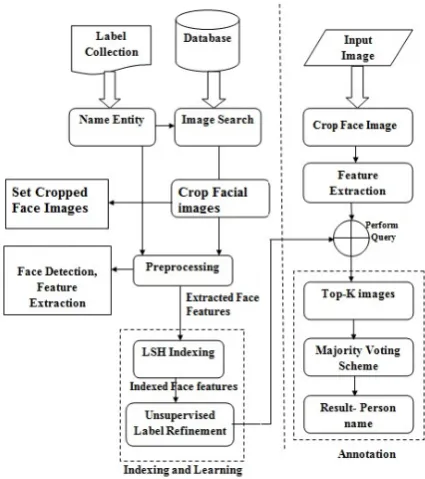
This proposed system performs different steps, such as collecting facial images in database, face alignment to align faces, feature extraction to extract facial features of faces, indexing extracted features, label refinement to enhance label quality, face annotation to label associated faces from images. Fig. 1 represents architecture of proposed system. In initial step it accepts facial image as input image. Next step performs alignment task on query image and gives cropped face from facial image, which is used in further processing steps. Facial features of query image and all database images are extracted and used to find similar facial images. Label refinement algorithm is implemented to enhance label quality and clustering algorithm improves the efficiency, scalability. It applied majority voting scheme on retrieved similar images to finalize label for query image.
Next step performs alignment task on query image and gives cropped face from facial image, which is used in further processing steps. Facial features of query image and all database images are extracted and used to find similar facial images. Label refinement algorithm is implemented to enhance label quality and clustering algorithm improves the efficiency, scalability. It applied majority voting scheme on retrieved similar images to finalize label for query image.
Fig. 1: Architecture of Proposed SBFA System
Principle Component Analysis (PCA): PCA is a dimensionality reduction technique which is used for feature extraction and face recognition. It is known as karhunen-loeve transformation or eigenspace projection. Eigen vectors calculated are referred as eigen faces. It is one of the more successful techniques of face recognition. The benefit of PCA is to reduce the dimension of the data. No data redundancy is found as components are orthogonal. With help of PCA, complexity of grouping the images can be reduced.
Algorithm:
1. Get Eigen vectors for each face image that forms the Eigen space.
2. Get or set the labels for the corresponding training images.
3. Get or set the Eigen distance threshold. (The smaller the number, the more likely an examined image will be treated as unrecognized object. Set it to a huge number (e.g. 5000) and the recognizer will always treated the examined image as one of the known object. )
4. Get the average Image.
5. Get the Eigen values of each of the training image. 6. Create an object recognizer using the specific training
data and parameters, it will always return the most similar object. (Parameters are like the images used for training, the labels corresponding to the images, the criteria for recognizer training etc.)
7. Create an object recognizer using the specific training data and parameters (The Eigen distance threshold, (0, ~1000). The smaller the number, the more likely an examined image will be treated as unrecognized object, if the threshold is < 0, the recognizer will always treated the examined image as one of the known object)
9. Get the Euclidean eigen-distance between input image and all other images from the database.
10. Given the image as query, find the most similar face images, return the index and the Eigen distance. 11. Try to recognize the facial image and return its label.
(The image to be recognized returns String- Label of the corresponding image. Or returns empty, if image is not recognized)
Locality Sensitivity Hashing (LSH): Locality sensitive hashing (LSH) is a basic primitive in large scale data processing algorithms that are designed to operate on objects (with features) in high dimensions. The idea of LSH is to employ random projections to approximate the Euclidean distance of original features. An inverted index structure can be constructed based on the hashing results, which facilitates efficient search. However, the LSH algorithm is completely data independent (using random projections), and thus the data structure is constructed without any learning. The idea behind LSH is the following: construct a family of functions that hash objects into buckets such that objects that are similar will be hashed to the same bucket with high probability. The K Nearest Neighbor (K-NN) problem is as follows: given a metric space (M, d) and a set S ⊆ M, maintain an index so that for any query point v ∈ M, the set I(v) of K points in S that are closest to v can be quickly identified. It assumes the metric space is the D-dimensional Euclidean space RD, which is
the most commonly, used metric space. In this case of RD
with L distance, the LSH family is defined as follows: H(v) = {h1(v), h2(v), ……, hM(v)}; ………(1)
hi(v) = ; i = 1, 2, ……., M ………..(2)
where ai RD is a vector with entries chosen independently.
Unsupervised Label Refinement: This ULR focused on learning refined label matrix F* IRn× m. It is obtaining
more accurate label matrix than the initial label matrix. Result of this proposed system is based on idea of “label smoothness”. Es (F, W) is represented as minimizing loss
function. It implemented an accelerated multi-step gradient algorithm to solve the quadratic programming iteratively. It reformulates the quadratic programming problem as: X* = arg min q(x | Q, c) = xTQx + cTx s.t.x 0……… (3)
It defined a linear approximation function p(x, z) for the above function q at point z:
pt(x, z)=q(z) + < x-z, q(z) > + || x-z||2F ………..(4)
In order to achieve solution X*, it updates two sequences x(k)
and z(k), iteratively.
z(k) = x(k) + (x(k) - x(k-1)); ……….(5)
x(k+1) = arg min p
t(x, z(k)) s.t.x 0………...(6)
= arg
s.t.x 0 ……...
(7)After ignoring terms that do not depend on x, the former optimization problem (4) could be equally presented as
,………....
(8)where .
The solution could be shown directly as follows:
; ………...
(9)The constraint for the subproblem is slightly different from (8), which is defined:
……….
(10)Where
v =
α and β are two regularization parameters;
X: extracted facial image features; n: number of facial images; d: the number of feature dimensions; Y : initial raw matrix; x(k-1) and x(k-2) : two previous approximate
solutions; x(k) : approximation ; F* : refined label matrix
;W: weight matrix; Algorithm:
Input: Q, c, t is the Lipshitz constant Output: Optimal solution X*
1. Begin
2. 0 = 1; k = 1; z(0) = x(0) = x(-1) = 0;
3. repeat
4. case SRF: Achieve x(k) with equation (7);
5. case CCF: Achieve x(k) with equation (10);
6. k = ;
7. z(k) = x(k) + (x(k) - x(k-1));
8. k = k + 1;
9. until CONVERGENCE; Clustering based Approximation (CBA):
This clustering-based approximation algorithm is implemented to speed up the solutions of proposed system. Here two approaches are considered such as “image level” and “name level”. Typically, n number for facial imagesis much larger than m number of names. The clustering on “image level” is much more time-consuming process than that on “name-level.” Thus, it adopted the “name level” clustering scheme for the sake of scalability and efficiency. After the clustering step, it solved the proposed ULR issues in each subset, and then merged all the learning results into the final enhanced label matrix F. The number of variables
in the existing problem is n × m.
This framework follows the terminology of shared nearest neighbors; it uses a co-occurrence likelihood to compute the similarity value Cij, which measures the
likelihood that instances from the two classes Xi , Xj are
co-occurred together in the retrieval results by some particular search models:
The instances in Xi and Xj should be put together
for joint class label refinement in proposed label enhancement step. To normalize the elements in the matrix C, it divides each column Ci* by its maximum value except
Cij:
=
,
if j
≠
i ……….
(12), if j = i,
n: Number of facial images in the retrieval database; m: Number of distinct names or classes; {n1, n2,…, nm}: Name
labels; X : facial images; Divided X images in m classes: X = [X1, X2,….., Xm]; C: class similarity matrix for all m
classes; Ci* : feature vector for class Xi; qc: cluster number;
SSE: sum-of-square-error; Iloop : number of iterations;
Algorithm: Input: C, qc, Lloop
Output: clustering highest order result list Llist
1. Add M0 to Llist;
2. Repeat
i. Remove the largest cluster Ml from Llist;
ii. For i=1 to t do
a. Bisect Ml to M1 (i) and M2 (i);
b. Compute sum of squared error (SSEi);
iii. Select the result with the lowest SSEi
value;
iv. Add m1 (i), m2 (i) to Llist;
v. Perform iterations until ¦Llist¦=qc;
Majority Voting (MV): MV combines the set of labels associated with these top K similar face images. It is based on the top-n retrieval images. The confidence weight depends on the Euclidean distance between the query image and the similarity image. In particular, for the i-th nearest similar face, it assigns a weight coefficient wi to the
corresponding label vector yi by
wi = ……….(13)
where (·, ·) is related to the distance between the query image Xq and its ith nearest sample Xi.
= ……….(14)
IV.RESULTS
In initial step of experiment it cropped faces from original facial images. Fig. 2 shows original faces and associated cropped face. All cropped faces are saved as gray scale face images having size 100 × 100 pixels. All images are having same size. This images are used in further processing steps.
Fig. 2: Original and respective cropped face images
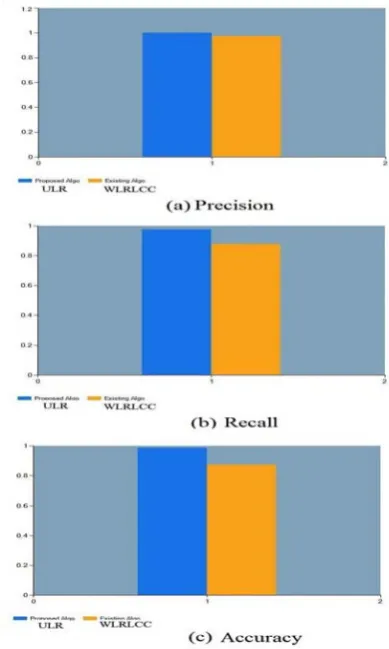
This experiment performed comparative analysis of proposed ULR algorithm and existing WLRLCC algorithm. Fig. 3 showed graphical presentation of comparative analysis.
Fig. 3: WLRLCC and ULR algorithm values
V. CONCLUSION
images from a weakly labeled facial dataset. At next step it annotates the facial image by performing voting on the labels associated with the top k similar facial images. It performed various extensive set of experiments on proposed system to achieved promising results. These experimental results showed that the proposed ULR technique significantly surpassed the other existing approaches. In future this work will adopt different machine learning techniques to enhance the label quality and system performance. Videos will be used instead of facial images to annotate faces from videos using search based face annotation technique.
REFERENCES
[1] D. Wang, S.C.H. Hoi, Y. He, and Jianke Zhu, “Mining Weakly Labeled Web Facial Images for Search-Based Face Annotation,” IEEE Transactions On Knowledge And Data Engineering, vol. 26, No. 1, January 2014.
[2] Dayong Wang, Steven C.H. Hoi, Pengcheng Wu, Jianke Zhu, Ying He, Chunyan Miao, “Learning to Name Faces: A Multimodal Learning Scheme for Search-Based Face Annotation”, IGIR’13, July 28–August 1, 2013.
[3] P.T. Pham, T. Tuytelaars, and M.-F. Moens, “Naming People in News Videos with Label Propagation,” IEEE Multimedia, vol. 18, no. 3, pp. 44-55, Mar. 2011.
[4] T.L. Berg, A.C. Berg, J. Edwards, M. Maire, R. White, Y.W. Teh, E.G. Learned-Miller, and D.A. Forsyth, “Names and Faces in the News,” Proc. IEEE CS Conf. Computer Vision and Pattern Recognition (CVPR), pp. 848-854, 2004.
[5] J. Zhu, S.C.H. Hoi, and M.R. Lyu, “Face Annotation Using Transductive Kernel Fisher Discriminant,” IEEE Trans. Multimedia, vol. 10, no. 1, pp. 86-96, Jan. 2008.
[6] X.-J. Wang, L. Zhang, F. Jing, and W.-Y. Ma, “AnnoSearch: Image Auto-Annotation by Search,” Proc. IEEE CS Conf. Computer Vision and Pattern Recognition (CVPR), pp. 14831490, 2006.
[7] L. Wu, S.C.H. Hoi, R. Jin, J. Zhu, and N. Yu, “Distance Metric Learning from Uncertain Side Information for Automated Photo Tagging,” ACM Trans. Intelligent Systems and Technology, vol. 2, no. 2, p. 13, 2011.
[8] P. Wu, S.C.H. Hoi, P. Zhao, and Y. He, “Mining Social Images with Distance Metric Learning for Automated Image Tagging,” Proc. Fourth ACM Int’l Conf. Web Search and Data Mining (WSDM ’11), pp. 197-206, 2011.
[9] G.B. Huang, M. Ramesh, T. Berg, and E. Learned-Miller, “Labeled Faces in the Wild: A Database for Studying Face Recognition in Unconstrained Environments,” technical report 07-49, 2007.
[10] M. Guillaumin, J. Verbeek, and C. Schmid, “Is that You? Metric Learning Approaches for Face Identification,” Proc. IEEE 12th Int’l Conf. Computer Vision (ICCV), 2009.
[11] Z. Cao, Q. Yin, X. Tang, and J. Sun, “Face Recognition with Learning-Based Descriptor,” IEEE Conf. Computer Vision and Pattern Recognition (CVPR), pp. 2707-2714, 2010.
[12] J. Fan, Y. Gao, and H. Luo, “Hierarchical Classification for Automatic Image Annotation,” Proc. 30th Ann. Int’l ACM SIGIR Conf. Research and Development in Information Retrieval (SIGIR), pp. 111-118, 2007.
[13] P. Pham, M.-F. Moens, and T. Tuytelaars, “Naming Persons in News Video with Label Propagation,” Proc. VCIDS, pp. 1528-1533, 2010.
[14] J. Tang, R. Hong, S. Yan, T.-S. Chua, G.-J. Qi, and R. Jain, “Image Annotation by KNN-Sparse Graph-Based Label
Propagation over Noisily Tagged Web Images,” ACM Trans. Intelligent Systems and Technology, vol. 2, pp. 14:1-14:15, 2011. [15] B.C. Russell, A. Torralba, K.P. Murphy, and W.T. Freeman,
“LabelMe: A Database and Web-Based Tool for Image Annotation,” Int’l J. Computer Vision, vol. 77, nos. 1-3, pp. 157-173, 2008.
[16] J. Cui, F. Wen, R. Xiao, Y. Tian, and X. Tang, “EasyAlbum: An Interactive Photo Annotation System Based on Face Clustering and Re-Ranking,” Proc. SIGCHI Conf. Human Factors in Computing Systems (CHI), pp. 367-376, 2007.
[17] D. Anguelov, K. Chih Lee, S.B. Gokturk, and B. Sumengen, “Contextual Identity Recognition in Personal Photo Albums,” Proc. IEEE Conf. Computer Vision and Pattern Recognition (CVPR ’07), 2007.
[18] J.Y. Choi, W.D. Neve, K.N. Plataniotis, and Y.M. Ro, “Collaborative Face Recognition for Improved Face Annotation in Personal Photo Collections Shared on Online Social Networks,” IEEE Trans. Multimedia, vol. 13, no. 1, pp. 14-28, Feb. 2011. [19] D. Ozkan and P. Duygulu, “A Graph Based Approach for Naming
Faces in News Photos,” Proc. IEEE CS Conf. Computer Vision and Pattern Recognition (CVPR), pp. 1477-1482, 2006.
[20] D.-D. Le and S. Satoh, “Unsupervised Face Annotation by Mining the Web,” Proc. IEEE Eighth Int’l Conf. Data Mining (ICDM), pp. 383-392, 2008.
[21] M. Guillaumin, T. Mensink, J. Verbeek, and C. Schmid, “Automatic Face Naming with Caption-Based Supervision,” Proc. IEEE Conf. Computer Vision and Pattern Recognition (CVPR), 2008.
[22] M. Guillaumin, T. Mensink, J. Verbeek, and C. Schmid, “Face Recognition from Caption-Based Supervision,” Int’l J. Computer Vision, vol. 96, pp. 64-82, 2011.
[23] T. Mensink and J.J. Verbeek, “Improving People Search Using Query Expansions,” Proc. 10th European Conf. Computer Vision (ECCV), vol. 2, pp. 86-99, 2008.
[24] T.L. Berg, A.C. Berg, J. Edwards, and D. Forsyth, “Who’s in the Picture,” Proc. Neural Information Processing Systems Conf. (NIPS), 2005.
[25] Z. Wu, Q. Ke, J. Sun, and H.-Y. Shum, “Scalable Face Image Retrieval with Identity-Based Quantization and Multi-Reference Re-Ranking,” Proc. IEEE Conf. Computer Vision and Pattern Recognition (CVPR), pp. 3469-3476, 2010.
[26] M. Zhao, J. Yagnik, H. Adam, and D. Bau, “Large Scale Learning and Recognition of Faces in Web Videos,” Proc. IEEE Eighth Int’l Conf. Automatic Face and Gesture Recognition (FG), pp. 1-7, 2008.
[27] D. Wang, S.C.H. Hoi, Y. He, and J. Zhu, “Retrieval-Based Face Annotation by Weak Label Regularized Local Coordinate Coding,” Proc. 19th ACM Int’l Conf. Multimedia (Multimedia), pp. 353362, 2011.
[28] D. Wang, S.C.H. Hoi, and Y. He, “A Unified Learning Framework for Auto Face Annotation by Mining Web Facial Images,” Proc. 21st ACM Int’l Conf. Information and Knowledge Management (CIKM), pp. 1392-1401, 2012.
[29] Y.-Y. Sun, Y. Zhang, and Z.-H. Zhou, “Multi-Label Learning with Weak Label,” Proc. 24th AAAI Conf. Artificial Intelligence (AAAI), 2010.
[30] J. Zhu, S.C.H. Hoi, and L.V. Gool, “Unsupervised Face Alignment by Robust Nonrigid Mapping,” Proc. 12th Int’l Conf. Computer Vision (ICCV), 2009.
[31] C. Siagian and L. Itti, “Rapid Biologically-Inspired Scene Classification Using Features Shared with Visual Attention,” IEEE Trans. Pattern Analysis and Machine Intelligence, vol. 29, no. 2, pp. 300-312, Feb. 2007.