Improving Caching Efficiency Based On
Multi-Channel K-Copy Intelligent Caching
Scheme in DTNs
Saurabh A.Rathi1, Pranali K.Mankar2, Snehal V. Babhulkar3, Ashwini N.Akhade4, Minal K.Pendor5,
Prof. Priyanka A.Jalan6
U.G. Student, Department of Computer Engineering, Bapurao Deshmukh college of Engineering, Sevagram,
Maharashtra, India1,2,3,4,5
Associate Professor, Department of Computer Engineering, Bapurao Deshmukh college of Engineering, Sevagram,
Maharashtra, India6
ABSTRACT:Mobile nodes in some challenging network scenarios suffer from intermittent connectivity and frequent partitions e.g. battlefield and disaster recovery scenarios. Disruption Tolerant Network (DTN) technologies are designed to enable nodes in such environments to communicate with one another. In this paper, we describe two network scenarios first one is K-copy intelligent caching scheme in single channel and second is K-copy intelligent caching scheme in multi-channel and both are using AODV routing protocol. And also perform performance evaluation between K-copy intelligent caching scheme in single channel and multi-channel K-copy intelligent caching scheme in terms of parameter energy consumption, delay and throughput. Our results reveal that the scheme that performs the best is the one that uses the K-copy intelligent caching combined with the multi-channel and AODV routing protocol.
KEYWORDS: Disruption Tolerant Network (DTN), Multi-channel
I. INTRODUCTION
A mobile ad-hoc network (MANET) is a collection of wireless mobile nodes dynamically forming a temporary network without the use of any existing network infrastructure or centralized administration. MANETs have their own advantages such as high robustness and easy to set up despite resource constraints like limited bandwidth and power. A mobile node in MANETs can transmit data packets to other mobile nodes that are within its radio range.
There is rapid growth in advancement in technology, we have many wireless computing devices e.g. PDAs, sensors etc. Such devices can form infrastructure less ad-hoc networks and communicate with one another via the help of intermediate nodes. Such ad-hoc networks are very useful in several scenarios e.g. battlefield operations, vehicular ad-hoc networks and disaster response scenarios. There is a situation when some interruption in network occurred and we are not able to send or received or retrieve any information via network. We can say that there is some disruption is created in network. So, to avoid such disruption in network, researcher find the new network called “Disruption Tolerant Network (DTN)”. Since the ultimate goal of having such a network is to allow mobile nodes to access information quickly and efficiently. For example, in a battlefield, soldiers need to access information related to detailed geographical maps, intelligent information about enemy locations, new commands from the general, weather information etc.
intelligent caching simply caches the replicated packets or information in number of nodes, from which we can retrieve packets or information whenever disruption in network causes loss of information from any node which is used for communication. But caching scheme developed in [1] and [9] i.e. K-copy intelligent caching had some drawback which can be avoid. Actually, this scheme is developed for single channel due to that packets lost was increases. Because of packets flow through single channel, packets had to wait until other packets reached to destination and this increased delay in the network and consumed more energy for communication. This can be prevented by using multi-channel in existence caching scheme.
The rest of the paper is organized as follows. In Section II, discussing related work. In Section III, describe proposed work i.e. K-copy intelligent caching with and without multi-channel. In Section IV, shown implementations and the performance evaluation of the K-copy intelligent caching scheme with and without multi-channel. In Section V, providing concluding remarks i.e. conclusion.
II. RELATEDWORK
Author compared two caching scheme i.e. K-copy intelligent scheme and K-copy random scheme for data caching in [1] and used LNS for query dissemination, and Prophet or HEFR scheme for message routing. . He found that K-copy intelligent scheme combined with LNS for query dissemination along with HEFR for message routing is more efficient than K-copy random scheme. But there was some issues on his paper is that K-copy intelligent scheme took maximum time to deliver data to destination i.e. had more delay, less throughput and had maximum energy consumption for communication.
Same author as in [1] worked on query dissemination scheme in [9]. But in next paper he compared same data caching scheme i.e. K-copy random and K-copy intelligent scheme. In that paper, author compared W-copy Selective Query Spraying (WSS) scheme with L-hop Neighbourhood Spraying (LNS) scheme. Author found that WSS scheme can achieve a higher query success ratio when compared to a scheme that does not use any data and query replication. The issues on that paper are also related with data caching scheme. It gives better results with WSS scheme, but on that paper also there was no concept of multi-channel.
Author proposed a cooperative caching for DTNs in [3], which enabled the sharing and coordination of cached data among multiple nodes. Author basic idea is to intentionally cache data at a set of Network Central Locations (NCLs), which can be accessed by other nodes in the network. Author proposed a scheme which ensures appropriate NCL selection based on a probabilistic selection metric and coordinates multiple caching nodes to optimize the tradeoff between data accessibility and caching overhead. But there was one drawback is that whatever the data is cached in the NCLs if there is some disruption in that path or if there is some loss of data in the particular NCL then the whole data stored on that NCL are loss. Cache resolution and cache management are two problem of cooperative caching.
To address the problem of intermittent connectivity, network nodes store messages on their buffers, carrying them through the network while waiting for transfer opportunities. The storage capacity of the nodes affects directly the network performance. Therefore, it is important to incorporate suitable network protocols using self-contained messages to improve communication that supports store-carry-and-forward operation procedures. Clearly, such procedures motivate content caching and retrieval. Author surveys the state-of-the art on intelligent caching and retrieval mechanisms focusing on ad-hoc and delay tolerant networks (DTN) in [4]. These approaches can offer important insights for upcoming proposals on intelligent caching and retrieval mechanisms for VDTNs.
Author considering the cache placement problem in [8] of minimizing total data access cost in ad hoc networks with multiple data items and nodes with limited memory capacity. The above optimization problem is known to be NP-hard. Defining benefit as the reduction in total access cost, author present a polynomial-time centralized approximation algorithm that provably delivers a solution whose benefit is at least one-fourth (one-half for uniform-size data items) of the optimal benefit. The approximation algorithm is a enable to localized distributed implementation, which is shown via simulations to perform close to the approximation algorithm. This distributed algorithm naturally extends to networks with mobile nodes.
A caching scheme for Internet based MANETs was presented in [11]. In this scheme, an Aggregate Caching mechanism is proposed. Here each mobile node stores data item in its local cache and these local caches are aggregated to unified large cache. The data items can be received from local caches of the mobile nodes or through an access point or a data center connected to the Internet. When a node needs a data item, it broadcasts a request to all of the adjacent nodes. The node which has the data item in its local cache will send a reply to the requester; otherwise, it will forward the request to its neighbors. Thus a request is broadcasted to the other connected nodes and eventually acknowledged by an access point or some nodes with cached copies of the requested data item. A broadcast based approach, called Simple Search (SS) algorithm, is implemented on the top of existing routing protocols, to locate the requested data items.
A store-and-forward approach has been proposed for disruption tolerant networks [10]. In authors earlier paper, they have evaluated a combined multi-hop and message ferrying approach in disruption tolerant networks. In that paper, author assumed that a special node is designated to be a message ferry. A more flexible approach is to let regular nodes volunteer to be message ferries when network dynamics mandate the presence of such ferries to ensure communications. Thus, after this, author designed a node density based adaptive routing (NDBAR) scheme in [12] that allows regular nodes to volunteer to be message ferries when there are very few nodes around them to ensure the feasibility of continued communications.
III.PROPOSEDWORK
In this paper, K-copy intelligent caching scheme in single channel and multi-channel K-copy intelligent caching scheme is developed.
We are evaluating the performance of both schemes with AODV routing protocol. The working of both schemes is same but only difference is that in multi-channel K-copy intelligent caching, we are applying multi-channel concept to make it more efficient.
3.1 K-COPY INTELLIGENT CACHING SCHEME-
K-copy intelligent caching scheme [1] & [9] is used with minor modification of calculating friendliness metric (FM). Suppose we need to communicate or send some information to other communicating nodes or some mobile device and there is some challenging network scenario, so by using K-copy intelligent caching we avoid packets loses. Suppose we want to communicate to node 12 via node 5. First of all, source i.e. node 5 selects the K-node to caches the K-copy of replicated packets or data. So that if there is any packets loss then we can retrieve the lost packets from other K-nodes on which the data or packets is stored or caches. The K-node is selected on the basis of FM value. The node which is closer to source which is calculated by FM value and having FM value less than FM threshold is selected. FM threshold is average distance between source and destination which is also calculated by Euclidean distance formula. FM value is nothing but the Euclidean distance between two nodes which is calculated as follows-
FM = √(x2-x1)² + (y2-y1)²
Where, x and y are the (x, y) coordinate of source and destination.
T1
T2 d
Data item d
N12
N5
N6
N7
N8 N9
N11 d
d
T3
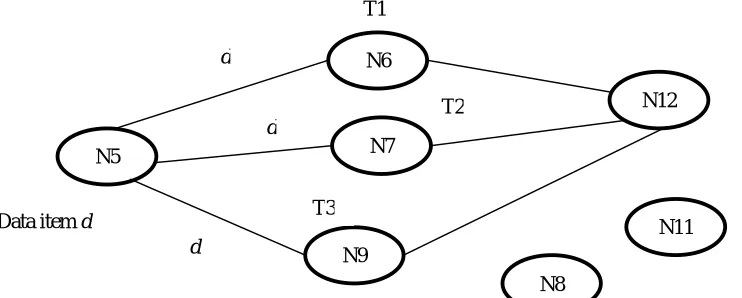
Figure 3.1 shows the working of K-copy intelligent caching scheme in single channel. As we shown, this scheme firstly select K-nodes to caches data and then it deliver packets or data to destination. If some packet is loses then we can retrieve it from other selected K-node. Here, we assume communication between node 5 and 12 and K=3. On the basis of FM value, it select K-node as 6, 7 & 9. After selecting K-node, node 6 sends data to destination node 12. Whatever the packet is loses during communication between node 6 and 12, it will recover it from node 7 & 9. Similarly, node 7 & 9 sends data to destination node 12 at a time.
3.2 MULTI-CHANNEL K-COPY INTELLIGENT CACHING SCHEME-
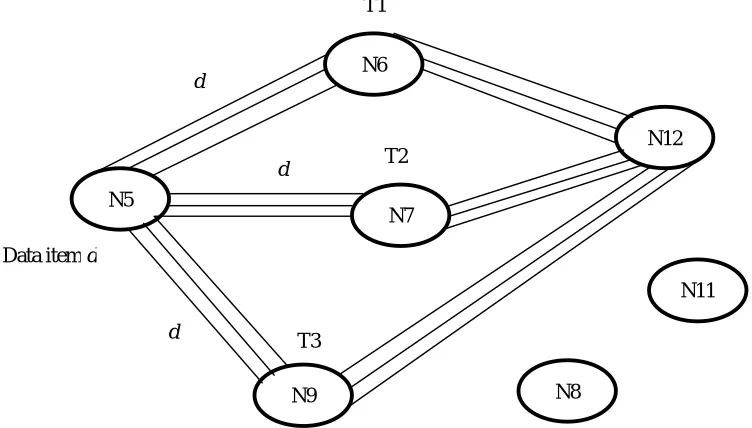
As shown in previous section, the working of K-copy intelligent caching is same for this scheme also. The only difference is that it is work with multi-channel means when sender send the packet to receiver it will go through number of channel. As in K-copy intelligent caching, it is select K caching node and then this caching node send packets to destination. So, here this all happen in addition with multi-channel concept. So, it help network to communicate more efficiently.
As shown in figure 3.2 our proposed scheme is based on multi-channel protocol. Assuming that the value of K is 3 and number of channel through which we are sending data item d is also 3. So that according to our proposed scheme, source node N5 firstly selecting first node i.e. N6 at time T1 and sending data to that node by number of channels, here is 3. Then, that node sends the available data item to destination via number of channels. After that it selects second node N7 and third node N9 at time T2 and T3 respectively. And similarly the data sends to destination via number of channels. Nodes N6, N7 and N9 are selected by comparing FM value of number of nodes in the network.
IV.IMPLEMENTATION & PERFORMANCE EVALUATION
Following are the implementation steps regarding to the work- 1. Formation of wireless network in communication.
2. Second task is divided into two tasks which are as follows:-
Developing K-copy intelligent scheme for improving the caching in the network.
Fig. 3.2 multi-channel K-copy intelligent caching scheme
T2
Data item d
N12
N5
N6
N7
N8 N9
N11 d
d
d
T1
3.
Implementation of multi-channel protocol for improving communication delay.4. Integrating multi-channel protocol with K-copy intelligent caching scheme for improve efficiency.
5.
Performance evaluation. 4.1 SIMULATION SETUP-To investigate the efficiency of different combinations of the design, we implement the different network scenarios in NS-2 version 2.34. We assume that the wireless bandwidth is 10 Mb/s and the transmission range is 200 m. We use a network that consists of 30 nodes randomly distributed over a 300x300 m².
In this paper, we are comparing two network scenarios i.e. IC-SC-AODV (network with K-copy intelligent caching with single channel using AODV routing protocol) and IC-MC-AODV (network with K-copy intelligent caching with multi-channel using AODV routing protocol).
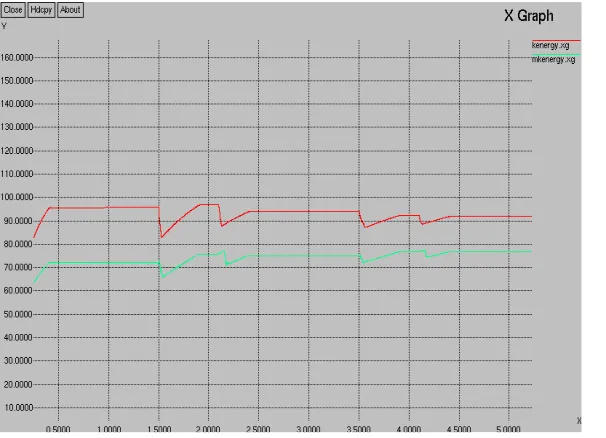
In figure 4.1, we are comparing energy consumption of IC-SC-AODV and IC-MC-AODV. On X-axis place the parameter jitter which defines the delay consistency of the network which is calculated in terms of millisecond or msecand can be calculated by formula given below-
Jitter = delay – mean delay
And on Y-axis place the parameter which is calculated such as delay, energy consumption, etc.
Whenever, communication is going on between numbers of node, this requires some energy for communication which is termed as Energy consumption. In figure 4.1 shows the calculated parameter is energy or power consumption so that placed energy consumption on Y-axis which is calculated in terms of millijouleor mJ. It is calculated by below
formula-Energy consumed = energy during sending packets – energy during receiving packets
Jitter
(msec)
Energy consumed (mJ)
IC-SC-AODV IC-MC-AODV
0.5 95 72
2.5 94 76
4.5 92 78
Fig. 4.1 Graphical evaluation of energy consumption
In figure 4.1, red line indicates the IC-SC-AODV scenario and green line indicate the IC-MC-AODV scenario. From figure 4.1, it is clear that K-copy intelligent caching with channel consume less energy than without multi-channel.
The overall evaluation is given in the Table I. As shown in Table I. when jitter value is 0.5 msec, the energy consumed by IC-SC-AODV 95 mJ whereas IC-MC-AODV consumed energy 72 mJ. From fig. 4.1, we consider three jitter value and their equivalent energy consumption and we found that IC-MC-AODV requires less energy for communication as compare to IC-SC-AODV.
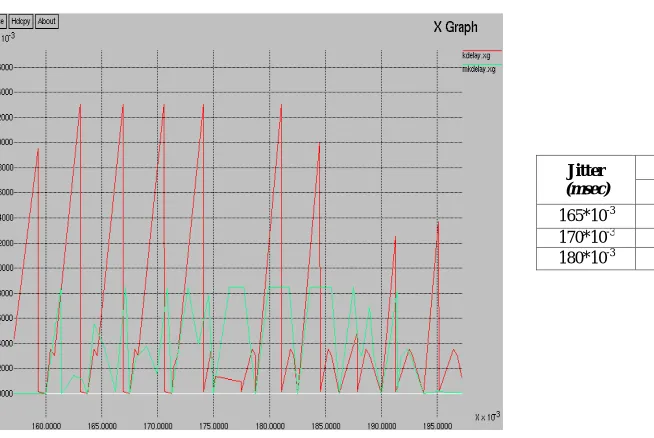
In figure 4.2, calculated parameter is delay so that placed delay on Y-axis which is calculated in terms of millisecond or msec. When data sends from source to destination, it requires some time to reach to destination which is termed as Delay. And it is calculated by the formula given below-
Delay = packet receiving time – packet sending time
In figure 4.2, red line indicates the IC-SC-AODV scenario whereas green line indicates the IC-MC-AODV scenario.
Table IIshows delayagainst different jitter value for IC-SC-AODV and IC-MC-AODV network scenarios. From fig. 4.1, we consider three jitter values and their equivalent delay in Table II and we found that IC-MC-AODV take less time to send packet as compare to IC-SC-AODV. At some point, IC-MC-AODV take more time to send packets due to searching the available channel and allocate packets to that channel, but the number of times that will happen will be less as compared to when the delay is optimum.
Jitter
(msec)
Delay (msec) * 10-3
IC-SC-AODV IC-MC-AODV
165*10-3 0.6 0.41
170*10-3 1.8 0.2
180*10-3 1.3 0.85
Throughput (kbps)
IC-SC-AODV IC-MC-AODV
-5130696077.88 -13744725002.62 Fig. 4.2 Graphical evaluation of Delay
Table II. Delay
Similarly, one more parameter i.e. throughput is evaluated. In simple word, throughput is defined as numbers of packet received at destination per unit time, which is calculated by a formula given below-
Throughput [kbps] = packets received / time
Note that negative sign indicate number of packet received but not transmitted. The throughput needs to be more for good results; here we consider the absolute value. Therefore, IC-MC-AODV having more throughput as compare to the IC-SC-AODV.
V. CONCLUSION
In this paper, K-copy intelligent caching scheme and multi-channel K-copy intelligent caching scheme are developed. It is evaluated that, by using multi-channel in intelligent caching scheme, network for communication becomes more efficient. This helps to reduce delay, energy consumption and increase throughput as compare intelligent caching scheme with single-channel. This paper compares network k-copy intelligent caching with multi-channel and without multi-channel and it is concluded that using multi-channel, it reduces energy consumption up to 15-24%, reducing delay near about 31-88% depending upon the available or allocated channel and increases throughput 62%. So, we can say that using multi-channel we can improve caching efficiency of K-copy intelligent caching.
REFERENCES
[1] M. Chuah, P. Yang, “Performance Evaluation of Content-Based Information Retrieval Schemes for DTNs”, IEEE Milcom, pg. 1-7, October, 2007.
[2] Tuan Le, You Lu, Mario Gerla, “Social Caching and Content Retrieval in Disruption Tolerant Networks (DTNs)”, Computing, Networking and communications (ICNC), 2015.
[3] Wei Gao, Guohong Cao, et. al, “Cooperative Caching for Efficient Data Access in Disruption Tolerant Networks” , IEEE Trans. , Volume: 13, Issue:3, pg. 611 - 625, 2014.
[4] Bruno M. C. Silva, Vasco N. G. J. Soares, et. al, “Towards Intelligent Caching and Retrieval Mechanisms for Upcoming Proposals on Vehicular Delay-Tolerant Networks” , JCOMSS , 2011.
[5] S. Manju, Mrs. K. Vanitha, “Efficient Message Caching Scheme for MANET”, IJIRCCE, March, 2014.
[6] Mrs. K.Shanmugavadivu, DrM.Madheswaran, “Caching Technique for Improving Data Retrieval Performance in Mobile Ad Hoc Networks” ,IJCSIT ,vol. 1(4) ,pg. 249-255,2010.
[7] M. Chuah, R. Metgzer, “Secure Data Retrieval System (SEDAR) for DTNs”, IEEE Milcom, pg. 1-7, 2008.
[8] B. Tang, H. Gupta, and S. Das, “Benefit-Based Data Caching in Ad Hoc Networks,” IEEE Trans. Mobile Computing, vol. 7, no. 3, pg. 289-304, Mar. 2008.
[9] M. Chuah, P.Yang, “Performance Evaluations of Data-Centric Information Retrieval Schemes for DTNs”, Proceedings of Milcom, October, 2007.
[10] Mooi-Choo Chuah, Peng Yang, et. al, “Store-and-Forward Performance in a DTN” , IEEE VTC, Volume: 1, pg. 187 – 191, 2006.
[11] S. Narravula, H.-W. Jin, et. al, “Designing Efficient Cooperative Caching Schemes for Multi-Tier Data-Centers over RDMA-enabled Networks”, IEEE, volume:1, pg. 401-408, 2006.
[12] M. Chuah, P. Yang, “Node Density-Based Adaptive Routing Scheme for Disruption Tolerant Networks”, IEEE MILCOM, pg. 1-6, 2006. [13] Sunho Lim, et. al, “A novel caching scheme for improving Internet-based mobile ad hoc networks performance”, Proc .12th Int. Conf.
Computer Comm. Networks (ICCCN 2004), pg. 38-43, october,2004.