1481 | P a g e
Data Centric Security in FPGA Based Data Center
Using Attribute Based Encryption
J. Joshua Daniel Raj
1, Dr.P . Karthik
21
Assistant Professor NHCE, Bangalore (India)
2
Professor , KSSEM, Bangalore (India)
ABSTRACT
One of the most important concerns about the big data applications is privacy, because users share more
personal data and content through their social networking sites and clouds. The security and privacy risks and
developing efficient and effective frame works are critical for its success; hence a secure framework such as
data centric security is the hot research areas. The Attribute based encryption would be a convenient
mechanism to implement data centric security. As the Big data applications require more server computational
power, in this paper we propose a novel approach to use FPGA based data centers for implementing both data
acceleration which would increase the server computational ability and security mechanisms to achieve data
centric security.
Keywords:
FPGA, Attribute based encryption, data center, OpenCL, data acceleration.
I. INTRODUCTION
Big data is referred to the large set of data that is generated by connected devices and social network sites,
which cannot be handled by a traditional database management system. Big Data analytics is the process of
analyzing large data sets to dig out hidden patterns, unknown correlation, market trends, customer preferences
and other useful business information. The result of analytics can be used for more effective marketing, new
revenue opportunities, better customer service, improved operational efficiency and other business benefits. A
data center is a place used to keep computer systems and related components such as communications and
storage systems. A data analyst who analyses the big data will take large set of data from data center for
analyzing. There are, three data analysis related challenges: movement, processing and interacting. The solution
to overcome these challenges is hardware data acceleration [7].
With data acceleration organizations can move data from its source to the place of work without losing any of it
quickly to extract insights from data and deliver it for processing and storage. Data acceleration supports fast
processing of data by using appropriate hardware equipments. Interactivity is about usability of data
infrastructure. Data acceleration allows users to connect to datacenters in universally acceptable manner such
that results are provided quickly. The FPGA based data acceleration is the solution to data analysis performance
challenges.
FPGA accelerated systems has three major benefits: performance, ease-of-use, and lower total cost of ownership.
1482 | P a g e
II. RELATED WORK
Young-kyu Choi [10] and his team have conducted quantitative analysis and in depth performance on modern
FPGA-CPU architectures and they found that that a QPI-based platform has greater advantage on fine-grained
(< 4KB) communication latency. Jagath Weerasinghe and Andreas Herkersdorf [11] proposed to decouple the
FPGA from the CPU and to connect FPGA directly to the Data Center networks. By connecting the FPGA as
standalone component enables large scale deployment of FPGA in cloud computing. A. Putnam [2] and his team
at Microsoft have designed a medium scale deployed FPGA based data centers which improved the throughput
by twice of Bing search engine.
III. FIELD PROGRAMMABLE GATE ARRAY
A field programmable gate array is a contemporary integrated circuit designed to be used by any type of
customers for their applications. The details about the configuration of FPGA are specified using Hardware
Description Languages. This sophisticated integrated circuit consists of huge set of resources and memory block
to implement complex computational algorithms and it can be used to solve any problem which involves
computation. Having confronted with the big data characteristics, there is an interest to use FPGA for the real
time application. The data centers are now accelerating their data analytics and computation using FPGA based
implementations that could meet the requirements of the big data era. The most widely used FPGA for big data
applications is Altera Stratix V and Xilinx Kintex Ultrascale+. The Stratix V FPGA consists of Altera's 28 nm.
Stratix® V FPGAs deliver the industry's highest bandwidth, highest level of system integration, and ultimate
flexibility with reduced cost and the lowest total power for high-end applications. Kintex® UltraScale+™
devices provide the best price/performance/watt balance in a Fin-FET node, delivering the most cost-effective
solution for high-end capabilities including transceiver and memory interface line rates, as well as 100G
connectivity cores. Our newest mid-range family is ideal for both packet processing and DSP-intensive
functions, and is well suited for applications ranging from wireless MIMO technology to Nx100G networking
and data center.
3.1. Programming with FPGAs
Traditionally, hardware developers have designed and verified digital circuits on FPGAs at the register-transfer
level (RTL) using hardware description languages (HDLs) such as Verilog HDL and VHDL. While these
traditional methods are effective to ensure efficient use of the devices, they are impractical for implementing
complex algorithms such as gene sequencing. In early 2012, Altera introduced the Altera SDK for OpenCL, a
software development kit that allows use of the OpenCL programming language to program Altera’s [1] FPGA
as computing accelerator devices. In late 2014 Xilinx Corporation, another leading FPGA vendor, announced
they were also developing a compiler for OpenCL. Altera’s SDK for OpenCL has been utilized for a wide array
of algorithms in a variety of computing fields such as deep learning , CNN algorithms, computer vision
algorithm. Etc..
IV. FPGA BASED DATACENTERS
FPGA gives flexible acceleration for many operations. The CPU-FPGA heterogeneous acceleration has great
1483 | P a g e
network connected stand alone resource with compute, memory and networking capabilities coupled with CPU.
4.1. Microsoft Catapult
Figure 1: A diagram of the server that hosts the FPGA board.
Catapult is a research project conducted by Microsoft to use FPGAs as data center accelerators to improve
performance, reduce power consumption, and provide new capabilities in the datacenter. For this project
Microsoft has used Altera Stratix V FPGAs. Using FPGAs, Microsoft has built a kind of super-search machine
network.
The system consists of 432 two-socket Intel Xeon-based nodes, each with 64 GB of memory and an Altera
Stratix V D5 FPGA with 8 GB of local DDR3 memory. FPGAs communicate to their host CPUs via a PCIe
Gen3 x8 connection, providing 8GB/s guaranteed-not-to-exceed bandwidth, and each FPGA can read and write
data stored on its host node using this connection [2].
Microsoft has used small daughter boards in each server with a single high end FPGA, and connected the card
directly with a secondary network in such a way that would provide low latency, high bandwidth and if an
application requires more than one FPGA can be mapped across FPGAs located at multiple servers.Microsoft
uses PCI to interface board to the CPU, local DRAM of 8GB.
Microsoft has found that Catapult improves the ranking throughput of each server by a factor of 95%. Microsoft
have designed an FPGA board that plugs into the Microsoft-designed server that was released publically as the
Open CloudServer V1. It’s comprised of 1,632 servers, each one with an Intel Xeon processor and a daughter
card that contains the Altera FPGA chip, linked to the Catapault network. The system takes search queries
coming from Bing and offloads a lot of the work to the FPGAs, which are custom-programmed for the heavy
computational work needed to figure out which webpages results should be displayed in which order. Figure 1
shows the position of the board in one of the datacenter servers.
The system consists of 432 two-socket Intel Xeon-based nodes, each with 64 GB of memory and an Altera
Stratix V D5 FPGA with 8 GB of local DDR3 memory. FPGAs communicate to their host CPUs via a PCIe
Gen3 x8 connection, providing 8GB/s guaranteed-not-to-exceed and width\ and each FPGA can read and write
data stored on its host node using this connection.
V. FABRIC
The Coherent Accelerator Processor Interface is an innovative solution for data acceleration by IBM. It provides
high performance solution for the cloud computation algorithms on an FPGA. This can replace application
programs running on a dedicated core. CAPI removes overhead and complexity of the input output system,
allows an accelerator to operate as part of an application. This requires less programming effort and can be used
1484 | P a g e
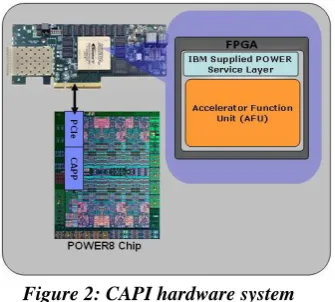
Figure 2: CAPI hardware system
While clouds with FPGAs are available in companies like IBM, there are, however, few FPGA clouds available
for public, especially academic, use. To target this problem, we created FAbRIC (FPGA Research Infrastructure
Cloud) a project led by Derek Chiou at The University of Texas at Austin. It enables FPGA research and
development on large-scale systems by providing FPGA systems, tools, and servers to run tools in a cloud
environment. The FAbRIC POWER8+CAPI system consists of a bunch of x86 servers and nine POWER8
servers. The x86 nodes are used as the gateway node, the file server and build machines are used for running
FPGA tools. Each POWER8 node is a heterogeneous compute platform. Figure 2 shows the schematic of
hardware system and it consists of three accelerating devices, a Nallatech 385 A7 Stratix V FPGA adapter, an
Alpha-data 7V3 Virtex7 Xilinx-based FPGA adapter and a NVIDIA Tesla K40m GPU card. FPGA boards are
CAPI enabled to provide coherent shared memory between the processor and accelerators.
VI. DATA CENTRIC SECURITY
Data centric security is a method to secure the data itself rather than the security of networks, servers of
applications. Data-centric security is the only way to ensure the most important asset of the business—the
data—is protected. Data centric protection makes the data unusable to anyone who does not have the key to
decrypt it. Encryption is a well suited data-centric technique to address the risk of data theft in smart phones,
laptops, desktops and even servers, including the cloud.
VII. ATTRIBUTE BASED ENCRYPTION
Attribute Based Encryption (ABE) [5] is a type of public key encryption in which the secret key of a user and
the Cipher text are dependent upon attributes. In ABE the decryption of a Cipher text is possible only if the set
of user key attributes of the user key matches the attributes of the cipher text. There are two types ABE
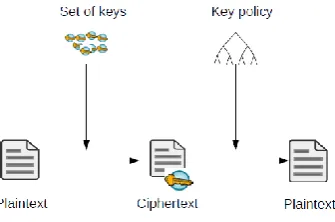
Key-Policy Attribute-Based Encryption (KP-ABE) and Cipher text-Key-Policy Attribute-Based Encryption (CP-ABE). In
KP-ABE, cipher texts are encrypted with a set of attributes and each user’s secret key is mapped with an
1485 | P a g e
Figure 3: Schematic of KP-ABE
In Cipher text-Policy Attribute-Based Encryption (CP-ABE), the schematic is shown in figure 4. A cipher text is
encrypted with a policy. Anyone whose attributes matches the policy can decrypt the cipher text; otherwise the
decryption fails. One of the most promising approaches is Cipher text-Policy Attribute-Based Encryption
(CP-ABE) [6].
Figure 4: Schematic of CP-ABE
7.1 Proposed implementation of ABE
In this paper figure 5 depicts the proposed implementation to obtain a data centric security by realizing Attribute
based encryption in the FPGA based data centers.
Figure 5: Proposed implementation of ABE in FPGA based data center
As the data are being generated at high speed and high volume, it is necessary to use data accelerated data center,
for our work, we propose to use FPGA accelerated data centers such as catapult and FAbRIC to implement
Attribute Based Encryption to obtain data – centric security.
The construction of cipher text ABE as follows, it consists of four algorithms setup, encryption,
Key generation and Decryption
6.1.1. Setup algorithm
It takes only the hidden parameter as an input and it outputs the public key and a master key. The setup
algorithm uses the bilinear group and rando components as input to generate
1486 | P a g e
public key as shown in equation 6.1 and 6.2.
MK = (β, gα) -- 6.2
6.1.2. Encryption algorithm
The encryption algorithm is function of PK, M (Message) and A (access structure), and it
--- 6.3
generates Cipher text as shown in equation 6.3.
6.1.3. Key generation algorithm
The key generation algorithm will use set of attributes and produces a key SK (secret key) as shown in equation
6.4 .
-- 6.4
VII. EXPECTED OUTCOME
In the age of big data, the data is being generated at a higher volume and velocity. Hence the security
mechanism should be able to encrypt the streaming data without missing anything. For this higher data
acceleration and faster encryption methods are essential. The expected timing requirement for the proposed
implementation is illustrated in Table in 1.
Table 1: Approximate time calculations
As the FPGA is considered for the proposed implementation, it is necessary that the FPGA resource
consumption is necessary to be monitored. Table 2 shows the approximate FPGA resource consumption in
percentage
Table 2: Approximate estimation of FPGA area consumption
Operation Approximate Time
Private key gen. 35 ms per attribute
Encryption 27 ms per leaf node
Decryption 0.5–0.8 ms per leaf
1487 | P a g e
Module
Generation of Public
key
Encryption Key generation
Logic
(%) 75 85 80
Memory
(%) 84 78 96
DSP
(%) 85 69 90
VIII. CONCLUSION
This paper is the first ever approach to propose the importance of data centric security in FPGA based data
centers. We have proposed that data centric security can be achieved by using Cipher text policy Attribute
Based Encryption. We believe that this approach can be implemented in FPGA based data centers to protect the
user data at both rest and transmit.
IX. REFERENCES
[1]. Chris Rauer and Nicholas Finamore Jr. “Accelerating Genomics Research with OpenCL and FPGAs”,
Altera
[2]. A. Putnam et al., “A reconfigurable fabric for accelerating large-scale datacenter services,” (ISCA),
Page(s):13 – 24, 2014.
[3]. Heiner Giefers ; IBM Research - Zurich ; Raphael Polig ; Christoph Hagleitner, “Accelerating arithmetic kernels with coherent attacjhed FPGA coprocessors ” Design, Automation & Test in Europe Conference &
Exhibition (DATE) , Pages 1072 – 1077, 2015
[4]. Junzuo Lai ; Robert H. Deng ; Chaowen Guan ; Jian Weng,” Attribute-Based Encryption With Verifiable Outsourced Decryption ” IEEE Transactions on Information Forensics and Security (Volume:8 , Issue: 8 ),
Page(s): 1343 – 1354.
[5]. Brent Waters ―Ciphertext-Policy Attribute-Based Encryption: An Expressive, Efficient, and Provably Secure Realization‖, Public Key Cryptography – PKC 2011 Volume 6571 of the series Lecture Notes in Computer
Science pp 53-70
[6.] T. M. Brewer, “Instruction set innovations for the convey hc-1 computer,” IEEE micro, no. 2, pp. 70–79,
2010.
[7]. “Data Acceleration: Architecture for the Modern Data Supply Chain‖, Accenture.
[8]. J. Stuecheli et al., “CAPI: A coherent accelerator processor interface,” IBM Journal of Research and
1488 | P a g e
[9]. “Top Ten Big Data Security and Privacy Challenges”
https://cloudsecurityalliance.org/.../top-ten-big-data-security-and-privacy-challenges
[10]. Young-kyu Choi et all ―A quantitative analysis on microarchitectures of modern CPU-FPGA platforms”
Proceedings of the 53rd Annual Design Automation Conference, Article No. 109 , 2016.
[11]. Jagath Weerasinghe et all “Enabling FPGAs in Hyper-scale Data Centers”, IEEE International