ISSN(Online): 2320-9801
ISSN (Print): 2320-9798
I
nternational
J
ournal of
I
nnovative
R
esearch in
C
omputer
and
C
ommunication
E
ngineering
(An ISO 3297: 2007 Certified Organization)
Vol. 3, Issue 7, July 2015
Content Based Retrieval of Multiple Objects
Blessy Mariam Mathews1, Dr. Jharna Majumdar2
P.G. Student, Department of C.S.E, Nitte Meenakshi Institute of Technology, Bangalore, India1
Dean R&D, Professor and Head, Dept of CSE [PG], Nitte Meenakshi Institute of Technology, Bangalore, India2
ABSTRACT: We look around us and we see most of our information is represented in the form of images. The image collections in different day-to-day areas, like medical field, crime prevention, education, military, photography archives, geographical and remote sensing systems, the World Wide Web, have been growing at a tremendous rate. This rapid growth in the size of image databases in various fields has motivated the need to develop tools to query the image databases. One such tool is the Content Based Image Retrieval Systems (CBIR). There has been a keen interest among researchers on CBIR. Research in this area has been an on-going work for over the decades. This paper addresses the problem of retrieving images from the database when the query image contains multiple objects. This paper proposes the use of Component Labeling for the detection and extraction of multiple objects. Further, feature extraction is carried out on these individual objects to process the query image and to fetch the matching images from the database.
KEYWORDS: CBIR, Component Labeling, Feature Extraction, Image Retrieval, Image Similarity
I. INTRODUCTION
Most of the information we use and store is in the form of images. A picture talks more than a thousand words put together [11]. Picturized information is well captured and easily analyzed by the human brain than when the information is depicted in the form of textual data. Data represented in such forms are increasing rapidly day by day. Huge collections of these image databases are found everywhere. It becomes necessary to develop a tool to query such databases. The large image databases are browsed for and queried by users to retrieve images with the help of Image Retrieval Systems. Researchers have found profound interest in various image retrieval systems since decades. Various advancements in this field have been exhibited by numerous researchers. Different approaches have been developed for image retrieval from large image databases [1]. The traditional approach to image retrieval is the Description-based Image Retrieval systems or Text-based image Retrieval, where the input given is textual query [12,4]. These systems are not dependent on the visual features but they rely on textual annotation of the images. The images in the database are first annotated with textual information called metadata and then they are searched for using a textual-search. The learning of the images is first done by annotating the images with text data and then using textual database systems for their retrieval [2,4]. Since the image databases are growing larger and larger day by day, this traditional approach (DBIR) however was not very practical and feasible. Annotating all the images in these large databases becomes a very cumbersome task [2,4]. Since the database size has been increasing day by day, the need to develop a tool to query large image databases has emerged in the recent past.
ISSN(Online): 2320-9801
ISSN (Print): 2320-9798
I
nternational
J
ournal of
I
nnovative
R
esearch in
C
omputer
and
C
ommunication
E
ngineering
(An ISO 3297: 2007 Certified Organization)
Vol. 3, Issue 7, July 2015
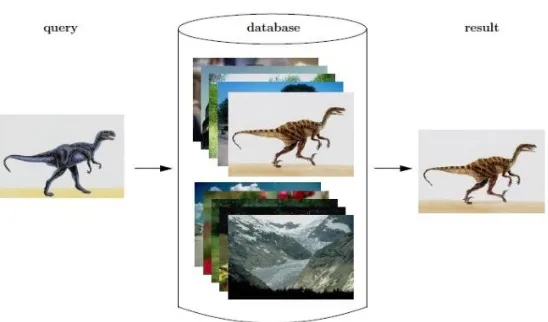
Fig 1: Content – based Image Retrieval System
Efficient Feature extraction techniques become the key to a successful CBIR system. The existing system of Content Based Image Retrieval is all about retrieving objects from an image database that are similar to the object in query [1,5,4]. A single object used to retrieve numerous objects from the database.
What we capture in an image is the 3-D world around us and the world we see around does not always have only a single object in an image capture. An image scene contains multiple objects. This makes it important to detect multiple objects in a scene. Learning features of each of these objects independently is an important task to perform content based image retrieval for each of these objects. This growing need of image retrieval has increased the demand for feature extraction in a scenario of multiple objects.
In the proposed work, we show how an image containing multiple objects is used as an input query to a Content Based Image Retrieval system. Here we deal with detection of multiple objects in an image using Component Labeling. Color and Shape Feature Extraction are carried out for each of the objects in the image.
This paper is organized as follows: Section 2 outlines the overview of the proposed system and also the methods used in the proposed work. Section 3 shows the experimental results of the proposed work. Section 4 presents the conclusion and future work.
II. PROPOSED WORK
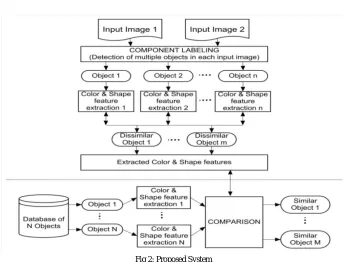
The architecture of the proposed work is divided into 4 components: 1. Component Labeling
2. Color Feature Extraction 3. Shape Feature Extraction 4. Similarity and Mismatch
A. Overview
ISSN(Online): 2320-9801
ISSN (Print): 2320-9798
I
nternational
J
ournal of
I
nnovative
R
esearch in
C
omputer
and
C
ommunication
E
ngineering
(An ISO 3297: 2007 Certified Organization)
Vol. 3, Issue 7, July 2015
Fig 2: Proposed System
B. Component Labeling
The technique used here to detect and extract out multiple objects in a scene is Component Labeling [10]. Component Labeling works only for Binary images. The basic understanding of Component Labeling is such that each foreground pixel of a binary image is labeled with unique values. The label values are then checked for its pixel connectivity. The foreground neighbor pixels of the labeled ones are replaced with the minimum label value in the neighborhood. When a foreground pixel with 2 foreground neighbors carrying different labels is found, the labels associated with the pixels in the neighborhood are called equivalent. The current pixel would be replaced with any one of the equivalent pixels which would lead to the same object having two different label values. The basic method does not resolve this conflict. In order to overcome this disadvantage, a new approach of Component Labeling is used in the proposed work such that it maintains an equivalent class array which contains class identifier for each label value. The label values in the image are each replaced with its respective class identifier [10].
C. Color Feature Extraction
Colors should be represented numerically within a mathematical formula so that they can be projected on computer storage or applications. This formal representation of colors is called as the color models. A color model is a mathematical model which describes the manner in which colors are depicted as tuples of numbers [13]. There are numerous color models existing today, for. E.g. Opponent Color Space, CIE L*u*v model, HSV, RGB and CIE L*a*b model [9,13].
In the proposed work, the input query image is represented in the RGB color space which is then converted to the HSI color model. These conversions are simple procedures that utilize mathematical formulas [9]. The RGB and HSI color models are both device-dependent color models, but the HSI color model is more User-oriented. The chrominance components in the HSI color model, H and S components depend on how human beings perceive the color spectrum. The advantage of using this model is that it separates out the Intensity component from the chrominance components which substantiate the perception of color by the human eye [9].
ISSN(Online): 2320-9801
ISSN (Print): 2320-9798
I
nternational
J
ournal of
I
nnovative
R
esearch in
C
omputer
and
C
ommunication
E
ngineering
(An ISO 3297: 2007 Certified Organization)
Vol. 3, Issue 7, July 2015
After the objects are extracted out from a scene containing multiple objects, the Red, Green and Blue buffer values are retrieved out for each. The Hue component for each extracted object is retrieved. Similar procedure is carried out for the images in the database. Thus extracting color features. The color features are stored as feature vectors.
D. Shape Feature Extraction
Shape features in a geometrical representation describe the part of space occupied by that object and that is defined by the external boundary of the object. There are many shape features that could contribute to efficient shape feature extraction mechanism for CBIR. They are categorized as Region-based and Boundary-based (Contour) shape descriptors [6,14].
In thiswork, the shape features that are used are:
Aspect Ratio:Aspect Ratio is defined as the “ratio between the maximum length of the bounding box to the
minimum length of the bounding box [14]” (Figure 3). It is scale-invariant [6].
Fig 3: Aspect Ratio
Boundary:This feature refers to the external layout of the object under consideration. The boundary of an
object can be traced by using pixel-connectivity. 4-connectivity or 8-connectivity can be employed [14].
Area:This is given by total number of pixels that defines the region of the object or image [6].
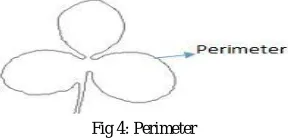
Perimeter:This is given by the count of boundary pixels (Figure 4).
Fig 4: Perimeter
Center of Gravity:CoG is the point in an object where the whole weight of the object is centered. It is simply
the mean of x and y coordinates of each object [14].
Rectangularity:This is given by the max ratio of area of object to area of bounding box. It is given by the
ISSN(Online): 2320-9801
ISSN (Print): 2320-9798
I
nternational
J
ournal of
I
nnovative
R
esearch in
C
omputer
and
C
ommunication
E
ngineering
(An ISO 3297: 2007 Certified Organization)
Vol. 3, Issue 7, July 2015
Fig 5: Rectangularity
Sphericity:It is the “ratios of radius of in-circle to radius of out-circle” (Figure 6). It is simply calculated by
finding distance of nearest and fartherest boundary points from CoG and it is given by their ratio [14,6].
Fig 6: Sphericity
Form Factor:It is a function of area and perimeter.
where ROI : Region of Interest
Compactness: It is a ratio of area to the square of perimeter.
E. Similarity and Mismatch
Color mismatch: The color feature vector of each object in the query image of multiple objects is compared with the color feature vector of every other object in the query image. The objects that throw a mismatch between the R, G and B values are detected as mismatched objects in the scene.
Color similarity: The color feature vectors of each mismatched object in the pair of input image queries are compared with the color feature vectors of the images in the database. The images in the database that have same Hue value as that of the mismatched objects are fetched out of the database.
Shape mismatch: The shape feature vector of each object in the query image of multiple objects is compared with the shape feature vector of every other object in the query image. The objects that throw a mismatch between the computed shape feature values are detected as mismatched objects in the scene.
Shape similarity: The shape feature vectors of each mismatched object in the pair of input image queries are compared with the shape feature vectors of the images in the database. The images in the database that have same shape feature value as that of the mismatched objects are fetched out of the database.
III. EXPERIMENTAL RESULTS
The primary requirement for this work is that a database of geometric planar objects is to be maintained. The color features (RGB values and Hue value) and Shape features (area, aspect ratio, sphericity, rectangularity, form factor, compactness and area) are learnt for each object in the database and the values are stored.
The Input to this work is 2 Images that contain multiple objects in each.
ISSN(Online): 2320-9801
ISSN (Print): 2320-9798
I
nternational
J
ournal of
I
nnovative
R
esearch in
C
omputer
and
C
ommunication
E
ngineering
(An ISO 3297: 2007 Certified Organization)
Vol. 3, Issue 7, July 2015
Color mismatched object in i/p1 Color mismatched object in i/p1
Color mismatched object in i/p2 Color mismatched object in i/p2
ISSN(Online): 2320-9801
ISSN (Print): 2320-9798
I
nternational
J
ournal of
I
nnovative
R
esearch in
C
omputer
and
C
ommunication
E
ngineering
(An ISO 3297: 2007 Certified Organization)
Vol. 3, Issue 7, July 2015 Name: Image1
Size : 256*256
Input1 (i/p 1) Input2 (i/p 2) Otsu threshold for i/p 1 Otsu threshold for i/p2
Component Labeling for i/p1 Component Labeling for i/p2
Feature Extraction for i/p 1
Features for i/p1 Object 1 Object 2 Object 3
Color Features
R 192.00 0.00 0.00
G 0.00 128.00 0.00
B 0.00 0.00 255.00
Hue 0.00 119.00 240.00
Shape Features
Aspect Ratio 0.921875 0.957143 0.465116
Compactness 0.055044 0.036177 0.043778
Sphericity 0.618872 0.326546 0.441383
Rectangularity 0.875000 0.579104 0.794477
ISSN(Online): 2320-9801
ISSN (Print): 2320-9798
I
nternational
J
ournal of
I
nnovative
R
esearch in
C
omputer
and
C
ommunication
E
ngineering
(An ISO 3297: 2007 Certified Organization)
Vol. 3, Issue 7, July 2015 Feature Extraction for i/p2
Features for i/p2 Object 1 Object 2 Object 3 Object 4
Color Features
R 0.00 255.00 0.00 235.00
G 230.00 238.00 0.00 223.00
B 162.00 0.00 255.00 16.00
Hue 163.00 56.00 240.00 57.00
Shape Features
Aspect Ratio 0.921875 0.957143 0.834862 0.904762
Compactness 0.055044 0.036177 0.045675 0.063916
Sphericity 0.618872 0.326546 0.344897 0.670913
Rectangularity 0.875000 0.579104 0.736768 1.025219
Form Factor 0.691349 0.45379 0.573678 0.802785
Shape mismatched object in i/p1 Shape mismatched object in i/p2
ISSN(Online): 2320-9801
ISSN (Print): 2320-9798
I
nternational
J
ournal of
I
nnovative
R
esearch in
C
omputer
and
C
ommunication
E
ngineering
(An ISO 3297: 2007 Certified Organization)
Vol. 3, Issue 7, July 2015
ISSN(Online): 2320-9801
ISSN (Print): 2320-9798
I
nternational
J
ournal of
I
nnovative
R
esearch in
C
omputer
and
C
ommunication
E
ngineering
(An ISO 3297: 2007 Certified Organization)
Vol. 3, Issue 7, July 2015 Color Similar objects from learnt database
ISSN(Online): 2320-9801
ISSN (Print): 2320-9798
I
nternational
J
ournal of
I
nnovative
R
esearch in
C
omputer
and
C
ommunication
E
ngineering
(An ISO 3297: 2007 Certified Organization)
Vol. 3, Issue 7, July 2015
IV. CONCLUSION AND FUTURE WORK
The applications of CBIR are widespread through various fields we come across in our day-to-day lives. With the advent of CBIR, image retrieval has become an easy task provided features are extracted out well in the most efficient way possible. Feature extraction is the key to a successful system that retrieves images on the basis of its visual content. The similarity matching procedure is used to match the feature vectors of image in question with those of the database images.
Shape Similar objects from learnt database
ISSN(Online): 2320-9801
ISSN (Print): 2320-9798
I
nternational
J
ournal of
I
nnovative
R
esearch in
C
omputer
and
C
ommunication
E
ngineering
(An ISO 3297: 2007 Certified Organization)
Vol. 3, Issue 7, July 2015
The ability of the proposed method to work with multiple objects in a scene at once has proved to be very useful since the image we capture in our 3-D world always have multiple objects in a scene and does not always consist of only 1 object per image captured. The analysis of the multiple objects can be done simultaneously in an efficient way.
New shape features that are rotational and translation invariant can be implemented to improve the efficiency for the retrieval of images. This concept of content based retrieval of multiple objects can be deployed into many kid’s toys and games. This can also be deployed into Robots to be used in various fields of mechanics, medical where the robot would pick up the various objects it sees as per need of the user of the robot.
REFERENCES
1. Darshak G. Thakore, A. I. Trivedi, “Content based image retrieval techniques- Issues, analysis and the state of the art”, Proceedings of International Symposium on Computer Engineering & Technology- ISCET 2010, March 2010.
2. PratheepAnantharatnasamy, Kaavyasriskandaraja, VahissanNandakumar and SampathDeegalla, “Fusion of Colour, Shape and Texture Features for Content Based Image Retrieval”, IEEE, Computer Science & Education (ICCE), 2013 8th International Conference, 26-28 April 2013, Colombo.
3. ReshmaChaudhari, A. M. Patil, “Content Based Image Retrieval Using Color and Shape Features”, International Journal of Advanced Research in Electrical, Electronics and instrumentation Engineering, Vol. 1, Issue 5, November 2012.
4. AmandeepKhokher, Rajneesh Talwar, “Content-based Image Retrieval: Feature Extraction Techniques and Applications”, International Conference on Recent Advances and Future Trends in information Technology (iRAFIT2012), Proceedings published in international Journal of Computer Appalications, 2012.
5. P.S. Hiremath, JagadeeshPujari, “Content Based Image Retrieval based on Color, Texture and Shape features using Image and its complement”, International journal of Computer Science and Secuirty, Volume (1):Issue (4), Dec 2007.
6. Dengsheng Zhang, Guojn Lu, “Review of shape representation and description techniques”, Pattern Recognition Society, The Journal of Pattern Recognition Society, July 2003.
7. Hwei-Jen Lin, Yang-Ta Kao, Shwu-Huey Yen, Chia-Jen Wang, “A study of Shape-based Image Retrieval”, Distributed Computing Systems Workshops,2004, Proceedings, 24th International Conference, 23-24 March,2004.
8. Zuoyong Li, Chuancai Liu, Guanghai Liu, Yong Cheng, Xibei Yang, Cairong Zhao, “A novel statistical image thresholding method”, International Journal of Electronics and Communications, Oct. 2009.
9. Noor A. Ibraheem, Mokhtar M. Hasan, Rafiqul Z. Khan, Pramod K. Mishra, “Understanding Color Models: A Review”, ARPN Journal of Science and Technology, Vol. 2, No. 3, April 2012.
10. Luigi Di Stefano, Andrea Bulgarelli, “A Simple and Efficient Connected Components Labeling Algorithm”, ICIAP’99 Proceedings of the 10th International Conference on image Analysis and Processing, Page 322 IEEE Computer Society Washington DC, USA, 1999.
11. B V Patel, B BMeshram, “Content Based Video Retrieval Systems”, International Journal of UbiComp, 2012
12. Dr. Fuhui Long, Dr. Hongjiang Zhang and Prof. David Dagan Feng, “Fundamentals Of Content-Based Image Retrieval”, Multimedia Information Retrieval and Management, Signals and Communication Technology, pp1-26, 2003
13. Harmeet Kaur Kelda, Prabhpreet Kaur, “A Review: Color Models in Image Processing”, International Journal Computer Technology and Applications, Vol. 5(2) ,319-322, March-April 2014.