University of New Orleans University of New Orleans
ScholarWorks@UNO
ScholarWorks@UNO
University of New Orleans Theses and
Dissertations Dissertations and Theses
5-22-2006
A Content-Based Image Retrieval System for Fish Taxonomy
A Content-Based Image Retrieval System for Fish Taxonomy
Fei Teng
University of New Orleans
Follow this and additional works at: https://scholarworks.uno.edu/td
Recommended Citation Recommended Citation
Teng, Fei, "A Content-Based Image Retrieval System for Fish Taxonomy" (2006). University of New Orleans Theses and Dissertations. 377.
https://scholarworks.uno.edu/td/377
A CONTENT-BASED IMAGE RETRIEVAL SYSTEM
FOR FISH TAXONOMY
A Thesis
Submitted to the Graduate Faculty of the University of New Orleans in partial fulfillment of the requirements for the degree of
Master of Science in
The Department of Computer Science
by
Fei Teng
B.S, Beijing University of Posts and Telecommunications, 2003
ACKNOWLEDGEMENTS
I would like to thank Dr. Chen for advising me throughout the master’s study. I am
grateful for his continuous help on this thesis. I must also thank Dr. Fu and Dr. Deng for their
TABLE OF CONTENTS
List of Tables………...iv
List of Illustrations………...v
Abstract………...………vi
Chapter 1: Introduction……….………...…....1
Chapter 2: Related work………..3
Chapter 3: Background Knowledge………..………...6
3.1 Image Used………7
3.2 Geometric Morphometrics………..………...8
Chapter 4: Our CBIR System……….………...11
4.1 An Overview of Our System………11
4.2 Feature Extraction...……….14
Chapter 5: Semantic Classification………17
5.1 Binary Classifiers……….………17
5.2 Feature Selection...……….18
5.2.1 Introduction to Supervised Learning and SVM Algorithm………19
5.2.2 SVM Classifier………21
Chapter 6: Similarity Matching……….………24
Chapter 7: Experimental Methods and Results…….………26
7.3.2 Linear Discriminant Analysis (LDA)………32
7.3.3 Boosting………... ……….…………34
Chapter 8: System Interface…..……….………38
Chapter 9: Discussions………..……….39
Conclusion……….41
Reference………...42
LIST OF TABLES
Table1. Features describing shape characters. Non-shape related variation has been removed
from LMi, the landmark coordinates…….……….………..…………..….………..15
Table2. Results from Semantic Classifier based on 2 features ...28
Table3. Results from Semantic Classifier based on 3 features……….….……28
Table4. Results from Semantic Classifier based on 12 features……….……...29
Table5. Results from Linear Regression of an Indicator Matrix………...32
Table6. Results from LDA……….33
Table7. Boosting Classifier to classify C.carpio / the rest……….35
Table8. Boosting Classifier to classify C.cyprinus / the rest……….36
LIST OF ILLUSTRATIONS
Fig.1 Similar images ………..…..………...4
Fig.2 The structure of the CBIR system…………..………...……….5
Fig.3 Ridge ending and ridge bifurcation………..………..…………..……..6
Fig. 4 Images of specimens from three species………..……….7
Fig. 5 Plot of 650 Carpiodes specimens……….………..9
Fig. 6 CBIR Data Flow Diagram………...………12
Fig. 7 Leaning algorithm………..………..13
Fig. 8 A hierarchical classifier for Carpiodes genus………...………...18
Fig. 9 Support Vector Machine………..……….…...20
Fig. 10 SVM maps the data points to a higher-dimensional feature space………21
ABSTRACT
It is estimated that less than ten percent of the world’s species have been discovered and
described. The main reason for the slow pace of new species description is that the science of
taxonomy, as traditionally practiced, can be very laborious: taxonomists have to manually gather
and analyze data from large numbers of specimens and identify the smallest subset of external
body characters that uniquely diagnoses the new species as distinct from all its known relatives.
The pace of data gathering and analysis can be greatly increased by the information technology.
In this paper, we propose a content-based image retrieval system for taxonomic research. The
system can identify representative body shape characters of known species based on digitized
landmarks and provide statistical clues for assisting taxonomists to identify new species or
subspecies. The experiments on a taxonomic problem involving species of suckers in the genera
Carpiodes demonstrate promising results.
Keywords: Content-based image retrieval, shape analysis, feature selection, image classification,
INTRODUCTION
The AI technology can be defined as: attempting to build artificial systems that will
perform better on tasks that humans currently do better [1]. However, since computer is naturally
better than people in the field of processing huge amount of data, AI is becoming more and more
popular today and has expanded from identifying customers by their voices to automatic pattern
classification. Successful retrieval of relevant images from large-scale image collections is one
of the current problems to AI.
One intuitive solution to image retrieval is text-based annotations and indexing. The
indexing process for large image collections is time consuming. Also, text-based indexing for
images only provides hit-or-miss type searching. If the user does not specify the right keywords,
the desired images may be forever unreachable [2]. To overcome these disadvantages,
researchers developed content-based image retrieval (CBIR), which is the set of techniques for
retrieving images from an image database based on automatically-derived image features [3].
This technology can be used to discover unknown species – It is estimated that less than ten
percent of the world’s species have been discovered and described. The main reason for the slow
pace of new species description is that the science of taxonomy, as traditionally practiced, can be
very laborious: taxonomists have to manually gather and analyze data from large numbers of
specimens, often from broad geographic areas, and identify the smallest subset of external body
characters that uniquely diagnoses the new species as distinct from all its known relatives. The
pace of data gathering and analysis in taxonomy can be greatly increased by the development of
information technology. The Internet is being used to link taxonomists, taxonomic literature and
for remote study of specimens archived as digital images. In this thesis, we propose a
content-based image retrieval system for taxonomic research. The system has a learning component that
can identify representative body shape characters of known species based on digitized landmarks.
The system can also provide statistical clues for assisting taxonomists to identify new species or
subspecies. The experiments on a taxonomic problem involving species of suckers in the genera
Carpiodes demonstrate promising results.
The rest of this thesis is organized as follows. In Chapter 2, we introduce related work
done within the field of image retrieval system. Chapter 3 describes the background information
on a taxonomic problem in the fish genus Carpiodes. Chapter 4 introduces the feature extraction
process. Chapters 5 and 6 presents a joint feature selection and classification approach for
semantic classification based on 1-norm support vector machines (SVMs) and a similarity
matching scheme based on the distance in the overall shape space and semantic classification.
Three other classifiers are tested. Chapter 7 demonstrates extensive experiments on a data set of
Carpiodes and discusses the results. Conclusions and possible future work are given in Chapter 7.
Keywords
Content-based image retrieval, shape analysis, feature selection, image classification, taxonomic
Related Work
Image retrieval algorithms roughly fall to two categories, depending on the query format:
text-based approaches and content-based methods. The analysis of user needs in the photo
archives embracing a variety of subject areas (e.g. museums, advertising mass communications)
suggests that text-based methods will remain the basic access method in the foreseeable future
[4]. The text-based approaches are based on the idea of storing a keyword, a set of keywords, or
a textual description of the image content, created and entered by a human annotator, in addition
to a pointer to the location of the raw image data. Image retrieval is then shifted to standard
database management capabilities combined with information retrieval techniques. As pointed
out by Svenonius [27] and Enser [28], text-based retrieval of images is a vicarious access method,
while visual access methods have a high potential to enhance retrieval capabilities.
The main goal of CBIR is to let the computer identify the descriptions of images: high
level concept such as sunset, human or mountain. It leads to a problem: how can the computer
link the nature of digital images, arrays of numbers, to the semantic words? Currently, CBIR
assumes that semantically relevant images have similar visual features, and uses these features,
such as color, texture, and shape to store, identify and search images. This method retrieves
images based on information automatically extracted from pixels. Initially, researchers focused
on querying by image example, where a query image or sketch is given as input by a user [8, 17,
23, 6, 10, 15, 16, 5, 9, 3, 4, 14]. Later systems incorporated feedback from users in an iterative
refinement process [25, 30, 7]. From a computational perspective, a typical CBIR system views
the query image and images in the database (i.e., target images) as a collection of features. It
ranks the relevance between the query and any target image in proportion to a similarity measure
the content of images. And the similarity measure quantifies the resemblance in content features
between a pair of images [21].
This “bridging the semantic gap” (Zhao & Grosky, 2001) problem is considered one of the
greatest challenges to computer vision scientists. Years of experience in the world gives human
beings the ability to distinguish objects -- people exam a picture from several aspects to decide
what it is. A number of general purpose image retrieval engines have been developed, people
still know little about how to effectively and efficiently select and use primitive features to
identify general images. For instance, figure 1 shows that “beach” and “dessert” are viewed
similar by a CBIR system.
(a) (b)
Figure1. Both (a) and (b) are formed by yellow (brown) region and blue region, which makes
them similar to the CBIR system, while actually (a) is beach and (b) is dessert.
In the commercial domain, IBM QBIC [5] is one of the earliest systems. Recently,
additional systems have been developed at IBM T.J. Watson [10], VIRAGE [11], NEC AMORA
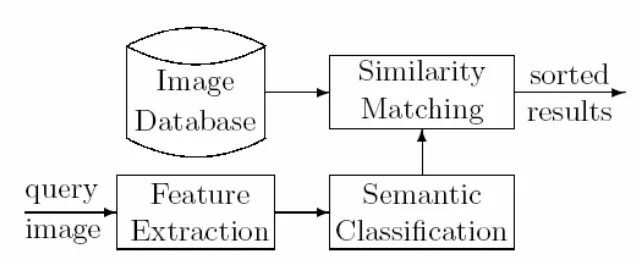
Figure 2: The structure of the CBIR system
However, CBIR is a good solution to specific kind of images, such as medical diagnostics
and fingerprints. Even this kind of pictures is “worse” than ordinary real-life pictures, such as
they often look the same from each others to untrained eyes, this restriction still can effectively
make the algorithm better because:
1. Color is not as important. The color feature can either be treated as discrete values or
colored regions. As shown in Figure1, it is clear that the color feature confuses the
CBIR – if it is understood as discrete values, brown and yellow sand would be identified
different; if it is understood as regions, blue sky and blue water would be identified the
same.
2. Structure of the image is one of the most important features, which makes it possible to
define the features by geometrical functions.
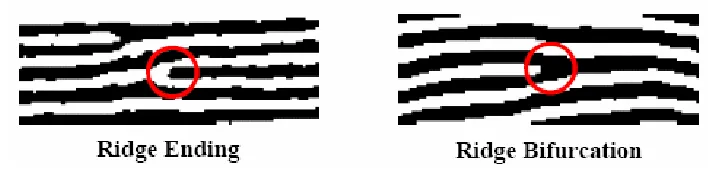
3. The amount of image semantic contents is limited. Figure 3 shows an example of
finger ridges. Representations predominantly based on ridge endings or bifurcations
[31]. Except really special cases, these two classes can represent all kinds of finger
Figure 3: Ridge ending and ridge bifurcation.
A query can be made by an example image and applying partial-match methods to rank retrieved
photos into some calculated similarity order.
So far, CBIR system has been widely utilized in the field of digital forensics, but few
works have been done to apply it to taxonomic research. We know that approximately 1.4
million species are known to science. However, estimates based on the rate of new species
discovery place the total number of species on earth about 10- 30 times of this number. Most
unrecognized species are in poorly studied groups (e.g., insects) occurring in unexplored habitats
(e.g., remote tropical forests). However, a surprising number of new species are still being
discovered in developed countries with long histories of taxonomic research. Human population
expansion and habitat destruction are causing extinctions of both known and yet to be discovered
species. The accelerated pace of species decline has fueled the current biodiversity crisis [18], in
which it is feared that many of the earth’s species will be lost before they can be discovered and
described.
The thesis proposed a CBIR system that can be used to assist taxonomists in discovering
Background Knowledge
1. Dataset
The image database used in this thesis comprises digital photographs of suckers of genus
Carpiodes. However, our approach can be applied to any fish populations. The genus Carpiodes,
as currently recognized, comprises three widely distributed species: the river carp-sucker
Carpiodes carpio (C. carpio); the quillback Carpiodes cyprinus (C. cyprinus), and the highfin
carp-sucker Carpiodes velifer (C. velifer). Figure 4 shows representative images of specimens of
the three species. Most taxonomists regard each of these species as a complex of multiple
biological species in need of revision [24]. The goal of the taxonomic revision in this case is
to identify and formally describe the unrecognized species.
Figure 4: Images of specimens from three species of the genus Carpiodes: C. Carpio, C.
2. Geometric Morphometrics
Over the past decade, geometric morphometric techniques have been developed for
analyzing variation in body shape using a collection of coordinates of biologically definable,
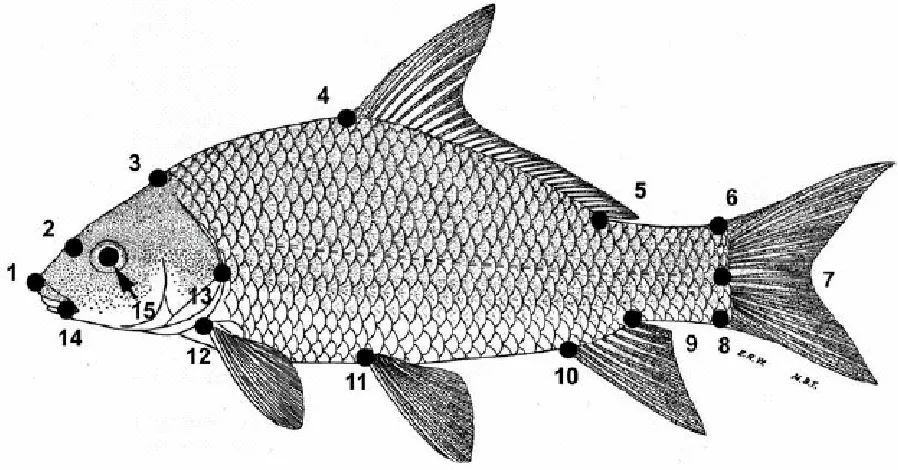
homologous landmarks along the body outline [1]. Figure 5 shows 15 homologous landmarks
digitized on a specimen using the TpsDIG software tool developed by F. James Rohlf of SUNY
Stony Brook2. The analysis methods accompanying the software focus on the landmark
coordinates and geometric information about their relative positions. Through the alignment of
landmarks and statistical analysis of the derived shape variables, groups of specimens may be
identified as distinct in overall shape space. Unfortunately, the current geometric morphometric
methods have two major limitations that hinder successful applications in taxonomic revision
tasks:
• Groups of specimens are distinguished from other populations based on a small set of
derived variables, which are usually functions (in their simplest form, linear
combinations) of all shape variables. As such, derived variables are difficult to
interpret in terms of particular body characters that taxonomists commonly use in
diagnosing new species.
• Shape variation of specimens from closely related species or subspecies may not be
discernible in overall shape space. Therefore, current geometric morphometric methods
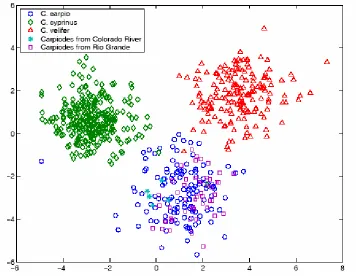
Figure 5: Plot of 650 Carpiodes specimens representing three distinct morphotypes on the first
two canonical variate axes based on derived shape variables from geometric morphometric
analysis of landmark data.
Over the years since [24] was published, Dr. Bart has examined shape and DNA
sequence variation in all Carpiodes populations. Figure 5 shows the results of an analysis of
overall body shape based on a geometric morphometric technique using canonical variate
analysis (CVA). CVA grouped specimens from the Rio Grande (squares), upper Colorado River
(stars), and other western Gulf Slope rivers with C. carpio specimens (circles) from the
Mississippi River Basin. However, a surprising finding from the DNAsequence analysis was that
the forms in Rio Grande and upper Colorado River system of Texas do not agree at all with C.
carpio. Rather, they are closely related to C. cyprinus, which was not known to occur on the
western Gulf Slope. Careful inspection of Carpiodes specimens in the Rio Grande and upper
is diagnostic of C. carpio and C. velifer. They also have a relatively large head and a long snout,
characters seen only in C. cyprinus. However, specimens from these populations also have an
elongate and slender body, and it is these characters that cause them to be erroneously classified
as C. carpio based on overall body shape analysis. It took Dr. Bart three years of careful study of
over 1000 Carpiodes specimens to determine that Rio Grande and upper Colorado River
populations were misdiagnosed as C. carpio, and instead represented a new species related to C.
cyprinus. The question this thesis addresses next is: Can CBIR based on shape features be
applied in a way that diagnoses taxonomic groups in genus Carpiodes more quickly and
The CBIR System
1. An Overview of Our System
The nature of taxonomic research brings the following requirements to the design of an
image retrieval system:
• Text query: Images of specimens from a natural history museum (i.e., the image
database) almost always have textual annotations, e.g., location and date of capture, size
of specimen, species, etc. Therefore, the image retrieval system should support
text-based searches.
• Query by example: A typical usage scenario of the system is to find specimens in the
database that are “semantically similar” to the query specimen based on the query image.
This is clearly a query by example situation. From a taxonomic research point of view,
the image semantics is defined as groupings of related specimens at different
hierarchical levels, which, in the science of taxonomy, are referred to as taxa of varying
rank, i.e., families, genera, species complexes, species, and subspecies.
• Learning component: For the query by example process, the system needs certain
mechanisms to associate feature similarity with semantic similarity, i.e., bridging the
semantic gap. One possible way is to include a learning component capable of
identifying the feature characters that unite populations within each semantic class as
well as distinguishing among semantic classes.
In this thesis, we focus on the CBIR part of the system. Specifically, we propose a
computational framework for categorizing semantic classes of populations based on body shape
the taxonomic research in the following ways:
• It provides taxonomists a tool of efficient searching, browsing, and retrieving images of
specimens archived in natural history museums at distant locations.
• It automatically identifies an “optimal” set of body characters that unites populations
within species, as well as distinguishes among species. Hence it can provide statistical
clues in assisting the discovery of new species or subspecies.
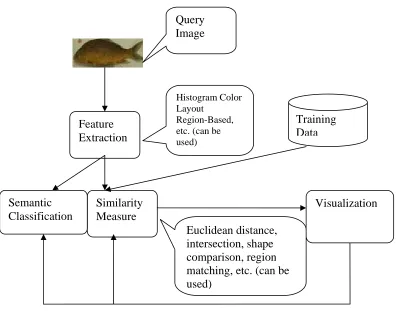
As shown in Figure 6, the system has three major components: Feature Extraction,
Semantic Classification, and Similarity Measure.
Training Data Feature
Extraction
Similarity Measure
Visualization
Histogram Color Layout
Region-Based, etc. (can be used)
Euclidean distance, intersection, shape comparison, region matching, etc. (can be Semantic
Classification
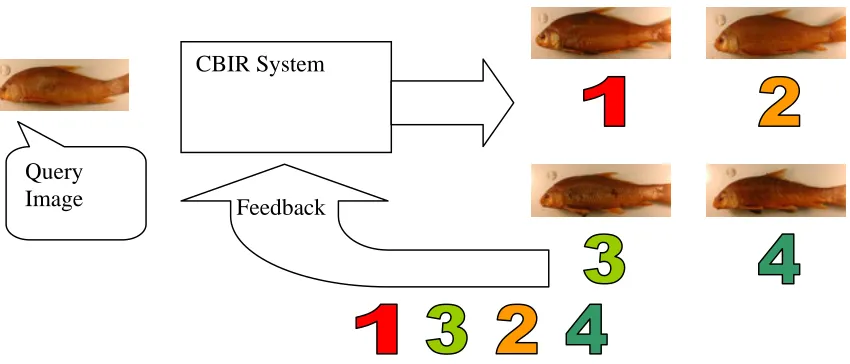
Figure 7: CBIR can be trained by the user
Most learning algorithms should be able to be taught by the user. The CBIR calculates
the similarity between the query image and images in its database, returns the neighbors by the
order of their distances. As shown in figure 7, if the system is given the result 1,2,3,4 and the
user knows that the current answer should be 1,3,2,4, he can tell this to the learning algorithm,
which would learn this issue and rebuild the classifiers. However, this function has not been
realized in our system since a species is just a species. It does not make sense to say that one
velifer is closer to the query velifer than another velifer. CBIR System
Feedback Query
2. Feature Extraction
Figure 6: Digitized 15 homologous landmarks using TpsDIG Version 1.4 (2004 by F. James
Rohlf ).
We focus on the digitized images of specimens with landmarks specified as in Figure 3.
Let LMj, j = 1, · · · , 15, be the coordinates of landmarks on a specimen. We used the technique of
Generalized Procrustes Analysis [12] to remove non-shape related variation in landmark
coordinates. Specifically, the centroid of each configuration (based on the 15 landmarks
associated with each specimen) was translated to the origin, and configurations were scaled to a
common unit size. We computed 12 features, x1, · · · , x12, for each specimen using the 15
• x1–x7: They describe shape characters that can be easily identified visually, for example,
the size of head, the length of body, the distance between the tip of the snout and the
nostril, the size of head in proportion of body size, etc.
• x8–x12: They can be easily evaluated from the landmark coordinates, but may not have a
straightforward visual interpretation. These are the features that a domain expert may
not identify easily, but are candidates of good indicators.
All 12 features were normalized across the specimens via translation and scaling.
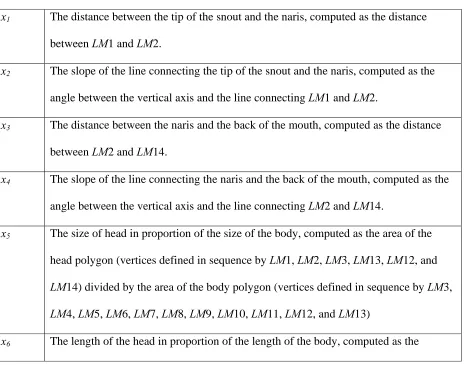
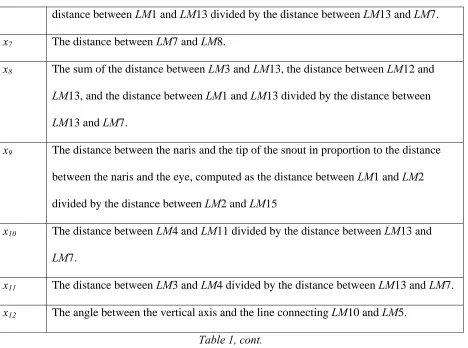
Table 1: Features describing shape characters. Non-shape related variation has been removed
from LMi, the landmark coordinates.
x1 The distance between the tip of the snout and the naris, computed as the distance
between LM1 and LM2.
x2 The slope of the line connecting the tip of the snout and the naris, computed as the
angle between the vertical axis and the line connecting LM1 and LM2.
x3 The distance between the naris and the back of the mouth, computed as the distance
between LM2 and LM14.
x4 The slope of the line connecting the naris and the back of the mouth, computed as the
angle between the vertical axis and the line connecting LM2 and LM14.
x5 The size of head in proportion of the size of the body, computed as the area of the
head polygon (vertices defined in sequence by LM1, LM2, LM3, LM13, LM12, and
LM14) divided by the area of the body polygon (vertices defined in sequence by LM3,
LM4, LM5, LM6, LM7, LM8, LM9, LM10, LM11, LM12, and LM13)
distance between LM1 and LM13 divided by the distance between LM13 and LM7.
x7 The distance between LM7 and LM8.
x8 The sum of the distance between LM3 and LM13, the distance between LM12 and
LM13, and the distance between LM1 and LM13 divided by the distance between
LM13 and LM7.
x9 The distance between the naris and the tip of the snout in proportion to the distance
between the naris and the eye, computed as the distance between LM1 and LM2
divided by the distance between LM2 and LM15
x10 The distance between LM4 and LM11 divided by the distance between LM13 and
LM7.
x11 The distance between LM3 and LM4 divided by the distance between LM13 and LM7.
x12 The angle between the vertical axis and the line connecting LM10 and LM5.
Semantic Classification
1. Binary Classifiers
Semantic classification in our CBIR system targets the following taxonomic problem:
given a collection of labeled specimens (xi' ) represented in a feature space, identify features s
and construct classifiers based on the selected features to distinguish among the known
categories (or species). This problem is closely related to taxonomic revision: if the classifiers
indeed capture the shape properties describing the known species, the classifiers will be helpful
in discovering new species whenever there is shape variation between the new species and all the
known species. For example, if the classifiers assign a group of unlabeled specimens, which are
believed to be taken from the same (but unknown) species, to several known species without a
strong preference on a particular species, it is likely that the unlabeled specimens belong to a
new species in need of description.
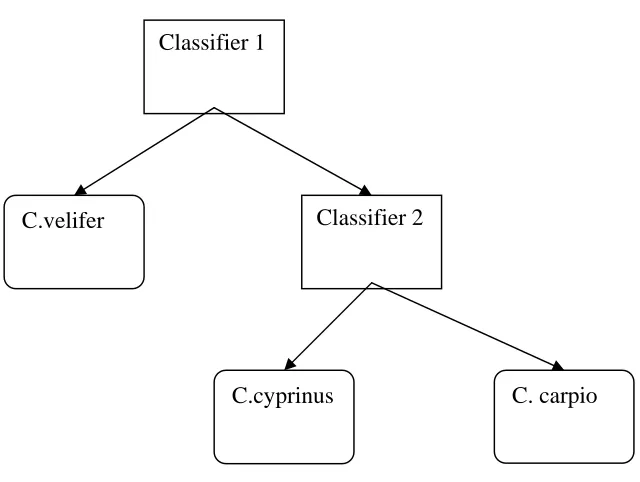
The classification of xiis clearly a multi-class problem. We propose to use a tree
structure to organize binary classifiers into a multi-class classifier. For example, Figure 8 shows
a hierarchical classifier consisting of two binary classifiers for the identification of all three
known species in Carpiodes genus. Finding an “optimal” structure is an interesting research
topic for its own sake, but is beyond the scope of this thesis. Here we assume the structure is
determined beforehand.
For a given collection of samples xi with the corresponding labelsyi∈{−1,1}, designing
a binary classifier can be solved by any conventional supervised learning algorithm. However,
we argue that feature selection is indispensable in our system for the following reasons. From a
Figure 8: A hierarchical classifier for Carpiodes genus.
diagnose a species as distinct from its known relatives. The feature selection procedure can
identify those “most” diagnostic features (in this case, body shape characters). From a machine
learning viewpoint, constraining the number of selected features is an effective way to avoid
overfitting. The experimental results in the following section also demonstrate the efficacy of
feature selection in avoiding potential overfitting.
2. Feature subset Selection
Feature subset selection is a well-researched topic in the areas of statistics, machine
learning, and pattern recognition [13, 28]. Existing selection approaches generally fall into two Classifier 1
C.velifer
C.cyprinus
Classifier 2
classification approach. They tend to produce better generalization but may require expensive
computational cost.
2.1 Introduction to Supervised Learning and SVM Algorithm
Supervised learning is a machine learning technique for creating a function from training
data (from Wikipedia.org). The training data consist of vectors (data) and class labels. The
function predicts the value of any valid input object after having learned a number of training
examples. It is a global model that maps input objects to desired outputs.
A support vector machine is a supervised learning algorithm developed over the past
decade by Vapnik and others (Vapnik, Statistical Learning Theory, 1998). SVM algorithm
addresses the general problem of learning to discriminate between positive and negative
members of a given class of n-dimensional vectors [33].
The main idea of this algorithm is to do classification by building a hyperplane in the
N
R space and checking at which side the vector (sample) stays. It can be described as finding a
hyperplane at that space separating the positive from the negative samples. As shown in figure 9,
there may be many separating planes. The statistical learning theory suggests that, for some
classes of well-behaved data, the choice of the maximum margin hyperplane tends to lead to
good generalization when predicting the classification of previously unseen examples (Vapnik,
Statistical Learning Theory, 1998). Sometimes, there is no separating hyperplane, which makes
the “maximum margin” algorithm unusable. Corinna Cortes and Vapnik suggested a modified
idea that allows for mislabeled examples in 1995, which is called soft margin.
-- The margin is understood as the distance from the plane to both classes’ closest data points.
Figure 9: the SVM chooses the plane that maintains a maximum margin from any point in the
training set
This operation may be described by decision functiony=sign(wTx+b), where w is the
vector orthogonal to hyperplane, b is the distance from hyperplane to the origin. In figure 9,
hyperplane A (B) is wTx+b=−1(wTx+b=1). SVM calculates (w,b) from the training data to
achieve the maximum margin 2/w and would like there is no data points between A and B – no
data points between A and B means y(wTx+b)≥1.
Unfortunately, it might be impossible to find a linear solution in the original input space.
The SVM algorithm then uses kernel functions to map the data points to a higher-dimensional
space and find a hyperplane there. Intuitively we can image this transformation would bring Maximum
Margin
Figure 10: SVM maps the data points to a higher-dimensional feature space
The relationship between the kernel function K and the mapping
(.)
φ isK(x,y)=<φ(x),φ(y)>. Intuitively, K(x,y) represents the similarity between x and y. The
great thing here is that we can directly compute K(x,y) without going through the map φ(x),
while the only requirement of this trick is that there is a φ(x) to this kernel.
In many real-world problems such as our CBIR system, the number of negative (positive)
samples is much larger than the number of positive (negative) samples, which would over-train
the classifier – the classifier would treat the weaker class as noise. In our system, we give
different weights to the training data and test data. Also, since our system is a multi-class case
and SVM can only handle one-on-one problem, we use a “one against others” structure as it is
shown figure 8.
2.2 SVM Classifier
The proposed approach is a wrapper model based on 1-norm SVM. Consider the problem
of finding a linear classifier
)
(w x b
sign
y= T +
where w and b are model parameters. The SVM approach constructs classifiers based on
regularization operator, λ is called the regularization parameter, and erroris commonly defined
through a hinge loss function
} 0 ), (
1
max{ −y wTx+b
= ε
When an optimal solution w is obtained, the magnitude of its component wkindicates the
significance of the effect of the k-th feature on the classifier. Those features corresponding to a
non-zero wk are selected and used in the classifier.
The regularization operator in standard SVMs is the 2-norm of the weight vector w,
which formulates SVMs as quadratic programs (QP). Solving QPs is typically computationally
more expensive than solving linear programs (LPs). SVMs can be transformed into LPs as in
[31]. This is achieved by regularizing with a sparse-favoring norm, i.e., the 1-norm of w,
∑
= kwk
w
1
Thus 1-norm SVM is also referred to as sparse SVM and has been similarly applied to other
practical problems such as drug discovery in [2].
Many practical problems in image classification relate to imbalances in samples, i.e., the
number of negative samples is much larger than the number of positive samples. To tackle this
imbalanced issue and make classifiers biased towards the minority class, we penalize differently
on errors produced respectively by positive samples and by negative ones.
Rewrite wk =uk −vk whereuk,vk ≥0. If either ukor vk has to equal to 0, thenwk =uk +vk.
− + − − + + = − = = +
=
=
≥
=
≥
=
≥
+
+
−
−
=
≥
+
+
−
−
+
+
+
∑
∑
∑
+ −l
j
l
i
d
k
v
u
l
j
b
x
v
u
l
i
b
x
v
u
t
s
l
u
l
u
v
u
j i k k j j T i i T l j j l i i d k k k,...,
1
,
,...,
1
,
0
,
,...,
1
,
0
,
,...,
1
,
1
]
)
[(
,...,
1
,
1
]
)
[(
.
1
)
(
min
1 1 1η
ε
η
ε
η
ε
λ
θwhere x i+ and
−
j
x denote a positive sample and a negative sample, respectively, ε and η are
hinge losses, 0 <u < 1 is a constant penalizing the errors from positive and negative samples,
) ( −
+ l
Similarity Matching
The image similarity measure consists of two parts. The first part corresponds to the
semantic similarity, which is determined by semantic classifier in previous section. If two
specimens belong to the same semantic class, their similarity is the maximum, otherwise the
similarity is zero. Specifically, the semantic similarity between two specimensx i and x j is
defined as ⎩ ⎨ ⎧ = otherwise class same the in are x and x x x
s i j i j
0 1 ) , ( 1
The second part reflects the overall shape similarity, and is defined as
2 2
)
,
(
2 δ j i x x ji
x
e
x
s
− −
=
where σ2 is chosen to be the sample variance of the overall shape distance. Note that xi−xj is
the distance in the shape space, hence describes the overall shape difference between two
specimens. The similarity measure is then defined as a convex combination of semantic
similarity and overall shape similarity:
)
,
(
)
1
(
)
,
(
)
,
(
x
ix
js
1x
ix
js
2x
ix
js
=
α
⋅
+
−
α
⋅
mainly return images that are semantically similar to the query, i.e., specimens in the same group.
Experimental Results
We test the proposed CBIR system on the specimens from the three Carpiodes
morphotypes: C. carpio, C. cyprinus, and C. velifer. The current database contains only 600
images of Carpiodes specimens. However, the proposed computational framework can be
applied to any number of images at any level of fish taxonomy. We are working to expand the
database by including images of specimens of a related group of suckers in the genus Ictiobus.
Our experiment consists of two steps:
• Demonstrating the efficacy of semantic classification by identifying features (or body
characters) for distinguishing among the three Carpiodes morphotypes;
• Applying the system to a taxonomic revision problem involving populations from
Colorado River in Texas and Rio Grande and comparing the results with those based
on the DNA analysis.
1. Experiment based on known fish
The images within each class are randomly divided into a training set and a test set of
equal size. The hierarchical classifier first separates C. velifer-like specimens from specimens of
other species. It then distinguishes C. carpio from C. cyprinus.
We apply the 1-norm SVM to select features and build classifiers simultaneously. The
subspecies.
If the query image is in the training database, the system gives the results by
calculating
s
(
x
i,
x
j)
=
α
⋅
s
1(
x
i,
x
j)
+
(
1
−
α
)
⋅
s
2(
x
i,
x
j)
, where s1(xi,xj)equals 0 or 1.If the query image is not in the training database, s1(xi,xj)has to be calculated
byy=sign(wTx+b).
Our proposed algorithm is a wrapper, i.e., the feature selection step is combined with the
classifier. + − − − + − − + + = − = = +
+
=
=
=
≥
=
≥
=
≥
+
+
−
−
=
≥
+
+
−
−
+
+
+
=
∑
∑
∑
− +l
l
l
l
j
l
i
d
k
v
u
l
j
b
x
v
u
l
i
b
x
v
u
to
subject
l
l
v
u
Z
j i k k j j T i i T l j j l i i d k k kµ
η
ε
η
ε
η
µ
ε
µ
λ
,...,
1
,
,...,
1
,
0
,
,...,
1
,
0
,
,...,
1
,
1
]
)
[(
,...,
1
,
1
]
)
[(
1
)
(
min
1 1 1A suitable regularization operator that penalizes large variations of w can reduce
overfitting. In the linear problem above, it makes some of wk =0,k∈[1,12] to do the feature
selection, and it is intuitive that the larger theλ, the fewer features would be selected. There is
no particular way to calculate theλ, we have to try several values to achieve our goals (to select
a certain number of features).
The error rate is defined as the number of misclassified samples over the total number of
Performance based on 2 features:
Table 2: Results from Semantic Classifier based on 2 features
Class Selected Features Training Error Test Error
C.velifer / the rest x10,x11 10% 11.7%
C.carpio / C.cyprinus x4,x7 12.9% 13.9%
From the results above, we can see that different classifiers need different features (since
we are using a wrapper). The best sub-feature space for distinguishing C.velifer and the rest is
11 10,x
x , and the best sub-feature space for distinguishing C.carpio and C.cyprinus is x4,x7.
Performance based on 3 features:
Table3. Results from Semantic Classifier based on 3 features
Class Selected Features Training Error Test Error
C.velifer / the rest x10,x11,x4 10.2% 11.8%
C.carpio / C.cyprinus x4,x7,x3 13.1 % 14%
We observe that the performance based on three selected features is similar to that based
on two selected features. Moreover, we should notice that one more feature does not mean lower
error rates – it may result in larger errors.
Performance based on all features:
C.velifer / the rest All 12 features 8.9% (Linear) 9.8%
C.carpio / C.cyprinus All 12 features 16.5% (Gaussian) 17.3%
Table 4, cont.
From the results above, we can see that all 12 features lead to better performance to
distinguish C.velifer and the rest, but worse performance to distinguish C.carpio and C.cyprinus.
From the results above, we can say that using 12 features cannot guarantee the best result.
However, this conclusion is incomplete since we have not use the classifiers to test suspicious
examples (may be C.velifer, C.carpio, C.cyprinus or other species).
2. Experiment with suspicious fish
Test our CBIR system based on 53 specimens from upper Colorado River in Texas and
the Rio Grande. They were traditionally recognized as C. carpio, yet recent DNA evidence
suggests that both populations are more closely related to C. cyprinus. So we view these 53
specimens as “suspicious” populations. Each “suspicious” specimen is submitted to the system
as a query image. The predicted class label of the query is determined by the majority class
among the top k retrieved images (specimens). We observed that the results are robust for k
varying from 10 to 60. So we pick k = 20. We first set the parameter αin the similarity measure
(1) 0.1. This corresponds to retrieving specimens that are similar to the query based on the
overall shape. It turns out that 52 out of the 53 suspicious specimens are recognized as C. carpio,
and only 1 specimen is identified as C. cyprinus. In other words, the overall shape suggests that
the “suspicious” specimens should be classified as C. carpio. Next, we increase αto 0.9, i.e., the
decision is based mainly on the semantic classifiers. In this case, 23 “suspicious” specimens are
identical results for α= 1.0. Although the hierarchical classifier can distinguish the three species
with reasonable accuracy using only four body shape characters, it has difficulty categorizing the
specimens from Colorado River in Texas and Rio Grande as either C. carpio or C. cyprinus;
43.4% of the “suspicious” specimens are assigned to C. carpio, and 56.6% to C. cyprinus. At the
same time, the retrieved images based on overall shape identify 52 out of 53 specimens as C.
carpio. These contradictory results can be viewed as an indication that the suspicious specimens
represent a new species. It is very interesting that overall shape analysis and the DNA analysis
give similar results: the suspicious specimens are more similar to C. carpio than to C. cyprinus in
terms of the overall shape, yet they are genetically closer to C. cyprinus. Note that our CBIR
system can easily obtain a similar conclusion by adjusting the value of parameter α.
3. Experiment with Suspicious Fish using Other Pattern Classification Techniques
These techniques are different from the algorithm introduced above. They simply build
classifiers that identify all 3 classes simultaneously. We use these classifiers to identify the
suspicious images and evaluate the results. Among the suspicious samples, if
1. None of these percentage values are much larger than the other two or two of them are
much larger than the other one. Since we know these suspicious samples are from one
class, we can make a decision that these fish are not from C.velifer, C.carpio or
C.cyprinus. They are from a new species.
2. One of them is much larger than the other two. Since we know these suspicious
3.1 Linear Regression of an Indicator Matrix
Under the assumption that the decision boundaries are linear, we can consider the
probability of an input x of being classified into class m as fm(x)=βm.0 +βmTx. X would be
labeled as class m if fm(x)> fi(x),i=1,...,d, where d is the number of classes. For every two
classes, there is a separating hyperplane in the input space.
The basic idea of is “Linear Regression of an Indicator Matrix” is to code each response
category via an indicator variable. For example, if we have 4 training examples belongs to class
1, 2, 3, 4, the indicator matrix is
⎥ ⎥ ⎥ ⎥ ⎦ ⎤ ⎢ ⎢ ⎢ ⎢ ⎣ ⎡ = 1 0 0 0 0 1 0 0 0 0 1 0 0 0 0 1
Y , then fm(x)=βm.0 +βmTxcan be rewritten as fm(x)=[1,xT]βm,
where m XTX 1XTym
)
( −
=
β .
SinceE(Yk |X =x)=Pr(Yk =1|X =x)*1+Pr(Yk =0|X =x)*0=Pr(Yk =1|X =x), we can
simply compute[1,xT]B, whereB=(XTX)−1XTY. The result is a row vector of d elements and
the largest one represents the class on which x lies.
Since the problem is to identify the suspicious images, we use all known images as the
training data and the 53 fish as the test data. Since “Linear Regression of an Indicator Matrix” is
also a linear classifier, we used the features selected for the semantic classifier. Note that these
sub-features may not be the optimal one, but it is a workable one since it is selected linearly. The
results from Linear Regression of an Indicator Matrix are listed below.
Table5. Results from Linear Regression of an Indicator Matrix
C.cyprinus, C.velifer]
were misclassified to
other species.
suspicious fish were
classified to
[C.carpio,
C.cyprinus, C.velifer]
percentage-values of
[C.carpio,
C.cyprinus, C.velifer]
All 12 features [20.31%, 1.68%,
2.32%]
[50, 3, 0] [94.34%, 5.66%, 0]
7 4,x
x [99.22%, 2.02%,
15.12%]
[0, 47, 6] [0, 88.68%, 11.32%]
11 10,x
x [72.66%, 13.13%,
12.21%]
[44, 9, 0] [0, 83.02%, 16.98%]
11 10 7 4,x ,x ,x
x [28.90%, 3.37%,
5.23%]
[45, 8, 0] [0, 84.91%, 15.09%]
Table 5, cont.
From this table, we can observe:
1. Using 12 features, the classifier is not good at identifying C. carpio and identifies the 53 fish
as C.carpio..
2. The classifier gives totally different result with different feature selection.
Given the result that the suspicious fish are from a new species, we know that Linear
distributions are Gaussian densities ∑ = = − − −
∑
) ( 2 ) ( 2 / 1 2 / ) 2 ( 1 ) | ( k k T k x x k p e K G x p µ µπ and all classes
have a common covariance matrix, we can say that the decision boundary between any two
classes is a hyperplane. These linear discriminant functions
are log ( )
2 1 )
(x x 1 1 p k
f T k kT k
k =
∑
−µ − µ∑
−µ + , which can be derived from) ( ) ( ) ( 2 1 ) ( ) ( log ) | Pr( ) | Pr(
log 1 1 k j
T j k T j k x j p k p x X j G x X k G µ µ µ µ µ µ + − + − − = = = = =
∑
∑
− −In the class conditional distributions, we can estimate the mean vector as
∑
= = k g i k k i x N 1
µ . The
covariance matrix is estimated as
∑
∑
∑
= = − − − = k g T k i k i K k i K N x
x )( ) /( )
(
1
µ
µ . p(k)=Nk/N
Since the problem is to identify the suspicious images, we use all known images as the
training data and the 53 fish as the test data. Since this classifier is not time-consuming, we tried
all combinations of any 2 features to achieve the best result. The results from Linear Regression
of an Indicator Matrix are listed below.
Table6. Results from LDA
Class Selected Features Training Error Test Error Suspicious Fish
C.velifer / the rest x10,x2 6.0% 8.6% 0 velifer
C.carpio / C.cyprinus x1,x7 10.3% 20.1% 21 Cyprinus, 31 Carpios
C.velifer / the rest All 12 features 5.1% 8.0% 0 velifer
Same as the semantic classification, the classifier identifies the suspicious fish as a new species if
we select features. With all 12 features, the LDA classifies most of the samples to carpio.
Furthermore, as we tried different training/test bipartitions, the LDA selected different
sub-features to achieve the best result. We observe that feature 10 will always be used to distinguish
velifer/ the rest and feature 7 will always be used to distinguish carpio/cyprinbus.
3.3 Boosting
Boosting was formulated based on an interesting result from machine learning: learners,
each performing only slightly better than random guess (“week learners”), can be combined to
form an arbitrary “strong” classifier.
The AdaBoost algorithm is:
Given training data (x1,y1),...,(xm,ym)wherexi∈X,yi∈{1,−1}. InitializeD1(i)=1/m,
For t=1,…,T
1. Train weak learner h1:X->{1,-1} using distribution Dt.
2. Compute error
∑
≠
=
i i
t x y
h i
i
t D i
) ( : ) ( ε
3. Choose ln(1 )
2 1 t t t ε ε α = − 4. Update ⎪⎩ ⎪ ⎨ ⎧ ≠ = = − + i i t i i t i t t y x h e y x h e Z i D i D t t ) ( ) ( * ) ( ) ( 1 α α
, where Ztis a normalization factor (chosen so
step 3, we can observe that a smaller error corresponds to a largerαt, which means a stronger
weaker classifier is “heavier” in the final decision. Also, in each round, step 4, the sample
distribution is also updated. The weights for all misclassified samples are increase, while the
weights for the rest samples are reduced. Intuitively, the misclassified samples will receive
higher attention in the next learning iteration.
This algorithm will generate 3 relatively good classifiers from the weak LDA classifier.
Each classifier can only recognize one class (one against others).
The first one is to distinguish C.carpio / the rest
Table7. Boosting Classifier to classify C.carpio / the rest
Selected Features Training Error
[t=1,…,t=10] (%)
Test Data
(with best T)
[C. carpio, the rest]
Percentage-values of
[C.carpio, the rest]
All 12 features [14.91, 7.70, 5.86,
6.03, 6.36, 6.19, 6.03,
6.19, 6.19, 6.19]
[53, 0] [100%, 0]
7 1,x
x [21.44, 20.26, 11.39,
11.39, 9.38, 9.04,
9.21, 9.04, 9.04,
9.04]
[26,27] [49.06%, 50.94%]
2 10,x
x [17.42, 10.05, 10.72,
9.55, 8.37, 8.04, 8.04,
8.04, 8.04, 8.04]
Following is the classifier 2, which identifies C.cyprinus / the rest.
Table8. Boosting Classifier to classify C.cyprinus / the rest
Selected Features Training Error
[t=1,…,t=10] (%)
Test Data
(with best T)
[C. carpio, the rest]
Percentage-values of
[C.carpio, the rest]
All 12 features [2.68, 1.67, 1.34,
1.17, 1.17, 1.17, 1.34,
1.34, 1.34, 1.34]
[41, 12] [77.36%, 22.64%]
7 1,x
x [7.53, 6.70, 6.53,
6.03, 6.03, 6.19, 6.19,
6.19, 6.19, 6.19]
[25, 28] [47.17%, 52.83%]
2 10,x
x [25.29, 25.46, 25.12,
24.28, 2.84, 2.84,
2.84, 2.84, 2.84,
2.84]
[25, 28] [47.17%, 52.83%]
Following is the classifier 2, which identifies C.cyprinus / the rest.
Table9. Boosting Classifier to classify C.velifer / the rest
Selected Features Training Error
[t=1,…,t=10] (%)
Test Data
(with best T)
Percentage-values of
4.18, 4.18, 3.85]
7 1,x
x [28.98, 25.63, 22.45,
16.75, 17.76, 17.92,
17.76, 17.76, 17.76,
17.59]
[30, 23] [56.60%, 43.40%]
2 10,x
x [12.73, 13.40, 11.55,
11.72, 11.56, 11.39,
11.39, 11.39, 11.39,
11.39]
[0, 53] [0, 100%]
Table 9, cont.
The classifiers achieved totally different results with different feature selections.
However, since the features we used are from a wrapper feature selection algorithm, the result
with 12 features is more reliable. From classifier C.carpio / the rest, we know that 100%
suspicious fish are from C.carpio. From classifier C.cyprinus / the rest, we know that 77.36%
suspicious fish are from C.cyprinus. From classifier C.velifer / the rest, we know that none of the
suspicious fish are from C.velifer. The contradictory from the first 2 classifiers and classifier 3’s
System Interface and Conclusion
1. System Interface
The system has a simple CGI-based query interface. Users can either enter the ID of an
image as the query or submit any image (along with a file containing the landmarks) via the
Internet. Figure 6 shows the 25 thumbnails returned by the system where the query image (C.
Cyprinus) is on the top left. The parameter αin (1) was chosen to be 0.8. Below each thumbnail
are image ID and the name of its taxonomic category. Users can start a new query search by
submitting a new image ID or image files.
section. We tested two classifiers, namely, linear SVM and SVM with Gaussian kernel. All the
classifiers were constructed using half of the 600 specimens and tested over the remaining 300
specimens. The 12-feature classifiers generate significantly different predictions on the 53
“suspicious” specimens from the selected-feature classifiers. Both classifiers assign the majority
of the 53 specimens to C. carpio, which contradicts the results generated by 1-norm SVM. An
interesting question arises: which results should we trust, those based on the selected features or
those using all the features? We argue that feature selection is indispensable for the following
reasons:
• From a taxonomic viewpoint, it is desirable to use a small number of body shape
characters to describe a species as distinct from its known relatives. The feature
selection procedure can identify those “most” diagnostic features (or body shape
characters).
• From a machine learning viewpoint, constraining the number of selected features is an
effective way to avoid overfitting. One may reason that the above conflicting result for
Colorado River and Rio Grande specimens is due to overfitting, i.e., the models trained
on all 12 features overfit the data.
For the other 3 pattern classification techniques, Linear Regression of an Indicator Matrix and
Linear Discriminant Analysis (LDA) do not work well on this problem. AdaBoost is good at
improving the performance of LDA and produced a classifier that can identify all four classes
(C.carpio, C.cyprinus, C.velifer and suspicious fish) correctly with 12 features. However, since
“from a taxonomic viewpoint, it is desirable to use a small number of body shape characters to
describe a species as distinct from its known relatives”, we cannot say that it will work on more
3. Thesis Conclusion
In this thesis, we proposed a content-based image retrieval approach for taxonomic
research. The system has a learning component that automatically identifies the semantic class of
a query based on digitized landmarks. We applied the system to a taxonomic problem in genus
Carpiodes. The results are promising: the proposed framework not only learned classifiers that
well separated the three known species in Carpiodes using only a few body shape features, but
also recognized “suspicious” specimens that could not be identified previously without the aid of
DNA analysis. Therefore, our framework provides a powerful tool for assisting the diagnosis of
new species and increasing the pace of taxonomic research. As continuations of this work,
several directions may be pursued. Our system can be linked to the Internet so that taxonomists
around the globe can not only retrieve specimens from the system, but can contribute images to
expand the database. The learning component in the system can potentially be extended to any
taxonomic problem involving a large data set and a significant percentage of unknown
specimens in a semi-supervised learning framework. An important future direction of this
References
[1] Robert Wray, Ron Chong, Joseph Phillips, Seth Rogers, and Bill Walsh, “A Survey of
Cognitive and Agent Architectures”, Winter 94
[2] J. R. Smith, S.F. Chang, “Tools and Techniques for Color Image Retrieval,” Proc.
IS&T/SPIE Storage & Retrieval for Still Image and Video Databases IV, San Jose, CA, Feb.,
1996, pp. 426-437.
[3] James Z. Wang, Jia Li, Gio Wiederhold, “SIMPLIcity: Semantics-sensitive Integrated
Matching for Picture Libraries” IEEE Trans. on Pattern Analysis and Machine Intelligence,
vol 23, no.9, pp. 947-963, 2001
[4] E. Sormunen, M. Markkula and K. Jarvelin, “The Perceived Similarity of Photos - A
Test-Collection Based Evaluation Framework for the Content-Based Image Retrieval Algorithms”,
MIRA '99 Glasgow, Scotland, 14th-16th April 1999
[5] M. Flickner, H. Sawhney, W. Niblack, J. Ashley, Q. Huang, B. Dom et al. “Query by Image
and Video Content: The QBIC System”, IEEE Computer, vol. 28, no. 9, 1995.
[7] Gong Y., “Intelligent image databases : towards advanced image retrieval”, Boston, Kluwer
Academic Publishers, 1998.
[8] Gudivada VN, Raghavan VV. “Modeling and retrieving images by content.” Information
processing & Management, 33(4):427-452, 1997
[9] Gupta A, Jain R. “Visual information retrieval”, Communications of the ACM, 40:71-79,
1997.
[10] J.R. Smith and C.S. Li, “Image Classification and Querying Using Composite Region
1999
[11] International Code of Zoological Nomenclature, 4th edition. International Trust for
Zoological Nomenclature, c/o Natural History Museum, 1999
[12] D. G. Kendall, “Shape-manifolds, procrustean metrics and complex projective spaces.”
Bulletin of the London Mathematical Society, 16:81-121, 1984
[13] R. Kohavi and G. H. John, “Wrappers for feature subset selection”, Artificial Intelligence,
97(1-2):273-324, 1997.
[14] J. Li and J. Z. Wang, “Automatic linguistic indexing of pictures by a statistical modeling
approach.” IEEE Trans. Pattern Analysis and Machine Intelligence, 25(9):1075-1088, 2003.
[15] W. Y. Ma and B. Manjunath, “NeTra: a toolbox for navigating large image databases.” In
Proc. IEEE Int’l Conf. on Image Processing, pages 568-571. 1997
[16] S. Mehrotra, Y. Rui, M. Ortega-Binderberer, and T. S. Huang, “Supporting content-based
queries over images in MARS” In Proc. IEEE Int’l Conf. on Multimedia Computing and
Systems, pages 632-633. 1997
[17] A. Pentland, R. W. Picard, and S. Sclaroff, “Photobook: content-based manipulation for
image databases.” International Journal of Computer Vision, 18(3):233-254, 1996.
[18] S. L. Pimm and J. H. Lawton, “Ecology–planning for biodiversity.” Science, 279:2068-2069,
1998.
[19] J. E. Rodman and J. H. Cody, “The taxonomic impediment overcome: NSF’s partnerships
[21] S. Santini and R. Jain, “Similarity measures” IEEE Trans. Pattern Analysis and Machine
Intelligence, 21(9):871-883, 1999.
[22] A. W. M. Smeulders, M. Worring, S. Santini, A. Gupta, and R. Jain, “Content-based image
retrieval at the end of the early years” IEEE Trans. Pattern Analysis and Machine
Intelligence, 22(12):1349-1380, 2000
[23] J. R. Smith S.F. Chang, “VisualSEEK a fully automated content-based query system” In
Proc. 4th ACM Int’l Conf. on Multimedia, pages 87-98. 1996.
[24] R. D. Suttkus and H. L. Bart, Jr., “A preliminary analysis of the river carpsucker, Carpiodes
Carpio, in the southern portion of its range.” In L. Lozano (ed.) Libro jubilar en honor al Dr.
Salvador Contreras Balderas, Universidad Autonoma de Nuevo Leon, Monterrey Mexico,
pages 209-221. 2002.
[25] S. Tong and E. Chang, “Support vector machine active learning for image retrieval” In Proc.
9th ACM Int’l Conf. on Multimedia, pages 107-118. 2001.
[26]Enser PG, “Pictorial information retrieval” Journal of Documentation 51, pages 126-170,
1995
[27] Q. D. Wheeler, P. H. Raven, and E. O. Wilson. “Taxonomy: impediment or expedient?”
Science, 303:285, 2004
[28] L. Yu and H. Liu, “Efficient feature selection via analysis of relevance and redundancy”
Journal of Machine Learning Research, 5:1205-1224, 2004
[29] M. Zelditch, D. Swiderski, D. Sheets, and W. Fink, “Geometric Morphometrics for
Biologists: a Primer.” Elsevier Academic Press: London, 2004.
[30] X. S. Zhou and T. S. Huang, “Comparing discriminating transformations and SVM for
137-146, 2001
[31] J. Zhu, S. Rosset, T. Hastie, and R. Tibshirani, “1-norm support vector machines” Advances
in Neural Information Processing Systems, 16. 2004
[32] A. K. Jain and S. Pankanti, “Fingerprint Classification and Matching”, Handbook for Image
and Video Processing, A. Bovik (ed.), Academic Press, April 2000.
[33] Li Liao, William Stafford Noble, "Combining pairwise sequence similarity and support
vector machines for remote protein homology detection", The Proceedings of The Sixth
International Conference on Research in Computational Molecular Biology (RECOMB
Vita
Fei Teng was born in Tianjin, China. With years of hard work like many other Chinese
students did, he was admitted to Beijing University of Posts & Telecommunications, one of the
top Chinese universities. He received his Bachelor’s Degree in Computer Science & Technology
in 2003. He worked 1 year as an assistant engineer in China Netcom Group, Beijing
Communications Corp. in the capital of China, Beijing.
He began his graduate study in Computer Science at University of New Orleans in Spring
2005 and worked as a graduate assistant under Dr.Yixin Chen.
In the spare time, he likes reading and traveling. He has great interests in history and