on Elliptic Curve Cryptography
Jean-Luc Danger1,2, Sylvain Guilley1,2, Philippe Hoogvorst2,
Cédric Murdica1,2, and David Naccache3 1 Secure-IC S.A.S., 80 avenue des Buttes de Coësmes,
f-35700 Rennes, France
{jean-luc.danger, sylvain.guilley, cedric.murdica}@secure-ic.com
2 Département COMELEC, Institut TELECOM,
TELECOM ParisTech, CNRS LTCI, Paris, France {jean-luc.danger, sylvain.guilley, philippe.hoogvorst,
cedric.murdica}@telecom-paristech.fr
3 École normale supérieure, Département d'informatique
45, rue d'Ulm, f-75230, Paris Cedex 05, France. [email protected]
Abstract. At CHES 2001, Walter introduced the Big Mac attack against an imple-mentation of rsa. It is an horizontal collision attack, based on the detection of common operands in two multiplications. The attack is very powerful since one single power trace of an exponentiation permits to recover all bits of the secret exponent. Moreover, the attack works with unknown or blinded input. The technique was later studied and improved by Clavier et alii and presented at INDOCRYPT 2012. At SAC 2013, Bauer et alii presented the rst attack based on the Big Mac principle on implementations based on elliptic curves with simulation results.
In this work, we improve the attack presented by Bauer et alii to considerably increase the success rate. Instead of comparing only two multiplications, the targeted imple-mentation permits to compare many multiplications. We give experiment results with traces taken from a real target to prove the soundness of our attack. In fact, the exper-imental results show that the original Big Mac technique given by Walter was better that the technique given by Clavier et alii. With our experiments on a real target, we show that the theoretical improvements are not necessarily the more suitable methods depending on the targeted implementations.
Keywords: Elliptic Curve Cryptography, Channel Attack, Big Mac Attack, Side-Channel Atomicity
1 Introduction
al. were able to perform an improved Big Mac attack on ecc [2]. They target a partic-ular implementation on ecc. The implementation uses a side-channel countermeasure called Side-Channel Atomicity [8,10]. In [2], the authors noticed a vulnerability in the Side-Channel Atomicity. If an attacker is able to detect if two dierent multiplications share a common operand, she can recover the scalar. They illustrated the soundness of their attack with simulation results.
In this paper, we extend the work of [2]. If the Side-Channel Atomicity is used, the attacker is able to compare many multiplications (precisely fourteen pairs) instead of only two. Moreover, we present experimental results on a real target. With our ex-perimentation, it turns out that the method presented in the rst place by Walter [14] works better (in practice) than the improved ones (from a theoretical standpoint) presented in [14,2].
The rest of the paper is organized as follows. In Section 2, we give the backgrounds on ecc. In Section 2.3, we recall on the Side-Channel Atomicity countermeasure, which brings protection on ecc against the Simple Power Analysis. Section 3 describes the Big Mac attack of Walter [14] and the improved ones of [5,2]. Our attack is presented in Section 4. Finally, we conclude in Section 6.
2 Elliptic Curve Cryptography
An elliptic curve over a nite prime eldFp of characteristic p >3 can be described by its reduced Weierstraÿ form:
E:y2=x3+ax+b . (1)
We denote by E(Fp) the set of points (x, y)∈F2p satisfying equation (1), plus the point at innityO.
E(Fp) is an additive abelian group dened by the following addition law. Let
P = (x1, y1) 6= O and Q = (x2, y2) 6∈ {O,−P} be two points on E(Fp). Point additionR= (x3, y3) =P+Q is dened by the formula:
x3 =λ2−x1−x2
y3 =λ(x1−x3)−y1
whereλ=
(y
1−y2
x1−x2 if P 6=Q, 3x2
1+a
2y1 if P =Q.
The inverse of pointP is dened as −P = (x1,−y1).
ecc relies on the diculty of the elliptic curve discrete logarithm problem (ecdlp, compute k given P and Q = [k]P) or on the hardness of related problems such as
2.1 Jacobian Projective Arithmetic
To avoid costly divisions when using the formulæ previously described, projective or Jacobian are preferably used.
The equation of an elliptic curve in the Jacobian projective coordinates system in the reduced Weierstraÿ form is:
EJ:Y2=X3+aXZ4+bZ6 .
The projective point(X, Y, Z)corresponds to the ane point(X/Z2, Y /Z3)and there
is an equivalence relation between the points: the point(X, Y, Z)is equivalent to any
point (r2X, r3Y, rZ) with r ∈F∗p. The point at innity is dened as O = (1,1,0) in
Jacobian coordinates.
We give addition (ecadd) and doubling (ecdbl) formulas in the Jacobian pro-jective coordinates system. LetP1= (X1, Y1, Z1) andP2 = (X2, Y2, Z2) two points of EJ(K).
ecdbl.P3 = (X3, Y3, Z3) = 2P1 is computed as: X3=T, Y3=−8Y14+M(S−T), Z3= 2Y1Z1, S = 4X1Y12, M = 3X12+aZ14, T =−2S+M2
ecadd.P3= (X3, Y3, Z3) =P1+P2 is computed as:
X3=−H3−2U1H2+R2, Y3=−S1H3+R(U1H2−X3), Z3=Z1Z2H, U1 =X1Z22, U2 =X2Z12, S1=Y1Z23, S2=Y2Z13, H =U2−U1, R=S2−S1
For speeding up the doubling, Cohen et al. introduced the modied Jacobian coordinates [6]. A pointPis represented by the coordinates(X, Y, Z, W)whereX, Y, Z
are the Jacobian coordinates of P and W = aZ4. The doubling of the point P1 = (X1, Y1, Z1, W1) is given below.
modecdbl.P3= (X3, Y3, Z3, W3) = 2P1 is computed as:
X3=A2−2C, Y3 =A(C−X3)−D, Z3= 2Y1Z1, W3= 2DW1 A= 3X12+W1, B= 2Y12, C = 2BX1, D = 2B2
Remark 1. We summarize in this remark the conventional use of indices for eld variables names in ECC operations. The inputs ofecdblandecadd, namely variables
X, Y, Z in Jacobian coordinates (X, Y, Z, W in modied Jacobian coordinates), have
indices 1 and 2. Of course, for ecdbl, indices 2 are not used. Index 3 is reserved for
theecdbl,ecaddand modecdbloutputs.
The indices used in the other (temporary) variables simply serve to uniquify them.
2.2 Elliptic Curve Scalar Multiplication
In ecc applications, one has to compute scalar multiplications (ecsms), i.e. compute
[k]P, givenP and an integerk. Several methods exist to perform such a computation.
Algorithm 1 Right-to-Left binary NAF multiplication using mixed coordinates [11]
Input: k, P= (X, Y, Z)
Output: [k]P
(X1, Y1, Z1)← O
(T1, T2, T3, T4)←(X, Y, Z, aZ4)
while k≥1do
if k0= 1then
u←2−(kmod 4)
k←k−u if u= 1then
(X1, Y1, Z1)←ecadd((X1, Y1, Z1),(T1, T2, T3))
else
(X1, Y1, Z1)←ecadd((X1, Y1, Z1),(T1,−T2, T3))
end if end if k←k/2
(T1, T2, T3, T4)←modecdbl(T1, T2, T3, T4)
end while
(X1, Y1, Z1)←ecadd((X1, Y1, Z1),(T1, T2, T3))
return(X1, Y1, Z1)
2.3 Side-Channel Atomicity
Naive ecsm, such as the Right-to-Left binary NAF mixed coordinates multiplication (Algorithm 1), is vulnerable to the Simple Power Analysis [7]. Indeed, the eld opera-tions involved for a doubling or an addition are quite dierent. Using the power trace of the ecsm, an attacker can detect which operation (doubling or addition of points) is performed and therefore deduce the scalar with a single trace.
Chevallier-Mames, Ciet and Joye introduced the concept of side-channel atomicity [8]. The formulæ to perform a doubling and an addition are rewritten into sequences of identical atomic patterns.
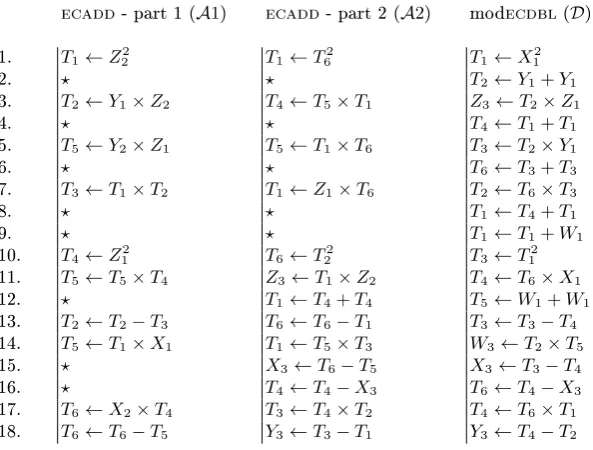
It was later improved by Giraud and Verneuil for ecadd and modecdbl for the Right-to-Left binary NAF mixed coordinates multiplication [10]. Figure 1 describes the computation of ecadd((X2, Y2, Z2),(X1, Y1, Z1))and modecdbl(X1, Y1, Z1, W1)
(see [10] for the details). Each column represents an atomic pattern. The addition is written with two patterns while the doubling is written with only one.
ecadd - part 1 (A1) ecadd - part 2 (A2) modecdbl (D)
1. T1←Z22 T1←T62 T1←X12
2. ? ? T2←Y1+Y1
3. T2←Y1×Z2 T4←T5×T1 Z3←T2×Z1
4. ? ? T4←T1+T1
5. T5←Y2×Z1 T5←T1×T6 T3←T2×Y1
6. ? ? T6←T3+T3
7. T3←T1×T2 T1←Z1×T6 T2←T6×T3
8. ? ? T1←T4+T1
9. ? ? T1←T1+W1
10. T4←Z12 T6←T22 T3←T12
11. T5←T5×T4 Z3←T1×Z2 T4←T6×X1
12. ? T1←T4+T4 T5←W1+W1
13. T2←T2−T3 T6←T6−T1 T3←T3−T4
14. T5←T1×X1 T1←T5×T3 W3←T2×T5
15. ? X3←T6−T5 X3←T3−T4
16. ? T4←T4−X3 T6←T4−X3
17. T6←X2×T4 T3←T4×T2 T4←T6×T1
18. T6←T6−T5 Y3←T3−T1 Y3←T4−T2
Fig. 1. ecadd and modecdbl operations written with the same atomic pattern (? represents a dummy operation)
3 Big Mac Attack
3.1 Big Mac Attack on rsa
We present in this section the Big Mac Attack introduced by Walter against rsa implementations [14].
Long Integer Multiplication. We give in Alg. 2 the classical eld multiplication.
wis the word size (w is generally equal to8,16,32 or 64in common architectures).
Algorithm 2 Long Integer Multiplication
Input: A= (am−1, . . . , a0)2w, B= (bm−1, . . . , b0)2w Output: C= (c2m−1, . . . , c0)2w=A×B
1: C←0
2: fori= 0tom−1do
3: u←0
4: forj= 0tom−1do
5: (u, v)2w←ai×bj
6: (u, v)2w←(u, v)2w+ci+j+u
7: ci+j←v
8: end for
9: ci+m←u
Modular multiplication is performed either with the classical modular multiplica-tion followed by a reducmultiplica-tion, like the Montgomery [13] or the Barrett reducmultiplica-tion [3], or with an interleaved modular multiplication. The important feature for the attack is the word-wise multiplication.
Goal of the attack. DenoteT1, T2 the traces during the computation of respectively
two multiplicationsA×B,C×D, withA6=C. The attacker tries to assert ifB =D
givenT1 and T2.
Averaging. We suppose that the device leaks the Hamming Weight (denoted HW) of the manipulated values.
The power consumption during the computation ofai×bj (line 5 of Algorithm 2) can be expressed with HW(bj), and other activities of the device (including HW(ai), HW(ai×bj)) and the noise.
si,j =HW(bj) +ri,j . (2) withri,j corresponds to other activities and the noise. The sample points of the trace
T1, in which eachbj, j∈[0, m[is manipulated, are averaged into one single value sj.
sj = m−1
X
0
si,j (3)
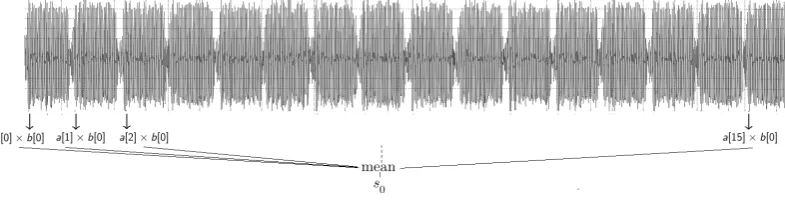
=HW(bj) +rj (4) withrj having a much smaller value compared with eachri,j. The computation of s0
is illustrated in Figure 2.
Fig. 2. Illustration of the computation ofs0 with a modular multiplication of integers of four words
(256-bit integers in a 64-bit architecture)
Euclidean Distance. Denote S1 =s0||. . .||sm−1 the concatenation of the sj. The same is done withT2 to obtainS2.
IfB =D, the Euclidean distance betweenS1andS2is small. In the case ofB 6=D,
Big Mac CoCo. Instead of using a Euclidean Distance, the authors of [5] suggest to use the Pearson correlation instead of the Euclidean Distance. This rened attack is called Big Mac CoCo (CoCo for collision-correlation) in[5].
Comparison between Big Mac and Big Mac CoCo. They give simulation results to compare the Euclidean Distance with the Pearson correlation. The Big Mac CoCo gives much better results than the original Big Mac of Walter.
3.2 Big Mac Attack on ecc
The classical Big Mac of Walter is considered not applicable on ecc because the number of words is large compared to ecc4.
However, Bauer et al. give simulation results of the Big Mac CoCo on elliptic curves size [2]. They target the Side-Channel Atomicity. Indeed, they notice that there are common operands regarding the side-channel atomicity formulæ. For instance, to dis-tinguish an addition from a doubling, they suggest to compare the rst multiplication (line 1) and the second multiplication (line 3) of Figure 1. If it is a doubling, the two multiplications share a common operand. They give the success rate on simulation results using a correlation which was high enough even for a 32 architecture.
We experimentally tried both the Big Mac and the Big Mac CoCo on real mea-surements on a 64 bits architecture and we failed. In the next section, we present a signicant improvement of the attack of [2]. We also present experimental results of our attack.
4 Improving the Big Mac Attack on the Side-Channel Atomicity
We describe in this section our attack. Instead of trying to dierentiate between elliptic curves operations (addition or doubling) and only two patterns, we will analyses a sequence of several patterns depending of a bit of the scalar. The attack is recursive. For a better clarity, we will see how to recover the rst bit of the scalar. The next bits are recover in the same way.
The core idea of the attack is to identify which operations are performed by analysing the possible repetitions of variables in the patterns.
4.1 Possibilities of the atomic patterns
For the rst iteration of algorithm 1, the possible operations of the three rst atomic patterns are:
1. A1;A2;D. In this case,k06= 0.
2. D;A1;A2. In this case,k0= 0.
3. D;D;A1. In this case,k0 = 0.
4. D;D;D. In this case,k0 = 0.
More precisely, the four cases are for the three rst bits ofk equal to 1xx, 01x, 001
and000 respectively, wherex represents any value (0 or 1). We want to assert if the
rst three patterns correspond toA1;A2;D(k0 6= 0).
4.2 Same values in the dierent patterns.
With Figure 1 and the dierent possibilities of the three rst patterns, we label the operations with a common operand only if the operations areA1;A2;D; we neglect the multiplications sharing a common operand if they possibly occur in another sequence of patterns.
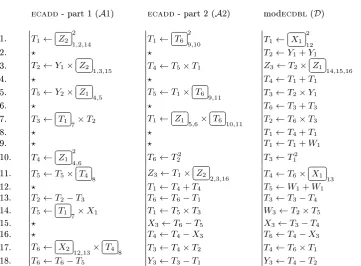
The common operands are illustrated in Figure 3. They are denoted with boxes with the same index. For example, the square at line 1 of the 1st pattern and the
multiplication at line 3 of the 1st pattern share a common operand (Z
2) only if the
sequence isA1;A2;D. Note that the multiplication at line 17 of the 1st pattern and
the multiplication at line 11 of the3rdpattern share a common operand (X2 andX1)
only ifA1;A2;Dis performed. The same holds forZ2 inA1;A2andZ1 inD. Indeed,
the point(X2, Y2, Z2) of A1;A2 and the point (X1, Y1, Z1) of D both correspond to
the pointR or −R in Algorithm 1.
The total number of pairs of multiplications or squares sharing a common operand is sixteen in the sequenceA1;A2;D.
4.3 Assembling the pieces of the puzzle
We want to apply the method of the Big Mac attack to detect if the three rst patterns indeed correspond toA1;A2;D. The low number of words is compensated by the large number of modular multiplications we compare. We can compare sixteen pairs (see Figure 3) instead of one, thanks to the atomicity countermeasure.
First, we split the trace of the three rst patterns; we separate the eld operations. We denote s(·) the method for constructingS1 or S2 as previously described for the
Big Mac attack.
We then construct two setsU1, U2as follows.U1, U2are rst set empty. We perform s(·) for the power traces of the multiplications that might share a common operand.
One element of each pair is put in U1, the other is put in U2. The construction of U1, U2 is illustrated in Figure 4 for the rst three pairs possibly sharing the same
operandZ2.
The Euclidean distance between U1 and U2 is low if each pair share a common
operand. In this case the three patterns observed are actually A1;A2;D, and the attacker concludes that k0 6= 0. She then iterates the method with the next three
ecadd - part 1 (A1) ecadd - part 2 (A2) modecdbl (D)
1. T1←
Z2 2
1,2,14 T1←
T6 2
9,10 T1←
X1
2 12
2. ? ? T2←Y1+Y1
3. T2←Y1×
Z2
1,3,15 T4←T5×T1 Z3←T2×
Z1 14,15,16
4. ? ? T4←T1+T1
5. T5←Y2×
Z1
4,5 T5←T1×
T6
9,11 T3←T2×Y1
6. ? ? T6←T3+T3
7. T3←
T1
7×T2 T1←
Z1 5,6×
T6
10,11 T2←T6×T3
8. ? ? T1←T4+T1
9. ? ? T1←T1+W1
10. T4←
Z1 2
4,6 T6←T
2
2 T3←T12
11. T5←T5×
T4
8 Z3←T1×
Z2
2,3,16 T4←T6× X1
13
12. ? T1←T4+T4 T5←W1+W1
13. T2←T2−T3 T6←T6−T1 T3←T3−T4
14. T5←
T1
7×X1 T1←T5×T3 W3←T2×T5
15. ? X3←T6−T5 X3←T3−T4
16. ? T4←T4−X3 T6←T4−X3
17. T6←
X2
12,13×
T4
8 T3←T4×T2 T4←T6×T1
18. T6←T6−T5 Y3←T3−T1 Y3←T4−T2
Fig. 3. Common operands in the atomic patterns
Fig. 4. Assembling the pieces of the puzzle of three atomic patterns
no multiplication among all multiplications shares a common operand. In this case, the three patterns observed are notA1;A2;D, and the attacker concludes thatk0= 0.
4.4 Experimental Results
We implemented a modular multiplication on a 64-bit architecture in the Side-channel Attack Standard Evaluation Board SASEBO-GII [SASEBO]. We mounted the attack with 384-bit integers (six words of 64 bits).
Characterization. The rst step of the attack is the characterisation of the arith-metic module. We constructed U1, U2 as previously described with fourteen pairs of
multiplications sharing a common operand5 1000 times. The average Euclidean dis-tance was 2.165. The same was done with fourteen pairs of multiplication with random operands. The average Euclidean distance was 3.198. We established that a distance lower than the mean 2.682 correspond toA1;A2;D.
Attack on real operations. We then assembled the pieces of the puzzle as previously described with a trace ofA1;A2;D 100 times. Only three distances were higher than 2.682. We conclude that the attacker can detectA1;A2;Dwith a success of 97%. The same was done with D;D;A1 100 times. Only four distances were lower than 2.682.
We conclude that the attacker wrongly detects a patterns triplet as A1;A2;D with probability 4%.
We performed the experiment with 256-bit integers (four words) as well. We ob-tained a probability of 96% to correctly detect A1;A2;D, and a probability of 16% that D;D;A1 was detected as A1;A2;D, which is still acceptable to perform the attack.
We believe that the success probability is higher on a 32-bit architecture because of the larger number of words.
Big Mac CoCo. We also tried using the Pearson correlation as in [5,2]. Surprisingly, the coecient was high (around 0.9) each time, even if the guess was incorrect (i.e. even if there are no common operand for all multiplications).
The reason is that there are similarities in long integer multiplications even if the values are dierent such as the variation of the word numbers manipulated. Our experiment shows that in certain cases, the Euclidean Distance is better than the correlation.
5 Countermeasures
In this section, we discuss on the classical countermeasures on ecc that thwart or not our attack.
5.1 Ineective Countermeasures
Scalar Randomization [7, 5.1]. If k is the scalar and P ∈ E the base point,
Coron suggests to randomize the scalar as k0 = k+r#E with #E the number of
points in the curve andra random integer. This prevents from the Dierential Power
Analysis [7]. When applying our attack, the attacker recoversk0 and trivially recovers
the original previous secretk=k0 mod #E.
Scalar Splitting [9, 4.2]. Clavier and Joye proposed a method to randomize the scalar. Instead of computing[k]P, one can computeQ= [k−r]P+[r]P with a random r. If the two scalar multiplications are performed successively, the attack presented
in this paper can trivially be applied for both ecsms and recover the initial scalar
k. On the other hand, if the two ecsms are performed in parallel, it is quite more
dicult. Indeed, when attacking the scalar of one ecsm, the power consumption or the electromagnetic radiation coming from the second ecsm is necessarily considered as noise. To conclude, the attack can still be applied in theory but the success rate should be decreased considerably.
Point Binding [7, 5.2]. The countermeasure, by Coron, consists in computing
Q = [k](P +R) instead of [k]P, with R a pseudo-random point. The chip returns Q−[k]R. Our attack does not need the knowledge of the base point and therefore
the countermeasure is ineective. We focus on possible collisions of values that will happen even if the base point is randomized this way.
Random Projective Coordinates [7, 5.3]. A point P = (X, Y, Z) in Jacobian
coordinates is equivalent to any point(r2X, r3Y, rZ), withr∈F∗p. Coron suggests to randomize the base point at the beginning of the ecsm by choosing a random nonzero
r. The previous analysis on the point blinding stands here.
Random Curve Isomorphism [12]. Elliptic curves E:y2 = x3 +ax+b and E0:y2 = x3 +a0x+b0 are isomorphic if and only if there exists u ∈ F∗
p such that
u4a0=aandu6b0 =b. The isomorphismϕ is dened as:
ϕ:E−∼→E0,
O → O
(x, y)→(u−2x, u−3y)
The countermeasure, introduced by Joye and Tymen, consists in computing the ecsm on a random curveE0 instead ofE. The previous analysis on the point blinding stands
here.
5.2 Eective Countermeasures
Multiplication with Random Permutation [CFG+10,1]. Clavier, Feix,
Gag-nerot, Rousselet and Verneuil introduced the Multiplication with Random Permuta-tion countermeasure [CFG+10]. It consists in randomizing the order of the
in randomizing the order of both loops (lines 2 and 4) with two random permutations in[0, m[ (m being the word number of the manipulated integers). The construction
of s0,0 ≤ j < m is no longer possible for the Big Mac attack. Another method for
randomizing the loops was proposed in [1].
No Same Values Algorithm. We suggest to implement elliptic curves without the possible repetitions of values depending on the scalar. The side-channel atomicity brings too much multiplications that we can compare. That makes our attack possible and practicable.
Other countermeasures exist to prevent the Simple Power Analysis aside the Side-Channel Atomicity. Regularizing the ecsm, i.e. perform the same elliptic curve op-erations at each iteration of the ecsm prevents the Simple Power Analysis without bringing many multiplications that possibly share common operands.
6 Conclusion
A practical horizontal attack on ecc is presented against the Side-Channel Atomicity countermeasure, based on the Big Mac principle [14]. It is an extension of the attack presented in [2]. The dierence is that we compare many multiplications instead of only one. The Side-Channel Atomicity permits to compare many multiplications.
This attack is powerful since it permits to recover the entire scalar with a single trace. The secret scalar can thus be recovered with a single execution of the ecsm and we can target protocol such as ecdsa where the scalar is randomly chosen for each new signature. Also, scalar randomization techniques are ineective.
Moreover, the base point does not matter for the attack. Therefore, countermea-sures which consist in randomizing the inputs are ineective.
To prove the soundness of our attack, we give experimental results. We emphasis in the fact that the correlation used as a distinguisher is not the optimal solution in our case (in fact we failed) as presented in [5,2]. The Euclidean Distance, as presented in the original Big Mac attack [14].
References
1. A. Bauer, É. Jaulmes, E. Prou and J. Wild, Horizontal and Vertical Side-Channel Attacks against Secure rsa Implementations. Proceedings of ct-rsa'13, lncs vol. 7779, Springer-Verlag, 2013, pp. 1-17.
2. A. Bauer, É. Jaulmes, E. Prou and J. Wild, Horizontal Collision Correlation Attack on Elliptic Curves. To appear in sac'13.
3. P. Barrett, Implementing the Rivest Shamir and Adleman Public Key Encryption Algorithm on a Standard Digital Signal Processor. Proceedings of crypto'86, lncs vol. 263, Springer-Verlag, 1987, pp. 311-323.
4. M. Ciet and M. Joye, (Virtually) Free Randomization Techniques for Elliptic Curve Cryptography. Proceedings of icis'03, lncs vol. 2836, Springer, 2003, pp. 348-359.
5. C. Clavier, B. Feix, G. Gagnerot, C. Giraud, M. Roussellet and V. Verneuil, ROSETTA for Single Trace Analysis. Proceedings of INDOCRYPT'12, lncs vol. 7668, Springer-Verlag, 2012, pp. 140-155.
[CFG+10] C. Clavier, B. Feix, G. Gagnerot, M. Roussellet and V. Verneuil, Horizontal Correlation
Analysis on Exponentiation. Proceedings of icics'10, lncs vol. 6476, Springer, 2010, pp. 46-61. 6. H. Cohen, A. Miyaji and T. Ono, Ecient Elliptic Curve Exponentiation Using Mixed
Coordi-nates. Proceedings of asiacrypt'98, lncs vol. 1514, Springer-Verlag, 1998, pp. 51-65.
7. J.-S. Coron, Resistance against Dierential Power Analysis for Elliptic Curve Cryptosystems. Proceedings of ches'99, lncs vol. 1717, Springer-Verlag, 1999, pp. 292-302.
8. B. Chevallier-Mames, M. Ciet and M. Joye, Low-Cost Solutions for Preventing Simple Side-Channel Analysis: Side-Side-Channel Atomicity. Journal of ieee Transactions on Computers'04, ieee Trans. Computers vol. 53, num. 6, 2004, pp. 460-468.
9. C. Clavier and M. Joye, Universal Exponentiation Algorithm. Proceedings of ches'01, lncs vol. 2162, Springer, 2001, pp. 300-308.
10. C. Giraud and V. Verneuil, Atomicity Improvement for Elliptic Curve Scalar Multiplication. Proceedings of cardis'10, lncs vol. 6035, Springer-Verlag, 2010, pp. 80-101.
11. M. Joye, Fast Point Multiplication on Elliptic Curves without Precomputation. Proceedings of waifi'08, lncs vol. 5130, Springer-Verlag, 2008, pp. 36-46.
12. M. Joye and C. Tymen, Protections against Dierential Analysis for Elliptic Curve Cryptography. Proceedings of ches'01, lncs vol. 2162, Springer, 2001, pp. 377-390.
13. P. L. Montgomery, Modular Multiplication without Trial Division. Journal of Mathematics of Computation'85, J. Mathematics of Computation vol. 44, num. 170, 1985, pp 519-521. [SASEBO] Side-channel Attack Standard Evaluation Board (SASEBO). http://www.rcis.aist.go.
jp/special/SASEBO/