Constrained PRFs for
NC
1in Traditional Groups
Nuttapong Attrapadung1, Takahiro Matsuda1, Ryo Nishimaki2,Shota Yamada1, Takashi Yamakawa2
1National Institute of Advanced Industrial Science and Technology (AIST), Tokyo, Japan
{n.attrapadung,t-matsuda,yamada-shota}@aist.go.jp
2NTT Secure Platform Laboratories, Tokyo, Japan
{nishimaki.ryo,yamakawa.takashi}@lab.ntt.co.jp
June 4, 2018
Abstract
We propose new constrained pseudorandom functions (CPRFs) intraditional groups. Traditional groups mean cyclic and multiplicative groups of prime order that were widely used in the 1980s and 1990s (sometimes called “pairing free” groups). Our main constructions are as follows.
• We propose a selectively single-key secure CPRF forcircuits with depthO(logn)(that is,NC1 circuits) in traditional groupswherenis the input size. It is secure under theL-decisional
Diffie-Hellman inversion (L-DDHI) assumption in the group of quadratic residuesQRqand the decisional Diffie-Hellman (DDH) assumption in a traditional group of orderqin the standard model.
• We propose a selectively single-keyprivate bit-fixingCPRF intraditional groups. It is secure under the DDH assumption in any prime-order cyclic groupin the standard model.
• We proposeadaptivelysingle-key secure CPRF forNC1and private bit-fixing CPRF in the
random oracle model.
Contents
1 Introduction 1
1.1 Background . . . 1
1.2 Our Contributions . . . 3
1.3 Technical Overview . . . 3
1.4 Other Related Works . . . 8
2 Preliminaries 8 2.1 Complexity Assumptions . . . 9
2.2 Pseudorandom Function . . . 9
2.3 Constrained Pseudorandom Function . . . 10
2.4 Private Constrained PRF . . . 12
2.5 Correlated-Input Secure Hash Function . . . 15
2.6 Collision Resistant Hash Function . . . 17
3 Building Block: Correlated-input Secure Hash 17 3.1 Naor-Reingold PRF and Our Variant . . . 17
3.2 Bellare-Cash CIH Construction and Our Variant . . . 21
4 CPRF for NC1Circuits 23 4.1 Our Basic Constrained PRF . . . 23
4.2 Selectively-secure CPRF in the Standard Model . . . 27
4.3 Adaptively-secure CPRF in the Random Oracle Model . . . 33
5 Private Constrained PRF for Bit-fixing 37 5.1 Construction in the Standard Model . . . 37
5.2 Construction in the Random Oracle Model . . . 42
6 Application to Secret-Key ABE 46 6.1 Definitions . . . 46
1
Introduction
1.1 Background
Pseudorandom functions (PRFs)are one of the most fundamental notions in cryptography [GGM86]. A
PRF is a deterministic functionPRF(·,·) :K × D → RwhereK,D, andRare its key space, domain, and range, respectively. Roughly speaking, we say thatPRFis a secure PRF if outputs ofPRF(msk,·)look
random for any inputx∈ Dand a randomly chosen keymsk∈ K. Not only are PRFs used to construct secure encryption schemes but also they frequently appear in the constructions of various cryptographic primitives.
Constrained PRF. Boneh and Waters introduced the notion ofconstrained PRFs (CRPFs)[BW13]
(Ki-ayias, Papadopoulos, Triandopoulos, and Zacharias [KPTZ13] and Boyle, Goldwasser, and Ivan [BGI14] also proposed the same notion in their concurrent and independent works). CPRFs are an advanced type of PRFs. Specifically, if we have a master secret keymskof a CPRFPRF, then we can generate a “constrained” keyskf for a functionf :D → {0,1}. We can compute the valuePRF(msk, x)fromskf
andxiff(x) = 0holds; otherwise cannot. For an inputxsuch thatf(x) = 1, the valuePRF(msk, x)
looks pseudorandom.1
CPRFs with various types of function classes have been considered. Here, we explain the classes of
bit-fixing functionsandcircuitssince we present new CPRFs for these functions.
Bit-fixing functions: Let{0,1}nbe the domain of a CPRF. Each function in this class is specified by a
“constraint vector”c= (c1, . . . , cn)∈ {0,1,∗}n, from which abit-fixingfunctionfc:{0,1}n→
{0,1}is defined as follows. Ifci =∗orxi =ci holds for alli∈[n], thenfc(x) = 0; otherwise
fc(x) = 1.
Circuits: This class consists of functions{fC}computable by polynomial-sized boolean circuits C,
defined byfC(·) :=C(·). We call a CPRF for this function class simply a CPRF for circuits. If a
CPRF supports functions computable by polynomial-sized boolean circuits with depthO(logn),
wherenis the input-length of the circuits, then we call it a CPRF forNC1.
The number of constrained keys that can be released (to a potentially malicious party) is one of the important security measures of CPRFs. If a-priori unbounded polynomially many constrained keys could be released (i.e., the number of queries is not a-priori bounded), then a CPRF is called
collusion-resistant. If only one constrained key can be released, it is called asingle-key secureCPRF.
Boneh and Waters [BW13] showed that (collusion-resistant) CPRFs have many applications such as broadcast encryption with optimal ciphertext length. (See their paper and references therein for more details.)
Private CPRF. Boneh, Lewi, and Wu [BLW17] proposed the notion of privacy for CPRFs
(Ki-ayias et al. also proposed policy privacy as essentially the same notion [KPTZ13]). Roughly speaking, private CPRFs do not reveal information about constraints embedded in constrained keys beyond what is leaked from the evaluation results using the constrained keys.
Known instantiations. The first papers on CPRFs [BW13, KPTZ13, BGI14] observed that the
Goldreich-Goldwasser-Micali [GGM86] PRF yields a puncturable PRF2 (and a CPRF for related
1We note that the role of the constraining functionfis “reversed” from the definition by Boneh and Waters [BW13], in the sense that the evaluation by a constrained keyskfis possible for inputsxwithf(x) = 1in their definition, while it is possible
for inputsxforf(x) = 0in our paper. Our treatment is the same as Brakerski and Vaikuntanathan [BV15].
simple functions). However, it turned out that achieving CPRFs for other types of function classes is quite challenging. Here, we review some prior works on CPRFs whose function classes are related to those we focus on in this study (i.e., bit-fixing functions andNC1circuits).
Boneh and Waters [BW13] constructed a left-right CPRF3in the random oracle model (ROM) from
bilinear maps, and a collusion-resistant bit-fixing CPRF and collusion-resistant CPRF for circuits from multilinear maps [GGH13] in the standard model. After that, Brakerski and Vaikuntanathan [BV15] constructed a single-key secure CPRF for circuits from standard lattice-based assumptions, without relying on multilinear maps.
Boneh et al. [BLW17] constructed a collusion-resistant private CPRF for circuits from indistinguisha-bility obfuscation (IO) [BGI+12,GGH+16], and a single-key private bit-fixing CPRF and puncturable CPRF from multilinear maps [BLW17]. After that, a single-key private puncturable PRF [BKM17], a single-key private CPRF forNC1[CC17], and a single-key private CPRF for circuits [BTVW17,PS18]
were constructed from standard lattice assumptions.
Our motivation. (Private) CPRFs have been attracting growing attention as above since they are useful
tools to construct various cryptographic primitives [BW13,BLW17]. A number of other types of CPRFs have been constructed [HKKW14,HKW15,DKW16,HKW15,HKKW14,BFP+15,AFP16]. However, all of known sufficiently expressive (private) CPRFs (such as bit-fixing, circuits) rely on IO, multilinear maps, or lattices, and there is currently no candidate of secure multilinear maps.
Very recently, Bitansky [Bit17] and Goyal, Hohenberger, Koppula, and Waters [GHKW17] proposed sub-string match4CPRFs intraditional groupsto construct verifiable random functions. In this paper,
by traditional groups we mean the multiplicative groups of prime order5that have been widely used to
construct various cryptographic primitives such as the ElGamal public-key encryption scheme, around two decades before bilinear maps dominate the area of cryptography [BF03]. (Of course, they are still being used for many cryptographic primitives.) However, their CPRFs are not expressive enough and do not satisfy the standard security requirements of CPRFs6. See Tables1and2for comparisons. There is no
construction ofexpressive enough(private) CPRF intraditional groups. This status might be reasonable
since lattices and multilinear maps are stronger tools.
Based on the motivation mentioned above, we tackle the following question:
Is it possible to construct sufficiently expressive (private) CPRFs in traditional groups?
In this study, we give affirmative answers to this question and show that traditional groups are quite powerful tools. From the theoretical point of view, the more instantiations of cryptographic primitives are available, the more desirable. One reason is that constructions from different tools can be alternatives when one tool is broken (like multilinear maps). Another reason is that, generally, new instantiations shed light on how to construct the studied primitive, and widen and deepen our insights on it. One remarkable example of this line of research would be the recent work by Döttling and Garg [DG17], who constructed an identity-based encryption (IBE) scheme and a hierarchical IBE scheme in traditional groups. Another example would be the work by Boyle, Ishai, and Gilboa [BGI16], who constructed communication-efficient secure two-party protocols in traditional groups. It is also expected that new instantiations provide us with insights on how to use the studied primitive in applications (in the real world or in the construction of another primitive as a building block).
3There are left and right constrained keys in whichv`andvrare hard-wired, respectively. We can compute outputs by using
the left (resp. right) constrained key if the first (resp. last) half of an input is equal tov`(resp.vr).
4This is the negation of bit-fixing functions, that is,fc(x) = 0if there exists an indexisuch thatxi6=ci(i-th bit of a
constraint) andci6=∗. It can be seen as a generalization of punctured predicates.
5For example, cyclic groupH⊂Z∗qof a prime orderpsuch thatq= 2p+ 1whereqis also a prime.
6In their sub-string match CPRFs, adversaries are not given access to the evaluation oracle, which gives outputs of a CPRF
1.2 Our Contributions
In this paper, we present new constructions of a CPRF and a private CPRF intraditional groupsas main
contributions.
The properties of our CPRFs are summarized as follows.
• Our first CPRF is aselectively single-key secure7CPRF forNC1in traditional groups. It is secure
under theL-decisional Diffie-Hellman inversion (L-DDHI) assumption8in the group of quadratic
residuesQRqand the decisional Diffie-Hellman (DDH) assumption9in a traditional groupGof
orderqin the standard model. Here,QRqdenotes the group of quadratic residue moduloq, where
qis a prime such thatq = 2p+ 1andpis also a prime. We need to use this specific type of group
for technical reasons. See Section1.3and Section4for the details.
• Our second CPRF is aselectively single-key private bit-fixing CPRFin traditional groups.
Specif-ically, it is secure under the standard DDH assumption in any prime-order cyclic group in the standard model.
• Our third and fourth CPRFs are anadaptively10single-key secure CPRF forNC1 circuitsand an adaptively single-key private bit-fixing CPRF, both in the ROM. Our standard model and ROM
constructions of CPRFs forNC1, share high-level ideas behind the constructions in common, and
the same is true for our bit-fixing CPRFs. These connections are explained in Section1.3. The main technique that enables us to achieve the above results, is a novel use ofcorrelated-input secure hash functions. We will explain the technical overview in Section1.3.
As an application of our results, we can obtain a single-key secret-key attributed-based encryption (ABE) scheme withoptimal ciphertext overheadin traditional groups. A (multi-key) public-key ABE
scheme with optimal ciphertext overhead was presented by Zhandry [Zha16], but it is based on multilinear maps. See Section6for more details.
1.3 Technical Overview
In this section, we provide an overview of our construction ideas. We ignore many subtle issues in this section and focus on the essential ideas for simplicity.
Basic construction satisfying no-evaluation security. To illustrate our ideas in a modular manner, we
start with a no-evaluation secure CPRF forNC1, that is, adversaries do not have access to the evaluation
oracle. We denote the PRF byPRFNE. It turns out that even in this simple setting, it is non-trivial to
construct a CPRF forNC1in traditional groups (or bilinear groups) since known constructions use some
sort of “fully homomorphic” properties of lattices or multilinear maps, both of which are not available in traditional groups. In the following, letλbe the security parameter.
The first challenge is how to implement anNC1circuit constraint in a key. Our idea is to encode an NC1 circuitf11into a bit stringf = (f1, . . . , fz)∈ {0,1}zand then embed this into a secret key. When
evaluating a PRF value on inputx = (x1, . . . , xn) ∈ {0,1}n, we will “homormorphically” evaluate
U(·, x)on the secret key, whereU(·,·)is a universal circuit that outputsU(f, x) =f(x)on input(f, x).
7Adversaries commit a function to be embedded in a constrained key at the beginning of the security experiment and have
access to the evaluation oracle, which gives outputs of CPRFs for queried inputs.
8TheL-DDHI assumption in a groupHof orderp[BB04,CHL05] says that it is hard to distinguish(g, gα, gα
2
, . . . , gαL, g1/α)
from(g, gα, gα2, . . . , gαL, gz)whereg←R H, α, z←R Zp. See Section2.1for the rigorous definition.
9The DDH assumption in a groupGof orderqsays that it is hard to distinguish(g, gx, gy, gxy)from(g, gx, gy, gz)where g←R G, x, y, z←R Zq.
Table 1:Comparison of CPRFs (we omit constructions based on multilinear maps or IO). In “Function” column, sub-match is sub-string match. Prefix-fixing means that a constrained key with prefixpenables
us to compute outputs for inputspk∗. “#keys” column means the number of issuable constrained keys.
“Eval.O” column means the evaluation oracle is available for adversaries or not. “Tool” column means what kinds of cryptographic tools are used. GGM, pairing, and group mean the PRF by Goldreich, Goldwasser, and Micali [GGM86], bilinear maps, and traditional groups, respectively. In “Assumptions” column, OWF, BDDH, LWE, and1D-SIS mean one-way function, bilinear Diffie-Hellman, learning with
errors, and one-dimensional short integer solution assumptions, respectively. In “Model” column, Std means the standard model. In “Misc” column, key-hom means key-homomorphic property.
Reference Function #keys Eval.O Tool Assumptions Model Misc
[BW13] puncturea N/A N/A GGM OWF Std
[BW13] left/right multi X pairing BDDH ROM
[KPTZ13] puncturea N/A N/A GGM OWF Std
[BGI14] puncturea N/A N/A GGM OWF Std
[BFP+15] prefix-fixing multi X lattice LWE Std key-hom
[BV15] circuit single X lattice LWE,1D-SIS Std
[Bit17] sub-match single no group DDH Std [GHKW17] sub-match single no group L-power DDH Std
[GHKW17] sub-match single no group Φ-hiding Std
Ours NC1 single X group DDH,L-DDHI Std
aMore precisely, they consider slightly different functions, but we write just “puncture” for simplicity
since their constructions are based on the GGM PRF. See their papers for details.
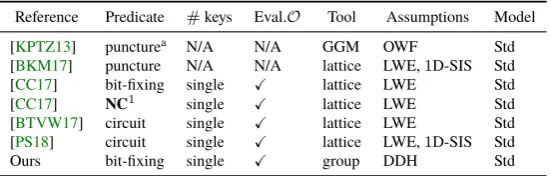
Table 2: Comparison of private CPRFs (we omit constructions based on multilinear maps and IO). See Table1for terms.
Reference Predicate #keys Eval.O Tool Assumptions Model [KPTZ13] puncturea N/A N/A GGM OWF Std
[BKM17] puncture N/A N/A lattice LWE,1D-SIS Std
[CC17] bit-fixing single X lattice LWE Std [CC17] NC1 single X lattice LWE Std [BTVW17] circuit single X lattice LWE Std [PS18] circuit single X lattice LWE,1D-SIS Std
Ours bit-fixing single X group DDH Std
aSame as in Table1.
To make the representation of the universal circuitU(·,·)compatible with our algebraic setting, we regard
U(·,·)as a degree-Dpolynomial of the variables{fi}and{xj}, such thatDis some fixed polynomial
ofλ.12 Furthermore, we extend the input space ofU(·,·)to be non-binary, where the computation is
done overZpusing the polynomial representation ofU(·,·). Specifically, we allow the input of the form ((b1, . . . , bz), x)∈Zzp× {0,1}n.
Now, we give a more detailed description of PRFNE. A master secret key msk of PRFNE is
of the form (b1, . . . , bz, α, g), where bi
R
← Zp for each i ∈ [z] and α ←R Z∗p, and g is a generator
of a traditional group Hof order p. (We will turn to the explanation on this group Hlater in this
subsection.) The evaluation algorithm ofPRFNEoutputsgx
0/α
, wherex0=U((b1, . . . , bz), x)∈Zp. To
compute a constrained keyskf of anNC1 circuitf, we setbi0 := (bi−fi)α−1. The constrained key is
skf = (f, b01, . . . , b0z, g, gα, gα
2
, . . . , gαD−1).
We then look closer at why this construction achieves the constraint defined by theNC1 circuitf.
When we computex0 :=U((b1, . . . , bz), x)by usingbi =α·b0i+fi, we can write the computation ofU
in the following way:
x0 =U((α·b01+f1, . . . , α·b0z+fz), x) =f(x) + D
X
j=1 cjαj,
where the coefficients{cj}j are efficiently computable from the descriptions ofU andf, {b0i}i, and
x since the degree D is polynomial in the security parameter. This can be seen by observing that U((α·b01+f1, . . . , α·b0z+fz), x)should be equal tof(x)whenα = 0since we haveU((f1, . . . , fz), x) =
f(x)by the definition of a universal circuit.
• Iff(x) = 0, then we can computegx0/α=gf(x)/α+
PD−1 j=0 cjα
j
since thegf(x)/αpart disappears
and the remaining part is computable fromskf = (f, b01, . . . , b0z, g, gα, . . . , gα
D−1
)andx.
• If f(x) = 1, then gx0/α = gf(x)/α+
PD−1 j=0 cjα
j
looks random since g1/α looks random even if
(g, gα, . . . , gαD−1)is given, due to the(D−1)-DDHI assumption inH.
This is a high-level intuition for whyPRFNEforNC1is no-evaluation secure. This CPRFPRFNEis our
base construction, and the idea behind our construction here is inspired by the affine partitioning function used in the recent construction of a verifiable random function by Yamada [Yam17].
On the other hand, this construction can be broken by making only one evaluation query: Suppose that x 6= xb satisfyf(x) = f(xb) = 1. Then we can write PRFNE(msk, x) = g
1/α+PD−1 j=0 cjα
j and PRFNE(msk,xb) = g
1/α+PD−j=01cbjαj by using {c
j}j and {cbj}j that are efficiently computable by an
adversary. Then we havePRFNE(msk,xb) =PRFNE(msk, x)·g PD−1
j=0(cbj−cj)α
j
. Therefore if an adversary obtainsPRFNE(msk, x), then it can efficiently computePRFNE(msk,xb)and break the security of the
PRF.
Single-key secure construction in the ROM. To achieve security against adversaries making a-priori
unbounded polynomially many evaluation queries (i.e., the number of queries is polynomial, but not fixed in advance), we consider using a random oracle as an intermediate step. (This construction is denoted by PRFrom.) PRFromis the same asPRFNEexcept that an output is now computed byH(gx
0/α
), instead of
gx0/α, whereH :H→ {0,1}n0
is a cryptographic hash function. In the ROM whereHis modeled as a
random oracle, adversaries make hash queries and obtain outputs of the hash functionH. Iff(x) = 1,
then an adversary cannot computegx0/αdue to the no-evaluation security, and thus H(gx0/α)seems
uniformly random from the view of the adversary. Therefore evaluation queries from an adversary can be answered with uniformly random strings, and the adversary cannot notice whether this is a correct behavior of the evaluation oracle as long as it does not find a collision(x1, x2)such thatgx01/α=gx
0 2/α wherex0i=U((b1, . . . , bz), xi). Our real construction is slightly modified from the above construction so
that such a collision exists only with negligible probability (see Section4.1for the detail).
The second challenge is how to remove the random oracle and achieve security against a-priori unbounded polynomially evaluation queries in the standard model.
Replacing a random oracle with a correlated-input secure hash function. We observe that we do
not need the full power of random oracles to prove the security of CPRFs. Specifically, we can use a
correlated-input secure hash function(CIH) [IKNP03,GL10,BC10a,GOR11]13, instead of random
oracles.
13Several works defined similar notions in different names such as related-key security. We use the name “correlated-input
Here, we briefly recall the definition of a CIH whose definition is associated with a class of functions
Ψ. At the beginning, the challenger chooses the challenge bitcoin← {R 0,1}, a function descriptionCIH,14 and a random elementrfrom the domain ofCIH. The adversary is givenCIHand access to an oracle that, upon a queryψi ∈Ψfrom the adversary, answersCIH(ψi(r))ifcoin= 1; otherwise the oracle answers
the query withRF(ψi(r)), whereRFis a truly random function. If it is hard for adversaries to distinguish
the casecoin= 1from the casecoin= 0, we say thatCIHis correlated-input pseudorandom forΨ(or
simply, a CIH forΨ).15
If there exists a CIH forgroup-inducedfunctionsψ∆:H→Hsuch that∆∈Handψ∆(y) :=y·∆
(denoted byCIH0) where·is the group operation ofH, thenCIH0(PRFNE(msk, x))is a secure CPRF. This
can be seen as follows: Forxsatisfyingf(x) = 1,PRFNE(msk, x)can be written asg1/α·g
PD−1 j=0 cjα
j
whereg1/αis pseudorandom andg
PD−1 j=0 cjα
j
is efficiently computable from the view of an adversary as discussed above. By applying the security of a CIH by settingy :=g1/αand∆ =g
PD−1 j=0 cjα
j
, we can see thatCIH0(PRFNE(msk, x))is computationally indistinguishable fromRF(PRFNE(msk, x)). This is
computationally indistinguishable from a random function as long asPRFNE(msk, x)has no collision, and
the actual construction ofPRFNE(msk, x)is made collision-free as mentioned in the previous paragraph.
However, there is one subtle issue: The only known instantiation of CIH for group induced functions which satisfies our security requirements is the CIH based on the DDH assumption by Bellare and Cash [BC10a] (denoted byCIHBC). InCIHBC, we consider them-dimensional, component-wise
group-induced functionsΨgm-indc:={ψ~a|~a∈(Z∗q)m}, whereψ~a: (Z∗q)m→(Z∗q)mis defined byψ~a(~r) :=~a ?~r
and?denotes the component-wise group operation onZ∗q. Here, the domain ofCIHBCis not compatible
with the range ofPRFNE(the output isgx
0/α i ∈
H). One might think thatm-folded parallel running
ofPRFNEonH:= Z∗q works, but this is not the case. This is because ifH :=Z∗q, then the L-DDHI
assumption can be easily broken by computing the Jacobi symbol.
We observe that the attack based on the Jacobi symbol does not work if we consider the group of quadratic residues moduloq, denoted byQRqinstead ofZ∗q, and it is reasonable to assume theL-DDHI
assumption holds onQRq. However, if we setH:= QRq, then we cannot simply use the security of
CIHBCsince it is not obvious if the security ofCIHBCstill holds when we restrict the domain ofCIHBCto
QRmq . We resolve the issue by proving that the CIH obtained by restricting the domain ofCIHBCtoQRmq
(denoted byCIH
f
BC) is also secure as a CIH for component-wise group operations onQR
m
q under the
DDH assumption on a group of an orderp= q−21 ifpis a prime. See Section3for more details ofCIH
f
BC.
We are now ready to explain our CRPFPRFforNC1. It uses multiple instances ofPRFNEand apply
a CIH form-dimensional component-wise group-induced functions to the outputs from those instances.
That is, we define
PRFNC1(msk, x) :=CIH
f
BC
PRFNE(msk1, x), . . . ,PRFNE(mskm, x)
.
Now, we look closer at why correlated-input pseudorandomness helps us achieve security in the presence of a-priori unbounded polynomially many evaluation queries. InPRFNE, when the inputsx
withf(x) = 1are used, we can view its output as consisting of two separate parts. Specifically, we
can writegx0/α=gf(x)/α+
PD−1 j=0 cjα
j
=Aux(msk)·SEval(skf, x)if we defineAux(msk) :=g1/αand
SEval(skf, x) :=g
PD−1 j=0 cjα
j
(whereSEvalstands for “semi”-evaluation). The first part is computable only from msk, and the second part is computable fromskf andx. Thanks to the (D−1)-DDHI
assumption, it is now easy to see thatAux(msk)is indistinguishable from a random element even ifskf is
14In the formal security definition, the function is parameterized by a public parameter generated by some setup procedure. We
ignore the public parameter in the explanation below for simplicity. See Section2.5for the rigorous security definition for CIHs.
15The definition of CIHs in this paper can be seen as a hybrid of correlated-input pseudorandom by Goyal. et al. [GOR11] and
given. Therefore, it holds that
PRFNC1(msk, x)≈cCIH
f
BC
r1·SEval(skf,1, x), . . . , rm·SEval(skf,m, x)
,
whereri
R
← Hfor alli ∈[m]and≈c denotes computational indistinguishability. Furthermore,skf,i
denotes the secret key associated tof generated frommski. (Namely, it corresponds to thei-th instance.)
Here,φi:=SEval(skf,i, x)∈Hare adversarially chosen correlated values and fall in the component-wise
group-induced functionsΨgm-indcdue to(φ1, . . . , φm)∈Hm. Therefore, by applying the correlated-input
pseudorandomness ofCIH
f
BC, we obtain
CIH
f
BC(r1·φ1, . . . , rm·φm)≈cRF(r1·φ1, . . . , rm·φm).
As long as adversaries do not find a collision(x1, x2)such that(SEval(skf,1, x1), . . . ,SEval(skf,m, x1)) =
(SEval(skf,1, x2), . . . ,SEval(skf,m, x2)),PRFNC1(msk,·)is pseudorandom sinceRFis a truly random function. It is not difficult to see that a collision is hard to find by the universality of the modifiedPRFNE
(see Lemma4.15for the detail). Therefore, we can prove the pseudorandomness ofPRFagainst a-priori unbounded polynomially many evaluation queries in the standard model by using the security of CIH for (m-dimensional, component-wise) group-induced functions.
How to achieve private constraint. Here, we give a brief explanation on how our single-key private
CPRF for bit-fixing functions is constructed. The basic strategy is the same as that of our CPRFs for
NC1. That is, we firstly construct a private bit-fixing CPRF in the ROM, and then convert it into a private
bit-fixing CPRF in the standard model via a CIH for an appropriate function class.
Our single-key private bit-fixing CPRF in the ROM is very simple. This is slightly different from what we present in Section5.2, but we stick to the following construction in this section since it is consistent with the standard model construction in Section5.1. A master secret key ismsk:={si,b}i∈[n],b∈{0,1}and a PRF output for inputxisH(Pn
i=1si,xi)whereHis a (standard) hash function. For convenience, we definePRFbf-NE(msk, x) :=Pni=1si,xi. A constrained key forc∈ {0,1,∗}nis{ti,b}i∈[n],b∈{0,1}where
ti,b:=si,bifci =∗orci =b; otherwiseti,b
R
←Zp. If an input does not match the constraintc, then the
sum includes completely unrelated values and we cannot compute the correct output. Adversaries are given just random values by the random oracle. Moreover, adversaries cannot distinguish two different constraints as long as a challenge input does not satisfy the constraints since bothsi,bandti,bare uniformly
random values inZp. This construction satisfies adaptive single-key privacy in the random oracle model,
without relying on any complexity assumption.
Now we replace the cryptographic hash function (random oracle)H with a CIHCIHaff foraffine
functionsΦaff ={φ~u,~v :Zmp →Zmp }where~u∈(Z∗p)m,~v∈Zmp , andφ~u,~v(~x) :=~u~x+~vwhereis
component-wise multiplication inZp. Our private bit-fixing CPRF is defined by
PRFBF(msk, x) :=CIHaff
PRFbf-NE(msk1, x), . . . ,PRFbf-NE(mskm, x)
.
A constrained keyskcconsists of constrained keys forcwith respect tomskj, for allj∈[m]. It is easy
to see that the correctness holds. For the security, we setti,b,j :=si,b,j−αj forci 6=∗andb= 1−ci
where αj
R
← Zp. Then, we can writePn
i=1si,xi,j = uαj +vj for someu ∈ [n](especially u 6= 0) wherevj =Pni=1ti,xi,jfor an evaluation queryxfrom an adversary, sincexis not allowed to satisfy the constraint. For two different constraints, the adversary cannot distinguish which constraint is used in a constrained key (that is,si,b,j ≈cti,b,j+αj) sinceti,b,jis uniformly random. Here,αj’s are uniformly
random anduandvjare adversarially chosen values. It is easy to see that this falls into the class of affine
functions. Thus, we can use the security of the CIHCIHafffor affine functions, and obtain
As long as a collision of(PRFbf-NE(msk1,·), . . . ,PRFbf-NE(mskm,·)is not found,RF(uα1+v1, . . . , uαm+
vm)is indistinguishable from a random value. Furthermore, it is not difficult to show that the condition
holds by the universality ofFt(x) := (uα1+v1, . . . , uαm+vm). Therefore, we can prove the security
of our private bit-fixing CPRF. See Lemma5.6for the details.
1.4 Other Related Works
While we focus on (private) CPRFs without IO and multilinear maps, many expressive (private) CPRFs have been proposed based on IO or multilinear maps: collusion-resistant CPRFs for circuit based on multilinear maps [BW13,BFP+15], adaptively secure CPRFs based on IO [HKKW14,HKW15], collusion-resistant CPRFs for Turing machines based on (differing-input) IO [DKW16,AFP16], collusion-resistant private CPRFs for circuits based on IO [BLW17].
CPRFs and private CPRFs are useful to construct advanced cryptographic primitives. Boneh and Waters showed that we can construct broadcast encryption with optimal ciphertext length, identity-based non-interactive key-exchange, and policy-based key distribution from CPRFs [BW13]. Boneh et al. showed that private constrained message authentication code (MAC), watermarking PRF, searchable encryption, and on-line/off-line 2-server private keyword search from private CPRFs [BLW17]. Requirements
on security of (private) CPRFs depends on these applications. Boneh, Kim, and Montgomery prove that single-key simulation-based private CPRFs imply single-key simulation-based secure secret-key functional encryption (FE) [BKM17]. Canetti and Chen prove that two-key indistinguishability-based (resp. simulation-based) private CPRFs for circuits imply indistinguishability (resp. virtual black-box) obfuscation (they also prove that private CPRFs imply secret-key FE) [CC17]. Cohen, Goldwasser, and Vaikuntanathan showed a connection between CPRFs for some class of functions and computational learning theory [CGV15]. See the papers and references therein for more details.
Organization. The rest of the paper is organized as follows. After introducing notations, security
definitions, and building blocks in Section2, we present our correlated-input secure hash function in Section3, our CPRFs forNC1 and its security proofs in Section4, and our private bit-fixing CPRF in
Section5.
2
Preliminaries
In this section, we review the basic notation and the definitions for complexity assumptions, tools, and cryptographic primitives.
Basic notation. We denote byNthe set of all natural numbers. Ifn∈N, then “[n]” denotes the set
{1, . . . , n}. We denote by “x := y” thaty is deterministically assigned tox. IfSis a finite set, then
“x←R S” denotes thatxis chosen uniformly at random fromS. IfDandD0are distributions (over some set), then “x← DR ” denotes thatxis chosen according to the distributionD, and “D ≈cD0” denotes that the two distributions are computationally indistinguishable. Ifxandyare bit-strings, then we denote by
“xky” the concatenation ofxandy, and “(x=? y)” is defined to be1ifx=yand0otherwise. “PPT”
stands forprobabilistic polynomial time. IfAis a probabilistic algorithm, then “y ← AR (x)” denotes
thatAcomputes and outputsyby takingxas input and using an internal randomness that is chosen
uniformly at random. If furthermoreOis a (possibly probabilistic) function, then “AO” denotes thatA has oracle access toO. A functionf(·) :N→[0,1]is said to benegligibleif for all polynomialsp(·)
and all sufficiently largeλ∈N, we havef(λ)<1/p(λ). Throughout the paper, we use “λ” to denote a
unspecified integer-valued positive polynomial ofλand by “negl(λ)” an unspecified negligible function
ofλ. For setsDandR, “Func(D,R)” denotes the set of all functions with domainDand rangeR.
2.1 Complexity Assumptions
Here, we review complexity assumptions on cyclic groups that we use in this paper. For convenience, we introduce the notion of a “group generator”. We say that a PPT algorithmGGenis agroup generator, if it
takes a security parameter1λas input and outputs a “group description”G:= (G, p)whereGis a group
with prime orderp= Ω(2λ), from which one can efficiently sample a generator uniformly at random.
Definition 2.1 (Decisional Diffie-Hellman Assumption).LetGGenbe a group generator. We say that thedecisional Diffie-Hellman (DDH) assumptionholds with respect toGGen, if for all PPT adversaries
A, the advantageAdvddhGGen,A(λ)defined below is negligible:
AdvddhGGen,A(λ) :=
Pr[A(G, g, g
x, gy, gxy) = 1]−Pr[A(G, g, gx, gy, gz) = 1] ,
whereG= (G, p)←R GGen(1λ),g←R G, andx, y, z←R Z∗p.
Definition 2.2 (L-Decisional Diffie-Hellman Inversion Assumption).LetGGenbe a group generator andL=L(λ) = poly(λ). We say that theL-decisional Diffie-Hellman inversion (DDHI) assumption
holds with respect toGGen, if for all PPT adversariesA, the advantageAdvLGGen-ddhi,A(λ)defined below is
negligible:
AdvLGGen-ddhi,A(λ) :=
Pr[A(G, g,(g
αi
)i∈[L], ψ0) = 1]−Pr[A(G, g,(gα
i
)i∈[L], ψ1) = 1]
,
whereG= (G, p)←R GGen(1λ),g←R G,α←R Z∗p,ψ0 :=g1/α, andψ1
R ←G.
2.2 Pseudorandom Function
A PRFPRFconsists of the three PPT algorithms(Setup,KeyGen,Eval)with the following interfaces:
Setup(1λ)→R pp: This is the setup algorithm that takes a security parameter1λ as input, and outputs
a public parameterpp, whereppspecifies the descriptions of the key spaceK, the input-length
n=n(λ) = poly(λ)(that defines the domain{0,1}n), and the rangeR.
KeyGen(pp)→R msk: This is the key generation algorithm that takes a public parameterppas input, and outputs a keymsk∈ K.
Eval(pp,msk, x) =:y: This is the deterministic evaluation algorithm that takes a public parameterpp, a keymsk∈ K, and an elementx∈ {0,1}nas input, and outputs an elementy∈ R.
Whenever clear from the context, we will dropppfrom the input ofEval. Furthermore, when there is no confusion, we may abuse the notation and usePRFto denote the evaluation algorithm itself, and use the notations such as “PRF:K × {0,1}n→ R” and “PRF(msk, x)” (where the latter means the execution
ofEval(msk, x)) for enabling easier and more intuitive descriptions.
Definition 2.3 (Security of PRF).We say thatPRF= (Setup,KeyGen,Eval)is a secure PRF if for all PPT adversariesA, the advantageAdvprfPRF,A(λ)defined below is negligible:
AdvprfPRF,A(λ) := Pr[A
Eval(msk,·)(pp) = 1]−Pr[ARF(·)(pp) = 1] ,
2.3 Constrained Pseudorandom Function
Here, we give the syntax and security definitions for a constrained pseudorandom function (CPRF). For clarity, we will define a CPRF as a primitive that has a public parameter. However, this treatment is compatible with the standard syntax in which there is no public parameter, because it can always be contained as part of a master secret key and constrained secret keys.
Syntax. LetF ={Fλ,k}λ,k∈N be a class of functions16 where eachFλ,kis a set of functions with
domain{0,1}kand range{0,1}, and the description size (when represented by a circuit) of every function
inFλ,kis bounded bypoly(λ, k).
A CPRF forFconsists of the five PPT algorithms(Setup,KeyGen,Eval,Constrain,CEval)where (Setup,KeyGen,Eval)constitutes a PRF (where a keymskoutput byKeyGenis called amaster secret
key), and the last two algorithmsConstrainandCEvalhave the following interfaces:
Constrain(pp,msk, f)→R skf: This is the constraining algorithm that takes as input a public parameterpp,
a master secret keymsk, and a functionf ∈ Fλ,n, wheren=n(λ) = poly(λ)is the input-length
specified bypp. Then, it outputs a constrained keyskf.
CEval(pp,skf, x) =:y: This is the deterministic constrained evaluation algorithm that takes a public
parameterpp, a constrained keyskf, and an elementx∈ {0,1}nas input, and outputs an element
y∈ R.
As in an ordinary PRF, whenever clear from the context, we will drop pp from the inputs of Eval, Constrain, andCEval, and the executions of them are denoted as “Eval(msk, x)”, “Constrain(msk, f)”,
and “CEval(skf, x)”, respectively.
Correctness. For correctness of a CPRF for a function classF ={Fλ,k}λ,k∈N, we require that for all λ∈N,pp←R Setup(1λ)(which specifies the input lengthn=n(λ) = poly(λ)),msk←R KeyGen(pp),
functionsf ∈ Fλ,n, and inputsx∈ {0,1}nsatisfyingf(x) = 0, we have
CEvalConstrain(msk, f), x=Eval(msk, x).
Remark2.4. We note that in our definition, the role of the constraining functionsf is “reversed” from
that in the original definition [BW13], in the sense that correctness (i.e. the equivalenceEval(msk,·) = CEval(skf,·)) is required for inputsxwithf(x) = 0, while it is required for inputsxwithf(x) = 1in
the original definition [BW13].
Security. Here, we give the security definitions for a CPRF. We only consider CPRFs that are secure in
the presence of a single constrained key, for which we consider two flavors of security:selective single-key securityandadaptive single-key security. The former notion only captures security against adversaries
Athat decide the constraining functionf (and the constrained keyskf is given toA) before seeing any
evaluation result of the CPRF, while the latter notion has no such restriction and captures security against adversaries that may decide the constraining functionf at any time. Also, in Section4, as a security
notion for a CPRF used as a building block, we will use the notion ofno-evaluation security, which
captures security against adversaries that have no access to the evaluation oracle. The definition below reflects these differences.
Formally, for a CPRF CPRF = (Setup,KeyGen,Eval,Constrain,CEval) (with input-length n =
n(λ)) for a function classF ={Fλ,k}λ,k∈Nand an adversaryA= (A1,A2), we define the single-key
security experimentExptcprfCPRF,F,A(λ)as described in Figure1(left).
16In this paper, a “class of functions” is a set of “sets of functions”. EachFλ,kinFconsidered for a CPRF is a set of functions
ExptcprfCPRF,F,A(λ) : coin← {R 0,1}
pp←R Setup(1λ)
msk←R KeyGen(pp) RF(·)←R Func({0,1}n,R)
OChal(·) :=
(
Eval(msk,·) ifcoin= 1 RF(·) ifcoin= 0 (f,stA)← AR OChal(·),Eval(msk,·)
1 (pp)
skf
R
←Constrain(msk, f)
d
coin← AR OChal(·),Eval(msk,·)
2 (skf,stA)
Return(coind
?
=coin).
ExptcprfCPRF-priv,F,A(λ) : coin← {R 0,1}
pp←R Setup(1λ)
msk←R KeyGen(pp)
(f0, f1,stA)← AR Eval(msk1 ,·)(pp) skfcoin
R
←Constrain(msk, fcoin)
d
coin← AR Eval(msk2 ,·)(skfcoin,stA) Return(coind
?
=coin).
Figure 1: Left: The experiment for defining single-key security for a CPRF.Right: The experiment for
defining single-key privacy for a CPRF.
In the security experiment, the adversaryA’s single constraining query is captured by the functionf
included in the first-stage algorithmA1’s output. Furthermore,A1andA2have access to thechallenge
oracleOChal(·)and theevaluationoracleEval(msk,·), where the former oracle takesx∗ ∈ {0,1}nas
input, and returns either the actual evaluation resultEval(msk, x∗) or the outputRF(x∗)of a random
function, depending on the challenge bitcoin∈ {0,1}.
We say that an adversaryA= (A1,A2)in the security experimentExptcprfCPRF,F,n,A(λ)isadmissible ifA1andA2are PPT and respect the following restrictions:
• f ∈ Fλ,n.
• A1andA2never make the same query twice.
• All challenge queriesx∗ made byA1andA2satisfyf(x∗) = 1, and are distinct from any of the
evaluation queriesxthat they submit to the evaluation oracleEval(msk,·).
Furthermore, we say thatAisselectively admissibleif, in addition to the above restrictions,A1makes no
challenge or evaluation queries. Finally, we say thatAis ano-evaluation adversaryifA1andA2 are
PPT, and they do not make any queries, except thatA2 is allowed to make only a single challenge query
x∗ such thatf(x∗) = 1.
Definition 2.5 (Security of CPRF).We say that a CPRF CPRF for a function class F is
adap-tively single-key secure, if for all admissible adversaries A, the advantage AdvcprfCPRF,F,A(λ) := 2· |Pr[ExptcprfCPRF,F,A(λ) = 1]−1/2|is negligible.
We define selective single-key security (resp. no-evaluation security) of CPRF analogously, by replacing the phrase “all admissible adversaries A” in the above definition with “all selectively admissible adversariesA” (resp. “all no-evaluation adversariesA”).
Remark2.6. As noted by Boneh and Waters [BW13], without loss of generality we can assume thatA makes a challenge query only once, because security for a single challenge query can be shown to imply security for multiple challenge queries via a standard hybrid argument. Hence, in the rest of the paper we only use the security experiment with a single challenge query for simplicity.
Remark2.7. In some existing works [BW13,FKPR14,DKW16], the term “selective” is used to mean
2.4 Private Constrained PRF
Here, we define an additional security notion for a CPRF calledprivacyintroduced by Boneh et al. [BLW17].
We only consider a CPRF that achieves privacy in the presence of a single constrained key, and as in the case of (ordinary) security in the previous subsection, we consider two flavors: selective single-key privacyandadaptive single-key privacy.
Formally, for a CPRF CPRF = (Setup,KeyGen,Eval,Constrain,CEval) (with input-length n =
n(λ)) for a function classF ={Fλ,k}λ,k∈Nand an adversaryA= (A1,A2), we define the single-key
privacy experimentExptcprfCPRF-priv,F,A(λ)as described in Figure1(right).
In the experiment, the adversaryA’s single challenge query is captured by the function pair(f0, f1)
output by its first-stage algorithm A1. Note that A1 and A2 have access to the evaluation oracle
Eval(msk,·).
We say that an adversaryA= (A1,A2)in the privacy experimentExptCPRFcprf-priv,F,A(λ)isadmissibleif
A1andA2are PPT and respect the following restrictions:
• f0, f1 ∈ Fλ,n, andf0 andf1 have the same description size.
• A1andA2never make the same query twice.
• All evaluations queriesxmade byA1andA2satisfyf0(x) =f1(x).
Furthermore, we say thatAisselectively admissibleif, in addition to the above restrictions,A1makes no evaluation query.
Definition 2.8 (Privacy of CPRF).We say that a CPRF CPRF for a class of functions F is
adap-tively single-key private, if for all admissible adversaries A, the advantage AdvcprfCPRF-priv,F,A(λ) := 2· |Pr[ExptcprfCPRF-priv,F,A(λ) = 1]−1/2|is negligible.
We defineselective single-key privacyofCPRFanalogously, by replacing the phrase “all admissible adversariesA” in the above definition with “all selectively admissible adversariesA”.
Simpler security notion in the selective single-key setting. So far, we have defined two kinds of
security notions: (ordinary) security and privacy. Here, for convenience, we introduce a simple security notion that implies both of the aforementioned security notions in the selective, single-key setting. This simple security notion makes the security analyses of our private CPRF in Section5simpler. (See the proof of Theorem5.2.)
Our security notion is a simulation-based one and involves a simulatorS: We call a PPT algorithm Sasimulatorif it takes a public parameterpp(output bySetup(1λ)) and the description size1|f|of a
functionf ∈ Fλ,nas input,17and outputs some value that “looks like” a constrained key.
For a CPRFCPRF= (Setup,KeyGen,Eval,Constrain,CEval)(with input-lengthn=n(λ)) for a
function classF ={Fλ,k}λ,k∈N, a simulatorS, and an adversaryA= (A1,A2), we define the “real”
single-key experimentExptcprfCPRF-sim,F-,realA (λ)and the “ideal” single-key experimentExptcprfCPRF-sim,F-,idealS,A(λ)as
described in Figure2.
Note that in both games,A2is given access to an oracle, which is implemented by the actual evaluation
algorithmEval(msk,·)in the real experiment, and by a random functionRF(·)in the ideal experiment.
We say thatA= (A1,A2)in the real/ideal experiments isselectively admissibleifA1 andA2 are
PPT and respect the following restrictions: • f ∈ Fλ,n.
17Our proposed private CPRFs in Section5are for bit-fixing functions, in which case the description size is determined by the
ExptcprfCPRF-sim,F-,realA (λ) : pp←R Setup(1λ) msk←R KeyGen(pp) (f,stA)← AR 1(pp) skf
R
←Constrain(msk, f)
d
coin← AR Eval(msk2 ,·)(skf,stA)
Returncoind.
ExptcprfCPRF-sim,F-,idealS,A(λ) : pp←R Setup(1λ)
RF(·)←R Func({0,1}n,R) (f,stA)← AR 1(pp)
skf
R
← S(pp,1|f|)
d
coin← AR RF(2 ·)(skf,stA)
Returncoind.
Figure 2: Security experiments for defining our simulation-based single-key security for a CPRF.Left:
The “real” single-key experiment. Right: The “ideal” single-key experiment involving a simulatorS.
• A2never makes the same query twice.
• All oracle queriesx ∈ {0,1}nmade byA
2 satisfyf(x) = 1. (i.e. Eval(msk, x)is not trivially
computable even givenskf).
Definition 2.9 (Simulation-Security of CPRF).We say that a CPRFCPRFfor a function classF is
selectively single-key simulation-secure, if there exists a PPT simulatorSsuch that for all selectively admissible adversariesA, the advantageAdvcprfCPRF-sim,F,S,A(λ)defined below is negligible:
AdvcprfCPRF-sim,F,S,A(λ) :=
Pr[Expt
cprf-sim-real
CPRF,F,A (λ) = 1]−Pr[Expt
cprf-sim-ideal
CPRF,F,S,A(λ) = 1]
.
The following lemma guarantees that the above defined simulation-based security notion implies (ordinary) security and privacy.
Lemma 2.10.LetCPRF= (Setup,KeyGen,Eval,Constrain,CEval)be a selectively single-key simulation-secure CPRF for a function classF ={Fλ,k}λ,k∈N. Then,CPRFis selectively single-key secure and
selectively single-key private as well.
Proof of Lemma2.10. LetS be a PPT simulator that is guaranteed to exist due to the simulation-security ofCPRF, which assures that the advantage is negligible for any selectively admissible adversary. Below, letn=n(λ) = poly(λ)denote the input-length ofCPRF.
We first show the selective single-key security ofCPRF, and then its selectively single-key privacy.
Selective single-key security. LetA= (A1,A2)be any selectively admissible adversary that attacks
the selective single-key security ofCPRF. For simplicity, we assume thatA2makes a challenge query only once (see Remark2.6), and all evaluation queriesx made by A2 satisfyf(x) = 1. The latter
assumption is without loss of generality, becauseA2is given the constrained keyskf and can by itself
computeEval(msk, x)forxwithf(x) = 0, by executingCEval(skf, x).
UsingA, we will show how to construct a selectively admissible adversaryBagainst the simulation-security ofCPRFsatisfying
AdvCPRFcprf ,F,A(λ) = 2·AdvCPRFcprf-sim,F,S,B(λ), (1)
which will complete the proof thatCPRFis selectively single-key secure. The description ofB= (B1,B2)is fairly straightforward, and is as follows:
B1(pp): B1 is identical to A1, namely, B1 runs (f,stA)
R
← A1(pp), and terminates with output
BO2(·)(skf,stB): (whereO(·)is eitherEval(msk,·)orRF(·)
R
←Func({0,1}n,R))B
2picksA’s challenge
bitcoin← {R 0,1}, and runsA2(skf,stA), whereB2responds toA2’s queries as follows:
• For the challenge queryx∗fromA2(which by definition satisfiesf(x∗) = 1), ifcoin= 1, then
B2forwardsx∗to its oracleOand receives the resultyfromO. Otherwise (i.e.,coin= 0),
B2picks a random elementy
R
← R. In either case,B2returnsytoA2.
• For an evaluation queryxfromA2(which by our simplification assumption satisfiesf(x) = 1
as well),B2sendsxto its oracleOand forwards the answeryfromOtoA2.
WhenA2 terminates with outputcoind,B2outputs(coind
?
=coin)and terminates.
The above completes the description ofB. It is straightforward to see thatBis selectively admissible. Consider the case thatBruns in the real experimentExptCPRFcprf-sim,F-,realB (λ). It is straightforward to see
that in this case,Bsimulates the security experimentExptcprfCPRF,F,A(λ)perfectly forA. SinceBoutputs1
if and only ifAsucceeds in guessing the challenge bit (i.e. coind =coin), due to the definition ofA’s
advantage, we have
AdvcprfCPRF,F,A(λ) = 2·
Pr[Expt
cprf-sim-real
CPRF,F,B (λ) = 1]− 1 2
.
On the other hand, note that whenBruns in the ideal experimentExptCPRFcprf-sim,F-,idealB (λ),A’s view is completely independent ofcoin. Indeed, sinceB’s oracle is a random functionRF(·), the answer to
A’s challenge query is an output of a random functionRF(·)ifcoin= 1, and is a random value inRif
coin= 0, and thus it is distributed uniformly overRregardless ofcoin. Furthermoreskf and the answers
toA’s evaluation queries obviously do not contain the information ofcoin. This means that the probability thatA’s guesscoind oncoinis correct (and consequentlyBoutputs1) is exactly1/2, i.e., we have
Pr[ExptCPRFcprf-sim,F-,idealS,B(λ) = 1] = 1 2.
Using the above two equations in the definition ofAdvcprfCPRF-sim,F,S,B(λ), we obtain Equation (1), as
required. This completes the proof for the selective single-key security ofCPRF.
Selective single-key privacy. LetA= (A1,A2)be any selectively admissible adversary that attacks
the selective single-key privacy ofCPRF. For simplicity, we assume that all evaluation queriesxmade by
A2satisfyf0(x) =f1(x) = 1. This is without loss of generality, becauseA2is given the constrained
keyskf andA2’s evaluation queriesxmust satisfyf0(x) =f1(x), and thusA2 can by itself compute
Eval(msk, x)forxwithf0(x) =f1(x) = 0, by executingCEval(skf, x).
UsingA, we will show how to construct a selectively admissible adversaryBagainst the simulation-security ofCPRFsatisfying
AdvCPRFcprf-priv,F,A(λ) = 2·AdvCPRFcprf-sim,F,S,B(λ), (2)
which will complete the proof thatCPRFis selectively single-key private. The description ofB= (B1,B2)is again fairly straightforward:
B1(pp): B1 runs (f0, f1,stA)
R
← A1(pp). ThenB1 picks A’s challenge bitcoin ← {R 0,1}, and sets the state informationstB as all the information known toB1. Finally,B1terminates with output
(fcoin,stB).
BO2(·)(skfcoin,stB): (whereO(·)is eitherEval(msk,·)orRF(·) R
←Func({0,1}n,R))B
2runsA2(skfcoin,stA), whereB2simulatesA2’s evaluation oracle by using its own oracleO. WhenA2terminates with
outputcoind,B2outputs(coind
?
The above completes the description ofB. It is straightforward to see thatBis selectively admissible. Consider the case thatBruns in the real experimentExptCPRFcprf-sim,F-,realB (λ). It is straightforward to see
that in this case,Bsimulates the privacy experimentExptcprfCPRF-priv,F,A(λ)perfectly forA. SinceBoutputs1
if and only ifAsucceeds in guessing the challenge bit (i.e. coind =coin), due to the definition ofA’s
advantage, we have
AdvcprfCPRF-priv,F,A(λ) = 2·
Pr[Expt
cprf-sim-real
CPRF,F,B (λ) = 1]− 1 2
.
On the other hand, note that whenBruns in the ideal experimentExptCPRFcprf-sim,F-,idealB (λ),A’s view is completely independent ofcoin. Indeed,skf is generated bySand thus is independent ofcoin, andA’s
evaluation queries are also answered independently ofcoin. This means that the probability thatA’s guesscoind oncoinis correct (and consequentlyBoutputs1) is exactly1/2, i.e., we have
Pr[ExptCPRFcprf-sim,F-,idealS,B(λ) = 1] = 1 2.
Using the above two equations in the definition ofAdvcprfCPRF-sim,F,S,B(λ), we obtain Equation (2), as
required. This completes the proof for the selective single-key privacy ofCPRF, and the entire proof of Lemma2.10.
2.5 Correlated-Input Secure Hash Function
Here, we review the definition of a correlated-input secure hash function (CIH) that was originally introduced in Goyal et al. [GOR11].
Syntactically, a CIH is an efficiently computable deterministic (hash) function that has a public parameterppthat is generated by using some setup procedure, and we refer to such a pair of function and setup procedure as apublicly parameterized function. In this paper, we will consider a CIH that is
associated with a group generatorGGen. Thus, we model its setup algorithm by a “parameter generation” algorithmPrmGenthat takes a group descriptionGgenerated byGGenas input, and outputs a public parameterpp.
Formally, a publicly parameterized functionCIHwith respect to a group generatorGGen, consists of the two PPT algorithms(PrmGen,Eval)with the following interfaces:
PrmGen(G)→R pp: This is the parameter generation algorithm that takes as input a group descriptionG output byGGen(1λ). Then, it outputs a public parameterpp, where we assume thatppcontainsG and the descriptions of the domainDand the rangeR.
Eval(pp, x) =:y: This is the deterministic evaluation algorithm that takes a public parameterppand an elementx∈ Das input, and outputs an elementy∈ R.
When there is no confusion, we will abuse the notation and denote by “CIH(pp, x)” to mean the execution
ofEval(pp, x). Furthermore, whenppis clear from the context, we may sometimes dropppfrom the input ofCIH, and treat as if it is a single function (e.g. “CIH:D → R”) for more intuitive descriptions.
Security of CIHs. The security definition of a CIH that we use in this paper is a slightly generalized
version ofcorrelated-input pseudorandomness[GOR11] (see Remark2.12for the differences from related
works).
LetGGenbe a group generator, andCIH= (PrmGen,Eval)be a publicly parameterized function with
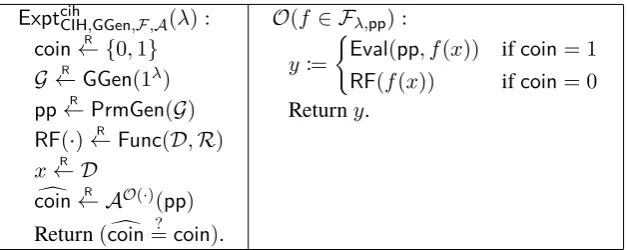
ExptcihCIH,GGen,F,A(λ) : coin← {R 0,1} G←R GGen(1λ) pp←R PrmGen(G) RF(·)←R Func(D,R)
x← DR
d
coin← AR O(·)(pp)
Return(coind
?
=coin).
O(f ∈ Fλ,pp) :
y:=
(
Eval(pp, f(x)) ifcoin= 1
RF(f(x)) ifcoin= 0
Returny.
Figure 3: Left: The security experiment for a CIH.Right: The definition of the oracle O in the experiment.
parameterized byλ∈Nandz∈ {0,1}∗,18and it is required that for allλ∈
N, ifG ←R GGen(1λ)and
pp←R PrmGen(G), then the domain and the range of functions inFλ,ppare identical to the domain of
Eval(pp,·).
For the publicly parameterized functionCIH, the group generatorGGen, the function classF, and an adversaryA, we define the security experimentExptcihCIH,F,A(λ)as described in Figure3.
Note that in the experiment, the oracleO(·)thatAhas access to, takesf ∈ Fλ,ppas input, and returns either the evaluation resultCIH(pp, f(x))or the outputRF(f(x))of the random functionRF, depending on the challenge bitcoin∈ {0,1}.
Definition 2.11 (Security of CIH).LetCIHbe a publicly parameterized function with respect to a group generatorGGen, and letFbe a function class. We say thatCIHis aCIH forF(or,F-CIH) with respect to
GGen, if for all PPT adversariesA, the advantageAdvcihCIH,GGen,F,A(λ) := 2· |Pr[ExptcihCIH,GGen,F,A(λ) = 1]−1/2|is negligible.
Remark2.12 (On the difference between CIHs and related-key secure PRFs (or PRGs)). This remark
provides additional information for readers who are familiar with related primitives. We note that Definition2.11is essentially the same as the definition of a related-key secure pseudorandom generator (RKA-PRG) by Bellare and Cash [BC10a, Section 6, Equation (27)]. A very minor difference is that we explicitly consider public parameters in the syntax. An RKA-PRG can be seen as a generalized version of correlated-input pseudorandomness by Goyal, O’Neill, and Rao [GOR11, Definition 7]. IfA in the security of a CIH must declare functions that will be queried to the oracle at the beginning of the experiment (i.e., selective security) andRF(f(x))is replaced by a uniformly random element inR, then it is the same as correlated-input pseudorandomness. The reason why we select the name “CIH” is that it is well-suited for our usage.
Moreover, an RKA-PRF implies an RKA-PRG19. Therefore, the RKA-PRF (or RKA-PRG) by
Bellare and Cash [BC10a, Theorem 4.2] and the RKA-PRF by Abdalla, Benhamouda, Passelègue, and Paterson [ABPP14, Theorem 7] are secure CIHs under our definition. (Of course, supported function classes are the same as theirs.)
In Sections3and5, we introduce two concrete function classes for CIHs used as building blocks in our proposed CPRFs.
18For a class of functionsFconsidered for CIHs, we allow each member ofFto be parameterized by not onlyλ∈Nbut also z∈ {0,1}∗. The role of
zis to associate the functions with a public parameterppgenerated bySetup(1λ). See the security experiment in Figure3.