Estimation and Control in Energy Harvesting
Wireless Communication Networks
Ph.D. Dissertation
Author
Miguel Calvo-FullanaAdvisors
Dr. Javier Matamoros Dr. Carles Ant´on-HaroAbstract
Long thought to be an unattainable ambition, self-sustainable and green-powered wireless networks are rapidly becoming a reality. This is driven by recent hardware improvements in what is known as Energy Harvesting (EH). This technology makes it possible for de-vices to scavenge energy from the environment, be it from solar, thermal, kinetic or other sources. One area where this idea has shown considerable promise is in Wireless Sensor Networks (WSNs). These networks consist of inexpensive, small and low-power sensors, making them a prime candidate for the deployment of energy harvesting technologies. However, when devices are equipped with these new technologies, the intermittent and random nature of the energy supply makes it necessary to take a new approach to the design of communication policies.
It is the main objective of this dissertation to study, evaluate and solve problems that arise in wireless sensor networks with energy harvesting capabilities. The nature of the problems studied can be grouped into two categories. On one hand, we address problems of estimation, which arise when EH sensors collect measurements of some physical phenomenon. On the other hand, we study problems of control, which emerge when EH sensors are part of a dynamical system.
First, we address the estimation problem in EH-powered wireless sensor networks. We approach the problem in a coded manner, where sensors transit their measurements to a Fusion Center (FC) digitally. We consider a point-to-point sensor-to-FC communication scenario, where the measured sources are time-correlated. We derive the transmission policies minimizing the average reconstruction distortion for both delay-constrained and delay-tolerant scenarios. Next, we study the case in which multiple sensors collaborate in the estimation of a source. In this problem, only a limited number of sensors can transmit simultaneously, due to the reduced number of sensor-to-FC channels. The goal is to jointly design the power allocation and sensor selection policies that minimize the average reconstruction distortion. However, this problem is not convex. To overcome this, we propose two policies, an iterative joint policy that finds a stationary solution of the original problem; and a heuristic separate policy in which the optimal power allocation
Further, as an alternative approach to the problem, we have also proposed the use of sparsity-promoting techniques.
Then, we turn our attention to problems of a control nature in energy harvesting communication networks. First, we study the problem of jointly routing and schedul-ing traffic in a communication network with EH-powered nodes. The routschedul-ing-schedulschedul-ing policies proposed act as a generalization the stochastic backpressure policies to energy harvesting communication networks. Specifically, we provide two policies, an easy to compute policy and a randomized policy with improved stability guarantees. Further-more, we ensure that given sustainable data and energy arrivals, the proposed policies stabilize the data queues over all the network. Finally, we study a more general control problem in which energy harvesting sensors share a wireless medium over which they transmit measurements to their respective controllers. Since the medium is shared, si-multaneous transmissions might lead to packet collisions. To overcome this issue, we propose the use of a random access scheduling policy. Furthermore, we show that given sustainable energy and stability requirements, the policies stabilize all the control sys-tems while satisfying the energy harvesting constraints.
Resumen
Consideradas durante mucho tiempo una ambici´on inalcanzable, las redes inal´ambricas auto-sostenibles y de energ´ıa renovable se est´an convirtiendo r´apidamente en una reali-dad. Esto viene impulsado por las recientes mejoras de hardware en lo que se conoce como recolecci´on de energ´ıa (energy harvesting). Esta tecnolog´ıa permite a los dispositi-vos recoger la energ´ıa del medio ambiente, ya sea de fuentes solares, t´ermicas, cin´eticas u otras. Un ´area en la que esta idea se ha mostrado considerablemente prometedora son las redes de sensores inal´ambricos. Estas redes consisten en sensores baratos, peque˜nos y de baja potencia, lo que los convierte en un excelente candidato para el despliegue de tecnolog´ıas de recolecci´on de energ´ıa. Sin embargo, cuando los dispositivos est´an equi-pados con estas nuevas tecnolog´ıas, la naturaleza intermitente y aleatoria del suministro de energ´ıa hace necesario adoptar un nuevo enfoque para el dise˜no de las pol´ıticas de comunicaci´on.
Es el objetivo principal de esta tesis doctoral estudiar, evaluar y resolver problemas que surgen en redes de sensores inal´ambricos con capacidades de recolecci´on de energ´ıa. La naturaleza de los problemas estudiados puede agruparse en dos categor´ıas. Por un lado, abordamos problemas de estimaci´on, que surgen cuando los sensores con capacida-des de recolecci´on de energ´ıa recogen mediciones de alg´un fen´omeno f´ısico. Por otro lado, estudiamos los problemas de control, que surgen cuando los sensores con capacidades de recolecci´on de energ´ıa forman parte de un sistema din´amico.
En primer lugar, abordamos el problema de estimaci´on en redes de sensores inal´ ambri-cos alimentados con recolecci´on de energ´ıa. Enfocamos el problema de una manera codi-ficada, donde los sensores transmiten sus mediciones digitalmente a un centro de fusi´on. Consideramos un escenario de comunicaci´on punto a punto de sensor a centro de fusi´on, donde las fuentes medidas est´an correlacionadas temporalmente. Derivamos las pol´ıti-cas de transmisi´on que minimizan la distorsi´on media de reconstrucci´on tanto para los escenarios con limitaci´on de retardo como con tolerancia al retardo. A continuaci´on, es-tudiamos el caso en el que m´ultiples sensores colaboran en la estimaci´on de una fuente. En este problema, s´olo un n´umero limitado de sensores puede transmitir simult´
res que minimicen la distorsi´on media de reconstrucci´on. Sin embargo, este problema no es convexo. Para superar esto, proponemos dos pol´ıticas, una pol´ıtica conjunta iterativa que encuentra una soluci´on estacionaria del problema original; y una pol´ıtica separada heur´ıstica en la que la asignaci´on de potencia ´optima viene dada por un problema de optimizaci´on convexa. Ambas pol´ıticas est´an relacionadas entre s´ı en el hecho de que ´esta ´ultima puede ser utilizada como un punto de inicializaci´on de la pol´ıtica iterativa anterior. Adem´as, como un enfoque alternativo al problema, tambi´en hemos propuesto el uso de t´ecnicas de promoci´on de la dispersi´on.
M´as tarde, centramos nuestra atenci´on en los problemas de control en las redes de comunicaciones con recolecci´on de energ´ıa. En primer lugar, estudiamos el problema de enrutamiento y planificaci´on conjunta del tr´afico en una red de comunicaciones con nodos alimentados por recolecci´on de energ´ıa. Las pol´ıticas de enrutamiento y planificaci´on que proponemos act´uan como una generalizaci´on de las pol´ıticas debackpressure estoc´asticas para las redes de comunicaciones con recolecci´on de energ´ıa. Espec´ıficamente, ofrecemos dos pol´ıticas, una pol´ıtica f´acil de calcular y una pol´ıtica aleatoria con mejores garant´ıas de estabilidad. Adem´as, aseguramos que dadas llegadas de datos y energ´ıa factibles, las pol´ıticas propuestas estabilizan las colas de datos en toda la red. Finalmente, estudia-mos un problema de control m´as general en el que los sensores con recolecci´on de energ´ıa comparten un medio inal´ambrico sobre el cual transmiten mediciones a sus respectivos controladores. Dado que el medio es compartido, las transmisiones simult´aneas pueden llevar a colisiones de paquetes. Para superar este problema, proponemos el uso de una pol´ıtica de planificaci´on de acceso aleatorio. Adem´as, demostramos que, dadas necesi-dades de energ´ıa y estabilidad factibles, las pol´ıticas estabilizan todos los sistemas de control y satisfacen las restricciones impuestas por la recolecci´on de energ´ıa.
Resum
Considerades durant molt de temps una ambici´o inassolible, les xarxes sense fils auto-sostenibles i d’energia renovable s’estan converting r`apidament en una realitat. Aquest fet ve impulsat per les recents millores de hardware en el que es coneix com recol·lecci´o d’energia (energy harvesting). Aquesta tecnologia permet als dispositius recollir l’energia del medi ambient, ja sigui de fonts solars, t`ermiques, cin`etiques o altres. Una `area en la que aquesta idea s’ha mostrat considerablement prometedora s´on les xarxes de sensors sense fils. Aquestes xarxes consisteixen en sensors barats, petits i de baixa pot`encia, el que els converteix en un excel·lent candidat per al desplegament de tecnologies de recol·lecci´o d’energia. No obstant, quan els dispositius estan equipats amb aquestes noves tecnologies, la naturalesa intermitent i aleat`oria del subministrament d’energia fa necessari adoptar un nou enfocament per al disseny de les pol´ıtiques de comunicaci´o.
´
Es l’objectiu principal d’aquesta tesi doctoral estudiar, avaluar i resoldre problemes que sorgeixen en xarxes de sensors sense fils amb capacitats de recol·lecci´o d’energia. La naturalesa dels problemes estudiats pot agrupar-se en dues categories. D’una ban-da, abordem problemes d’estimaci´o, que sorgeixen quan els sensors amb capacitats de recol·lecci´o d’energia recullen mesuraments d’algun fenomen f´ısic. D’altra banda, estudi-em els problestudi-emes de control, que sorgeixen quan els sensors amb capacitats de recol·lecci´o d’energia formen part d’un sistema din`amic.
En primer lloc, abordem el problema d’estimaci´o en xarxes de sensors sense fils ali-mentats amb recol·lecci´o d’energia. Enfoquem el problema d’una manera codificada, on els sensors transmeten els seus mesuraments digitalment a un centre de fusi´o. Consi-derem un escenari de comunicaci´o punt a punt de sensor a centre de fusi´o, on les fonts mesurades estan correlacionades temporalment. Derivem les pol´ıtiques de transmissi´o que minimitzen la distorsi´o mitjana de reconstrucci´o tant per als escenaris amb limitaci´o de retard com amb toler`ancia al retard. A continuaci´o, estudiem el cas en qu`e m´ultiples sensors col·laboren en l’estimaci´o d’una font. En aquest problema, nom´es un nombre limitat de sensors pot transmetre simult`aniament, a causa del nombre redu¨ıt de canals de sensor a centre de fusi´o. L’objectiu ´es dissenyar de manera conjunta les pol´ıtiques
pol´ıtiques, una pol´ıtica conjunta iterativa que troba una soluci´o estacion`aria del proble-ma original; i una pol´ıtica separada heur´ıstica en qu`e l’assignaci´o de pot`encia `optima ve donada per un problema d’optimitzaci´o convexa. Les dues pol´ıtiques estan relacionades entre si en el fet que aquesta ´ultima pot ser utilitzada com un punt d’inicialitzaci´o de la pol´ıtica iterativa anterior. A m´es, com un enfocament alternatiu al problema, tamb´e hem proposat l’´us de t`ecniques de promoci´o de la dispersi´o.
M´es tard, centrem la nostra atenci´o en els problemes de control en les xarxes de comunicacions amb recol·lecci´o d’energia. En primer lloc, estudiem el problema d’enca-minament i planificaci´o conjunta del tr`ansit en una xarxa de comunicacions amb nodes alimentats per recol·lecci´o d’energia. Les pol´ıtiques d’encaminament i planificaci´o que proposem actuen com una generalitzaci´o de les pol´ıtiques debackpressure estoc`astiques per a les xarxes de comunicacions amb recol·lecci´o d’energia. Espec´ıficament, oferim du-es pol´ıtiqudu-es, una pol´ıtica f`acil de calcular i una pol´ıtica aleat`oria amb millors garanties d’estabilitat. A m´es, assegurem que donades arribades de dades i energia factibles, les pol´ıtiques propostes estabilitzen les cues de dades en tota la xarxa. Finalment, estudi-em un problestudi-ema de control m´es general en el qual els sensors amb recol·lecci´o d’energia comparteixen un mitj`a sense fils sobre el qual transmeten mesuraments als seus respec-tius controladors. At`es que el mitj`a ´es compartit, les transmissions simult`anies poden dur a col·lisions de paquets. Per superar aquest problema, proposem l’´us d’una pol´ıtica de planificaci´o d’acc´es aleatori. A m´es, demostrem que, donades necessitats d’energia i estabilitat factibles, les pol´ıtiques estabilitzen tots els sistemes de control i satisfan les restriccions imposades per la recol·lecci´o d’energia.
Acknowledgements
It is quite difficult to come to terms with the realization that three years have already gone by since I started to work in this Ph.D. thesis. The end of it, which I once thought to be in the distant future, is now very close. As I finish this document, I would like to devote the last written lines to remember the people who have made this journey possible and, above all, truly enjoyable.
First of all, I must express my most sincere gratitude to my advisors Javier Mata-moros and Carles Ant´on-Haro. Their guidance, comments, suggestions and constructive criticism have been essential to the successful development of this thesis, as well as my improvements as a researcher. At the same time, I am also grateful to Alejandro Ribeiro. During my four-month stay in Philadelphia, he welcomed me to his research group at the University of Pennsylvania with the same dedication that he shows to his own students. For this, and many other things, I am sincerely thankful.
Further, I would like to extend my gratitude to Prof. Antonio Pascual Iserte, Prof. Antonio G. Marques and Prof. Geert Leus for agreeing to serve in this thesis’ committee. My gratitude also extends to Prof. Davide Dardari for reviewing this thesis, and together with Dr. Miquel Payar´o, for fulfilling the role of substitute members of the committee.
During these last years I have been fortunate enough to spend many hours interacting with the people from CTTC, UPC and Penn. To avoid the risk of turning this section into an endless list of names, I will simply thank all of them. All our interactions, in and outside our respective institutions, have delighted me greatly, both at a professional and a personal level. Also, I cannot forget that some of these interactions have resulted in friendships that I greatly cherish. In the same vein, I could not forget the rest of my friends. All of our shared moments have made the ups and downs of being a Ph.D. student a much more enjoyable experience.
Last but not least, I must also express how deeply indebted I am to my family. Ever since I was young, they have provided me with all their love and support. A large part of this thesis belongs to them.
Miguel Calvo Fullana, Barcelona, May 2017
List of Acronyms
BP Backpressure
DMC Discrete Memoryless Channel
DP Dynamic Programming
EH Energy Harvesting
ESO Ergodic Stochastic Optimization
FC Fusion Center
GSM Global System for Mobile Communications
i.i.d. Independent and Identically Distributed
IoT Internet of Things
JSS-EH Joint Sensor Selection and Power Allocation with Energy Harvesting
KKT Karush-Kuhn-Tucker
LHS Left Hand Side
LQG Linear-Quadratic-Gaussian
MAC Multiple Access Channel
MDP Markov Decision Process
MM Majorization-Minimization
MMSE Minimum Mean Squared Error
MSE Mean Squared Error
pdf Probability Density Function
RF Radio Frequency
RFID Radio Frequency IDentification
RHS Right Hand Side
SBP Stochastic Backpressure
SS-EH Separate Sensor Selection and Power Allocation with Energy Harvesting
SSBP Stochastic Soft Backpressure
SSBP-EH Stochastic Soft Backpressure with Energy Harvesting
SSS-EH Sparse Sensor Selection and Power Allocation with Energy Harvesting
SWIPT Simultaneous Wireless Information and Power Transfer
WLAN Wireless Local Area Network
WPT Wireless Power Transfer
w.r.t. With Respect To
WSN Wireless Sensor Network
Notation
x A scalar.
x A column vector.
X A matrix.
X A set.
R The set of real numbers.
Rn The set of real nvectors. Rm×n The set of real m×nmatrices. relintX Relative interior of set X.
domf Domain of functionf.
|X | Cardinality of set X.
k · k Norm.
(·)T Transpose operator.
trX Trace of matrix X.
diag(x) Matrix with the entries of vectorx in its diagonal.
X−1 Inverse of matrix X. I Identity matrix. max Maximum. min Minimum. sup Supremum. inf Infimum. log Logarithm. lim Limit. arg Argument. xiii
∇xf(x) Gradient of functionf with respect tox.
∂f(x)
∂xi Partial derivative of functionf with respect to xi.
[·]+ Projection to the interval [0,∞], i.e., [·]+= max{0,·}. [·]b
a Projection to the interval [a, b], i.e., [·]ba= min{max{a,·}, b}. I(·) Indicator function.
Pr(·) Probability.
E[·] Expected value.
H(·) Entropy.
I(·;·) Mutual information.
∼ Distributed according to.
N(µ,Σ) Real Gaussian distributed vector with mean µand covariance matrixΣ.
Contents
Abstract iii Resumen v Resum vii Acknowledgements ix List of Acronyms xi Notation xiii 1 Introduction 1 1.1 Motivation . . . 11.2 Outline of the Thesis . . . 2
1.3 Contribution . . . 4
2 State of the Art in Energy Harvesting Technologies 7 2.1 Sources and Models for Energy Harvesting . . . 7
2.2 Wireless Networks Powered by Energy Harvesting . . . 10
2.2.1 Information-theoretic Approaches . . . 10
2.2.2 Design of Offline Transmission Policies . . . 12
2.2.3 Design of Online Transmission Policies . . . 13
3 Mathematical Preliminaries 15 3.1 Convex Optimization . . . 15
3.1.1 Convexity . . . 16
3.1.2 Convex Optimization Problems . . . 17
3.1.3 Duality . . . 18
3.1.4 Optimality Conditions . . . 19 xv
3.3 Ergodic Stochastic Optimization . . . 21
4 Reconstruction of Correlated Sources 25 4.1 Introduction . . . 25
4.1.1 Contribution . . . 26
4.2 System Model . . . 27
4.2.1 Source Coding and Distortion . . . 29
4.3 Minimization of the Average Distortion: The Delay-Constrained Scenario 31 4.3.1 Optimal Power Allocation . . . 33
4.3.2 Optimal Rate Allocation . . . 34
4.3.3 Optimization Algorithm . . . 34
4.4 Minimization of the Average Distortion: The Delay-Tolerant Scenario . . 36
4.5 Numerical Results . . . 38
4.5.1 Delay-Constrained Scenario (d= 1) . . . 39
4.5.2 Delay-Tolerant Scenario (d >1) . . . 40
4.5.3 Comparison with an Online Policy . . . 42
4.5.4 Convergence . . . 44
4.5.5 Allocation of Individual Rates . . . 44
4.6 Conclusions . . . 46
4.7 Appendix: Derivation of the Average Distortion in (4.11) . . . 48
4.8 Appendix: Proof of Proposition 4.2. . . 49
5 Sensor Selection and Power Allocation Strategies 53 5.1 Introduction . . . 53
5.1.1 Contribution . . . 54
5.2 System Model . . . 55
5.3 Problem Statement: Sensor Selection and Power Allocation in an Energy Harvesting Framework . . . 57
5.4 Joint Sensor Selection and Power Allocation with Energy Harvesting (JSS-EH) . . . 59
5.4.1 Remarks . . . 61
5.5 Separate Sensor Selection and Power Allocation with Energy Harvesting (SS-EH) . . . 61
5.5.1 Optimal Power Allocation for a Given Sensor Selection . . . 62
5.5.2 EH-aware Sensor Selection . . . 64
5.5.3 Remarks . . . 65
5.5.4 Online SS-EH Strategy . . . 65 xvi
5.6 Sparse Sensor Selection and Power Allocation with Energy Harvesting
(SSS-EH) . . . 66
5.7 Numerical Results . . . 68
5.7.1 Subsets of Active Sensors . . . 69
5.7.2 Impact of Cropping the Selection Vector . . . 71
5.7.3 Distortion Performance . . . 72
5.7.4 Comparison of the Online and Offline Strategies . . . 72
5.7.5 Sparse Sensor Selection . . . 75
5.8 Conclusions . . . 76
6 Stochastic Routing and Scheduling Policies 79 6.1 Introduction . . . 79
6.2 System Model . . . 81
6.2.1 Routing and Scheduling with Energy Harvesting . . . 83
6.3 Joint Routing and Scheduling Algorithm . . . 85
6.3.1 Stochastic Backpressure with Energy Harvesting (SBP-EH) . . . . 87
6.3.2 Stochastic Soft Backpressure with Energy Harvesting (SSBP-EH) . 88 6.4 Causality and Stability Analysis . . . 89
6.4.1 Energy Causality . . . 89
6.4.2 Queue Stability . . . 90
6.4.3 Remarks and Practical Considerations . . . 95
6.5 Numerical Results . . . 95
6.5.1 Network Queues . . . 96
6.5.2 Network Balance . . . 99
6.5.3 Network Delay . . . 101
6.6 Conclusions . . . 102
7 Random Access Policies for Wireless Networked Control Systems 105 7.1 Introduction . . . 105
7.1.1 Contribution . . . 106
7.2 System Model and Problem Formulation . . . 106
7.2.1 Control Model . . . 106 7.2.2 Communication Model . . . 107 7.2.3 Energy Harvesting . . . 108 7.2.4 Control Performance . . . 108 7.2.5 Problem Formulation . . . 109 7.3 Stochastic Algorithm . . . 111 7.4 Numerical Results . . . 113 7.5 Conclusions . . . 115 xvii
8.2 Future Work . . . 120
Bibliography 122
List of Figures
2.1 Wireless communication model powered by energy harvesting. . . 11
3.1 Majorization-Minimization algorithm. . . 21
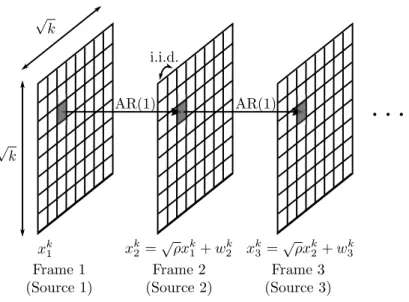
4.1 Temporal and spatial correlation models in video coding. . . 26
4.2 System Model. . . 28
4.3 Simultaneous transmission of source measurements. . . 29
4.4 Optimal power and cumulative rate allocation. . . 33
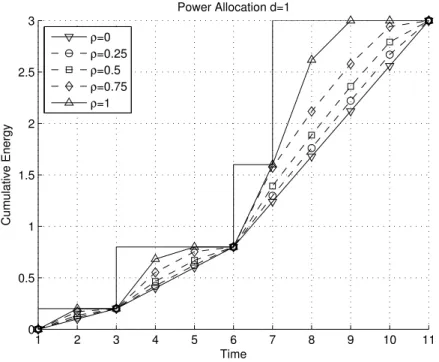
4.5 Optimal power allocation ford= 1 and varying correlation coefficientρ. . 40
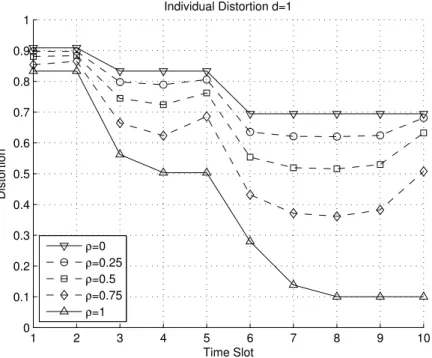
4.6 Individual distortion for d= 1 and varyingρ. . . 41
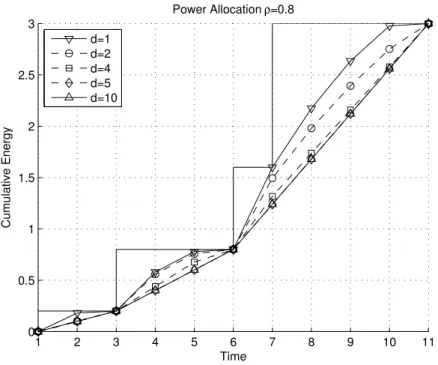
4.7 Optimal power allocation forρ= 0.8 and varying delay d. . . 42
4.8 Average distortion vs. delay dfor varying correlationρ. . . 43
4.9 Reduction in average distortion. . . 44
4.10 Average distortion for the offline and online policies, for low (ρ = 0.2) and high (ρ = 0.8) correlation, and delay-constrained (d= 1) and delay-tolerant (d= 10) scenarios. . . 45
4.11 Relative distortion error for ρ= 0.8 and varying d. . . 46
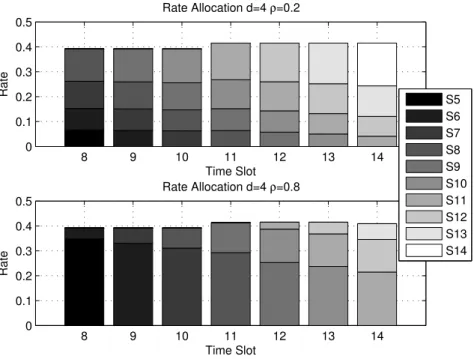
4.12 Allocation of individual rates for sources with low (top) and high (bottom) correlation (K = 20; d = 4; energy profile: E1 = 0.2, E2 = 1, E4 = 0.6, E6 = 1, E7 = 0.8, E8 = 0.2, E9 = 0.4, E11 = 1.4, E13 = 0.6, E14 = 0.6, E16= 0.8,E17= 0.2, E18= 1,E19= 0.2, andE20= 0.4). . . 47
5.1 System model. . . 55
5.2 Two-dimensional directional waterfilling for a sensor i∈ M in a scenario withT = 5 time slots and energy arrivals in time slots 1,2 and 4. . . 63
5.3 Sparsity-promoting penalty functions. . . 67
5.4 Sensor selection policies. Energy arrivals are denoted by +. The sensors selected by the SS, SS-EH and JSS-EH policies are denoted by , ◦ and , respectively (M = 20, T = 50, K= 10, µ= 0.5, σw2 = 0.1). . . 69
Power Allocation strategies, and the EH-agnostic Sensor Selection (SS) one. The cumulative energy harvesting (cEH) curve is shown as a reference. 70 5.6 Histogram of the selection variable zi[t] after convergence of the JSS-EH
scheme (top) and zoomed-in area with details (bottom). Results are shown for a total of 20 independent runs with random initializations (M = 50, T = 20, µ= 1, σ2
w = 0.1). . . 71
5.7 Reconstruction distortion vs. number of active sensors, for high (σw2 = 0.01) and low-SNR scenarios (σw2 = 0.5) and lower bound (M = 100, T = 20, µ= 0.25). . . 73
5.8 Reconstruction distortion vs. number of iterations for various initializa-tions of the JSS-EH algorithm: SS-EH, all-zeros, and random for 20 dif-ferent realizations (M = 50, T = 20, K = 10,µ= 1,σ2w= 0.1). . . 74
5.9 Distortion associated to the online and offline SS-EH and JSS-EH strate-gies, for scenarios with a low (K = 10) and high (K = 40) number of selected sensors (M = 50, T = 20, σ2 w = 0.01). . . 75
5.10 Reconstruction distortion for the online SS-EH and JSS-EH strategies, in scenarios with low (µ= 0.1, E= 25) and high (µ= 2.5, E= 1) intensity rates (M = 50,T = 20,σ2w= 0.01). . . 76
5.11 Distortion vs. Average number of selected sensors for high and low energy scenarios in the SSS-EH policy. . . 77
5.12 Power allocation for a single sensor in the SSS-EH policy. . . 78
6.1 Relationship between data queues, batteries and their Lagrange multipli-ers. Example with ¯γk i = 5 and bmaxi = 5. . . 86
6.2 Example of a SSBP-EH routing decision for a node node serving two flows and four neighbors. . . 88
6.3 Connectivity graph of the simulated network. . . 96
6.4 Total amount of packets queued in the network at each time slot. Average values are shown in dashed lines. . . 97
6.5 Average data queues at each node in the network. . . 98
6.6 Total energy stored in the network at a given time slot. . . 99
6.7 Average value of the queue multipliers γik for node 5 (i= 5,k= 1). . . 100
6.8 Average data balance in the network, given by the expression 1tPtl=0 P i∈N P k∈K ak i[l]−rijk[l] , where j=Nk (dest). . . 101
6.9 Average energy balance in the network, given by the expression 1tPtl=0 P i∈N P k∈K ei[l]−Pj∈Nir k ij[l] . . . 102
6.10 Histogram of packet elapsed time before reaching a sink node. . . 103 xx
7.1 System model. . . 107
7.2 Probability of decoding as a function of the channel state. . . 108
7.3 Evolution of the plant state at each time slot. . . 114
7.4 Energy stored in the batteries at each time slot. . . 114
7.5 Average evolution of the dual variablesνi[t] at each time slot. . . 115
7.6 Evolution of the control system performance at each time slot. . . 115
Chapter
1
Introduction
1.1
Motivation
Usually, wireless communication devices are equipped with batteries acting as their only energy supply. Even though these batteries might be rechargeable, the wireless nature of such communication devices means that they tend to lack access to a wired energy source from which to easily recharge them. However, in recent years, attention has turned to advances in technologies that make it possible to gather energy from the environment. This technology, energy harvesting, has emerged as capable of overcoming (or, at least, alleviating) some of the limitations imposed by traditional battery operation. Devices powered by energy harvesting are capable of acquiring energy from a varied array of natural sources, with the most common being solar, thermal, or vibrational sources. Not only that, even man-made sources, such as Radio Frequency (RF) signals can be exploited by energy harvesting technologies to obtain energy.
An area where this technology has shown much promise is in wireless sensor networks. These networks are composed of sensor nodes which are usually powered by batteries. However, due to their nature, WSNs are sometimes deployed in remote and difficult to access locations. This makes it very difficult for the devices to have access to the power grid in order to have their batteries recharged. Besides, the process of replacing the batteries can be very expensive and difficult. Additionally, with the current micro-manufacturing technology allowing for small, ultra-low power wireless sensors, wireless sensor networks pose an excellent deployment scenario for energy harvesting technologies. Given the wide availability of energy sources coupled with the small energy needs of sensors, it is expected that EH-powered nodes could extend their lifetime considerably. This is to say, they could even operate perpetually, until hardware failure. Also, recently emerging concepts such as the Internet of Things (IoT) envision massive deployment of wireless sensors. It is expected that energy harvesting technologies will play a major role in enabling this vision.
The hardware and circuit design aspects of energy harvesting technologies have long been studied. However, when dealing with the design of communication policies, previous efforts have been in the design of energy efficient policies, focused on reducing the power consumption of the wireless nodes. While this is a sensible approach for battery powered systems, the random nature of the energy harvesting process introduces fundamental changes in the communication system, leaving previous policies inefficient. Hence, the emergence of wireless networks equipped with energy harvesting technologies represents a paradigm shift in the way that communication problems are treated.
The need to design EH-aware communication policies poses several research ques-tions. Specifically, we aim to investigate some of the issues that arise when dealing with problems of estimation and control in communication networks powered by energy har-vesting. Consider a system of EH-powered sensors acquiring some type of measurements which they must transmit to a fusion center for further processing. What is the optimal power allocation for transmission if our goal is to minimize the reconstruction distortion? If the measurements are obtained from a time-correlated source, how does correlation affect the transmission policies? Can we allow some delay in the reconstruction to better exploit the intermittency of the energy supply? Now, if the estimation is done with multiple sensors which share a wireless medium of limited bandwidth, how do we select which sensors are allowed to transmit at each time? Additionally, all this information needs to be delivered to its destination. This might require the routing and scheduling of data traffic. How can we design policies that ensure that the data queues are stable when the energy supply itself is subject to randomness? And, what if the sensors are measuring any kind of dynamical system. Can we give some guarantees on the stability of the system when control policies rely on the measurements collected and transmitted by an energy harvesting device? These are some of the questions that this dissertation aims to answer.
1.2
Outline of the Thesis
As discussed earlier, in this dissertation we study wireless sensor networks powered by energy harvesting. Specifically, our focus lies on issues related to estimation and control in the energy harvesting scenario. Broadly speaking, the contribution of this thesis can be split in two parts. The first part (Chapters 4 and 5) is devoted to estimation problems, while the second part (Chapters 6 and 7) studies control problems. In more detail, this document is organized as follows.
In Chapter 2, we provide the reader with some background knowledge on the state of the art of energy harvesting technologies. Specifically, we review the sources from which energy can be harvested and how they are modeled. Also, we survey the communica-tion aspects of wireless devices powered by energy harvesting. Notably, we review the
1.2 Outline of the Thesis 3 information-theoretical foundations as well as the current advances in both offline and online transmission policies.
In Chapter 3, we review a number of important mathematical concepts over which much of the work of this thesis is built. Specifically, we review convex optimization, non-convex optimization and ergodic stochastic optimization.
We begin the contributions of this dissertation in Chapter 4. We start by considering the estimation of a phenomenon which is correlated over time. More formally, we consider apoint-to-point communication scenario between a sensor node and a fusion center. The sensor node is powered by energy harvesting and obtains measurements from a series of time-correlated sources. In this scenario, we aim to find coded transmission policies which minimize the average reconstruction distortion at the fusion center. Due to correlation, the transmission policies leverage on the previously encoded sources as side information. We derive these policies for both a delay-constrained case (in which sources must be reconstructed at the next time slot) and a delay-tolerant scenario (where a certain time lag is allowed in the reconstruction of sources). We take an offline approach to the problem and pose it in a convex optimization framework. The optimal policies can be computed by the proposed iterative algorithm, which consists of a coupling between a two-directional waterfilling (for power allocation) and a reverse waterfilling (for rate allocation). Furthermore, we also provide an online myopic form of these policies, for which its offline counterpart serves as a benchmark.
Chapter 5 extends some of the ideas of the previous chapter to the case of multiple
sensor nodes. Specifically, we consider a scenario in which multiple EH-powered sensors acquire different measurements of the same source and want to transmit them to a fu-sion center. Due to the limited number of available sensor-to-FC channels, a decifu-sion on which sensors should transmit must be made at each time slot. Additionally, the sensors must design their power allocation policy. Our goal is to jointly derive the sensor selec-tion and power allocaselec-tion policies which minimize the average reconstrucselec-tion distorselec-tion of the source at the fusion center. Unfortunately, we show that this problem is not con-vex. Instead, we propose two suboptimal offline policies. First, we provide ajoint sensor selection and power allocation scheme, based on an iterative majorization-minimization procedure which allows us to find a locally optimal solution of the original non-convex problem. Then, we also propose a separate sensor selection and power allocation policy. In this separate policy, we propose a heuristic sensor selection policy which takes into account the energy harvesting process. Then, given this selection, the optimal power allo-cation can be computed as the solution to a convex optimization problem. Furthermore, the separate sensor selection and power allocation policy can be used as an initialization point of the iterative algorithm of the joint policy, which then in turn, improves on the separate policy. Also, as in the previous chapter, we provide the online myopic form of these policies. Further, we also study an alternative approach to the problem, based in
promoting sparsity in the power allocation.
In Chapter 6 we turn our attention to some control aspects of energy harvesting net-works. Specifically, in this chapter we investigate the problem of routing and scheduling traffic in an energy harvesting communication network. Each node in the network inde-pendently generates data packets to be delivered to some other node in the network and nodes must collaborate to ensure that data packets are delivered to their destination. To solve this problem, we propose routing-scheduling policies which act as a generalization of the well-known backpressure family of algorithms for EH-powered networks. To do this, we leverage on stochastic subgradient methods on the dual domain. Specifically, we propose two distinct policies: (i) a straightforward policy where the routing-scheduling decision is taken by the comparison of a node’s and its neighbors’ Lagrange multipli-ers; and (ii) a policy given by a randomized decision. Instead of a direct comparison between a node’s and its neighbors’ Lagrange multipliers, this second policy equalizes the differences between multipliers by means of an inverse waterfilling. This results in a routing-scheduling probability mass function over which the node samples to take its decision. This second policy results in a faster convergence speed. Furthermore, we show that given sustainable packet and energy arrival processes, both policies stabilize the data queues over all the network. And, hence, such stabilization can be regarded as a control problem.
In Chapter 7 we investigate networked control systems in a more general manner. Specifically, we study a scenario in which multiple EH-powered sensor nodes must trans-mit measurements to their respective controllers in order to stabilize their dynamical system. This transmission occurs over a shared wireless medium. Due to this, collisions might occur if sensors transmit simultaneously. Under these conditions, our goal is to design transmission policies capable of stabilizing all the control loops subject to the constraints imposed by the energy harvesting process. Since each control loop might have a different control performance requirement, we propose the use of a control perfor-mance abstraction which translates the average control requirements into probabilities of successful transmission in a random access communication scheme. Then, leveraging on dual subgradient methods, we propose a policy satisfying these probabilities of successful transmission.
Finally, in Chapter 8 we conclude this thesis by providing a summary and final remarks on the main results of this work. Also, we outline and discuss some possible lines of future work.
1.3
Contribution
The research presented in this dissertation has also been disseminated through the fol-lowing publications [1–11].
1.3 Contribution 5
Chapter 4
• M. Calvo-Fullana, J. Matamoros, and C. Ant´on-Haro, “Reconstruction of Corre-lated Sources with Energy Harvesting Constraints in constrained and Delay-tolerant Communication Scenarios,”IEEE Transactions on Wireless Communica-tions, vol. 16, no. 3, pp. 1975-1986, March 2017.
• M. Calvo-Fullana, J. Matamoros, and C. Ant´on-Haro, “Reconstruction of Corre-lated Sources with Energy Harvesting Constraints,” in Proceedings of European Wireless (EW), Budapest, Hungary, May 2015.
Chapter 5
• M. Calvo-Fullana, J. Matamoros, and C. Ant´on-Haro, “Sensor Selection and Power Allocation Strategies for Energy Harvesting Wireless Sensor Networks,” IEEE Journal on Selected Areas in Communications, vol. 34, no. 12, pp. 3685-3695, December 2016.
• M. Calvo-Fullana, J. Matamoros, and C. Ant´on-Haro, “Decentralized Sparsity-Promoting Sensor Selection in Energy Harvesting Wireless Sensor Networks,” in Proceedings of European Signal Processing Conference (EUSIPCO), Budapest, Hungary, August 2016.
• M. Calvo-Fullana, J. Matamoros, C. Ant´on-Haro, and Sophie M. Fosson, “Sparsity-promoting Sensor Selection with Energy Harvesting Constraints,” in Proceedings ofInternational Conference on Acoustics, Speech and Signal Processing (ICASSP), Shanghai, China, March 2016.
• M. Calvo-Fullana, J. Matamoros, and C. Ant´on-Haro, “Sensor Selection in Energy Harvesting Wireless Sensor Networks,” in Proceedings ofIEEE Global Conference on Signal and Information Processing (GlobalSIP), Orlando, USA, December 2015.
Best Paper Award.
Chapter 6
• M. Calvo-Fullana, C. Ant´on-Haro, J. Matamoros, and A. Ribeiro, “Stochastic Routing and Scheduling Policies for Energy Harvesting Communication Networks,” to be submitted, 2017.
• M. Calvo-Fullana, J. Matamoros, C. Ant´on-Haro, and A. Ribeiro, “Stochastic Backpressure in Energy Harvesting Networks,” in Proceedings of International Conference on Acoustics, Speech and Signal Processing (ICASSP), New Orleans, USA, March 2017.
Chapter 7
• M. Calvo-Fullana, C. Ant´on-Haro, J. Matamoros, and A. Ribeiro, “Random Access Communication for Wireless Control Systems with Energy Harvesting Sensors,” in preparation, 2017.
• M. Calvo-Fullana, C. Ant´on-Haro, J. Matamoros, and A. Ribeiro, “Random Access Policies for Wireless Networked Control Systems with Energy Harvesting Sensors,” in Proceedings ofAmerican Control Conference (ACC), Seattle, USA, May 2017.
Other contributions not included in this dissertation
• J. Matamoros, M. Calvo-Fullana, and C. Ant´on-Haro, “On the impact of corre-lated sampling processes in WSNs with Energy-neutral operation,” in Proceedings of IEEE International Conference on Communications (ICC), London, UK, June 2015. Best Paper Award.
Chapter
2
State of the Art in Energy
Harvesting Technologies
In this section, we provide an overview of the current state of the art in energy harvesting technologies. Specially, we focus on wireless communication systems powered by energy harvesting. As discussed earlier in the introduction, batteries alone are not capable of coping with the demands of current devices. Consequently, the attention has turned to energy harvesting as a way to extend the lifetime of wireless devices.
2.1
Sources and Models for Energy Harvesting
The first step to EH-powered systems is to have an energy source providing an adequate supply of energy. Scavenging energy from sources like water and wind goes back in time to structures like water wheels and windmills. Nowadays, solar farms, wind farms and hydroelectric plants form the main bulk of renewable energy generation. These tend to be very large installations meant to supply energy to the power grid in a sustainable manner. However, as advances in microelectronics allowed for the manufacturing of small and power efficient devices, interest arose to also use energy harvesting to power those devices. In this case, due to their low-power nature, the range of energy harvesting sources available is considerably larger. In Table 2.1 we provide an overview of a variety of energy sources and their associated power densities. Also, we discuss some of these sources in the following.
• Light. By using photovoltaic cells, photons can be converted into electricity. The efficiency of this process depends on the materials used for the construction of the photovoltaic cells, with usual efficiency values around 5−30%. When deployed outside with direct solar illumination, photovoltaic cells have a power density of around 100 mW/cm2. This makes the sun an excellent source for energy harvesting.
Energy source Power density
Acoustic Noise [12] 0.003µW/cm3 at 75 dB 0.96 µW/cm3 at 100 dB Temperature Variation [13] 10 µW/cm3
Ambient Radio Frequency [14] <1 µW/cm2
Ambient Light [15] 100 mW/cm2 (Direct sun) 100µW/cm2 (Illuminated office)
Thermoelectric [16] 60 µW/cm2
Vibrational Microgenerators [17] 4 µW/cm3 (Human motion, Hz) 800µW/cm3 (Machines, kHz) Vibrations (Piezoelectric) [18] 200µW/cm3 Ambient Airflow [19] 1 µW/cm2 Push buttons [20] 50 µJ/N Hand generators [21] 30 W/kg Heel strike [22] 7 W/cm2
Table 2.1: Power density of several energy harvesting sources [23].
When deployed indoors, the available illumination levels tend to be smaller, with resulting power densities around 100 µW/cm2. Altogether, photovoltaic cells are a well developed and mature technology.
• Radio frequency. With the extensive amount of radio signals in today’s world, the harvesting of RF waveforms to obtain energy is a possibility. The most com-mon sources being Global System for Mobile Communications (GSM) and Wireless Local Area Network (WLAN) signals. However, power densities tend to be very small, less than 1µW/cm2, making it difficult to harvest enough energy for practi-cal applications. A more promising idea is the concept of Wireless Power Transfer (WPT) [24], where a dedicated RF source transmits for the sole purpose of being harvested as energy. Recently, there has also been considerable interest in the idea of transmitting both information and power, a concept known as Simultaneous Wireless Information and Power Transfer (SWIPT) [25]. A practical example of WPT are Radio Frequency IDentification (RFID) tags, which wirelessly receive their required amount of energy, which can be as low as 1 µW. On a more gen-eral note, at a transmission power of 100 mW and 20 cm of separation, harvested values of 1.5 mW have been reported [26]. And, in [27], for the same 100 mW of transmission power, 200µW were harvested at a distance of 2 m.
• Thermoelectric. By heat transfer, objects or environments that present a differ-ence in temperature offer the opportunity to generate power. A classical example of this is any of the widely used heat engines throughout history. More interesting
2.1 Sources and Models for Energy Harvesting 9 however, is the Seebeck effect, which states that when two junctions made of two dissimilar conductors are kept at different temperatures, an open circuit voltage develops between them [15]. Thermoelectric devices exploiting the Seebeck effect can be used to harvest energy in human body applications. At an ambient tem-perature of 22◦C, a thermal gradient of 15◦C can be converted to energy with an an efficiency around 0.8%. The resulting power density is around 15µW/cm2 [28]. Practical uses of thermoelectric energy harvesting in human body applications can be found, for example, to power a wristwatch by the small thermal gradient pro-vided by the human body heat over ambient temperature. On another note, for industrial applications with a much higher thermal gradient, power densities of 60
µW/cm2 have been reported [16].
• Vibrational and mechanical. Vibrational and mechanical stimuli are widely available. In order to convert them into energy, the most common transduction mechanism are piezoelectric, or electromagnetic. The former exploits the piezoelec-tric effect, by which some materials generate an elecpiezoelec-tric charge under mechanical stress. When piezoelectrics are coupled with vibrating structures, they can gener-ate up to around 200 µW/cm3 [18]. Besides, electromagnetic transducers tend to be found in vibrational microgenerators. These systems are based on the interac-tion between moving magnets and coils. They exploit vibrainterac-tions, with power levels ranging from 4µW/cm3 (typical human motion, a motion of 5 mm at 1 Hz) up to 800 µW/cm3 (machine motion, a motion of 2 nm at 2.5 kHz) [17]. Another sig-nificant source of mechanical power is human input in various forms. Examples of this are pushing, shaking or pulling to power devices (e.g., typical examples of this use of human sources are self-winding wristwatches or shake-powered flashlights). For example, the available power in a walking person’s heel strike is 7 W/cm2 (70 kg at 1 Hz), with demonstrated systems harvesting around 250−700 mW out of it [22].
In oder to design systems powered by energy harvesting, it is important to have an accurate characterization of the energy harvested from the sources. In this regard, considerable attention has been given in the literature to this issue, with light energy sources being the most researched ones. Models for solar power in outdoor scenarios have been studied in [29], with a focus on wireless sensor networks. Similarly, the authors in [30] improve solar source models with the inclusion of weather forecasts. In [31], the authors propose a model that adapts to seasonal variations in sunlight and diurnal cycles. Furthermore, in [32] the authors developed an indoor light model. With respect to other types of sources, a wind model has been studied in [31], while a mechanical energy model related to human motion (such as, walking, running and cycling), has been considered in [33].
In a more general sense, the energy harvesting process can be modeled as a discrete-time stochastic process. This is convenient, for instance, in order to design EH-aware communication policies. The stochastic process can be characterized either statistically or from samples of real harvested energy measurements. For tractability, some specific stochastic processes have been considered in the literature. For example, the authors in [34] consider an stationary Markov chain and the authors in [35] extend those results to a non-stationary Markov model.
2.2
Wireless Networks Powered by Energy Harvesting
While the hardware and modeling aspects of energy harvesting have been researched for a long time, the study of wireless communication systems powered by energy harvesting is more recent. When powered by energy harvesting, the random nature of the energy supply introduces fundamental changes in how wireless communication problems need to be addressed. In this section, we provide an overview of recent results in energy harvesting wireless communication1. First, we discuss how the introduction of energy harvesting alters the communication problem from an information-theoretic perspective. Then, we review the transmission policies found in the literature. For the latter, there are two distinct approaches, offline transmission policies and online transmission policies. Offline policies are derived under non-causal knowledge of the energy harvesting process by the transmitter. That is, they assume the knowledge of present, past and future energy arrivals and their magnitudes. For tractability reasons, these strategies are widely used to derive upper bounds on the performance of the system. On the contrary, online policies assume only a causal knowledge of the energy harvesting process (even though, statistical knowledge is also acceptable). Hence, they are more realistic and applicable to real systems.
2.2.1 Information-theoretic Approaches
When dealing with EH-powered communication, some information-theoretic questions require some thought. Mainly, the study of the channel capacity under the consideration that energy harvesting constrains the transmission has received considerable attention. In general, energy harvesting can be modeled as a discrete stochastic process. Hence, the use of energy harvesting introduces a new energy queue in the system. The canonical model for energy harvesting communication systems is shown in Figure 2.1.
In the classical Additive White Gaussian Noise (AWGN) channel with unit-variance Gaussian noise, the capacity is given by the well-known expression C = 12log(1 +P),
2.2 Wireless Networks Powered by Energy Harvesting 11
Figure 2.1: Wireless communication model powered by energy harvesting. whereP is the average power constraining the transmitted codewords Xi, that is
1 2 n X i=1 Xi2 ≤P, (2.1)
forn very large. In the case of an energy harvesting system, let us consider the energy harvesting process Ei as a stationary and ergodic random process with average arrival
rate E[Ei] = P. In order to transmit a codeword, a sufficient amount of energy must
have been harvested and stored first. The resulting constraints are called the energy causality constraints, given by
k X i=1 Xi2 ≤ k X i=1 Ei, k= 1, . . . , n. (2.2)
That is, for each channel use, the cumulative energy spent cannot exceed the cumulative harvested energy. Consequently, transmission decisions made in a given channel use also affect all future channel uses. For each time instant, additional constraints stem from the battery state. We define a battery stateBi, with evolution given by
Bi+1 =
Bi−Xi2+Ei
Bmax
0 , (2.3)
whereBmaxcorresponds to the battery capacity. Hence, the battery stateBi is a random
process correlated over time even when the energy arrivals are independent and iden-tically distributed (i.i.d.). Then, the instantaneous transmission constraints are simply given byXi2 ≤Bi.
Due to this, the study of the capacity of the energy harvesting channel is an intricate problem for which some preliminary results can be found in the literature. The most tractable case to tackle is that ofinfinite battery capacity, i.e.,Bmax=∞. For this case, and the AWGN channel, the authors in [38] derive two schemes capable of asymptotically achieving the classical AWGN channel capacity. These results have been extended in [39] and [40] to include the Multiple Access Channel (MAC).
The other extreme case entails the lack of battery, i.e., Bmax = 0. In this case, the instantaneous constraints are given by Xi2 ≤Ei, that is, just depending on the energy
that become active when they receive energy (e.g., those who store energy in supercapac-itors), which they immediately consume to transmit, and become inactive again. This case has been studied by the authors in [41], where they derive the capacity for this sce-nario and provide a coding scheme to achieve it. The resulting capacity is related to the capacity of the amplitude-constrained AWGN channel [42]. The constraints, however, are not deterministic and constant, but time-varying and stochastic. As expected, the capacity is significantly lower than that of the Bmax = ∞ case. Complementarily, the extension to the MAC channel has been studied in [43].
Results for afinite battery are much more elusive. For a unit battery size,Bmax= 1, the authors in [44] study the capacity over a binary noiseless channel. They derive the channel capacity by showing that the noiseless binary channel with a unit battery can be equivalently modeled as a timing channel [45]. For the more general case of batteries of an arbitrary size, the authors in [46] conjecture an expression for the capacity, and compute it numerically. Also, in [47], the authors provide for the AWGN channel with finite battery size, an approximate capacity expression with a guarantee on the approximation gap.
2.2.2 Design of Offline Transmission Policies
A common preliminary assumption when designing transmission policies is the assump-tion of non-causal knowledge of the time-varying system variables (channel state, energy and data arrivals). Usually, this simplifies the problem, allowing it to be cast into a convex optimization framework. As discussed earlier, typically, the performance of such offline policies is used as a benchmark for the performance of online ones.
We start by discussing point-to-point communication scenarios. Under the assump-tion of an infinite size battery and communicaassump-tion over a AWGN channel, the authors in [48], derive the power allocation policy which minimizes the transmission completion time. Since minimizing the transmission completion time given a number of bits is equiv-alent to maximizing the number of bits given a duration, this problem is equivequiv-alent to throughput maximization. These results are then extended to the case of finite battery capacity by the authors in [49]. Both policies can be analyzed by means of the cumula-tive curve methodology introduced in [50]. These results show that the optimal power allocation policy must be piecewise linear and due to the concavity of the power-rate function, power allocation is kept as constant as possible subject to the energy harvest-ing constraints and battery overflow conditions. Battery imperfections have also been considered in [51], where the authors study the case in which the battery suffers energy leakage over time. This modifies the resulting power allocation policy due to the change in the cumulative energy profile. The authors in [52] have considered the fading channel, where they also introduce the directional waterfilling algorithm. This algorithm allows to solve the KKT conditions associated to the optimization problem and acts as a
gen-2.2 Wireless Networks Powered by Energy Harvesting 13 eralized version of the waterfilling algorithm under energy harvesting constraints. Its behavior is similar to that of a waterfilling algorithm, however, right-permeable walls are placed at energy arrival times, restricting the direction of the water flow and representing the causality constraints imposed by the energy harvesting process. These results are further extended in [53], in which the authors consider processing costs, where energy is not only spent in transmission but also for transmission circuitry. They derive the throughput maximizing power allocation under this scenario, which is given by a direc-tional glue-pouring algorithm. The optimal policy results into a bursty transmission due to the effect of the processing cost.
Multiuser scenarios have also been extensively analyzed. The two-user broadcast channel with an infinite battery capacity transmitter has been studied in [54]. The authors derive the optimal transmit power allocation policy, which follows the same structure as in the point-to-point scenario. However, the authors show that there exists a cut-off power level, where only the power above this level is allocated to the weaker user. These results are then generalized in [55] to the broadcast channel with an arbitrary number of users and finite battery capacity. For this case, a similar structure of multiple cut-off powers is identified. The two-user Multiple Access Channel (MAC), has been studied in [56]. The authors assume a battery of infinite capacity and characterize, by means of an energy harvesting version of the generalized iterative waterfilling algorithm [57], the transmission policies which maximize the departure region of the transmitters. These results are then extended in [58] to the finite battery case for an arbitrary number of transmitters. The resulting transmission policy can be computed by a generalization of the iterative waterfilling algorithm [59] to the energy harvesting case. This results in a dynamic waterfilling algorithm, the waterlevels of which varies with the battery level. The two-user Gaussian interference channel has been considered in [60], where the authors provide sum-rate optimal transmission policies. The two-hop full duplex
relay channel has been studied in [61]. The scenario studied consists on a source and relay terminal, powered by energy harvesting. The authors show that the optimal policy can be computed independently between source and relay, where the source maximizes its throughput with respect to its energy supply only. Likewise, the relay maximizes its throughput with respect to the data received from the source and its energy supply. These results are then generalized to the half-duplex case in [62].
2.2.3 Design of Online Transmission Policies
In practice, the assumptions of non-causal knowledge of the energy harvesting and data arrival processes used in offline transmission policies are rarely realistic. In this section, we consider transmission policies that drop this assumption and merely need causal
knowledge of the processes.
har-vesting problems can be cast as stochastic control problems. Usually, the transmitter attempts to maximize a certain expected outcome, but due to the energy causality con-straints, their decision at any time affects all future decisions. The optimal solution to this problem can be found by using standard Dynamic Programming (DP) tools. How-ever, due to the time-coupled nature of the problem, the computational complexity grows rapidly with the state space. This means that finding the optimal solution incurs a high computational cost, making these policies impractical.
In order to render the online problem solvable many authors have casted into a Markov Decision Process (MDP) framework. Each state of the system has a set of actions (idle, transmit) and transitions depend on events (harvested energy). Then, a policy is designed such that decisions are taken in order to maximize a given reward. Under this framework, state transitions satisfy the Markov property, which makes the resulting state space sufficiently manageable. Under perfect knowledge of the battery state, [63] studies for the MDP framework, the optimal online transmission policy, where the reward function is given by an importance value assigned to packets. These results are then extended to the case of a time-correlated energy supply in [64]. In some cases, perfect knowledge of the battery state is difficult to obtain, this is studied in [65], where the resulting system model is given by a partially observable Markov decision process. In [66] these results are extended to the case of time-correlated energy supply.
Chapter
3
Mathematical Preliminaries
In this section we aim to provide the reader with an overview of some important math-ematical concepts that are used throughout this thesis. We focus on concepts related to optimization theory, namely, convex optimization, non-convex optimization and ergodic stochastic optimization. These are the most important tools used to solve the problems tackled in this thesis. Since these are vast fields of knowledge, it is our intent to present only the most relevant parts of the subject matter. Hence, we refer the reader to classical texts such as [67] and [68] for a more in-depth discussion.
3.1
Convex Optimization
Convex optimization deals with a specific subclass of optimization problems, that is,
convex problems. Due to their convexity, these problems have certain characteristics that make them deserving of independent study from a more general class of optimiza-tion problems. Their main singularity being that local optimality and global optimality are equivalent. While, in general, convex optimization problems have no analytical solu-tion, there exist efficient algorithms for computing their solutions. This means that this type of problems can be solved numerically with high reliability and efficiency. Convex optimization problems are very common, arising in a vast number of disciplines and sce-narios, such as statistics, signal processing, communications and control systems, among others. Convex optimization is a well studied subject, even though it is still one of very active research. In the following, we present a brief summary of its foundations1.
1Hereinafter, we present a summary based on Chapters 2 to 5 in [67].
3.1.1 Convexity
Definition 3.1. A set C is convex if the line segment between any two points inC lies inC, i.e., if for any x1, x2 ∈ C and anyθ with 0≤θ≤1, we have
θx1+ (1−θ)x2∈ C. (3.1)
Essentially, this means that a set is convex if the line between any two points inside the set lies inside the set.
Definition 3.2. A functionf :Rn→Ris convex ifdomf is a convex set and if for all
x,y∈domf and θ with 0≤θ≤1, we have
f(θx+ (1−θ)y)≤θf(x) + (1−θ)f(y). (3.2) When dealing with functions, we have a similar interpretation as in sets. Geomet-rically, this means that for a convex function, any line between (x, f(x)) and (y, f(y)) must lie above the graph. Also, we refer to any function that satisfies (3.2) with strict inequality for x 6= y and 0 ≤ θ ≤ 1 as strictly convex. Furthermore, we say that a functionf is concave if−f is convex. Likewise, we that a function f is strictly concave
if−f is strictly convex.
Definition 3.3. The epigraph of a function f :Rn→Ris defined as
epif ={(x, t)|x∈domf, f(x)≤t}. (3.3) The epigraph allows to establish a relationship between convex sets and convex func-tions. Namely, a function is convex if and only if its epigraph is a convex set. Now, we establish the conditions that allow us to identify convexity.
Proposition 3.4(First-order conditions). Suppose f is differentiable. Thenf is convex if and only if domf is convex and
f(y)≥f(x) +∇f(x)T(y−x). (3.4) The right hand side term of this inequality corresponds to the first-order Taylor approximation of the functionf nearx. The inequality shows that for convex functions, the first-order Taylor approximation acts as a global lower bound of the function. This is one of the most important properties of convex functions. From this inequality, we can conclude that if∇f(x) =0, thenxis a global minimizer of f, i.e. f(y)≥f(x) for all y∈domf.
Proposition 3.5 (Second-order conditions). Assume thatf is twice differentiable, that is, its Hessian or second derivative ∇2f exists at each point in domf, which is open. Thenf is convex if and only if domf is convex and its Hessian is positive semidefinite: for allx∈domf,
3.1 Convex Optimization 17 Geometrically, this condition corresponds to the requirement that the function have upward curvature atx.
3.1.2 Convex Optimization Problems
Definition 3.6. Anoptimization problem can be written in general form as minimize
x f0(x) (3.6a)
subject to fi(x)≤0, i= 1, . . . , m (3.6b)
hi(x) = 0, i= 1, . . . , p (3.6c)
where x ∈ Rn is the optimization variable, f0 : Rn → R is the objective function,
fi : Rn → R are the inequality constraint functions, and hi : Rn → R are the equality constraint functions. The inequalitiesfi(x)≤0 are called theinequality constraints, and
the equationshi(x) = 0 are called the equality constraints.
Definition 3.7. The optimization problem (3.6) is a convex optimization problem if the objective function f0(x) is convex, the inequality constraint functions functions fi(x), i= 1, . . . , m are convex and the equality constraint functions hi(x), i= 1, . . . , p
are affine.
By convention, we express problems in the minimization form. With a slight abuse of notation, we will also refer toconcave maximization problems as convex optimization problems. A maximization problem can be solved under this convention by the simple minimization of the −f0(x) objective function.
Definition 3.8. The set of points for which the objective and all constraint functions are defined, is called thedomain of the optimization problem, and is given by
D= m \ i=0 domfi∩ p \ i=1 domhi. (3.7)
In the case of a convex optimization problem, the domain is convex.
Definition 3.9. A pointx∈ D is calledfeasible if it satisfiesfi(x)≤0 fori= 1, . . . , m
and hi(x) = 0 for i= 1, . . . , p.
Definition 3.10. The optimal value p? of the optimization problem is given by
p?= inf{f0(x)|f0(x)≤0, i= 1, . . . , m, hi(x) = 0, i= 1, . . . , p}. (3.8)
Furthermore, we say x? is anoptimal point, ifx? is feasible andf0(x?) =p?.
Definition 3.11. We say a feasible point xis locally optimal if there is an R >0 such that
f0(x) = inf{f0(z)|fi(z)≤0, i= 1, . . . , m, hi(z) = 0, i= 1, . . . , p,kz−xk2≤R}. (3.9) This is to say that a locally optimal point minimizes f0 over nearby feasible points.
3.1.3 Duality
Definition 3.12. TheLagrangian L:Rn×Rm×Rp→Rof optimization problem (3.6)
is defined as L(x,λ,ν) =f0(x) + m X i=1 λifi(x) + p X i=1 νihi(x), (3.10)
whereλi is referred as theLagrange multiplier associated to constraintfi(x)≤0 andνi
as the Lagrange multiplier associated to constrainthi(x) = 0. The vectorsλ,ν are the Lagrange multiplier vectors, also called the dual variables of the optimization problem.
Definition 3.13. TheLagrange dual function g:Rm×Rp→R is defined as
g(λ,ν) = inf x∈DL(x,λ,ν) = infx∈D f0(x) + m X i=1 λifi(x) + p X i=1 νihi(x). ! (3.11) Furthermore, we denote any pair (λ,ν) withλ≥0 and (λ,ν)∈domg asdual feasible. An important thing to notice is that since the dual function g(λ,ν) is given by the pointwise infimum of a family of affine functions, it is concave even when the original problem is not convex.
Proposition 3.14 (Lower bound on optimal value). The dual function gives a lower bound on the optimal value p?, for any λ≥0 and ν we have
g(λ,ν)≤p?. (3.12)
Since for each pair (λ,ν) withλ≥0 , the dual function provides a lower bound on the optimal value p?, one might want to obtain the best lower bound possible. This is the dual problem.
Definition 3.15. TheLagrange dual problem is given by maximize
λ,ν g(λ,ν) (3.13a)
subject to λ≥0 (3.13b)
(3.13c) We denote byd? the optimal value of the Lagrange dual problem. As previously said, the Lagrange dual problem allows us to find the best lower bound possible. Furthermore, since the dual function is concave, the Lagrange dual problem is a convex optimization problem even when the original problem (3.6) is not convex.
Proposition 3.16 (Duality gap). We have the inequality
d? ≤p?, (3.14)
this property is called weak duality and we refer to the difference p?−d? as the duality gap. If p? =d? we say that strong duality holds.
3.2 Non-convex Optimization 19 In general, strong duality does not hold. When the primal problem is a convex optimization problem, usually (but not always), strong duality holds. There exist several results that establish conditions under which strong duality holds. These conditions are called constraint qualifications. One important constraint qualification under which strong duality holds is Slater’s condition.
Proposition 3.17 (Slater’s condition). There exists an x∈relintDsuch that
fi(x)<0, i= 1, . . . , m (3.15) and
hi(x) = 0, i= 1, . . . , p. (3.16) Furthermore, a point satisfying these conditions is called an strictly feasible point.
Slater’s condition not only implies strong duality for convex problems. It also implies the existence of a dual feasible pair (λ?,ν?) withg(λ?,ν?) =p?=d?.
3.1.4 Optimality Conditions
Proposition 3.18 (Karush-Kuhn-Tucker conditions). Assume the functions f0, . . . , fm and h1, . . . , hp are differentiable and let x? and (λ?,ν?) be any primal and dual optimal points with zero duality gap. Then the following Karush-Kuhn-Tucker (KKT) conditions must be satisfied, fi(x?)≤0, i= 1, . . . , m (3.17) hi(x?) = 0, i= 1, . . . , p (3.18) λ?i ≥0, i= 1, . . . , m (3.19) λ?ifi(x?) = 0, i= 1, . . . , m (3.20) ∇f0(x?) + m X i=1 λ?i∇fi(x?) + p X i=1 νi?∇hi(x?) = 0 (3.21)
The Karush-Kuhn-Tucker (KKT) conditions say that any pair of primal and dual optimal points must satisfy these conditions. Furthermore, if the optimization problem is convex, then the KKT conditions are necessary and sufficient for optimality. While these conditions give us the requirements for optimality. they can rarely be solved analytically. Instead, we usually resort to iterative algorithms to find solutions satisfying the KKT conditions.
3.2
Non-convex Optimization
When the optimization problem is not convex, there are in general no effective meth-ods for solving the problem. As a whole, we can subdivide the approach taken in two subfields,global optimization andlocal optimization.