ISSN: 1992-8645 www.jatit.org E-ISSN: 1817-3195
176
SIGNIFICANT PREPROCESSING METHOD IN EEG-BASED
EMOTIONS CLASSIFICATION
1
MUHAMMAD NADZERI MUNAWAR, 2RIYANARTO SARNO, 3DIMAS ANTON ASFANI,
4TOMOHIKO IGASAKI, 5BRILIAN T. NUGRAHA
1 2 5
Department of Informatics, Institut Teknologi Sepuluh Nopember, Surabaya, Indonesia 3
Department of Electrical Engineering, Institut Teknologi Sepuluh Nopember, Surabaya, Indonesia 4
School of Science and Technology, Kumamoto University, Kumamoto, Japan
E-mail: [email protected], [email protected] , [email protected], 4
[email protected], [email protected]
ABSTRACT
EEG preprocessing methods for classifying person emotions have been widely applied. However, there still remain some parts where determining significant preprocessing method can be improved. In this regards, this paper proposes a method to determine the most significant preprocessing methods, among them to determine (i) denoising method; (ii) frequency bands; (iii) subjects; (iv) channels; and (v) features. The purposes are to improve the accuracy of emotion classification based on valence and arousal emotion model. EEG data from 34 participants will be recorded with the questionnaires (valence and arousal) that have been taken from the participants when they receive stimuli from picture, music, and video. EEG data will be divided into 5 seconds for each trial. Then, EEG data will be processed using denoising method and feature extraction. After that, the most significant preprocessing methods will be chosen using statistical analysis Pearson-Correlation. The preprocessed EEG data will be categorized. The average accuracy results using SVM are 66.09% (valence) and 75.66% (arousal) while the average accuracy results using KNN are 82.33% (valence) and 87.32% (arousal). For comparison, the average accuracy results without choosing the most significant preprocessing method are 52% (valence) and 49% (arousal) using SVM while the average accuracy results using KNN are 50.13% (valence) and 56% (arousal).
Keywords: Significant Preprocessing Method, Electroencephalogram (EEG), Emotion Classification, Valence, Arousal
1. INTRODUCTION
Emotions play an important role in decision making, perception, interaction, and human intelligence. Therefore emotions are one of the important things in humans. Emotions can be expressed through words, voice intonations, and facial expressions. In HCI field, computer is difficult to knowing exactly human emotions [1]. Previous researches proposed that emotions recognition only focus on facial expressions and voice intonations. However, emotions recognition with facial expressions or voice intonations does not showing exactly real emotions because anyone can easily change their face expression. As well as voice intonation, anyone can easily change their voice intonation. Therefore further researches need to be done, so we can know the real human emotions.
Emotions are a physiological process which is a process that can causing physical changes in human body. Their changes include the change of (i) heart rate, (ii) galvanic skin response (GSR), (iii) electrooculogram (EOG), (iv) breathing pattern, (v) body temperature, (vi) electromyogram (EMG), and (vii) electroencephalogram (EEG) [2]. In this study, we used EEG to recognize human emotions.
ISSN: 1992-8645 www.jatit.org E-ISSN: 1817-3195
[image:2.612.92.526.64.258.2]177
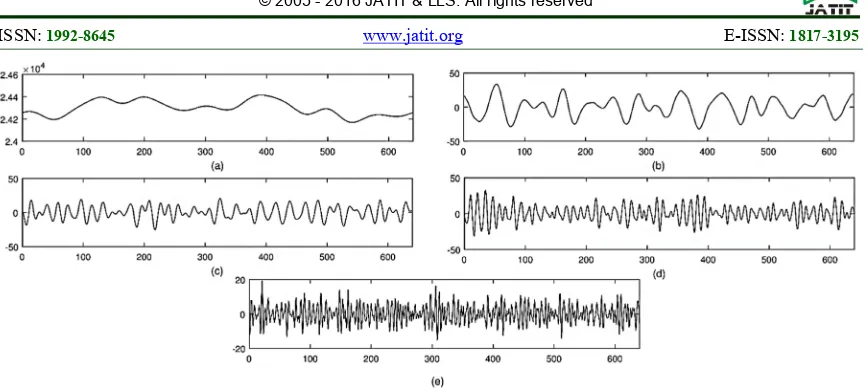
[image:2.612.103.274.288.479.2]Figure 1. Brainwaves (a) Delta, (b) Theta, (c) Alpha, (d) Beta, (e) Gamma
Figure 2. Emotiv EPOC Channels
There are various methods which are applied in this study, among them fast fourier transform (FFT) and stationary wavelet transform (SWT). These methods are one of denoising methods that can be used to convert EEG data from time domain to frequency domain [5]. Independent component analysis (ICA) can be expected to separating EEG data and noise [6]. In this study, we used combination of ICA, SWT, and FFT to denoising EEG data. Pearson-Correlation is statistical analysis method which is used to selecting the most significant preprocessing methods, among them to choosing (i) denoising method, (ii) frequency bands, (iii) subjects, (iv) channels, and (v) features. SVM and KNN are the methods which are used in classification. Result from this study is web-based applications which is able to predict the emotions of EEG data. The purpose of this study can be utilized in various fields [7][8][9][10] [11].
2. ELECTROENCEPHALOGRAM (EEG)
EEG is electrical recording activity on the human scalp. EEG measures the voltage changing from brain ions. Brainwave voltages are small which have the main frequency up to 50 hertz. As seen in Figure 1, there are five types of brainwaves according to their frequency, among them (i) delta (0.5 - 4 Hz), (ii) theta (4-8 Hz), (iii) alpha (8-13 Hz), ( iv) beta (13-40 Hz), and (v) gamma (30-50 Hz).
Brain Computer Interface (BCI) is a device for recording EEG data. BCI records brainwave activities during a certain time. Emotiv EPOC is one of BCI device that we used in this study. Figure 2 shows channels placement in Emotiv EPOC. Each channel shows position which is applied on the human scalp.
There are many channels in EEG data. Each channel is denoted by letters and numbers. Letters indicate the area of the head. For example, F indicates the frontal lobe (the front side of the scalp) and T indicates the temporal lobe (the central side of the scalp). Even numbers indicate the right side of the scalp, while the odd numbers indicate the left side of the scalp.
ISSN: 1992-8645 www.jatit.org E-ISSN: 1817-3195
[image:3.612.256.516.67.296.2]178 3. EMOTIONS MODEL
[image:3.612.90.298.293.434.2]Figure 3. Circumplex Emotion Model
Figure 4. Self Assessment Manikin (SAM)
James A. Russell proposed a model of emotional which was named circumplex emotion model [11]. As seen in Figure 3 this model categorizes human emotions into four dimensions based on valence and arousal, among them:
1) Class 1, High Arousal Low Valence (HALV) Representing anger, upset, stress, and frustrated.
2) Class 2, High Arousal High Valence (HAHV) Representing happy, excited, and interested. 3) Class 3, Low Arousal High Valence (LAHV)
Representing relief, relaxed, and comfortable. 4) Class 4, Low Arousal Low Valence (LALV)
Representing tired, bored, and sad.
As seen in Figure 4, we use self assessment manikin (SAM) to measuring the score of valence and arousal [13]. SAM is a questionnaire that is expressed in manikin form. Each score indicates
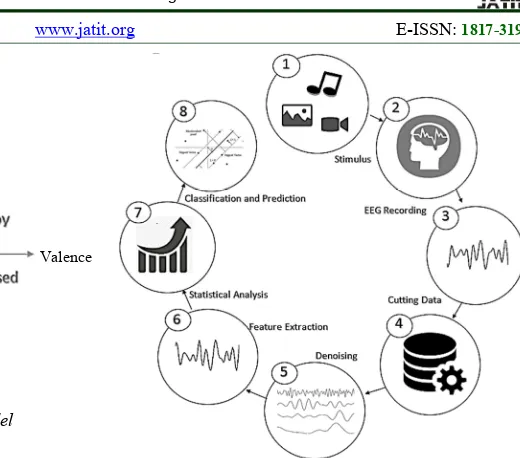
Figure 5. Research Method Process
different emotions expression. Valence has score between 1 to 9. The lower of score indicates more sad. Conversely, the higher of score indicates more happy. Same to valence, arousal has score between 1 to 9. The lower of score indicates more calm. Conversely, the higher of score indicates more excited.
In this study, we assumed that the scores have low category if the scores are between 1 to 4 and have high category if the scores are between 6 to 9. So each valence and each arousal have two classes, among them valence with low or high scores and arousal with low or high scores.
4. RESEARCH METHODS
As seen in Figure 5, there are several steps to classifying emotions from EEG data. First, we prepare stimuli, among them (i) pictures, (ii) music, and (iii) videos. The stimuli are used to getting participants emotions while recording their EEG data. After that, we perform preprocessing EEG data, among them (i) cutting EEG data, (ii) denoising EEG data, and (ii) doing feature extraction. Then, we do statistical analysis based on extracted features of EEG data. Finally, we create classification models which use preprocessing methods based on statistical analysis results.
4.1.Stimuli
There are several stimuli that can be used to getting emotion of the person, among them (i) thinking something, (ii) remembering, (iii) seeing a picture, (iv) listening a music, (v) smelling, (vi) watching a video, (vii) playing a game, etc. [14].
Arousal
ISSN: 1992-8645 www.jatit.org E-ISSN: 1817-3195
179 Currently there are some researchers who published stimuli database, among them:
1) Geneva Affective Picture Database (GAPED) provides a database with picture stimuli [15]. 2) 1000 Songs for Emotional Analysis of Music
provides a database with music stimuli [16]. 3) LIRIS-ACCEDE: A Video Database for
Affective Content Analysis provides a database with video stimuli [17].
In this study, (i) pictures, (ii) music, and (iii) videos are used as stimuli to get emotion of the person. There are 5 pictures, 5 music and 4 videos that are used as emotions stimuli. At picture stimuli, we took 4 pictures from Internet and a picture from [15]. At music stimuli, we took 4 music from internet and a music from [16]. At video stimuli, we took all of videos from Internet. For selecting stimuli from the internet, the stimuli are voted to 5 people from ITS students for determining the stimuli which are most significant to emotion (High Valence, Valence Low, High Arousal, and Low Arousal).
[image:4.612.92.298.387.444.2]4.2.EEG Recording
Figure 6. EEG Recording
In this study, EEG data were taken from participants. The greater the number of participants, the better results obtained. We got participants from ITS student. Total of participants that we got were 34 people, among them 20 men and 14 women (with an average age was 20.5). The majority of EEG data recording performed during a day with total time for each participant was 25 minutes.
Emotiv EPOC is a device which is used to obtain EEG data from the participants. As seen in Figure 2, there are 14 channels which are used in Emotiv EPOC. Their channel names are AF3, AF4, F3, F4, F7, F8, FC5, FC6, P7, P8, T7, T8, O1 and O2. Sampling rate which is used in the device is 128 Hz.
Before performing EEG recording, we explained the rules of experiment to the participants. The
purpose of the rule is to minimize the noise in EEG data. The rules are:
1) When participants received music stimuli, we asked them closed their eyes.
2) When participants received pictures stimuli, we asked them to keep their eyes open without blinking.
3) When participants received video stimuli, we asked them to minimize their eyes blinking. 4) During all of the experiment, we asked
participants to minimize body movement.
After we explained the experiment rules, we noted participants profile such as (i) age, (ii) gender, (iii) uses of glasses, (iv) uses of contact lenses, (v) sleep hours in the last 24 hours, and (vi) the level of current participants valence. After that, we put Emotiv EPOC on participants scalp until reaching green indicator in Emotiv EPOC software. After all of the preparation was done, EEG data recording and experimentation will be begun.
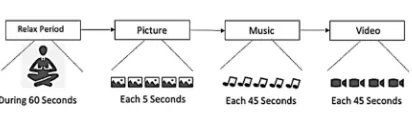
As seen in Figure 6, the following steps are performed during the experiment:
1) The early step of the experiment is relax period. During relax period, we asked participant to closing their eyes for 60 seconds while listening to a relax music. The purpose is to balancing participants emotions. 2) After that, we instruct participants to keeping
their eyes close while inform that the first stimuli which is used is pictures. Then we remind participants to keeping their eyes open without blinking. After participant was ready, we prepare picture stimuli. When the stimuli ready to be shown, we inform participant that in third count we will ask to opening their eyes to focus on the stimuli and EEG data recording will be begun. After 5 seconds, we stopped the recording and asked participant to telling their questionnaire (valence and arousal) which was felt after seeing the stimuli. Until this point, a trial EEG recording using pictures stimuli completed. Then, the processes will be repeated until all of picture stimuli are displayed.
ISSN: 1992-8645 www.jatit.org E-ISSN: 1817-3195
[image:5.612.89.526.73.190.2]180
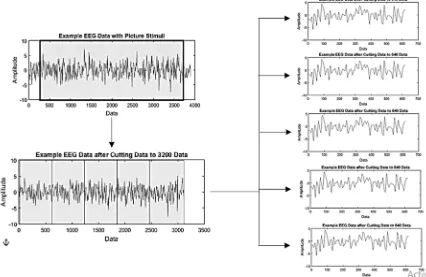
Figure 7. Cutting EEG Data in Picture Stimuli
Figure 8. Cutting EEG Data in Music and Video Stimuli
used is music. Then, we remind participant to keeping their eyes close while the recording. After participant was ready, we prepare music stimuli. When the stimuli ready to be played, we inform participants that in third count we will ask to closing their eyes to focus on the stimuli and EEG recording will be begun. After 45 seconds, we stop the recording and ask participant to telling their questionnaire (valence and arousal) which was felt after hearing the stimuli. Until this point, a trial EEG recording using music stimuli completed. Then, the processes will be repeated until all of music stimuli are played. 4) After all of music have been shown, we
instruct the participants to closing their eyes while inform that the next stimuli which is
[image:5.612.97.523.219.496.2]ISSN: 1992-8645 www.jatit.org E-ISSN: 1817-3195
181 4.3.Cutting EEG Data
In this study, a total of EEG data for each second is 128 data. EEG recording time for each trial is 5 seconds for picture stimuli and 45 seconds for music or video stimuli. We cut EEG data due to differences in the length of data for each trial. As seen in Figure 7 and Figure 8, we cut EEG data to 5 seconds (640 data) for each trial. The explanation of the methods are:
1) As shown in Figure 7 when the total EEG data on picture stimuli more than 640, we take 640 middle of data.
2) As shown in Figure 8 when the total EEG data on music or video stimuli more than 3200, we take 3200 middle of data. After that, we cut the data for every 640 data. Because of that, each trial of EEG data with music or video stimuli to be 5 trial of EEG data.
By using this method, the number of trials for each subject from initially 14 trial (5 stimuli picture + 5 stimuli music + 4 stimuli video) becomes 50 trial (5 stimuli picture + 25 stimuli music + 20 stimuli video). There are 14 channels in each trial and 640 EEG data in each channel.
4.4.Denoising Method
The purpose of denoising EEG data is reducing noise in EEG. There are several denoising methods of EEG data, such as:
4.4.1. Independent component analysis
Independent Component Analysis can eliminate noise in EEG data, among them (i) muscles movement, (ii) heart rate, (iii) eyeball movement, and (iv) eyes blinking [5]. ICA works by separating data between noise and original EEG data. In this study, ICA was performed on each trial of all the subjects. As seen in (1), ICA transforms the data in a linear form. Where x is a mixture of EEG data (resulted from mixed EEG data and their noise), A is mixing matrix, and s is the original EEG data that containing independent component (IC). The purpose of ICA is looking for s by estimating matrix W which is the inverse of matrix A. Thus the form of equation becomes as shown in (2). Because matrix W and matrix A are unknown, the value of matrix W needs to be estimated. ICA can estimate the value of W by maximizing the non-gaussian. Higher value of non-gaussian from W and x, more independent the value of s. There are various algorithms of ICA, among them (i)
infomax, (ii) natural gradient, and (iii) FastICA. FastICA is one of ICA algorithm that computes faster than the others. There are two main processes in FastICA: preprocessing ICA and extraction component [18]. The explanation of the preprocessing FastICA among them:
- Centering, a process to make the average value of each channel to zero. The implementation of this can be seen in (3). Where x is the EEG signal with dimension N x M, N is the number of channels, and M is the length of data on each channels.
- Whitening, a process for making inter-channel are not correlated and having variance value one. The general process for whitening EEG data is calculating eigenvalue and eigenvector. Implementation of this can be seen in (4). Where x is EEG signal with dimension N x M, E is eigenvector matrix, and D is eigenvalue in diagonal.
Extraction component is the main process in FastICA by maximizing non-gaussian to estimate W. The process is calculated each channel with the number of C (number of the desired component, where C ≤ N). The implementation of this process can be seen in (5), (6) and (7). Where p is an index iteration from 1 to C, g is tanh function, and g’ is 1-tanh2 function. The value of Wp is initialized by random vector with length N.
x As (1)
(2) 1
(3)
/ (4)
1 1 ′ 1 (5)
(6)
! ! (7)
4.4.2. Fast fourier transform
ISSN: 1992-8645 www.jatit.org E-ISSN: 1817-3195
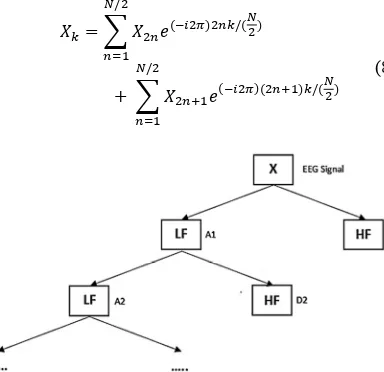
182 them (i) delta (0.5-4 Hz), (ii) theta (4-8 Hz), (iii) alpha (8-13 Hz), (v) beta (13-30 Hz), and (v) gamma (30-50 Hz). In this study FFT performed on each channel of the entire trial and subject. (8) shows the implementation of the FFT. Where X is EEG data, N is the length of EEG data, k is an index iteration from 1 to N, and i is the imaginary unit.
" #$ % #"/ & &/
#
' #($ % #( "/ &
&/
#
[image:7.612.307.522.183.469.2](8)
[image:7.612.98.290.204.390.2]Figure 9. SWT Signal Decomposition Structure
Table 1. SWT Frequency Band Separation
4.4.3. Stationary wavelet transform
Wavelet denoising is a method to improving performance of ICA. One of the wavelet denoising methods is discrete wavelet transform (DWT). However DWT has its disadvantages, among them has longer computation time because of down sampling process (reduction of features number in the data). Stationary wavelet transform (SWT) is a modification function of DWT. SWT has faster computation because of absence of down sampling process [19]. Same as DWT, SWT uses the function of low pass filter and a high pass filter to separate the EEG data into frequency band which are different at each level of decomposition. Figure 9 shows the decomposition process using low-pass
filter (LF) and high-pass filter (HF). Table 1 shows the decomposition of EEG signal into 5 frequency bands, among them (i) delta (0-4 Hz), (ii) theta (4-8 Hz), (iii) alpha (8-16 Hz), (iv) beta (16-32 Hz), and (v) gamma (32-64 Hz). In this study SWT performed on each channel of the entire trial and subject.
Figure 10. Denoising Methods to Obtain The Frequency Band
Figure 11. Feature Extraction Process
As seen in Figure 10, in this study there are several combination of denoising methods, among them:
1) Fast Fourier Transform.
2) Independent Component Analysis & Fast Fourier Transform.
3) Stationery Wavelet Transform.
4) Independent Component Analysis & Stationery Wavelet Transform.
[image:7.612.92.295.437.497.2]ISSN: 1992-8645 www.jatit.org E-ISSN: 1817-3195
[image:8.612.90.530.68.523.2]183
Figure 12. Statistical Analysis Process
4.5.Feature Extraction
As seen in Figure 11, feature extraction from 5 frequency bands of each denoising methods were calculated. In this study, feature extraction methods were used among them:
1) Minimum, the smallest value of each frequency band.
2) Maximum, the greatest value of each frequency band.
3) Average, the average value of each frequency band.
4) Standard deviation, the standard deviation of each frequency band.
5) Power, the average value from squared
frequency band.
6) Energy, sum of squared frequency band.
4.6.Statistical Analysis
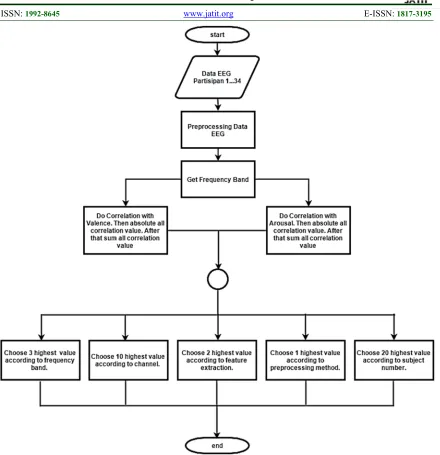
As seen in Figure 12, at this step we investigate (i) method denoising, (ii) frequency bands, (iii) subjects, (iv) channels, and (v) features which have the most significant characteristics with the questionnaire (valence and arousal). To do this, we use Pearson-correlation method.
ISSN: 1992-8645 www.jatit.org E-ISSN: 1817-3195
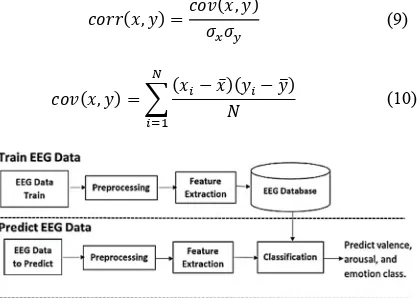
184 multiplication of their standard deviation. The formula to calculate Pearson-correlation can be seen in (9), where x and y indicate each data between the two variables. Formula to calculate covariance can be seen in (10), where xi and yi are the data on the column number i.
)*++ , - )*. , -/
0/1 (9)
)*. , - ̅ -4 -3
&
[image:9.612.92.302.171.320.2](10)
Figure 13. Process of Training and Prediction EEG Data
In this study, we calculate sum of correlation from each (i) denoising method, (ii) frequency band, (iii) subject, (iv) channel, and (v) features that their absolute value are greater or equal than 0.4. The highest correlation number will be selected and used as a classification model. Amounts of preprocessing method that we choose are: (i) 3 frequency bands, (ii) 10 subjects, (iii) 2 features, (iv) 1 denoising method, and (v) 20 subjects which have highest correlation to the questionnaire (valence and arousal).
4.7.Classification and Prediction
We use Support Vector Machine (SVM) and K-Nearest Neighbors (KNN) as classification methods. The classification that we did in this study is divided into two parts, among them classification with valence (high valence and low valence) and classification with arousal (high arousal and low arousal).
To measure the accuracy of the classification, it is necessary to train and test the data. We use K fold cross-validation with the value K = 10 for separating data train and data test. After the accuracies were obtained, select classification method that has the best accuration value to be used at prediction emotion. The purpose of that is to obtained predictions as accurate as possible. Figure 13 shows a diagram of classification and prediction process where preprocessing method were obtained from statistical analysis results.
5. RESULTS AND DISCUSSION
5.1.Find The Best Denoising Method
At this step, we were looking for correlation values to obtain the best denoising method. The process that we do was looking for correlations between each denoising method and the questionnaires (valence and arousal). After receiving the results of the correlation, we made absolute all of correlation value. Then count all of correlation value that had value more or equal than 0.4. Count of the highest correlation value will be selected for used on classification and prediction.
1) Count of correlation with valence
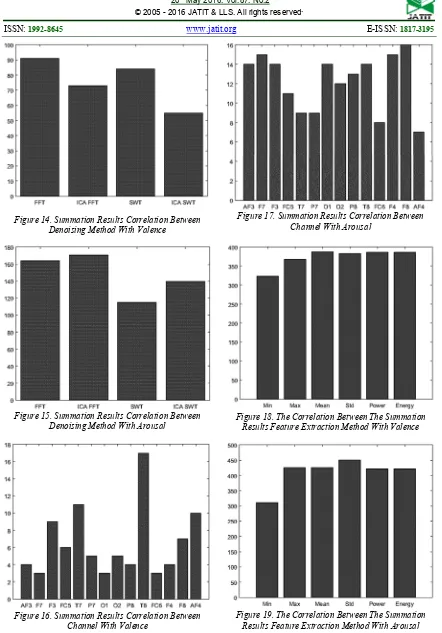
Figure 14 shows the results count of correlation value between each denoising method and valence. On the figures we can conclude that the best denoising method for valence was Fast Fourier Transform (FFT). So at classification and prediction, we use FFT for denoising EEG data.
2) Count of correlation with arousal
Figure 15 shows the results count of correlation value between each denoising method and arousal. On the figures we can conclude that the best denoising method for arousal was ICA & FFT. So at classification and prediction, we use ICA & FFT for denoising EEG data.
5.2.Find The Best Channels
ISSN: 1992-8645 www.jatit.org E-ISSN: 1817-3195
185 Figure 14. Summation Results Correlation Between
Denoising Method With Valence
Figure 15. Summation Results Correlation Between Denoising Method With Arousal
Figure 16. Summation Results Correlation Between Channel With Valence
Figure 17. Summation Results Correlation Between Channel With Arousal
[image:10.612.87.529.52.685.2]Figure 18. The Correlation Between The Summation Results Feature Extraction Method With Valence
ISSN: 1992-8645 www.jatit.org E-ISSN: 1817-3195
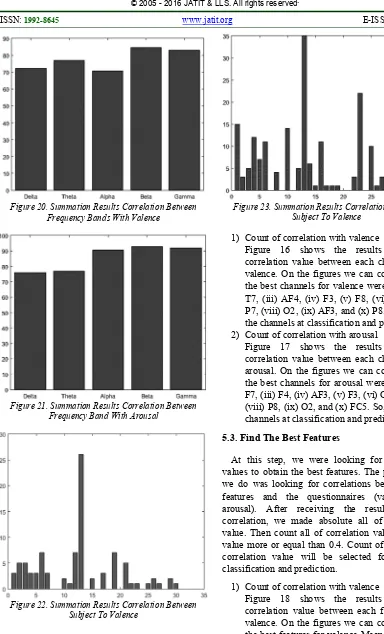
186 Figure 20. Summation Results Correlation Between
Frequency Bands With Valence
Figure 21. Summation Results Correlation Between Frequency Band With Arousal
[image:11.612.91.475.61.695.2]Figure 22. Summation Results Correlation Between Subject To Valence
Figure 23. Summation Results Correlation Between Subject To Valence
1) Count of correlation with valence
Figure 16 shows the results count of correlation value between each channels and valence. On the figures we can conclude that the best channels for valence were (i) T8, (ii) T7, (iii) AF4, (iv) F3, (v) F8, (vi) FC5, (vii) P7, (viii) O2, (ix) AF3, and (x) P8. So, we use the channels at classification and prediction. 2) Count of correlation with arousal
Figure 17 shows the results count of correlation value between each channels and arousal. On the figures we can conclude that the best channels for arousal were (i) F8, (ii) F7, (iii) F4, (iv) AF3, (v) F3, (vi) O1, (vii) T8, (viii) P8, (ix) O2, and (x) FC5. So, we use the channels at classification and prediction.
5.3.Find The Best Features
At this step, we were looking for correlation values to obtain the best features. The process that we do was looking for correlations between each features and the questionnaires (valence and arousal). After receiving the results of the correlation, we made absolute all of correlation value. Then count all of correlation value that had value more or equal than 0.4. Count of the highest correlation value will be selected for used on classification and prediction.
1) Count of correlation with valence
ISSN: 1992-8645 www.jatit.org E-ISSN: 1817-3195
187 2) Count of correlation with arousal
Figure 19 shows the results count of correlation value between each features and valence. On the figures we can conclude that the best features for valence Mean and Standard Deviation. So at classification and prediction, we use Mean and Standard Deviation that are used as features.
5.4.Find The Best Frequency Bands
At this step, we were looking for correlation values to obtain the best frequency bands. The process that we do was looking for correlations between each frequency bands and the questionnaires (valence and arousal). After receiving the results of the correlation, we made absolute all of correlation value. Then count all of correlation value that had value more or equal than 0.4. Count of the highest correlation value will be selected for used on classification and prediction.
1) Count of correlation with valence
Figure 20 shows the results count of correlation value between each frequency bands and valence. On the figures we can conclude that the best frequency bands for valence was Theta, Beta, and Gamma. So, we use the frequency bands at classification and prediction.
2) Count of correlation with arousal
Figure 21 shows the results count of correlation value between each frequency bands and arousal. On the figures we can conclude that the best frequency bands for arousal was Alpha, Beta, and Gamma. So, we use the frequency bands at classification and prediction.
5.5.Find The Best Subjects
At this step, we were looking for correlation values to obtain the best subjects. The process that we do was looking for correlations between each subjects and the questionnaires (valence and arousal). After receiving the results of the correlation, we made absolute all of correlation value. Then count all of correlation value that had value more or equal than 0.4. Count of the highest correlation value will be selected for used on classification and prediction.
1) Count of correlation with valence
Figure 22 shows the results count of correlation value between each subjects and
valence. On the figures we can conclude that the best subjects for valence were subject number 13, 6, 12, 19, 2, 3, 21, 1, 4, 5, 7, 17, 10, 15, 26, 29, 11, 22, 23, and 25. So, we use the subjects at classification and prediction. 2) Count of correlation with arousal
Figure 23 shows the results count of correlation value between each subjects and arousal. On the figures we can conclude that the best subjects for valence were subject number 13, 23, 1, 10, 4, 6, 16, 25, 5, 14, 3, 12, 8, 2, 22, 27, 15, 17, 18, and 19. So, we use the subjects at classification and prediction.
5.6.Find Accuracy
At this step, we calculated accuration value for each classification methods (SVM and KNN). Preprocessing methods which are used in this step were resulted from statistical analysis. Following are the results of classification:
1) Support Vector Machine (SVM)
• Classification with valence
Table 2 shows the results using SVM classification.
Table 2. Valence SVM Classification Results
Accuracy = (True Positive+True Negative)/Total Population Accuracy = (291+255) / 826 Accuracy = 546 / 826 = 66.09%
• Classification with arousal
Table 3. Arousal SVM Classification Results shows the classification results arousal using SVM.
Table 3. Arousal SVM Classification Results True Positive :
291
False Positive : 191 False Negative :
89
True Negative : 255
True Positive : 236
False Positive : 89 False Negative :
76
ISSN: 1992-8645 www.jatit.org E-ISSN: 1817-3195
188 Figure 24. Application Homepage
Figure 25. Display Applications When Input Prediction
Accuracy = (True Positive+True Negative)/Total Population Accuracy = (236+277) / 678 Accuracy = 513 / 678 = 75.66%
2) K-Nearest Neighbors (KNN)
• Classification with valence
Table 4. Results Valence KNN Classification shows the classification results using the KNN valence.
Table 4. Results Valence KNN Classification
Accuracy = (True Positive+True Negative)/Total Population Accuracy = (303+377) / 826
Accuracy = 680 / 826 = 82.33% • Classification with arousal
[image:13.612.89.530.61.485.2]Table 5. Classification results Arousal KNN shows the classification results arousal using KNN.
Table 5. Classification results Arousal KNN
Accuracy = (True Positive+True Negative)/Total Population Accuracy = (270+322) / 678 Accuracy = 592 / 678 = 87.32%
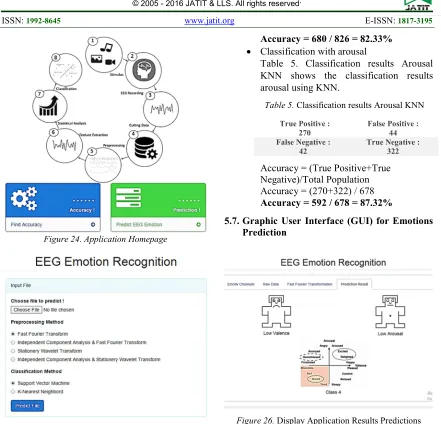
[image:13.612.315.524.319.475.2]5.7.Graphic User Interface (GUI) for Emotions Prediction
Figure 26. Display Application Results Predictions
In this study, we created web-based application that can simplify the process of emotional prediction from EEG data as shown in Figure 24. In addition we also make other features, among them emotion prediction of EEG data and classification of each different method. Figure 25 shows the display for input process on emotion prediction, among them the input EEG file path, preprocessing methods, and classification. After input the data, the system displays the results of prediction of emotion as seen in Figure 26. In the display we can see that the example of his emotions prediction is low valence and low arousal. So the results are getting class 4 (LALV), which represents the feeling of tired, bored and sad.
6. CONCLUSION
This paper present a method to determine significant preprocessing methods in EEG-based True Positive :
303
False Positive : 69 False Negative :
77
True Negative : 377
True Positive : 270
False Positive : 44 False Negative :
42
ISSN: 1992-8645 www.jatit.org E-ISSN: 1817-3195
189 emotion classification using statistical analysis Pearson-Correlation. Based on the results, the most significant denoising method uses FFT for valence and ICA & FFT for arousal. The most significant channels are T8, T7, and AF4 for valence and F8, F7, and F4 for arousal. The most significant features are average & power for valence and average & standard deviation for arousal. The most significant frequency bands are theta, beta, and gamma for valence and alpha, beta, and gamma for arousal. The most significant subjects are subject number 13, 6, 12, 19, 2, 3, 21, 1, 4, 5, 7, 17, 10, 15, 26, 29, 11, 22, 23, and 25 for valence and subject number 13, 23, 1, 10, 4, 6, 16, 25, 5, 14, 3, 12, 8, 2, 22, 27, 15, 17, 18, and 19 for arousal. The most significant classification method is using K-Nearest Neighbors (KNN) with accuration values are 82.33% for valence and 87.32% for arousal. GUI has been created in order to predict emotions from EEG data easier.
7. ACKNOWLEDGEMENTS
This research is supported by Institut Teknologi Sepuluh Nopember and the Ministry of Research, Technology and Higher Education. We would like to thank participants who contributed in this study, also to [15] and [16] which have provided stimuli databases for this study.
REFERENCES
[1] A. Luneski, E. Konstantinidis and P.D. Bamidis, "Affective medicine: a review of affective computing efforts in medical informatics," Methods of Information in
Medicine, vol. 49, no. 3, p. 12, 2010.
[2] S. Koelstra, C. Muhl, M. Soleymani, Jong-Seok, A. Yazdani, T. Ebrahimi, T. Pun, A. Nijholt and I. Patras, "DEAP: A Database for Emotion Analysis using Physiological Signals," IEEE Transactions on Affective
Computing, vol. 3, no. 1, pp. 18-31, 2012.
[3] D. Huang, C. Guan, K. K. Ang and H. Zhang, "Asymmetric Spatial Pattern for EEG-based emotion detection," Proceedings of the International Joint Conference on Neural
Networks, pp. 1-7, Brisbane, Australia, June
2012.
[4] M. Islam, T. Ahmed, S. S. Mostafa, M. S. U. Yusuf and M. Ahmad, "Human Emotion Recognition using Frequency & Statistical Measures of EEG Signal," Conference:
International Conference on Informatics
Electronics & Vision (ICIEV13), pp. 1-6,
Dhaka, 17-18 May 2013.
[5] P. Khatwani and A. Tiwari, "A survey on different noise removal techniques of EEG signals," International Journal of Advanced Research in Computer and Communication
Engineering, vol. 2, no. 3, pp. 1091-1095,
2013.
[6] T.-P. Jung, S. Makeig, C. Humphries, T.-W. Lee, M. J. Mckeown, V. Iragui and T. J.
Sejnowski, "Removing
electroencephalographic artifacts by blind source separation," Psychophysiology, vol. 30, no. 2, pp. 163-178, 2000.
[7] R. Sarno, B. A. Sanjoyo, I. Mukhlash and H. M. Astuti, "Petri net model of ERP business process variation for small and medium enterprises," Journal of Theoretical and
Applied Information Technology, vol. 54, no.
1, pp. 31-38, 2013.
[8] R. Sarno, C. A. Djeni, I. Mukhlash and D. Sunaryono, "Developing a workflow management system for enterprise resource planning," Journal of Theoretical and Applied
Information Technology, vol. 72, no. 3, pp.
412-421, 2015.
[9] R. Sarno, R. D. Dewandono, T. Ahmad, M. F. Naufal and F. Sinaga, "Hybrid Association Rule Learning and Process Mining for Fraud Detection," IAENG International Journal of
Computer Science, vol. 42, no. 2, pp. 59-72,
2015.
[10] A. H. Basori, R. Sarno and S. Widyanto, "The development of 3D multiplayer mobile racing games based on 3D photo satellite map,"
Proceedings of the IASTED International
Conference on Wireless and Optical
Communications, pp. 1-5, Surabaya, May
2008.
[11] R. Sarno, P. Sari, H. Ginardi and D. Sunaryono, "Decision mining for multi choice workflow patterns," Computer, Control,
Informatics and Its Applications (IC3INA), pp.
337-342, 2013.
[12] J. A. Russell, "A Circumplex Model of Affect," Journal of Personality and Social
Psychology, vol. 39, no. 6, p. 4, 1980.
[13] J. D. Morris, "Observations: SAM: The self-assessment manikin. An efficient cross-cultural measurement of emotional response,"
ISSN: 1992-8645 www.jatit.org E-ISSN: 1817-3195
190 [14] N. Jatupaiboon, S. Pan-ngum and P. Israsena,
"Real-Time EEG-Based Happiness Detection System," The Scientific World Journal, vol. 2013, pp. 1-12, 2013.
[15] Dan-Glauser, E. S. and Scherer, K. R., "The Geneva affective picture database (GAPED): a new 730-picture database focusing on valence and normative significance," Behavior
Research Methods, vol. 43, pp. 468-477, 2011.
[16] M. Soleymani, M. N. Caro, E. M. Schmidt, C.-Y. Sha and C.-Y.-H. Yang, "1000 songs for emotional analysis of music," Proceedings of the ACM International Multimedia Conference
and Exhibition, pp. 1-6, 2013.
[17] Y. Baveye, E. Dellandrea, C. Chamaret and L. Chen, "LIRIS-ACCEDE: A Video Database for Affective Content Analysis," IEEE
Transactions on Affective Computing, vol. 6,
no. 1, pp. 1-14, 2015.
[18] A. Huvarinen and E. Oja, "Independent component analysis: algorithms and applications," Neural Networks, vol. 13, no. 4-5, pp. 411-430, June 2000.
[19] M. T. Akhtar, W. Mitsuhashi and C. J. James, "Employing spatially constrained ICA and wavelet denoising, for automatic removal of artifacts from multichannel EEG data," Signal