ISSN: 1992-8645 www.jatit.org E-ISSN: 1817-3195
CONGESTION MANAGEMENT USING HYBRID FISH BEE
OPTIMIZATION
1S. THANGALAKSHMI, 2P. VALSALAL
1Assoc. Prof., Department of Electrical and Electronics Engineering, GKM College of Engineering and
Technology, Chennai, India
2Assoc. Prof., Department of Electrical and Electronics Engineering, CEG Campus, Anna University,
Chennai, India
E-mail: [email protected], [email protected]
ABSTRACT
Congestion management is a task performed by Independent System Operator (ISO) to ensure the operation of transmission system within limits. In an emerging electric power market, congestion management is highly important and inefficient management can be a barrier to electricity trading. To minimize congestion, it is required to maximize transmission line generation and decrease its cost. A Hybrid Fish Bee Swarm Optimization based algorithm to manage congestion is proposed to achieve this objective. The Fish Bee Swarm Optimization is based on two algorithms namely Artificial Bee Colony (ABC) and Fish School Search (FSS) methods. The proposed algorithm is validated on an IEEE 30 bus system. Results show the performance of the proposed optimization technique decreases congestion.
Keywords: Congestion Management, Hybrid optimization, Artificial Bee Colony (ABC), Fish School Search (FSS)
1. INTRODUCTION
The drastic growth of economical and technological challenges in electrical power industry prompted power system restructuring. Restructuring or Deregulation in power industry initiates private sectors to invest in the power market to reach higher efficiency in electricity production and utilization. Deregulation also enhances competition and brings choices & economic benefits to consumers. In a deregulated atmosphere the previously performed tasks in power i.e. generation, transmission, distribution and retail sales are divided into separate companies dedicated to each task.
Deregulation has lead to exhaustive usage of transmission grid that operates near its rated capacity resulting in overloading of lines. This situation leads to congestion. Essentially, congestion occurs when power flow through transmission line is higher than that permitted by operating reliability limits. In a competitive electricity market, congestion happens when transmission networks are unable to accommodate all transactions because of system operating limits.
Congestion management includes transmission system activities which relieve transmission constraints in competitive electricity markets.
Presently, competitive power markets have various utilities to manage congestion using specific physical/financial mechanisms with a set of rules/guidelines. There are many congestion management schemes reported in the literature based on different electricity market structure. There are two paradigms that are economically employable for congestion management viz. cost-free means and not-cost-cost-free means [1]. The former includes congested lines outaging, transformer taps operation, phase shifters/ FACTS devices. These are called cost-free as only marginal costs (not capital costs) are involved in usage and they are nominal. The later includes generation rescheduling and prioritization/curtailment of loads/ transactions.
ISSN: 1992-8645 www.jatit.org E-ISSN: 1817-3195
solution of generator-rescheduling/load-shedding which returns the system to normalcy.
Though transmission system congestion is unavoidable, it should persist only for a short duration. Otherwise it results in cascading outages with uncontrolled load loss. Thus congestion is of concern and action should be initiated to decrease its effect even if it cannot be managed fully. Based on strategic behaviour congestion management methods are splitted into two domains:
a) Technical congestion management methods
b) Market model congestion management methods.
Technical congestion management methods reveal accurate results. Optimal Power Flow (OPF) is a significant procedure in technical congestion management that convinces current transmission and operational constraints. OPF based congestion management methods use the objective function derivative to determine search direction. But, generally OPF objective function is non-convex, non-smooth, and non-differentiable which are due to valve point thermal units loading. Economics of supply/demand govern prices at each bus with stiff constraints enforced in transmission line in Market model congestion management methods [3].
The structural change in electric power market incorporates optimization methods in decision making. Industry restructuring leads to new optimization tasks hallmarked by complexity and variables that influence optimization. In some cases, conventional optimization techniques are either difficult/impossible to solve such multi-dimensional problems. Special searching algorithms and evolutionary algorithms (EAs) are used as optimization procedures in solving complex issues because of their effectiveness [4].
Swarm intelligence [5] is a collective intelligence from a group (a large one usually) of simple entities, called agents. Frequently used agent-based models are ant colonies, bird flocks, termites, bee swarms, and fish schools. Swarm intelligence completes complicated tasks in dynamic and multi-dimensional ambience. This method requires no external guidance or control for distributed problem solving. It can react to environmental changes.
An optimization algorithm is proposed in this paper to alleviate congestion. The proposed hybrid Fish Bee optimization algorithm solves the combinatorial optimization problem. Hence, the focus is also to minimize cost and maximize line generation.
2. OVERVIEW OF CONGESTION MANAGEMENT
Congestion management includes the
determination of proper generation pattern without breaking the line flow restrictions. In such an environment an optimal power flow can perform the function of avoiding congestion and minimizing the cost.
Transmission pricing and congestion
management are the key elements in a competitive, direct access based electricity market. Most debate is focused on them concerning alternative approaches to market design and implementation of a common carrier electricity system. Oren [6] highlighted trade-offs between simplicity and economic efficiency in meeting transmission pricing and congestion management scheme objectives. The author contrasts two extreme approaches: postage stamp approach vs. nodal pricing. The proposed method questions nodal pricing paradigm due to its rigidity/complexity. The author argues that the theoretical efficiency in nodal pricing is unrealistic and there are drawbacks in implementing the suggested approach. Least cost congestion relief’s underlying principles are explained and adopted in California to treat congestion relief as an ancillary service. This enables ISO to ensure efficient congestion relief with minimal energy market intervention. It also discusses zonal aggregation, describing a new zonal priority network access pricing. An inter-zonal congestion pricing mechanism is dealt to locate generation resources economically.
2.1 Use of FACTS Devices in Congestion Management
ISSN: 1992-8645 www.jatit.org E-ISSN: 1817-3195
best location for TCSC installation, suiting both objectives.
Jumaat, et al., [9] described about the optimal sizing of a static varcompensator (SVC) based on PSO. The objective of minimizing the transmission losses considering cost function is achieved through PSO algorithm. As compensation device, Static varcompensator (SVC) has been selected in the
proposed approach. Validation through
implementation on IEEE 26-bus system reveals that PSO achieves the task. Simulations results are compared with those from Bee Algorithm (BA) technique to highlight its advantages.
2.2 Optimization Techniques in Congestion Management
Kumar, et al., [8] suggested a new zonal/cluster-based congestion management approach where zones are determined based on power flow in the transmission line. The line flow is characterized by the real and reactive power flow sensitivity indexes. Sensitive zone generators with strong, non-uniform sensitivity indexes are identified to reschedule real power output for congestion management. Additionally, reactive power output’s optimal rescheduling impact by generators/capacitors in most sensitive zones is studied. The suggested new zonal concept has been tested on a 39-bus New England system and a 75-bus Indian system.
An alternate multi-objective particle swarm optimization (MOPSO) method is presented to solve this nonlinear optimization problem by Hazra, & Sinha, [10]. A frequency and voltage dependent load flow method is employed accounting load voltage and frequency. The new algorithm has been tested on IEEE 30, IEEE 118 bus systems and Northern Region Electricity Board (NREB), India 390-bus system with smooth and non-smooth cost functions because of valve point loading effect.
A novel cost-efficient scheme to manage congestion in power systems is proposed by Hazra, & Seetharam, [11] which manages network congestion at acceptable levels with optimal operation cost and reduced cascading failures risk. It is a two phase scheme. It reduces congestion through an optimal (optimized for fuel cost) generation rescheduling, as first option. If revised generation schedule does not reduce congestion, it opts for the next method which is optimal (minimizing impact on revenues/customers) load shedding. The scheme employs Particle Swarm Optimization to optimize individual options using Fuzzy satisfying technique to select best solution from Pareto optimal solutions set. The proposed
system is evaluated on IEEE 30 and 118 bus test systems and its results are included.
PSO algorithm for congestion management in a pool based electricity market is proposed by Sujatha et.al, [12]. This approach relieves line overloads with limited generation deviations from initial market settlement. The security constraints like line loading, load bus voltages are handled in optimization problems using a penalty approach. The proposed algorithm is tested on modified IEEE 30 bus and IEEE 57 bus systems. Numerical results are presented for illustration and compared with simulated annealing (SA) & random search method (RSM) methods. It is evident from the results that PSO is a challenging optimization method, which can obtain high quality solutions for congestion management issues.
The drawbacks of the existing methods are eliminated using the proposed algorithm.
3. PROBLEM STATEMENT
This section describes the objective of the proposed work. The aim of this work is to maximize the utilization by reducing the difference between the maximum line capacity and utilized line capacity. Similarly, it is also sought to minimize the difference between the maximum generator capacity and actual used capacity.
i. Minimize
max 1
max
max max
( )
L Utilized line capacity Maximum Line Capacity
Goal is to achieve 0 and ensure 0
m
n n
n
n
n n n n
L L
L
L L L L
= −
− −
− → − ≥
∑
ii. max
max
0
G is the maximum rated capacity of Generator i G is the used the actual capacity used
i i
i
i
G − →G
iii. min _
min
_
( ) 0
where C is the lowest bid obtained
C is the current price from bidder i used for generation
price price i
price
price i
C −C →
, + =1
O is the individual objective function for optimizing price and voltage qualtiy
price vquality
O O
where
α +β α β
3.1 Existing Algorithms
ISSN: 1992-8645 www.jatit.org E-ISSN: 1817-3195
techniques are centred on assessing the first derivatives to locate the optima on a given constrained surface and can only be applied to a small range of real world problems. In contrast, the evolutionary algorithms (EA) yield promising solution. EA have inherent parallel computational ability and can deal with smooth, non-continuous and non-differentiable functions. They can search a complicated and uncertain area to find the global optimization. The three main steps that are to be accounted to apply EA are representation of variables, treatment of constraints and formation of fitness function.
The following sections describe few optimization techniques to manage congestion in competitive power market namely, the Artificial Bee Colony algorithm, the Fish Swarm Intelligence algorithm followed by the proposed hybrid algorithm.
3.1.1 Artificial bee colony algorithm
Karaboga [13] proposed ABC algorithm and its performance was analysed in 2007. The algorithm was developed through inspection of behaviour of real bees to locate food sources called nectar, and sharing food sources information to bees in the hive. In ABC, artificial agents are defined/classified into 3 classes, namely, employed bee, onlooker bee, and scout. Each plays a different role in this process: the employed bee remains on a food source keeping source neighbourhood in memory; the onlooker gets food source information from employed hive bees and selects one food source from which to gather nectar; the scout has to find new food and new nectar sources. The ABC algorithm process is presented as follows:
Step 1: Initialization: Spray ne percentage of
populations into solution space randomly, and calculate fitness values called nectar amounts, where ne represents ratio of employed bees to total population. Once populations are positioned in solution space, they are called employed bees.
Step 2: Move onlookers: Calculate probability of selecting food source by equation (1), select food source to move to through roulette wheel selection for all onlooker bees and determine their nectar amounts. The movement of onlookers follows equation (2).
Step 3: Move scouts: If fitness values of employed bees are not improved by continuous predetermined iterations, called “ܮ݅݉݅ݐ”, such food sources are abandoned, and employed bees become scouts. The scouts are moved by equation (3).
Step 4: Update best food source found till now: Memorize best fitness value and position, found by bees.
Step 5: Termination checking: Check if iterations amount satisfies termination condition. If termination condition is satisfied, terminate program and output results; or else revert to Step 2.
∑
−−−− ==== s 1 k k i i ) F(θ ) F(θ Pwhere ߠ݅ denotes position of ݅ݐℎ employed bee, ܵ represents number of employed bees, and ܲ݅ the probability of selecting ݅ݐℎ employed bee.
)) ( ) ( ( ) 1
(t t t
xij + =
θ
ij+ϕ
θ
ij −θ
kjwhere ݔ݅ denotes position of ݅ݐℎ onlooker bee, ݐ
denotes iteration number, ߠ݇ is randomly chosen
employed bee, ݆ represents dimension of solution andϕproduces a series of random variable in range [−1, 1].
)
( max min
min ij ij
ij
ij θ rθ θ
θ = + −
where ݎ is a random number and ݎ ∈ [0, 1].
3.1.2 Fish swarm intelligent algorithm
Fish School Search (FSS) is an optimization algorithm based on ocean fish behaviour. It was proposed by Bastos-Filho, et al., [14]. In FSS, each fish represents a solution to a problem. The success of a fish during search process is indicated by weight. FSS has 4 operators executed for every fish of school at every iteration: (i) individual movement responsible for local search step ind; (ii) feeding, which updates fish weights indicating success/failure during search process till now; (iii) collective-instinctive movement, which makes fish move to a resultant direction; and (iv) collective-volitive movement controlling search granularity. This paper deals with dynamic environments, only feeding and collective-volitive movement operators build proposed hybrid algorithm.
Feeding operator determines fish weight variation at every iteration. It is noticed that fish can increase/decrease its weight depending on success/failure during search. Fish weight is evaluated according to following equation:
) max( ) ( ) 1 ( f f t W t W i i i ∆ ∆ = = +
where Wi (t) is weight of fish i, ∆fi is variation of fitness function between new position and current
(1)
(2)
ISSN: 1992-8645 www.jatit.org E-ISSN: 1817-3195
position of fish, max(|∆f|) is absolute value of greatest fitness variation among all fish. There is a parameter wscale limiting maximum fish weight. The
weight fish varies between 1 and w scale with an initial value equal to wscale/2.
Other popular evolutionary algorithms used in literature are adaptive bacterial foraging [15], Evolutionary algorithm with Neural Network [16], Fuzzy adaptive Bacterial foraging algorithm [17], Multi objective functions [18, 19, 20], Particle Swarm Optimization [21] and Genetic Algorithm [22].
3.2 Proposed Algorithm
The proposed algorithm is a hybrid algorithm which combines the above two algorithms to get an effective and competent solution. It integrates the advantages of both the algorithms so as to make the search efficient, especially when the problem has many solutions. The search capability is increased and it ultimately results in improved solution quality and efficiency.
3.2.1 Hybrid fish bee swarm optimization
Both the optimization is run parallel to optimize the line generation and cost. The optimization terminates on achieving the objective. The objective being, minimize:
max 0 and ensure max 0
n n n n
L − →L L − ≥L
max 0
i i
G − →G and
min _
(C price−Cprice i)→0
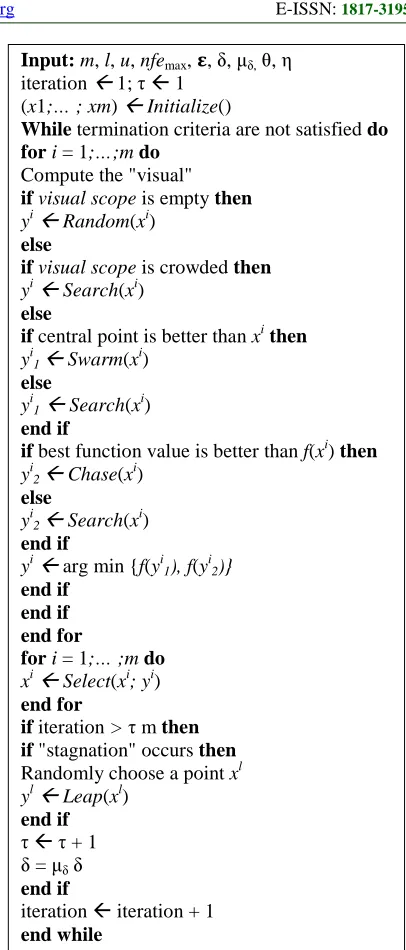
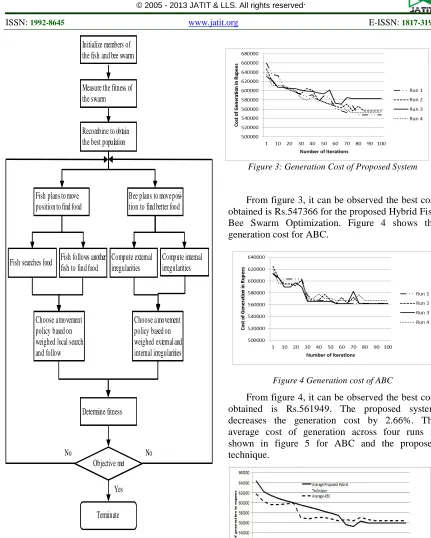
[image:5.612.316.519.77.552.2]The pseudocode of the proposed algorithm is shown in figure 1. The flow chart of the proposed hybrid algorithm is shown in figure 2.
Figure 1: Pseudo Code of the Proposed Optimization Technique
Input: m, l, u, nfemax, ઽ, δ, µδ, θ, η
iteration 1; τ 1 (x1;… ; xm) Initialize()
While termination criteria are not satisfied do for i = 1;…;m do
Compute the "visual"
if visual scope is empty then yi Random(xi)
else
if visual scope is crowded then yi Search(xi)
else
if central point is better than xi then yi1 Swarm(xi)
else
yi1 Search(x i
)
end if
if best function value is better than f(xi) then yi2 Chase(xi)
else
yi2 Search(xi)
end if
yi arg min {f(yi1), f(yi2)}
end if end if end for
for i = 1;… ;m do xi Select(xi; yi)
end for
if iteration > τ m then if "stagnation" occurs then
Randomly choose a point xl yl Leap(xl)
end if
τ τ + 1 δ = µδ δ end if
ISSN: 1992-8645 www.jatit.org E-ISSN: 1817-3195
Initialize members of the fish and bee swarm
Measure the fitness of the swarm
Recombine to obtain the best population
Fish plans to move position to find food
Bee plans to move posi-tion to find better food
Compute external irregularities
Compute internal irregularities Fish searches food Fish follows another
fish to find food
Choose a movement policy based on weighed external and internal irregularities Choose a movement
policy based on weighed local search and follow
Determine fitness
Objective met
Terminate Yes
[image:6.612.85.516.59.597.2]No No
Figure 2: A Hybrid Fish Bee Swarm Optimization For Congestion Management
4. RESULTS AND DISCUSSION
[image:6.612.318.523.308.433.2]The proposed system was tested on a IEEE 30 bus system using MATLAB 7.6 platform. The IEEE 30 bus system was used to test the proposed algorithm. Optimal power flow study was carried out with an initial population of 20. Four runs were conducted with different random seeds and the convergence occurred after about 80 iterations. Results were compared with ABC algorithm.
Figure 3: Generation Cost of Proposed System
From figure 3, it can be observed the best cost obtained is Rs.547366 for the proposed Hybrid Fish Bee Swarm Optimization. Figure 4 shows the generation cost for ABC.
Figure 4 Generation cost of ABC
[image:6.612.314.518.527.652.2]From figure 4, it can be observed the best cost obtained is Rs.561949. The proposed system decreases the generation cost by 2.66%. The average cost of generation across four runs is shown in figure 5 for ABC and the proposed technique.
Figure 5: The Average Run Cost of ABC and Proposed Technique
ISSN: 1992-8645 www.jatit.org E-ISSN: 1817-3195
5. CONCLUSION
This paper proposes a method for congestion management using hybrid fish bee optimization. The basic idea of Fish Bee Swarm Optimization is to imitate the fish behaviors with local search of fish individual for reaching the global optimum; it is random and parallel search algorithm. The main objective of this paper is to alleviate congestion, minimize cost and maximize line generation. Hybrid Fish Bee optimization algorithm is proposed to execute this multi objective task because it can solve combinatorial optimization problem. Simulated results verified the validity and feasibility of the proposed algorithm with rational parameters. The results prove that the method has a strong robustness, faster convergence speed and better estimation precision. Also, the cost is reduced and found to be more beneficial for large systems.
REFRENCES:
[1] Saini A., and Saxena A. K., “Optimal power flow based congestion management methods for competitive electricity markets”, International Journal of Computer and Electrical Engi-neering, vol. 2 (No. 1), 2010, pp. 1793-1813.
[2] Reddy S.S., Kumari M.S., and Sydulu M., “Congestion management in deregulated power system by optimal choice and allocation of facts controllers using multi-objective genetic algorithm”, Transmission and Distribution Conference and Exposition, 2010 IEEE PES, Apr 2010, pp. 1-7.
[3] Shih-Chieh Hsieh, Chien-Chih Chu, and Hsin-Min Wang, “Congestion cost allocation and congestion indices for a competitive electricity market”, Industrial Technology, IEEE ICIT '02, IEEE International Conference, vol. 2, Dec 2002, pp.854-859.
[4] Kundu S., “Congestion Management By Rescheduling Of Active Power Of Generators Using Generator Sensitivity Generator Sensitivity Based On Differential Evolution Based On Differential Evolution”, Doctoral Dissertation, Jadavpur University, Kolkata, 2012.
[5] Lhotska L., Macas M., Strackeljan J., and Jantzen, J., “Applied Nature Inspired System: Preliminary Investigation”.
[6] Oren Shmuel S., “Transmission Pricing and
Congestion Management: Efficiency,
Simplicity and Open Access”, Proceedings of
the EPRI Conference on Innovative Pricing, Washington DC, Jun 1998.
[7] Acharya N., and Mithulananthan, N, “Locating series FACTS devices for congestion management in deregulated electricity markets”, International journal of Electric power systems research, vol. 77 (3), 2007, pp. 352-360.
[8] Ashwani Kumar, Srivastava S.C., and Singh S.N., “A zonal congestion management approach using real and reactive power rescheduling”, IEEE Trans. on Power Systems, vol.19, no.1, Feb 2004, pp. 554-562.
[9] Jumaat S.A., Musirin I., Othman M.M., and Mokhlis, H, “Transmission loss minimization using SVC based on particle swarm optimization”, IEEE Symposium on Industrial Electronics and Applications (ISIEA), Sep 2011, pp. 419-424.
[10] Hazra J., and Sinha A.K., “Congestion man-agement using multiobjective particle swarm optimization”, IEEE Transactions on Power Systems, vol. 22 (4), 2007, pp. 1726-1734. [11] Hazra J., and Seetharam D.P., “A network
congestion management approach considering the risk of cascading failures”, Joint International Conference on Power Electronics, Drives and Energy Systems (PEDES) & Power India, Dec 2010, pp. 1-7. [12] Sujatha Balaraman and Kamaraj N.,
“Transmission Congestion Management using Particle Swarm Optimization”, Journal of Electrical Systems, ESR Group, UK, vol.7, issue 1, 2011, pp. 54-70.
[13] Karaboga D., “An Idea Based On Honey Bee Swarm For Numerical Optimization”, Technical Report-TR06, Erciyes University, Engineering Faculty, Computer Engineering Department, Oct 2005.
[14] Fernandes E.M.D.G., Martins T.F., and Rocha, A.M.A., “Fish swarm intelligent algorithm for bound constrained global optimization”, International Conference on Computational and Mathematical Methods in Science and Engineering, CMMSE, Jul 2009.
ISSN: 1992-8645 www.jatit.org E-ISSN: 1817-3195
[16] Seema N. Pandey, Shashikala Tapaswi, and Laxmi Srivastava, “Integrated evolutionary neural network approach with distributed computing for congestion management”, Journal of Applied Soft Computing, vol. 10, issue 1, Jan 2010, pp. 251-260.
[17] Ch Venkaiah, and Vinod Kumar D.M., “Fuzzy adaptive bacterial foraging congestion management using sensitivity based optimal active power re-scheduling of generators”, Journal of Applied Soft Computing, vol. 11, issue 8, Dec 2011, pp. 4921-4930.
[18] Yog Raj Sood, and Randhir Singh, “Optimal model of congestion management in deregulated environment of power sector with promotion of renewable energy sources”, Renewable Energy, vol. 35, issue 8, Aug 2010, pp. 1828-1836.
[19] Yi Wang, Haozhong Cheng, Chun Wang, Zechun Hu, Liangzhong Yao, Zeliang Ma, and Zhonglie Zhu, “Pareto optimality-based multi-objective transmission planning considering transmission congestion”, International Journal of Electric Power Systems Research, vol. 78, issue 9, Sep 2008, pp. 1619-1626. [20] Singh A.K., and Parida S.K., “Congestion
management with distributed generation and its impact on electricity market”, International Journal of Electrical Power & Energy Systems, vol. 48, Jun 2013, pp. 39-47.
[21] Panida Boonyaritdachochai, Chanwit Boonchuay, and Weerakorn Ongsakul, “Optimal congestion management in an electricity market using particle swarm optimization with time-varying acceleration coefficients”, Journal of Computers & Mathematics with Applications, vol. 60, issue 4, Aug 2010, pp. 1068-1077.
[22] Granelli G., Montagna M., Zanellini F., Bresesti P., Vailati R., and Innorta M., “Optimal network reconfiguration for congestion management by deterministic and genetic algorithms”, International Journal of Electric Power Systems Research, vol. 76, issues 6-7, Apr 2006, pp. 549-556.
[23] Seyed Abbas Taher, and Muhammad Karim Amooshahi, “Optimal placement of UPFC in power systems using immune algorithm”, Journal of Simulation Modelling Practice and Theory, vol. 19, issue 5, May 2011, pp. 1399-1412.
[24] Charan Sekhar, and Ashwani Kumar, “Congestion management in pool electricity markets with load ability limits”, Journal of Engg & Technology, vol. 2, issue 1, Sep 2012, pp. 24-31.
[25] Biswas S. (Raha), Mandal K.K., and Chakraborty N., “Modified Differential Evolution based Multi-Objective Congestion
Management in Deregulatory Power