266
RESEARCH OF THE WORKFLOW MANAGEMENT
SYSTEM BASED ON MICROKERNEL
1ZHISONG HOU, 2ZHOU YU
1Lecturer, School of Information Engineering, Henan Institute of Science and Technology
Xinxiang, China
2Assoc. Prof., School of Information Engineering, Henan Institute of Science and Technology
Xinxiang, China
E-mail: [email protected], [email protected]
ABSTRACT
Based on the analysis of limitation of existing workflow management system, a workflow management system based on micro kernel is researched and designed. In this system, a micro kernel based workflow engine is designed by separating the service implementation and activity scheduling; the workflow engine interface is defined to connect the related workflow components seamlessly; and then graphics oriented business process modeling is achieved by adopting digraph based business process model. Furthermore, workflow client and administration tools based on Web technology are implemented. The results show that: all this improves the flexibility of the workflow engine in system architecture and reduces the cost of reconstruction and maintaining; at the same time, the user experience is improved.
Keywords: Micro Kernel, Workflow, Workflow Management System, Directed Graph, Workflow Engine
1. INTRODUCTION
With the progress of the society and the development of the economy, enterprises are facing the increasing fierce market competition. In order to improve production efficiency, and enhance the market competitiveness, modern enterprises have to transform the traditional organization and operation mechanism based on competency into the process-centered management model. For the system of workflow technology was get the attention in the enterprise, workflow management system rapidly expanded. In the information age, the core competition ability of the enterprise depends on the efficient business processes, however, workflow technology achieves business process reengineering and business process operation control and improves the business process flexibility, and then improves its execution efficiency by providing an automation execution platform for the efficient perforation of the business process in a enterprise and among enterprises to help enterprises improve and optimize business processes.
The business process must adjust itself rapidly following the changes in the market; at the same time, when the enterprises expand their business, enterprise information system should be able to quickly reconstruct without affecting the overall system operation. Therefore, the main standards to
measure workflow management system for the enterprises are: whether the business process customized can be realized or its reengineering can be supported; whether the system can be reconstructed rapidly or the system functions can be expanded. However, the architecture of all the existing workflow management systems are the macro kernel structure, and many functions are realized together, so the coupling degree of system is high and its structure is bloated and lacks of flexibility; at the same time, this kind of system cannot realize business process reengineering and the cost of its reconstruction is high. Therefore, in the view of deficiencies of the traditional workflow management system, following the standard of the workflow management coalition, a workflow management system based on microkernel is researched and designed.
267 the comparison with other systems, including commercial and open source system, is given.
2. LIMITATION OF EXISTING SYSTEM
Workflow management system is defined by Workflow Management Coalition as: A system that completely defines manages and executes “workflows” through the execution of software whose order of execution is driven by a computer representation of the workflow logic [1].
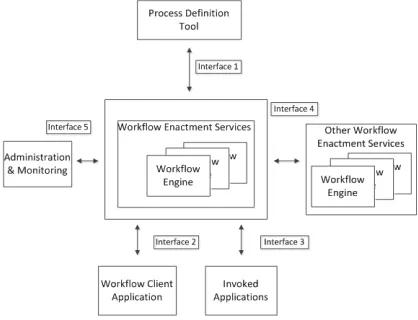
[image:2.612.89.298.319.479.2]For the implementation of interoperability, Workflow Management Coalition made the standards of standardization for related terms, architecture and component interface based on the merits and demerits of the workflow production, and the workflow reference model [2] was provided by the Workflow Management Coalition (WfMC) which is shown in Figure 1.
Figure 1 The Workflow Reference Model In different workflow management system, the architecture and implementation of the workflow services are different as usual. According to the model from workflow management Coalition, workflow engine could be divided into several servicing components which work together. As a result, servicing components are implemented respectively, then whole workflow engine could be completed as components packaged. Therefore, structure of the workflow engine is simple and easy to implement. In workflow engine, the most important functions are scheduling function of business activity and task allocating function. There is no little doubt that the algorithms of that are complicated. On the other hand, the functions of the workflow are stable. Therefore, when the re-construction of workflow engine is needed, the algorithm of the functions would maintain. The necessary work is to modify or add specific servicing components.
However, the existing workflow management systems usually adopt macro kernel structure which integrates workflow engine, process definition tool and management and monitoring tool together. Then, the functions of business process modeling, implementation, monitoring and client application would influence each other. When an error occurs in a module, the error will affect other modules of the system, which leads the system to crash directly; on the other hand, if a function is needed to modify, it will inevitably affect the other service component whose function is relatively stable. Therefore, the disadvantages of workflow management system which adopts macro kernel are as follow: excessive concentration function, confused logic and bloated architecture. This leads to reducing the reliability and flexibility of the system and increasing the cost of system reconfiguration.
3. WORKFLOW MANAGEMENT SYSTEM
BASED ON MICROKERNEL
According to the relatively stable and independent function of business activities scheduling and task allocation in workflow engine, the workflow engine based on microkernel is constructed through separating workflow engine from workflow management system; other workflow modules interact with the workflow engine through a well-defined workflow interface to complete the execution and management of workflow task. At this time, when a function of the workflow management system needs to be reconstructed, it is only needed to modify without affecting the workflow management system itself, thus improving the robustness and flexibility of the system and reducing the cost of the system reconstruction.
The system is designed and achieved by separating workflow engine from workflow management system. Then with the workflow engine based on microkernel as the kernel of the system, the business process is described and implemented by the process definition language based on XML and activity scheduling mechanism based on finite state machine [3]; other modules can only access workflow engine through workflow interface; finally, these modules cooperate mutually to achieve the task of workflow management system.
268 maintainability of workflow management system in the structure [4].
System Structure
In order to reduce the degree of coupling between modules, workflow management system is usually subdivided into many different components which can communicate and cooperate with each other to complete the execution and management of business process.
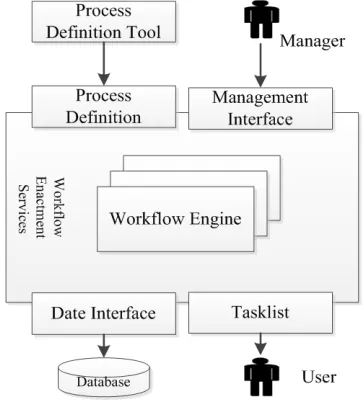
[image:3.612.103.285.280.481.2]A complete workflow management system usually contains process definition tool, process definition interface, workflow enactment service, task list, data interface, database and so on. The structure of the components is shown in Figure 2.
Figure 2 The Architecture Of The Workflow Management System
As shown in Figure 2: in a workflow management system, related components cooperate with each other to construct a complete workflow management system.
In order to complete the execution of business process, firstly, through the process definition tool, the business process is transformed into process definition which workflow enactment service could understand; secondly, the workflow engine analyses process definition, creates process instance and completes one execution of business process; thirdly, business person accesses the task list to get the business task which is assigned by the process definition, and submits the business data to complete the interaction with the workflow engine; finally, if necessary, workflow enactment service saves the data into the database during the running
of the business process to ensure business process effective permanently through the data interface.
Process Definition Modeling
Process definition tool is used to create a business process description which is represented by a form that the computer can understand. It is based on the formalized process definition language, object-relation model, script, or route set for transmitting information among the business actors. In this system, analysis and modeling of business process is achieved by the workflow model based on directed graph.
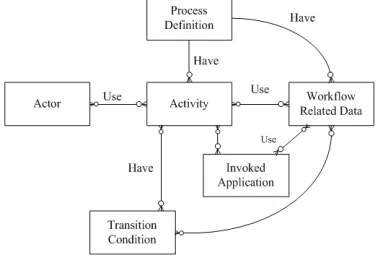
From workflow technology perspective, workflow model is an abstract description of business process, and it converts the real business process into the description of computer data. Workflow model applies simple and direct formation to describe complicated and abstract business process, and supplies a referent structure of world description. In a workflow model, except the process elements for describing the process structure, execution logic of process and transition and action of process function are provided. Therefore, there is a basic Meta model which is used to describe workflow model. Process definition Meta model is a description which converting the real business process into structured formation in computer, then a process definition which could be explained and executed by workflow is created.
The Meta model is the model which describes model. In workflow management system, the Meta model of process definition is the model that describes the internal relation of process definition. The structure and internal relation could be performed by that. Employment of Meta model, it could define a process which is not related with implementation.
269 In workflow model based on directed graph, the business nodes of business process are represented by the vertexes of digraph, and connected by the directed edges to determine the execution logic between nodes. Therefore process definition modeling in graphical way is conducted.
Figure 3 The Meta Model Of Process Definition Business process modeling is the process of describing business process with digraph. Process definition is the result which is formatted by business process definition tool. Process definition consists of a series of nodes and transitions, and each node represents a specific type of process elements, such as: start, activity, task and decision.
In a digraph, both node and transition can be considered as a graphic element; therefore, a process definition is a set of graphic elements. The data structure of these graphical elements is shown in Figure 4.
Figure 4 The Structure Of Graph Element As shown in Figure 4: a process definition consists of several graphic elements which include nodes and transitions. Nodes are used to represent the activities and tasks of process definition, and
connected by the transitions which represent the business execution logic between the nodes. Therefore, a business process can be described as a collection of graph elements which are responsible for the activities in business process and a set of transitions between the graph elements which represent the business logic.
The result of process definition modeling is a well-formatted process definition. The process definition must be imported into workflow engine and parsed by workflow engine. With the process definition, the workflow could execute business process automatically.
Architecture of Workflow Engine
According to the rule which separates service components and scheduling function, the engine extracts the stable function, like business activity schedule and task allocation, and creates the core layer. The architecture of workflow engine is shown as in Figure 5.
Figure5 The Architecture Of The Workflow Engine As can be seen from Figure 5, there are four layers in the workflow engine. The functions and components of each layer are as follow:
(1) Infrastructure Layer: this layer supplies public service component for workflow engine. Execution logging and work-day management are in this layer.
[image:4.612.92.299.472.659.2]270 Main functions of Runtime Support module are explaining for process definition and maintaining for process instance. According to the creation of business instance, firstly, the parsing function parses process definition, and then the function collects the data for process instance creation and finishes the initialization of the process instance. Secondly, the initialized process instance would be sent to kernel layer, and then the kernel layer implements the schedule execution. Persistence service provides storage service for kernel layer which saves workflow related data into database. Runtime Optimization module optimizes workflow engine, which applied to increase the executing efficiency. This is non-related with workflow engine function. Runtime Assistance module expands the service of workflow engine, which is applied to enhance its function. The module functions are event handling, abnormal handling, condition handling or rollback.
(3) Kernel Layer: this layer is the core of workflow engine, which provides activity scheduling function and task allocation function. There are four modules in this layer: Micro kernel, Workflow Execute module, Process Instance module and Activity Management module. Micro kernel is responsible for that schedules business activity, implements execution of business instance and allocates the task to actor; Workflow Execute module tries to implement the operations of instance execution, for example, start, suspend, active or ended; Process Instance module manages business instance, supplies the instance to database for persistence; management of business activity is implemented by Activity Management module.
(4) Interface Layer: interface layer is the interface with external component. External application communicates with workflow engine via the interface and then business operation and management is implemented. The interface follows the specification of workflow application interface made by Workflow Management Coalition, and implements the connection between productions seamlessly. The layer is divided into Application Interface module and Administration & Monitoring Interface module. Application Interface module provides interface related with workflow service. External application accesses the service of workflow engine via the interface; management of workflow service, for example, start, suspend or delete process instance, is achieved by Administration & Monitoring Interface module.
Consequently, workflow engine based on micro kernel separated activity scheduling and task
allocation from service and packaged core function into a kernel layer. Service implementation is achieved by the service layer. Therefore, function of workflow engine in non-related with implementation. The necessary work is to modify or create service component when workflow service needs to re-construction. This contributes the increasing stability, and the flexibility of system is enhanced while the cost of reconstruction decreased.
Client Based on Web
In the workflow management system, each user has a task list (also known as the taskbar) which is a part of the workflow client application. The workflow engine makes use of this list to show which works need to be carried out.
Selecting a work item, the user could perform a task of a process instance. Therefore, in principle, each user has a personal task list which shows the work items that the user needs to do. That is, task list is the interface between the user and business task.
In order to simplify the user operation, the system uses client based on the Web. After user login system, they will get their own task, execute related operations, and complete the tasks which wait to be coped with, ultimately drive the business process forward.
System Administration and Monitoring
System administration and monitoring is one of the necessary tools of workflow management system. In order to guarantee business system effective continuously, improve the efficiency of system, and enhance the adaptability of the system, system administration and monitoring tool is usually adopted to monitor the process instance execution of the business process, for understanding the status of business instance, obtaining relevant parameters of the process instance and managing or auditing the steps of process instance.
For understanding the implementation situation of process examples, to obtain the status of information and running, to manage or audit execution steps of process instance, then to optimize the business process specially. And then business process is optimized to improve efficiency.
System Implementation
271 to other modules of workflow management system, such as, modeling tools and client application. The operations of workflow data is implemented by the object-relation mapping (ORM) framework which supplies the database independent. In this system, the ORM framework is Hibernate which is provided by JBoss. Process instance is one execution of business process. In this system, the execution of process instance is designed by the command design pattern and the chain of responsibility design pattern. In this way, the activities can be pushed to the corrected user.
The business process modeling tools is the graphical user interface which translates the real world workflow into well-formed business process. Therefore, the ease of use is to determine whether the system is good or bad. Eclipse Modeling Framework (EMF) is a modeling framework and code generation facility for building tools, which is best choice to build this process modeling tools.
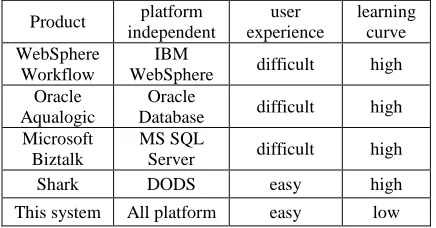
[image:6.612.89.307.404.518.2]In this system, all components are built using open source technology. The comparison with other product, including commercial and open source software, is shown in Table. 1.
Table. 1 Comparison With Other Product
Product platform independent
user experience
learning curve WebSphere
Workflow
IBM
WebSphere difficult high Oracle
Aqualogic
Oracle
Database difficult high Microsoft
Biztalk
MS SQL
Server difficult high
Shark DODS easy high
This system All platform easy low
As shown in Table. 1, this system is independent of all platform and supplies better user experience and lower learning curve. In actual usage scenarios, the cost of development and deployment is reduced and the praise of users is received.
4. SUMMARY
In this paper, by investigating the limitation of the existing workflow management system, a workflow management system based on microkernel was designed. The workflow engine is separated from the workflow management system. In workflow engine, business process scheduling and service implementation is divided to ensure the kernel layer independent and stable. Other components in the system interact with the workflow engine through a well-defined workflow interface to realize the cooperation and execution of
the business process, which ensures the flexibility and scalability of the system in the architecture. Business process modeling based on digraph is introduced, and give an intuitive modeling mechanism that could understand and operate easily. At the same time, client tool based on Web and system administration and monitoring tool based on Web were adopted to make the operation simple.
REFRENCES:
[1] Ching-Hong Tsaia, Kuo-Chan Huangb and Feng-Jian Wanga, “A distributed server architecture supporting dynamic resource provisioning for BPM-oriented workflow management systems”, Journal of Systems and Software, Vol. 83, No. 8, 2010, pp. 1538-1552. [2] Burkhard Linke, Robert Giegerich and
Alexander Goesmann1, “Conveyor: a workflow engine for bioinformatic analyses”,
Bioinformatics, Vol. 27, No. 7, 2011, pp. 903-911.
[3] Cai XiaoWu, Han YongGuo and Lan Ke, “Research and Design of Lightweight Workflow Engine”, Computer Engineering, Vol. 36, No. 20, 2010, pp. 78-79.
[4] Joshua Orvis1, Jonathan Crabtree1 and Kevin Galens1, “Ergatis: a web interface and scalable software system for bioinformatics workflows”,
Bioinformatics, Vol. 26, No. 12, 2010, pp. 1488-1492.
[5] Huei-Huang Chen, Kuo-Shean Liu and Shih-Chih Chen, “An Overview of Workflow Management System Structure in the Supply Chain”, Australian Journal of Business and Management Research, Vol. 2, No. 4, 2012, pp.12-19.
[6] Dlogo M.R.Ferreira and J.J.pinto Ferreira, “Developing a reusable Workflow engine”,
Journal of systems Architecture, Vol. 50, No. 6, 2004, pp. 309-324.
[7] Ming-Yang Sua, Gwo-Jong Yub and Chun-Yuen Lin, “A real-time network intrusion detection system for large-scale attacks based on an incremental mining approach”,
Computers & Security, Vol. 28, No. 5, 2009, pp. 301–309.