3195 -1817 ISSN: -E
www.jatit.org
8645 -1992 ISSN:
115
THE ROLE OF WEB-BASED GROUP DECISION SUPPORT
SYSTEMS IN CLARIFYING THE COLLECTIVE
INTELLIGENCE: MEASURING THE OUTCOMES
1
KHALED SALEH Al OMOUSH, 2RAED MUSBAH ALQIREM, 3MOHAMMAD IQBAL AJLOUNI
1Asstt Prof., Department of Management Information Systems, Al-Zaytoonah University of Jordan 2
Asstt Prof., Department of Management Information Systems, Al-Zaytoonah University of Jordan
3Asstt Prof., Business Administration, Al-Zaytoonah University of Jordan
E-mail: [email protected] , [email protected] , [email protected]
ABSTRACT
The main objective of this research is to develop a conceptual framework for exploring the role of GDSSs in shaping the dimensions of collective intelligence and the expected outcomes. The ever-increasing complexities and controversial challenges in today's business environment require organizations to be recognized as adaptive systems and be examined as an evolving intelligent being. An organization is intelligent only if it is able to nurture a high level of collective intelligence. The tremendous advances in Internet and Web applications bring impetus to Web-based Group Decision Support Systems (GDSSs) development as the most recent collective intelligence systems. Based on extensive literature review, six dimensions of collective intelligencewere identified in this paper. These dimensions are freedom of mind, shared memory, knowledge sharing, collective perception, collective problem-solving, and collective learning. Furthermore, the study's framework identified four major expected outcomes, involving sense and response capability, relationship quality, decision making quality, and continuous organization learning.
Keywords: Collective Intelligence, Web-Based Gdsss, Freedom Of Mind, Shared Memory, Collective Perception, Sense And Response Capability, Relationship Quality
1. INTRODUCTION
Todays’ organizations are faced with controversial challenges that have critical impact on businesses’ ability to survive and remain competitive. These evolving challenges present both threats and opportunities forcing the business organizations to rethink the way they manage their intangible assets. The increasing capabilities of collaborative Information Technology (IT) play a vital role in giving the support and facilities to deal with these threats and challenges.
In such a volatile environment and simultaneous challenges, organizations have to be recognized as complex adaptive systems [1], [2], [3], [4]. They have to get rid of its mechanic and procedural life to behave and think as human beings. Human beings cannot function like machines, and likewise the contemporary organizations. They must collaborate, learn, self-organize, adapt, compete, and evolve [3], [5]. This new awareness requires organizations to be
re-examined as an evolving intelligent being and not merely as an economic production machine [3], [5], [6], [7]. In such a paradigm, intelligence is the prized asset of an organization [3], [6], [8]. An organization is intelligent only if it is able to nurture a high level of collective intelligence [8]. The interaction in form of collaboration, information sharing, collective learning, knowledge acquisition, collective perception, and decision-making are the key issues of such systems [8], [9]. Therefore, intelligent organization is the organization that can clarify and provide the appropriate organizational environment for innovating, achieving and employing the collective intelligence to serve its survival, prosperity, and superiority.
3195 -1817 ISSN: -E
www.jatit.org
8645 -1992 ISSN:
116 traditional approaches to decision making failed to generate those innovative solutions necessary for coping with such complexity [2], [4], [10]. As the increasing of the internal and external complexities, organizations have begun to push the outer envelope of collaborative skill-building and collective functioning [11]. Whenever there is a need and an opportunity to collaboration, the principles of collective intelligence can be applied. Collective intelligence of any group increases the capacity for effective action in pursuit of common aims and finding emergent and sustainable solutions to the complex problems [12].
A wide range of Web-based applications have emerged in the past few years. Collaborative Web-based systems have become a major trend in today’s business environment reaching into almost every aspect of organizational work. These systems leverage the combined efforts of very large groups of people to solve complex problems, and often referred to as collective intelligence systems [11], [13], [14]. The tremendous advances in Internet applications bring impetus to Web-based GDSSs development as the most recent IT-supported collaborative tool. Most of the previous research (e.g. [15], [16], [17], [18]) focused on the architecture, design, and development of new models for Web-based GDSS. This leaves many topics and issues to be solved.
While IT revolution is continuous, 6Tmany questions are revealed regarding 6Thow can organizations use collaborative IT to clarify collective intelligence?. This paper contributes to the ongoing stream of research correlating to the role of collaborative IT in clarifying the collective intelligence in business organizations and the expected outcomes. The paper proposes a framework for exploring the dimensions of collective intelligence, the role of Web-based GDSSs, as the most recent IT-supported collaborative tool, in shaping these dimensions, and the expected outcomes.
2. COLLECTIVE INTELLIGENCE
With the growing interest in complex adaptive systems, the concept of collective intelligence is coming more and more to the fore [1], [3], [19]. Organizations are natural gathering of intense human intelligence sources, who are seeking to solve problems, learn, and engage with knowledge sharing and acquisition [3]. In this context, business organizations can be defined as human
systems formed with the basic objective of pooling different human abilities or expertise together to create certain synergetic effects to achieve the business objectives [8]. From this perspective, organizations are visualized as intelligent beings possessing systems with high collective intelligence, and other intelligence-related characteristics that are commonly found in highly intelligent human beings [3].
There are many definitions of collective intelligence. For example, Hiltz et al. [20] and Heylighen [1] defined collective intelligence as the ability of a group to arrive at a solution that is better than any of the members achieved individually. Malone et al. [11] described collective intelligence as groups of individuals doing things collectively that seem intelligent. Organizational intelligence refers to the capacity of an organization as a whole to gather information, to innovate, to generate knowledge, and to act effectively based on the knowledge it has generated [7]. It includes the historical knowledge inherent in the organization and generative intelligence that results from collaboration among organizational members [7].
3. WEB-BASED GROUP DECISION SUPPORT SYSTEMS
The advances in ICTs have4T given impetus to4T the emergence, dissemination, and applying the collective intelligence [21], [22]. New technologies are now making it possible to organize groups in very new ways that have never been possible before in the history of humanity [11]. As the increasing of the organization’s complexities, the important organizational decisions are often entrusted to groups instead of individuals because groups can access a larger and more diverse pool of information and expertise than individuals alone. This was the main reason behind developing the Group Decision Support Systems (GDSSs). These systems are a particular subclass of the computerized collaborative work systems [23], [24], designed to lower the problem’s complexity level, and thus enhance the effectiveness and efficiency of decision making process.
3195 -1817 ISSN: -E
www.jatit.org
8645 -1992 ISSN:
117 computer-based system that facilitates the solution of unstructured problems in decision making by a group and aims to influence the decision outcome through communication using technology. Hiltz et al. [20] defined it as an interactive computer-based system that facilitates solution of problems by a group of decision makers. According to Er and Ng [25], GDSS is an interactive information system which combines the capabilities of communication, database, computer, and decision technologies to support the identification, analysis, formulation, evaluation, and solution of semi-structured or unsemi-structured problems by a group.
Collaborative Web-based systems are the most recent path discovered for opening up the possibilities of collective choice and the most up-to-date tool available for improving the collective intelligence that were simply unconceivable even few years ago [24], [27], [28]. The advances in Internet-based applications have opened wider chance for the development of GDSSs [10]. The combination of DSSs and the Internet applications transformed traditional GDSS-based decision making to Web-based GDSSs.
According to Istudor and Duta [24] and Chen et al. [17], the most intensively utilized technologies for deploying the GDSS are web-based and client-server technologies to solve complex problems that are less structured. Web-based GDSSs have been designed to support group problem solving and decision making with generic problem solving tools that can be used anytime and anywhere [4]. A number of web-based GDSSs have been developed in the last few years. The users can access to Web-based GDSS with web browsers deployed on corporate intranets to support decision making processes.
4. LITRETURE REVIEW
There’s already a large amount of work that has been done to develop different frameworks of collective intelligence with different perspectives, in different fields of applications. Collective Intelligence has been a topic of interest for social psychology, organization theory, artificial intelligence, learning, democracy, natural and environmental sciences, physics, and others. Web-based GDSS is a relatively new and emerging field of DSS. 2TThis may explain2T17T why17T the majority of previous research (e.g. [10], [15], [16], [17], [18], [29], [30], [31]) is basically technical oriented focusing on design and development of new
Web-based GDSSs models. There is also a growing body of research (e.g. [24], [32]) shed light into the value of GDSSs and its impact on performance improvement in term of efficiency, effectiveness, and decisions’ quality. Some researches (e.g. [33]) focused on group awareness information in web-based GDSSs, group member activities, and their behaviors in Web-based collaborative work.
Many important issues are still sparse. According to Kapetanios [34], the transition from personalized data, knowledge, and contents towards collectively intelligent forms of synergies in an amalgamation of humans and technology is at its infancy and raises many questions. These questions vary from the notion of collective intelligence to the methodologies and principles for computations and engineering of collective intelligence-based systems.
In the social Internet age, most previous researches (e.g. [22], [24], [27], [28], [35]) focused on the role of Web 2.0 applications in clarifying the collective intelligence in a social context. As of yet, a little attention has been paid to study the role of collaborative IT, and Web-based GDSSs in particular, in clarifying the collective intelligence in the context of business organizations. Most previous research (e.g. [29], [36], [37])
4T
concentrated on 4Timproving the architecture and design of new models of GDSSs to achieve the collective intelligence. Far less attention has been paid to study the role of Web-based GDSSs, in generating the collective intelligent and the expected outcomes. Although it’s rare, the previous research in this regard also focused on the architecture and design of Web-based GDSSs in order to4T 2T4Treach2T4T a 2T4Tcollective intelligence2T. For example, 10TWang and Ohsawa [38] developed 10Ta novel Web-based innovation support system for collective innovation. Introne et al. [14] proposed a design of Web-based collective intelligence system to help people solve the unstructured problems of global climate change. Turban et al. [22] proposed a framework for exploring the contributions of Web 2.0 applications and tools in supporting the collaborative group decision making process and generating the collective intelligence.
2T
3195 -1817 ISSN: -E
www.jatit.org
8645 -1992 ISSN:
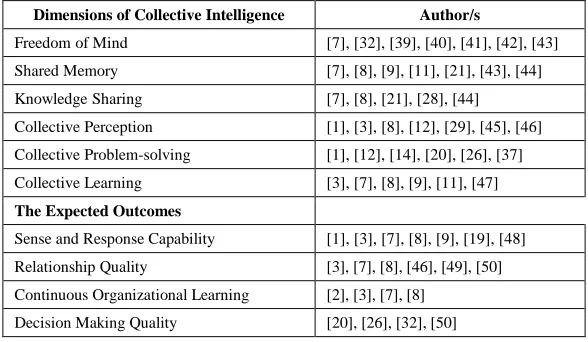
118 these technologies generating the collective intelligence?. To address these issues, a review of literature (table 1) was conducted in the areas of collective intelligence, collaborative IT, and GDSSs to identify the dimensions and characteristics of collective intelligence that can be
[image:4.612.159.453.220.391.2]supported by Web-based GDSSs and the expected outcomes. Table (1) summarized the dimensions of collective intelligence dimensions and the expected outcomes that can be achieved through using Web-based GDSSs.
Table 1. The Collective Intelligence Dimensions And The Expected Outcomes That Can Be Achieved Using Web-Based Gdsss
Dimensions of Collective Intelligence Author/s
Freedom of Mind [7], [32], [39], [40], [41], [42], [43]
Shared Memory [7], [8], [9], [11], [21], [43], [44]
Knowledge Sharing [7], [8], [21], [28], [44]
Collective Perception [1], [3], [8], [12], [29], [45], [46]
Collective Problem-solving [1], [12], [14], [20], [26], [37]
Collective Learning [3], [7], [8], [9], [11], [47]
The Expected Outcomes
Sense and Response Capability [1], [3], [7], [8], [9], [19], [48]
Relationship Quality [3], [7], [8], [46], [49], [50]
Continuous Organizational Learning [2], [3], [7], [8]
Decision Making Quality [20], [26], [32], [50]
5. THE PROPOSED MODEL OF RESEARCH
The research model (figure1) proposes that the organization can be visualized as intelligent beings possessing system with high collective intelligence. The collective intelligence of organizations can be clarified through the deeper support of Web-based GDSSs to establish its dimensions. These dimensions are freedom of mind, shared memory, knowledge sharing, collective perception, collective problem-solving and collective learning.
In general, outcomes measurement has an important communications role to play by making groups and organizations aware of what is important to success and the areas of evaluation. The contribution and success of Web-based GDSSs in the efforts of achieving collective intelligence through clarifying its dimensions cannot be assured unless the outcomes is properly determined and monitored. Based on the literature review, the framework of research proposes four expected outcomes that have to be considered and monitored for the purpose of evaluating the success of Web-based GDSSs in clarifying the dimensions of collective intelligence. These outcomes include sense and response capability,
3195 -1817 ISSN: -E
www.jatit.org
8645 -1992 ISSN:
119
Figure1. The Dimensions Of Collective Intelligence Enabled By Web-Based Gdsss And Expected Outcomes.
Below each dimension of collective intelligence that can be clarified using the Web-based GDSSs and the expected outcomes are discussed in more details.
5.1. Dimentions Of Collective Intelligence 5.1.1. Freedom of Mind
The freedom of mind is the basic to produce the intelligence [42]. Collective intelligence is intangible and cannot be acquired by force or achieved following pre-specified procedures and routines [8]. According to Dewey’s political philosophy, the conditions of intelligent action are constituted by an environment of positive freedom [42]. The freedom of mind provides the ability to behave flexibly in different situations and adjust behavior to suit the situation [1]. Albrecht [41] classified the kinds of collective stupidity into the learned kind and the designed-in kind. The learned kind prevails when people are not authorized to think. The designed-in kind prevails when the rules and systems make it difficult or impossible for people to think creatively, constructively, or independently.
To achieve the collective intelligent, organizations must first establish conditions under which free individual and team decisions lead to interconnection and coordination toward common good rather than pure chaos [7], [40]. The structural architecture flexibility of an intelligent organization is not the brilliance of organizational designers sitting at the top, but the free choices of people in the middle and bottom of the
organization [7], [40]. Intelligent organizations guarantee members free speech, freedom of association, developing synergistic integrations with others [7], [39], [40], and giving their opinions and benefiting more easily from other users' advice [43].
GDSSs advocate open expression of individual attitudes and beliefs, and prizes collective agreement on a mutually satisfactory solution [32]. Anonymous environment encourages participants to express their ideas freely. Using GDSSs, anonymous presentation of ideas by group members eliminates many social cues prevalent in non-GDSS mediated group meetings. Such anonymity provides a more open environment, where ideas are examined based on their merits and not subject to bias which may be directed toward specific group members [18], [25], [32]. Users who fear receiving negative evaluations from others in the face-to-face session may not have this fear in the environment of anonymity in Web-based GDSS [32]. Furthermore, collective intelligence research (e.g. [23], [24], [32]) has shown that GDSSs, in general, eliminate production blocking by allowing members to access the communication medium equally in parallel since users no longer have to wait for others to express their ideas.
Web-based GDSS
Collective Problem-solving Collective
Perception Knowledge
Sharing Shared
Memory
Collective Intelligence
Continuous Organizational
Learning
Relationship Quality
Decision Making Quality
Sense & Response
capability
Freedom of Mind
3195 -1817 ISSN: -E
www.jatit.org
8645 -1992 ISSN:
120 5.1.2. Shared Memory
Organizational intelligence consists of the capacity of an organization as a whole to gather information, to innovate, to generate knowledge, and to act effectively basing on the knowledge it has generated [7]. It includes historical knowledge inherent in the organization and generative intelligence that results from collaboration among organizational members [7]. Organization's information and knowledge structures do not only reside in the mind of the interacting agents alone. As an organization learns, information and knowledge accumulate and the latter have to be stored physically [8]. Memory has a significant influence on the emergence of collective intelligence through gathering and accumulating the information and knowledge to accomplish the collective intelligent activities [8], [28], [43].
Intelligent organizations have to create additional knowledge structures outside the traditional human thinking systems. Usually, these externalized knowledge structures are stored in external physical storages [8]. In the context of collective intelligence, organizational memory according to Jacko et al. [28] can be thought of as repositories for information and knowledge acquired through experience, and other means accumulated and stored for future use. According to Cross and Baird [51], such repositories consist of the minds of individual employees, the relationships between employees, paper and electronic databases, work processes and technologies, and products or services offered.
IT plays a critical role in supporting, storing, organizing, and accessing organizational memory. GDSS generally aims at harvesting knowledge and building knowledge repositories [2]. One of the basic GDSS components is data system which includes data warehouse, data marts, OLAP, and data mining [37]. Typical intelligence activities that a Web-based GDSS supports include depth accessing all information assets [24]. This include accessing legacy and relational data sources, comparative data figures, projected figures based on new data or assumptions to identify, model, and solve decision problems [16], [24], [32]. Furthermore, the Web-based GDSS, by using web mining and related web intelligence techniques, allow decision makers to access external data sources, during the decision-making process [16]. It also consists of a relational database, called meeting repository, to store all the meeting related information including meeting setup information
as well as ideas generated and evaluated by various group tools [4].
5.1.3. Knowledge Sharing
The accelerated transformation of the knowledge revolution is propelling the human world rapidly into the intelligence era [3]. Knowledge management is increasingly identified as a key to integrating and sharing the diversity of knowledge in a community that desires to achieve collective goals [21], [44]. Many authors (e.g. [7], [44], [47]) indicated that collective intelligence is fostered through information and knowledge sharing. According to DeSanctis and Galluple [23], collaboration enables collective intelligence to emerge through the pooling of knowledge, research, arguments, and insights from diverse groups of people.
Staskeviciute et al. [7] identified organizational intelligence as the knowledge-based capacity inherent in the organization. Many previous researches (e.g. [3], [6], [7], [8], [21]) also indicated that knowledge sharing is a highly significant function of intelligent organizations. It is a natural gathering of intense human intelligence sources, who are seeking to learn and engage with knowledge sharing and acquisition [3]. Thus, the management of the collective intelligence in organizations has to facilitate knowledge transfer and sharing [21].
3195 -1817 ISSN: -E
www.jatit.org
8645 -1992 ISSN:
121 5.1.4. Collective Perception
One of the very important characteristics of collective intelligence is the collective cognitive capacity and behavior [46]. Wagner and Back [29] revealed that the reasons for the superior performance of collective intelligence are better cognition, coordination, and cooperative behaviors. According to Zara [50], at its core, collective intelligence is about harmonious connections. In this case, people make shared meaning of their diverse perspectives and experiences by surfacing, testing, and improving the collective thinking [12]. The connectivity can be understood as dissolving the ego boundaries and barriers of individualism in order to better tap the powerful essence of individuality in the context of collective activity through collective perception [46]. Likewise, Zara [50] revealed that managing collective intelligence means combining all of the tools, methods and processes that enable connection and cooperation among individuals’ intelligences. In the context of collective intelligence, a number of researchers (e.g. [1], [16], [45]) revealed that the collaborative problem solving requires aggregating the perceptions of the different agents of the present situation into a collective perception.
The collective perception can be also explained in terms of transforming from mindfulness to orgmindfulness. Mindfulness is an ability to exercise meta-cognition, take action based on it and to continuously enhance this state of meta-cognitive awareness and pro-activity [3]. At the individual level, when a person is mindful, it means that the person is observing his internal mental state more closely and is able to establish better linkages and interaction with the external systems [3]. The same concept can be extended to the organizational level. Orgmindfulness is a key factor that assists the faster increase in nurturing collective intelligence. According to Liang [8], orgmindfulness represent the introduction of intelligence strategy to bind a group of human thinking systems and elevate the collective intelligence of the organization.
Collaborative IT facilitated the connectivity among the sources of collective intelligence in different ways [6], [21]. The previous research (e.g. [4], [10], [24], [32], [36]) confirmed that GDSSs provide the group cognition support through many features, such as cognitive decision models, cognitive feedback, and cognitive-aid structures component. Rao and Turoff [36]
referred that the cognitive-aid structures component deals with the appropriation of linear and non-linear cognitive processes and group member interaction complexities encountered in decision-making. Web-based GDSSs aim at facilitating formal and informal communication among distributed teams of decision makers without any barriers. It can provide for interacting groups to reach the level of accuracy of judgment comparable to their most capable members supporting the connectivity among them [10], [24], [36]. Web-based GDSSs also include several tools, such as multi-aspect brainstorming, discussion forum, and information sharing tools that enable the connectivity by supporting the collecting of divergent thinking of participants [4].
5.1.5. Collective Problem Solving
Problem solving methodology is described as a systematic approach for innovation [4]. Heylighen [1] indicated that a system is more intelligent than another system if in a given time interval it can solve more problems, or find better solutions to the same problems. Collective intelligence is the motivation behind all forms of group problem solving since the birth of collaboration [1], [26]. Heylighen [1] and Hiltz et al. [20] demonstrated that the better understanding of collective intelligence requires the analyses of intelligence in general, as collective problem-solving ability.
Collective intelligence of any group, increasing the capacity for effective action in pursuit of common aims and finding emergent and sustainable solutions to the complex problems and challenges faced by organizations and communities [12]. A group can then be said to exhibit collective intelligence if it can find more or better solutions than the whole of all solutions that would be found by its members working individually.
3195 -1817 ISSN: -E
www.jatit.org
8645 -1992 ISSN:
122 categorization, prioritization tools, weighted evaluation and voting to improve the productivity and accuracy of data processing and resolve the problems of insufficient time [4], [32]. Using idea generation tools, such as the brainstorming tool, a group can generate many ideas collectively and efficiently [4].
5.1.6. Collective Learning
Intelligence is the energy behind learning [3]. To be collectively intelligent, the organizational groups as a whole must learn [8], [9], [50]. According to Zara [50], the learning expeditions trigger collective intelligence and are themselves the fruit of a collective intelligence process. Collective learning emphasizes the social aspects of learning and cognition, where information and knowledge are coordinated, held in, and transformed from people to people [47].
In the intelligent organization, learning represents the biggest pool of intense intelligence sources [3]. Many researchers (e.g. [3], [8], [52]) indicated that the capacity for learning in an organization is dependent on its collective intelligence. Therefore, the collective learning represents an important aspect of organizational intelligence [8]. All organizational learning phases could be improved by collective learning specially the accumulation of experience [47].
The emphasis is also put on the role of IT as facilitators of learning in collaborative environments [4], [34], [37]. According to Fadul [47], collective learning illustrates the process of interaction between people and technologies in order to determine how to best represent, store and provide access to digital resources and other artifacts. Tang [37] demonstrated that creativity support systems are oriented to enhance human’s creative and learning ability toward unknown problem solving. Many previous researches (e.g. [30], [31], [36], [22], [53]) indicated that GDSSs in general, and Web based in particular, support a collaborative learning context where people can interact, create, and share information and knowledge.
5.2. The Outcomes of Collective Intelligence
The impacts and contributions of Web-based GDSSs in clarifying the dimensions of collective intelligence can be analyzed in light of four expected outcomes:
5.2.1. Sense and Respond Capabilities
One of the most important outcomes of employing the Web-based GDSSs in establishing
collective intelligence is enhancing the sense and responding capability of the organizations. In a world where organizations have to be recognized as complex adaptive systems, the concept of collective intelligence is coming more and more to the fore [1], [3], [19]. The main them of sense and respond is adaptability to environmental changes [54]. Today’s organizations need to be more sensitive to their external environment, react and respond rapidly and dynamically, and having the flexibility to reproduce itself in case of environmental changes [2], [4], [55]. According to Staskeviciute et al. [7] and Bloom [48], adaptability is the ultimate test of intelligence.
Organizations must be intelligent enough to be adaptable and sustainable in the re-defined and highly complex, rapid changing, and totally unpredictable environment [3]. Therefore, adaptation and evolution are intelligence-related traits that are commonly found in highly intelligent organizations [3]. An intelligent organization possesses the ability that enables it to consume new information and knowledge, adapt to changing environment, and evolve with time [8]. The structural architecture of an intelligent organization is flexible and responsive, shifting to meet new challenges and current situations [7]. This includes adaptation to a fundamentally different work environment that is structured based on collective intelligence and shared experience [6].
The previous research (e.g. [54], [55], [56]) indicated that decision support technologies are appropriate to supporting decision making under conditions of uncertainty and complexity. There is sufficient evidence showing that Web-based GDSS can extend the applications of traditional GDSS and support more effectively organizational decision-making performance,4T achieving 2T4Tfaster adaptability2T4T to changes in 2T4Tenvironment2T [14], [15], [16], [24], [33]. Web-based GDSS has been known as a unique knowledge-based technology for generating new concepts [4]. It provides an advantageous environment to stimulate creativity efficiently in term of resources, efforts, time, and productivity [4], [22], [31].
5.2.2. Relationship Quality
3195 -1817 ISSN: -E
www.jatit.org
8645 -1992 ISSN:
123 mutual respect, openness, and mutual trust [3]. When the boundaries between individuals vanish, become permeable, or fade into harmonious relationship, a collective intelligence can think, feel, respond and act as one entity [46]. Many previous researches (e.g. [57], [58], [59], [60]) illustrated that the predominant characteristics of a high quality relationships include collective problem solving. The quality of the relationship is also a critical factor for the transferring and sharing knowledge between donor and recipient groups [7], [49]. The level of collective intelligence therefore, depends on the quality of connectivity and relationships [3], [8], [46].
Many researchers (e.g. [29], [57], [61]) mentioned that trust, satisfaction, and commitment are key attributes of relationship quality. According to Zara [50], Scarlat and Maries [19] and Ng and Liang [3], sustaining trust is one of the pillars of collective intelligence. In the context of collective intelligence, Zara [50] and Staskeviciute et al. [7] also indicated that the purpose of collective management is to promote the shared commitment among members within groups. Another stream of research (e.g. [50], [7], [43]) concluded that enhancing participants’ satisfaction is important criterion of achieving the collective intelligence.
GDSSs capabilities support the relationship quality in several aspects. According to Fjermestad and Hiltz [62] and Paul et al. [63], GDSSs support the quality of decisions making through improving the process satisfaction, decision satisfaction and general satisfaction. The previous research (e.g. [22], [30], [31], [64]) also demonstrated that using of Web-based GDSSs lead to higher satisfaction. These Web-based systems also support high commitment for accomplishing a group task [33]. Finally, some researchers (e.g. [17], [22], [31]) indicated that building trust among group members is a major factor that affects the performance of Web-based collaborative decision making.
5.2.3. Decision Making Quality
According to Endsley [65], collaboration is a process in which decision makers work together in order to reach a better,6T 4T6Tdeeper,4T more complete, consistent, and correct understanding of the situation making a high quality decisions. As a whole, perceived decision quality reflects the group members’ confidence in the decision outcome and their perceptions of the usefulness of this outcome [32]. The main advantage of
intelligent organization is that inner processes influence more qualitative decision making, what in turn, not only guarantees the survival of organization in global processes, but also initiates competitive superiority [7]. A number of researchers (e.g. [20], [26], [50]) measured the performance of collective intelligence against the individual in term of decision quality.
DSSs are considered as a combination of computing power and intelligent algorithms for supporting and improving the quality of decision making [30]. Many researches (e.g. [2], [20], [32], [62], [63]) demonstrated that GDSSs are successful in improving the reliability and quality of the group decision-making process. The aim of GDSSs is to help rising rationality in decision making processes, seeking to counterbalance the intuition of decision makers, ultimately contributing to improve the overall quality of decision making [31].
Fan and Shen [32] revealed that GDSSs improving the quality of decision through enhancing the legitimacy of decision, the participatory process, facilitating the information exchange, generating unique ideas, and encouraging interaction. Jongsawat and Premchaiswadi [33] demonstrated that the goal of Web-based GDSS is to achieve a final group decision with a high level of quality and effective consensus needs. The previous research (e.g. [16], [32], [38], [64], [66]) also showed that Web-based GDSS can improve the solving of decision problems and the effectiveness of decision-making performance, and therefore improve the quality of decisions.
3195 -1817 ISSN: -E
www.jatit.org
8645 -1992 ISSN:
124 organizations. With the use of collective intelligence over time, knowledge structures are created and expanded by the learning processes [5]. To be able to solve complex problems, the quality knowledge structure embedded in the intelligent organizations has to be updated through continuous learning coupled with innovation and creativity [2], [8].
An intelligent organization possesses a continuous learning ability that enables it to consume new information, adapt to changing environment, make better decision, create and enhance knowledge structures, and evolve with time [8]. Organizations that function as learning organizations are those who have systems and structures that enable staff at all levels to, collaboratively and continuously, learn and put new learning to use [7]. Learning organization can be characterized as a conscious series of processes that continuously collect, manage and disseminate knowledge throughout the whole organization in order to achieve organizational transformation [7], [29]. All organizations have to be sustained by continuous extensive knowledge creation, usage and renewal capabilities [3].
The concept of organizational learning is receiving an increasing attention in the research and practices of ISs field due to its potential for affecting organizational outcomes, including the exploitation of knowledge and intelligence [68]. DSS has become more sophisticated to encompass such paradigms as expert systems, intelligent DSSs, active DSSs, and adaptive DSSs playing a major role in enhancing the learning organization abilities [56], [67]. Zack [56] indicated that DSSs are appropriate to supporting decision making under conditions of uncertainty and tightly integrated for organizational learning. Many previous researches (e.g. [2], [4], [17], [32]) emphasized on the role of Web-based GDSSs in establishing the organizational Learning.
6. CONCLUSIONS, IMPLICATIONS, AND FUTURE RESEARCH
The ever-increasing complexity and changes in the business environment with controversial challenges and dynamic decision-making situations have critical impact on businesses’ ability to survive and remain competitive. In such a volatile environment, organizations have to be recognized as complex adaptive systems. They have to behave and think as human beings. In such paradigm, intelligence is the prized asset of an
organization. An organization is intelligent only if it is able to nurture a high level of collective intelligence. Collaborative Web-based systems have become a major trend in today’s business environment reaching into almost every aspect of organizational work. The combination of DSSs and the Internet applications transformed traditional GDSS-based decision making to Web-based GDSSs. These systems are often referred to as collective intelligence systems.
As of yet, less attention has been paid to investigate how collaborative Web-based systems contribute to achieve the collective intelligence. Very few studies tried to combine the role of Web-based GDSSs, as the most recent IT-supported collaborative tool, in achieving the collective intelligence, and the expected outcomes into a comprehensive framework. Therefore, the main objective of this research was to develop a conceptual framework for exploring the role of Web-based GDSSs in shaping the dimensions of collective intelligence and the expected outcomes. Based on extensive literature review, the paper proposed a framework for exploring the dimensions of collective intelligence, the role of Web-based GDSSs in shaping these dimensions, and the expected outcomes.
This study contributes to the ongoing stream of research regarding the role of collaborative IT tools in clarifying the collective intelligence in business organizations and the expected outcomes. The idea behind the framework of research is to highlights the increasing importance of collective intelligence and understanding how can Web-based GDSSs participate effectively in clarifying its dimensions. Furthermore, the framework provides the top management and executives with a road map to achieve the collective intelligence addressing the controversial challenges that have critical impact on businesses’ ability to survive and remain competitive. In addition, this study supports the efforts of providing the strategies and policies makers in business organizations with the evaluation areas of adopting Web-based GDSSs to clarify the collective intelligence. This will help in the planning to provide the organizational environment of collective intelligence, providing the success factors of Web-based GDSSs adoption, and to take corrective actions if deviations occur against the planned outcomes.
3195 -1817 ISSN: -E
www.jatit.org
8645 -1992 ISSN:
125 its contributions, as with any research, there are some limitations which, at the same time, can serve as directions for future research. First of all, the findings of the study are presented in the form of a conceptual framework that will need to be tested empirically in future research. Furthermore, the scope of this study is limited to the role of Web-based GDSSs in clarifying the dimensions of collective intelligent, avoiding critical issues, such as the determinants and constraints. Future research is needed to take these determinants into consideration, such as organizations’ characteristics and cultural values, especially the
dimension of individualism/ collectivisms that may have possible impact on achieving the collective intelligent through the collaborative Web-based systems adoption. Finally, the role of Web-based GDSSs in achieving each dimension of collective intelligent had been considered independently from the other dimensions. It was noted that these dimensions of collective intelligent might likely be interrelated in important and complex ways. Therefore, there is a need to pay more attention to discuss the relationships between theses dimensions.
REFERENCES
[1] F. Heylighen, “Collective Intelligence and its Implementation on the Web: algorithms to develop a collective mental map”, Computational and Mathematical Organization Theory, Vol. 5, No. 3, 1999, pp. 253–280.
[2] P.J. Beersi, H.P. Boshuizen, and P.A. Kirschner, “Decision-support and Complexity in Decision Making”, proceedings of 5th JURE conference, Amsterdam, the Netherlands 19–23 August, 2002.
[3] P.T. Ng and T.Y. Liang, “Educational Institution Reform: Insights from the Complexity-intelligence Strategy”, Human Systems Management, Vol. 29, No. 1, 2010, pp. 1-9.
[4] Y. Liou and M. Chen, “Using Collaborative Technology for Triz Innovation Methodology”, International Journal of Electronic Business Management, Vol. 9, No. 1, 2011, pp. 12-23.
[5] T.Y. Liang, “The Inherent Structure and Dynamic of Intelligent Human Systems”, Human Systems Management, Vol. 21, No. 1, 2002, pp. 9-19.
[6] R.A. Berk, “How Do You Leverage the Latest Technologies, including Web 2.0 Tools, in Your Classroom?”, International Journal of Technology in Teaching and Learning, Vol. 6, No. 1, 2010, pp. 1-13.
[7] I. Staskeviciute, B. Neverauskas, and R. Ciutiene, “Applying the Principles of Organizational Intelligence in University Strategies”, Engineering Economics, Vol. 48, No. 3, 2006, pp. 63-72.
[8] T.Y. Liang, “Intelligence Strategy: The Evolution and Co-evolution Dynamics of Intelligent Human Organizations and their Interacting Agents”, Human Systems Management, Vol. 23, No. 2, 2004, pp. 137-149.
[9] K. Blomqvist and J. Levy, “Collaboration Capability – A Focal Concept in Knowledge Creation and Collaborative Innovation in Networks”, International Journal of Management Concepts and Philosophy, Vol. 2, No. 1, 2006, pp. 31-48.
[10] K. Suryadi, “Planning and Developing a Web Based Group Decision Support System for Project Oriented Company Using Analytic Hierarchy Process Method”, Proceedings of 8th International Symposium on the Analytic Hierarchy Process Multi-criteria Decision Making, ISAHP, Honolulu, Hawaii, July 8-10, 2005.
[11] T.W. Malone, “What is Collective Intelligence and What Will We Do About It?”, In Mark Tovey (Ed.), Collective Intelligence: Creating a Prosperous World at Peace. Oakton, Virginia: Earth Intelligence Network, 2008, pp. 1-4.
[12] C. Dumas, “Hosting Conversations for Effective Action”, Journal of Knowledge Globalization, Vol. 3, No. 1, 2010, pp. 99-116.
3195 -1817 ISSN: -E
www.jatit.org
8645 -1992 ISSN:
126 [14] J. Introne, R. Laubacher, G. Olson, and T.
Malone, “The Climate CoLab: Large Scale Model-based Collaborative Planning”, Proceedings of International Conference on Collaboration Technologies and Systems, (CTS 2011), Philadelphia, Pennsylvania, USA, May 23-27, 2011.
[15] K.J. Wang and C.F. Chien, “Designing an Internet-based Group Decision Support System”, Robotics and Computer Integrated Manufacturing, Vol. 19, No. 1, 2003, pp. 65-77.
[16] J. Lu, G. Zhang, and F. Wu, “Web-based Multi-criteria Group Decision Support System with Linguistic Term Processing Function”, IEEE Intelligent Informatics Bulletin, Vol. 5, No. 1, 2005, pp. 35-43. [17] M. Chen, Y. Liou, C-W. Wang Y-W. Fan,
and Y-P.J. Chi, “TeamSpirit: Design, Implementation, and Evaluation of a Web-based Group Decision Support System,?”, Decision Support Systems, Vol. 43, No. 4, 2007, pp. 1186-1202.
[18] A. Iwai and K. Sado, “A Design of Web-based GDSS that Supports Anonymous Communication and the Convergent Process”, Proceedings of the International MultiConference of Engineers and Computer Scientists, IMECS, Vol. I, March 17 - 19, Hong Kong, 2010.
[19] E. Scarlat and I. Maries, “Towards an Increase of Collective Intelligence within Organizations Using Trust and Reputation Models”, Proceedings of the 1st International Conference on Computational Collective Intelligence. Semantic Web, Social Networks and Multiagent Systems. Lecture Notes in Computer Science, 2009, Vol. 5796, 2009, pp. 140-151.
[20] S.R. Hiltz, K. Johnson, and M. Turoff, “Group Decision Support: The Effects of Designated Human Leaders and Statistical Feedback in Computerized Conferences”, Journal of Management Information Systems, Vol. 8, No. 2, 1991, pp. 81-108. [21] L.N. Mosia and P. Ngulube, “Managing the
Collective Intelligence of Local Communities for the Sustainable Utilisation of Estuaries in the Eastern Cape”, South African Journal of Libraries and Information Science, Vol. 71, No. 2, 2005, pp. 175-186.
[22] E. Turban, T-P. Liang, and S.P.J. Wu, “A Framework for Adopting Collaboration 2.0 Tools for Virtual Group Decision Making”, Group Decision and Negotiation, Vol. 20, No. 2, 2011, pp. 137-154.
[23] G. DeSanctis and R.B. Galluple, “A foundation for the Study of Group Decision Support Systems”, Management Science, Vol. 33, No. 5, 1987, pp. 598-600.
[24] I. Istudor and L. Duta, “Web-based Group Decision Support System: An Economic Application”, Informatica Economica Journal, Vol. 14, No. 1, 2010, pp. 191−200. [25] M.C. Er and A.C. Ng, “The Anonymity and
Proximity Factors in Group Decision Support Systems”, Decision Support Systems, Vol. 14, No. 1, 1995, pp. 75-83.
[26] D. Steinbock, C. Kaplan, M.A. Rodriguez, J. Diaz, N. Der, and S. Garcia, “Collective Intelligence Quantified for Computer-Mediated Group Problem Solving”, Santa Cruz, CA: UCSC Technical Report, 2002. http://www.steinbock.org/pubs/steinbock-collective.pdf
[27] H.P. Kuklinski, J. Brandt, and J.P. Puerta, “Mobile Web 2.0. A Theoretical-Technical Framework and Developing Trends”, International Journal of Interactive Mobile Technologies, Vol. 2, No. 4, 2008, pp. 54-61.
[28] J.A. Jacko, G. Salvendy, and F. Sainfort, “Intranets and Organizational Learning: A Research and Development Agenda”, International Journal of Human-Computer Interaction, Vol. 14, No. 1, 2002, pp. 93-130 [29] C. Wagner and A. Back, “Group Wisdom
Support Systems: Aggregating the Insights of Many through Information Technology”, Issues in Information Systems, Vol. IX, No. 2, 2008, pp. 343-350.
[30] S. Asghar, S. Fong, and Rukhsana, “A Contemplation of Group Decision Support Systems”, Proceedings of 4th International Conference on Computer Sciences and Convergence Information Technology. Seoul, Korea 24-26 November, 2009.
3195 -1817 ISSN: -E
www.jatit.org
8645 -1992 ISSN:
127 [32] S. Fan and Q. Shen, “The Effect of Using
Group Decision Support Systems in Value Management Studies: An Experimental Study in Hong Kong”, International Journal of Project Management, Vol. 29, No. 1, 2011, pp. 13-25.
[33] N. Jongsawat and W. Premchaiswadi, “Group Awareness Information in Web-Based Group Decision Support System”, Proceedings of IEEE International Conference on Systems, Man, and Cybernetics. San Antonio, TX, USA – October, 2009.
[34] E. Kapetanios, “On the Notion of Collective Intelligence: Opportunity or Challenge?”, International Journal of Organizational and Collective Intelligence, Vol. 1, No. 1, 2010, pp. 1-14.
[35] T. Gruber, “Ontology of Folksonomy: A Mash-Up of Apples and Oranges”, International Journal of Semantic Web and Information Systems, Vol. 3, No. 1, 2007, pp. 1–11.
[36] G.R. Rao and M. Turoff, “A Hypermedia-based Group Decision Support System to Support Collaborative Medical Decision-making”, Decision Support Systems, Vol. 30, No. 2, 2000, pp. 187–216.
[37] X. Tang, “Towards Meta-Synthetic Support to Unstructured Problem Solving”, International Journal of Information Technology & Decision Making, Vol. 6, No. 3, 2007, pp. 491–508.
[38] H.Wang and Y. Ohsawa, “iChance: A Web-Based Innovation Support System for Business Intelligence”, Organizational and Collective Intelligence, Vol. 2, No. 4, 2011, pp. 48-61.
[39] T. Brown, “The Rise of the Intelligent Organization”, Industry Week, Vol. 243, No. 1, 1994, pp. 16-18.
[40] R.G. Stein and G. Pinchot, “Building an Intelligent Organization”, Association Management, Vol. 47, No. 11, 1995, pp. 32-39.
[41] K. Albrecht, “The Power of Minds at Work: Organizational Intelligence in Action”, 1st Edition. AMACOM/American Management Association: New York, 2002.
[42] R. Nash, “Cognitive Habitus and Collective Intelligence: Concepts for the Explanation of Inequality of Educational Opportunity”, Journal of Education Policy, Vol. 20, No. 1, 2005, pp. 3–21.
[43] L. Lancieri, “Relation between the Complexity of Individuals' Expression and Groups Dynamic in Online Discussion Forums”, The Open Cybernetics and Systemics Journal, Vol. 2, No. 1, 2008, pp. 68-82.
[44] A. Osarenkhoe, “A Study of Inter-firm Dynamics between Competition and Cooperation - A Coopetition Strategy”, Journal of Database Marketing & Customer Strategy Management, Vol. 17, No. 3-4, 2010, pp. 201 – 221.
[45] V. Ramos, C. Fernandez, and A.C. Rosa, “Social Cognitive Maps, Swarm Collective Perception and Distributed Search on Dynamic Landscapes”, Brains, Minds and Media- Journal of New Media in Neural and Cognitive Science, Germany, 2005.
[46] T. Atlee, “Co-Intelligence, Collective Intelligence, and Conscious Evolution”, In Mark Tovey (ed), Collective Intelligence: Creating a Prosperous World at Peace: Earth Intelligence Network, Oakton, Virginia, 2008, pp. 5-14.
[47] J.A. Fadul, “Collective Learning: Applying Distributed Cognition for Collective Intelligence”, The International Journal of Learning, Vol. 16, No. 4, 2009, pp. 211-220. [48] H. Bloom, “Who’s Smarter: Chimps,
Baboons or Bacteria? The Power of Group IQ”, In Mark Tovey (ed), Collective Intelligence: Creating a Prosperous World at Peace: Earth Intelligence Network, Oakton, Virginia, 2008, pp. 51-260.
[49] G. Szulanski, “The Process of Knowledge Transfer: A Diachronic Analysis of Stickiness”, Organizational Behavior and Human Decision Processes, Vol. 82, No. 1, 2000, pp. 9-27.
[50] O. Zara, “Managing Collective Intelligence: Toward a New Corporate Governance”, M21
Editions, 2004, http://www.axiopole.com/pdf/Managing_coll
ective_intelligence.pdf
[51] R. Cross and L. Baird, “Technology is not Enough: Improving Performance by Building Organizational Memory”, Sloan Management Review, Vol. 14, No. 3, 2000, pp. 69–78.
3195 -1817 ISSN: -E
www.jatit.org
8645 -1992 ISSN:
128 [53] R. C-W. Kwok, J. Ma, and D. Vogel, “Effect
of GSS and Facilitation on Knowledge Restructuring”, Proceedings of 33rd Hawaii International Conference on System Sciences (CD/ROM), 2000, Hawaii, Computer Society Press, January 4-7, 2000.
[54] S.H. Haeckel, “Adaptive Enterprise Design: The Sense-and-Respond Model”, Planning Review, Vol. 23, No. 3, 1995, pp. 6-42. [55] V. Sambamurthy, A. Bharadwaj, and V.
Grover, “Shaping Agility through Digital Options: Reconceptualizing the Role of Information Technology in Contemporary Firms”, MIS Quarterly, Vol. 27, No. 2, 2003, pp. 237-263.
[56] M.H. Zack, “The Role of Decision Support Systems in an Indeterminate World”, Decision Support Systems, Vol. 43, No. 4, 2007, pp. 1664-1674.
[57] K. Chang, “Relationship Quality and Negotiation Interdependence: The Case Study of International Defect Claim”, Total Quality Management & Business Excellence, Vol. 16, No. 7, 2005, pp.903-914.
[58] E.W.L. Cheng, H. Li, and P.E.D. Love, “Establishment of Critical Success Factors for Construction Partnering”, Journal of Management in Engineering, Vol. 16, No. 2, 2000, pp. 84-92.
[59] S. De Burca, B. Fynes, and E. Roche, “Evaluating Relationship Quality in a Business-to-business Context”, Irish Journal of Management, Vol. 25, No. 2, 2004, pp.61-75.
[60] B. Fynes, S. De Barca, and C. Voss, “Supply Chain Relationship Quality, the Competitive Environment and Performance”, International Journal of Production Research, Vol. 43, No. 16, 2005, pp. 3303-3320. [61] J. Luftman, “Assessing Business-IT
Alignment Maturity”, Communications of the Association for Information Systems, Vol. 4, No. 14, 2000, pp. 1-51.
[62] J. Fjermestad and S.R. Hiltz, “An Assessment of Group Support Systems Experimental Research Methodology and Results”, Journal of Management Information Systems, Vol. 15, No. 3, 1998-99, pp. 7–149.
[63] S. Paul, P. Seetharaman, and K. Ramamurthy, “User Satisfaction with, Decision Process and Outcome in GDSS Based Meeting: An Experimental Investigation”, Proceedings of 37th Hawaii International Conference on System Sciences, (HICSS 2004), Big Island, Hawaii, January 5-8, 2004.
[64] P. Bharati and A. Chaudhury, “An Empirical Investigation of Decision-making Satisfaction in Web-based Decision Support Systems”, Decision Support Systems, Vol. 37, No. 2, 2004, pp. 187–197.
[65] M.R. Endsley, “Situation Awareness: A Key Cognitive Factor in Effectiveness of Battle Command”, In A. Kott (Ed.), The Battle of Cognition: The Future of Information-rich Warfare and the Mind of the Commander, Westport, CT: Praeger, 2008, pp. 95-119. [66] J. P. Shim, M. Warkentin, J.F. Courtney, D.J.
Power, R. Sharda, and C. Carlsson, “Past, Present, and Future of Decision Support Technology”, Decision Support Systems, Vol. 33, No. 2, 2002, pp. 111-126.
[67] G.D. Bhatt and J. Zaveri, “The Enabling Role of Decision Support Systems in Organizational Learning”, Decision Support Systems, Vol. 32, No. 3, 2001, pp. 297-309. [68] G.F. Templeton, B.R. Lewis, C.A. and