5314
FUTURE OF MODIFICATIONS ON THE HUMAN BODY
ACCORDING TO SCIENCE FICTION: WETWARE AND THE
CYBORG ERA
1DR SHAZIA ZAHEER, 2V. GNEVASHEVA, 3 S.Butt
1Faculty of Science and Arts- Sharourah, Najran University Kingdom of Saudi Arabia 2Institute of socio-political research RAS, MGIMO University (RUSSIAN FEDERATION),
3Atlantic International University, Honolulu, HI 96813, United States
E-mail: 1[email protected], 2[email protected], 3[email protected]
ABSTRACT
Science Fiction (Sci-Fi) brings several examples of modifications made in the human body, each having different goals in mind — it may be either improving or compromising intellectual, physical, or psychological abilities. Lately, with consistent advancements in the Health field, mostly brought about by e-Health startups and the interdisciplinary combination of Biology, Medicine, Computer Science, and Engineering, many of the modifications seen in big screens became a reality, albeit from a weak signal point of view and not yet mainstream solutions to Health issues. Aiming to define the scope of this research, as Sci-Fi works are abundant and take the form of movies, animes, mangas, and books, filtering all of those would be a herculean job. Hence, for this paper, only movies and animes were assessed, according to precepts established in the Methodology section. Taking our society’s progress into consideration, the aims of this work are twofold: (i) knowing to what extent there has already been real scientific progress with regard to science fiction scenarios and predictions of human body transformations; (ii) understanding the repercussions of humans undergoing such modifications applied to several fields, such as Economics, Sociology and Ethics, pinpointing scenarios that should be discussed in preparation for future changes.
Keywords: Wetware, Science Fiction, Human augmentation, Cyborgs, Future wheels
1. INTRODUCTION
The human body, both in the real world and Sci-Fi worlds, has undergone changes of different natures. These changes can be objectively categorized into different types, each with its own characteristics. The present session merely pinpoints types of observed changes, and is not yet concerned with its consequences, nor with chronological organization.
The first one identified is the genetic engineering type of change. In movies such as Gattaca (Niccol, 1997) or Brave New World (Libman & Williams, 1998), part of the social organization and possibilities of a human being has to do directly with its genetic material, which undergoes an engineering focused on serving certain purposes– whether to make the person more capable of
exercising complex mental tasks or more apt to obey.
5315 limbs and developed new ones which were optimized for climbing (Wired, 2015). However, implanting improved organs, or replacing them not only for Health reasons or rehabilitation, but also for aesthetics or performance, marking a new era of proactive improvement of one’s functions, is still an incipient idea.
A third type of modification that this work contemplates is the introduction of software in the human body. Currently, software is shipped only on electronic devices; the use of software and hardware components in the human body opens up a great field of discussion on ethical issues, mental security, collective consciousness, plagiarism, and which kinds of abilities should be developed. Movies and animes such as The Matrix (Wachowski & Wachowski, 1999) and Psycho-Pass (Shiotani & Motohiro, 2012) address these issues, and companies such as Elon Musk's Neuralink are set to build the next stage of Brain-Machine Interfaces (BMI), which will depend on hardware, but also on neural laces, the establishment of brain-machine handshakes and protocols. Neuralink is still on its first steps as a company and still hiring their main developers and engineers, but is set to develop simpler brain implants to treat diseases such as depression in the coming years (Newitz, 2017; SYZYGY, 2017). For now, Neuralink’s BMI would not be much different from Deep Brain Stimulation (DBS), an already viable, common alternative for Parkinson’s patients whose medications are not working as they should. DBS relieves essential tremor, aspiration, as well as other symptoms (National Institute of Neurological Disorders and Stroke, n.d.)
A fourth kind of modification, which is not actually physical but has psychological significance and is related to extending human boundaries through computer systems is that of the avatars and chars that humans build in virtual worlds (Blascovich et al., 2002; McCreery, Kathleen Krach, Schrader, & Boone, 2012; Yoon & Vargas, 2014); as the popularity and verisimilitude of such worlds increase, and more transactions and interactions are made possible in it, the relationship humanity has with their bodies might change completely, and even foster the need to achieve real-world, physical modifications that may allow for better integration with such virtual worlds. For example, in the movie The Matrix (Wachowski & Wachowski, 1999), the real-world human bodies were modified by the ruling machines in a way that the connectivity to the matrix was an innate, natural feature.
Finally, there is an ethical matter latent to this work, as different types of modifications transform the human bodies, which is the primal question of what makes a human being different from a machine – if every human being is essentially organic matter, from what point on a person becomes a machine – or the other way around? This debate is relevant but out of the scope of this work. Ethical questions will be raised, but not addressed or extensively discussed.
This study is especially interested in body modifications that make it possible to classify a human as a cyborg, as many such modifications are already being made nowadays and hold likeness to modifications seen in Science Fiction works. This allows for a more relevant comparison of how far Medicine and Bioengineering have come and to make a better assessment on which technological stage we are regarding the possibilities raised in Sci-Fi.
2. GROUND ZERO
In this section, one shall establish the definition of wetware and cyborgs in the scope of this work. Wetware, “is the underlying generative code for an organism, as found in the genetic material, in the biochemistry of the cells, and in the architecture of the body’s tissues” (“Wetware,” n.d.). There is a tendency of oversimplifying this term and using it as a synonym for the brain of a human being per se, as it is defined by the Merriam Websters Dictionary, defining wetware as “the human brain or a human being considered especially with respect to human logical and computational capabilities”. This was not as the term was intended when it first appeared in 1975, following the widespread use of the terms software and hardware in the beginning of the Computer era. Biological creatures are described as wetware because water is the prime component of their bodies .
5316 among others. An astounding number of humans would be considered cyborgs under this definition.
A more recent and specific alternative is that of Joseph Carvalko, who postulates a cyborg is “an organism that has restored function or enhanced abilities due to the integration of some artificial component or technology that relies on some sort of feedback” (Carvalko, 2012). This still covers current medicine practices, e.g.: artificial iron lungs, heart pacemakers, deep brain stimulators, and some new prosthetic limbs, among others. However, the ability to work based on bodily feedback makes implicit the more complex level of integration between the human body and the artificial part introduced. Therefore, this definition is the one guiding this work
3. ASSEMBLING ALL THE PARTS
The process and decisions followed are explained step by step in this section. This work is concerned with future studies, and the methodology chosen to carry out the prospection is defined as follows: (i) a review of Science Fiction movies and animes; (ii) a filtering of the main body modifications that are present in these works;
(iii)the usage of modifications found to define research keywords and browse weak signals and current modifications that may mirror the ones found, comparing what already exists to what is proposed in the movies and animes; and (iv) the construction of a relevance tree based on facts or trends, which then branch out on multiple levels - -1st order consequences, 2nd order consequences, and so forth, until one deems enough. This type of relevance tree in future studies is known as Future Wheels
3.1 Science Fiction Review
Science fiction Fiction is considered source of valuable information for futurists, as its commitment to some degree of scientific research into possibilities makes is distinct from the Fantasy genre. As Science itself attempts to anticipate the future, using scenarios and results of Science Fiction works as input for academic validated research is becoming common in the fields of design, interaction, and robotics (Figueiredo, Pinheiro, Vilar Neto, & Teichrieb, 2015; Masamune, 1989; Schmitz, Endres, & Butz, 2008; Shedroff & Noessel, 2012). The present paper takes advantage of the same Sci-Fi applications in order to investigate the possible developments of augmenting the human body and creating cyborgs.
Before defining the Science Fiction research and which works would be used, since numerous possibilities exist as the genre is very rich, two premises were established:
1. The future is built in the present: more pervasive ideas have a higher chance of becoming concrete. The popularity of an idea helps in its dissemination and, consequently, its tangibilization.
2. The opinion of a group of people, on average, is more reliable than the opinion of any single person by herself. This phenomenon, described as Wisdom of the Crowds, was proposed and formalized in Surowiecki, 2005.
As this a preliminary study, books and mangas were not contemplated, for it is much more time consuming to filter and classify these works; secondly, the databases that rank written works them are not as comprehensive and populated as those for audiovisual works; thirdly, written works are usually the result of the author’s point of view, a single person, while audiovisual works involve several people with varied expertise, building together. As the pool of creators is more diversified, the final product is also more likely to cover different aspects and arrive at real developments of the future scenarios being envisioned. This is also according to premise 2, above.
5317 There is a certain tendency among western movies, as seen in the films Metropolis, Terminator, AI, Blade Runner, and Ex Machina, among others, to set up future scenarios where robots, humans or modified humans do not coexist peacefully, or where there is a hierarchy between humans and robots or modified humans. Animes were included to offer a different view; in them, society is more heterogenous and there are more examples of modifications in the human body in both the real and virtual realms. There is greater exploration of human possibilities within the factors of genetic, mechanical, and software changes. Furthermore, society achieves several rules and organizations, which are not commonly under war. The most relevant voting platform for Animes found was Anime Underground , which compiles the votes of more than 5.8 thousand unique voters.
The rating algorithms differ between Rotten Tomatoes and Anime Underground. While the former has millions of unique voters on movies the editors add to the website themselves, the latter has a few thousand voters that may add new animes in a wiki style poll. The former also attributes scores in percentages, plus an undisclosed correction factor that takes into consideration the number of voters. The latter uses upvotes and downvotes for each anime option, and tends to use the net value of votes to rank animes; the ranking is not completely trustworthy though, as after the 24th position, option have extremely close net vote counts due to low number of voters, and the ranking is not always updated. Due to this reason, a constraint was included and all animes with less than 200 voters were eliminated from the list considered in this work. This decision is in harmony with the 2nd premise concerning wisdom of the crowds.
Each movie and anime in the list was either watched entirely or had their detailed synopsis read, including plot, extensive character information, and story endings. According to their storyline and characters, movies and animes were separated into six different categories: Human modifications, Time travel, Space travel, Parallel realities, Technogical singularity, and Alien contact. Rarely does any of the movies or animes have Human modifications as their central theme; therefore, any works containing human modifications was automatically put into this category, even if it mostly focused on other subjects (such as Star Wars III - The Revenge of Sith, which would be more related to space travel). When no human
modifications were present, the movies were classified into the other five options, according to its predominant subject. In total, 100 movies and 30 animes were analyzed. The categorization results are presented in Section 4.
3.2 Filtering types of modifications
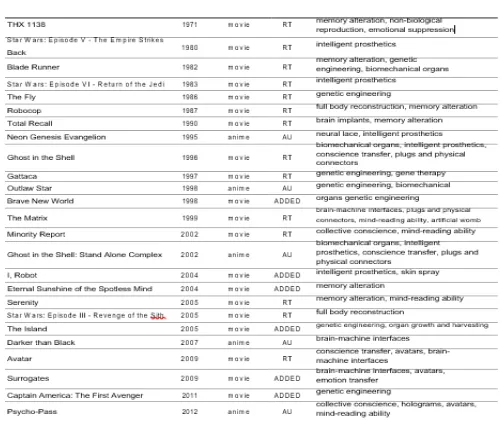
This was a straightforward step, based on what was seen in the movies and animes, or read in the plots’ synopsis. The filtering process relied mostly on the observation of the researcher, as most features were defined and subsequently registered; however, some of them relied on the researcher’s interpretation of whether a given aspect could be considered a modification in the scope of this work or an extrapolation of how some actions were possible in the movies from a scientific point of view. Hence, sometimes it was necessary to imply the existence of modifications such as brain-machine interfaces even though they were not explicitly mentioned. Some movies that were related to the body modifications found were added on the researcher’s discretion. They were deemed relevant and connected to the movies and animes extracted from the lists. This step yielded a table with 27 different types of modifications or technological influences that were relevant to the human concept and life experience. They are related to each science fiction work from where they were extracted
3.3 Comparing reality and fiction
5318 At this point, the main issues one aims to address is how far technology has come and whether there are any similar alternatives to those seen in the movies and animes. These alternatives might already be present in the real world or in the process of becoming a reality. Section 5 discusses weak signals and trends for the human body, connecting the fictional technological influences and the actual ones.
3.4 Foresight and prospections
Finally, having established a relation between reality and fiction from a technological point of view, the last aim of this article is to understand the repercussions of such modifications on the current society in several fields. In order to perform such an analysis, two methods were employed: Future Wheels and STEEP trend analysis.
The STEEP trend analysis is a technique used in this work to guide the foresight activity and the composition of the Future Wheels. STEEP stands for Social, Technological, Economical, Environmental, and Political (Garland, 2016) It is beneficial to define the scope of the changes and topics to be considered during the foresight activity, as this makes prospection more tangible and helps to focus during the data collection stage. There are modifications to the STEEP method, which may include other fields, such as Law (America, Rommes, & Obbink, 2004). However, in spite of having considered some repercussions from the legal point of view, the STEEP acronym was maintained in this article as it frequently surfaces in future studies reports, and the core purpose is the same.
The Future Wheels method is a form of relevance tree created by Jerome C. Glenn, and represents graphically direct and indirect future consequences of a trend or event (Glenn, 1972). An important development is placed in the center of the circle and 1st-order consequences are connected to it; subsequently, 2nd-order consequences are connected to the previous ones, forming a visual ripple effect of a change. Future Wheels also is a useful tool for structured brainstorming, determining needs, planning strategically, and building consensus (Watkins, West Meiers, & Visser, 2012). In this work, two main disruptions were chosen and different Wheels were build based on them. Although they were assembled based on the scenarios presented in the movies and animes investigated, all connections and
causal-consequence relations present are proposed by the researcher, constituting an analytical, creative job.
4. MOVIES AND ANIMES: COMMENTS
AND INSIGHTS
[image:5.612.331.508.452.695.2]The movies were divided into six groups according to their plots and the central themes addressed. Those groups are, alphabetically: Alien contact, Human modifications, Parallel realities, Space travel, Technological singularity, and Time travel. Of the initial 100 movies, only 18 have dealt with changes in the human body to some extent and are useful to this study. The same was done for the animes, but a certain treatment of the data had to be done – of the initial 30 animes, only 24 qualified. Seasons one and two 2 of both Ghost in the Shell and Code Geass (Kamiyama, 2002; Taniguchi, 2006) were included in the list as being distinct animes; their scores were added and the series ranking modified according to the new number of net upvotes. Four other anime series, after careful review of plot, list of characters, and list of episodes, were classified as being simply fiction, not science fiction, and therefore eliminated. Fig. 1 depicts the aggregate occurrences of movies and animes in each of the six categories. One must bear in mind that the classification was done according to the predominant theme, which does not mean that other issues are not addressed. The single exception is the case of human modifications. In this
5319 case, there is no need for it to be the central theme; if there is any example of modification in the film, it is already included in this category, according to what was explained in the methodology. In general, most movies and animes deal with space travel and spatial wars, parallel reality, presence or contact with extraterrestrial beings, and societies where technological singularity comes to reality. Although this last group has a great interface with the object of study of this work, of mechanizing humans, rarely do they approach the question of modifications in the human body at the same time, usually characterizing humans and robots as completely separate. Ideally, one would hope to identify in these works a continuum where humans, cyborg, androids, and robots would coexist and connect, producing complex scenarios and offering insights into each of these groups. This does not happen.
Different levels and kinds of body modification are present in each movie and anime, and many of them closely resemble technology we have already developed: e.g. medical prostheses, mechanical body members, bodily interventions and parts such as platinum plates and screws, pacemakers, artificial respirators, or other devices and machines that are primarily intended to reconstitute functions that are common in humans, but that may have been lost or not properly developed – in a word, the main objective of the technology we have now is rehabilitation. In this, there is no novelty or future study. Nonetheless, those are trends that must be observed and that can cause disruption when the modifications cease to be reactive and become proactive. This is a noteworthy discussion; these terms were not found in related literature, being employed on the researcher’s own discretion.
Reactive changes are those such as Anakin and Luke Skywalker's new arm or hand, after being lost in duels between Sith and Jedi in Star Wars II: Attack of the Clones and Star Wars V: The Empire Strikes Back, respectively (Kershner, 1980; Lucas, 2002). The intelligent biomechanical parts are installed because they needed to recover lost limbs.
Proactive changes are different. They take place due to the willingness to change, as it is often the case of current plastic surgery. In the most recent rendition of Ghost in the Shell, the character Batou chooses to replace his eyes with more powerful ones, with the ability to make thermal, infrared, and augmented readings. Another bystander character casually comments on choosing to switch his liver
to be able to ingesting more alcohol and party harder (Sanders, 2016). The motivation for reactive and proactive changes are different, and this may be what awaits humans in the next years.
Obviously, the space of reactive and proactive modifications is not discretized, but continuous. Changes may not be permanent, as in Pacific Rim (Toro, 2013), where a neural bridge allows mentally compatible humans to operate giant mechas and be cyborgs for some time, increasing their firepower and ability to defend the species, which is being targeted by extraterrestrial monsters. This change is transient and totally proactive, differently from Imperator Furiosa’s prosthetic arm in Mad Max: Fury Road (Miller, 2015). She does not have an arm, therefore her change was probably not proactive; however, she may remove the prosthetic limb whenever she pleases, as it is the case with many amputees who make use of prosthetics, making the change temporary. In the anime Darker than Black (Okamura, 2007), Mao, one of the main characters, lost his body but his brain was kept intact. He then refused cyborg bodies and chose to connect his brain to a network which allowed the free flow of information and a new way to experience life. This is reactive, because it was only done since he lost his body; but also proactive, as he did not try to recover what he lost, finding a way to modify his existence. The definitions of reactive and proactive changes are not simple and can be much further discussed.
5. REALITY OR FICTION
5320 were that occurrences found did not preserve the intended meaning, some terms are used in other fields and lost their characterization, or there were no relevant studies on the subject yet.
The paramount conclusion at this step is that, from a technological perspective, humanity is quite advanced. Even though there are major challenges in all fields, especially in genetic engineering, genome mapping, neuroscience, and brain functions understanding, plenty of weak signals were found demonstrating a real ability to create and manipulate organs and organic-like tissue, reconstructing body parts, building intelligent and sensitive prosthetic limbs and exoskeletons, using gene therapy, and working on neural laces and brain-machine interfaces. As a matter of fact, work on brain-machine interfaces have been fruitful for more than a decade, having started out with rhesus monkeys trials and prosthetic operations (Carmena et al., 2003). Research has become numerous, with highly cited and relevant works in the field of BMI (Andersen, Musallam, & Pesaran, 2004; Guenther et al., 2009; Lebedev, Crist, & Nicolelis, 2008; Nair, 2013; Ramos-Murguialday et al., 2013); but that is not the only one. Brain hacking and biohacking have already started to stir the scientific community (Bennett, Gilman, Stavrianakis, & Rabinow, 2009; Ienca & Haselager, n.d.; Koch, 2010), as well as artificial wombs, whose concept can be traced back to 1977 (Bulletti et al., 2011; Goldstein, 1977; Knight, 2002; Simonstein, 2006) and brain implants (Gilbert, 2015; Guttinger et al., 2005; Haik, Shear, Schroeder, Sabel, & Dunbar, 2000; Kimble, Bremiller, & Stickrod, 1986; Lindvall, 1989).
[image:7.612.318.569.89.300.2]What separates this research from Science Fiction is precisely the fact that most of these works are attempting to rehabilitate and restore lost common bodily function. Therefore, there is nothing new about BMI in itself; nevertheless, its application as Elon Musk and Neuralink envisions it, as a way for humans to be connected to the web and able to compete with AI, improving their cognitive abilities, is a proactive change. This shows the relevance of studying reactive and proactive changes as a key to modifications to the human body in the future.
Table 1. Study of body modifications that were present in each one of the Science Fiction works investigated. RT listed movies came from Rotten Tomatoes; AU listed from Anime Underground; and ADDED were deemed relevant and related to works already in the list and included by the researcher
.
Table 2. Summary of all perceived modifications, without repetitions and ordered alphabetically
5321
6. POSSIBLE FUTURES
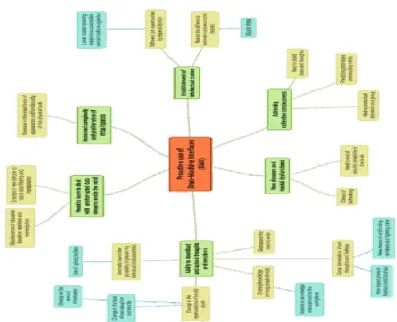
After exploring the technological possibilities and state-of-the-art, the next and final step is to study future possibilities and repercussions that may arise from these changes. Two main events were chosen by the researcher as being of paramount importance for triggering the most significant future consequences. Those were (i) the creation of BMIs (Brain-Machine Interfaces), as they might take the human consciousness to a new level and radically change the way one perceives and experiences the world; and (ii) the substitution of organic components, as this blurs the differences among humans, cyborgs, androids, and robots, possibly prompting a new way of organizing society, law and the relationship one has with one’s own body. Figures 1 and 2 depict the Future Wheels for events (i) and (ii), respectively. They were not organized precisely as circles, as well as the figure itself was rotated, both for the sake of readability and fitting the document format.
6.1 Creation on BMIs
Fig. 2 presents the future wheels in which the core event is the proactive use of BMIs. The first order – or direct – consequences raised were (i) the establishment of new intellectual castes; (ii) the need to learn to deal with uninterrupted data streams flowing through the brain; (iii) the increased complexity and proliferation of virtual spaces; (iv) the ability to download and upload thoughts, information and emotions;
(v) the occurrence of new diseases and mental dysfunctions; and (vi) the achievement of a collective consciousness. The establishment of castes is seen in PsychoPass, Blade Runner, THX1138, and Minority Report. Different job opportunities with different civil rights and pay ensue, probably augmenting the gap between socioeconomic classes. Lower castes, that cannot afford a brain upgrade, may be modified by higher-caste employers, who can use that to accomplish tasks or business agendas.
In a world where the flow of information is uninterrupted, there will be the need for humans to learn to deal with the constant noise in their brains. Traditional school systems, based on memorization and repetition, whose model is already outdated, will be obsolete; instead, new schools will be created, and teach how to better filter, tune in and out, and manipulate the available data, as seen in multiple instances of as shown in all instances of
Ghost in the Shell works. This new way to use the brain will make it susceptible to new diseases and mental dysfunctions, as it has already started to happen with patients who undergo surgery for Deep Brain Stimulation (Park et al., 2011). The brain, connected to networks and using software, will be a probable target of biohackers, who could steal information, knowledge, or perhaps even alter memories, as it happens in Blade Runner 2049, Robocop (1987 and 2014), and Inception. New security systems, with brain firewalls, would be set up in every new modified brain, as seen in the new version of the movie Ghost in the Shell (2016). A BMI could make it possible to download and upload thoughts and emotions. Being able to preserve an individual consciousness outside their organic brain might be the key for immortality, as seen in Darker than Black. This will cause a shift in the perception and definition of death, changing laws concerning inheritance, and the very definitions of murder or manslaughter, as well as provide new means to investigate crimes, as seen in Ghost in the Sheel: Stand Alone Complex.
5322
Fig. 2. Future wheels where the core event in orange is the proactive use of BMIs . In green, there are first-order consequences; in yellow, second-order consequences; and in blue, fourth-order consequences.
body. On the bright side, sharing knowledge would be much simpler, as suggested in Ender’s Game, Ghost in the Shell (1995), and Robocop (2014). Finally, if all brains are connected in a single network, there is the possibility of achieving a collective consciousness, as seen in Psycho-Pass and Minority Report. That would trigger privacy issues, as it would be possible to know a person’s intent of even read their minds; consequently, there would be a need to protect ideas and thoughts – not only the personal and emotional ones, but also business secrets, future patents and any other thought whose disclosure is time-
sensitive or capable of generating profit. It would become increasingly challenging to separate individual from group intelligence and consciousness, as decisions would be made collectively.
6.2 Substitution of organic components
5323 memories, especially at a point in time where the brain is more deeply known and mapped (Gondry, 2004). Finally, this substitution of body parts may become similar to an iPhone or Samsung Galaxy S, where new, periodic upgrades might become available for purchasing and improving one’s abilities. At the same time, as human body parts become obsolete, android robots will likely follow a similar trend (Proyas, 2004; Spielberg, 2001). This unfolds other types of consequences that, for simplicity sake, will not be considered in this future wheel, as they are more related to robot humanization than organic part substitution per se.
Improving abilities is a whole new path, as it will be possible to build bodies that are optimized for specific functions, as it is the case with this runner, whose new legs spurred controversy in the London 2012 Olympics (Mark Phillips, 2012), or with RoboCop (Padilha, 2014; Verhoeven, 1987). A performance industry could arise, similar to the current aesthetics one, and job positions could be open with specific cyborgs and modifications in mind (Kamiyama, 2002). The aesthetics industry would also change, and probably become even more relevant. The creation of new transplant and plastic surgery techniques could make, for example, legs longer, or permanently change one’s eye color. The fashion industry would also be impacted, being able to create new beauty standards and fashion concepts beyond garments, such as colorful or patterned skin, for instance (Sanders, 2016). Substituting organic parts implies being able to create artificial ones, such as 3D-printed organs, which are already a reality for many startups (Krassenstein, 2015; Sher, 2015). These would modify the organ trafficking market, implying that changes in the Law would have to be made to allow selling organs. Prices could differ dramatically between an organic option versus an improved, but artificial one, and it is not possible to tell which factor would be preponderant. The wait lines for organ transplants could be drastically reduced if these organs are produced and sold widely.
The acceptance of artificial parts could make humans opt for reproducing non-biologically, but through genetic engineering and assembling of biomechanical components as it is the case with the character Harry from the Outlaw Star anime (Hongo, 1998). Even if beings are created more traditionally, through in vitro fertilization, which is nothing new, artificial wombs could become increasingly ubiquitous, ending the need for pregnancies. Recent developments have allowed for complete gestation
periods of a calf during 2017 in an artificial womb, similar to the ones seen in The Matrix and Blade Runner 2049 (Dvorsky, 2017; Knight, 2002; Villeneuve, 2017; Wachowski & Wachowski, 1999). This would imply changing Laws concerning families and inheritance, as well as observing modifications in human relationships and the value placed in blood ties, which are intrinsic to many cultures. At the end, it would be natural to question the definition of humanity and human being. It would be crucial to understand what it means to be human. Some Science Fiction works establish the ability to feel as a humanizing feature (Banks, 1987). On the other hand, the approaching technological singularity might make humans wary of granting human status and rights to robots and AIs, and an upgrade in the definition of human rights would be necessary, as seen in Blade Runner or I, Robot (Proyas, 2004; Scott, 1982).
Several other consequences could be listed, from the first order onwards to the more indirect effects. The main goal, however, is to use these scenarios to devise normative action plans. These are considered out of the scope of this article at the moment. The main purpose of the present work is to list and connect possible consequences of imminent technological advancements that shift traditional social arrangements, as well as fuel the preemptive discussions of such themes.
7. CONCLUTION
5324
REFRENCES:
[1] America, P., Rommes, E., & Obbink, H. (2004). Multi-view Variation Modeling for Scenario Analysis (pp. 44–65). Springer, Berlin, Heidelberg. https://doi.org/10.1007/978-3-540-24667-1_5
[2] Andersen, R. A., Musallam, S., & Pesaran, B. (2004). Selecting the signals for a brain– machine interface. Current Opinion in Neurobiology,14(6),720–726.
https://doi.org/10.1016/J.CONB.2004.10.005
[3] Astor, M. (2017, July 25). Microchip Implants for Employees? One Company Says Yes. The New York Times. Retrieved from https://www.nytimes.com/2017/07/25/technolog
y/microchips-wisconsin-company-employees.html
[4] Banks, I. M. (1987). Consider Phlebas. (MacMillan, Ed.).
[5] Bennett, G., Gilman, N., Stavrianakis, A., & Rabinow, P. (2009). From synthetic biology to biohacking: are we prepared? Nature Biotechnology, 27(12), 1109–1111. https://doi.org/10.1038/nbt1209-1109
[6] Blascovich, J., Loomis, J., Beall, A. C., Swinth, K. R., Hoyt, C. L., & Bailenson, J. N. (2002). Immersive Virtual Environment Technology as a Methodological Tool for Social Psychology. Psychological Inquiry, 13(2), 103–124. https://doi.org/10.1207/S15327965PLI1302_01 [7] Blomkamp, N. (2013). Elysium.
[8] Bulletti, C., Palagiano, A., Pace, C., Cerni, A., Borini, A., & de Ziegler, D. (2011). The artificial womb. Annals of the New York Academy of Sciences, 1221(1), 124–128.
https://doi.org/10.1111/j.1749-6632.2011.05999.x
[9] Carmena, J. M., Lebedev, M. A., Crist, R. E., O’Doherty, J. E., Santucci, D. M., Dimitrov, D. F.,Nicolelis, M. A. L. (2003). Learning to Control a Brain–Machine Interface for Reaching and Grasping by Primates. PLoS Biology, 1(2), e42. https://doi.org/10.1371/journal.pbio.0000042 [10] Carvalko, J. (2012). The Techno-human
Shell-A Jump in the Evolutionary Gap. Sunbury Press.
[11] Clynes, M., & Kline, N. (1960). Cyborgs and space. Astronautics, (September), 26–27, 74– 75.
[12] Dvorsky, G. (2017). The Most Futuristic Predictions That Came True in 2017. Retrieved
from https://gizmodo.com/the-most-futuristic-
predictions-that-came-true-in-2017-1821226186/amp
[13] Figueiredo, L. S., Pinheiro, M. G. M., Vilar Neto, E. X. C., & Teichrieb, V. (2015). An open catalog of hand gestures from Sci-Fi movies. Conference on Human Factors in Computing Systems - Proceedings, 18, 1319–1324. https://doi.org/10.1145/2702613.2732888 [14] Garland, E. (2016). How to use STEEP trend
analysis for business strategy. Medium. Retrieved from https://medium.com/@ericgarland/how-to-use- steep-trend-analysis-for-business-strategy-52e3656b17f9
[15] Gilbert, F. (2015). A Threat to Autonomy? The Intrusion of Predictive Brain Implants. AJOB Neuroscience, 6(4), 4–11. https://doi.org/10.1080/21507740.2015.107608 7
[16] Glenn, J. C. (1972). Futurizing Teaching vs Futures Course. Social Science Record, 9(3). [17] Goldstein, M. A. (1977). Choice Rights and
Abortion: The Begetting Choice Right and State Obstacles to Choice in Light of Artificial Womb Technology. Southern California Law Review, 51. Retrieved from http://heinonline.org/HOL/Page?handle=hein.jo urnals/scal51&id=893&div=&collection= [18] Gondry, M. (2004). Eternal Sunshine of the
Spotless Mind.
[19] Guenther, F. H., Brumberg, J. S., Wright, E. J., Nieto-Castanon, A., Tourville, J. A., Panko, M., Kennedy, P. R. (2009). A Wireless Brain-Machine Interface for Real-Time Speech Synthesis. PLoS ONE, 4(12), e8218. https://doi.org/10.1371/journal.pone.0008218 [20] Guttinger, M., Fedele, D., Koch, P., Padrun, V.,
Pralong, W. F., Brustle, O., & Boison, D. (2005). Suppression of Kindled Seizures by Paracrine Adenosine Release from Stem Cell-Derived Brain Implants. Epilepsia, 46(8), 1162– 1169. https://doi.org/10.1111/j.1528-1167.2005.61804.x
5325 [23] Ienca, M., & Haselager, P. (n.d.). Hacking the
brain: brain–computer interfacing technology and the ethics of neurosecurity. Ethics and Information Technology, 18. https://doi.org/10.1007/s10676-016-9398-9 [24] Kamiyama, K. (2002). Ghost in the Shell: Stand
Alone Complex.
[25] Kershner, I. (1980). Star Wars: Episode V - The Empire Strikes Back.
[26] Kimble, D. P., Bremiller, R., & Stickrod, G. (1986). Fetal brain implants improve maze performance in hippocampal-lesioned rats. Brain Research, 363(2), 358–363. https://doi.org/10.1016/0006-8993(86)91023-1 [27] Knight, J. (2002). Artificial wombs: An out of
body experience. Nature, 419(6903), 106–107. https://doi.org/10.1038/419106a
[28] Koch, C. (2010). A smart vision of brain hacking. Nature, 467(7311), 32–32. https://doi.org/10.1038/467032b
[29] Krassenstein, B. (2015). 11 Companies Leading the 3D Bioprinting Space |. Retrieved December 18, 2017, from https://3dprint.com/88792/3d-bioprinting-companies/
[30] Lebedev, M. A., Crist, R. E., & Nicolelis, M. A. L. (2008). Building Brain–Machine Interfaces to Restore Neurological Functions. Methods for Neural Ensemble Recordings. Retrieved from http://www.ncbi.nlm.nih.gov/pubmed/21204440 [31] Libman, L., & Williams, L. (1998). Brave New
World.
[32] Lindvall, O. (1989). Transplantation into the human brain: present status and future possibilities. Journal of Neurology, Neurosurgery, and Psychiatry, Suppl(Suppl), 39–54. Retrieved from http://www.ncbi.nlm.nih.gov/pubmed/2666578 [33] Lucas, G. (2002). Star Wars: Episode II –
Attack of the Clones.
[34] Mark Phillips. (2012). “Blade Runner”s’ artificial legs controversial at Olympics. CBS News.Retrieved from https://www.youtube.com/watch?v=lSGBwUEc M6c
[35] Martins, A., & Rincon, P. (2014). Paraplegic in robotic suit kicks off World Cup. BBC News. Retrieved from
http://www.bbc.com/news/science-environment-27812218
[36] Masamune, S. (1989). Ghost in the Shell. (Kodansha, Ed.).
[37] McCormick, R. (2015, June 30). Mark Zuckerberg says we’ll be able to send emotions to each other soon. The Verge. Retrieved from https://www.theverge.com/platform/amp/2015/6 /30/8873819/mark-zuckerberg-facebook-sending-emotions-soon
[38]. McCreery, M. P., Kathleen Krach, S., Schrader, P. G., & Boone, R. (2012). Defining the virtual self: Personality, behavior, and the psychology of embodiment. Computers in Human Behavior, 28(3), 976– 983. https://doi.org/10.1016/J.CHB.2011.12.019 [39] Miller, G. (2015). Mad Max: Fury Road. [40] Nair, P. (2013). Brain-machine interface.
Proceedings of the National Academy of Sciences of the United States of America, 110(46), 18343. https://doi.org/10.1073/pnas.1319310110 [41] National Institute of Neurological Disorders and
Stroke. (n.d.). Deep Brain Stimulation for Parkinson’s Disease Information Page | National Institute of Neurological Disorders and Stroke. Retrieved December 20, 2017, from https://www.ninds.nih.gov/Disorders/All- Disorders/Deep-Brain-Stimulation-Parkinsons-Disease-Information-Page
[42] Newitz, A. (2017, March 27). Elon Musk is setting up a company that will link brains and computers |Ars Technica. Ars Technica. Retrieved from
https://arstechnica.com/information- technology/2017/03/elon-musk-is-setting-up-a-company-that-will-link-brains-and-computers/ [43] Niccol, A. (1997). Gattaca.
[44] Okamura, T. (2007). Darker than Black. [45] Padilha, J. (2014). RoboCop.
[46] Park, J. H., Chung, S. J., Lee, C. S., & Jeon, S. R. (2011). Analysis of hemorrhagic risk factors during deep brain stimulation surgery for movement disorders: comparison of the circumferential paired and multiple electrode insertion methods. Acta Neurochirurgica, 153(8), 1573–1578. https://doi.org/10.1007/s00701-011-0997-2 [47] Proyas, A. (2004). I, Robot.
5326 [49] Sanders, R. (2016). Ghost in the Shell.
[50] Schmitz, M., Endres, C., & Butz, A. (2008). A Survey of Human-Computer Interaction Design in Science Fiction Movies. Proceedings of the 2nd International Conference on INtelligent TEchnologies for Interactive enterTAINment, 1–10.
https://doi.org/10.4108/ICST.INTETAIN2008.2 476
[51] Scott, R. (1982). Blade Runner.
[52] Shedroff, N., & Noessel, C. (2012). Make It So: Interaction Design Lessons from Science Fiction. Rosenfeld Media.