R E V I E W
Open Access
Genomic approaches for studying crop
evolution
Mona Schreiber
1, Nils Stein
1and Martin Mascher
1,2*Abstract
Understanding how crop plants evolved from their wild
relatives and spread around the world can inform about
the origins of agriculture. Here, we review how the rapid
development of genomic resources and tools has made
it possible to conduct genetic mapping and population
genetic studies to unravel the molecular underpinnings
of domestication and crop evolution in diverse crop
species. We propose three future avenues for the study
of crop evolution: establishment of high-quality
reference genomes for crops and their wild relatives;
genomic characterization of germplasm collections;
and the adoption of novel methodologies such as
archaeogenetics, epigenomics, and genome editing.
Introduction
Since the Neolithic, humans have domesticated a large
number of different plant species to create a reliable
source of nutrition for themselves and their domestic
animals. Crop plants comprise a large variety of species
from diverse taxa that differ in habitat, growth habit,
and life cycle, such as annual grasses, perennial trees,
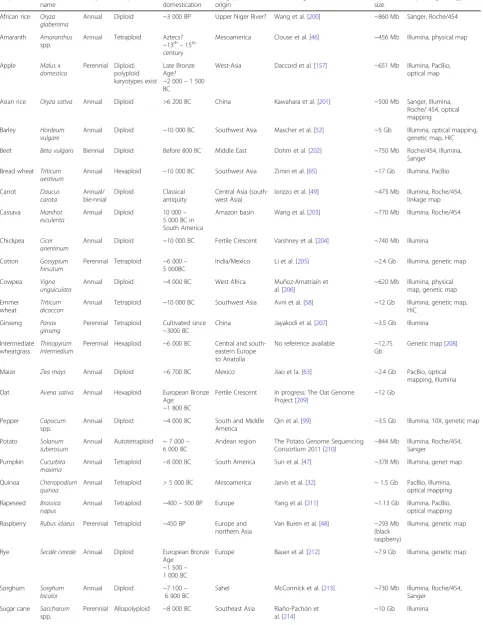
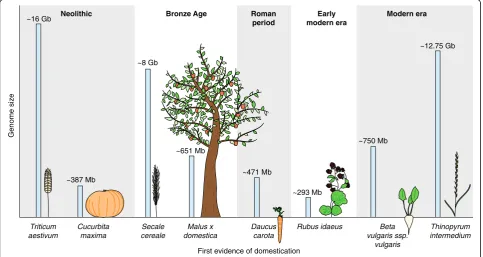
and medicinal herbs (Table
1
, Fig.
1
). However,
world-wide crop production is dominated by a few major
crops, such as wheat, rice, maize, potato, sugar cane, and
soybean [
1
], that serve globally as staples for human and
animal nutrition. By contrast, minor crops can be
broadly defined as a non-homogeneous group
compris-ing staple crops traditionally only of regional
import-ance, such as quinoa, teff, and African rice; or crops of
world-wide importance but comparatively little
contri-bution to human food consumption such as nuts or
small fruits. Active research and breeding communities
exist for almost every crop plant; however, research into
* Correspondence:[email protected]
1Leibniz Institute of Plant Genetics and Crop Plant Research (IPK)
Gatersleben, Corrensstraße 3, 06466 Seeland, Germany
2German Centre for Integrative Biodiversity Research (iDiv) Halle-Jena-Leipzig,
Deutscher Platz 5e, 04103 Leipzig, Germany
the molecular genetics of domestication has focused
mainly on the major crops [
2
].
Crop domestication has been studied for more than
a century and benefited recently from technological
innovations in genomics. Comparative analysis of
population genomic data of large samples of current
and past varieties of crops together with their wild
progenitors provides insight into the domestication
history of species [
3
,
4
], for example, (i) when and
where domestication occurred, (ii) how the
domesti-cates spread to new habitats and which genetic
changes accompanied this transition, and (iii) whether
gene flow has occurred between the crops and wild
relatives. A synthesis of archaeological and population
genetic data evidence indicated that the initial stages
of domestication in Southwest Asia should be
consid-ered a protracted process [
5
,
6
] rather than a rapid
evolution of cultivated plants as presumed previously
[
7
–
9
]. The
“
democratization
”
of genomics [
10
,
11
] has
now opened new avenues for understanding the
gen-etic consequences of domestication in a much wider
range of species from different centers of origin such
as Mesoamerica and Africa.
Much has been written on plant domestication.
Re-cent review articles have focused on convergent
phenotypic evolution [
12
], causative mutations
affect-ing phenotypic variation [
13
,
14
], the effect of gene
functions on crop adaptation and selection
mecha-nisms [
15
], the reduction of genetic diversity and the
influence of epigenetic modifications [
16
], the impact
of genomic methods in future crop improvement [
17
],
the value of crop wild relatives [
18
], sequencing
an-cient plant DNA [
19
,
20
], and general concepts in
plant domestication research [
21
–
23
]. Here, we focus
on the assembly of reference genome sequences for
domesticated plants and their wild relatives; surveying
sequence diversity in large diversity panels; and the
application of novel approaches such as epigenomics,
archaeogenetics, and genome editing to plant
domesti-cation research.
© The Author(s). 2018Open AccessThis article is distributed under the terms of the Creative Commons Attribution 4.0
Table 1
Examples of domesticated crops with domestication origin, available reference genomes and sequencing strategies.
Crop Botanicalname
Lifecycle Ploidy level Time of domestication
Geographical origin
Reference genome Genome size
Sequencing strategy
African rice Oryza glaberrima
Annual Diploid ~3 000 BP Upper Niger River? Wang et al. [200] ~860 Mb Sanger, Roche/454
Amaranth Amaranthus spp.
Annual Tetraploid Aztecs? ~13th–
15th century
Mesoamerica Clouse et al. [46] ~456 Mb Illumina, physical map
Apple Malusx domestica
Perennial Diploid; polyploid karyotypes exist
Late Bronze Age? ~2 000–1 500 BC
West-Asia Daccord et al. [157] ~651 Mb Illumina, PacBio, optical map
Asian rice Oryza sativa Annual Diploid >6 200 BC China Kawahara et al. [201] ~500 Mb Sanger, Illumina, Roche/ 454, optical mapping
Barley Hordeum vulgare
Annual Diploid ~10 000 BC Southwest Asia Mascher et al. [52] ~5 Gb Illumina, optical mapping, genetic map, HiC
Beet Beta vulgaris Biennial Diploid Before 800 BC Middle East Dohm et al. [202] ~750 Mb Roche/454, Illumina, Sanger
Bread wheat Triticum aestivum
Annual Hexaploid ~10 000 BC Southwest Asia Zimin et al. [65] ~17 Gb Illumina, PacBio
Carrot Daucus carota
Annual/ bie-nnial
Diploid Classical antiquity
Central Asia (south-west Asia)
Iorizzo et al. [49] ~473 Mb Illumina, Roche/454, linkage map
Cassava Manihot esculenta
Annual Diploid 10 000– 5 000 BC in South America
Amazon basin Wang et al. [203] ~770 Mb Illumina, Roche/454
Chickpea Cicer arientinum
Annual Diploid ~10 000 BC Fertile Crescent Varshney et al. [204] ~740 Mb Illumina
Cotton Gossypium hirsutum
Perennial Tetraploid ~6 000– 5 000BC
India/Mexico Li et al. [205] ~2.4 Gb Illumina, genetic map
Cowpea Vigna unguiculata
Annual Diploid ~4 000 BC West Africa Muñoz-Amatriaín et al. [206]
~620 Mb Illumina, physical map, genetic map
Emmer wheat
Triticum dicoccon
Annual Tetraploid ~10 000 BC Southwest Asia Avni et al. [58] ~12 Gb Illumina, genetic map, HiC
Ginseng Panax ginseng
Perennial Tetraploid Cultivated since ~3000 BC
China Jayakodi et al. [207] ~3.5 Gb Illumina
Intermediate wheatgrass
Thinopyrum intermedium
Perennial Hexaploid ~6 000 BC Central and south-eastern Europe to Anatolia
No reference available ~12.75 Gb
Genetic map [208]
Maize Zea mays Annual Diploid ~6 700 BC Mexico Jiao et la. [63] ~2.4 Gb PacBio, optical mapping, Illumina
Oat Avena sativa Annual Hexaploid European Bronze Age
~1 800 BC
Fertile Crescent In progress: The Oat Genome Project [209]
~12 Gb
Pepper Capsicum spp.
Annual Diploid ~4 000 BC South and Middle America
Qin et al. [99] ~3.5 Gb Illumina, 10X, genetic map
Potato Solanum tuberosum
Annual Autotetraploid ~ 7 000– 6 000 BC
Andean region The Potato Genome Sequencing Consortium 2011 [210]
~844 Mb Illumina, Roche/454, Sanger
Pumpkin Cucurbita maxima
Annual Tetraploid ~8 000 BC South America Sun et al. [47] ~378 Mb Illumina, genet map
Quinoa Chenopodium quinoa
Annual Tetraploid > 5 000 BC Mesoamerica Jarvis et al. [32] ~ 1.5 Gb PacBio, Illumina, optical mapping
Rapeseed Brassica napus
Annual Tetraploid ~400–500 BP Europe Yang et al. [211] ~1.13 Gb Illumina, PacBio, optical mapping
Raspberry Rubus idaeus Perennial Tetraploid ~450 BP Europe and northern Asia
Van Buren et al. [48] ~293 Mb (black raspberry)
Illumina, genetic map
Rye Secale cereale Annual Diploid European Bronze Age
~1 500– 1 000 BC
Europe Bauer et al. [212] ~7.9 Gb Illumina, genetic map
Sorghum Sorghum bicolor
Annual Diploid ~7 100– 6 900 BC
Sahel McCormick et al. [213] ~730 Mb Illumina, Roche/454, Sanger
Sugar cane Saccharum spp.
Perennial Allopolyploid ~8 000 BC Southeast Asia Riaño-Pachón et al. [214]
High-quality reference sequence assemblies for
crops and their wild relatives
Extant crop wild relatives are excellent tools to
under-stand crop evolution and as sources of novel allelic
di-versity for future crop improvement [
24
,
25
]. The wild
gene pool of a crop includes its wild progenitor species,
with which it is often fully interfertile, and species from
the same or closely related genera that can differ greatly
in divergence times and interfertility with the crop [
26
].
An unbiased assessment of genetic diversity in distantly
related taxa using the single reference genome sequence
of the domesticate is complicated by sequence
diver-gence, which prevents the alignment of short reads,
es-pecially in non-coding regions. Comparison of short
reads to a single reference will also not reveal structural
variants such as chromosomal inversions and
transloca-tions. Thus, reference genome sequence assemblies of
crop wild relatives are important tools to understand
do-mestication history.
Genome sequencing and assembly have been applied
to many different species for decades. In the context of
plant domestication research, genomic resources such as
high-quality reference genome sequences of crops and
their wild relatives, but also dense genetic and physical
maps, have provided the infrastructure for the genetic
mapping of loci underlying key domestication traits [
27
,
[image:3.595.57.539.111.180.2]28
] and their subsequent isolation by map-based cloning
[
29
–
32
]. Genome sequence assemblies serve as common
references for the alignment of resequencing data from
diversity panels comprising crops and their wild
progeni-tors [
33
,
34
], thus underpinning genome scans for
phenotypic associations and for targets of selection
under domestication [
3
,
35
]. In the past, the large size,
repeat-rich structure and polyploid nature of many crop
genomes have been major impediments to the
construc-tion of contiguous sequence assemblies [
36
]. Here, we
summarize recent developments in sequencing
technol-ogy and computational methods that have contributed
Table 1
Examples of domesticated crops with domestication origin, available reference genomes and sequencing strategies.
(Continued)
Crop Botanical name
Lifecycle Ploidy level Time of domestication
Geographical origin
Reference genome Genome size
Sequencing strategy
Sunflower Helianthus annuus
Annual Diploid ~6 000 BC Eastern North America
Badouin et al. [215] ~3.6 Gb PacBio, genetic map
Tomato Solanum lycopersicum
Annual Diploid Before 15th century
Andean region The Tomato Genome Sequencing Consortium 2012 [216]
~900 Mb Roche/454, Illumina
Triticum aestivum
~16 Gb Neolithic
Genome size
First evidence of domestication Bronze Age Roman
period
Early modern era
Modern era
~387 Mb
~8 Gb
~651 Mb
~471 Mb
Cucurbita maxima
Secale cereale
Malus x domestica
Daucus carota
Rubus idaeus Beta
vulgaris ssp. vulgaris
Thinopyrum intermedium
~293 Mb
~750 Mb
~12.75 Gb
[image:3.595.57.541.458.715.2]to overcoming these long-standing obstacles; provide
re-cent examples for the construction of high-quality
refer-ence for crops and their wild relatives; and outline
future directions.
The traditional approach of laborious and
time-consuming Sanger sequencing along a minimum tiling
path of bacterial artificial chromosomes (BACs) [
37
]
has been attempted for only a few crops with small
genomes such as rice [
38
] or crops of the highest
eco-nomic importance—and commensurate research
fund-ing—such as maize [
39
], wheat [
40
], and barley [
41
].
In the latter two species, progress in sequencing and
genome mapping technologies has prompted the
re-spective international sequencing consortia that set
out years ago with physical map construction to revise
their strategy by adopting short-read sequencing [
42
,
43
]. Wet-lab protocols and computational methods for
genome sequence assembly using short Illumina reads
were established about a decade ago [
44
,
45
]. The
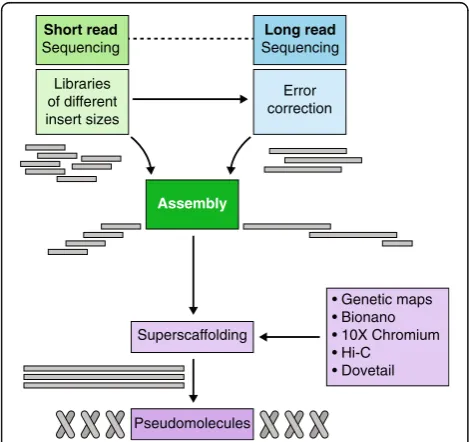
gen-eral approach of genome sequence assembly is shown
in Fig.
2
and can be summarized as follows: (i) contig
assembly from deep-coverage paired-end reads; (ii)
scaffolding with mate-pair information; (iii) filling of
sequence gaps introduced in this step; and (iv)
high-level ordering of sequence scaffolds into
so-called pseudomolecules as representatives of entire
chromosomes (‘superscaffolding’). A large number of
crop plant genomes have been sequenced using this
method, including minor crops such as amaranth [
46
],
pumpkin [
47
], raspberry [
48
], and carrot [
49
]. Genome
as-semblies for 12 species in the genus
Oryza
, i.e., wild and
domesticated rice, and an outgroup species (
Leersia
perrieri
) provided a comprehensive overview of structural
genome evolution, thus contributing to the overarching
aim of the International Oryza Map Alignment Project to
establish genus-wide comparative genomics to discover
genes for crop improvement [
50
].
In the large-genome cereals wheat, barley, and rye,
short-read sequencing has been widely adopted to
com-pile complementary datasets for higher-order scaffolding
such as linkage maps [
51
,
52
], physical maps [
53
], and
chromosome-specific sequences [
54
]. However, strong
reservations persisted against performing initial contig
assembly with short reads only. This skepticism was
vin-dicated by the mixed success of initial efforts in wheat
and barley. The gene space was reasonably complete and
approximately ordered along the genome with the help
of genetic and physical maps; however, sequence
contiguity was on the kilobase-scale and the repetitive
portion of the genome was severely underrepresented
[
55
–
57
]. Until recently, researchers were unwilling to
take the risk of amassing the large amount of sequences
required for short-read assembly of multi-gigabase crop
genomes without a proven strategy for assembling them.
In an eye-opening study, Avni et al. [
58
] constructed a
chromosome-scale assembly of the genome of tetraploid
wild emmer (genome size 10 Gb) from very deep
Illu-mina sequencing data from multiple paired-end,
mate-pair libraries and chromosome-conformation capture
sequencing data, thus establishing a precedent for the
construction of a high-quality sequence assembly of a
repeat-rich polyploid plant genome [
59
]. Several factors
contributed to the feasibility and success of their
ap-proach, such as improved library construction methods
ensuring uniform genome representation [
60
] and
in-creases in throughput and read length of the Illumina
platform (2 × 250 bp) accompanied by decreases in
se-quencing costs. One important caveat of the work by
Avni et al. [
58
] is that the software used to construct
se-quence scaffolds with megabase-scale contiguity is the
trade secret of a commercial service provider, NRGene.
Open-source alternatives for Illumina-only sequence
as-sembly exist and their results exceed asas-sembly metrics
of previous efforts by an order of magnitude [
61
], but
they have not yet achieved the contiguity of the wild
emmer assembly.
Long reads (> 10 kb) from the PacBio or Oxford
Nanopore platforms are two orders of magnitude longer
than Illumina reads (100
–
300 bp) but have reduced
sequence accuracy [
62
]. Recently, PacBio sequencing
was used to construct a new version of the maize
refer-ence genome [
63
], which achieved a higher contiguity
and better genome representation than the previous
AssemblySuperscaffolding
Pseudomolecules Libraries
of different insert sizes
Error correction
• Genetic maps • Bionano • 10X Chromium • Hi-C
• Dovetail Short read
Sequencing
Long read Sequencing
[image:4.595.56.291.453.674.2]BAC-by-BAC assembly [
39
] and corrected many errors
in the order and orientation of sequence contigs of its
predecessor. Schmidt et al. [
64
] used Oxford Nanopore
data to assemble the genome sequence of the tomato
wild relative
Solanum pennellii
(genome size ~ 1 Gb).
The resultant sequence scaffolds were highly contiguous
(N50 2.5 Mb) but required correction with
supplemen-tary Illumina reads to increase accuracy at the single
nucleotide level. Similarly, Zimin et al. [
65
] used a
com-bination of PacBio and Illumina data to reconstruct the
genome sequences of hexaploid bread wheat and its
dip-loid progenitor
Aegilops tauschii
[
66
]. The N50 values of
these assemblies are in the range of several hundred
kilobases, which confirms that long-read sequences can
produce better assembly than short-read technology
even in the most complex genomes, but also highlights
the necessity of obtaining short-read sequences for error
correction and complementary mid- and long-range
information to achieve chromosome-scale contiguity.
Another important drawback of using inaccurate long
reads are the immense computational requirements of
the assembly process (> 100,000 CPU hours for bread
wheat [
65
]).
Until recently, there was a
‘contiguity gap’
in the
assembly of complex plant genomes. The contiguity of
sequence assemblies was limited to kilobase-sized
con-tigs, but conventional methods for higher-order
scaffold-ing and assembly validation such as genetic mappscaffold-ing
[
67
,
68
], cytogenetic methods [
69
,
70
], BAC-based
phys-ical mapping [
53
,
71
], or radiation hybrid mapping [
72
]
are effective only at the scale of megabases. Moreover,
these techniques are time-consuming and require
resources that are difficult or sometimes impossible to
generate (e.g., genetic maps in asexual organisms).
Methodology has improved dramatically over the past 3
years. Deep-coverage short-read sequencing of
paired-end and mate-pair can now deliver contigs of
megabase-scale contiguity in complex plant genomes. Furthermore,
a plethora of methods
—
many of them employing
Illu-mina sequencing—has been developed to validate,
correct, and improve initial sequence assembly from
ei-ther long or short reads (Fig.
2
). Among the first of these
was optical mapping, a method that measures the
dis-tances of fluorescently labeled nicking sites in linearized
long DNA molecules to construct megabase-scale
con-tigs composed of molecules with matching labeling
pat-terns [
73
]. Optical mapping on the Bionano platform
has been used for scaffolding the PacBio assembly of the
maize genome [
63
] and for higher-order scaffolding of
BAC-based or chromosome-specific assemblies in wheat,
barley, and tetraploid finger millet [
42
,
74
,
75
].
One of the limitations of the current Bionano platform
is the need for input assemblies of high contiguity so
that sequence scaffolds comprise a sufficient number of
label sites to confidently align sequence assembly and
optical map. Technologies based on Illumina short-read
sequencing can better control data density by increasing
sequencing depth. One of these, the Chromium 10X
platform, employs a microfluidic device to create
so-called
‘
linked reads
’
, which incorporate short barcode
sequences that are shared by reads originating from the
same high-molecular weight DNA fragment [
76
].
Chro-mium reads serve as mid-range linkage information in a
similar manner as mate-pair reads or BAC end sequences,
but with the added value of longer span size (> 50 kb) and
multiple linked short reads that support connections
be-tween sequence scaffolds to effectively bridge repetitive
re-gions [
77
]. Intriguingly, deeply sequenced 10X libraries
can be used on their own for genome assembly. After
stripping of the barcode from the reads, 10X chromium
data can play the role of short-read sequences for
assem-bling by contigs, which are subsequently scaffolded by
le-veraging information on the molecular origin of reads
[
78
]. Hulse-Kemp et al. [
79
] used this approach to
assem-ble the genome sequence of bell pepper (
Capsicum
annum
) and achieved a scaffold N50 of 3.7 Mb.
Arguably, the most disruptive technology in recent
assembly for genome mapping has been chromosome
conformation capture sequencing (Hi-C). Hi-C was
ori-ginally developed as a method to assay genome-wide
chromatin contact probabilities [
80
], but it was soon
realized that the linkage information afforded by
chro-matin proximity can be effectively used for scaffolding
fragmented genome assemblies to chromosome-scale
contiguity [
81
,
82
]. In addition to ordering and orienting
scaffolds, Hi-C can also effectively detect misassemblies.
Chromatin contact probabilities between pairs of loci are
strongly correlated to their distance in the linear genome
[
42
,
80
,
83
]. Thus, the likely cause for any strong
devia-tions from the expected rate of distance-dependent
decay of contact probabilities are misassemblies [
84
].
Hi-C mapping made it possible to order sequence
scaf-folds in the large (> 300 Mb) non-recombining proximal
regions of the barley [
42
] and tetraploid wheat [
58
]
ge-nomes, for which the construction of high-resolution
molecular marker maps of high density had remained
elusive [
85
]. Lightfoot et al. [
86
] used a combination of
Hi-C and PacBio long reads to increase the contiguity of
the genome assembly of amaranth to chromosome-scale
scaffolds. The principle of proximity ligation also
un-derlies the Chicago method, which derives linkage
in-formation
from
Hi-C
libraries
constructed
from
We believe it is possible to obtain for any plant
taxon—wild or domesticated—a high-quality reference
genome sequence assembly within a year’s time frame
without prior resources. But, which is the most
cost-effective combination of sequencing methods and
genome mapping approaches [
88
,
89
]? A contiguous,
complete, and correctly annotated reference sequence
will support research into the contribution of ancestral
diversity in the wild progenitors, the footprints of
artifi-cial selection in the domesticate, and gene flow between
wild and cultivated taxa.
Genomic characterization of germplasm
collections
The wild progenitors of most crop plants remain extant
[
92
] and can be collected from the wild. Furthermore,
traditional landraces have been collected and stored in
germplasm collections (so called
‘genebanks’
or
‘seed
banks’) for more than a century. Germplasm collections
can provide the raw material for population genomic
studies to unravel the origin of crops, their
demo-graphic history, as well as past and present selection
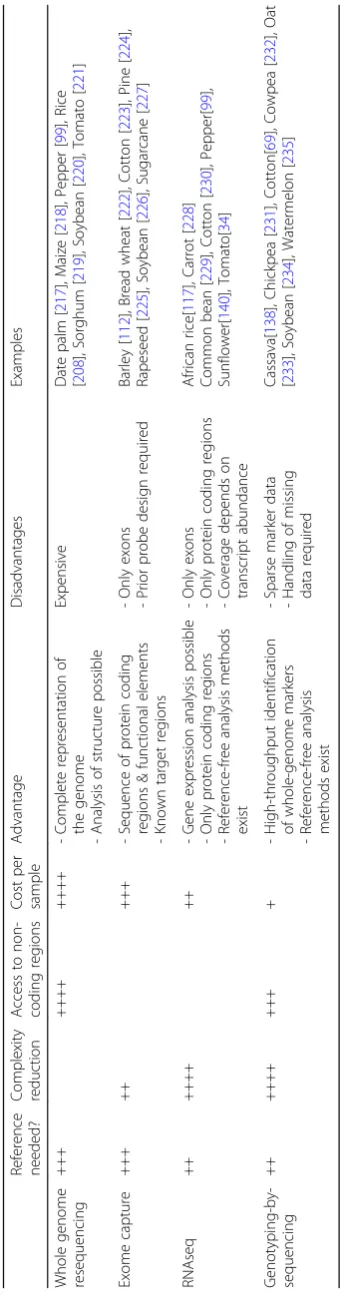
pressures. Several strategies based on high-throughput
sequencing are available to catalogue and analyze
gen-etic variation in crop diversity panels, namely
whole-genome sequencing, exome capture, RNA sequencing,
and reduced representation resequencing. The key
dif-ference between these approaches lies in the fraction of
the genomes targeted for sequencing, which determines
the requirements for prior resources and the per
sam-ple cost (Table
2
).
The most straightforward method for assessing genetic
diversity in species with a reference genome is shotgun
sequencing of short-insert libraries on the Illumina
plat-form and alignment of the sequence reads to the
refer-ence assembly [
93
]. Whole-genome shotgun sequencing
has been used in major crops such as maize [
3
,
94
], rice
[
33
,
95
,
96
], soybean [
97
], and Solanaceous species [
98
,
99
] to study genome-wide sequence diversity in the crop
and its wild relatives with a focus on domestication
his-tory and the genetic basis of crop improvement. In rice,
whole-genome sequencing and phenotyping of diversity
panels, together with efficient transgenic methods for
testing candidate gene function, has emerged as a
powerful approach for isolating genes of agronomic
im-portance [
95
,
100
]. Deep-coverage whole-genome
se-quencing data of multiple individuals is a prerequisite
for advanced population genetic methods to infer
demo-graphic history such as the Pairwise-Sequentially
Mar-kovian Coalescent model [
101
] and its derivatives [
102
,
103
], which were used to study historic changes of
popu-lation size in maize [
104
], grapevine [
105
], African rice
[
106
], and their respective wild progenitors.
An important drawback of whole-genome sequencing
is the financial burden associated with amassing
suffi-cient sequence data for large diversity panels in minor
crops or those with large genomes. Several techniques
have been developed to reduce genome complexity prior
to sequencing so as to increase read depth in certain
genomic regions. Sequence capture with oligonucleotide
baits can be applied at the scale of whole exome [
107
] or
gene families [
108
]. For example, whole-exome capture
assays have been developed in wheat [
109
,
110
] and
bar-ley [
111
] and applied in population genetic studies.
Rus-sell et al. [
112
] analyzed exome sequences from > 250
wild and domesticated barleys to understand contrasting
patterns of diversity in both taxa and to study changes
in haplotype structure of flowering time genes during
range expansion. Similarly, Avni et al. [
58
] used exome
capture data from 65 accessions of wild and
domesti-cated emmer to detect genomic regions under selection.
Resistance gene enrichment sequencing (RenSeq) was
originally developed to enable rapid mapping of
nucleo-tide binding-site leucine-rich repeat resistance genes in
mutant collections and segregation populations [
108
,
113
], but has been recently adopted by Arora et al. [
114
]
for association genetics and applied to gene isolation in
Aegilops tauschii
, a wild diploid progenitor of bread
wheat. Witek et al. [
115
] combined resistance gene
en-richment sequencing with PacBio sequencing to clone a
resistance gene against potato late blight disease in
Sola-num americaSola-num
, a diploid, non-tuber bearing wild
relative of potato.
High-throughput RNA sequencing (RNA-seq) [
116
] is
an alternative to whole-exome capture that does not
re-quire the design of oligonucleotide baits and can assess
sequence variation for a large portion of the transcribed
part of the genome. For example, Nabholz et al. [
117
]
used RNA-seq to study domestication bottlenecks in
Af-rican rice. As a method to quantify transcript
abun-dance, RNA sequencing affords information on gene
expression levels in addition to genetic variation. Koenig
et al. [
34
] performed RNA-seq on tomato and related
Solanum
species to detect footprints of selection based
on genetic variation at the DNA sequence level, and also
found selection pressure on gene expression level in the
domesticate. Lemmon et al. [
118
] analyzed allele-specific
expression in F
1crosses between maize and teosinte to
understand the changes in the regulatory architecture of
gene expression as a consequence of domestication.
term
‘genotyping-by-sequencing (GBS)’
as it captures
the essence of these methods: they do not produce
resequencing data for a gene set, but apply
high-throughput sequencing to obtain dense genome-wide
marker data. As such, GBS is similar to genotyping
with SNP chips. In contrast to SNP chips, however, no
prior knowledge and expenses are required to develop
genotyping assays and ascertainment bias [
123
] is
re-duced. Challenges in the analysis of GBS data include
allelic dropout [
124
] and handling of missing data
[
125
,
126
]. In principle, GBS data can be analyzed
without a reference genome [
127
,
128
], but care needs
to be taken in the interpretation of estimates of
popu-lation genetic parameters [
129
].
GBS is a versatile and inexpensive method for natural
and experimental populations of crops and their wild
relatives. Linkage maps for wild relatives of Triticeae
crops [
130
–
132
] and crop–wild cross in tomato [
133
]
have been constructed in recent years. Moreover, GBS
has been used to characterize crop–wild introgression
lines in barley [
134
] and tomato [
135
]. In addition to the
analysis of experimental populations, GBS has been
widely adopted for population genetic studies. For
ex-ample, it has been used to compare diversity between
crops and their wild progenitors in chickpea [
136
],
am-aranth [
137
], and cassava [
138
]; to study geneflow
be-tween wild and domesticated sunflower taxa [
139
,
140
];
and to elucidate the demographic history of wild
Phaseo-lus vulgaris
, the progenitor of common bean [
141
].
Moreover, GBS is a cost-effective method to screen
large germplasm collections. For example, Romay et al.
[
142
] used GBS to study genetic variation in 2815 maize
inbred lines maintained at the US national seedbank. If
used at the scale of entire collections, GBS holds the
po-tential of developing molecular passport data for gene
bank management, complementing traditional
morpho-logical markers and field evaluation. This can help
re-solve issues regarding (i) duplication within and between
gene banks around the world [
143
], (ii) the genetic
in-tegrity of accessions after decades of ex situ maintenance
[
144
,
145
], and (ii) the development of truly
representa-tive
core
collections
[
146
]
to
be
subjected
to
whole-genome sequencing [
147
] and in-depth
phenotyp-ing. The power of this approach was exemplified by a
re-cent study in maize. Navarro et al. [
148
] genotyped and
phenotyped a panel of > 4000 F
1hybrids between elite
breeding material and diverse landraces sampled from
the collection of the International Maize and Wheat
Im-provement Center (CIMMYT). Genome-wide
associ-ation scans revealed a co-associassoci-ation of genes to both
flowering time and altitude. Similar approaches are
un-derway in other cereal crops such as wheat [
149
], barley
[
150
], common bean [
151
], Solanaceous crops [
152
], and
rice [
153
]. As more genotypic and phenotypic data for
large germ plasm collections accrue, strategies for the
ef-fective utilization of plant genetic resources into
breed-ing without inflictbreed-ing yield losses are needed [
154
].
Novel approaches to domestication research
High-throughput sequencing has also been used to
ob-tain measurements on aspects of the genome other than
nucleotide sequence variation. Here, we describe future
directions in domestication research that will benefit
from these technological innovations, such as
epige-nomics, archaeogenetics, genome editing, domestication
of novel crops, and new computational methods for
ana-lysis of population genetic data (Fig.
3
).
Epigenomics refers to the study of the entirety of
her-itable changes other than changes in DNA sequence,
such as DNA methylation or histone modifications. The
interaction between euchromatin and heterochromatin
likely plays a role in silencing of transposable elements
and influences gene expression [
155
]. Compared to
gen-etic diversity, little is known about epigengen-etic diversity in
crops, which may prove an untapped reservoir of useful
variation for crop improvement [
156
]. Some important
initial results have been published recently. Daccord
et al. [
157
] generated an improved genome assembly of
domesticated apple and created a genome-wide map of
DNA methylation. Their results hint at a potential role
of epigenetic marks in the expression of agronomic traits
in perennial fruit trees. Epigenetic regulation is of
par-ticular importance to study the relationship of
subge-nomes in polyploid crops such as wheat [
158
], cotton
[
159
], and rapeseed [
160
].
Archaeogenetics
—
the extraction, sequencing, and
ana-lysis of ancient DNA fragments—has transformed our
concepts of the history of human and animal species
[
161
–
163
]. Until recently, plant genetics has not had
ac-cess to this window into the past, mainly owing to a
paucity of archaeobotanical remains containing sufficient
amounts of well-preserved DNA [
164
,
165
]. Recent
stud-ies in maize and barley retrieved DNA sequences from
samples preserved under arid conditions and analyzed
them together with sequences from extant individuals.
da Fonseca et al. [
166
] thus reconstructed the past
dem-ography of maize in the southwest United States.
Mascher et al. [
167
] reported a close genetic affinity of
6000-year- old barley grains from the Judean desert to
present-day landraces from the Southern Levant. Swarts
et al. [
168
] employed genomic prediction models trained
on modern data to understand the temporal dynamics of
adaption to temperate climates as maize cultivation
spread northwards.
individuals and creating novel useful variation in the
do-mesticate. For example, Soyk et al. [
171
] isolated two
regulators of inflorescence architecture in tomato by
means of map-based cloning and validation through
classic mutants and CRISPR-Cas9 knock-out. Naturally
occurring mutations in both genes had been
independ-ently selected either to increase fruit size or to facilitate
mechanical harvesting. However, due to negative
epi-static interaction between both genes, combinations of
alleles that are beneficial on their own resulted in loss of
fertility and excessive branching. Soyk et al. [
171
] then
evaluated allelic series of both loci for epistatic
interac-tions and found new beneficial allelic combinainterac-tions that
overcame negative epistasis. Braatz et al. [
172
] used
CRISPR-Cas9 in tetraploid oilseed rape (
Brassica napus
)
to knockout simultaneously both homeologs of
ALCA-TRAZ
, a known regulator of seed shattering in
Arabi-dopsis
[
173
]. Siliques of double mutants were partially
resistant to shattering, an important trait to avoid seed
loss during mechanical harvesting.
The domestication of new plant species has been
pro-posed as an important future contribution to sustainable
agriculture. For instance, the development of perennial
grain crops has received considerable attention [
174
,
175
]. Progress has been made in bringing intermediate
wheatgrass (
Thinopyrum intermedium
; Fig.
1
), a
per-ennial relative of wheat, into cultivation with the
es-tablishment of dense linkage maps [
131
] and the
implementation of genomic selection [
176
]. The
do-mestication of bioenergy crops has been put forward
to meet the growing demands for biofuel. Proposed
targets include the aquatic fern
Azolla
[
177
],
Mis-canthus
species [
178
], and the duckweeds [
179
].
As large population genomic datasets accrue in more
species, analysis methods need to keep pace with the
growing amount of input data. Efficient data structures
have been devised to structure and handle large marker
matrices [
180
,
181
]. Imputation strategies to infer
miss-ing genotypes in low-coverage sequence data have been
adopted in human genetics [
182
,
183
]. Moreover,
imput-ation methods, which take into account inbreeding or
are geared towards experimental populations, have been
developed specifically for plant genetics [
184
]. We
ex-pect genotype imputation to be widely used in plant
genetic studies as comprehensive haplotype reference
panels become available [
185
]. As an alternative or
Diverse contemporary samples Material
Methods
Wild relatives Ancient samples
Population genetics Epigenomics Gene editing
[image:9.595.58.541.91.395.2]complement to the imputation of discrete allelic states,
statistical uncertainties in genotype calling from shallow
sequencing data can be recorded and considered during
population genetic analyses [
186
,
187
].
New algorithms have been developed to speed up
trad-itional analysis methods such as principal component
ana-lysis [
188
,
189
] and statistical inference of population
structure [
190
]. These include flashpca [
191
], FastPCA
[
192
], fastSTRUCTURE [
193
], ADMIXTURE [
194
], and
sNMF [
195
]. Methods for understanding past
demo-graphic processes such as bottlenecks and migration
events include genome-wide comparisons of allele
fre-quencies from dense genomic marker datasets [
196
,
197
],
fitting coalescent models to whole-genome sequence data
[
100
,
101
], and computational environments for
demo-graphic simulations [
198
,
199
].
In summary, progress in sequencing technology and
analysis methods will make it possible to study the
gen-etics and genomics of domestication in a wider range of
crop species. In the coming years, chromosome-scale
reference sequence assemblies and resequencing studies
of large diversity panels will contribute to understanding
the past and present diversity of domesticated plants
and their wild relatives.
Abbreviations
BAC:Bacterial artificial chromosome; GBS: Genotying-by-sequencing; Hi-C: Chromosome conformation capture (quantifies interactions between all possible pairs of fragments simultaneously); RNA-seq: RNA sequencingSNP, Single-nucleotide polymorphism
Acknowledgments
None.
Funding
This work was supported by a grants from the Leibniz Association to N.S. (Pakt fr Forschung und Innovation: SAW-2015-IPK-1) and from the Germen Federal Ministry of Education and Research (BMBF; grant 031B0190A.ú SHAPE.) to N.S. and M.M.
Authors’contributions
MS, NS, and MM wrote the article. MS designed the figures. All authors read and approved the final manuscript.
Competing interests
The authors declare that they have no competing interests.
Publisher
’
s Note
Springer Nature remains neutral with regard to jurisdictional claims in published maps and institutional affiliations.
References
1. Food and Agriculture Organisation of the United Nations. FAOSTAT statistics database. 2016.http://www.fao.org/faostat/en/#home. Accessed 9 Aug 2018.
2. Doebley JF, Gaut BS, Smith BD. The molecular genetics of crop domestication. Cell. 2006;127:1309–21.
3. Hufford MB, Xu X, van Heerwaarden J, Pyhäjärvi T, Chia JM, Cartwright RA, et al. Comparative population genomics of maize domestication and improvement. Nat Genet. 2012;44:808–11.
4. Cao K, Zheng Z, Wang L, Liu X, Zhu G, Fang W, et al. Comparative population genomics reveals the domestication history of the peach,Prunus persica, and human influences on perennial fruit crops. Genome Biol. 2014; 15:415.
5. Purugganan MD, Fuller DQ. Archaeological data reveal slow rates of evolution during plant domestication. Evolution. 2011;65:171–83. 6. Fuller DQ, Denham T, Arroyo-Kalin M, Lucas L, Stevens CJ, Qin L, et al.
Convergent evolution and parallelism in plant domestication revealed by an expanding archaeological record. Proc Natl Acad Sci U S A. 2014;11:6147–52. 7. Abbo S, Lev-Yadun S, Gopher A. Agricultural origins: centers and noncenters
–a Near Eastern reappraisal. Crit Rev Plant Sci. 2010;29:317–28.
8. Innan H, Kim Y. Pattern of polymorphism after strong artificial selection in a domestication event. Proc Natl Acad Sci U S A. 2004;101:10667–72. 9. Hillman GC, Davies MS. Domestication rates in wild-type wheats and barley
under primitive cultivation. Biol J Linn Soc. 1990;39:39–78.
10. Ekblom R, Galindo J. Applications of next generation sequencing in molecular ecology of non-model organisms. Heredity (Edinb). 2011;107:1–15. 11. Cannon SB, May GD, Jackson SA. Three sequenced legume genomes and
many crop species: rich opportunities for translational genomics. Plant Physiol. 2009;151:970–7.
12. Lenser T, Theißen G. Molecular mechanisms involved in convergent crop domestication. Trends Plant Sci. 2013;18:704–14.
13. Meyer RS, Purugganan MD. Evolution of crop species: genetics of domestication and diversification. Nat Rev Genet. 2013;14:840–52. 14. Huang X, Han B. Natural variations and genome-wide association studies in
crop plants. Annu Rev Plant Biol. 2014;65:531–51.
15. Olsen KM, Wendel JF. A bountiful harvest: genomic insights into crop domestication phenotypes. Annu Rev Plant Biol. 2013;64:47–70. 16. Shi J, Lai J. Patterns of genomic changes with crop domestication and
breeding. Curr Opin Plant Biol. 2015;24:47–53.
17. Bevan MW, Uauy C, Wulff BB, Zhou J, Krasileva K, Clark MD. Genomic innovation for crop improvement. Nature. 2017;543:346–54.
18. Turcotte MM, Araki H, Karp DS, Poveda K, Whitehead SR. The eco-evolutionary impacts of domestication and agricultural practices on wild species. Philos Trans R Soc Lond Ser B Biol Sci. 2017;372:20160033.
19. Gutaker RM, Burbano HA. Reinforcing plant evolutionary genomics using ancient DNA. Curr Opin Plant Biol. 2017;36:38–45.
20. Palmer SA, Smith O, Allaby RG. The blossoming of plant archaeogenetics. Ann Anat. 2012;194:146–56.
21. Abbo S, Gopher A. Near eastern plant domestication: A history of thought. Trends Plant Sci. 2017;22:491–511.
22. Kantar MB, Nashoba AR, Anderson JE, Blackman BK, Rieseberg LH. The genetics and genomics of plant domestication. Bioscience. 2017;67:971–82. 23. Pankin A, von Korff M. Co-evolution of methods and thoughts in cereal
domestication studies: a tale of barley (Hordeum vulgare). Curr Opin Plant Biol. 2017;36:15–21.
24. Harlan JR, Zohary D. Distribution of wild wheats and barley. Science. 1966; 153:1074–80.
25. Dempewolf H, Eastwood RJ, Guarino L, Khoury CK, Müller JV, Toll J. Adapting agriculture to climate change: a global initiative to collect, conserve, and use crop wild relatives. Agroecol Sust Food. 2014;38:369–77. 26. Harlan JR, de Wet JM. Toward a rational classification of cultivated plants.
Taxon. 1971;20:509–17.
27. Briggs WH, McMullen MD, Gaut BS, Doebley J. Linkage mapping of domestication loci in a large maize–teosinte backcross resource. Genetics. 2007;177:1915–28.
28. Peng J, Ronin Y, Fahima T, Röder MS, Li Y, Nevo E, et al. Domestication quantitative trait loci inTriticum dicoccoides, the progenitor of wheat. Proc Natl Acad Sci U S A. 2003;100:2489–94.
29. Jin J, Huang W, Gao JP, Yang J, Shi M, Zhu M-Z, et al. Genetic control of rice plant architecture under domestication. Nat Genet. 2008;40:1365–9. 30. Pourkheirandish M, Hensel G, Kilian B, Senthil N, Chen G, Sameri M, et al.
Evolution of the grain dispersal system in barley. Cell. 2015;162:527–39. 31. Clark RM, Wagler TN, Quijada P, Doebley J. A distant upstream enhancer at
the maize domestication genetb1has pleiotropic effects on plant and inflorescent architecture. Nat Genet. 2006;38:594–7.
32. Jarvis DE, Ho YS, Lightfoot DJ, Schmöckel SM, Li B, Borm TJ, et al. The genome ofChenopodium quinoa. Nature. 2017;542:307–12.
34. Koenig D, Jiménez-Gómez JM, Kimura S, Fulop D, Chitwood DH, Headland LR, et al. Comparative transcriptomics reveals patterns of selection in domesticated and wild tomato. Proc Natl Acad Sci U S A. 2013;110:E2655–62.
35. Shang Y, Ma Y, Zhou Y, Zhang H, Duan L, Chen H, et al. Biosynthesis, regulation, and domestication of bitterness in cucumber. Science. 2014;346: 1084–8.
36. Feuillet C, Leach JE, Rogers J, Schnable PS, Eversole K. Crop genome sequencing: lessons and rationales. Trends Plant Sci. 2011;16:77–88. 37. Lander ES, Linton LM, Birren B, Nusbaum C, Zody MC, Baldwin J, et al. Initial
sequencing and analysis of the human genome. Nature. 2001;409:860–921. 38. International Rice Genome Sequencing Project. The map-based sequence of
the rice genome. Nature. 2005;436:793–800.
39. Schnable PS, Ware D, Fulton RS, Stein JC, Wei F, Pasternak S, et al. The B73 maize genome: complexity, diversity, and dynamics. Science. 2009;326: 1112–5.
40. Choulet F, Alberti A, Theil S, Glover N, Barbe V, Daron J, et al. Structural and functional partitioning of bread wheat chromosome 3B. Science. 2014;345: 1249721.
41. Schulte D, Close TJ, Graner A, Langridge P, Matsumoto T, Muehlbauer G, et al. The international barley sequencing consortium—at the threshold of efficient access to the barley genome. Plant Physiol. 2009;149:142–7. 42. Mascher M, Gundlach H, Himmelbach A, Beier S, Twardziok SO, Wicker T,
et al. A chromosome conformation capture ordered sequence of the barley genome. Nature. 2017;544:427–33.
43. Beier S, Himmelbach A, Schmutzer T, Felder M, Taudien S, Mayer KF, et al. Multiplex sequencing of bacterial artificial chromosomes for assembling complex plant genomes. Plant Biotechnol J. 2016;14:1511–22. 44. Li R, Fan W, Tian G, Zhu H, He L, Cai J, et al. The sequence and de novo
assembly of the giant panda genome. Nature. 2010;463:311–7. 45. Li R, Zhu H, Ruan J, Qian W, Fang X, Shi Z, et al. De novo assembly of
human genomes with massively parallel short read sequencing. Genome Res. 2010;20:265–72.
46. Clouse JW, Adhikary D, Page JT, Ramaraj T, Deyholos MK, Udall JA, et al. The amaranth genome: genome, transcriptome, and physical map assembly. Plant Genome. 2016;9.https://doi.org/10.3835/plantgenome2015.07.0062. 47. Sun H, Wu S, Zhang G, Jiao C, Guo S, Ren Y, et al. Karyotype stability and unbiased fractionation in the paleo-allotetraploid cucurbita genomes. Mol Plant. 2017;10:1293–306.
48. VanBuren R, Bryant D, Bushakra JM, Vining KJ, Edger PP, Rowley ER, et al. The genome of black raspberry (Rubus occidentalis). Plant J. 2016;87:535–47. 49. Iorizzo M, Ellison S, Senalik D, Zeng P, Satapoomin P, Huang J, et al. A
high-quality carrot genome assembly provides new insights into carotenoid accumulation and asterid genome evolution. Nat Genet. 2016;48:657–66.
50. Jacquemin J, Bhatia D, Singh K, Wing RA. The InternationalOryzaMap Alignment Project: development of a genus-wide comparative genomics platform to help solve the 9 billion-people question. Curr Opin Plant Biol. 2013;16:147–56.
51. Huang X, Feng Q, Qian Q, Zhao Q, Wang L, Wang A, et al. High-throughput genotyping by whole-genome resequencing. Genome Res. 2009;19:1068–76. 52. Mascher M, Muehlbauer GJ, Rokhsar DS, Chapman J, Schmutz J, Barry K,
et al. Anchoring and ordering NGS contig assemblies by population sequencing (POPSEQ). Plant J. 2013;76:718–27.
53. van Oeveren J, de Ruiter M, Jesse T, van der Poel H, Tang J, Yalcin F, et al. Sequence-based physical mapping of complex genomes by whole genome profiling. Genome Res. 2011;21:618–25.
54. Mayer KF, Taudien S, Martis M, Simkova H, Suchankova P, Gundlach H, et al. Gene content and virtual gene order of barley chromosome 1H. Plant Physiol. 2009;151:496–505.
55. International Wheat Genome Sequencing Consortium. A chromosome-based draft sequence of the hexaploid bread wheat (Triticum aestivum) genome. Science. 2014;345:1251788.
56. Chapman JA, Mascher M, Buluc AN, Barry K, Georganas E, Session A, et al. A whole-genome shotgun approach for assembling and anchoring the hexaploid bread wheat genome. Genome Biol. 2015;16:26.
57. International Barley Genome Sequencing Consortium. A physical, genetic and functional sequence assembly of the barley genome. Nature. 2012;491: 711–6.
58. Avni R, Nave M, Barad O, Baruch K, Twardziok SO, Gundlach H, et al. Wild emmer genome architecture and diversity elucidate wheat evolution and domestication. Science. 2017;357:93–7.
59. Lu F-H, McKenzie N, Kettleborough G, Heavens D, Clark MD, Bevan MW. Independent assessment and improvement of wheat genome assemblies using Fosill jumping libraries. Gigascience. 2018;7.https://doi.org/10.1093/ gigascience/giy053.
60. Aird D, Ross MG, Chen W-S, Danielsson M, Fennell T, Russ C, et al. Analyzing and minimizing PCR amplification bias in Illumina sequencing libraries. Genome Biol. 2011;12:R18.
61. Clavijo BJ, Venturini L, Schudoma C, Accinelli GG, Kaithakottil G, Wright J, et al. An improved assembly and annotation of the allohexaploid wheat genome identifies complete families of agronomic genes and provides genomic evidence for chromosomal translocations. Genome Res. 2017;27: 885–96.
62. Koren S, Schatz MC, Walenz BP, Martin J, Howard JT, Ganapathy G, et al. Hybrid error correction and de novo assembly of single-molecule sequencing reads. Nat Biotechnol. 2012;30:693–700.
63. Jiao Y, Peluso P, Shi J, Liang T, Stitzer MC, Wang B, et al. Improved maize reference genome with single-molecule technologies. Nature. 2017;546: 524–7.
64. Schmidt MH-W, Vogel A, Denton AK, Istace B, Wormit A, van de Geest H, et al. De novo assembly of a newSolanum pennelliiaccession using nanopore sequencing. Plant Cell. 2017;29:2336–48.
65. Zimin AV, Puiu D, Hall R, Kingan S, Clavijo BJ, Salzberg SL. The first near-complete assembly of the hexaploid bread wheat genome,Triticum aestivum. Gigascience. 2017;6:1–7.
66. Zimin AV, Puiu D, Luo M-C, Zhu T, Koren S, Marçais G, et al. Hybrid assembly of the large and highly repetitive genome ofAegilops tauschii, a progenitor of bread wheat, with the MaSuRCA mega-reads algorithm. Genome Res. 2017;27:787–92.
67. Fierst JL. Using linkage maps to correct and scaffold de novo genome assemblies: methods, challenges, and computational tools. Front Genet. 2015;6:220.
68. Mascher M, Stein N. Genetic anchoring of whole-genome shotgun assemblies. Front Genet. 2014;5:208.
69. Zhang T, Hu Y, Jiang W, Fang L, Guan X, Chen J, et al. Sequencing of allotetraploid cotton (Gossypium hirsutumL. acc. TM-1) provides a resource for fiber improvement. Nat Biotechnol. 2015;33:531–7.
70. Aliyeva-Schnorr L, Beier S, Karafiátová M, Schmutzer T, Scholz U, Doležel J, et al. Cytogenetic mapping with centromeric bacterial artificial chromosomes contigs shows that this recombination-poor region comprises more than half of barley chromosome 3H. Plant J. 2015;84:385–94.
71. Luo MC, Thomas C, You FM, Hsiao J, Ouyang S, Buell CR, et al. High-throughput fingerprinting of bacterial artificial chromosomes using the snapshot labeling kit and sizing of restriction fragments by capillary electrophoresis. Genomics. 2003;82:378–89.
72. Hukriede NA, Joly L, Tsang M, Miles J, Tellis P, Epstein JA, et al. Radiation hybrid mapping of the zebrafish genome. Proc Natl Acad Sci U S A. 1999; 96:9745–50.
73. Lam ET, Hastie A, Lin C, Ehrlich D, Das SK, Austin MD, et al. Genome mapping on nanochannel arrays for structural variation analysis and sequence assembly. Nat Biotechnol. 2012;30:771–6.
74. Hatakeyama M, Aluri S, Balachadran MT, Sivarajan SR, Patrignani A, Grüter S, et al. Multiple hybrid de novo genome assembly of finger millet, an orphan allotetraploid crop. DNA Res. 2017.https://doi.org/10. 1093/dnares/dsx036.
75. Stankova H, Hastie AR, Chan S, Vrana J, Tulpova Z, Kubalakova M, et al. BioNano genome mapping of individual chromosomes supports physical mapping and sequence assembly in complex plant genomes. Plant Biotechnol J. 2016;14:1523–31.
76. Zheng GX, Lau BT, Schnall-Levin M, Jarosz M, Bell JM, Hindson CM, et al. Haplotyping germline and cancer genomes with high-throughput linked-read sequencing. Nat Biotechnol. 2016;34:303–11.
77. Yeo S, Coombe L, Chu J, Warren RL, Birol I. ARCS: assembly roundup by chromium scaffolding. bioRxiv. 2017:100750.https://doi.org/10.1101/100750. 78. Weisenfeld NI, Kumar V, Shah P, Church DM, Jaffe DB. Direct determination
of diploid genome sequences. Genome Res. 2017;27:757–67.
79. Hulse-Kemp AM, Maheshwari S, Stoffel K, Hill TA, Jaffe D, Williams SR, et al. Reference quality assembly of the 3.5-Gb genome ofCapsicum annuum from a single linked-read library. Hortic Res. 2018;5:4.
81. Burton JN, Adey A, Patwardhan RP, Qiu R, Kitzman JO, Shendure J. Chromosome-scale scaffolding of de novo genome assemblies based on chromatin interactions. Nat Biotechnol. 2013;31:1119–25.
82. Kaplan N, Dekker J. High-throughput genome scaffolding from in vivo DNA interaction frequency. Nat Biotechnol. 2013;31:1143–7.
83. Grob S, Schmid MW, Grossniklaus U. Hi-C analysis inArabidopsisidentifies the KNOT, a structure with similarities to the flamenco locus ofDrosophila. Mol Cell. 2014;55:678–93.
84. Dudchenko O, Batra SS, Omer AD, Nyquist SK, Hoeger M, Durand NC, et al. De novo assembly of theAedes aegyptigenome using Hi-C yields chromosome-length scaffolds. Science. 2017;356:92–5.
85. Ariyadasa R, Mascher M, Nussbaumer T, Schulte D, Frenkel Z, Poursarebani N, et al. A sequence-ready physical map of barley anchored genetically by two million single-nucleotide polymorphisms. Plant Physiol. 2014;164:412–23. 86. Lightfoot D, Jarvis DE, Ramaraj T, Lee R, Jellen E, Maughan P.
Single-molecule sequencing and Hi-C-based proximity-guided assembly of amaranth (Amaranthus hypochondriacus) chromosomes provide insights into genome evolution. BMC Biol. 2017;15:74.
87. Putnam NH, O’Connell BL, Stites JC, Rice BJ, Blanchette M, Calef R, et al. Chromosome-scale shotgun assembly using an in vitro method for long-range linkage. Genome Res. 2016;26:342–50.
88. Jiao W-B, Accinelli GG, Hartwig B, Kiefer C, Baker D, Severing E, et al. Improving and correcting the contiguity of long-read genome assemblies of three plant species using optical mapping and chromosome conformation capture data. Genome Res. 2017;27:778–86.
89. Moll KM, Zhou P, Ramaraj T, Fajardo D, Devitt NP, Sadowsky MJ, et al. Strategies for optimizing BioNano and Dovetail explored through a second reference quality assembly for the legume model,Medicago truncatula. BMC Genomics. 2017;18:578.
90. Reyes-Chin-Wo S, Wang Z, Yang X, Kozik A, Arikit S, Song C, et al. Genome assembly within vitroproximity ligation data and whole-genome triplication in lettuce. Nat Commun. 2017;8:14953.
91. Thind AK, Wicker T,Šimková H, Fossati D, Moullet O, Brabant C, et al. Rapid cloning of genes in hexaploid wheat using cultivar-specific long-range chromosome assembly. Nat Biotechnol. 2017;35:793–6.
92. Ford-Lloyd BV, Schmidt M, Armstrong SJ, Barazani O, Engels J, Hadas R, et al. Crop wild relatives—undervalued, underutilized and under threat? Bioscience. 2011;61:559–65.
93. Goodwin S, McPherson JD, McCombie WR. Coming of age: ten years of next-generation sequencing technologies. Nat Rev Genet. 2016;17:333–51. 94. Chia J-M, Song C, Bradbury PJ, Costich D, De Leon N, Doebley J, et al. Maize
HapMap2 identifies extant variation from a genome in flux. Nat Genet. 2012; 44:803–7.
95. Huang X, Wei X, Sang T, Zhao Q, Feng Q, Zhao Y, et al. Genome-wide association studies of 14 agronomic traits in rice landraces. Nat Genet. 2010; 42:961–7.
96. Huang X, Zhao Y, Li C, Wang A, Zhao Q, Li W, et al. Genome-wide association study of flowering time and grain yield traits in a worldwide collection of rice germplasm. Nat Genet. 2012;44:32–9.
97. Fang C, Ma Y, Wu S, Liu Z, Wang Z, Yang R, et al. Genome-wide association studies dissect the genetic networks underlying agronomical traits in soybean. Genome Biol. 2017;18:161.
98. Hardigan MA, Laimbeer FPE, Newton L, Crisovan E, Hamilton JP, Vaillancourt B, et al. Genome diversity of tuber-bearingSolanumuncovers complex evolutionary history and targets of domestication in the cultivated potato. Proc Natl Acad Sci U S A. 2017;114:E9999–E10008.
99. Qin C, Yu C, Shen Y, Fang X, Chen L, Min J, et al. Whole-genome sequencing of cultivated and wild peppers provides insights into
Capsicumdomestication and specialization. Proc Natl Acad Sci U S A.
2014;111:5135–40.
100. Yano K, Yamamoto E, Aya K, Takeuchi H, Lo P-C, Hu L, et al. Genome-wide association study using whole-genome sequencing rapidly identifies new genes influencing agronomic traits in rice. Nat Genet. 2016;48:927–34.
101. Li H, Durbin R. Inference of human population history from individual whole-genome sequences. Nature. 2011;475:493–6.
102. Schiffels S, Durbin R. Inferring human population size and separation history from multiple genome sequences. Nat Genet. 2014;46:919–25.
103. Nadachowska-Brzyska K, Burri R, Smeds L, Ellegren H. PSMC analysis of effective population sizes in molecular ecology and its application to black-and-whiteFicedulaflycatchers. Mol Ecol. 2016;25:1058–72.
104. Wang L, Beissinger TM, Lorant A, Ross-Ibarra C, Ross-Ibarra J, Hufford MB. The interplay of demography and selection during maize domestication and expansion. Genome Biol. 2017;18:215.
105. Zhou Y, Massonnet M, Sanjak JS, Cantu D, Gaut BS. Evolutionary genomics of grape (Vitis viniferassp.vinifera) domestication. Proc Natl Acad Sci U S A. 2017;114:11715–20.
106. Meyer RS, Choi JY, Sanches M, Plessis A, Flowers JM, Amas J, et al. Domestication history and geographical adaptation inferred from a SNP map of African rice. Nat Genet. 2016;48:1083–8.
107. Ng SB, Turner EH, Robertson PD, Flygare SD, Bigham AW, Lee C, et al. Targeted capture and massively parallel sequencing of 12 human exomes. Nature. 2009;461:272–6.
108. Jupe F, Witek K, Verweij W,Śliwka J, Pritchard L, Etherington GJ, et al. Resistance gene enrichment sequencing (RenSeq) enables reannotation of the NB-LRR gene family from sequenced plant genomes and rapid mapping of resistance loci in segregating populations. Plant J. 2013;76: 530–44.
109. Jordan KW, Wang S, Lun Y, Gardiner LJ, MacLachlan R, Hucl P, et al. A haplotype map of allohexaploid wheat reveals distinct patterns of selection on homoeologous genomes. Genome Biol. 2015;16:48.
110. Krasileva KV, Vasquez-Gross HA, Howell T, Bailey P, Paraiso F, Clissold L, et al. Uncovering hidden variation in polyploid wheat. Proc Natl Acad Sci U S A. 2017;114:E913–21.
111. Mascher M, Richmond TA, Gerhardt DJ, Himmelbach A, Clissold L, Sampath D, et al. Barley whole exome capture: a tool for genomic research in the genusHordeumand beyond. Plant J. 2013;76:494–505.
112. Russell J, Mascher M, Dawson IK, Kyriakidis S, Calixto C, Freund F, et al. Exome sequencing of geographically diverse barley landraces and wild relatives gives insights into environmental adaptation. Nat Genet. 2016;48: 1024–30.
113. Steuernagel B, Periyannan SK, Hernández-Pinzón I, Witek K, Rouse MN, Yu G, et al. Rapid cloning of disease-resistance genes in plants using mutagenesis and sequence capture. Nat Biotechnol. 2016;34:652–5.
114. Arora S, Steuernagel B, Chandramohan S, Long Y, Matny O, Johnson R, et al. Resistance gene discovery and cloning by sequence capture and association genetics. bioRxiv. 2018:248146.https://doi.org/10.1101/248146. 115. Witek K, Jupe F, Witek AI, Baker D, Clark MD, Jones JD. Accelerated cloning
of a potato late blight-resistance gene using RenSeq and SMRT sequencing. Nat Biotechnol. 2016;34:656–60.
116. Mortazavi A, Williams BA, McCue K, Schaeffer L, Wold B. Mapping and quantifying mammalian transcriptomes by RNA-Seq. Nat Methods. 2008;5: 621–8.
117. Nabholz B, Sarah G, Sabot F, Ruiz M, Adam H, Nidelet S, et al. Transcriptome population genomics reveals severe bottleneck and domestication cost in the African rice (Oryza glaberrima). Mol Ecol. 2014;23:2210–27.
118. Lemmon ZH, Bukowski R, Sun Q, Doebley JF. The role of cis regulatory evolution in maize domestication. PLoS Genet. 2014;10:e1004745. 119. Davey JW, Hohenlohe PA, Etter PD, Boone JQ, Catchen JM, Blaxter ML.
Genome-wide genetic marker discovery and genotyping using next-generation sequencing. Nat Rev Genet. 2011;12:499–510.
120. Davey JW, Blaxter ML. RADSeq: next-generation population genetics. Brief Funct Genomics. 2010;9:416–23.
121. Elshire RJ, Glaubitz JC, Sun Q, Poland JA, Kawamoto K, Buckler ES, et al. A robust, simple genotyping-by-sequencing (GBS) approach for high diversity species. PLoS One. 2011;6:e19379.
122. Sun X, Liu D, Zhang X, Li W, Liu H, Hong W, et al. SLAF-seq: an efficient method of large-scale de novo SNP discovery and genotyping using high-throughput sequencing. PLoS One. 2013;8:e58700.
123. Clark AG, Hubisz MJ, Bustamante CD, Williamson SH, Nielsen R. Ascertainment bias in studies of human genome-wide polymorphism. Genome Res. 2005;15:1496–502.
124. Gautier M, Gharbi K, Cezard T, Foucaud J, Kerdelhué C, Pudlo P, et al. The effect of RAD allele dropout on the estimation of genetic variation within and between populations. Mol Ecol. 2013;22:3165–78.
125. Arnold B, Corbett-Detig RB, Hartl D, Bomblies K. RADseq underestimates diversity and introduces genealogical biases due to nonrandom haplotype sampling. Mol Ecol. 2013;22:3179–90.