5
II
February 2017
Technology (IJRASET)
Lagrangian Decomposition Approach Based
Voltage Security Constrained Unit Commitment
Ms. S. Adhitya1, Mr. S. Purushotham2
Electrical and Electronics Engineering, Anna University Chennai
Abstract
:
As the electrical industry increases many problems arises in controlling the generating units. Unit commitment decides which unit to operate during a certain period time. The objective of the unit commitment is to find a unit commitment schedule that minimizes the commitment and the dispatch costs of meeting the forecast system load taking into account various constraints. The problem will become voltage security constrained when the constraints are imposed to ensure voltage flow does not exceed chosen limit following a contingency. Lagrangian Decomposition Approach method which approximates a difficult problem of constrained optimization by a simpler method is proposed. The proposed Lagrangian Decomposition Approach is flexible in dealing with different types of constraints such as reactive power constraint, minimum up time constraint, minimum down time constraint, fuel constraint, start-up constraint and voltage constraint. A five generating unit in IEEE-14 bus network have been taken and the proposed algorithm is applied to solve it for the SCUC with voltage constraints to demonstrate the efficiency of the proposed method. In the proposed method the production cost is minimized and the voltage is maintained at a secure level in the power system. The performance of the proposed model is verified using MATLAB Software.Keywords
:
Security constrained unit commitment (SCUC), Lagrangian Decomposition Approach (LDA), Unit commitment problem (UCP), Voltage Security constrained unit commitment (VSCUC), Unit Commitment (UC).
I. INTRODUCTION
Security Constrained Unit Commitment (SCUC) is a pre-eminent problem in the power system operation. There are several methods to solve the unit commitment problem. They are priority list method, Bender decomposition, Lagrangian decomposition, dynamic programming method and Lagrangian relaxation method. The proposed idea helps the researchers to solve the UC problem under deregulated and regulated power industries. The Transmission Switching sub problem is analysed and the changes required for the UC master problem solution is identified when the severity of the contingencies cannot be made in the Transmission Switching sub problem [2]. To form the wind generation stochastic model have been adopted. To resolve the forecasted irregular wind power generation the Bender’s Decomposition method has been proposed. To eradicate the disobedience Benders cut has been produced. Benders cuts are shaped additional to the master problem to modify the result of the unit commitment. To get the wind forecasting imitation, arithmetical method or grouping of two had been planned. The stochastic optimization would reduce the system cost by 0.25% in the unit commitment when compared with the deterministic method. The large combination of irregular wind generation (WG) in power systems has necessitated the addition of more original and complicated approaches in the power system [3].
The mixed-integer programming (MIP) application shows the capacity to handle large-scale problems. The proposed Security Constrained Unit Commitment solution depends on the Benders decomposition to decay the problem into two sub problems and a master problem. To decrease the disobedience Benders cut has been shaped. Benders cuts are produced and added to the master problem to discover the result of the unit commitment. The method planned applies a method of break down to part the natural gas transmission and the power transmission as two break up subproblem from the unit commitment (UC) in the master crisis. Gas contracts have been planned, modeled and then included in the master Unit Commitment Problem. The natural gas transmission sub problem checks the possibility of natural gas transmission plus transmission security constraints with natural gas for the unit commitment and for the gas-fired generating units transmit. If several violations arose in the natural gas transmission, parallel energy constraints would be shaped and supplementary with the master problem for solving the UC next iteration [4]. The method uses a stochastic model to get the long term explanation of security-constrained unit commitment (SCUC). The planned model would be used very often by the vertically integrated market utilities as well at the same time as the Independent Standard Operators in the markets of electricity.
Technology (IJRASET)
term deterministic sub problems of SCUC. For each long-term SCUC the fuel plus emission constraints stand for the supply constraints in the upright incorporated market. In arrange to decay the sub problems along with the long-term SCUC into the obedient short-term MIP-based SCUC sub problems exclusive of bearing in mind the reserve constraints the Lagrangian relaxation algorithm is used. To copy random individuality of power systems the Monte Carlo (MC) simulation scheme has been adopted. The planned stochastic development form uses many scenarios in the Monte Carlo simulation [5]. This paper proposes a form to get possible result for the security constrained unit commitment (SCUC) problems within the Lagrangian relaxation structure [6]. Gas contracts were designed and included in the master UC crisis. The sub problem of the natural gas transmission checks the possibility of natural gas transmission as healthy as natural gas transmission security constraints for the obligation [7]. Lagrangian Relaxation technique was practical to decompose the unique optimization crisis into sub troubles for midterm invention and communication preservation setting up and instant SCUC. Mixed Integer Programming (MIP) has been planned to explain SCUC [8]. A stochastic copy was planned to program assets. Demand reply Providers (DRPS) offers Demand-side reserve. A mixed-integer depiction of reserve provided by DRPs and its linked cost function were worn in the projected stochastic form [9]. The hourly exact Response (DR) was included into security-constrained unit commitment (SCUC) for financial and sanctuary purposes. At climax periods Demand-side sharing may diminish the loads [10].
This paper is structured as follows: In Section 2, the security constrained unit commitment with voltage constrains problem formulation is offered. Lagrangian technique for security constrained unit commitment for master problem is specified in Section 3. Section 4 discusses flowchart and algorithm for the planned method. The consequences of the voltage security constrained unit commitment are offered in section 5. Section 6 summarises the conclusion.
II. PROBLEMFORMULATIONOFSCUCWITHVOLTAGECONSTRAINTS
The main function of Security Constrained Unit Commitment (SCUC) is to secure a unit commitment schedule at minimal production cost without compromising the system performance. The existing unit commitment algorithm determines the unit schedules to reduce the operating costs and satisfy the present constraints such as load balance, system spinning reserve, ramp rate limits, fuel constraints, reactive power generation limits and minimum up and down time limits over a set of particular time periods. The units in the system supply the load demands and particularly maintain transmission flows and bus voltages within their permitted limits. SCUC is an optimization problem that reduces the operating costs based on the incremental costs given for each generating units.
The objective function for the SCUC is given as
Ng 1 i N 1 t ti
(P(i,
t))I(i,
t)
S(i,
t)]
[C
(1) where
Cfi(P(i,t)) - Production Cost
S(i,t) - Start Up Cost
Many constraints can be involved to the Security Constrained Unit Commitment problem. The constraint involved in this paper is system real power balance,reactive power generation limits, system voltage limits and fuel constraints.
System real power balance
The real power balance constraint in the system is the most important constraint in the SCUC problem. The power generated from all the given units should be same as the load demand. This is formulated in the equilibrium equation as
(2)
where
P (i, t) - Generation of unit i at time t
PD (t) - Total real power load demand of the system at time t
Reactive Power Generation Limit
The reactive power operating reserve condition is formulated as
(3) (t)
Ng 1
t (P(i, t))I(i, t) PD
Q Q
Technology (IJRASET)
where
Qmin - Reactive power lower limit vector of the system
Qmax - Reactive power upper limit vector of the system
System Voltage Limits
The voltage limits of the system is formulated as
(4) where
Vmin - Voltage lower limit vector
Vmax - Voltage upper limit vector
Fuel Constraints
The fuel constraint of the system is formulated as
F
min(FT)
≤
(
(
,
)
(
,
))
(
,
)
max(
)
1
FT
F
t
i
s
t
i
I
t
i
P
C
f Ntt iFT
fi
(5)
where
Fmin (FT) - Minimum fuel consumption
Fmax (FT) - Maximum fuel consumption
Cfi (P (i,t)) - Fuel consumption utility of unit i
Sf (i, t) - Unit i Start Up fuel at time t
III. LAGRANGIANDECOMPOSITIONAPPROACH
Lagrangian Decomposition Approach is invented by Lagrange in 1797. This technique has been very useful in conjunction with Branch and Bound methods. Since 1970 this has been the bounding decomposition technique of choice until the beginning of the 1990. Lagrangian Decomposition Approach procedure uses the idea of relaxing the explicit linear constraints by bringing them into the objective function with associated Lagrangian Multiplier. Decomposition approach which decomposes a difficult problem of constrained optimization by a simpler problem. Solution to the decomposed problem approximates solution to the original problem and provides useful information. The Lagrangian Decomposition Approach is based on the sub gradient method. The method penalizes violation of inequality constraints using a Lagrangian Multiplier which imposes a cost on violations. Thus added costs are used instead of the strict inequality constraints in the optimization good feasible solution. Lagrangian Decomposition Approach is a well-known algorithm for solving constrained optimization problem. This decomposed problem can be often solved more easily than the original problem. A solution to the decomposed problem is an approximate solution to the original problem, and provides useful information. The Lagrangian decomposition technique decomposes the unit commitment problem in to a master problem and more manageable subproblems that are solved iteratively until a near optimal solution is obtained.
The sub problems are solved independently. Each subproblem determines the commitment of a single unit. The problems are linked by Lagrangian Multiplier that is added to master problem which yield a dual problem. The dual problem has very less dimensions when compared with primal problem and is easier to solve. For the Unit Commitment problem, the primal function should be greater than or equal to the function that is defined by weak duality. The difference between the two functions yields the duality gap for which the primal function is an upper bound. The duality gap provides a measure of near optimality of the solution. The Lagrangian Multipliers are computed at the master problem level. Once computed Lagrangian Multiplier are passed to the subproblem. The solution of the subproblem by Forward Dynamic Programming is fed back to the master problem and updated multipliers are obtained and used by subproblem again. For the short term unit commitment problem the multipliers are updated through a sub gradient method with a scaling factor and timing constants that are determined. Lagrangian Decomposition Approach penalizes violation of constraints instead of enforcing them. Lagrangian Decomposition Approach is a standard method for combinational optimization. Reduce the original problem based on the solution to the relaxed problem. The Lagrangian Decomposition method transforms the solutions of the relaxed problem into feasible solutions of the original problem, trying to obtain near optimal solutions. The optimal value of the decomposed problem is a lower bound of the optimal objective of the original problem.
V
V
Technology (IJRASET)
IV. PROPOSED ALGORITHM A. Algorithm of Lagrangian Decomposition ApproachLagrangian Decomposition algorithm is the most excellent algorithm to solve the double optimization problem. The algorithm of planned method is as follows:
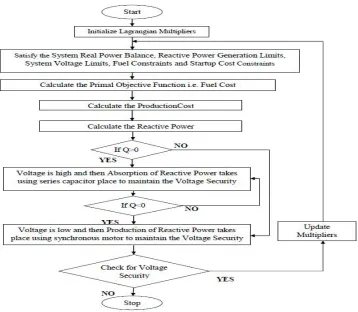
Start the crisis
Initialize the Lagrangian Multipliers. The sum of the multipliers depends on the number of the constraints. Assure the constraints such as real power balance,fuel cost, voltage limits, reactive power and start up cost.
Compute the original Objective Function. The original objective at this point is the fuel Cost. The fuel cost can be planned from the cost coefficients
Compute the Reactive Power on or after the reactance and the voltage of the corresponding units.
Determine the Production Cost as the construction cost is the product of the heat rate plus the fuel cost additional beside the start up cost.
Verify whether the reactive power is superior than or less important than zero. If it is superior than zero go to the subsequent step otherwise go to step 10.
If the reactive power is lesser than zero go to the subsequent step.
Voltage is high and at that time Absorption of Reactive Power takes consign to continue the Voltage Security. Voltage is low down and after that construction of Reactive power takes situate to uphold the Voltage Security. Make sure for Voltage Security. If the voltage is inside the limit go to the step 12 or else go to the subsequent step. Inform the Lagrangian Multipliers and exit to step 2 awaiting the voltage security is attained.
B. Flowchart for Lagrangian Decomposition Approach
[image:5.612.142.500.378.690.2]The flowchart for the proposed algorithm is shown below
Technology (IJRASET)
V. SIMULATION RESULTSIn this paper, the production cost of the generating units is calculated and the voltage is maintained within the limits. The production cost of the 5 generating units are calculated by taking in account the heat rate, fuel cost and start up cost. When the voltage in the system is high reactive power is absorbed. When the voltage in the system is low reactive power is generated in order to maintain the security. The production cost of the units increase when size of the number of the units increases and decreases when the number of the units get reduced. Unit data and load demand for IEEE Standard 14 Bus system and 5generating units are shown below:
Table 6.2.1 Operating Data for 14 Bus Systems
Table 6.2.2 Voltage and Reactance Value for 14 BusSystems Unit Pma
x
Pmin a b c MU M
D
Hcost Ccost
1 250 10
0.0031 5
2.0 0 1 1 70 176
2 139 20 0.0175 1.7 5
0 2 1 74 187
3 100 15 0.0625 1.0 0
0 1 1 50 113
4 120 10 0.0083 4
3.2 5
0 2 2 110 267
5 45 10 0.025 3.0 0
0 1 1 72 180
Uni t
Qmax Qmin Vma x
Vmi n
X C I E
1 10 -10.0 1.0 6 0.8 5 0.059 10 -9.50
10 229
2 0.5 -0.40 1.0 5 0.9 6 0.198 30 -0.41
2.67 210
3 0.4 20.0 1.0 0 0.8 7 0.171 03 19.3 0
3.78 195
4 0.0 17.0 1.0 4 0.9 4 0.042 11 17.3 7 14.9 6 194
Technology (IJRASET)
VI. CONCLUSIONVoltage security is the capability of a power system to keep the steady adequate voltages in the system at standard operating environment and after being subjected to a disturbance.Voltage security is a problem in power systems operation which results due to the occurrence of faulted or has a shortage of reactive power. The problem of voltage security affects the whole system, although it typically has a large participation in one of the critical areas of the power system. The insertion of voltage limits constraints assists the method to achieve a minimal amount of control while maintaining a sufficient voltage profile. The reduced aspect of the optimization problem makes the approach fit for real time crisis management. As future work, Voltage Security Constrained Unit Commitment schedule can be formulated for units like hydro power generation plants, nuclear power plants, wind power generation plants and solar power plants etc.
REFERENCES
[1] Narayana Prasad Padhy, “Unit Commitment - A Bibliographical Survey”, IEEE Transactions on Power Systems, Vol. 19, no. 2, pp.1196-1205, 2004.
[2] Amin Khodaei and Mohammad Shahidehpour,” Transmission switching in security-constrained Unit commitment”, IEEE Transactions on Power Systems, Vol.
25, no. 1, pp.1937-1945, 2010.
[3] Jianhui Wang, Mohammad Shahidehpour, and Zuyi Li, ”Security Constrained Unit Commitment with Volatile Wind Power Generation”, IEEE Transactions on
Power Systems, Vol. 23, no. 3, pp.1319-1327, 2008.
[4] Yong Fu, Mohammad Shahidehpour and Zuyi Li,“Security-constrained unit commitment with ac constraints”, IEEE Transactions on Power Systems, Vol. 20,
no. 3, pp.1538-1550, 2005.
[5] Lei Wu, Mohammad Shahidehpour and Tao Li, “Stochastic Security- Constrained Unit Commitment” , IEEE Transactions on Power Systems, Vol. 22, no. 2,
pp.800-811, 2007.
[6] Xiaohong Guan, Sangang Guo, and Qiaozhu Zhai, “The Conditions for Obtaining Feasible Solutions to Security Constrained Unit Commitment Problems”,
IEEE Transactions on Power Systems, Vol. 20, no. 4, pp.1746-1756, 2005.
[7] Cong Liu, Mohammad Shahidehpour, Yong Fu, and Zuyi Li,”Security-constrained unit commitment with natural gas transmission constraints”, IEEE
Transactions on Power Systems, Vol. 24, no. 3, pp.1523-1536, 2009.
[8] Peter B. Luh, Danqing Yu, Sada Soorapanth, Alexander.I, Khibnik, and Ravi Rajamani, ”A lagrangian relaxation based approach to schedule asset overhaul
and repair services ”, IEEE Transactions on Automation Science and Engineering, Vol. 2, no. 2, pp.145-157, 2005.
[9] Takeshi Seki, Nobuo Yamashita, and Kaoru Kawamoto, ”Demand Response Scheduling by Stochastic SCUC”, IEEE Transactions on Smart Grid, Vol. 1, no.1,
pp.89-98, 2010.
[10] Amin Khodaei and Mohammad Shahidehpour, ”SCUC With Hourly Demand Response Considering Intertemporal Load Characteristics”, IEEE Transactions on