International Research Journal of Natural and Applied Sciences Vol. 4, Issue 6, June 2017 Impact Factor- 5.46 ISSN: (2349-4077)
© Associated Asia Research Foundation (AARF)
Website: www.aarf.asiaEmail : [email protected] , [email protected]
A STUDY ON STABILIZATION OF EXPANSIVE SOIL USING
TERRAZYME
Rajendran. J and Jaisankar. V
Post-Graduate and Research Department of Chemistry, Presidency College,(Autonomous), Chennai-600 005. India
ABSTRACT
Due to rapid industrialization, availability of land is depleting in the developing nations like
India. Because of this scenario it is required to utilize the problematic land for various
construction activities. Various problematic soils are expansive soils, loess, collapsible
soils, dispersive soils etc. These soils can be used for construction purpose only after
adopting suitable ground improvement techniques. Though several methods are available to
improve the problematic soils, chemical stabilization is best suited for improving expansive
soil. Lime and fly ash are the traditional chemical stabilizers used for improving the
characteristics of expansive soil. However, due to advancement in the field of construction
industry, several other chemical stabilizers also available for stabilizing the expansive soils
which requires detailed investigation. Terrazyme is such a stabilizer which started gaining
attention of the researchers. The soil is treated with Terrazyme independently and
tested for the index properties i.e. liquid limit, plastic limit and shrinkage limit and UCC
strength characteristics for 7, 14 and 28 days of curing. The test results indicate that the
plasticity characteristics of soil treated with Terrazyme decreased with increase in
percentage of Terrazyme and curing period. The shrinkage limit values are increased upon
stabilization by Terrazyme. Similarly the UCS values increased with increase in percentage
of Terrazyme and curing period. From the present study it is brought out that Terrazyme can
I.INTRODUCTION
Several parts of arid and semi-arid regions of the world particularly Australia, Canada, China, India, Israel, South Africa and the United States are covered by expansive soils. Expansive soils, typically exhibit moderate to high plasticity, low to moderate strength and high swell-shrink characteristics (Holtz and Gibbs 1956; Sherwood 1962; Puppala et al 2006, Nasrizar et al 2010). Urbanization and industrialization forces the utilization of land with unsuitable soil by improving its properties by using appropriate ground improvement technique in order to meet the engineering requirement. Stabilization of expansive soil by using chemicals is one of the popular methods of improving the properties of expansive soil (Bell, 1993). The addition of lime to such soils to improve their engineering properties so that the stabilized soil could be used for construction purposes has a very long history. For instance, McDowell (1959) mentioned that stabilized earth roads were used in ancient Mesopotamia and Egypt, and that the Greeks and Romans used soil-lime mixtures.
Many researchers concentrated on improving the properties of expansive soil using traditional chemical stabilizers like lime and fly ash, since chemical stabilizers are mostly preferred to stabilize expansive soils. It is a proven fact that these stabilizers improve the engineering properties of expansive soil significantly. Since construction industry is growing in an exponential order, several other chemicals are commercially available which are used during construction. One such chemical used for improvement is Terrazyme. (Agarwal & Kaur, 2014; Lekha e t a l 2013; Saini & Vaishnava, 2015; Swathy et al, 2015; Vinayaga M o u r t h y , 2010), But, the effect of these modern chemicals on improving the engineering properties of expansive soil is not well documented. Therefore, the present study aims to carryout extensive experimental study on the effect of Terrazyme on index properties and strength of expansive soil.
In this study, an expansive soil is treated with different percentages of a Terrazyme which was cured for 7, 14 and 28 days and then liquid limit, plastic limit and shrinkage limit tests are conducted to obtain index properties and also unconfined compressive strength test is conducted to get strength of stabilized soil.
II.MATERIALS A. Soil
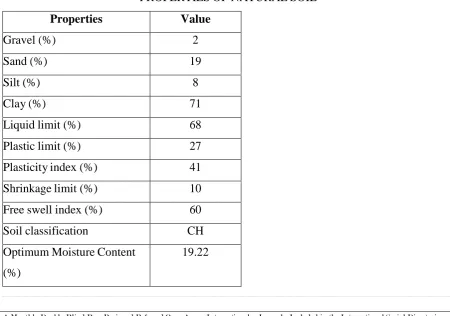
compaction test and unconfined compressive strength tests are conducted on natural soil. The properties of the natural soil are summarized in Table 1. The soil composed of 2% gravel, 19% sand, 8% silt and 71% clay. The soil showed liquid limit of 68%, plastic limit of 27%, plasticity index of 41%, shrinkage limit of 20% and differential free swell index of 60%. As per Indian Soil Classification system, the soil is classified as Clay of High plasticity (CH).
B. Terrazyme
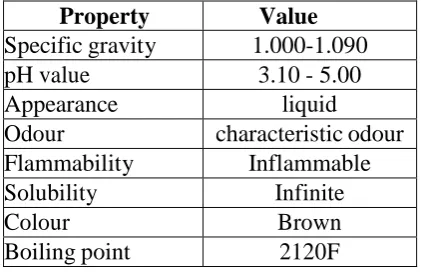
A bio enzyme is used as additive to stabilize the soil in this study. Terrazyme is basically a bio enzymatic product has been used in various part of world for the improvement of pavements. Terrazyme is non toxic, non corrosive and inflammable liquid which can be easily mixed with water. Terrazyme improves the properties of soil and strength of soil significantly. The properties of Terrazyme are shown in Table 2.
C. Experimental Programme
[image:3.595.69.520.463.779.2]Experiments were conducted on natural soil mixed with 0.2, 0.3 & 0.4 ml of Terrazyme per kg of sample and the soil -chemical mix is cured for 7, 14 a nd 28 days prior to testing. The various tests conducted are liquid limit, plastic limit and shrinkage limit tests and also unconfined compressive strength test.
TABLE 1
PROPERTIES OF NATURAL SOIL
Properties Value
Gravel (%) 2
Sand (%) 19
Silt (%) 8
Clay (%) 71
Liquid limit (%) 68
Plastic limit (%) 27
Plasticity index (%) 41
Shrinkage limit (%) 10
Free swell index (%) 60
Soil classification CH
Optimum Moisture Content (%)
TABLE 2
CHEMICAL COMPOSITION OF TERRAZYME
Property Value
Specific gravity 1.000-1.090
pH value 3.10 - 5.00
Appearance liquid
Odour characteristic odour Flammability Inflammable
Solubility Infinite
Colour Brown
Boiling point 2120F
III. RESULTS AND INTERPRETATION
A. Influence of Terrazymes on the properties of soil
The index properties such as liquid limit, plastic limit and shrinkage limit plays a vital role in understanding the engineering behavior of fine grained soil. Irrespective of the soil conditions many empirical correlations have been developed to predict engineering behavior of fine grained soil based on index properties. Atterberg limits are found to correlate with the engineering behavior of soils because both the Atterberg limits and engineering properties are found to be influenced by the same factors such as the clay minerals, the ions in the pore water and the stress history of the soil deposit.
Maximum Dry unit weight
(kN/m3)
16.1
Swell pressure (kN/m2) 200
Fine silts and clays, whose strength is influenced by cohesion is determined from unconfined compressive strength test. The peak values of stress strain curve are designated as unconfined compressive strength test. Unconfined compressive strength test were conducted on samples treated with various percentages of chemicals. The influence of various chemicals on the index and strength properties is dealt in following sub sections.
B. Effect of Terrazyme on Index properties and strength
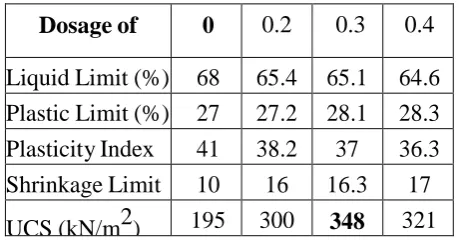
Effect of different percentage of Terrazyme on index properties (liquid limit, plastic limit, plasticity index, shrinkage limit) and UCC strength have been presented in Tables 3 to 5.
C. Effect of percentage of Terrazyme on index properties
Figure 1 shows the variation of liquid limit with curing periods for the Terrazyme dosage of 0.2 ml/kg, 0.3 ml/kg and 0.4 ml/kg of soil. It is observed that liquid limit marginally decreases with curing period and with dosage of Terrazyme added. For 7 days curing period the liquid limit reduces from 68% to 65% for the dosage of 0.3 ml/kg. The liquid limit reduces from 68% to 64.4% for 28 days curing period.
Figure 2 shows the variation of plastic limit for different dosages of Terrazyme with various curing period. The plastic limit has increased slightly from 27% to maximum of 29% with the difference of only 2%. The maximum increase in plastic limit is for enzyme dosage of 0.3 ml/kg of soil for the curing period of 28 days.
Shrinkage limit is an indicative of the structure and swell nature of the soil. For any given soil, the soil with flocculent fabric shrinks lesser than dispersed structure. Figure 4 shows the variation of shrinkage limit with different curing period. The graph shows increase in
TABLE 3
INFLUENCE OF TERRAZYME ON PLASTICITY CHARACTERISTICS AND UCC STRENGTH FOR 7 DAYS CURING
Dosage of
Terrazyme
0 0.2
ml/kg
0.3 ml/kg
0.4 ml/kg Liquid Limit (%) 68 66 65.5 65 Plastic Limit (%) 27 26.6 27 28 Plasticity Index
(%)
41 39.4 38.5 37 Shrinkage Limit
(%)
10 15 14.1 14.3
TABLE 4
INFLUENCE OF TERRAZYME ON PLASTICITY CHARACTERISTICS AND UCC STRENGTH FOR 14 DAYS CURING
Dosage of
Terrazyme
0 0.2
ml/kg 0.3 ml/kg
0.4 ml/kg Liquid Limit (%) 68 65.4 65.1 64.6 Plastic Limit (%) 27 27.2 28.1 28.3 Plasticity Index
(%)
41 38.2 37 36.3 Shrinkage Limit
(%)
10 16 16.3 17
[image:6.595.77.307.123.246.2]UCS (kN/m2) 195 300 348 321
TABLE 5
STUDY INFLUENCE OF TERRAZYME ON PLASTICITY CHARACTERISTICS AND UCC STRENGTH FOR 28 DAYS CURING
Dosage of
Terrazyme
0 0.2
ml/kg 0.3 ml/kg
0.4 ml/kg Liquid Limit (%) 68 65.2 65 64.4 Plastic Limit (%) 27 27 28.4 29 Plasticity Index
(%)
41 38.2 36.6 35.4 Shrinkage Limit
(%)
10 17 17.5 17.5
UCS (kN/m2) 195 331.6 400.93 373.8
Fig.1. Liquid limit vs curing period for various percentage of Terrazyme
Fig.2. Plastic Limit vs curing period for various percentage of Terrazyme
Fig.4. Shrinkage Limit vs curing period for various percentage of Terrazyme
D. Effect of percentage of Terrazyme on strength properties
Remoulded specimens were prepared using three levels of Terrazyme. The Terrazyme mixed soil was also cured for the period of 7, 14 and 28 days. Figures 5 to 7 show the variation of axial stress with axial strain for various dosages of Terrazyme for 7, 14 and 28 days curing period respectively. From Figures 5 to 7 it can be seen clearly that strength increases for all dosages of Terrazyme. It can be seen from the figure 5 that the sample fails at maximum axial stress of 207 kPa, 311 kPa and 320 kPa for Terrazyme dosage of 0.2 ml/kg, 0.3 ml/kg and 0.4 ml/kg respectively. From the dosages considered in the present study it is observed that 0.3 ml/kg gives higher UCS except for 7 days curing.
Fig.5. Stress-strain relationships for Terrazyme stabilized soil after 7 days curing period
Fig.7. Stress-strain relationships for Terrazyme stabilized soil after 28 days curing period
Fig.8. Variation of UCS of stabilized soil cured for 7, 14 and 28 days with different percentages of Terrazyme
The peak value of stress was obtained from the stress-strain curves which are designated as unconfined compressive strengt (UCS). Figure 8 show the variation of UCS with different dosage of Terrazyme for all curing period. It shows increase in strength with increase in curing period. The increase in strength was found to be higher for 0.3 ml/kg Terrazyme dosage for higher curing days. This increase in strength is due to the enzymatic reaction of Terrazyme with adsorbed layer on surface of clay particles. Terrazyme replaces adsorbed water with organic cations, thus neutralizing the negative charge on a clay particle. The organic cations also reduce the thickness of the electrical double layer. This allows Terrazyme treated soils to be compacted more tightly together. These factors can promote the superior density and inturn leads to higher strength.
IV. CONCLUSION
percentage of Terrazyme and duration of curing period. The general conclusions drawn from the analysis of test results are further below.
1. Addition of Terrazyme, decreases the liquid limit and increases the plastic limit which in turn decreases plasticity index values of soil. The reduction in plasticity characteristic has been attributed to the suppression of double layer thickness caused by cation exchange of high valency ions. Reduction in plasticity behavior reduces the swelling nature of soil.
2. The shrinkage limit of soil treated with Terrazyme has increased moderately with increase in percentage of chemical and curing period. The higher the shrinkage limit lower is its swell-shrinkage behavior of soil.
3. The unconfined compressive strength was increased for any percentage of Terrazyme. The increase in strength for Terrazyme treated soil was 2 folds higher than that of untreated soil for dosage of 0.3 ml/kg.
4. The soil samples treated with Terrazyme shows ductile nature of failure
5. The strength increases as the curing period increases for Terrazyme.
A. General conclusion
The study was intended to look for the possibility of using Terrazyme for the improvement of problematic soil as a substitute for ordinary commercial chemical such as Lime, owing to the specific advantage of these chemicals. The Terrazyme when mixed with soils reduces the plasticity characteristics and enhances the strength soil considerably. Hence it is concluded that Terrazyme can also be used to improve the characteristics of expansive soil.
REFERENCES
1. Agarwal P. and Kaur S. (2014), „Effect of Bio-Enzyme Stabilization on Unconfined Compressive Strength of Expansive Soil‟, International Journal of Research in Engineering and Technology, Vol.03, No. 05, pp. 30-33.
3. Holtz, W. G. and Gibbs, H. J. “Engineering properties of expansive clays.” Transactions of the American Society of Civil Engineers, Vol.121, pp. 641-677, 1956.
4. Lekha B.M., Sarang G., Chaitali N. and Shankar R.A.U. (2013), „Laboratory Investigation on black cotton soil stabilized with Non Traditional stabilizer‟, International Conference on Innovations in Civil Engineering, No. 2278-1684, pp.7-13.
5. McDowell, C. (1959) „„The relation of laboratory testing to design for pavements and structures on expansive soils.‟‟ Quart. Colorado School of Mines, Vol. 54, No. 4, pp. 127-153.
6. Nasrizar, A.A., Muttharam, M. and Ilamparuthi, K. (2010) “Effect of Placement Water Content on Strength of Temperature Cured Lime Treated Expansive Soil”,
ASCE, Geotechnical Special Publication,Vol. 207, pp. 174-180.
7. Puppala, A. J., Konnamas, P., and Vanapalli, S. K. (2006) “Soil-Water Characteristic Curves of Stabilized Expansive Soils”, Geotechnical and Geoenvironmental
Engineering., Vol. 132, No. 6, pp. 736-751.
8. Saini V. and Vaishnava P. (2015), „soil stabilization by using Terrazyme‟, International Journal of Advances in Engineering and Technology (IJAET),Vol. 8, No. 4, pp. 566-573.
9. Sherwood, P. T. (1967), “Views of Road Research laboratory on soil stabilization in the UK.” Cement, Lime and Gravel. Vol.42, pp. 277-280.
10. Swathy M., Muraleedharan and Niranjana K. (2015), „Stabilisation of Weak Soil using BioEnzyme‟, International Journal of Advanced Research Trends in Engineering and Technology (IJARTET) Vol. 2, No. 10,pp. 25-29.