A Transition-based System for Universal Dependency Parsing
Hao Wang1,2, Hai Zhao1,2,∗, Zhisong Zhang1,2
1Department of Computer Science and Engineering, Shanghai Jiao Tong University 2Key Laboratory of Shanghai Education Commission for Intelligent Interaction and Cognitive Engineering, Shanghai Jiao Tong University, Shanghai, 200240, China
{wanghao.ftd, zzs2011}@sjtu.edu.cn, [email protected],
Abstract
This paper describes the system for our participation of team Wanghao-ftd-SJTU in the CoNLL 2017 Shared Task: Multi-lingual Parsing from Raw Text to Univer-sal Dependencies. In this work, we design a system based on UDPipe1 for
univer-sal dependency parsing, where transition-based models are trained for different tree-banks. Our system directly takes raw texts as input, performing several intermediate steps like tokenizing and tagging, and fi-nally generates the corresponding depen-dency trees. For the special surprise lan-guages for this task, we adopt a delexical-ized strategy and predict based on trans-fer learning from other related languages. In the final evaluation of the shared task, our system achieves a result of 66.53% in macro-averaged LAS F1-score.
1 Introduction
Universal Dependencies (UD) (Nivre et al.,2016, 2017b) and universal dependency parsing take ef-forts to build cross-linguistically treebank annota-tion and develop cross-lingual learning to parse many languages even low-resource languages. Universal Dependencies release 2.02(Nivre et al.,
2017b) includes rich languages and treebanks re-sources and the parsing task in CoNLL 2017 is
∗Correspondence author. This paper was partially
sup-ported by Cai Yuanpei Program (CSC No. 201304490199 and No. 201304490171), National Natural Science Foun-dation of China (No. 61170114, No. 61672343 and No. 61272248), National Basic Research Program of China (No. 2013CB329401), Major Basic Research Program of Shang-hai Science and Technology Committee (No. 15JC1400103), Art and Science Interdisciplinary Funds of Shanghai Jiao Tong University (No. 14JCRZ04), Key Project of National Society Science Foundation of China (No. 15-ZDA041).
1http://ufal.mff.cuni.cz/udpipe 2http://universaldependencies.org/
based on this dataset. In fact, dependency pars-ing has been adopted as topic of the shared task in CoNLL-X and CoNLL-2007 (Buchholz and Marsi,2006;Nivre et al.,2007), which have been the milestones for the researching field of parsing. This time, the task is taking a universal annotation version and trying to exploit cross-linguistic simi-larities between various languages.
In this paper, we describe the system of team Wanghao-ftd-SJTU for the CoNLL 2017 Shared Task: Multilingual Parsing from Raw Text to Uni-versal Dependencies (Zeman et al., 2017). For this task, we only use provided treebanks to train models without any other resources including pre-trained embeddings.
For dependency parsing, there have been two major parsing methods: graph-based and transition-based. The former searches for the fi-nal tree through graph algorithms by decompos-ing trees into factors, utilizdecompos-ing decompos-ingenious dynamic programming algorithms (Eisner, 1996; McDon-ald et al., 2005; McDonald and Pereira, 2006); while the latter parses sentences by making a se-ries of shift-reduce decisions (Yamada and Mat-sumoto, 2003; Nivre, 2003). In our system, we will utilize the transition-based system for its sim-plicity and relatively lower computation cost.
Transition-based dependency parsing takes lin-ear time complexity and utilizes rich features to make structural prediction (Zhang and Clark, 2008; Zhang and Nivre, 2011). Specifically, a buffer for input words, a stack for partially built structure and shift-reduce actions are basic ele-ments in a transition-based dependency parsing. For the transition systems of dependency parsing, there have been two major ones:arc-standardand arc-eager (Nivre, 2008). Our system adopts the former, whose basic algorithm can be described as
following:
Start:σ= [ROOT], β=w1, ..., wn, A=∅ 1.Shift:
σ, wi|β, A→σ |wi, β, A 2.Left-Arcr :
σ|wi |wj, β, A→σ |wj, β, A∪r(wj, wi) 3.Right-Arcr :
σ|wi |wj, β, A→σ |wi, β, A∪r(wi, wj) Finish:σ= [w], β=∅
where σ, β, A represent the stack, queue and the actions respectively.
One major difference for parsing between the situation of current and that of ten years ago is that recently we have seen a rising of neu-ral network based methods in the field of Natu-ral Language Processing and parsing has also been greatly changed by the neural methods. With dis-tributed representation for words and sentences and the powerful non-linear calculation ability of the neural networks, we could explore deeper syn-tactic and maybe semantic meaning in text analy-sis, and both graph-based (Pei et al.,2015;Wang and Chang,2016) and transition-based (Chen and Manning, 2014; Weiss et al., 2015; Dyer et al., 2015;Andor et al., 2016) parsing have benefited a lot from neural representation learnings. In our system, the model, which is trained by UDPipe, for the transition action predictor is also based on neural network, which is similar to the one of Chen and Manning(2014).
For this shared task, our system is built based on UDpipe (Straka et al., 2016), which provides a pipeline from raw text to dependency structures, including a tokenizer, taggers and the dependency predictor. We trained and tuned the models on different treebanks, and in the final evaluation, a score of 66.53% in macro-averaged LAS F1-score measurement is achieved. In the task, there are several surprise languages which lack of annotated resources, which means it is hard to train spec-ified models for those languages. To tackle this problem, we exploit the universal part-of-speech (POS) tags, which could be represented as cross-lingual knowledge to avoid language-specific in-formation, and adopting a delexicalized and cross-lingual method, which relies solely on universal POS tags and annotated data in close-related lan-guages.
The rest of the paper is organized as follows:
Multi-lingual Inputs
Model Selector
Raw Text
Tokenizer
Tagger
Parser Parser
CoNLL-U
Known Language
[image:2.595.315.524.65.384.2]Parser Surprise Language Parser
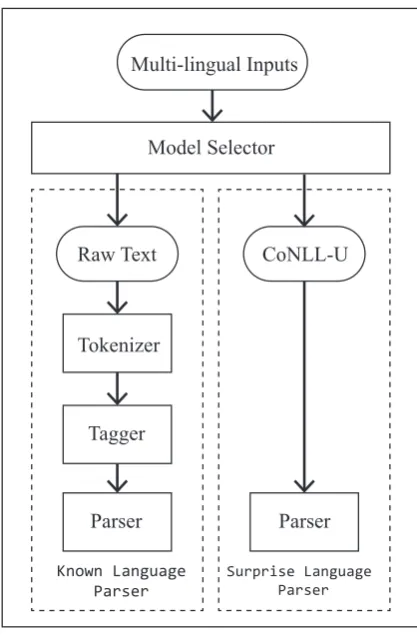
Figure 1: System overview.
Section 2 describes our system overview, Section 3 elaborates the components of the system, Sec-tion 4 shows the experiments and results for our participation in the shared task, and Section 5 con-cludes this paper.
2 System Overview
The overall architecture of our universal depen-dency parser is shown in Figure 1. The whole system can be divided into two parts:Known Lan-guage ParserandSurprise Language Parser. The former deals with known languages, including rich resource treebanks and low resource treebanks, whose annotations as the training data are acces-sible, while the latter disposes of the ones with-out dependency annotations. When the text to be processed by the system is inputed, it is first dis-criminated as rich-resource or low-resource and then dispatched to the corresponding sub-systems, which will be described as follows.
For the Known Language Parser, the related pipeline contains three steps as follow.
anal-ysis, which is the main task of the tokenizer. For all rich resource languages, we train tokenziers us-ing provided trainus-ing data, includus-ing the languages which can be easily tokenized by specific delim-iters.
(2) Tagger The tokenized texts are labeled by taggers, which provides them with the tags which will be utilized in the later dependency analysis, such as POS and morphological features. Like the previous step, we train taggers for all the rich re-source languages.
(3) Dependency Parser Tokens and linguistic features generated by taggers are put into the de-pendency parser to generate the final dede-pendency structures.
For Surprise Language Parser, only Depen-dency Parseris needed. We directly take the pro-vided CoNLL-U files which already include the tokens and features as inputs and predicts the re-sults. Without annotated training data, we could not train the tokenizers and taggers for these lan-guages; Meanwhile for the parsing, we adopt a delexicalized and cross-lingual strategy, which will be described later in Section3.3.
3 System Components
3.1 Model Selector
In the final testing phase of the shared task, there are mainly three types of test data (Nivre et al., 2017a), Ordinary Provided Resource Test Set which have corresponding training datasets , Parallel Test Set which concerns selected known languages but may have different domain from their training data andSurprise Languageswhose training annotations are not available in the pro-vided dataset. The model selector aims to discrim-inate these different input types, and dispatch the inputs to different sub-systems. Specifically, for the first two types which we refer to as Known Language, they will be dealt by the Known Lan-guage Parser, while theSurprise Language Parser will dispose with the surprise languages.
As forParallel Test Set, we use its correspond-ing treebank without specific domain in treebank name.3
3It may be better if we use the whole treebanks of corre-sponding language
Parameter Name Value tokenize url 1 allow spaces 1
iterations 20
batch size 50
learning rate 0.005
[image:3.595.354.478.60.161.2]dropout 0.1
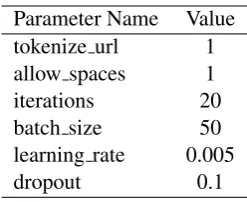
Table 1: Parameters for the training of tokenizers.
Parameter Name Value guesser suffix rules 8 guesser prefixes max 4 guesser prefix min count 10 guesser enrich dictionary 0
iterations 20
[image:3.595.333.502.189.344.2]dimension of upostag 20 dimension of feats 20 dimension of xpostag 20 dimension of form 50 dimension of deprel 20
Table 2: Parameters for the training of taggers.
3.2 Known Language Parser 3.2.1 Tokenizer
In theKnown Language Parser, the first step is to tokenize the input raw text, generating the basic units for later processing. We train tokenizers for all the languages using UDPipe, including those ones which are quite easy to separate using simple rules, like identifying the blank spaces in English. Considering there are some languages that could not be simply tokenized by blank spaces, we adopt this unified treatment for this step. The tokenizers are trained mainly using the SpaceAfter features provided in the CoNLL-U files and the parameters ofUDPipe Tokenizerare shown in Table1. 3.2.2 Tagger
1. Lemma: Lemma or stem of word forms. 2. UPOS: Universal POS tags.
3. XPOS: Language-specific POS tags.
4. FEATS: Morphological features from the uni-versal feature inventory or from a defined language-specific extension.
These features will be used as inputs in the final parsing step for Rich Resource Languages. 3.2.3 Dependency Parser
For the final step, we generate the final depen-dency outputs with the tokens and features gen-erated by the pre-trained POS taggers. The parser uses Parsito (Straka et al., 2015b). Parsito4 is a
transition-based parser with neural network clas-sifier, which is similar to the one of (Chen and Manning, 2014). The inputs to the model rep-resent the current configuration of the stack and buffer, including features of the top three nodes on both of them and child nodes of the nodes on the stack. After we projected features to embed-dings and concatenated the generated embedembed-dings to representations of features, the vector represen-tations of the input are fed to a hidden layer ac-tivated withtanh, and the output layer is softmax indicating the probabilities of each possible tran-sition actions.
The parser supports projective and non-projective dependency parsing, which is config-ured by the option transition system. In Univer-sal Dependencies release 2.0, only UD Japanese and UD Galician have no non-projective depen-dency trees; while UD Chinese, UD Polish and UD Hebrew have a few non-projective trees, around 1% in the treebanks. According to the pro-jective tree quantities of the whole treebanks5, we
train non-projective parsing for most treebanks ex-cept UD Japanese and UD Galician. In projective parsing, we use dynamic oracle which usually per-forms better but more slowly. In non-projective parsing, we use static lazy and search-based ora-cle (Straka et al.,2015a).
Excepttransition systemoption, other configu-rations ofParsitoare the same in all the training of different treebanks. For the structured interval option, we kept the default value 8. To make sure that there is a only single root when pars-ing,single rootoption is set to 1. Transition-based
4http://ufal.mff.cuni.cz/parsito
5Projective tree extraction script is from https://github.com/ftyers/ud-scripts
Parameter Name Value
iteration 20
hidden layer 200
batch size 10
[image:4.595.339.491.61.201.2]learning rate 0.1 dimension of upostag 20 dimension of feats 20 dimension of xpostag 20 dimension of form 50 dimension of deprel 20
Table 3: Parameters for the training of parsers.
Surprise Language Source Language
Buryat Turkish
Kurmanji Persian
North Sami Finnish
Upper Sorbian Czech
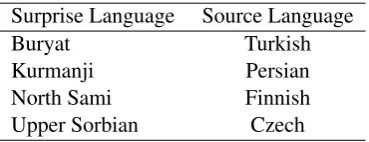
Table 4: Surprise languages and corresponding source languages.
method could employ rich features effectively. In our system, we use the linguistic features gener-ated by previous taggers, including lemma, POS tags and morphological features as described in Section3.2.2. The parameters for the parser train-ing are shown in Table3.
3.3 Surprise Language Parser
This sub-system deals with the surprise languages without enough training data. We use a simple delexicalized and cross-lingual method, that is, parsing these low resource languages based on the models learned from other languages. This fol-lows the method of (Zeman and Resnik, 2008), which shows that transfer learning for another lan-guage based on delexicalized parser can perform well. Although different languages may have dif-ferent word forms, the underlying syntactic in-formation could overlap and the universal POS tags could be utilized to explore the correlations. To achieve this, we train a dependency parser in a close-relation language (source language) for a surprise language, and then feed the delexicalized POS tag sequence of the surprise language to the source language parser. We consider language family and close area to find the source language for surprise language. Table4shows surprise lan-guages and their corresponding source lanlan-guages we found.
[image:4.595.325.510.232.303.2]Treebank’s Type LAS Big treebanks 71.20 PUD treebanks 65.55 Small treebanks 52.13 Surprise languages 34.49
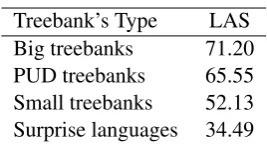
Table 5: Results of main types of treebanks.
Surprise Language LAS UAS
Buryat 28.11 49.67
Kurmanji 19.85 30.49
[image:5.595.95.270.166.250.2]North Sami 33.39 45.60 Upper Sorbian 56.60 64.33 Macro-average 34.49 47.52 Table 6: Final LAS scores for the surprise lan-guages.
predict the surprise language’s dependency struc-tures. The input is CoNLL-U file in which we fil-ter other linguistic features except Universal POS tags. Blind test results of surprise language are showed in Section4.
Results Our System Best
LAS 66.53 76.30
UAS 72.69 81.30
CLAS 60.85 72.57
UPOS 90.63 93.09
XPOS 79.64 82.27
Morphological Features 82.27 82.58 Morphological Tags 73.81 73.92
Lemmas 81.63 83.74
Sentence segmentation 88.40 89.10 Word Segmentation 98.55 98.81
Tokenization 98.81 98.95
Table 7: Final results for the task.
4 Results
Evaluation process of this shared task is deployed in TIRA6(Potthast et al.,2014). LAS is the main
scoring metric and we show performances of our system in several types of treebanks in Table5 us-ing the same groups as the official results. What’s more, LAS of our system in Surprise Languages are shown in Table 6. We show several official evaluation results such as LAS, UAS and other re-sults and compared with best rere-sults in Table7.
6http://www.tira.io/tasks/conll
5 Conclusion
In this paper, we describe the universal depen-dency parser for our participation in the CoNLL 2017 shared task. The official evaluation shows that our system achieves 66.53% in macro-averaged LAS F1-score measurement on the of-ficial blind test. Further improvements could be obtained by more carefully fine-tuning models and adopting more sophisticated neural models.
References
Daniel Andor, Chris Alberti, David Weiss, Aliaksei Severyn, Alessandro Presta, Kuzman Ganchev, Slav Petrov, and Michael Collins. 2016. Globally nor-malized transition-based neural networks. In Pro-ceedings of the 54th Annual Meeting of the Associa-tion for ComputaAssocia-tional Linguistics (Volume 1: Long Papers). Berlin, Germany, pages 2442–2452.
Sabine Buchholz and Erwin Marsi. 2006. Conll-x shared task on multilingual dependency parsing. In
Proceedings of the Tenth Conference on Computa-tional Natural Language Learning (CoNLL-X). As-sociation for Computational Linguistics, New York City, pages 149–164.
Danqi Chen and Christopher Manning. 2014. A fast and accurate dependency parser using neural net-works. InProceedings of the 2014 Conference on Empirical Methods in Natural Language Processing (EMNLP). Doha, Qatar, pages 740–750.
Michael Collins. 2002. Discriminative training meth-ods for hidden markov models: Theory and experi-ments with perceptron algorithms. InProceedings of the 2002 Conference on Empirical Methods in Natural Language Processing. pages 1–8.
Chris Dyer, Miguel Ballesteros, Wang Ling, Austin Matthews, and Noah A. Smith. 2015. Transition-based dependency parsing with stack long short-term memory. In Proceedings of the 53rd Annual Meeting of the Association for Computational Lin-guistics and the 7th International Joint Conference on Natural Language Processing (Volume 1: Long Papers). Beijing, China, pages 334–343.
Jason M. Eisner. 1996. Three new probabilistic mod-els for dependency parsing: An exploration. In
Proceedings of the 16th International Conference on Computational Linguistics. Copenhagen, pages 340–345.
[image:5.595.73.296.384.549.2]Ryan McDonald and Fernando Pereira. 2006. Online learning of approximate dependency parsing algo-rithms. InProceedings of the 11th Conference of the European Chapter of the ACL (EACL 2006). pages 81–88.
Joakim Nivre. 2003. An efficient algorithm for pro-jective dependency parsing. In Proceedings of the 8th International Workshop on Parsing Technologies (IWPT). pages 149–160.
Joakim Nivre. 2008. Algorithms for deterministic in-cremental dependency parsing. Computational Lin-guistics34(4):513–553.
Joakim Nivre, ˇZeljko Agi´c, Lars Ahrenberg, et al. 2017a. Universal dependencies 2.0 CoNLL 2017 shared task development and test data. LIN-DAT/CLARIN digital library at the Institute of For-mal and Applied Linguistics, Charles University. http://hdl.handle.net/11234/1-2184.
Joakim Nivre, Marie-Catherine de Marneffe, Filip Gin-ter, Yoav Goldberg, Jan Hajiˇc, Christopher Man-ning, Ryan McDonald, Slav Petrov, Sampo Pyysalo, Natalia Silveira, Reut Tsarfaty, and Daniel Zeman. 2016. Universal Dependencies v1: A multilingual treebank collection. InProceedings of the 10th In-ternational Conference on Language Resources and Evaluation (LREC 2016). Portoro, Slovenia, pages 1659–1666.
Joakim Nivre, Johan Hall, Sandra K¨ubler, Ryan Mc-Donald, Jens Nilsson, Sebastian Riedel, and Deniz Yuret. 2007. The CoNLL 2007 shared task on de-pendency parsing. In Proceedings of the CoNLL Shared Task Session of EMNLP-CoNLL 2007. As-sociation for Computational Linguistics, Prague, Czech Republic, pages 915–932.
Joakim Nivre et al. 2017b. Universal Dependencies 2.0. LINDAT/CLARIN digital library at the Insti-tute of Formal and Applied Linguistics, Charles Uni-versity, Prague. http://hdl.handle.net/11234/1-1983.
Wenzhe Pei, Tao Ge, and Baobao Chang. 2015. An effective neural network model for graph-based de-pendency parsing. In Proceedings of the 53rd An-nual Meeting of the Association for Computational Linguistics and the 7th International Joint Confer-ence on Natural Language Processing (Volume 1: Long Papers). Beijing, China, pages 313–322.
Martin Potthast, Tim Gollub, Francisco Rangel, Paolo Rosso, Efstathios Stamatatos, and Benno Stein. 2014. Improving the reproducibility of PAN’s shared tasks: Plagiarism detection, author identifica-tion, and author profiling. In Evangelos Kanoulas, Mihai Lupu, Paul Clough, Mark Sanderson, Mark Hall, Allan Hanbury, and Elaine Toms, editors, In-formation Access Evaluation meets Multilingual-ity, MultimodalMultilingual-ity, and Visualization. 5th Interna-tional Conference of the CLEF Initiative (CLEF 14). Berlin Heidelberg New York, pages 268–299.
Milan Straka, Jan Hajic, Jana Strakov´a, and Jan Ha-jic jr. 2015a. Parsing universal dependency tree-banks using neural networks and search-based or-acle. InInternational Workshop on Treebanks and Linguistic Theories (TLT14). page 208.
Milan Straka, Jan Hajiˇc, and Jana Strakov´a. 2016. UD-Pipe: trainable pipeline for processing CoNLL-U files performing tokenization, morphological anal-ysis, pos tagging and parsing. In Proceedings of the Tenth International Conference on Language Re-sources and Evaluation (LREC’16). Paris, France. Milan Straka, Jan Hajiˇc, Jana Strakov´a, and Jan
Hajiˇc jr. 2015b. Parsing universal dependency tree-banks using neural networks and search-based or-acle. In Proceedings of Fourteenth International Workshop on Treebanks and Linguistic Theories (TLT 14).
Jana Strakov´a, Milan Straka, and Jan Hajiˇc. 2014. Open-Source Tools for Morphology, Lemmatiza-tion, POS Tagging and Named Entity Recognition. In Proceedings of 52nd Annual Meeting of the As-sociation for Computational Linguistics: System Demonstrations. Baltimore, Maryland, pages 13– 18.
Wenhui Wang and Baobao Chang. 2016. Graph-based dependency parsing with bidirectional lstm. In Pro-ceedings of the 54th Annual Meeting of the Associa-tion for ComputaAssocia-tional Linguistics (Volume 1: Long Papers). Berlin, Germany, pages 2306–2315. David Weiss, Chris Alberti, Michael Collins, and Slav
Petrov. 2015. Structured training for neural net-work transition-based parsing. InProceedings of the 53rd Annual Meeting of the Association for Compu-tational Linguistics and the 7th International Joint Conference on Natural Language Processing (Vol-ume 1: Long Papers). Beijing, China, pages 323– 333.
Hiroyasu Yamada and Yuji Matsumoto. 2003. Statis-tical dependency analysis with support vector ma-chines. In Proceedings of the 8th International Workshop on Parsing Technologies (IWPT). pages 195–206.
Mandl, Jesse Kirchner, Hector Fernandez Alcalde, Jana Strnadova, Esha Banerjee, Ruli Manurung, An-tonio Stella, Atsuko Shimada, Sookyoung Kwak, Gustavo Mendonc¸a, Tatiana Lando, Rattima Nitis-aroj, and Josie Li. 2017. CoNLL 2017 Shared Task: Multilingual Parsing from Raw Text to Universal Dependencies. InProceedings of the CoNLL 2017 Shared Task: Multilingual Parsing from Raw Text to Universal Dependencies. Association for Computa-tional Linguistics.
Daniel Zeman and Philip Resnik. 2008. Cross-language parser adaptation between related lan-guages. InIJCNLP. pages 35–42.
Yue Zhang and Stephen Clark. 2008. A tale of two parsers: Investigating and combining graph-based and transition-based dependency parsing. In Pro-ceedings of the 2008 Conference on Empirical Meth-ods in Natural Language Processing. Honolulu, Hawaii, pages 562–571.
Yue Zhang and Joakim Nivre. 2011. Transition-based dependency parsing with rich non-local features. In