Proceedings of the CoNLL 2018 Shared Task: Multilingual Parsing from Raw Text to Universal Dependencies, pages 256–263 Brussels, Belgium, October 31 – November 1, 2018. c2018 Association for Computational Linguistics
256
A Simple yet Effective Joint Training Method for
Cross-Lingual Universal Dependency Parsing
Danlu Chen*1, Mengxiao Lin*12, Zhifeng Hu*1, Xipeng Qiu1
1Fudan University 2Megvii Inc
[email protected], [email protected], {zfhu16,xipeng}@fudan.edu.cn
Abstract
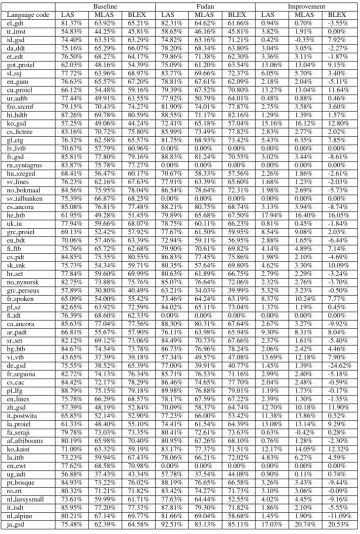
This paper describes Fudan’s submission to CoNLL 2018’s shared task Universal Dependency Parsing. We jointly train models when two languages are simi-lar according to linguistic typology and then do an ensemble of the models us-ing a simple re-parse algorithm. Our system outperforms the baseline method by 4.4% and 2.1% on the develop-ment and test set of CoNLL 2018 UD Shared Task, separately.1. Our code is available on https://github.com/ taineleau/FudanParser.
1 Introduction
Dependency Parsing has been a fundamental task in Natural Language Processing (NLP). Recently, universal dependency parsing (Zeman et al.,
2018a,b; Nivre et al., 2018) has unified the an-notations of different languages and thus made transfer learning among languages possible. Sev-eral works using cross-lingual embedding (Duong et al.,2015;Guo et al.,2015) have successfully in-creased the accuracy of cross-lingual parsing. Be-yond embedding-based methods, a natural ques-tion is whether we can use a simple way to utilize the universal information. Some previous research either regarded the universal information as ex-tra ex-training signals (e.g., delexicalized embedding (Dehouck and Denis,2017)), or implicitly trained a network with all features (e.g., adversarial train-ing for parstrain-ing in Sato et al.(2017)). In our sys-tem, we manually and explicitly share the univer-sal annotations via a shared LSTM component.
* Authors contributed equally.
1Unfortunately, we did not finish the run before the
dead-line. As a result, the official accuracy gain for test set is only 0.54% and we ranks 17th out of 27 teams.
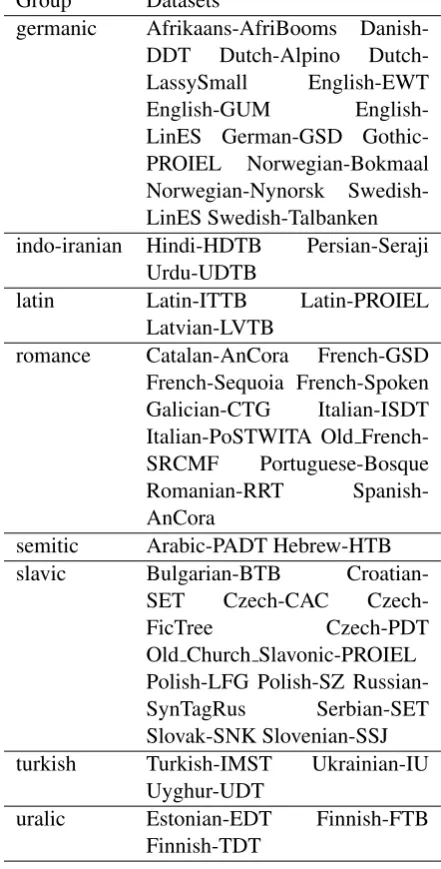
Similar to Vania et al. (2017), different lan-guages are first grouped based on typology, as shown in table1. Then, we train a shared model for each pair of languages within the same group, and apply a simple ensemble method over all trained models. Note that our method is orthogo-nal to other cross-lingual approaches for universal parsing such as cross-lingual embedding.
In the following parts, we first describe the baseline method (Section2) and our system (Sec-tion3). We show the result on both development set and test set in Section4and provide some anal-ysis of the model in Section5.
2 Baseline
In this section, we briefly introduce the baseline system, UDPipe 1.2 (Straka and Strakov´a,2017), which is an improved version of original UDPipe (Straka et al.,2016). The tokenizing, POS tagging and lemma outputs of UDPipe are utilized by Fu-danParser.
UDPipe employs a GRU network during the in-ference of segmentation and tokenization. The tagger uses characters features to predict the POS and lemma tags. Finally, a transition-based neu-ral dependency parser with one hidden layer pre-dicts the transition actions. The parser also makes use of the information from lemmas, POS taggings and dependency relationships through a group of embeddings precomputed byword2vec.
In the later discussion, we take the baseline per-formance result from the web page of the shared task2for comparison.
3 System Description
In this submission, we only consider parsing in an end-to-end manner and handle each treebank
sep-2http://universaldependencies.org/
Group Datasets
germanic Afrikaans-AfriBooms
Danish-DDT Dutch-Alpino
Dutch-LassySmall English-EWT
English-GUM
English-LinES German-GSD Gothic-PROIEL Norwegian-Bokmaal Norwegian-Nynorsk Swedish-LinES Swedish-Talbanken indo-iranian Hindi-HDTB Persian-Seraji
Urdu-UDTB
latin Latin-ITTB Latin-PROIEL
Latvian-LVTB
romance Catalan-AnCora French-GSD
French-Sequoia French-Spoken Galician-CTG Italian-ISDT Italian-PoSTWITA Old
French-SRCMF Portuguese-Bosque
Romanian-RRT
Spanish-AnCora
semitic Arabic-PADT Hebrew-HTB
slavic Bulgarian-BTB
Croatian-SET Czech-CAC
Czech-FicTree Czech-PDT
Old Church Slavonic-PROIEL Polish-LFG Polish-SZ
Russian-SynTagRus Serbian-SET
Slovak-SNK Slovenian-SSJ
turkish Turkish-IMST Ukrainian-IU
Uyghur-UDT
uralic Estonian-EDT Finnish-FTB
[image:2.595.70.291.180.615.2]Finnish-TDT
Table 1: Grouping languages according to typol-ogy.
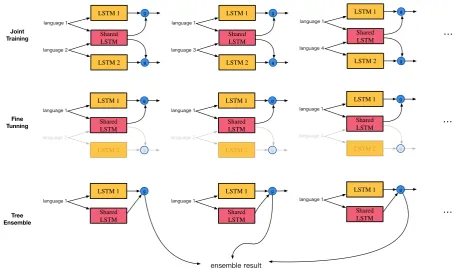
arately. We first train a monotonic model for all “big” treebanks. Besides, for each language, there areN−1models fine-tuned from joint-trained (see Figure2), whereN is the number of languages in the same language group.
For small treebanks where training set is less than 50 sentences, we use the delexicalized method the same as Shi et al. (2017)’s approach for the surprise languages. Shi et al.(2017) took delexicalized features (morphology and POS tag) as input and apply 50% dropout rate to the input. In practice, we found that the baseline method per-forms much better than ours on“fi pud”, “br keb” “ja modern” and “th pud”, so we use the baseline method instead for these languages.
Our whole system needs about 90 hours to do the inference of all models on TIRA and requires no more than 560M main memory.
3.1 Architecture
Features We use words, characters as the lex-ical information, and use morphologlex-ical features3 and POS tags as the delexicalized information. We also tried subword embeddings, but it mostly did not help. More precisely, the character-level fea-tures are treated as bag-of-characters. Similarly, we use bag-of-morphology for morphological fea-tures (one can see number=single as a charac-ter). We first assign the embedding vectors for characters and morphological features, and then for each word, we apply a Convolutional Network (CNN) to encode variable length embeddings into one fixed length feature.
Biaffine BiLSTM. Similar to Shi et al.(2017);
Sato et al.(2017);Vania et al.(2017), we use last year’s first-place model (Dozat et al., 2017), the graph-based biaffine bizLSTM model as our back-bone. Given a sentence ofN words, the input is first fed to a bi-directional LSTM and obtain the feature of each wordwi. A head MLP and a
de-pendent MLP are used to translate the features, which is then fed into a hidden layer to calculate the biaffine attention. Finally, we are able to com-pute the score of arcs and labels in following way:
3
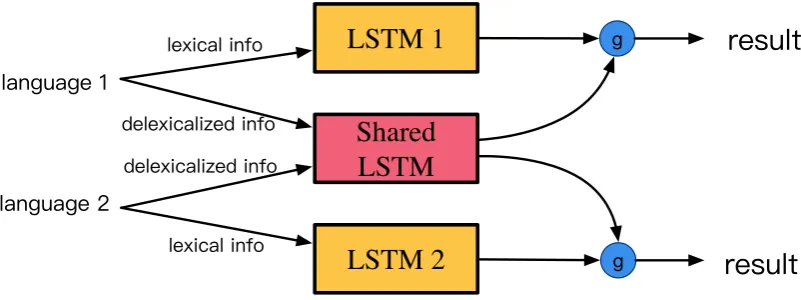
LSTM 1
Shared
LSTM
LSTM 2
g
[image:3.595.97.498.63.213.2]g
Figure 1: An illustration of the joint training framework for two languages.
hhi =MLPhead(wi)
hdi =MLPdep(wi)
si=HhU1hdi +Hhu2
whereU1 ∈ Rd×dandu2 ∈ Rdare trainable
pa-rameters.
3.2 Joint Training
For a joint training model ofNlanguages, we have
N+1Biaffne Bi-LSTMs (called LSTMs), see Fig-ure 1. For each language, we have a language-specific LSTM to process the lexical information such as word- or character- level embedding, and the output is wl
i,j. For all languages we have a
shared LSTM which takes delexicalized informa-tion such as morphology and POS tags as input and the output is wdi,j. Inspired by Sato et al.
(2017), we use a gating mechanism to combine these two set of features. Formally,
x= [wli,j;wi,jd ],
g=G(x), y =xg,
where wl indicates lexical feature, wd indicates delexicalized feature, andis element-wise mul-tiplication.
The difference between Sato et al.(2017) and ours is that we remove the adversarial training loss, which is because we have already use the uni-versal information in the shared network.
3.3 Fine-tuning
We fine-tunning each joint-training model for 100 steps (see Figure2).
3.4 Tree Ensemble
We follow the re-parsing method proposed in
Sagae and Lavie (2006) to perform model en-semble. Suppose k parsing trees have been ob-tained, denoted by T1, T2, ...Tk, a new graph is
constructed by setting the score of each edge to
S[u→v] = k X
i=1
[u→v]∈Tk
This graph is feed to a MST algorithm to get the ensemble parsing treeTe. Then the relation label
of edge[u→v]inTeis voted by all inputsTithat
contains edge[u→v].
3.5 Hyper-parameters
We followed the hyper-parameter settings in (Dozat et al., 2017). We train 30,000 steps for each model and then fine-tune (onot necessary) for 100 steps for the given language. For all the in-put features, the dimension is 100. For LSTM, we use hidden size equals to 400 and the number of layers is 3. 0.33% dropout rate is applied to the input and LSTM hidden layer. We use Bayesian dropout (Gal and Ghahramani,2016) in the LSTM layers. We also use word dropout (dropping the whole word with a probability) in the input layer.
4 Results
LSTM 1
Shared LSTM
LSTM 2
g
g
LSTM 1
Shared LSTM
LSTM 2
g
g
LSTM 1
Shared LSTM
LSTM 2
g
g
…
LSTM 1
Shared LSTM
LSTM 2
g
g
LSTM 1
Shared LSTM
LSTM 2
g
g
LSTM 1
Shared LSTM
LSTM 2
g
g
…
LSTM 1
Shared LSTM
g LSTM 1
Shared LSTM
g LSTM 1
Shared LSTM
g
… LSTM 1 g
Joint Training
Fine Tunning
[image:4.595.70.527.60.333.2]Tree Ensemble
Figure 2: Take four languages as an example. We aim at testing sentence in language 1. We first jointly train languages 1 and other three languages in three separate network. And then we only keep LSTM 1 and the shared LSTM part to fine tune the models for language 1. Finally we re-parse it as an ensemble to obtain the final parsing tree for a given sentence in language 1.
As shown in both Table 6 and 6, we find that our system achieves higher improvements on the datasets with large size of training data. It is rea-sonable since our model contains enormous pa-rameters, which is easy to get overfitting if the training set is too small. More analysis are in-cluded in Section5.
5 Analysis
5.1 Language similarity
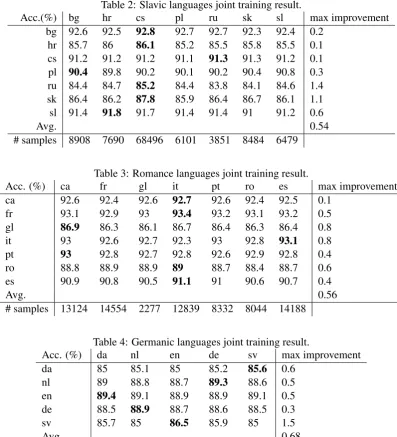
The accuracy of the joint training model actually reveals the syntactic similarity between two lan-guages. The accuracy of three language groups, Slavic (Table2), Romance (Table3) and Germanic (Table4). A number in rowi, columnjmeans the accuracy of languageitesting on the model jointly training on languageiand languagej. Thebold
font indicates it is the best model for language i. We can see that for every language, jointly trained models consistently beat single models (the num-ber on the diagonal) which shows the efficacy of the proposed approach.
5.2 Morphology
Morphology is extremely helpful when predict-ing the dependency between words, especially for those morphology rich languages. However, the UD Parsing task is not done in an end-to-end fash-ion (i.e. the input morphological features are not the ground-true labels) and thus the morphology information is noisy. The performance is hurt greatly because of the noisy predicted morphology features. A significant accuracy gain should be ob-tained if a better morphology prediction model is used.
6 Conclusion
Our system provided a simple yet effective method –sharing the universal features to the same part of neural network– to boost the accuracy of syntactic parsing. We also demonstrated that morphological feature plays an important role in syntactic pars-ing, which is a promising direction to work on.
Table 2: Slavic languages joint training result.
Acc.(%) bg hr cs pl ru sk sl max improvement
bg 92.6 92.5 92.8 92.7 92.7 92.3 92.4 0.2
hr 85.7 86 86.1 85.2 85.5 85.8 85.5 0.1
cs 91.2 91.2 91.2 91.1 91.3 91.3 91.2 0.1
pl 90.4 89.8 90.2 90.1 90.2 90.4 90.8 0.3
ru 84.4 84.7 85.2 84.4 83.8 84.1 84.6 1.4
sk 86.4 86.2 87.8 85.9 86.4 86.7 86.1 1.1
sl 91.4 91.8 91.7 91.4 91.4 91 91.2 0.6
Avg. 0.54
[image:5.595.97.495.72.510.2]# samples 8908 7690 68496 6101 3851 8484 6479
Table 3: Romance languages joint training result.
Acc. (%) ca fr gl it pt ro es max improvement
ca 92.6 92.4 92.6 92.7 92.6 92.4 92.5 0.1
fr 93.1 92.9 93 93.4 93.2 93.1 93.2 0.5
gl 86.9 86.3 86.1 86.7 86.4 86.3 86.4 0.8
it 93 92.6 92.7 92.3 93 92.8 93.1 0.8
pt 93 92.8 92.7 92.8 92.6 92.9 92.8 0.4
ro 88.8 88.9 88.9 89 88.7 88.4 88.7 0.6
es 90.9 90.8 90.5 91.1 91 90.6 90.7 0.4
Avg. 0.56
[image:5.595.103.494.73.221.2]# samples 13124 14554 2277 12839 8332 8044 14188
Table 4: Germanic languages joint training result.
Acc. (%) da nl en de sv max improvement
da 85 85.1 85 85.2 85.6 0.6
nl 89 88.8 88.7 89.3 88.6 0.5
en 89.4 89.1 88.9 88.9 89.1 0.5
de 88.5 88.9 88.7 88.6 88.5 0.3
sv 85.7 85 86.5 85.9 85 1.5
Avg. 0.68
# samples 4384 12331 12544 14119 4303
Baseline Fudan Improvement
Language code LAS MLAS BLEX LAS MLAS BLEX LAS MLAS BLEX
af afribooms 77.88% 64.48% 66.60% 80.02% 67.34% 66.04% 2.14% 2.86% -0.56% grc perseus 57.75% 31.05% 38.74% 63.31% 34.58% 38.22% 5.56% 3.53% -0.52% grc proiel 67.57% 49.51% 55.85% 69.54% 51.35% 53.03% 1.97% 1.84% -2.82% ar padt 66.41% 55.01% 57.60% 67.33% 55.88% 58.63% 0.92% 0.87% 1.03% hy armtdp 21.79% 5.00% 11.94% 26.24% 10.00% 13.85% 4.45% 5.00% 1.91% eu bdt 70.13% 57.65% 63.50% 72.74% 58.98% 57.41% 2.61% 1.33% -6.09%
br keb 10.25% 0.00% 0.00% 10.25% 0.00% 0.00% 0.00% 0.00% 0.00%
bg btb 84.91% 75.30% 73.78% 86.47% 77.04% 77.70% 1.56% 1.74% 3.92%
bxr bdt 12.61% 0.00% 5.00% 12.61% 0.00% 5.00% 0.00% 0.00% 0.00%
ca ancora 85.61% 76.74% 77.27% 88.37% 80.17% 66.01% 2.76% 3.43% -11.26% hr set 78.61% 58.72% 70.26% 81.01% 60.92% 66.61% 2.40% 2.20% -3.65%
cs cac 83.72% 70.89% 77.65% 86.28% 73.90% 79.54% 2.56% 3.01% 1.89%
cs fictree 82.49% 69.26% 74.96% 85.22% 72.01% 77.18% 2.73% 2.75% 2.22% cs pdt 83.94% 74.32% 79.39% 85.35% 75.89% 74.68% 1.41% 1.57% -4.71% cs pud 80.08% 66.53% 73.79% 81.05% 67.97% 68.99% 0.97% 1.44% -4.80% da ddt 75.43% 65.41% 66.04% 78.38% 68.20% 62.51% 2.95% 2.79% -3.53% nl alpino 77.60% 61.55% 64.76% 79.02% 63.89% 60.53% 1.42% 2.34% -4.23% nl lassysmall 74.56% 61.85% 63.14% 77.41% 64.64% 49.81% 2.85% 2.79% -13.33% en ewt 77.56% 68.70% 71.02% 78.44% 68.99% 62.92% 0.88% 0.29% -8.10% en gum 74.20% 62.66% 62.14% 75.29% 63.36% 57.45% 1.09% 0.70% -4.69% en lines 73.10% 64.03% 65.42% 74.83% 65.78% 62.80% 1.73% 1.75% -2.62% en pud 79.56% 67.59% 71.14% 78.80% 67.20% 64.26% -0.76% -0.39% -6.88% et edt 75.02% 67.12% 63.85% 77.80% 69.82% 61.53% 2.78% 2.70% -2.32%
fo oft 25.19% 0.00% 5.00% 26.95% 0.00% 5.00% 1.76% 0.00% 0.00%
fi ftb 75.64% 65.22% 61.76% 78.27% 68.03% 66.99% 2.63% 2.81% 5.23%
fi pud 80.15% 73.16% 65.46% 80.15% 73.16% 65.46% 0.00% 0.00% 0.00%
fi tdt 76.45% 68.58% 62.19% 79.18% 70.74% 59.79% 2.73% 2.16% -2.40% fr gsd 81.05% 72.16% 74.22% 83.19% 74.01% 68.58% 2.14% 1.85% -5.64% fr sequoia 81.12% 71.34% 74.41% 83.39% 73.59% 69.28% 2.27% 2.25% -5.13% fr spoken 65.56% 53.46% 54.67% 65.63% 52.96% 52.82% 0.07% -0.50% -1.85%
gl ctg 76.10% 62.11% 65.29% 80.38% 67.42% 71.64% 4.28% 5.31% 6.35%
gl treegal 66.16% 49.13% 51.60% 68.08% 50.06% 52.80% 1.92% 0.93% 1.20% de gsd 70.85% 34.09% 60.56% 71.88% 35.12% 34.30% 1.03% 1.03% -26.26% got proiel 62.16% 48.57% 55.02% 65.49% 51.72% 54.63% 3.33% 3.15% -0.39% el gdt 82.11% 65.33% 68.67% 82.56% 65.58% 64.68% 0.45% 0.25% -3.99%
he htb 57.86% 44.09% 46.51% 58.87% 44.89% 47.37% 1.01% 0.80% 0.86%
hi hdtb 87.15% 69.09% 79.93% 88.43% 70.48% 81.52% 1.28% 1.39% 1.59% hu szeged 66.76% 52.82% 56.92% 68.74% 54.66% 53.52% 1.98% 1.84% -3.40%
zh gsd 57.91% 48.49% 52.92% 60.13% 49.17% 54.29% 2.22% 0.68% 1.37%
id gsd 74.37% 63.42% 62.50% 75.51% 63.54% 71.50% 1.14% 0.12% 9.00%
ga idt 62.93% 37.66% 42.06% 64.87% 39.22% 42.44% 1.94% 1.56% 0.38%
it isdt 86.26% 77.06% 77.12% 88.28% 79.48% 72.47% 2.02% 2.42% -4.65% it postwita 66.81% 53.64% 53.99% 67.58% 53.93% 44.53% 0.77% 0.29% -9.46%
ja gsd 72.32% 58.35% 60.17% 73.16% 59.39% 60.92% 0.84% 1.04% 0.75%
ja modern 22.71% 10.00% 10.00% 22.71% 10.00% 10.00% 0.00% 0.00% 0.00%
kk ktb 24.21% 10.00% 10.00% 24.21% 10.00% 10.00% 0.00% 0.00% 0.00%
ko gsd 61.40% 54.10% 50.50% 74.94% 68.34% 62.21% 13.54% 14.24% 11.71% ko kaist 70.25% 61.49% 57.68% 82.74% 75.55% 69.47% 12.49% 14.06% 11.79%
kmr mg 23.92% 5.00% 11.86% 23.92% 5.00% 11.86% 0.00% 0.00% 0.00%
la ittb 75.95% 66.08% 71.87% 80.07% 71.95% 76.29% 4.12% 5.87% 4.42% la perseus 47.61% 30.16% 32.19% 49.99% 31.35% 33.75% 2.38% 1.19% 1.56% la proiel 59.66% 47.05% 53.65% 63.93% 51.19% 54.64% 4.27% 4.14% 0.99% lv lvtb 69.43% 54.96% 58.25% 70.89% 56.14% 57.30% 1.46% 1.18% -0.95%
pcm nsc 12.18% 5.00% 10.87% 10.00% 5.00% 5.00% -2.18% 0.00% -5.87%
sme giella 56.98% 46.05% 42.35% 61.58% 49.88% 44.19% 4.60% 3.83% 1.84% no bokmaal 83.47% 74.65% 76.32% 85.29% 76.97% 70.82% 1.82% 2.32% -5.50% no nynorsk 82.13% 72.40% 74.22% 84.09% 74.71% 69.97% 1.96% 2.31% -4.25% no nynorsklia 48.95% 37.60% 40.69% 52.84% 40.67% 43.70% 3.89% 3.07% 3.01% fro srcmf 79.27% 70.70% 74.45% 82.70% 75.06% 78.96% 3.43% 4.36% 4.51% cu proiel 65.46% 53.96% 58.39% 70.03% 58.51% 63.28% 4.57% 4.55% 4.89% fa seraji 79.10% 72.20% 69.43% 79.57% 71.96% 69.42% 0.47% -0.24% -0.01% pl lfg 87.53% 74.54% 78.58% 88.78% 75.92% 77.55% 1.25% 1.38% -1.03%
pl sz 81.90% 63.84% 71.98% 83.54% 65.25% 72.25% 1.64% 1.41% 0.27%
pt bosque 82.07% 67.40% 72.04% 84.59% 70.21% 62.91% 2.52% 2.81% -9.13% ro rrt 80.27% 71.48% 71.87% 82.67% 74.11% 71.11% 2.40% 2.63% -0.76% ru syntagrus 84.59% 76.87% 78.01% 87.70% 79.58% 82.35% 3.11% 2.71% 4.34% ru taiga 55.51% 36.79% 39.79% 57.94% 38.59% 42.12% 2.43% 1.80% 2.33% sr set 82.07% 70.04% 74.12% 83.54% 70.86% 66.69% 1.47% 0.82% -7.43%
sk snk 75.41% 54.38% 60.35% 78.45% 56.57% 67.75% 3.04% 2.19% 7.40%
sl ssj 77.33% 63.47% 68.93% 79.15% 65.05% 69.10% 1.82% 1.58% 0.17%
sl sst 46.95% 34.19% 38.73% 46.19% 33.61% 38.00% -0.76% -0.58% -0.73% es ancora 84.43% 76.01% 76.43% 87.66% 80.08% 68.03% 3.23% 4.07% -8.40% sv lines 74.06% 58.62% 66.39% 75.87% 59.96% 64.81% 1.81% 1.34% -1.58% sv pud 70.63% 43.38% 54.47% 72.26% 44.27% 52.52% 1.63% 0.89% -1.95% sv talbanken 77.91% 69.22% 70.01% 80.00% 70.66% 71.49% 2.09% 1.44% 1.48%
th pud 0.70% 0.03% 0.42% 0.70% 0.03% 0.42% 0.00% 0.00% 0.00%
tr imst 54.04% 44.50% 45.91% 57.57% 46.59% 46.27% 3.53% 2.09% 0.36%
uk iu 74.91% 56.78% 63.72% 76.27% 57.66% 63.11% 1.36% 0.88% -0.61%
[image:6.595.71.434.63.774.2]Baseline Fudan Improvement
Language code LAS MLAS BLEX LAS MLAS BLEX LAS MLAS BLEX
el gdt 81.37% 63.92% 65.21% 82.31% 64.62% 61.66% 0.94% 0.70% -3.55% tr imst 54.83% 44.25% 45.81% 58.65% 46.16% 45.81% 3.82% 1.91% 0.00% id gsd 74.40% 63.51% 63.29% 74.82% 63.16% 71.21% 0.42% -0.35% 7.92% da ddt 75.16% 65.29% 66.07% 78.20% 68.34% 63.80% 3.04% 3.05% -2.27% et edt 76.50% 68.27% 64.17% 79.86% 71.38% 62.30% 3.36% 3.11% -1.87% got proiel 62.03% 48.16% 54.39% 75.09% 61.20% 63.54% 13.06% 13.04% 9.15%
sl ssj 77.72% 63.96% 68.97% 83.77% 69.66% 72.37% 6.05% 5.70% 3.40%
en gum 76.63% 65.57% 67.20% 78.81% 67.61% 62.09% 2.18% 2.04% -5.11% cu proiel 66.12% 54.48% 59.16% 79.39% 67.52% 70.80% 13.27% 13.04% 11.64% ur udtb 77.44% 49.91% 63.55% 77.92% 50.79% 64.01% 0.48% 0.88% 0.46% fro srcmf 79.15% 70.43% 74.27% 81.90% 74.01% 77.87% 2.75% 3.58% 3.60% hi hdtb 87.26% 69.78% 80.59% 88.55% 71.17% 82.16% 1.29% 1.39% 1.57% ko gsd 57.25% 49.06% 44.24% 72.41% 65.18% 57.04% 15.16% 16.12% 12.80% cs fictree 83.16% 70.72% 75.80% 85.99% 73.49% 77.82% 2.83% 2.77% 2.02%
gl ctg 76.32% 62.58% 65.57% 81.75% 68.93% 73.42% 5.43% 6.35% 7.85%
lv lvtb 70.67% 57.79% 60.96% 0.00% 0.00% 0.00% 0.00% 0.00% 0.00%
fr gsd 85.81% 77.80% 79.16% 88.83% 81.24% 70.55% 3.02% 3.44% -8.61% ru syntagrus 83.87% 75.78% 77.27% 0.00% 0.00% 0.00% 0.00% 0.00% 0.00% hu szeged 68.41% 56.47% 60.17% 70.67% 58.33% 57.56% 2.26% 1.86% -2.61% sv lines 76.23% 62.16% 67.63% 77.91% 63.39% 65.60% 1.68% 1.23% -2.03% no bokmaal 84.56% 75.95% 78.04% 86.54% 78.64% 72.31% 1.98% 2.69% -5.73% sv talbanken 75.39% 66.87% 68.25% 0.00% 0.00% 0.00% 0.00% 0.00% 0.00% es ancora 85.08% 76.81% 77.48% 88.21% 80.75% 68.74% 3.13% 3.94% -8.74% he htb 61.95% 49.28% 51.45% 79.89% 65.68% 67.50% 17.94% 16.40% 16.05%
uk iu 77.94% 59.66% 68.07% 78.75% 60.11% 66.23% 0.81% 0.45% -1.84%
grc proiel 69.13% 52.42% 57.92% 77.67% 61.50% 59.95% 8.54% 9.08% 2.03% eu bdt 70.06% 57.46% 63.39% 72.94% 59.11% 56.95% 2.88% 1.65% -6.44%
fi ftb 75.76% 65.72% 62.68% 79.90% 70.61% 69.82% 4.14% 4.89% 7.14%
cs pdt 84.85% 75.35% 80.55% 86.83% 77.45% 75.86% 1.98% 2.10% -4.69% sk snk 75.73% 54.34% 59.71% 80.35% 57.64% 69.80% 4.62% 3.30% 10.09% hr set 77.84% 59.60% 69.99% 80.63% 61.89% 66.75% 2.79% 2.29% -3.24% no nynorsk 82.75% 73.88% 75.76% 85.07% 76.64% 72.06% 2.32% 2.76% -3.70% grc perseus 57.89% 30.80% 40.49% 63.21% 34.03% 39.99% 5.32% 3.23% -0.50% fr spoken 65.09% 54.00% 55.42% 73.46% 64.24% 63.19% 8.37% 10.24% 7.77%
pl sz 82.65% 63.92% 72.59% 84.02% 65.11% 73.04% 1.37% 1.19% 0.45%
fi tdt 76.39% 68.60% 62.33% 0.00% 0.00% 0.00% 0.00% 0.00% 0.00%
ca ancora 85.63% 77.04% 77.56% 88.30% 80.31% 67.64% 2.67% 3.27% -9.92% ar padt 66.81% 55.67% 57.90% 76.11% 63.98% 65.94% 9.30% 8.31% 8.04% sr set 82.12% 69.12% 73.06% 84.49% 70.73% 67.66% 2.37% 1.61% -5.40%
bg btb 84.67% 74.54% 73.78% 86.73% 76.96% 78.24% 2.06% 2.42% 4.46%
vi vtb 43.65% 37.39% 39.18% 57.34% 49.57% 47.08% 13.69% 12.18% 7.90% de gsd 75.55% 38.52% 65.39% 77.00% 39.91% 40.77% 1.45% 1.39% -24.62% fr seguoia 82.72% 74.13% 76.34% 85.71% 76.53% 71.16% 2.99% 2.40% -5.18% cs cac 84.42% 72.17% 78.29% 86.46% 74.65% 77.70% 2.04% 2.48% -0.59% pl lfg 88.79% 75.15% 79.18% 89.98% 76.88% 79.01% 1.19% 1.73% -0.17% en lines 75.78% 66.29% 68.57% 78.17% 67.59% 67.22% 2.39% 1.30% -1.35% zh gsd 57.39% 48.19% 52.84% 70.09% 58.37% 64.74% 12.70% 10.18% 11.90% it postwita 65.85% 52.14% 52.90% 77.23% 66.00% 53.42% 11.38% 13.86% 0.52% la proiel 61.33% 48.40% 55.10% 74.41% 61.54% 64.39% 13.08% 13.14% 9.29% fa seraji 79.78% 73.03% 73.35% 80.41% 72.61% 73.63% 0.63% -0.42% 0.28% af afribooms 80.19% 65.98% 70.40% 80.95% 67.26% 68.10% 0.76% 1.28% -2.30% ko kaist 71.00% 63.32% 59.19% 83.17% 77.37% 71.51% 12.17% 14.05% 12.32% la ittb 73.23% 59.94% 67.43% 78.06% 66.21% 72.02% 4.83% 6.27% 4.59%
en ewt 77.62% 68.58% 70.98% 0.00% 0.00% 0.00% 0.00% 0.00% 0.00%
ug udt 56.88% 37.43% 43.34% 57.78% 37.54% 44.08% 0.90% 0.11% 0.74%
[image:7.595.71.432.133.668.2]pt bosque 84.93% 73.22% 76.02% 88.19% 76.65% 66.58% 3.26% 3.43% -9.44% ro rrt 80.32% 71.21% 71.82% 83.42% 74.27% 71.73% 3.10% 3.06% -0.09% nl lassysmall 73.61% 59.99% 61.71% 77.63% 64.44% 52.55% 4.02% 4.45% -9.16% it isdt 85.95% 77.20% 77.37% 87.81% 79.30% 71.82% 1.86% 2.10% -5.55% nl alpino 80.21% 67.14% 69.77% 81.66% 69.04% 58.68% 1.45% 1.90% -11.09% ja gsd 75.48% 62.39% 64.58% 92.51% 83.13% 85.11% 17.03% 20.74% 20.53%
References
Mathieu Dehouck and Pascal Denis. 2017. Delexical-ized word embeddings for cross-lingual dependency parsing. InEACL. hal.inria.fr, volume 1, pages 241– 250.
Timothy Dozat, Peng Qi, and Christopher D Manning. 2017. Stanford’s graph-based neural dependency parser at the conll 2017 shared task. Proceedings of the CoNLL 2017 Shared Task: Multilingual Pars-ing from Raw Text to Universal Dependenciespages 20–30.
Long Duong, Trevor Cohn, Steven Bird, and Paul Cook. 2015. Low resource dependency parsing: Cross-lingual parameter sharing in a neural network parser. In Proceedings of the 53rd Annual Meet-ing of the Association for Computational LMeet-inguistics and the 7th International Joint Conference on Natu-ral Language Processing (Volume 2: Short Papers). volume 2, pages 845–850.
Yarin Gal and Zoubin Ghahramani. 2016. A theoret-ically grounded application of dropout in recurrent neural networks. InAdvances in neural information processing systems. pages 1019–1027.
Jiang Guo, Wanxiang Che, David Yarowsky, Haifeng Wang, and Ting Liu. 2015. Cross-lingual depen-dency parsing based on distributed representations. In Proceedings of the 53rd Annual Meeting of the Association for Computational Linguistics and the 7th International Joint Conference on Natural Lan-guage Processing (Volume 1: Long Papers). vol-ume 1, pages 1234–1244.
Joakim Nivre et al. 2018. Universal
Dependen-cies 2.2. LINDAT/CLARIN digital library
at the Institute of Formal and Applied Lin-guistics, Charles University, Prague, http:
//hdl.handle.net/11234/1-1983xxx.
http://hdl.handle.net/11234/1-1983xxx.
Kenji Sagae and Alon Lavie. 2006. Parser combination by reparsing. In Proceedings of the Human Lan-guage Technology Conference of the NAACL, Com-panion Volume: Short Papers. Association for Com-putational Linguistics, pages 129–132.
Motoki Sato, Hitoshi Manabe, Hiroshi Noji, and Yuji Matsumoto. 2017. Adversarial training for cross-domain universal dependency parsing. In Proceed-ings of the CoNLL 2017 Shared Task: Multilingual Parsing from Raw Text to Universal Dependencies. Association for Computational Linguistics, pages 71–79. https://doi.org/10.18653/v1/K17-3007.
Tianze Shi, Felix G. Wu, Xilun Chen, and Yao Cheng. 2017. Combining global models for pars-ing universal dependencies. InProceedings of the CoNLL 2017 Shared Task: Multilingual Parsing from Raw Text to Universal Dependencies. Associ-ation for ComputAssoci-ational Linguistics, pages 31–39. https://doi.org/10.18653/v1/K17-3003.
Milan Straka, Jan Hajiˇc, and Jana Strakov´a. 2016. UD-Pipe: trainable pipeline for processing CoNLL-U files performing tokenization, morphological anal-ysis, POS tagging and parsing. In Proceedings of the 10th International Conference on Language Resources and Evaluation (LREC 2016). European Language Resources Association, Portoro, Slovenia.
Milan Straka and Jana Strakov´a. 2017. Tokeniz-ing, pos taggTokeniz-ing, lemmatizing and parsing ud 2.0 with udpipe. In Proceedings of the CoNLL 2017 Shared Task: Multilingual Parsing from Raw Text to Universal Dependencies. Association for Compu-tational Linguistics, Vancouver, Canada, pages 88– 99. http://www.aclweb.org/anthology/K/K17/K17-3009.pdf.
Clara Vania, Xingxing Zhang, and Adam Lopez. 2017. Uparse: the edinburgh system for the conll 2017 ud shared task. In Proceedings of the CoNLL 2017 Shared Task: Multilingual Parsing from Raw Text to Universal Dependencies. Associa-tion for ComputaAssocia-tional Linguistics, pages 100–110. https://doi.org/10.18653/v1/K17-3010.
Dan Zeman et al. 2018a. Universal Dependencies 2.2 CoNLL 2018 shared task development and test data. LINDAT/CLARIN digital library at the Insti-tute of Formal and Applied Linguistics, Charles
Uni-versity, Prague, http://hdl.handle.net/
11234/1-2184. http://hdl.handle.net/11234/1-2184.
Daniel Zeman, Filip Ginter, Jan Hajiˇc, Joakim Nivre, Martin Popel, Milan Straka, and et al. 2018b. CoNLL 2018 Shared Task: Multilingual Parsing from Raw Text to Universal Dependencies. In Pro-ceedings of the CoNLL 2018 Shared Task: Multi-lingual Parsing from Raw Text to Universal Depen-dencies. Association for Computational Linguistics, pages 1–20.