Medical equipments high precise detection technology basing
on morphology-harris operator
Yang-Yang Mei, Hai-Ming Xie, Lu Han, Shi-Jun Guo
School of Medical Instrument and Food Engineering, USST, Shanghai, China. Email: [email protected]
Received 5 January 2010; revised 8 February 2010; accepted 4 March 2010.
ABSTRACT
Medical equipments related to life safety of human, it is important to detect by a high precise method. Image mosaic which based on Harris corner operator is a commonly used method in this area; Harris operator has low calculation burden, it is simple and stable, so it is more effective comparing with other feature point extracted operators. But in this algorithm, corner points can only be detected in a single-scale, there may be los-ing information of corner points, causlos-ing corner point location offset, extracting false corner points because of noise. In order to solve this question, the acquired im-ages should be processed by dilation and erosion opera-tion firstly, then do image mosaic. Results show that image noise can be eliminated effectively after those morphological processes, as well as the false positive noise generated by image glitch. The success rate of image mosaic and detection accuracy can be greatly improved through the Morphology-Harris operator. Measurement of precision instruments which based on this new method will improve the measurement accu-racy, and the research in this area will promote the fur-ther development of machine vision technology.
Keywords: Image Mosaic; Harris Operator; Feature Point Extraction; High Precise Detection; Dilation and Erosion
1. INTRODUCTION
With the improvement of living standards, people are concerned about the health problems more and more, especially in recent years, surgical accidents have been happening continuously, which make the physician- patient relationship nervous. In this situation, the con-troversy focused on medical equipment whether it is qualified or not is increasing, so it is important to detect medical equipment in a high precise and steady way. Traditional detection methods are inefficiency, the
accu-racy is often affected by Man-made factors. Revolution-ary changes of precision equipment detection have hap-pened after the rapid development of computer. Through computer vision, we can make non-contact detection for medical instruments which not only improves the detec-tion accuracy but also reduces the impact of Man-made factors. However, a number of common machine vision detection equipments which are restricted by the optical field of view can not capture large view field and wide angle images, and if we pursuit large field of view sim-ply, the image resolution will be reduced, the detection accuracy will be reduced too. In this case, some re-quirements of detection accuracy of medical devices have not been fulfilled. To resolve this problem, this paper presents a method of using image mosaic which based on Morphology-Harris operator to obtain images of the medical instruments, enhancing image resolution and measuring accuracy.
was first brought in this article, the algorithm will be automatic completed fully and the results are effective. At the same time, the development of image mosaic is grow-ing rapidly in our country too, algorithms which were pro-posed by Xiao-Rui Wang, Zu-Xun Zhang et al. greatly promoted the development of image mosaic technology.
Image mosaic technology was early used in photo-graphic mapping to integrate a large number of satellite images. In this application, the accuracy of splicing does not ask for much. But, in detection of precision instru-ments, especially for precision medical equipinstru-ments, it is the key point; detection accuracy is affected directly by it. The image mosaic model is shown in Figure 1. Image registration is the key of image mosaic; it is closely re-lated to the success of it. At present, the method of im-age registration, based on feature point, is used com-monly and widely. It has several advantages such as low calculation burden, high sensitive and little affected by noise [5].
3. HARRIS CORNER OPERATION
In field of image mosaic, points that change obviously are called feature points. Extraction of feature points is the basis of image registration. There is one sort of fea-ture points called corner points, which are changing in-tensely of gray value or the intersection point of the out-line in image, they reflect the important information of image, so we can get the information that is important and ignore information that is secondary by corner points. Harris corner detector is the most commonly used operator in image mosaic.
3.1. Principle of Harris Corner Operator
Harris detector was brought forward by C. Harris and M. J. Stephens in 1988 and based on the feature points of image [6]. While this feature detector is usually called corner detector, it is not just the corners select-ing, but rather any image location having large gradi-ents in all directions at a predetermined scale [7]. Sig-nals are processed through auto-correlation function and the result is a matrix M of auto-correlation func-tion. Eigenvalue of matrix M is first-order curvature of the correlation function, and the point could be viewed as a corner if two curvature values are high. Only the first-order difference of the gray image is used in Har-ris, so the operation is simple and is widely used in practice. The principle is to calculate the gray value changes during the window moving along any direc-tion; it is supposed that the small window of center pixel point (x,y) has moved along the direction u
Figure 1.Image mosaic model.
of X, as well as along the direction of , then analytical expression about gray value changes will be given out by Harris, as Eq.1:
V Y
2,
, , , ,
x y
E u v
w x y I x u y v I x y (1)In the function above, stands for the
win-dow function;
,w x y
,
,
2I x u y v I x y
,w x
stands for the gradient of gray image; usually, stands for gauss filter. For a small displacement, Eq.1 can be replaced by Eq.2, as follows:
y v u M v u v uE( , ) [ , ] (2)
Mcan be expressed as follows:
, 2 2x x y
x y y
I I I M w x y
I I I
(3) In Eq.3, Ixand are the first derivatives of each image channel. is very similar to the local auto- correlation function and
y
I
E
M describes the shape of the origin of auto-correlation function. 1 , 2are
as-sumed to be two eigenvalues of M , and they will proportion with the local auto-correlation function, constituting a non-variable rotation to M [8]. Through judgment 1 and 2 the region which changed
slowly could be determined, as well as corner and edge.
The maximum value of local region can be defined by Harris feature point:
2
R D M kT M
(4)
T M denotes the matrix trace ofM , and T(M) =
1 2
; D M
stands for the determinant of matrix M , and D M
1 2. The value of is usually recom-mended of 0.02 - 0.06.k
With the theory of Harris corner detection, several steps could be concluded as follows:
1) Filter every pixel of the image by horizontal and vertical difference operator, through this, Ix and
y
I can be obtained [9].
2) Deal with the four elements of matrix M by gauss filter, a new M will be obtained. Gaussian function is showed below:
2 2
2
exp 2
x y Gauss
(5)
Image Registeration Image fusion
Image input
function Eq.4.
4) Set the threshold and do non-maximum suppres-sion by it.
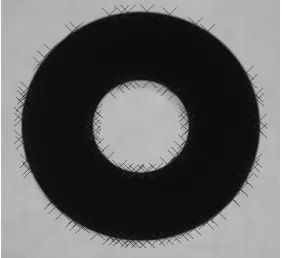
The corner points, detected by Harris detection are shown in Figure 2.
3.2. Disadvantage of Harris Operator and Ameliorate Method
Harris operator is a widely used feature point extraction operator and has several advantages, but it has some disadvantages too. For example, in this algorithm, cor-ner points can only be detected in a single-scale, there may be losing information of corner points, causing corner point location offset, extracting false corner points because of noise, inaccurate localization to T and diagonal T and so on.
For tiny medical devices, measurement accuracy is extremely demanding, but because of light, as well as the lens distortion, the image edges will produce some distortion. If the device edge which near the image edge has a glitch, the glitch will have a shape distortion in the two images for mosaic, causing corner point lo-cation offset, thus affecting the accuracy of image mo-saic. For which we first using morphological dilation and erosion operation to preprocess the image, elimi-nating the false positive noise generated by image glitch, thus eliminating the inaccurate positioning of the corner points caused by noise, as well as the effect of the corner point location offset, greatly improved the splicing accuracy and detection accuracy.
4. EXPERIMENT RESULTS
4.1. Dilation and Erosion OperationAccording to the illumination of 3.2, first, we process the image through dilation and erosion operation. The result is shown in Figure 3, the left part is the former image, we can see the glitch clearly in the small circle marked on the image, and right half part is image after processing, the glitch is completely disposed.
4.2. Image Mosaic
[image:3.595.354.495.81.210.2]In this part, we use tablet punch to demonstrate the mo-saic course. The size of tablet punch determines the weight and density of tablets, the precise of punch is important. First of all, two images of tablet punch using a large field camera can be acquired, then do dilation and erosion operation, the result can be shown in Figure 4. Be attention that the two images must have some over-lapped parts, and this is the basis of image mosaic. Then we can extract the feature points of each image by Harris operator; do image registration by the nor-malized cross-correlation and image fusion. The result is shown in Figure 5.
[image:3.595.310.538.251.318.2]Figure 2.Corner points detected by Harris.
[image:3.595.310.537.358.448.2]Figure 3.Dilation and erosion processing.
[image:3.595.344.502.487.579.2]Figure 4.Images waiting for mosaic.
Figure 5.Image after mosaic.
4.3. Test and Contrast
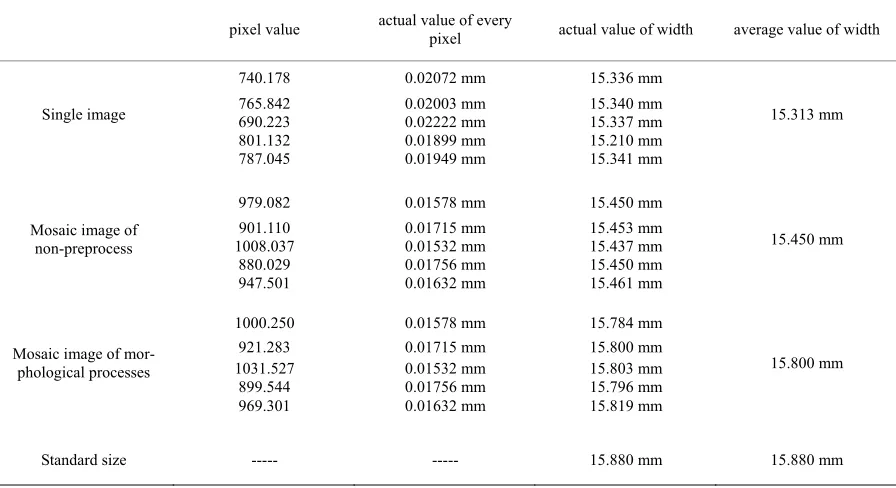
one is the highest, the left one is the lowest. Size is measured by a method which based on sub-pixel meas-urement, the pixel value is not an integer number in this way and the measurement result has a higher precise; the value at top left corner of image is every pixel value which is measured after the camera is calibrated using the 30 mm standard block .
In order to compare the result conveniently, we can see the Table 1 below. In this table, five values can be measured through moving the high of camera in every situation. Absolute difference between single image size and standard size is 0.567 mm; the value between non-preprocess mosaic image and standard size is 0.430 mm; and the value between Mosaic image of morphological processes and standard size is 0.080 mm. Comparing the results, it is obvious to see that the measurement accu-racy of mosaic image after morphological processes is much higher than the single image and Mosaic image of non-preprocess. Through this comparison, the important of dilation and erosion processing of image mosaic in
the precision instrument measurement is proved, and the detection accuracy will be improved through im-age mosaic.
5. CONCLUSIONS
[image:4.595.78.523.320.412.2]Medical equipments related to life safety of human, ac-curate measurement is particularly important. In this paper, we use the morphology-Harris operator preproc-essing images, eliminate the noise caused by lens distor-tion and light uneven, extract feature point accurately, position accuracy is higher than the untreated image. Through dilation and erosion processes, the accuracy of the mosaic image is improved, simultaneity the cost of additional hardware needed is reduced too. The experi-ment results has proved that, accuracy of medical device testing which based on morphology-Harris operator of image mosaic fully meets the requirements. This is an efficient, high-precision medical device detection tech-nology, suitable for promotion.
Figure 6.Width of tablet punch image.
Table 1.Result compared.
pixel value actual value of every pixel actual value of width average value of width
740.178 0.02072 mm 15.336 mm
765.842 0.02003 mm 15.340 mm
690.223 0.02222 mm 15.337 mm
801.132 0.01899 mm 15.210 mm
Single image
787.045 0.01949 mm 15.341 mm
15.313 mm
979.082 0.01578 mm 15.450 mm
901.110 0.01715 mm 15.453 mm
1008.037 0.01532 mm 15.437 mm
880.029 0.01756 mm 15.450 mm
Mosaic image of non-preprocess
947.501 0.01632 mm 15.461 mm
15.450 mm
1000.250 0.01578 mm 15.784 mm
921.283 0.01715 mm 15.800 mm
1031.527 0.01532 mm 15.803 mm
899.544 0.01756 mm 15.796 mm
Mosaic image of mor-phological processes
969.301 0.01632 mm 15.819 mm
15.800 mm
[image:4.595.75.523.470.714.2]6. ACKNOWLEDGEMENTS
Here, I wish to thank my tutor Professor Haiming Xie, under his care-ful guidance, I completed the paper and related experiments, thanks my lab colleagues Lu Han, Shijun Guo, and under their help I finished my dissertation fast and accurately.
REFERENCES
[1] Szeliski, R. (1996) Video mosaics for virtual environments. IEEE Computer Graphics and Applications, 16(2), 22-30. [2] Peleg, S. and Rousso, B. (2000) Mosaicing on adaptive
manifolds. IEEE Transactions on PAMI, 22(10), 1144-1154. [3] Brown, M. and Lowe, D.G. (2003) Recognising pano-ramas. Proceedings of IEEE International Conference on Computer Vision, 2(1), 1218-1225.
[4] Mikolajczyk, K. and Schmid, C. (2004) Scale & Affine
invariant interest point detectors. International Journal of Computer Vision, 60(1), 63-86.
[5] Xie, D.H. and Zhan, Z.Q. (2003) Improving Harris cor-ner detector. Journal of Geomatics, 28(2), 22-23. [6] Harris, C. and Stephens, M.J. (1988) A combined corner
and edge detector. Proceedings Fourth Alvey Vision Con- ference, Manchester, 1988, 147-151.
[7] Qian, W., Fu, Z.Z. and Liu, Q.Q. (2008) Voting- strategy-based approach to image registration. Opto-Elec-tronic Engineering, 35(10), 86-91.
[8] Zhao, W.J., Gong, S.R. and Liu, C.P. (2008) Adaptive Harris corner detection algorithm. Computer Engineering,
34(10), 212-214.