Akamon: An Open Source Toolkit
for Tree/Forest-Based Statistical Machine Translation
∗Xianchao Wu†, Takuya Matsuzaki∗, Jun’ichi Tsujii‡ †Baidu Inc.
∗National Institute of Informatics ‡Microsoft Research Asia
[email protected],[email protected],[email protected]
Abstract
We describeAkamon, an open source toolkit for tree and forest-based statistical machine translation (Liu et al., 2006; Mi et al., 2008; Mi and Huang, 2008). Akamon implements all of the algorithms required for tree/forest-to-string decoding using tree-tree/forest-to-string trans-lation rules: multiple-threadforest-based de-coding, n-gram language model integration, beam- and cube-pruning, k-best hypotheses extraction, and minimum error rate training. In terms of tree-to-string translation rule ex-traction, the toolkit implements the tradi-tional maximum likelihood algorithm using PCFG trees (Galley et al., 2004) and HPSG trees/forests (Wu et al., 2010).
1 Introduction
Syntax-based statistical machine translation (SMT) systems have achieved promising improvements in recent years. Depending on the type of input, the systems are divided into two categories: string-basedsystems whose input is a string to be simul-taneously parsed and translated by a synchronous grammar (Wu, 1997; Chiang, 2005; Galley et al., 2006; Shen et al., 2008), andtree/forest-based sys-tems whose input is already a parse tree or a packed forest to be directly converted into a target tree or string (Ding and Palmer, 2005; Quirk et al., 2005; Liu et al., 2006; Huang et al., 2006; Mi et al., 2008; Mi and Huang, 2008; Zhang et al., 2009; Wu et al., 2010; Wu et al., 2011a).
∗Work done when all the authors were in The University of
Tokyo.
Depending on whether or not parsers are explic-itly used for obtaining linguistically annotated data during training, the systems are also divided into two categories: formally syntax-based systems that do not use additional parsers (Wu, 1997; Chiang, 2005; Xiong et al., 2006), andlinguistically syntax-based
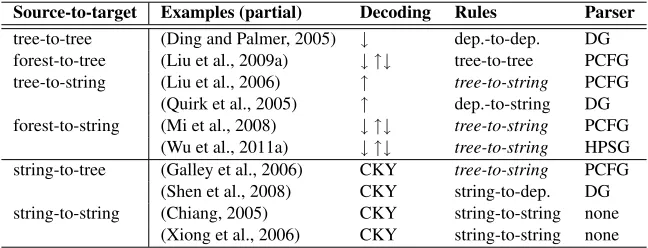
systems that use PCFG parsers (Liu et al., 2006; Huang et al., 2006; Galley et al., 2006; Mi et al., 2008; Mi and Huang, 2008; Zhang et al., 2009), HPSG parsers (Wu et al., 2010; Wu et al., 2011a), or dependency parsers (Ding and Palmer, 2005; Quirk et al., 2005; Shen et al., 2008). A classification1of syntax-based SMT systems is shown in Table 1.
Translation rules can be extracted from aligned string-string (Chiang, 2005), tree-tree (Ding and Palmer, 2005) and tree/forest-string (Galley et al., 2004; Mi and Huang, 2008; Wu et al., 2011a) data structures. Leveraging structural and linguis-tic information from parse trees/forests, the latter two structures are believed to be better than their string-string counterparts in handling non-local re-ordering, and have achieved promising translation results. Moreover, the tree/forest-string structure is more widely used than the tree-tree structure, pre-sumably because using two parsers on the source and target languages is subject to more problems than making use of a parser on one language, such as the shortage of high precision/recall parsers for languages other than English, compound parse error rates, and inconsistency of errors. In Table 1, note that tree-to-string rules are generic and applicable to many syntax-based models such as
tree/forest-to-1
This classification is inspired by and extends the Table 1 in (Mi and Huang, 2008).
Source-to-target Examples (partial) Decoding Rules Parser tree-to-tree (Ding and Palmer, 2005) ↓ dep.-to-dep. DG forest-to-tree (Liu et al., 2009a) ↓ ↑↓ tree-to-tree PCFG tree-to-string (Liu et al., 2006) ↑ tree-to-string PCFG
(Quirk et al., 2005) ↑ dep.-to-string DG forest-to-string (Mi et al., 2008) ↓ ↑↓ tree-to-string PCFG
(Wu et al., 2011a) ↓ ↑↓ tree-to-string HPSG string-to-tree (Galley et al., 2006) CKY tree-to-string PCFG
(Shen et al., 2008) CKY string-to-dep. DG string-to-string (Chiang, 2005) CKY string-to-string none
[image:2.612.144.468.63.187.2](Xiong et al., 2006) CKY string-to-string none
Table 1: A classification of syntax-based SMT systems. Tree/forest-based and string-based systems are split by a line. All the systems listed here are linguistically syntax-based except the last two (Chiang, 2005) and (Xiong et al., 2006), which are formally syntax-based. DG stands for dependency (abbreviated as dep.) grammar.↓and↑denote top-down and bottom-up traversals of a source tree/forest.
string models and string-to-tree model.
However, few tree/forest-to-string systems have been made open source and this makes it diffi-cult and time-consuming to testify and follow exist-ing proposals involved in recently published papers. The Akamon system2, written in Java and follow-ing the tree/forest-to-strfollow-ing research direction, im-plements all of the algorithms for both tree-to-string translation rule extraction (Galley et al., 2004; Mi and Huang, 2008; Wu et al., 2010; Wu et al., 2011a) and tree/forest-based decoding (Liu et al., 2006; Mi et al., 2008). We hope this system will help re-lated researchers to catch up with the achievements of tree/forest-based translations in the past several years without re-implementing the systems or gen-eral algorithms from scratch.
2 Akamon Toolkit Features
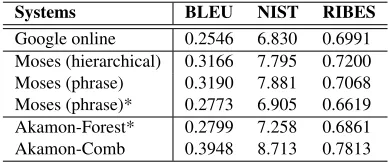
Limited by the successful parsing rate and coverage of linguistic phrases, Akamon currently achieves comparable translation accuracies compared with the most frequently used SMT baseline system, Moses (Koehn et al., 2007). Table 2 shows the auto-matic translation accuracies (case-sensitive) of Aka-mon and Moses. Besides BLEU and NIST score, we further list RIBES score3, , i.e., the software imple-mentation of Normalized Kendall’sτas proposed by (Isozaki et al., 2010a) to automatically evaluate the translation between distant language pairs based on rank correlation coefficients and significantly
penal-2Code available at https://sites.google.com/site/xianchaowu2012 3
Code available at http://www.kecl.ntt.co.jp/icl/lirg/ribes
izes word order mistakes.
In this table, Akamon-Forest differs from Akamon-Comb by using different configurations: Akamon-Forest used only 2/3 of the total training data (limited by the experiment environments and time). Akamon-Comb represents the system com-bination result by combining Akamon-Forest and other phrase-based SMT systems, which made use of pre-ordering methods of head finalization as de-scribed in (Isozaki et al., 2010b) and used the total 3 million training data. The detail of the pre-ordering approach and the combination method can be found in (Sudoh et al., 2011) and (Duh et al., 2011).
Also, Moses (hierarchical) stands for the hi-erarchical phrase-based SMT system and Moses (phrase) stands for the flat phrase-based SMT sys-tem. For intuitive comparison (note that the result achieved by Google is only for reference and not a comparison, since it uses a different and unknown training data) and following (Goto et al., 2011), the scores achieved by using the Google online transla-tion system4are also listed in this table.
Here is a brief description of Akamon’s main fea-tures:
• multiple-thread forest-based decoding: Aka-mon first loads the development (with source and reference sentences) or test (with source sentences only) file into memory and then per-form parameter tuning or decoding in a paral-lel way. The forest-based decoding algorithm is alike that described in (Mi et al., 2008),
4
Systems BLEU NIST RIBES Google online 0.2546 6.830 0.6991 Moses (hierarchical) 0.3166 7.795 0.7200 Moses (phrase) 0.3190 7.881 0.7068 Moses (phrase)* 0.2773 6.905 0.6619 Akamon-Forest* 0.2799 7.258 0.6861 Akamon-Comb 0.3948 8.713 0.7813
Table 2: Translation accuracies of Akamon and the base-line systems on the NTCIR-9 English-to-Japanese trans-lation task (Wu et al., 2011b). * stands for only using 2 million parallel sentences of the total 3 million data. Here, HPSG forests were used in Akamon.
i.e., first construct a translation forest by ap-plying the tree-to-string translation rules to the original parsing forest of the source sentence, and then collectk-best hypotheses for the root node(s) of the translation forest using Algo-rithm 2 or AlgoAlgo-rithm 3 as described in (Huang and Chiang, 2005). Later, thek-best hypothe-ses are used both for parameter tuning on addi-tional development set(s) and for final optimal translation result extracting.
• language models: Akamon can make use of one or manyn-gram language models trained by using SRILM5(Stolcke, 2002) or the Berke-ley language model toolkit, berkeBerke-leylm-1.0b36 (Pauls and Klein, 2011). The weights of multi-ple language models are tuned under minimum error rate training (MERT) (Och, 2003).
• pruning: traditional beam-pruning and cube-pruning (Chiang, 2007) techniques are incor-porated in Akamon to make decoding feasi-ble for large-scale rule sets. Before decoding, we also perform the marginal probability-based inside-outside algorithm based pruning (Mi et al., 2008) on the original parsing forest to con-trol the decoding time.
• MERT: Akamon has its own MERT module which optimizes weights of the features so as to maximize some automatic evaluation metric, such as BLEU (Papineni et al., 2002), on a de-velopment set.
5http://www.speech.sri.com/projects/srilm/ 6
http://code.google.com/p/berkeleylm/
e.tok corpus
f.seg tokenize word segment
e.tok.lw f.seg.lw lowercase lowercase
clean
e.clean f.clean
GIZA++
alignment
Rule set rule extraction SRILM
Akamon Decoder (MERT) N-gram LM
e.tok dev.e
tokenize
e.tok.lw lowercase
e.forests Enju e.forests
Enju
dev
f.seg dev.f word segmentation
f.seg.lw lowercase pre-processing
Figure 1: Training and tuning process of the Akamon sys-tem. Here, e = source English language, f = target foreign language.
• translation rule extraction: as former men-tioned, we extract tree-to-string translation rules for Akamon. In particular, we imple-mented the GHKM algorithm as proposed by Galley et al. (2004) from word-aligned tree-string pairs. In addition, we also implemented the algorithms proposed by Mi and Huang (2008) and Wu et al. (2010) for extracting rules from word-aligned PCFG/HPSG forest-string pairs.
3 Training and Decoding Frameworks
Figure 1 shows the training and tuning progress of the Akamon system. Given original bilingual par-allel corpora, we first tokenize and lowercase the source and target sentences (e.g., word segmentation of Chinese and Japanese, punctuation segmentation of English).
[image:3.612.89.285.63.144.2]here, i.e., only relatively short sentence pairs will be used to train word alignments. Then, we can use GIZA++ (Och and Ney, 2003) and symmetric strate-gies, such as grow-diag-final(Koehn et al., 2007), on the tokenized parallel corpus to obtain a word-aligned parallel corpus.
The source sentence and its packed forest, the tar-get sentence, and the word alignment are used for tree-to-string translation rule extraction. Since a 1-best tree is a special case of a packed forest, we will focus on using the term ‘forest’ in the continuing discussion. Then, taking the target language model, the rule set, and the preprocessed development set as inputs, we perform MERT on the decoder to tune the weights of the features.
The Akamon forest-to-string system includes the decoding algorithm and the rule extraction algorithm described in (Mi et al., 2008; Mi and Huang, 2008).
4 Using Deep Syntactic Structures
In Akamon, we support the usage of deep syn-tactic structures for obtaining fine-grained transla-tion rules as described in our former work (Wu et al., 2010)7. Similarly, Enju8, a state-of-the-art and freely available HPSG parser for English, can be used to generate packed parse forests for source sentences9. Deep syntactic structures are included in the HPSG trees/forests, which includes a fine-grained description of the syntactic property and a semantic representation of the sentence. We extract fine-grained rules from aligned HPSG forest-string pairs and use them in the forest-to-string decoder. The detailed algorithms can be found in (Wu et al., 2010; Wu et al., 2011a). Note that, in Akamon, we also provide the codes for generating HPSG forests from Enju.
Head-driven phrase structure grammar (HPSG) is a lexicalist grammar framework. In HPSG, linguis-tic entities such as words and phrases are represented by a data structure called a sign. A sign gives a
7However, Akamon still support PCFG tree/forest based translation. A special case is to yield PCFG style trees/forests by ignoring the rich features included in the nodes of HPSG trees/forests and only keep the POS tag and the phrasal cate-gories.
8http://www-tsujii.is.s.u-tokyo.ac.jp/enju/index.html 9
Until the date this paper was submitted, Enju supports gen-erating English and Chinese forests.
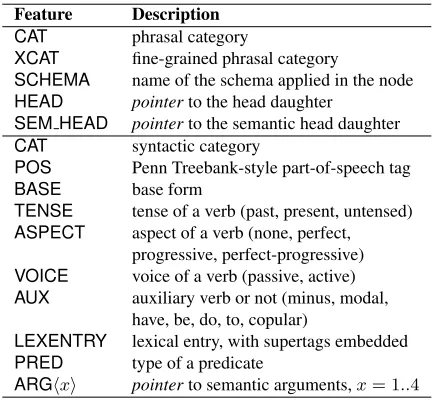
Feature Description CAT phrasal category
XCAT fine-grained phrasal category
SCHEMA name of the schema applied in the node HEAD pointerto the head daughter
SEM HEAD pointerto the semantic head daughter CAT syntactic category
POS Penn Treebank-style part-of-speech tag
BASE base form
TENSE tense of a verb (past, present, untensed) ASPECT aspect of a verb (none, perfect,
progressive, perfect-progressive) VOICE voice of a verb (passive, active) AUX auxiliary verb or not (minus, modal,
have, be, do, to, copular)
LEXENTRY lexical entry, with supertags embedded PRED type of a predicate
[image:4.612.317.535.62.262.2]ARG⟨x⟩ pointerto semantic arguments,x= 1..4
Table 3: Syntactic/semantic features extracted from HPSG signs that are included in the output of Enju. Fea-tures in phrasal nodes (top) and lexical nodes (bottom) are listed separately.
factored representation of the syntactic features of a word/phrase, as well as a representation of their semantic content. Phrases and words represented by signs are composed into larger phrases by applica-tions ofschemata. The semantic representation of the new phrase is calculated at the same time. As such, an HPSG parse tree/forest can be considered as a tree/forest of signs (c.f. the HPSG forest in Fig-ure 2 in (Wu et al., 2010)).
An HPSG parse tree/forest has two attractive properties as a representation of a source sentence in syntax-based SMT. First, we can carefully control the condition of the application of a translation rule by exploiting the fine-grained syntactic description in the source parse tree/forest, as well as those in the translation rules. Second, we can identify sub-trees in a parse tree/forest that correspond to basic units of the semantics, namely sub-trees covering a pred-icate and its arguments, by using the semantic rep-resentation given in the signs. Extraction of trans-lation rules based on such semantically-connected
sub-trees is expected to give a compact and effective set of translation rules.
She ignore
fact
want I
dispute
ARG1 ARG2
ARG1 ARG1
ARG2
ARG2
John kill
Mary
[image:5.612.92.282.66.108.2]ARG2 ARG1
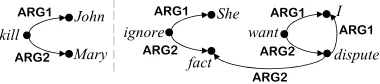
Figure 2: Predicate argument structures for the sentences of “John killed Mary” and “She ignored the fact that I wanted to dispute”.
(feature values) are typed. In the original HPSG for-malism, the types are defined in a hierarchy and the DAG can have arbitrary shape (e.g., it can be of any depth). We however use a simplified form of TFS, for simplicity of the algorithms. In the simplified form, a TFS is converted to a (flat) set of pairs of feature names and their values. Table 3 lists the fea-tures used in our system, which are a subset of those in the original output from Enju.
In the Enju English HPSG grammar (Miyao et al., 2003) used in our system, the semantic content of a sentence/phrase is represented by a predicate-argument structure (PAS). Figure 2 shows the PAS of a simple sentence, “John killed Mary”, and a more complex PAS for another sentence, “She ignored the fact that I wanted to dispute”, which is adopted from (Miyao et al., 2003). In an HPSG tree/forest, each leaf node generally introduces a predicate, which is represented by the pair of LEXENTRY (lexical entry) feature andPRED (predicate type) feature. The arguments of a predicate are designated by the pointers from the ARG⟨x⟩ features in a leaf node to non-terminal nodes. Consequently, Akamon in-cludes the algorithm for extracting compact com-posed rules from these PASs which further lead to a significant fast tree-to-string decoder. This is be-cause it is not necessary to exhaustively generate the subtrees for all the tree nodes for rule matching any more. Limited by space, we suggest the readers to refer to our former work (Wu et al., 2010; Wu et al., 2011a) for the experimental results, including the training and decoding time using standard English-to-Japanese corpora, by using deep syntactic struc-tures.
5 Content of the Demonstration
In the demonstration, we would like to provide a brief tutorial on:
• describing the format of the packed forest for a
source sentence,
• the training script on translation rule extraction,
• the MERT script on feature weight tuning on a development set, and,
• the decoding script on a test set.
Based on Akamon, there are a lot of interesting directions left to be updated in a relatively fast way in the near future, such as:
• integrate target dependency structures, espe-cially target dependency language models, as proposed by Mi and Liu (2010),
• better pruning strategies for the input packed forest before decoding,
• derivation-based combination of using other types of translation rules in one decoder, as pro-posed by Liu et al. (2009b), and
• taking other evaluation metrics as the opti-mal objective for MERT, such as NIST score, RIBES score (Isozaki et al., 2010a).
Acknowledgments
We thank Yusuke Miyao and Naoaki Okazaki for their invaluable help and the anonymous reviewers for their comments and suggestions.
References
Bob Carpenter. 1992.The Logic of Typed Feature Struc-tures. Cambridge University Press.
David Chiang. 2005. A hierarchical phrase-based model for statistical machine translation. InProceedings of ACL, pages 263–270, Ann Arbor, MI.
David Chiang. 2007. Hierarchical phrase-based transla-tion.Computational Lingustics, 33(2):201–228. Yuan Ding and Martha Palmer. 2005. Machine
trans-lation using probabilistic synchronous dependency in-sertion grammers. InProceedings of ACL, pages 541– 548, Ann Arbor.
Kevin Duh, Katsuhito Sudoh, Xianchao Wu, Hajime Tsukada, and Masaaki Nagata. 2011. Generalized minimum bayes risk system combination. In Proceed-ings of IJCNLP, pages 1356–1360, November. Michel Galley, Mark Hopkins, Kevin Knight, and Daniel
Michel Galley, Jonathan Graehl, Kevin Knight, Daniel Marcu, Steve DeNeefe, Wei Wang, and Ignacio Thayer. 2006. Scalable inference and training of context-rich syntactic translation models. In Proceed-ings of COLING-ACL, pages 961–968, Sydney. Isao Goto, Bin Lu, Ka Po Chow, Eiichiro Sumita, and
Benjamin K. Tsou. 2011. Overview of the patent ma-chine translation task at the ntcir-9 workshop. In Pro-ceedings of NTCIR-9, pages 559–578.
Liang Huang and David Chiang. 2005. Better k-best parsing. InProceedings of IWPT.
Liang Huang, Kevin Knight, and Aravind Joshi. 2006. Statistical syntax-directed translation with extended domain of locality. InProceedings of 7th AMTA. Hideki Isozaki, Tsutomu Hirao, Kevin Duh, Katsuhito
Sudoh, and Hajime Tsukada. 2010a. Automatic eval-uation of translation quality for distant language pairs. InProc.of EMNLP, pages 944–952.
Hideki Isozaki, Katsuhito Sudoh, Hajime Tsukada, and Kevin Duh. 2010b. Head finalization: A simple re-ordering rule for sov languages. InProceedings of WMT-MetricsMATR, pages 244–251, July.
Philipp Koehn, Hieu Hoang, Alexandra Birch, Chris Callison-Burch, Marcello Federico, Nicola Bertoldi, Brooke Cowan, Wade Shen, Christine Moran, Richard Zens, Chris Dyer, Ondˇrej Bojar, Alexandra Con-stantin, and Evan Herbst. 2007. Moses: Open source toolkit for statistical machine translation. In Proceed-ings of the ACL 2007 Demo and Poster Sessions, pages 177–180.
Yang Liu, Qun Liu, and Shouxun Lin. 2006. Tree-to-string alignment templates for statistical machine transaltion. InProceedings of COLING-ACL, pages 609–616, Sydney, Australia.
Yang Liu, Yajuan L¨u, and Qun Liu. 2009a. Improving tree-to-tree translation with packed forests. In Pro-ceedings of ACL-IJCNLP, pages 558–566, August. Yang Liu, Haitao Mi, Yang Feng, and Qun Liu. 2009b.
Joint decoding with multiple translation models. In
Proceedings of ACL-IJCNLP, pages 576–584, August. Haitao Mi and Liang Huang. 2008. Forest-based transla-tion rule extractransla-tion. InProceedings of EMNLP, pages 206–214, October.
Haitao Mi and Qun Liu. 2010. Constituency to depen-dency translation with forests. InProceedings of ACL, pages 1433–1442, July.
Haitao Mi, Liang Huang, and Qun Liu. 2008. Forest-based translation. In Proceedings of ACL-08:HLT, pages 192–199, Columbus, Ohio.
Yusuke Miyao, Takashi Ninomiya, and Jun’ichi Tsujii. 2003. Probabilistic modeling of argument structures including non-local dependencies. InProceedings of RANLP, pages 285–291, Borovets.
Franz Josef Och and Hermann Ney. 2003. A system-atic comparison of various statistical alignment mod-els.Computational Linguistics, 29(1):19–51.
Franz Josef Och. 2003. Minimum error rate training in statistical machine translation. InProceedings of ACL, pages 160–167.
Kishore Papineni, Salim Roukos, Todd Ward, and Wei-Jing Zhu. 2002. Bleu: a method for automatic evalu-ation of machine translevalu-ation. InProceedings of ACL, pages 311–318.
Adam Pauls and Dan Klein. 2011. Faster and smaller n-gram language models. InProceedings of ACL-HLT, pages 258–267, June.
Chris Quirk, Arul Menezes, and Colin Cherry. 2005. De-pendency treelet translation: Syntactically informed phrasal smt. InProceedings of ACL, pages 271–279. Libin Shen, Jinxi Xu, and Ralph Weischedel. 2008. A
new string-to-dependency machine translation algo-rithm with a target dependency language model. In
Proceedings of ACL-08:HLT, pages 577–585.
Andreas Stolcke. 2002. Srilm-an extensible language modeling toolkit. In Proceedings of International Conference on Spoken Language Processing, pages 901–904.
Katsuhito Sudoh, Kevin Duh, Hajime Tsukada, Masaaki Nagata, Xianchao Wu, Takuya Matsuzaki, and Jun’ichi Tsujii. 2011. Ntt-ut statistical machine trans-lation in ntcir-9 patentmt. InProceedings of NTCIR-9 Workshop Meeting, pages 585–592, December. Xianchao Wu, Takuya Matsuzaki, and Jun’ichi Tsujii.
2010. Fine-grained tree-to-string translation rule ex-traction. InProceedings of ACL, pages 325–334, July. Xianchao Wu, Takuya Matsuzaki, and Jun’ichi Tsujii. 2011a. Effective use of function words for rule gen-eralization in forest-based translation. InProceedings of ACL-HLT, pages 22–31, June.
Xianchao Wu, Takuya Matsuzaki, and Jun’ichi Tsujii. 2011b. Smt systems in the university of tokyo for ntcir-9 patentmt. InProceedings of NTCIR-9 Work-shop Meeting, pages 666–672, December.
Dekai Wu. 1997. Stochastic inversion transduction grammars and bilingual parsing of parallel corpora.
Computational Linguistics, 23(3):377–403.
Deyi Xiong, Qun Liu, and Shouxun Lin. 2006. Maxi-mum entropy based phrase reordering model for statis-tical machine translation. InProceedings of COLING-ACL, pages 521–528, July.