Advanced LIGO’s First Observing Run
B. P. Abbott,1 R. Abbott,1T. D. Abbott,2 M. R. Abernathy,3F. Acernese,4,5 K. Ackley,6 C. Adams,7 T. Adams,8 P. Addesso,9 R. X. Adhikari,1 V. B. Adya,10 C. Affeldt,10 M. Agathos,11 K. Agatsuma,11 N. Aggarwal,12 O. D. Aguiar,13 L. Aiello,14,15 A. Ain,16 P. Ajith,17 B. Allen,10,18,19 A. Allocca,20,21 P. A. Altin,22 A. Ananyeva,1 S. B. Anderson,1W. G. Anderson,18S. Appert,1 K. Arai,1M. C. Araya,1J. S. Areeda,23 N. Arnaud,24 K. G. Arun,25
S. Ascenzi,26,15G. Ashton,10 M. Ast,27 S. M. Aston,7 P. Astone,28P. Aufmuth,19 C. Aulbert,10 A. Avila-Alvarez,23 S. Babak,29 P. Bacon,30 M. K. M. Bader,11 P. T. Baker,31 F. Baldaccini,32,33G. Ballardin,34 S. W. Ballmer,35 J. C. Barayoga,1S. E. Barclay,36B. C. Barish,1 D. Barker,37F. Barone,4,5 B. Barr,36 L. Barsotti,12M. Barsuglia,30
D. Barta,38 J. Bartlett,37 I. Bartos,39 R. Bassiri,40 A. Basti,20,21 J. C. Batch,37 C. Baune,10V. Bavigadda,34 M. Bazzan,41,42 C. Beer,10M. Bejger,43 I. Belahcene,24 M. Belgin,44 A. S. Bell,36B. K. Berger,1 G. Bergmann,10 C. P. L. Berry,45D. Bersanetti,46,47A. Bertolini,11 J. Betzwieser,7S. Bhagwat,35R. Bhandare,48I. A. Bilenko,49 G. Billingsley,1C. R. Billman,6 J. Birch,7R. Birney,50 O. Birnholtz,10S. Biscans,12,1A. S. Biscoveanu,74A. Bisht,19
M. Bitossi,34 C. Biwer,35M. A. Bizouard,24 J. K. Blackburn,1 J. Blackman,51 C. D. Blair,52 D. G. Blair,52 R. M. Blair,37 S. Bloemen,53 O. Bock,10 M. Boer,54 G. Bogaert,54 A. Bohe,29 F. Bondu,55 R. Bonnand,8 B. A. Boom,11R. Bork,1V. Boschi,20,21 S. Bose,56,16 Y. Bouffanais,30 A. Bozzi,34 C. Bradaschia,21 P. R. Brady,18
V. B. Braginsky∗,49 M. Branchesi,57,58 J. E. Brau,59 T. Briant,60 A. Brillet,54 M. Brinkmann,10 V. Brisson,24 P. Brockill,18 J. E. Broida,61 A. F. Brooks,1 D. A. Brown,35 D. D. Brown,45 N. M. Brown,12 S. Brunett,1 C. C. Buchanan,2 A. Buikema,12 T. Bulik,62 H. J. Bulten,63,11 A. Buonanno,29,64 D. Buskulic,8 C. Buy,30 R. L. Byer,40M. Cabero,10 L. Cadonati,44 G. Cagnoli,65,66C. Cahillane,1 J. Calder´on Bustillo,44 T. A. Callister,1
E. Calloni,67,5 J. B. Camp,68 W. Campbell,120 M. Canepa,46,47 K. C. Cannon,69 H. Cao,70 J. Cao,71 C. D. Capano,10 E. Capocasa,30 F. Carbognani,34 S. Caride,72J. Casanueva Diaz,24 C. Casentini,26,15 S. Caudill,18
M. Cavagli`a,73 F. Cavalier,24 R. Cavalieri,34 G. Cella,21 C. B. Cepeda,1L. Cerboni Baiardi,57,58 G. Cerretani,20,21 E. Cesarini,26,15 S. J. Chamberlin,74 M. Chan,36 S. Chao,75 P. Charlton,76 E. Chassande-Mottin,30 B. D. Cheeseboro,31 H. Y. Chen,77 Y. Chen,51 H.-P. Cheng,6A. Chincarini,47 A. Chiummo,34 T. Chmiel,78 H. S. Cho,79 M. Cho,64 J. H. Chow,22 N. Christensen,61 Q. Chu,52 A. J. K. Chua,80 S. Chua,60 S. Chung,52 G. Ciani,6 F. Clara,37J. A. Clark,44 F. Cleva,54 C. Cocchieri,73 E. Coccia,14,15P.-F. Cohadon,60 A. Colla,81,28 C. G. Collette,82 L. Cominsky,83 M. Constancio Jr.,13 L. Conti,42 S. J. Cooper,45T. R. Corbitt,2 N. Cornish,84 A. Corsi,72 S. Cortese,34C. A. Costa,13 E. Coughlin,61 M. W. Coughlin,61 S. B. Coughlin,85 J.-P. Coulon,54 S. T. Countryman,39 P. Couvares,1 P. B. Covas,86 E. E. Cowan,44 D. M. Coward,52 M. J. Cowart,7 D. C. Coyne,1
R. Coyne,72 J. D. E. Creighton,18 T. D. Creighton,87 J. Cripe,2 S. G. Crowder,88 T. J. Cullen,23 A. Cumming,36 L. Cunningham,36 E. Cuoco,34 T. Dal Canton,68 S. L. Danilishin,36 S. D’Antonio,15 K. Danzmann,19,10 A. Dasgupta,89 C. F. Da Silva Costa,6 V. Dattilo,34 I. Dave,48 M. Davier,24 G. S. Davies,36 D. Davis,35 E. J. Daw,90 B. Day,44 R. Day,34 S. De,35 D. DeBra,40 G. Debreczeni,38 J. Degallaix,65 M. De Laurentis,67,5
S. Del´eglise,60 W. Del Pozzo,45 T. Denker,10 T. Dent,10 V. Dergachev,29 R. De Rosa,67,5 R. T. DeRosa,7 R. DeSalvo,91J. Devenson,50R. C. Devine,31 S. Dhurandhar,16 M. C. D´ıaz,87 L. Di Fiore,5 M. Di Giovanni,92,93 T. Di Girolamo,67,5A. Di Lieto,20,21 S. Di Pace,81,28 I. Di Palma,29,81,28 A. Di Virgilio,21 Z. Doctor,77 V. Dolique,65
F. Donovan,12K. L. Dooley,73 S. Doravari,10I. Dorrington,94 R. Douglas,36 M. Dovale ´Alvarez,45 T. P. Downes,18 M. Drago,10 R. W. P. Drever,1J. C. Driggers,37Z. Du,71 M. Ducrot,8S. E. Dwyer,37T. B. Edo,90 M. C. Edwards,61
A. Effler,7 H.-B. Eggenstein,10 P. Ehrens,1 J. Eichholz,1 S. S. Eikenberry,6 R. C. Essick,12Z. Etienne,31 T. Etzel,1 M. Evans,12 T. M. Evans,7 R. Everett,74 M. Factourovich,39 V. Fafone,26,15,14 H. Fair,35 S. Fairhurst,94 X. Fan,71 S. Farinon,47 B. Farr,77 W. M. Farr,45 E. J. Fauchon-Jones,94 M. Favata,95 M. Fays,94 H. Fehrmann,10
M. M. Fejer,40 A. Fern´andez Galiana,12I. Ferrante,20,21 E. C. Ferreira,13 F. Ferrini,34 F. Fidecaro,20,21 I. Fiori,34 D. Fiorucci,30 R. P. Fisher,35 R. Flaminio,65,96 M. Fletcher,36 H. Fong,97 S. S. Forsyth,44 J.-D. Fournier,54 S. Frasca,81,28 F. Frasconi,21 Z. Frei,98A. Freise,45 R. Frey,59 V. Frey,24 E. M. Fries,1 P. Fritschel,12V. V. Frolov,7
P. Fulda,6,68 M. Fyffe,7 H. Gabbard,10 B. U. Gadre,16 S. M. Gaebel,45 J. R. Gair,99 L. Gammaitoni,32 S. G. Gaonkar,16 F. Garufi,67,5 G. Gaur,100 V. Gayathri,101 N. Gehrels,68G. Gemme,47 E. Genin,34 A. Gennai,21
J. George,48 L. Gergely,102 V. Germain,8 S. Ghonge,17 Abhirup Ghosh,17Archisman Ghosh,11,17S. Ghosh,53,11 J. A. Giaime,2,7 K. D. Giardina,7 A. Giazotto,21 K. Gill,103 A. Glaefke,36 E. Goetz,10 R. Goetz,6 L. Gondan,98 G. Gonz´alez,2J. M. Gonzalez Castro,20,21 A. Gopakumar,104M. L. Gorodetsky,49 S. E. Gossan,1 M. Gosselin,34
R. Gouaty,8 A. Grado,105,5 C. Graef,36 M. Granata,65 A. Grant,36 S. Gras,12 C. Gray,37 G. Greco,57,58 A. C. Green,45P. Groot,53 H. Grote,10 S. Grunewald,29G. M. Guidi,57,58X. Guo,71 A. Gupta,16 M. K. Gupta,89
K. E. Gushwa,1 E. K. Gustafson,1 R. Gustafson,106 J. J. Hacker,23B. R. Hall,56 E. D. Hall,1 G. Hammond,36 M. Haney,104M. M. Hanke,10 J. Hanks,37 C. Hanna,74 M. D. Hannam,94 J. Hanson,7 T. Hardwick,2 J. Harms,57,58
G. M. Harry,3 I. W. Harry,29 M. J. Hart,36 M. T. Hartman,6 C.-J. Haster,45,97 K. Haughian,36 J. Healy,107 A. Heidmann,60 M. C. Heintze,7H. Heitmann,54 P. Hello,24G. Hemming,34 M. Hendry,36I. S. Heng,36 J. Hennig,36
J. Henry,107 A. W. Heptonstall,1 M. Heurs,10,19 S. Hild,36D. Hoak,34D. Hofman,65 K. Holt,7 D. E. Holz,77 P. Hopkins,94 J. Hough,36 E. A. Houston,36 E. J. Howell,52 Y. M. Hu,10 E. A. Huerta,108 D. Huet,24 B. Hughey,103S. Husa,86 S. H. Huttner,36 T. Huynh-Dinh,7 N. Indik,10 D. R. Ingram,37 R. Inta,72H. N. Isa,36
J.-M. Isac,60 M. Isi,1 T. Isogai,12 B. R. Iyer,17 K. Izumi,37 T. Jacqmin,60 K. Jani,44 P. Jaranowski,109 S. Jawahar,110 F. Jim´enez-Forteza,86 W. W. Johnson,2 D. I. Jones,111 R. Jones,36 R. J. G. Jonker,11 L. Ju,52
J. Junker,10 C. V. Kalaghatgi,94 V. Kalogera,85 S. Kandhasamy,73 G. Kang,79 J. B. Kanner,1 S. Karki,59 K. S. Karvinen,10M. Kasprzack,2 E. Katsavounidis,12 W. Katzman,7 S. Kaufer,19 T. Kaur,52 K. Kawabe,37 F. K´ef´elian,54 D. Keitel,86D. B. Kelley,35 R. Kennedy,90 J. S. Key,112 F. Y. Khalili,49 I. Khan,14 S. Khan,94 Z. Khan,89 E. A. Khazanov,113 N. Kijbunchoo,37Chunglee Kim,114 J. C. Kim,115 Whansun Kim,116W. Kim,70
Y.-M. Kim,117,114 S. J. Kimbrell,44 E. J. King,70 P. J. King,37 R. Kirchhoff,10 J. S. Kissel,37 B. Klein,85 L. Kleybolte,27 S. Klimenko,6 P. Koch,10 S. M. Koehlenbeck,10 S. Koley,11 V. Kondrashov,1 A. Kontos,12
M. Korobko,27 W. Z. Korth,1 I. Kowalska,62 D. B. Kozak,1 C. Kr¨amer,10 V. Kringel,10 A. Kr´olak,118,119 G. Kuehn,10 P. Kumar,97 R. Kumar,89 L. Kuo,75 A. Kutynia,118B. D. Lackey,29,35 M. Landry,37 R. N. Lang,18
J. Lange,107 B. Lantz,40 R. K. Lanza,12 A. Lartaux-Vollard,24 P. D. Lasky,120 M. Laxen,7 A. Lazzarini,1 C. Lazzaro,42 P. Leaci,81,28 S. Leavey,36 E. O. Lebigot,30 C. H. Lee,117 H. K. Lee,121 H. M. Lee,114 K. Lee,36 J. Lehmann,10 A. Lenon,31 M. Leonardi,92,93 J. R. Leong,10 N. Leroy,24 N. Letendre,8Y. Levin,120 T. G. F. Li,122
A. Libson,12 T. B. Littenberg,123 J. Liu,52 N. A. Lockerbie,110 A. L. Lombardi,44 L. T. London,94 J. E. Lord,35 M. Lorenzini,14,15 V. Loriette,124 M. Lormand,7 G. Losurdo,21 J. D. Lough,10,19 G. Lovelace,23 H. L¨uck,19,10
A. P. Lundgren,10 R. Lynch,12 Y. Ma,51 S. Macfoy,50 B. Machenschalk,10 M. MacInnis,12 D. M. Macleod,2 F. Maga˜na-Sandoval,35 E. Majorana,28I. Maksimovic,124 V. Malvezzi,26,15N. Man,54 V. Mandic,125 V. Mangano,36
G. L. Mansell,22 M. Manske,18 M. Mantovani,34 F. Marchesoni,126,33 F. Marion,8 S. M´arka,39 Z. M´arka,39 A. S. Markosyan,40 E. Maros,1 F. Martelli,57,58L. Martellini,54I. W. Martin,36 D. V. Martynov,12 K. Mason,12
A. Masserot,8 T. J. Massinger,1 M. Masso-Reid,36 S. Mastrogiovanni,81,28 A. Matas,125 F. Matichard,12,1 L. Matone,39N. Mavalvala,12N. Mazumder,56 R. McCarthy,37 D. E. McClelland,22 S. McCormick,7 C. McGrath,18
S. C. McGuire,127G. McIntyre,1J. McIver,1 D. J. McManus,22 T. McRae,22 S. T. McWilliams,31 D. Meacher,54,74 G. D. Meadors,29,10 J. Meidam,11 A. Melatos,128 G. Mendell,37 D. Mendoza-Gandara,10 R. A. Mercer,18 E. L. Merilh,37 M. Merzougui,54 S. Meshkov,1 C. Messenger,36 C. Messick,74 R. Metzdorff,60 P. M. Meyers,125 F. Mezzani,28,81 H. Miao,45 C. Michel,65H. Middleton,45 E. E. Mikhailov,129L. Milano,67,5 A. L. Miller,6,81,28 A. Miller,85B. B. Miller,85 J. Miller,12 M. Millhouse,84 Y. Minenkov,15 J. Ming,29 S. Mirshekari,130 C. Mishra,17 S. Mitra,16 V. P. Mitrofanov,49 G. Mitselmakher,6 R. Mittleman,12A. Moggi,21 M. Mohan,34S. R. P. Mohapatra,12
M. Montani,57,58 B. C. Moore,95 C. J. Moore,80 D. Moraru,37 G. Moreno,37 S. R. Morriss,87 B. Mours,8 C. M. Mow-Lowry,45 G. Mueller,6 A. W. Muir,94 Arunava Mukherjee,17 D. Mukherjee,18 S. Mukherjee,87
N. Mukund,16 A. Mullavey,7 J. Munch,70 E. A. M. Muniz,23 P. G. Murray,36 A. Mytidis,6 K. Napier,44 I. Nardecchia,26,15 L. Naticchioni,81,28G. Nelemans,53,11T. J. N. Nelson,7 M. Neri,46,47 M. Nery,10 A. Neunzert,106
J. M. Newport,3 G. Newton,36 T. T. Nguyen,22 A. B. Nielsen,10 S. Nissanke,53,11 A. Nitz,10 A. Noack,10 F. Nocera,34 D. Nolting,7 M. E. N. Normandin,87 L. K. Nuttall,35J. Oberling,37 E. Ochsner,18 E. Oelker,12
G. H. Ogin,131 J. J. Oh,116 S. H. Oh,116 F. Ohme,94,10 M. Oliver,86 P. Oppermann,10 Richard J. Oram,7 B. O’Reilly,7 R. O’Shaughnessy,107 D. J. Ottaway,70 H. Overmier,7 B. J. Owen,72 A. E. Pace,74 J. Page,123 A. Pai,101 S. A. Pai,48J. R. Palamos,59O. Palashov,113 C. Palomba,28 A. Pal-Singh,27 H. Pan,75 C. Pankow,85
F. Pannarale,94 B. C. Pant,48 F. Paoletti,34,21 A. Paoli,34 M. A. Papa,29,18,10 H. R. Paris,40 W. Parker,7 D. Pascucci,36 A. Pasqualetti,34 R. Passaquieti,20,21 D. Passuello,21 B. Patricelli,20,21 B. L. Pearlstone,36 M. Pedraza,1 R. Pedurand,65,132 L. Pekowsky,35 A. Pele,7 S. Penn,133 C. J. Perez,37 A. Perreca,1 L. M. Perri,85
G. A. Prodi,92,93 L. G. Prokhorov,49 O. Puncken,10 M. Punturo,33 P. Puppo,28 M. P¨urrer,29H. Qi,18 J. Qin,52 S. Qiu,120 V. Quetschke,87 E. A. Quintero,1 R. Quitzow-James,59 F. J. Raab,37 D. S. Rabeling,22 H. Radkins,37 P. Raffai,98 S. Raja,48 C. Rajan,48M. Rakhmanov,87 P. Rapagnani,81,28 V. Raymond,29 M. Razzano,20,21 V. Re,26
J. Read,23 T. Regimbau,54 L. Rei,47 S. Reid,50 D. H. Reitze,1,6 H. Rew,129 S. D. Reyes,35 E. Rhoades,103 F. Ricci,81,28K. Riles,106 M. Rizzo,107 N. A. Robertson,1,36R. Robie,36 F. Robinet,24 A. Rocchi,15L. Rolland,8
J. G. Rollins,1 V. J. Roma,59 J. D. Romano,87 R. Romano,4,5 J. H. Romie,7 D. Rosi´nska,134,43 S. Rowan,36 A. R¨udiger,10 P. Ruggi,34 K. Ryan,37 S. Sachdev,1 T. Sadecki,37 L. Sadeghian,18 M. Sakellariadou,135 L. Salconi,34 M. Saleem,101 F. Salemi,10 A. Samajdar,136 L. Sammut,120 L. M. Sampson,85 E. J. Sanchez,1
V. Sandberg,37 J. R. Sanders,35 B. Sassolas,65 B. S. Sathyaprakash,74,94 P. R. Saulson,35 O. Sauter,106 R. L. Savage,37 A. Sawadsky,19 P. Schale,59 J. Scheuer,85 S. Schlassa,61 E. Schmidt,103 J. Schmidt,10 P. Schmidt,1,51 R. Schnabel,27 R. M. S. Schofield,59 A. Sch¨onbeck,27 E. Schreiber,10 D. Schuette,10,19 B. F. Schutz,94,29 S. G. Schwalbe,103 J. Scott,36 S. M. Scott,22 D. Sellers,7 A. S. Sengupta,137 D. Sentenac,34
V. Sequino,26,15 A. Sergeev,113 Y. Setyawati,53,11 D. A. Shaddock,22 T. J. Shaffer,37 M. S. Shahriar,85 B. Shapiro,40 P. Shawhan,64 A. Sheperd,18 D. H. Shoemaker,12 D. M. Shoemaker,44 K. Siellez,44X. Siemens,18
M. Sieniawska,43 D. Sigg,37 A. D. Silva,13 A. Singer,1L. P. Singer,68 A. Singh,29,10,19 R. Singh,2 A. Singhal,14 A. M. Sintes,86 B. J. J. Slagmolen,22 B. Smith,7 J. R. Smith,23 R. J. E. Smith,1 E. J. Son,116 B. Sorazu,36 F. Sorrentino,47 T. Souradeep,16A. P. Spencer,36 A. K. Srivastava,89 A. Staley,39M. Steinke,10 J. Steinlechner,36
S. Steinlechner,27,36 D. Steinmeyer,10,19 B. C. Stephens,18 S. P. Stevenson,45 R. Stone,87 K. A. Strain,36 N. Straniero,65G. Stratta,57,58S. E. Strigin,49 R. Sturani,130 A. L. Stuver,7 T. Z. Summerscales,138 L. Sun,128 S. Sunil,89 P. J. Sutton,94B. L. Swinkels,34 M. J. Szczepa´nczyk,103 M. Tacca,30D. Talukder,59 D. B. Tanner,6 D. Tao,61 M. T´apai,102 A. Taracchini,29R. Taylor,1 T. Theeg,10 E. G. Thomas,45 M. Thomas,7 P. Thomas,37
K. A. Thorne,7 E. Thrane,120 T. Tippens,44 S. Tiwari,14,93 V. Tiwari,94 K. V. Tokmakov,110 K. Toland,36 C. Tomlinson,90M. Tonelli,20,21 Z. Tornasi,36 C. I. Torrie,1 D. T¨oyr¨a,45 F. Travasso,32,33G. Traylor,7 D. Trifir`o,73 J. Trinastic,6 M. C. Tringali,92,93 L. Trozzo,139,21 M. Tse,12 R. Tso,1M. Turconi,54D. Tuyenbayev,87 D. Ugolini,140
C. S. Unnikrishnan,104 A. L. Urban,1S. A. Usman,94 H. Vahlbruch,19 G. Vajente,1 G. Valdes,87N. van Bakel,11 M. van Beuzekom,11 J. F. J. van den Brand,63,11 C. Van Den Broeck,11 D. C. Vander-Hyde,35 L. van der Schaaf,11
J. V. van Heijningen,11 A. A. van Veggel,36 M. Vardaro,41,42 V. Varma,51S. Vass,1 M. Vas´uth,38 A. Vecchio,45 G. Vedovato,42 J. Veitch,45 P. J. Veitch,70 K. Venkateswara,141 G. Venugopalan,1D. Verkindt,8 F. Vetrano,57,58
A. Vicer´e,57,58 A. D. Viets,18 S. Vinciguerra,45 D. J. Vine,50 J.-Y. Vinet,54 S. Vitale,12 T. Vo,35 H. Vocca,32,33 C. Vorvick,37 D. V. Voss,6 W. D. Vousden,45 S. P. Vyatchanin,49 A. R. Wade,1 L. E. Wade,78M. Wade,78
M. Walker,2 L. Wallace,1 S. Walsh,29,10 G. Wang,14,58 H. Wang,45 M. Wang,45 Y. Wang,52 R. L. Ward,22 J. Warner,37M. Was,8 J. Watchi,82B. Weaver,37 L.-W. Wei,54 M. Weinert,10 A. J. Weinstein,1 R. Weiss,12
L. Wen,52 P. Weßels,10 T. Westphal,10 K. Wette,10 J. T. Whelan,107 B. F. Whiting,6 C. Whittle,120 D. Williams,36 R. D. Williams,1 A. R. Williamson,94 J. L. Willis,142 B. Willke,19,10 M. H. Wimmer,10,19 W. Winkler,10 C. C. Wipf,1H. Wittel,10,19 G. Woan,36 J. Woehler,10 J. Worden,37 J. L. Wright,36 D. S. Wu,10
G. Wu,7 W. Yam,12 H. Yamamoto,1 C. C. Yancey,64 M. J. Yap,22 Hang Yu,12 Haocun Yu,12 M. Yvert,8 A. Zadro˙zny,118 L. Zangrando,42 M. Zanolin,103 J.-P. Zendri,42 M. Zevin,85 L. Zhang,1 M. Zhang,129 T. Zhang,36
Y. Zhang,107 C. Zhao,52M. Zhou,85 Z. Zhou,85 S. J. Zhu,29,10X. J. Zhu,52 M. E. Zucker,1,12 and J. Zweizig1
(LIGO Scientific Collaboration and Virgo Collaboration)
∗Deceased, March 2016.
1
LIGO, California Institute of Technology, Pasadena, CA 91125, USA
2
Louisiana State University, Baton Rouge, LA 70803, USA
3
American University, Washington, D.C. 20016, USA
4
Universit`a di Salerno, Fisciano, I-84084 Salerno, Italy
5
INFN, Sezione di Napoli, Complesso Universitario di Monte S.Angelo, I-80126 Napoli, Italy
6
University of Florida, Gainesville, FL 32611, USA
7
LIGO Livingston Observatory, Livingston, LA 70754, USA
8
Laboratoire d’Annecy-le-Vieux de Physique des Particules (LAPP), Universit´e Savoie Mont Blanc, CNRS/IN2P3, F-74941 Annecy-le-Vieux, France
9University of Sannio at Benevento, I-82100 Benevento,
Italy and INFN, Sezione di Napoli, I-80100 Napoli, Italy
10
Albert-Einstein-Institut, Max-Planck-Institut f¨ur Gravitationsphysik, D-30167 Hannover, Germany
11
12
LIGO, Massachusetts Institute of Technology, Cambridge, MA 02139, USA
13Instituto Nacional de Pesquisas Espaciais, 12227-010 S˜ao Jos´e dos Campos, S˜ao Paulo, Brazil 14INFN, Gran Sasso Science Institute, I-67100 L’Aquila, Italy
15
INFN, Sezione di Roma Tor Vergata, I-00133 Roma, Italy
16
Inter-University Centre for Astronomy and Astrophysics, Pune 411007, India
17International Centre for Theoretical Sciences, Tata Institute of Fundamental Research, Bengaluru 560089, India 18
University of Wisconsin-Milwaukee, Milwaukee, WI 53201, USA
19
Leibniz Universit¨at Hannover, D-30167 Hannover, Germany
20Universit`a di Pisa, I-56127 Pisa, Italy 21
INFN, Sezione di Pisa, I-56127 Pisa, Italy
22
Australian National University, Canberra, Australian Capital Territory 0200, Australia
23California State University Fullerton, Fullerton, CA 92831, USA
24LAL, Univ. Paris-Sud, CNRS/IN2P3, Universit´e Paris-Saclay, F-91898 Orsay, France 25
Chennai Mathematical Institute, Chennai 603103, India
26
Universit`a di Roma Tor Vergata, I-00133 Roma, Italy
27Universit¨at Hamburg, D-22761 Hamburg, Germany 28
INFN, Sezione di Roma, I-00185 Roma, Italy
29
Albert-Einstein-Institut, Max-Planck-Institut f¨ur Gravitationsphysik, D-14476 Potsdam-Golm, Germany
30APC, AstroParticule et Cosmologie, Universit´e Paris Diderot,
CNRS/IN2P3, CEA/Irfu, Observatoire de Paris, Sorbonne Paris Cit´e, F-75205 Paris Cedex 13, France
31West Virginia University, Morgantown, WV 26506, USA 32Universit`a di Perugia, I-06123 Perugia, Italy 33
INFN, Sezione di Perugia, I-06123 Perugia, Italy
34
European Gravitational Observatory (EGO), I-56021 Cascina, Pisa, Italy
35Syracuse University, Syracuse, NY 13244, USA 36
SUPA, University of Glasgow, Glasgow G12 8QQ, United Kingdom
37
LIGO Hanford Observatory, Richland, WA 99352, USA
38Wigner RCP, RMKI, H-1121 Budapest, Konkoly Thege Mikl´os ´ut 29-33, Hungary 39Columbia University, New York, NY 10027, USA
40
Stanford University, Stanford, CA 94305, USA
41
Universit`a di Padova, Dipartimento di Fisica e Astronomia, I-35131 Padova, Italy
42INFN, Sezione di Padova, I-35131 Padova, Italy 43
Nicolaus Copernicus Astronomical Center, Polish Academy of Sciences, 00-716, Warsaw, Poland
44
Center for Relativistic Astrophysics and School of Physics, Georgia Institute of Technology, Atlanta, GA 30332, USA
45
University of Birmingham, Birmingham B15 2TT, United Kingdom
46
Universit`a degli Studi di Genova, I-16146 Genova, Italy
47INFN, Sezione di Genova, I-16146 Genova, Italy 48RRCAT, Indore MP 452013, India 49
Faculty of Physics, Lomonosov Moscow State University, Moscow 119991, Russia
50
SUPA, University of the West of Scotland, Paisley PA1 2BE, United Kingdom
51Caltech CaRT, Pasadena, CA 91125, USA 52
University of Western Australia, Crawley, Western Australia 6009, Australia
53
Department of Astrophysics/IMAPP, Radboud University Nijmegen, P.O. Box 9010, 6500 GL Nijmegen, The Netherlands
54
Artemis, Universit´e Cˆote d’Azur, CNRS, Observatoire Cˆote d’Azur, CS 34229, F-06304 Nice Cedex 4, France
55
Institut de Physique de Rennes, CNRS, Universit´e de Rennes 1, F-35042 Rennes, France
56Washington State University, Pullman, WA 99164, USA 57Universit`a degli Studi di Urbino ’Carlo Bo’, I-61029 Urbino, Italy 58
INFN, Sezione di Firenze, I-50019 Sesto Fiorentino, Firenze, Italy
59
University of Oregon, Eugene, OR 97403, USA
60Laboratoire Kastler Brossel, UPMC-Sorbonne Universit´es, CNRS,
ENS-PSL Research University, Coll`ege de France, F-75005 Paris, France
61
Carleton College, Northfield, MN 55057, USA
62Astronomical Observatory Warsaw University, 00-478 Warsaw, Poland 63
VU University Amsterdam, 1081 HV Amsterdam, The Netherlands
64
University of Maryland, College Park, MD 20742, USA
65Laboratoire des Mat´eriaux Avanc´es (LMA), CNRS/IN2P3, F-69622 Villeurbanne, France 66Universit´e Claude Bernard Lyon 1, F-69622 Villeurbanne, France
67
Universit`a di Napoli ’Federico II’, Complesso Universitario di Monte S.Angelo, I-80126 Napoli, Italy
68
NASA/Goddard Space Flight Center, Greenbelt, MD 20771, USA
69RESCEU, University of Tokyo, Tokyo, 113-0033, Japan. 70
71
Tsinghua University, Beijing 100084, China
72Texas Tech University, Lubbock, TX 79409, USA 73The University of Mississippi, University, MS 38677, USA 74
The Pennsylvania State University, University Park, PA 16802, USA
75
National Tsing Hua University, Hsinchu City, 30013 Taiwan, Republic of China
76Charles Sturt University, Wagga Wagga, New South Wales 2678, Australia 77
University of Chicago, Chicago, IL 60637, USA
78
Kenyon College, Gambier, OH 43022, USA
79Korea Institute of Science and Technology Information, Daejeon 305-806, Korea 80
University of Cambridge, Cambridge CB2 1TN, United Kingdom
81
Universit`a di Roma ’La Sapienza’, I-00185 Roma, Italy
82University of Brussels, Brussels 1050, Belgium 83Sonoma State University, Rohnert Park, CA 94928, USA
84
Montana State University, Bozeman, MT 59717, USA
85
Center for Interdisciplinary Exploration & Research in Astrophysics (CIERA), Northwestern University, Evanston, IL 60208, USA
86
Universitat de les Illes Balears, IAC3—IEEC, E-07122 Palma de Mallorca, Spain
87
The University of Texas Rio Grande Valley, Brownsville, TX 78520, USA
88Bellevue College, Bellevue, WA 98007, USA 89
Institute for Plasma Research, Bhat, Gandhinagar 382428, India
90
The University of Sheffield, Sheffield S10 2TN, United Kingdom
91California State University, Los Angeles, 5154 State University Dr, Los Angeles, CA 90032, USA 92Universit`a di Trento, Dipartimento di Fisica, I-38123 Povo, Trento, Italy
93
INFN, Trento Institute for Fundamental Physics and Applications, I-38123 Povo, Trento, Italy
94
Cardiff University, Cardiff CF24 3AA, United Kingdom
95Montclair State University, Montclair, NJ 07043, USA 96
National Astronomical Observatory of Japan, 2-21-1 Osawa, Mitaka, Tokyo 181-8588, Japan
97
Canadian Institute for Theoretical Astrophysics, University of Toronto, Toronto, Ontario M5S 3H8, Canada
98
MTA E¨otv¨os University, “Lendulet” Astrophysics Research Group, Budapest 1117, Hungary
99
School of Mathematics, University of Edinburgh, Edinburgh EH9 3FD, United Kingdom
100
University and Institute of Advanced Research, Gandhinagar, Gujarat 382007, India
101IISER-TVM, CET Campus, Trivandrum Kerala 695016, India 102
University of Szeged, D´om t´er 9, Szeged 6720, Hungary
103
Embry-Riddle Aeronautical University, Prescott, AZ 86301, USA
104Tata Institute of Fundamental Research, Mumbai 400005, India 105
INAF, Osservatorio Astronomico di Capodimonte, I-80131, Napoli, Italy
106
University of Michigan, Ann Arbor, MI 48109, USA
107Rochester Institute of Technology, Rochester, NY 14623, USA 108NCSA, University of Illinois at Urbana-Champaign, Urbana, IL 61801, USA
109
University of Bia lystok, 15-424 Bia lystok, Poland
110
SUPA, University of Strathclyde, Glasgow G1 1XQ, United Kingdom
111University of Southampton, Southampton SO17 1BJ, United Kingdom 112
University of Washington Bothell, 18115 Campus Way NE, Bothell, WA 98011, USA
113
Institute of Applied Physics, Nizhny Novgorod, 603950, Russia
114Seoul National University, Seoul 151-742, Korea 115
Inje University Gimhae, 621-749 South Gyeongsang, Korea
116
National Institute for Mathematical Sciences, Daejeon 305-390, Korea
117Pusan National University, Busan 609-735, Korea 118NCBJ, 05-400 ´Swierk-Otwock, Poland 119
Institute of Mathematics, Polish Academy of Sciences, 00656 Warsaw, Poland
120
The School of Physics & Astronomy, Monash University, Clayton 3800, Victoria, Australia
121Hanyang University, Seoul 133-791, Korea 122
The Chinese University of Hong Kong, Shatin, NT, Hong Kong
123
University of Alabama in Huntsville, Huntsville, AL 35899, USA
124ESPCI, CNRS, F-75005 Paris, France 125
University of Minnesota, Minneapolis, MN 55455, USA
126
Universit`a di Camerino, Dipartimento di Fisica, I-62032 Camerino, Italy
127
Southern University and A&M College, Baton Rouge, LA 70813, USA
128The University of Melbourne, Parkville, Victoria 3010, Australia 129
College of William and Mary, Williamsburg, VA 23187, USA
130
Instituto de F´ısica Te´orica, University Estadual Paulista/ICTP South American Institute for Fundamental Research, S˜ao Paulo SP 01140-070, Brazil
131
132
Universit´e de Lyon, F-69361 Lyon, France
133Hobart and William Smith Colleges, Geneva, NY 14456, USA
134Janusz Gil Institute of Astronomy, University of Zielona G´ora, 65-265 Zielona G´ora, Poland 135
King’s College London, University of London, London WC2R 2LS, United Kingdom
136IISER-Kolkata, Mohanpur, West Bengal 741252, India
137Indian Institute of Technology, Gandhinagar Ahmedabad Gujarat 382424, India 138
Andrews University, Berrien Springs, MI 49104, USA
139
Universit`a di Siena, I-53100 Siena, Italy
140Trinity University, San Antonio, TX 78212, USA 141
University of Washington, Seattle, WA 98195, USA
142
Abilene Christian University, Abilene, TX 79699, USA
A wide variety of astrophysical and cosmological sources are expected to contribute to a stochastic gravitational-wave background. Following the observations of GW150914 and GW151226, the rate and mass of coalescing binary black holes appear to be greater than many previous expectations. As a result, the stochastic background from unresolved compact binary coalescences is expected to be particularly loud. We perform a search for the isotropic stochastic gravitational-wave background using data from Advanced LIGO’s first observing run. The data display no evidence of a stochastic gravitational-wave signal. We constrain the dimensionless energy density of gravitational waves to be Ω0 < 1.7×10⁻⁷ with 95% confidence, assuming a flat energy density spectrum in the most sensitive part of the LIGO band (20−86 Hz). This is a factor of ∼33 times more sensitive than previous measurements. We also constrain arbitrary power-law spectra. Finally, we investigate the implications of this search for the background of binary black holes using an astrophysical model for the background.
Introduction.— Many astrophysical and cosmological phenomena are expected to contribute to a stochastic gravitational-wave background, henceforth, simply ref-ered to as a “background”. These include unresolved compact binary coalescences of both black holes and neu-tron stars [1–5], rotating neuneu-tron stars [6–8], supernovae [9–12], cosmic strings [13–16], inflationary models [17– 24], phase transitions [25–27], and the pre-Big Bang sce-nario [28–31]. The variety of mechanisms potentially con-tributing to the background provides the opportunity to study a number of different environments within the Uni-verse.
The recent detections of binary black hole (BBH) coa-lescences by Advanced LIGO [32, 33] suggest that the Universe may be rich with coalescing BBHs. While events like GW150914 and GW151226 are loud enough to be clearly detected, we expect there to be many more events that are too far away to be individually resolved and that contribute to the background. Since this BBH population originates from sources that are too distant to be individually detected, the stochastic search probes a distinct population of binaries compared to nearby sources [34]. The background from these bina-ries provides complementary information to individually resolved binary coalescences [35].
In this Letter, we report on the search for an isotropic background using data from Advanced LIGO’s first ob-serving run O1. We search for the background by cross-correlating data streams from the two separate LIGO detectors and looking for a coherent signal. We find no evidence for the background and place the best upper limits to date on the energy density of the background in the LIGO frequency band. We also update the
impli-cations for a BBH background using all the data from O1.
Data.—Before this analysis, the best limits on the background from Initial LIGO and Virgo data were ob-tained using 2009–2010 [36] and 2005–2007 data [37]. In this work we use data from the upgraded Advanced LIGO observatories in Hanford, WA (H1) and Livingston, LA (L1) [38]. We analyze O1 data from September 18, 2015 15:00 UTC-January 12, 2016 16:00 UTC.
Method.— We define the background energy density spectrum as [39]
ΩGW(f) = f ρc
dρGW
df , (1)
wheref is the frequency, ρc = 3c2H02/(8πG) is the crit-ical energy density to close the Universe (numercrit-ically, ρc = 7.8 ×10⁻⁹ erg/cm3 using the Hubble constant H0= 68 km s−1Mpc−1from [40, 41]), and dρGW is the gravitational-wave energy density in the frequency range from f to f +df. For the LIGO frequency band, most theoretical models for ΩGW(f) can be approximated as a power law in frequency [39, 42, 43]:
ΩGW(f) = Ωα
f fref
α
. (2)
Following [35], we assume a reference frequency of 25 Hz, which corresponds to the most sensitive band of the LIGO stochastic search for a detector network operat-ing at design sensitivity. The variable Ωα characterizes
we use these two spectral indices but also include limits on the background spectrum assuming α = 2/3, which describes the background dominated by compact binary inspirals [35, 46]. This choice of spectral index is espe-cially interesting given the loud background from BBHs inferred from recent Advanced LIGO detections in O1 [32, 33, 35, 47].
Our search uses a cross-correlation method optimized to search for the background using the pair of LIGO detectors [39]. As discussed for instance in [48], cross-correlation is preferred to auto-cross-correlation methods be-cause the noise variances in each detector are not known sufficiently well to perform subtraction of the noise auto-power. We define the estimator
ˆ Yα=
Z ∞
−∞
df
Z ∞
−∞
df0δT(f−f0)˜s∗1(f)˜s2(f
0) ˜Q
α(f0) (3)
with variance
σY2≈T 2
Z ∞
0
df P1(f)P2(f)|Q˜α(f)|2, (4)
where ˜s1,2(f) are the Fourier transforms of the strain time series data from the two detectors, δT(f −f0) is
a finite-time approximation to the Dirac delta function, T is the observation time, P1,2 are the one-sided power spectral densities for the detectors, and ˜Qα(f) is a filter
function to optimize the search [49],
˜
Qα(f) =λα
γ(f)H2 0 f3P1(f)P2(f)
f
fref
α
. (5)
The spatial separation and relative orientation of the two detectors are accounted for in the overlap reduction func-tion,γ(f) [50] and the normalization constantλαis
cho-sen such thathYˆαi= Ωα.
Data Quality.—For this analysis, the strain time se-ries data are down-sampled to 4096 Hz from 16384 Hz and separated into 50%-overlapping 192 s segments, as in [42]. The segments are Hann-windowed and high-pass filtered with a 16th order Butterworth digital filter with knee frequency of 11 Hz. The data are coarse-grained to a frequency resolution of 0.031 Hz. This is a finer frequency resolution than was used in previous analyses due to the need to remove many finely spaced lines at low frequencies.
We apply cuts in the time and frequency domains, fol-lowing [36]. The total live time after all time domain vetoes have been applied was 29.85 days. These cuts re-move 35% of the time-series data. The frequency domain cuts remove 21% of the observing band. In the Supple-mentary Matrial [51], which includes Refs. [52–55], we discuss in more detail the removed times and frequencies, the recovery of hardware and software injections, and an analysis of correlated noise due to geophysical Schumann resonances.
20 30 40 50 60 70 80
−6 −4 −2 0 2 4 6
x 10−5
Frequency (Hz)
Ω 0
[image:7.612.320.569.56.258.2]Ω0 ± 2 σΩ 0
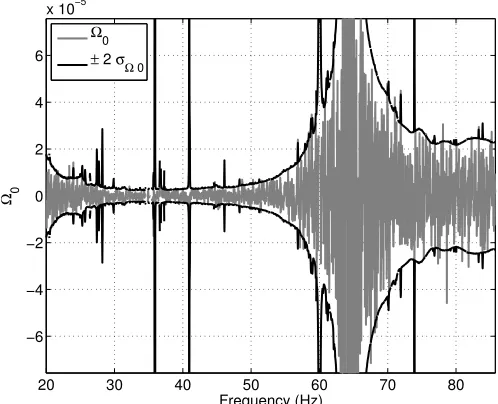
FIG. 1. We show the estimator for Ω0in each frequency bin, along with±2σ error bars, in the frequency band that con-tains 99% of the sensitivity forα= 0. The loss of sensitivity at around 65 Hz is due to a zero in the overlap reduction func-tion. There are several lines associated with known instru-mental artifacts which do not lead to excess cross-correlation. The data are consistent with Gaussian noise, as described in the Results section.
Results.—Our search finds no evidence of the back-ground, and the data are consistent with statistical fluc-tuations, assuming Gaussian noise. The integrand of Equation 3, multiplied by df = 0.031 Hz, gives an es-timator for Ω0in each frequency bin. We plot this quan-tity, along with ±2σ error bars, in Figure 6. To check for Gaussianity, we employ a noise model that the esti-mator in each frequency bin is drawn from a Gaussian distribution with zero mean with the standard deviation of that frequency bin. We obtain aχ2per degree of free-dom of 0.92, indicating that the data are consistent with Gaussian noise.
Consequently, we are able to place upper bounds on the energy density present in the background. Forα= 0, we place the bound Ω0 <1.7×10⁻⁷ at 95% confidence, where 99% of the sensitivity comes in the frequency band 20−86 Hz. This is a factor of 33 times more sensitive than the previous best limit at these frequencies [36].
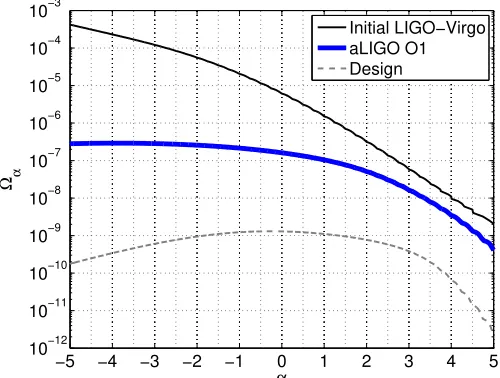
Following [56], we show 95% confidence contours in the Ωα−αplane in Figure 2 by computing the joint posterior
for Ωα and α. In addition, in Table I, we report upper
limits on the energy density for specific fixed values of the spectral index, marginalizing over amplitude calibration uncertainty [57] using the conservative estimates of 11.8% for H1 and 13.4% for L1. Phase calibration uncertainties are negligible.
Spectral indexα Frequency band with 99% sensitivity Amplitude Ωα 95% CL upper limit Previous limits [36]
0 20−85.8 Hz (4.4±5.9)×10−8 1.7×10⁻⁷ 5.6×10⁻⁶ 2/3 20−98.2 Hz (3.5±4.4)×10−8 1.3×10⁻⁷ –
[image:8.612.70.544.51.111.2]3 20−305 Hz (3.7±6.5)×10−9 1.7×10⁻⁸ 7.6×10⁻⁸
TABLE I. The frequency band with 99% of the sensitivity are shown, along with the point estimate and standard deviation for the amplitude of the background, and 95% confidence level upper limits using O1 data for three values of the spectral index,
α= 0,2/3,3. We also show the previous upper limits using Initial LIGO-Virgo data.
−5 −4 −3 −2 −1 0 1 2 3 4 5
10−12 10−11 10−10 10−9 10−8 10−7 10−6 10−5 10−4 10−3
α Ω α
Initial LIGO−Virgo aLIGO O1 Design
FIG. 2. Following [56], we present 95 % confidence contours in the Ωα−αplane. The region above these curves is excluded
at 95% confidence. We show the constraints coming from the final science run of Initial LIGO-Virgo [36] and from O1 data. Finally, we display the projected (not observed) design sensitivity to Ωαandαfor Advanced LIGO and Virgo [58].
Hanford site (H1 and H2). In [37], the limit Ω3<7.7× 10⁻⁴ in the frequency band 460−1000 Hz was obtained for the spectral index α= 3 and fref = 900 Hz. Using this same frequency band, and using the cross-correlated data between the Hanford and Livingston detectors, we place a limit Ω3 < 1.7×10⁻² for f
ref = 900 Hz. This is about a factor of 22 larger than the limit from the co-located detectors, in part due to the loss in sensitivity of a stochastic search from cross-correlating detectors at different spatial locations.
In Figure 3, we show the constraints from this analysis and from previous analyses using other detectors, theo-retical predictions, and the expected sensitivity of future measurements by LIGO-Virgo and by the Laser Inter-ferometer Space Antenna (LISA). Where applicable, we show constraints using power-law integrated curves (PI curves) [59], which account for the broadband nature of the search by integrating a range of power-law signals over the sensitive frequency band of the detector. By construction, any power-law spectrum which crosses a PI curve is detectable with SNR≥2.
The blue curve labeled ‘aLIGO O1’ in Figure 3 shows the measured O1 PI curve. We also display the PI curve for the final science run of Initial LIGO and Virgo [36], H1-H2 [37], as well as the projected design sensitivity for the advanced detector network. The curve labeled ‘Design’ assumes 2 years of co-incident data taken with both Advanced LIGO and Virgo operating at design sen-sitivity, using the projections in [58]. For the sake of comparison, the measured O1 PI curve atα = 0 is 1.6 times larger than the projected PI curve atα= 0 using the projections in [58] and 29.85 days of live time, which is fairly good agreement between predicted and achieved sensitivity. Finally, in red we present the projected sen-sitivity of a space-based detector with similar sensen-sitivity to LISA, using the PI curve presented in [59] computed using the projections in [64, 65].
We compare these constraints with direct limits from the ringing of Earth’s normal modes [63], indirect lim-its from the Cosmic Microwave Background (CMB) and Big Bang Nucleosynthesis (BBN) [61], and limits from pulsar timing arrays [62] and CMB measurements at low multipole moments [60].
In addition, we give examples of several models which can contribute to the background. We show the back-ground expected from slow-roll inflation with a tensor-to-scalar-ratior= 0.11 (the upper limit allowed by Planck [40]). We also show examples of the BBH coalescence model, and the binary neutron star (BNS) coalescence model, which we describe below. As noted in [66], LISA is likely to be able to detect the BBH background of the size considered here.
Astrophysical Implications.—In order to model the background from binary systems we will follow the ap-proach of [35]. We divide the compact binary population into classes labeled byk[67, 68]. Each class has distinct values of source parameters (for example the masses), which we denote by θk. The total astrophysical
back-ground is a sum over the contributions in each class. The contribution of classkto the background may be written in terms of an integral over the redshiftzas [1, 5, 69–74]
ΩGW(f;θk) = f ρcH0
Z zmax
0
dzRm(z;θk) dEGW
df (fs;θk)
(1 +z)E(ΩM,ΩΛ, z) ,
(6) where Rm(z;θk) is the binary merger rate per unit
[image:8.612.57.307.176.365.2]FIG. 3. Presented here are constraints on the background in PI form [59], as well as some representative models, across many decades in frequency. We compare the limits from ground-based interferometers from the final science run of Initial LIGO-Virgo, the co-located detectors at Hanford (H1-H2), Advanced LIGO (aLIGO) O1, and the projected design sensitivity of the advanced detector network assuming two years of coincident data, with constraints from other measurements: CMB measurements at low multipole moments [60], indirect limits from the Cosmic Microwave Background (CMB) and Big-Bang Nucleosynthesis [61, 62], pulsar timing [62], and from the ringing of Earth’s normal modes [63]. We also show projected limits from a space-based detector such as LISA [59, 64, 65], following the assumptions of [59]. We extend the BNS and BBH distributions using anf2/3 power-law down to low frequencies, with a low-frequency cut-off imposed where the inspiral time-scale is of order the Hubble scale. In Figure 5, we show the region in the black box in more detail.
energy spectrum emitted by a single binary evaluated in terms of the source frequency fs = (1 + z)f, and E(ΩM,ΩΛ, z) =
p
ΩM(1 +z)3+ ΩΛaccounts for the
de-pendence of comoving volume on cosmology. We use cosmological parameters from Planck [40], and ΩM =
1−ΩΛ= 0.308.
The energy spectrumdEGW/df is determined from the strain waveform of the binary system. The dominant contribution to the background comes from the inspiral phase, however for BBH we include the merger and ring-down phases using the waveforms from [5, 75] with the modifications from [76]. We choose to cut off the red-shift integral at zmax = 10. Redshifts larger than five contribute little to the integral due to the small number of stars formed at such high redshift [1, 5, 34, 69–74].
To compute the binary merger rateRm(z;θk), we use
the same assumptions as in [35], unless stated otherwise. For the BNS case, we assume that the minimal time be-tween the formation and the coalescence of the binary is tmin = 20 Myr, following for instance [46]. This is to be compared totmin= 50 Myr for BBH [35, 77].
As was emphasized in [78], heavy stellar mass black holes are expected to form in regions of low metallicity, which are associated with weaker stellar winds. To ac-count for this effect, following [35], for binary systems with chirp masses larger than 30 M, we use only the
fraction of stars that form in an environment with metal-licity Z < Z/2. For BBH (and BNS) systems with
smaller masses, we do not use a cutoff. However, we note that it makes little difference whether or not the cutoff is applied to high masses.
With the model defined above, the free parameters are the local merger rateRlocal=Rm(0;θk) and the average
chirp mass Mc. The distribution of the chirp mass has
little effect on the spectrum for a fixed average chirp mass [5].
We place upper limits at 95% confidence in theMc− Rlocal plane, which are shown in Figure 4. Alongside the O1 results, we show the limits using Initial LIGO-Virgo data, as well as projected sensitivity of the ad-vanced detector network. The limits presented here are about 10 times more sensitive than those placed with Initial LIGO-Virgo data. Furthermore, the future runs of the advanced detectors are expected to yield another factor of 100 improvement in sensitivity in Rlocal for a given average chirp mass. We also show the local rate and chirp mass inferred from direct detections of BBH mergers during O1 [47, 68]. Comparing the projected design sensitivity on Rlocal and Mc, with the values
in-ferred from BBH observations in O1, suggests that it may be possible for the advanced detector network to detect the astrophysical BBH background.
100 101 102 100
102 104 106
M
c (Msolar)
R local
(Gpc
−3
yr
−1
)
BNS BBH Flat
Power
Initial LIGO−VIRGO aLIGO O1
[image:10.612.58.303.54.247.2]Design
FIG. 4. Displayed here are the 95% confidence contours on the local rate and average chirp mass parameters, using the model described in the Astrophysical Implications section. In addition to the constraint from Advanced LIGO (aLIGO) O1 data, we show the constraint from the final science run of Initial LIGO-Virgo, and the projected design sensitivity of Advanced LIGO-Virgo. We also show the median rate with 90% uncertainty inferred from O1 data for the power-law and flat-log mass distributions [47], along with the band contain-ing 68% of the chirp mass for each distribution. The gray band separates BNS from BBH backgrounds. The dip at 30
M is due to the metallicity cutoff, as described in the As-trophysical Implications section.
the background, including statistical uncertainty bands showing the 90% uncertainty in the local rate. The three rate models agree well in the sensitive frequency band of advanced detectors (10-100 Hz). Note also that the final sensitivity of the advanced detectors may be sufficient to detect this background.
Conclusions.—The results presented here represent the first search for the stochastic gravitational-wave back-ground made with the Advanced LIGO detectors. With no evidence of a stochastic signal, we place an upper limit of Ω0<1.7×10⁻⁷on the GW energy density, for a spec-tral indexα= 0. This is∼33 times more sensitive than previous direct measurements in this frequency band. We also constrain the binary coalescence parameters of chirp mass and local merger rate. For fixed chirp mass be-low the high mass threshold of 30M, the constraint on
the merger rate is improved by a factor of ∼ 24, while for fixed merger rate, the constraint on the chirp mass is improved by a factor of∼7, as can be seen from Fig-ure 4. Finally, we update the background predictions due to BBH coalescences using data from O1. In this work we have focused the implications of our results for an as-trophysical BBH background, as this provides the most promising candidate for first detecting the background. The implications of our search for other astrophysical and
cosmological models can be seen in Figure 3. There is also an upcoming publication that will study implications for cosmic string models in more detail.
These O1 results are a glimpse of the improvements in sensitivity to be seen in upcoming years. As the ad-vanced detectors reach design sensitivity, there is a rea-sonable possibility of detecting the background due to BBHs. Even if no detection is made with these future searches, the searches will be able to constrain impor-tant cosmological and astrophysical background models.
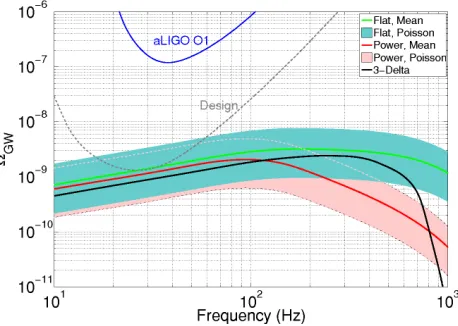
FIG. 5. We present a range of potential spectra for a BBH background, using the flat-log, power-law, and 3-delta mass distribution models described in [47, 78], with the local rate inferred from the O1 detections [47]. For the flat-log and power-law distributions, we show the 90% Poisson uncertainty band due to the uncertainty in the local rate measurement. In addition, we show the measured O1 PI curve and the pro-jected PI curve for Advanced LIGO-Virgo operating at design sensitivity.
[image:10.612.323.552.192.355.2]Science & Engineering Research Board (SERB), India, Ministry of Human Resource Development, India, the Spanish Ministerio de Econom´ıa y Competitividad, the Conselleria d’Economia i Competitivitat and Conselleria d’Educaci´o, Cultura i Universitats of the Govern de les Illes Balears, the National Science Centre of Poland, the European Commission, the Royal Society, the Scottish Funding Council, the Scottish Universities Physics Al-liance, the Hungarian Scientific Research Fund (OTKA), the Lyon Institute of Origins (LIO), the National Re-search Foundation of Korea, Industry Canada and the Province of Ontario through the Ministry of Economic Development and Innovation, the Natural Science and Engineering Research Council Canada, Canadian Insti-tute for Advanced Research, the Brazilian Ministry of Science, Technology, and Innovation, Funda¸c˜ao de Am-paro `a Pesquisa do Estado de S˜ao Paulo (FAPESP), Russian Foundation for Basic Research, the Leverhulme Trust, the Research Corporation, Ministry of Science and Technology (MOST), Taiwan and the Kavli Foun-dation. The authors gratefully acknowledge the support of the NSF, STFC, MPS, INFN, CNRS and the State of Niedersachsen/Germany for provision of computational resources. This article has been assigned the document number LIGO-P1600258-v19.
[1] X.-J. Zhu, E. J. Howell, D. G. Blair, and Z.-H. Zhu, Mon. Not. R. Ast. Soc.431, 882 (2013).
[2] S. Marassi, R. Schneider, G. Corvino, V. Ferrari, and S. P. Zwart, Phys. Rev. D84, 124037 (2011).
[3] C. Wu, V. Mandic, and T. Regimbau, Phys. Rev. D85, 104024 (2012).
[4] P. A. Rosado, Phys. Rev. D84, 084004 (2011).
[5] X.-J. Zhu, E. Howell, T. Regimbau, D. Blair, and Z.-H. Zhu, Astrophys. J. 739, 86 (2011).
[6] P. D. Lasky, M. F. Bennett, and A. Melatos, Phys. Rev. D87, 063004 (2013).
[7] P. A. Rosado, Phys. Rev. D86, 104007 (2012).
[8] X.-J. Zhu, X.-L. Fan, and Z.-H. Zhu, Astrophys. J.729, 59 (2011).
[9] S. Marassi, R. Schneider, and V. Ferrari, Mon. Not. R. Ast. Soc.398, 293 (2009).
[10] X.-J. Zhu, E. Howell, and D. Blair, Mon. Not. R. Ast. Soc.409, L132 (2010).
[11] A. Buonanno, G. Sigl, G. G. Raffelt, H.-T. Janka, and E. M¨uller, Phys. Rev. D72, 084001 (2005).
[12] P. Sandick, K. A. Olive, F. Daigne, and E. Vangioni, Phys. Rev. D73, 104024 (2006).
[13] T. Damour and A. Vilenkin, Phys. Rev. D 71, 063510 (2005).
[14] T. W. B. Kibble, Journal of Physics A Mathematical General9, 1387 (1976).
[15] S. Sarangi and S.-H. H. Tye, Physics Letters B536, 185 (2002).
[16] X. Siemens, V. Mandic, and J. Creighton, Physical Re-view Letters 98, 111101 (2007).
[17] R. Bar-Kana, Phys. Rev. D50, 1157 (1994).
[18] A. A. Starobinskiˇı, Soviet Journal of Experimental and Theoretical Physics Letters30, 682 (1979).
[19] R. Easther, J. T. Giblin, Jr., and E. A. Lim, Physical Review Letters99, 221301 (2007).
[20] N. Barnaby, E. Pajer, and M. Peloso, Phys. Rev. D85, 023525 (2012).
[21] J. L. Cook and L. Sorbo, Phys. Rev. D85, 023534 (2012). [22] A. Lopez and K. Freese, arXiv:1305.5855.
[23] M. S. Turner, Phys. Rev. D55, 435 (1997). [24] R. Easther and E. A. Lim, JCAP4, 010 (2006). [25] A. Kosowsky, M. S. Turner, and R. Watkins, Phys. Rev.
Lett.69, 2026 (1992).
[26] M. Kamionkowski, A. Kosowsky, and M. S. Turner, Phys. Rev. D49, 2837 (1994).
[27] J. T. Giblin Jr. and E. Thrane, Phys. Rev. D90, 107502 (2014).
[28] M. Gasperini and G. Veneziano, Astropart. Phys.1, 317 (1993).
[29] M. Gasperini and G. Veneziano, Mod. Phys. Lett.A8, 3701 (1993).
[30] V. Mandic and A. Buonanno, Phys. Rev. D73, 063008 (2006).
[31] M. Gasperini, JCAP1612, 010 (2016).
[32] B. P. Abbottet al. (LIGO Scientific Collaboration and Virgo Collaboration), Phys. Rev. Lett. 116, 061102 (2016).
[33] B. P. Abbottet al. (LIGO Scientific Collaboration and Virgo Collaboration), Phys. Rev. Lett. 116, 241103 (2016).
[34] T. Callister, L. Sammut, S. Qiu, I. Mandel, and E. Thrane, Phys. Rev. X6, 031018 (2016).
[35] B. P. Abbottet al. (LIGO Scientific Collaboration and Virgo Collaboration), Phys. Rev. Lett. 116, 131102 (2016).
[36] J. Aasi et al., Physical Review Letters 113, 231101 (2014).
[37] J. Aasiet al. (LIGO Scientific Collaboration and Virgo Collaboration), Phys. Rev. D91, 022003 (2015). [38] J. Aasi et al. (LIGO Scientific Collaboration), Class.
Quantum Grav.32, 074001 (2015).
[39] B. Allen and J. D. Romano, Phys. Rev. D 59, 102001 (1999).
[40] P. A. R. Ade et al. (Planck), Astron. Astrophys. 594, A13 (2016).
[41] J. N. Griebet al.(BOSS), Submitted to: Mon. Not. Roy. Astron. Soc. (2016), arXiv:1607.03143.
[42] B. Abbottet al., Astrophys. J.659, 918 (2007). [43] J. Abadieet al., Phys. Rev. D85, 122001 (2012). [44] B. P. Abbottet al., Nature460, 990 (2009).
[45] J. Abadie et al., Physical Review Letters 107, 271102 (2011).
[46] D. Meacheret al., Phys. Rev.D92, 063002 (2015). [47] B. P. Abbottet al.(Virgo, LIGO Scientific), Phys. Rev.
X6, 041015 (2016).
[48] J. D. Romano and N. J. Cornish, Living Reviews In Rel-ativity (to appear).
[49] The Hubble constant appears explicitly, rather than be-ing absorbed into λα, to emphasize that the estimator
for ΩGW depends on the measured value ofH0. [50] N. Christensen, Phys. Rev. D46, 5250 (1992).
[51] B. P. Abbott et al. (LIGO Scientific Collabora-tion and Virgo CollaboraCollabora-tion),https://dcc.ligo.org/ LIGO-P1600258.
(2016).
[53] C. Biweret al.,https://dcc.ligo.org/LIGO-P1600285/ public.
[54] E. Thrane, N. Christensen, and R. M. S. Schofield, Phys. Rev. D87, 123009 (2013).
[55] E. Thrane, N. Christensen, R. M. S. Schofield, and A. Ef-fler, Phys. Rev. D90, 023013 (2014).
[56] V. Mandic, E. Thrane, S. Giampanis, and T. Regimbau, Phys. Rev. Lett.109, 171102 (2012).
[57] J. T. Whelan, E. L. Robinson, J. D. Romano, and E. H. Thrane, Journal of Physics Conference Series484, 012027 (2014).
[58] B. P. Abbottet al.(LIGO Scientific Collaboration, Virgo Collaboration), Living Rev. Relat.19, 1 (2016). [59] E. Thrane and J. D. Romano, Phys. Rev. D88, 124032
(2013).
[60] P. A. R. Adeet al.(Planck), Astron. Astrophys.536, A1 (2011).
[61] L. Pagano, L. Salvati, and A. Melchiorri, Phys. Lett. B760, 823 (2016).
[62] P. D. Laskyet al., Phys. Rev.X6, 011035 (2016). [63] M. Coughlin and J. Harms, Phys. Rev. D90, 042005
(2014), 1406.1147.
[64] N. J. Cornish and S. L. Larson, Class. Quant. Grav.18, 3473 (2001).
[65] J. Crowder and N. J. Cornish, Phys. Rev.D72, 083005 (2005).
[66] A. Sesana, Physical Review Letters116, 231102 (2016), arXiv:1602.06951 [gr-qc].
[67] C. Kim, V. Kalogera, and D. Lorimer, Astrophys. J. 584, 985 (2003).
[68] B. P. Abbott et al. (Virgo, LIGO Scientific), (2016), arXiv:1602.03842.
[69] T. Regimbau, Research in Astronomy and Astrophysics 11, 369 (2011).
[70] P. A. Rosado, Phys. Rev. D84, 084004 (2011).
[71] S. Marassi, R. Schneider, G. Corvino, V. Ferrari, and S. P. Zwart, Phys. Rev. D84, 124037 (2011).
[72] C. Wu, V. Mandic, and T. Regimbau, Phys. Rev. D85, 104024 (2012).
[73] C.-J. Wu, V. Mandic, and T. Regimbau, Phys. Rev. D 87, 042002 (2013).
[74] I. Kowalska-Leszczynska, T. Regimbau, T. Bulik, M. Do-minik, and K. Belczynski, Astronomy and Astrophysics 574, A58 (2015).
[75] P. Ajithet al., Phys. Rev. D77, 104017 (2008). [76] P. Ajithet al., Phys. Rev. Lett.106, 241101 (2011). [77] M. Dominik, K. Belczynski, C. Fryer, D. E. Holz,
E. Berti, T. Bulik, I. Mandel, and R. O’Shaughnessy, Astrophys. J.779, 72 (2013).
[78] B. Abbottet al., Astrophys. J. Lett.818(2016).
SUPPLEMENT–UPPER LIMITS ON THE STOCHASTIC GRAVITATIONAL-WAVE BACKGROUND FROM ADVANCED LIGO’S
FIRST OBSERVING RUN
In this supplement we describe in more detail how the data in the main text are analyzed. Data used in the analysis are from times when both detectors are in a low-noise observing mode. We exclude certain times and frequencies based on auxiliary channels that established them as instrumental effects within the detectors.
We remove times due to known instrumental artifacts, such as radio frequency (RF) glitching and electronics saturations [52], or due to simulated signals (referred to as hardware injections) generated by coherently moving the interferometer mirrors [53]. We also exclude segments associated with detections of gravitational waves. Data are also excluded when the detectors’ noise power spectra vary by more than 20% over the course of three 192s seg-ments. This cut is performed to remove non-stationary noise, and has been used in previous analyses [36]. A dedicated study has verified that removing variations of 20% provides a close-to-optimal balance between the false positive and false negative rates. The total live time with all vetoes applied, for 192s segments, is 29.85 days. These cuts remove 35% of the time-series data.
We exclude frequencies known to be associated with in-strumental artifacts, such as vibrations of the test mass suspensions and calibration lines. We also remove fre-quencies that are known to be instrumentally correlated between the two LIGO detectors. As an example, we detected a comb-like structure (a series of lines evenly spaced in frequency) at half Hz frequencies with 1 Hz separation. This structure was coherent between the two sites and subsequently observed in auxiliary chan-nels. The contributing frequency bins were not included in the analysis. The frequency domain cuts remove 21% of the observing band within each segment.
To verify the data analysis cuts described above, we introduce an artificial time shift of 1 s between the two sites. This effectively blinds the analysis by removing cor-relations due to a broadband gravitational-wave signal, while maintaining instrumental correlations with coher-ence times greater than 1 s. This method also allows us to identify additional instrumental artifacts that are not identified using the cuts above, without biasing our anal-ysis of the data. Upon studying the time-shifted data with the analysis cuts described above, we find no excess correlation, which is consistent with statistical expecta-tions of uncorrelated Gaussian noise.
of 600 s. Both types of injections were successfully re-covered within 1 σ uncertainty: the hardware injection measured (8.8±0.6)×10−5 and the software injection measured (9.0±0.6)×10−5.
Finally, we study the possibility of correlated noise be-tween H1 and L1 so that we may be confident that the systematic error in our measurements is negligible. After accounting for narrowband correlation detector artifacts arising from digital systems, we estimate the contamina-tion from the environment. Previous investigacontamina-tions have identified geophysical Schumann resonances as the most likely source of correlated environmental noise [54, 55]. Excitations in the spherical shell cavity formed between the surface of the Earth and the ionosphere cause mag-netic fields to be correlated over great distances, compa-rable to the separation between H1 and L1. The magnetic fields, in turn, can couple mechanically to the test mass through the suspension system or electronically [55]. In order to ascertain the systematic error from environmen-tal correlated noise, we construct a correlated noise bud-get. We employ a number of conservative assumptions in order to estimate the worst-case-scenario contamination. The first step is to measure the frequency-dependent coupling of the detector to ambient magnetic fields using external coils as an actuator [54, 55]. It is not practi-cal to induce fields that act on the entire detector si-multaneously, so we measure the coupling at each test mass. Next, we use magnetometers to measure the mag-netic coherence between the two sites. Using the method described in [54, 55], we combine the magnetic cross-power spectra and the coupling functions to estimate the worst-case correlated noise from Schumann resonances Ωnoise(f). Our conservative noise budget for O1
corre-102 10−14
10−12 10−10 10−8 10−6 10−4 10−2 100
Frequency (Hz)
Ω GW
O1 PI Curve
[image:13.612.322.568.53.247.2]Correlated Noise Budget
FIG. 6. We show the O1 power-law integrated curve (PI curve) along with the correlated noise budget as described in the text. The noise budget falling below the O1 PI curve indicates that correlated noise does not affect the O1 analysis.
![FIG. 3. Presented here are constraints on the background in PI form [59], as well as some representative models, across manydecades in frequency](https://thumb-us.123doks.com/thumbv2/123dok_us/9380358.440835/9.612.94.519.61.222/fig-presented-constraints-background-representative-models-manydecades-frequency.webp)