LIMSI @ WMT’12
Hai-Son Le1,2, Thomas Lavergne2, Alexandre Allauzen1,2, Marianna Apidianaki2,Li Gong1,2,Aur´elien Max1,2, Artem Sokolov2,Guillaume Wisniewski1,2,Franc¸ois Yvon1,2
Univ. Paris-Sud1and LIMSI-CNRS2
rue John von Neumann, 91403 Orsay cedex, France
{firstname.lastname}@limsi.fr
Abstract
This paper describes LIMSI’s submissions to the shared translation task. We report results for French-English and German-English in both directions. Our submissions usen-code, an open source system based on bilingual
n-grams. In this approach, both the transla-tion and target language models are estimated as conventional smoothedn-gram models; an approach we extend here by estimating the translation probabilities in a continuous space using neural networks. Experimental results show a significant and consistent BLEU im-provement of approximately 1 point for all conditions. We also report preliminary experi-ments using an “on-the-fly” translation model.
1 Introduction
This paper describes LIMSI’s submissions to the shared translation task of the Seventh Workshop on Statistical Machine Translation. LIMSI partic-ipated in the French-English and German-English tasks in both directions. For this evaluation, we used n-code, an open source in-house Statistical Machine Translation (SMT) system based on bilin-gual n-grams1. The main novelty of this year’s participation is the use, in a large scale system, of the continuous space translation models described in (Hai-Son et al., 2012). These models estimate the n-gram probabilities of bilingual translation units using neural networks. We also investigate an alter-native approach where the translation probabilities of a phrase based system are estimated “on-the-fly”
1http://ncode.limsi.fr/
by sampling relevant examples, instead of consider-ing the entire trainconsider-ing set. Finally we also describe the use in a rescoring step of several additional fea-tures based on IBM1 models and word sense disam-biguation information.
The rest of this paper is organized as follows. Sec-tion 2 provides an overview of the baseline systems built with n-code, including the standard transla-tion model (TM). The continuous space translatransla-tion models are then described in Section 3. As in our previous participations, several steps of data pre-processing, cleaning and filtering are applied, and their improvement took a non-negligible part of our work. These steps are summarized in Section 5. The last two sections report experimental results ob-tained with the “on-the-fly” system in Section 6 and withn-code in Section 7.
2 System overview
n-code implements the bilingual n-gram approach to SMT (Casacuberta and Vidal, 2004; Mari˜no et al., 2006; Crego and Mari˜no, 2006). In this framework, translation is divided in two steps: a source reorder-ing step and a (monotonic) translation step. Source reordering is based on a set of learned rewrite rules that non-deterministically reorder the input words. Applying these rules result in a finite-state graph of possible source reorderings, which is then searched for the best possible candidate translation.
2.1 Features
Given a source sentencesofIwords, the best trans-lation hypothesisˆt is defined as the sequence ofJ words that maximizes a linear combination of
ture functions:
ˆ
t= arg max
t,a
( M X
m=1
λmhm(a,s,t) )
(1)
whereλmis the weight associated with feature
func-tionhmandadenotes an alignment between source
and target phrases. Among the feature functions, the peculiar form of the translation model constitute one of the main difference between then-gram approach and standard phrase-based systems. This will be fur-ther detailled in section 2.2 and 3.
In addition to the translation model, fourteen feature functions are combined: a target-language model (Section 5.3); fourlexicon models; six lexi-calized reordering models (Tillmann, 2004; Crego et al., 2011) aiming at predicting the orientation of the next translation unit; a “weak” distance-based distortion model; and finally a word-bonus model and atuple-bonus model which compensate for the system preference for short translations. The four lexicon modelsare similar to the ones used in stan-dard phrase-based systems: two scores correspond to the relative frequencies of the tuples and two lexi-cal weights are estimated from the automatic word alignments. The weights vector λ is learned us-ing a discriminative trainus-ing framework (Och, 2003) (Minimum Error Rate Training (MERT)) using the newstest2009 as development set and BLEU (Pap-ineni et al., 2002) as the optimization criteria.
2.2 Standardn-gram translation models
n-gram translation models rely on a specific de-composition of the joint probability of a sentence pair P(s,t): a sentence pair is assumed to be decomposed into a sequence of L bilingual units calledtuplesdefining a joint segmentation: (s,t) =
u1, ..., uL2. In the approach of (Mari˜no et al., 2006),
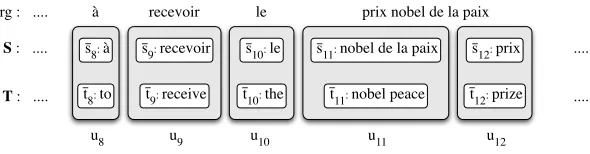
this segmentation is a by-product of source reorder-ing obtained by “unfoldreorder-ing” initial word alignments. In this framework, the basic translation units are tuples, which are the analogous of phrase pairs and represent a matching u = (s, t) between a source s and a target t phrase (see Figure 1). Using the n-gram assumption, the joint probability of a
seg-2
From now on, (s,t) thus denotes analignedsentence pair, and we omit the alignment variableain further developments.
mented sentence pair decomposes as:
P(s,t) = L Y
i=1
P(ui|ui−1, ..., ui−n+1) (2)
During the training phase (Mari˜no et al., 2006), tu-ples are extracted from a word-aligned corpus (us-ing MGIZA++3 with default settings) in such a way that a unique segmentation of the bilingual corpus is achieved. A baseline n-gram translation model is then estimated over a training corpus com-posed of tuple sequences using modified Knesser-Ney Smoothing (Chen and Goodman, 1998).
2.3 Inference
During decoding, source sentences are represented in the form of word lattices containing the most promising reordering hypotheses, so as to reproduce the word order modifications introduced during the tuple extraction process. Hence, only those reorder-ing hypotheses are translated and they are intro-duced using a set of reordering rules automatically learned from the word alignments.
In the example in Figure 1, the rule [prix no-bel de la paix ; nobel de la paix prix] repro-duces the invertion of the French words that is ob-served when translating from French into English. Typically, part-of-speech (POS) information is used to increase the generalization power of these rules. Hence, rewrite rules are built using POS rather than surface word forms (Crego and Mari˜no, 2006).
3 SOUL translation models
A first issue with the model described by equa-tion (2) is that the elementary units are bilingual pairs. As a consequence, the underlying vocabulary, hence the number of parameters, can be quite large, even for small translation tasks. Due to data sparsity issues, such model are bound to face severe estima-tion problems. Another problem with (2) is that the source and target sides play symmetric roles: yet, in decoding, the source side is known and only the target side must be predicted.
3.1 A word factored translation model
To overcome these issues, then-gram probability in equation (2) can be factored by decomposing tuples
s̅8: à
t̅8: to
s̅9: recevoir
t̅9: receive
s̅10: le
t̅10: the
s̅11: nobel de la paix
t̅11: nobel peace
s̅12: prix
t̅12: prize
u8 u9 u10 u11 u12
S : ....
T : ....
à recevoir le prix nobel de la paix org : ....
....
[image:3.612.161.456.57.134.2]....
Figure 1: Extract of a French-English sentence pair segmented into bilingual units. The original (org) French sentence appears at the top of the figure, just above the reordered sourcesand targett. The pair(s,t)decomposes into a sequence ofLbilingual units (tuples)u1, ..., uL. Each tupleuicontains a source and a target phrase:siandti.
in two parts (source and target), and by taking words as the basic units of then-gram TM. This may seem to be a regression with respect to current state-of-the-art SMT systems, as the shift from the word-based model of (Brown et al., 1993) to the phrase-based models of (Zens et al., 2002) is usually con-sidered as a major breakthrough of the recent years. Indeed, one important motivation for considering phrases was to capture local context in translation and reordering. It should however be emphasized that the decomposition of phrases into words is only re-introduced here as a way to mitigate the param-eter estimation problems. Translation units are still pairs of phrases, derived from a bilingual segmen-tation in tuples synchronizing the source and target n-gram streams. In fact, the estimation policy de-scribed in section 4 will actually allow us to take into accountlarger contextsthan is possible with conven-tionaln-gram models.
Let ski denote the kth word of source tuple si.
Considering the example of Figure 1, s1
11 denotes
the source word nobel, s411 the source word paix. We finally denote hn−1(tki) the sequence made of then−1words precedingtk
i in the target sentence:
in Figure 1, h3(t211) thus refers to the three words contextreceive the nobelassociated witht211peace. Using these notations, equation (2) is rewritten as:
P(a,s,t) = L Y
i=1 h
|ti|
Y
k=1
P tki|hn−1(tki), hn−1(s1i+1)
× |si|
Y
k=1
P ski|hn−1(ti1), hn−1(ski) i (3)
This decomposition relies on then-gram assump-tion, this time at the word level. Therefore, this model estimates the joint probability of a sentence
pair using two sliding windows of lengthn, one for each language; however, the moves of these win-dows remain synchronized by the tuple segmenta-tion. Moreover, the context is not limited to the cur-rent phrase, and continues to include words from ad-jacent phrases. Using the example of Figure 1, the contribution of the target phraset11 =nobel, peace
toP(s,t)using a3- gram model is:
P nobel|[receive, the],[la, paix]
×P peace|[the, nobel],[la, paix].
A benefit of this new formulation is that the vo-cabularies involved only contain words, and are thus much smaller that tuple vocabularies. These models are thus less at risk to be plagued by data sparsity is-sues. Moreover, the decomposition (3) now involves two models: the first term represents a TM, the sec-ond term is best viewed as a reordering model. In this formulation, the TM only predicts the target phrase, given its source and target contexts.
P(s,t) = L Y
i=1 h
|si|
Y
k=1
P ski|hn−1(ski), hn−1(t1i+1)
× |ti|
Y
k=1
P tki|hn−1(si1), hn−1(tki)
i (4)
4 The principles of SOUL
the well-known data sparsity issue. In this work, we take advantage of the recent proposal of (Le et al., 2011). Using a specific neural network architec-ture (theStructured OUtput Layeror SOUL model), it becomes possible to handle large vocabulary lan-guage modeling tasks. This approach was experi-mented last year for target language models only and is now extended to translation models. More details about the SOUL architecture can be found in (Le et al., 2011), while its extension to translation models is more precisely described in (Hai-Son et al., 2012). The integration of SOUL models for large SMT tasks is carried out using a two-pass approach: the first pass uses conventional back-offn-gram trans-lation and language models to produce ak-best list (thek most likely translations); in the second pass, the probability of a m-gram SOUL model is com-puted for each hypothesis and the k-best list is ac-cordingly reordered. In all the following experi-ments, we used a context size for SOUL ofm= 10, and usedk= 300. The two decompositions of equa-tions (3) and (4) are used by introducing 4 scores during the rescoring step.
5 Corpora and data pre-processing
Concerning data pre-processing, we started from our submissions from last year (Allauzen et al., 2011) and mainly upgraded the corpora and the associated language-dependent pre-processing routines.
5.1 Pre-processing
We used in-house text processing tools for the to-kenization and detoto-kenization steps (D´echelotte et al., 2008). Previous experiments have demonstrated that better normalization tools provide better BLEU scores: all systems are thus built in “true-case”. Compared to last year, the pre-processing of utf-8 characters was significantly improved.
As German is morphologically more complex than English, the default policy which consists in treating each word form independently is plagued with data sparsity, which severely impacts both training (alignment) and decoding (due to unknown forms). When translating from German into En-glish, the German side is thus normalized using a specific pre-processing scheme (described in (Al-lauzen et al., 2010; Durgar El-Kahlout and Yvon,
2010)), which aims at reducing the lexical redun-dancy by (i) normalizing the orthography, (ii) neu-tralizing most inflections and (iii) splitting complex compounds. All parallel corpora were POS-tagged with the TreeTagger (Schmid, 1994); in addition, for German, fine-grained POS labels were also needed for pre-processing and were obtained using the RF-Tagger (Schmid and Laws, 2008).
5.2 Bilingual corpora
As for last year’s evaluation, we used all the avail-able parallel data for the German-English language pair, while only a subpart of the French-English par-allel data was selected. Word alignment models were trained using all the data, whereas the transla-tion models were estimated on a subpart of the par-allel data: the UN corpus was discarded for this step and about half of the French-English Giga corpus was filtered based on a perplexity criterion as in (Al-lauzen et al., 2011)).
For French-English, we mainly upgraded the training material from last year by extracting the new parts from the common data. The word alignment models trained last year were then up-dated by running a forced alignment 4 of the new data. These new word-aligned data was added to last year’s parallel corpus and constitute the train-ing material for the translation models and feature functions described in Section 2. Given the large amount of available data, three different bilingual n-gram models are estimated, one for each source of data: News-Commentary, Europarl, and the French-English Giga corpus. These models are then added to the weighted mixture defined by equation (1). For German-English, we simply used all the available parallel data to train one single translation models.
5.3 Monolingual corpora and language models
For the monolingual training data, we also used the same setup as last year. For German, all the train-ing data allowed in the constrained task were di-vided into several sets based on dates or genres: News-Commentary, the news crawled from the Web grouped by year, and Europarl. For each subset, a standard 4-gram LM was estimated using inter-polated Kneser-Ney smoothing (Kneser and Ney,
4
1995; Chen and Goodman, 1998). The resulting LMs are then linearly combined using interpolation coefficients chosen so as to minimize the perplexity of the development set. The German vocabulary is created using all the words contained in the parallel data and expanded to reach a total of 500k words by including the most frequent words observed in the monolingual News data for 2011.
For French and English, the same monolingual corpora as last year were used5. We did not observe any perplexity decrease in our attempts to include the new data specifically provided for this year’s evaluation. We therefore used the same language models as in (Allauzen et al., 2011).
6 “On-the-fly” system
We also developped an alternative approach imple-menting “on-the-fly” estimation of the parameter of a standard phase-based model, using Moses (Koehn et al., 2007) as the decoder. Implementing on-the-fly estimation for n-code, while possible in the-ory, is less appealing due to the computational cost of estimating a smoothed language model. Given an input source file, it is possible to compute only those statistics which are required to translate the phrases it contains. As in previous works on on-the-fly model estimation for SMT (Callison-Burch et al., 2005; Lopez, 2008), we compute a suffix array for the source corpus. This further enables to consider only a subset of translation examples, which we select by deterministic random sampling, meaning that the sample is chosen randomly with respect to the full corpus but that the same sample is always returned for a given value of sample size, hereafter denoted N. In our experiments, we used N = 1,000and computed from the sample and the word alignments (we used the same tokenization and word alignments as in all other submitted systems) the same translation6 and lexical reordering models as the standard training scripts of the Moses system. Experiments were run on the data sets used for WMT English-French machine translation evalua-tion tasks, using the same corpora and optimizaevalua-tion
5
The fifth edition of the English Gigaword (LDC2011T07) wasnotused.
6
An approximation is used forp(f|e), andcoherent transla-tion estimatransla-tion is used; see (Lopez, 2008).
procedure as in our other experiments. The only no-table difference is our use of the Moses decoder in-stead of then-gram-based system. As shown in Ta-ble 1, our on-the-fly system achieves a result (31.7 BLEU point) that is slightly worst than then-code baseline (32.0) and slightly better than the equiva-lent Moses baseline (31.5), but does it much faster. Model estimation for the test file is reduced to 2 hours and 50 minutes, with an additional overhead for loading and writing files of one and a half hours, compared to roughly 210 hours for our baseline sys-tems under comparable hardware conditions.
7 Experimental results
7.1 n-code with SOUL
Table 1 summarizes the experimental results sub-mitted to the shared translation for French-English and German-English in both directions. The perfor-mances are measured in terms of BLEU on new-stest2011, last year’s test set, and this year’s test setnewstest2012. For the former, BLEU scores are computed with the NIST scriptmteva-v13.pl, while we provide for newstest2012 the results computed by the organizers 7. The Baseline results are ob-tained with standardn-gram models estimated with back-off, both for the bilingual and monolingual tar-get models. With standardn-gram estimates, the or-der is limited ton = 4. For instance, the n-code French-English baseline achieves a 0.5 BLEU point improvement over a Moses system trained with the same data setup in both directions.
From Table 1, it can be observed that adding the SOUL models (translation models and target language model) consistently improves the base-line, with an increase of 1 BLEU point. Con-trastive experiments show that the SOUL target LM does not bring significant gain when added to the SOUL translation models. For instance, a gain of 0.3 BLEU point is observed when translating from French to English with the addition of the SOUL tar-get LM. In the other translation directions, the differ-ences are negligible.
7
Direction System BLEU test2011 test2012∗
en2fr Baseline 32.0 28.9
+ SOUL TM 33.4 29.9
on-the-fly 31.7 28.6
fr2en Baseline 30.2 30.4
+ SOUL TM 31.1 31.5
en2de Baseline 15.4 16.0
+ SOUL TM 16.6 17.0
de2en Baseline 21.8 22.9
[image:6.612.74.298.54.207.2]+ SOUL TM 22.8 23.9
Table 1: Experimental results in terms of BLEU scores measured on the newstest2011 and newstest2012. For newstest2012, the scores are provided by the organizers.
7.2 Experiments with additional features
For this year’s evaluation, we also investigated sev-eral additional features based on IBM1 models and word sense disambiguation (WSD) information in rescoring. As for the SOUL models, these features are added after then-best list generation step.
In previous work (Och et al., 2004; Hasan, 2011), the IBM1 features (Brown et al., 1993) are found helpful. As the IBM1 model is asymmetric, two models are estimated, one in both directions. Con-trary to the reported results, these additional features do not yield significant improvements over the base-line system. We assume that the difficulty is to add information to an already extensively optimized sys-tem. Moreover, the IBM1 models are estimated on the same training corpora as the translation system, a fact that may explain the redundancy of these ad-ditional features.
In a separate series of experiments, we also add WSD features calculated according to a variation of the method proposed in (Apidianaki, 2009). For each word of a subset of the input (source lan-guage) vocabulary, a simple WSD classifier pro-duces a probability distribution over a set of trans-lations8. During reranking, each translation hypoth-esis is scanned and the word translations that match one of the proposed variant are rewarded using an additional score. While this method had given some
8
The difference with the method described in (Apidianaki, 2009) is that no sense clustering is performed, and each transla-tion is represented by a separate weighted source feature vector which is used for disambiguation
small gains on a smaller dataset (IWSLT’11), we did not observe here any improvement over the base-line system. Additional analysis hints that (i) most of the proposed variants are already covered by the translation model with high probabilities and (ii) that these variants are seldom found in the reference sen-tences. This means that, in the situation in which only one reference is provided, the hypotheses with a high score for the WSD feature are not adequately rewarded with the actual references.
8 Conclusion
In this paper, we described our submissions to WMT’12 in the French-English and German-English shared translation tasks, in both directions. As for our last year’s participation, our main sys-tems are built withn-code, the open source Statis-tical Machine Translation system based on bilingual n-grams. Our contributions are threefold. First, we have experimented a new kind of translation mod-els, where the bilingualn-gram distribution are es-timated in a continuous space with neural networks. As shown in past evaluations with target language model, there is a significant reward for using this kind of models in a rescoring step. We observed that, in general, the continuous space translation model yields a slightly larger improvement than the target translation model. However, their combination does not result in an additional gain.
We also reported preliminary results with a sys-tem ”on-the-fly”, where the training data are sam-pled according to the data to be translated in order to train contextually adapted system. While this sys-tem achieves comparable performance to our base-line system, it is worth noticing that its total train-ing time is much smaller than a comparable Moses system. Finally, we investigated several additional features based on IBM1 models and word sense dis-ambiguation information in rescoring. While these methods have sometimes been reported to help im-prove the results, we did not observe any imim-prove- improve-ment here over the baseline system.
Acknowledgment
References
Alexandre Allauzen, Josep M. Crego, ˙Ilknur Durgar El-Kahlout, and Franc¸ois Yvon. 2010. LIMSI’s statis-tical translation systems for WMT’10. InProc. of the Joint Workshop on Statistical Machine Translation and MetricsMATR, pages 54–59, Uppsala, Sweden. Alexandre Allauzen, Gilles Adda, H´el`ene
Bonneau-Maynard, Josep M. Crego, Hai-Son Le, Aur´elien Max, Adrien Lardilleux, Thomas Lavergne, Artem Sokolov, Guillaume Wisniewski, and Franc¸ois Yvon. 2011. LIMSI @ WMT11. InProceedings of the Sixth Work-shop on Statistical Machine Translation, pages 309– 315, Edinburgh, Scotland, July. Association for Com-putational Linguistics.
Marianna Apidianaki. 2009. Data-driven semantic anal-ysis for multilingual WSD and lexical selection in translation. InProceedings of the 12th Conference of the European Chapter of the ACL (EACL 2009), pages 77–85, Athens, Greece, March. Association for Com-putational Linguistics.
Peter F. Brown, Vincent J. Della Pietra, Stephen A. Della Pietra, and Robert L. Mercer. 1993. The mathemat-ics of statistical machine translation: parameter esti-mation. Comput. Linguist., 19(2):263–311.
Chris Callison-Burch, Colin Bannard, and Josh Schroeder. 2005. Scaling phrase-based statisti-cal machine translation to larger corpora and longer phrases. In Proceedings of the 43rd Annual Meeting of the Association for Computational Linguistics (ACL’05), pages 255–262, Ann Arbor, Michigan, June. Association for Computational Linguistics. Francesco Casacuberta and Enrique Vidal. 2004.
Ma-chine translation with inferred stochastic finite-state transducers. Computational Linguistics, 30(3):205– 225.
Stanley F. Chen and Joshua T. Goodman. 1998. An empirical study of smoothing techniques for language modeling. Technical Report TR-10-98, Computer Sci-ence Group, Harvard Un iversity.
Josep M. Crego and Jos´e B. Mari˜no. 2006. Improving statistical MT by coupling reordering and decoding.
Machine Translation, 20(3):199–215.
Josep M. Crego, Franc¸ois Yvon, and Jos´e B. Mari˜no. 2011. N-code: an open-source Bilingual N-gram SMT Toolkit. Prague Bulletin of Mathematical Linguistics, 96:49–58.
Ilknur Durgar El-Kahlout and Franc¸ois Yvon. 2010. The pay-offs of preprocessing for German-English Statis-tical Machine Translation. In Marcello Federico, Ian Lane, Michael Paul, and Franc¸ois Yvon, editors, Pro-ceedings of the seventh International Workshop on Spoken Language Translation (IWSLT), pages 251– 258.
Daniel D´echelotte, Gilles Adda, Alexandre Allauzen, Olivier Galibert, Jean-Luc Gauvain, H´el`ene May-nard, and Franc¸ois Yvon. 2008. LIMSI’s statisti-cal translation systems for WMT’08. InProc. of the NAACL-HTL Statistical Machine Translation Work-shop, Columbus, Ohio.
Hai-Son, Alexandre Allauzen, and Franc¸ois Yvon. 2012. Continuous space translation models with neural net-works. InNAACL ’12: Proceedings of the 2012 Con-ference of the North American Chapter of the Associ-ation for ComputAssoci-ational Linguistics on Human Lan-guage Technology.
Saˇsa Hasan. 2011. Triplet Lexicon Models for Statisti-cal Machine Translation. Ph.D. thesis, RWTH Aachen University.
Reinhard Kneser and Herman Ney. 1995. Improved backing-off for m-gram language modeling. In Pro-ceedings of the International Conference on Acoustics, Speech, and Signal Processing, ICASSP’95, pages 181–184, Detroit, MI.
Philipp Koehn, Hieu Hoang, Alexandra Birch, Chris Callison-Burch, Marcello Federico, Nicola Bertoldi, Brooke Cowan, Wade Shen, Christine Moran, Richard Zens, Chris Dyer, Ondrej Bojar, Alexandra Con-stantin, and Evan Herbst. 2007. Moses: Open source toolkit for statistical machine translation. In Proceed-ings of the 45th Annual Meeting of the Association for Computational Linguistics Companion Volume Pro-ceedings of the Demo and Poster Sessions, pages 177– 180, Prague, Czech Republic, June. Association for Computational Linguistics.
Hai-Son Le, Ilya Oparin, Alexandre Allauzen, Jean-Luc Gauvain, and Franc¸ois Yvon. 2011. Structured output layer neural network language model. InProceedings of ICASSP’11, pages 5524–5527.
Adam Lopez. 2008. Tera-scale translation models via pattern matching. InProceedings of the 22nd Interna-tional Conference on ComputaInterna-tional Linguistics (Col-ing 2008), pages 505–512, Manchester, UK, August. Coling 2008 Organizing Committee.
Jos´e B. Mari˜no, Rafael E. Banchs, Josep M. Crego, Adri`a de Gispert, Patrick Lambert, Jos´e A.R. Fonollosa, and Marta R. Costa-Juss`a. 2006. N-gram-based machine translation. Computational Linguistics, 32(4):527– 549.
May 2 - May 7. Association for Computational Lin-guistics.
Franz Josef Och. 2003. Minimum error rate training in statistical machine translation. InACL ’03: Proc. of the 41st Annual Meeting on Association for Computa-tional Linguistics, pages 160–167.
Kishore Papineni, Salim Roukos, Todd Ward, and Wei-Jing Zhu. 2002. BLEU: a method for automatic eval-uation of machine translation. In ACL ’02: Proc. of the 40th Annual Meeting on Association for Compu-tational Linguistics, pages 311–318. Association for Computational Linguistics.
Helmut Schmid and Florian Laws. 2008. Estimation of conditional probabilities with decision trees and an application to fine-grained POS tagging. In Proceed-ings of the 22nd International Conference on Com-putational Linguistics (Coling 2008), pages 777–784, Manchester, UK, August.
Helmut Schmid. 1994. Probabilistic part-of-speech tag-ging using decision trees. In Proc. of International Conference on New Methods in Language Processing, pages 44–49, Manchester, UK.
Christoph Tillmann. 2004. A unigram orientation model for statistical machine translation. In Proceedings of HLT-NAACL 2004, pages 101–104. Association for Computational Linguistics.