http://www.scirp.org/journal/epe ISSN Online: 1947-3818
ISSN Print: 1949-243X
Day-Ahead Probabilistic Load Flow Analysis
Considering Wind Power Forecast Error
Correlation
Qiang Ding
1, Chuancheng Zhang
1, Jingyang Zhou
1, Sai Dai
1, Dan Xu
1, Zhiqiang Luo
2,
Chengwei Zhai
31Power Automation Department, China Electric Power Research Institute, Beijing, China
2National Electric Power Dispatch and Control Center, State Grid Corporation of China, Beijing, China 3Electrical and Electronic Engineering College, Zhejiang University, Hangzhou, China
Abstract
Short-term power flow analysis has a significant influence on day-ahead gen-eration schedule. This paper proposes a time series model and prediction er-ror distribution model of wind power output. With the consideration of wind speed and wind power output forecast error’s correlation, the probabilistic distributions of transmission line flows during tomorrow’s 96 time intervals are obtained using cumulants combined Gram-Charlier expansion method. The probability density function and cumulative distribution function of transmission lines on each time interval could provide scheduling planners with more accurate and comprehensive information. Simulation in IEEE 39-bus system demonstrates effectiveness of the proposed model and algo-rithm.
Keywords
Wind Power, Time Series Model, Forecast Error Distribution, Forecast Error Correlation, Probabilistic Load Flow, Gram-Charlier Expansion
1. Introduction
Recently, with the increase of wind power portion in power generation in China, how to conduct effective power flow analysis of power system including wind farm is always the focus of researchers. Day-ahead wind power prediction and probabilistic power flow analysis is valuable to guarantee the reliability and economy of short-term dispatch plan.
However, nowadays, for short-term dispatch plan including wind power, only How to cite this paper: Ding, Q., Zhang,
C.C., Zhou, J.Y., Dai, S., Xu, D., Luo, Z.Q. and Zhai, C.W. (2017) Day-Ahead Proba-bilistic Load Flow Analysis Considering Wind Power Forecast Error Correlation. Energy and Power Engineering, 9, 292-299.
https://doi.org/10.4236/epe.2017.94B034
a predicting time sequence is provided to operators which is not accurate enough for a reliable generation schedule. Most literature these days is focusing on wind power generation prediction, wind power prediction error, probabilistic power flow analysis based on long-term wind power models. And most literature relating to Gram-Charlier expansion is using this method with the Weibull dis-tribution to analyze long-term probabilistic load flow, however, Weibull distri-bution’s frequency spectrum is dispersed which makes it inappropriate to ana-lyze short-term flow analysis.
Towards these problems, this paper puts forward a method for analyzing the probabilistic load flow on each time interval of day-ahead generation schedule based on prediction error distribution and Gram-Charlier expansion method. Combined with day-ahead wind speed prediction model and wind power pre-diction error’s distribution which considering its correlation, this method pro-vides more data and information support for a more advanced economic dis-patch.
2. Methodology
2.1. Overall Model
This method starts from establishing a single wind farm’s wind speed forecasting time series by day-ahead wind speed anticipation methods such as density fore-cast and regression analysis etc. In this thesis, ARMA combined time shift tech-nique will be used to generate a simulated forecasting time series applying in example. More sophisticated wind speed anticipation method should be used in practical application. This step provides an expected value for following cumu-lants calculation and series expansion.
In fact, errors exist in wind speed and wind power output anticipation me-thods these days always. Using statistics meme-thods, we can establish forecasting errors’ probabilistic distribution models. This thesis adopts Beta distribution to fit forecasting errors’ frequency distribution histogram. By establishing the model of wind power predicting errors’ correlation complete the whole simu-lated scene. This thesis quantitative analyze the correlation of forecasting errors and qualitative analyze the correlation between forecasting wind power and wind power predicting errors. Meanwhile, by using covariance matrix transfor-mation method to decouple correlated distributions solves the problem of only independent random variables can be used in DC probabilistic load flow calcula-tion by series expansion method.
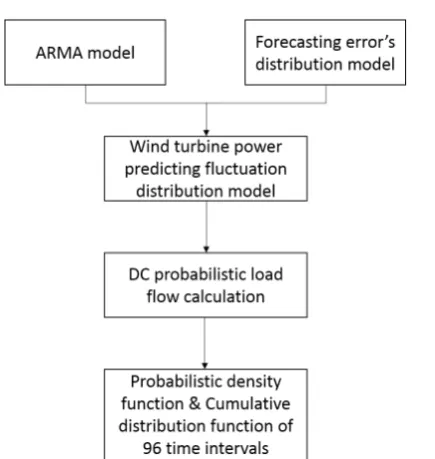
At last, obtaining each wind power predicting fluctuation’s independent probabilistic distribution, by using Gram-Charlier expansion combined cumu-lants to calculate each power line’s probabilistic load flow’s distribution. Apply-ing this method is both convenient and efficient in analyzApply-ing day-ahead proba-bilistic flow distribution. Figure 1 is the illustrative diagram of this article.
2.2. ARMA Model & Time Shifting Technic
Figure 1. Illustrative diagram of day-ahead power flow analysis considering wind power output forecast error distribution.
time shifting technique to generate a time series considering wind speed’s spatial correlation. Though ARMA model and time shifting technique can effectively predict wind speed and consider multiple wind farm’s correlation, then use the wind turbine output model to acquire multiple wind power predicting model.
ARMA model is widely applied in establishing wind speed and wind speed prediction time series. The classic ARMA model can be described as the follow-ing equation:
1 1
n n
t i t i t j t j
i j
s ϕs− α θ α−
= =
=
∑
+ −∑
(1)where st is the time series value at time t, φi and θj are the auto-regressive and moving average parameters of the model, respectively. αt is a normal white noise process with zero mean and a variance of σ2 as a normal independent distribu-tion.
The hourly simulated wind speed SWt at time t is obtained from the mean speed, its standard deviation and the time series st:
t t t t
SW =µ σ+ s (2)
Thus, a single wind farm’s day-ahead prediction wind speed time series is generated.
Then, by using the time shifting technique we can produce multiple wind farms’ wind speed prediction time series with certain correlation value. Assume that the new wind speed time series designated as s't is to be produced from
the original simulated series st with a certain correlation coefficient R. Let
0
t=K+t , K is the integral part and t0 is the fractional part of time shifting
[image:3.595.271.489.64.294.2]0 0 1
'K i (1 ) i i
s + = −t × + ×s t s+ (3) If each item’s subscript value exceeds n, then replaces the value by its original value minus a n.
After obtaining multiple wind farm’s wind speed time series, through the wind turbine output model we can get multiple wind power prediction time se-ries model.
2.3. Wind Power Prediction Error’s Distribution Model
This thesis uses non-standard Beta distribution to fit wind turbine output fore-casting errors’ distribution. This kind of probabilistic distribution shows a good reliability in wind turbine output intervals forecasting errors fit.
Non-standard Beta distribution’s probabilistic density equation can be de-scribed as 1 1 1 ( ) ( ) ( ) ( , ) ( , , , , ) 0
x a b x
a x b
b a b a b a
f x a b
other
γ η
β γ η γ η − − − − ≤ ≤ − − − =
(4)
where a and b is the bound of value x. γ and η is shape parameter, defined
as 2 2 2 2 2 2 ( ) ( ) ( ) ( ) ( )( ) ( ) ( )
x x x x
x
x x x x
x
a b a
b a
a b b
b a
µ µ σ µ
γ
σ
µ µ σ µ
η σ − − − − = − − − − − = − (5)
where µx and σx is the mean and standard deviation, respectively. Then,
di-vide wind turbine output into several intervals
2.4. Forecasting Errors Correlation Analysis
There exists a correlation among multiple wind turbine output forecasting errors. With analysis of actual wind farm’s historical wind turbine output’s forecasting errors’ time series we can calculate the correlation coefficient. There are several characteristics of forecasting errors correlation.
1) The cross-correlation value of multiple wind can be calculated with two wind farms’ wind speed time series.
2) The correlation coefficient is influenced by the distance of wind farms, wind speed and wind direction. The nearer of wind farms, the higher of wind speed and the more similar of wind direction, the higher the forecasting error’s correlation coefficient among wind farms.
3) The lower of wind speed, the higher of the auto-correlation coefficient but the lower of the cross correlation coefficient.
4) There exists a positive correlation between wind turbine output’s predicting time series and its forecasting error.
1) When the predicting wind speed less than 10 m/s, consider the forecasting error distributions in this range are irrelevant.
2) When the predicting wind speed more than 10 m/s, consider the forecast-ing error distributions in this range as a moderate correlation.
3) Since there is little specific data about forecasting error’s correlation be-tween different wind turbine output intervals, consider distribution in different output intervals as irrelevant.
Then, we use covariance matrix transformation method to decouple distribu-tion with correladistribu-tion. The essence is to use the original forecasting error’s cova-riance matrix’s eigenvalue replaces as the new distribution’s deviation, also as the second order cumulant.
2.5. DC PLF Equation and Gram-Charlier Expansion
The equation of DC probabilistic load flow (PLF) is
line
P = TZP = HP (6)
where H is the flow sensitivity matrix. Each element represents as when add 1
MW at bus j then line ik’s value. Matrix H is defined as
( )
ij kj ik j
ik
H Z Z
X −
= (7)
If bus j is the slack bus, then H(ik j) =0.
If a probabilistic distribution’s cumulants has been acquired, its distribution equation can be calculated with Gram-Charlier expansion as
( ) 0 ( ) 0 ( ) ( ) ! 1 ( ) ( ) ! i i i i i i c x F x i c x f x i µ σ µ ϕ σ σ ∞ = ∞ = = = − Φ −
∑
∑
(8)where ci is parameters.
Use the additivity and DC PLF equation, we can calculate the cumulants of each line as
(1) (2) ( )
1 2
n
i i in
hυ hυ hυ
υ υ υ υ
γ = γ + γ ++ γ (9)
Then, each line’s probabilistic density function and cumulative distribution function can be calculated by Gram-Charlier expansion.
3. Case Study
1.0 0.5 0.6
0.5 1.0 0.4
0.6 0.5 1.0 R
=
(10)
and use covariance matrix transformation method to correct the original cumu-lants values of these three wind turbine output buses.
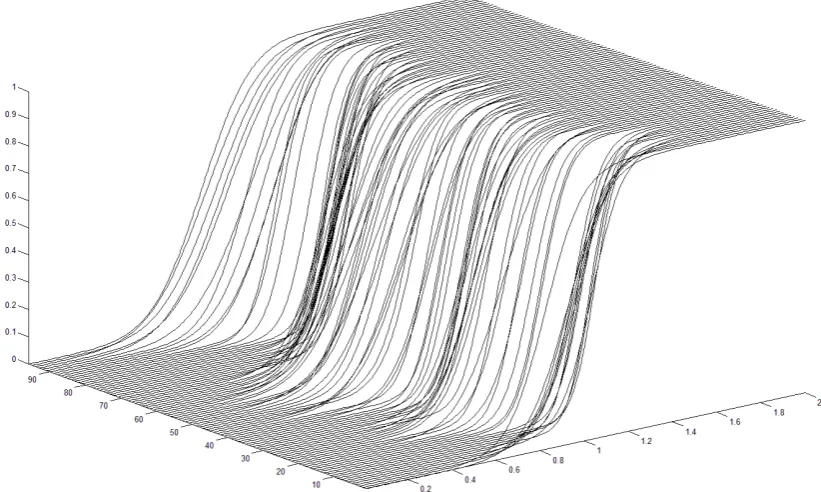
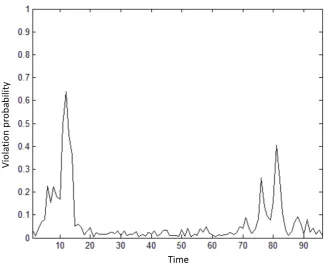
[image:6.595.122.541.226.423.2] [image:6.595.123.534.465.711.2]Figure 2 and Figure 3 is line 5 - 6 flow’s probabilistic density function and cumulative distribution function curves. And if the flow limit of line 5 - 6 is 1.2 per unit value, Figure 4 is its load flow limit violation probability graph.
Figure 2. Probabilistic density curves of load flow on line 5 - 6 for tomorrow’s 96 time intervals.
Figure 4. Load flow limit violation probability on line 5 - 6 for tomorrow’s 96 time inter-vals.
4. Conclusion
This article puts forward a method based on prediction error’s distribution and Gram-Charlier expansion to analyze every time intervals of tomorrow combin-ing day-ahead wind speed prediction model and wind power prediction error’s distribution considering its correlation. Based on every time interval’s probabil-istic density function and cumulative distribution function, load flow informa-tion with time series feature can be effectively acquired.
Acknowledgements
This work was financially supported by the Science and Technology Project of China State Grid Corp.
References
[1] Ding, H.J., Song, Y.H., Hu, Z.C., Wu, J.C. and Fan, X.X. (2013) Probability Density Function of Day-Ahead Wind Power Forecast Errors Based on Power Curves of Wind Farms. Proceedings of the CSEE, 33, 136-144.
[2] Liu, X.J. and Xie,C.Y. (2014)Wind Power Fluctuation Interval Estimation Based on Beta Distribution. Electric Power Automation Equipment, 34, 26-30.
[3] Lin, W.X., Wen, J.Y., Ai, X.M., Cheng, S.J. and Lee, W.J. (2012) Probability Density Function of Wind Power Variations. Proceedings of the CSEE, 32, 38−46.
[4] Xie, K.G. and Billinton, R. (2009) Considering Wind Speed Correlation of WECS in Reliability Evaluation Using the Time-Shifting Technique. Electric Power Systems Research, 79, 687−693.https://doi.org/10.1016/j.epsr.2008.10.013
Pre-diction Errors. Wind Energy, 16,999-1012.https://doi.org/10.1002/we.1527
[6] Zhang, P. and Lee, S. (2004) Probabilistic Load Flow Computation Using the Me-thod of Combined Cumulants and Gram-Charlier Expansion.IEEE Transactions on Power Systems, 19, 676-682.https://doi.org/10.1109/TPWRS.2003.818743
[7] Zhang, K.F., Yang, G.Q., Chen, H.Y. and Ding, Q. (2014) AnEstimate Method for Wind Power Forecast Errors Based on Numerical Feature Extraction. Automation of Electric Power Systems,38, 22−28.
[8] Ye, L. and Zhao, Y.N. (2014) A review on Wind Power Prediction Based on Spatial Correlation Approach. Automation of Electric Power Systems, 38, 126-134.
[9] Zhang, J.Z. and Cheng, M. (2012) Modeling of Time Series Stochastic Wind Speed for Wind Power Generation. Technology, 1,58-61.
[10]Tang, B., Chen, B., Qu, Z.H., et al. (2014) Research of Day-Ahead Forecasting Model for Wind Power Based on Time Series and Its Application.Water Resources and Power, 32,193−196.
Submit or recommend next manuscript to SCIRP and we will provide best service for you:
Accepting pre-submission inquiries through Email, Facebook, LinkedIn, Twitter, etc. A wide selection of journals (inclusive of 9 subjects, more than 200 journals)
Providing 24-hour high-quality service User-friendly online submission system Fair and swift peer-review system
Efficient typesetting and proofreading procedure
Display of the result of downloads and visits, as well as the number of cited articles Maximum dissemination of your research work