ISSN Online: 2169-0502 ISSN Print: 2169-0499
DOI: 10.4236/aar.2019.81001 Dec. 28, 2018 1 Advances in Aging Research
Relationship between Traffic Related Air
Pollutants and Cognitive Function among
Elderly in Egypt
Tomader Taha Abdel Rahman
1, Maram Maher Monier
1*,
Sally Adel Hakim
2,
Lamyaa Kamel Ebrahim
11Department of Geriatrics & Gerontology, Faculty of Medicine, Ain Shams University, Cairo, Egypt 2Department of Industrial Medicine, Faculty of Medicine, Ain Shams University, Cairo, Egypt
Abstract
Background: Cognitive impairment is a major health issue particularly with the increasing aging population. There are around 47.5 million dementia cas-es globally. Traffic air pollution issue is a chief environmental problem prin-cipally in the mega cities such as Cairo. Methodology: In a Cross sectional and comparative research study the study subjects recruited involved 200 in-dividuals, categorized into two research groups: 100 from Cairo’s elderly home residents and 100 from EL-Gharbaya’s elderly home residents. Results: Statistical linear regression analysis revealed that fine particulate matter, car-bon monoxide, and nitric oxide have a statistically significant impact on cog-nitive function (p values < 0.001) (shown in Table 4). Conclusions: Traffic related air pollutants were strongly associated with cognitive impairment within elderly population in geriatric home residents in Egypt. Regarding to statistically significant difference in concentration of traffic related air pollu-tants between urban and rural areas, urban areas were more polluted than rural areas.
Keywords
Cognitive Function, Traffic Related Air Pollutants, Elderly in Egypt
1. Introduction
Air pollution is a chief issue in public health since various research studies have displayed its several unfavorable health sequalae (e.g. respiratory and cardiovas-cular diseases). Air pollution has also been considered a prominent environ-mental risk factor for neurological diseases and neuropathology, and additional-How to cite this paper: Rahman, T.T.A.,
Monier, M.M., Hakim, S.A. and Ebrahim, L.K. (2019) Relationship between Traffic Related Air Pollutants and Cognitive Func-tion among Elderly in Egypt. Advances in Aging Research, 8, 1-13.
https://doi.org/10.4236/aar.2019.81001
Received: October 30, 2018 Accepted: December 25, 2018 Published: December 28, 2018
Copyright © 2019 by authors and Scientific Research Publishing Inc. This work is licensed under the Creative Commons Attribution International License (CC BY 4.0).
DOI: 10.4236/aar.2019.81001 2 Advances in Aging Research ly it is considered to be neurotoxicant [1] [2] [3] [4] [5].
The brain regions correlated to executive functions e.g. working memory and attention are largely presented within the prefrontal cortex and the striatum, which have revealed inflammatory responses after traffic-related air pollution exposure.[6] [7] [8] [9] [10].
Air pollution could also affect the nervous system, in a manner causing mem-ory disturbances, fatigue and hazy vision. Long term exposure to ambient pollu-tion could cause growth of white matter pathological lesions and inhibipollu-tion of cognitive functions [11] [12] [13] [14] [15].
Ambient air pollution has been correlated to impairment of lung functional performance and chronic obstructive pulmonary disease in the elderly individu-als. Impairment of lung function has been correlated with impaired cognitive function. Consequently, cognitive functional decline is highly prevalent in indi-viduals with lung function impairment [16] [17] [18] [19] [20].
Various research studies explored the linkage between midlife pulmonary functional levels and cognitive functional performance in old age which have revealed that pulmonary dysfunction in midlife is correlated with raised risk of poor cognition in elderly life [21] [22] [23] [24] [25].
The influence of pulmonary function on cognitive decline could result from various risk factors involving hypoxia, decreased neurotransmitter function, raised systemic inflammatory processes, or a conjunction of these risk factors [26] [27] [28] [29] [30].
There is rising research based epidemiological evidence of a correlation be-tween air pollution exposure and cognitive functional performance decline, par-ticularly impairment of visuo-construction performance. Epidemiological re-search studies interestingly reveal and display a correlation between distance to major roads and reduced functions cognitive denoting that particles from traffic pollution could, have detrimental effects on cognition due to either their size or composition [31] [32] [33] [34].
2. Aim of the Work
Assessment of the correlation between traffic-related air pollutants exposure and cognitive functional levels is in elderly at geriatric homes in Egypt. Comparison between cognitive function within elderly is exposed to high and low air pollu-tant levels.
3. Methodology
DOI: 10.4236/aar.2019.81001 3 Advances in Aging Research living in urban areas) and (in rural nursing homes must had past history of living in rural areas) or at least admitted for 5 years, elderly admitted to those geriatrics homes were apparently healthy. Exclusive research criteria: Refusal to participate in the research study, elderly who has previous history of stroke Oral consent was obtained from 200 study subjects from elderly living in geriatric homes exposed to high & low traffic related air pollution (urban & rural areas).
3.1. Direct Measurements of Traffic Related Geriatric Homes Air
Pollution
Our research team focused on fine particulate matter (PM10), nitric oxide (NO), carbon monoxide (CO) and lead, which are considered to be the most dangerous forms of air pollution. The pollutants measured were real time concentrations. We measured both in Cairo & in EL-Gharbia related to geriatric home that we recruited the study subjects from them. Measurements were performed by co-operation from Environmental Monitoring Center by usage of a portable field device for measurement of inhaled particles (PM10), lead, carbon monoxide, ni-tric oxide.
3.2. Cognitive Assessment
Cognition was assessed using Cambridge cognition Examination (CAMCOG), by usage of its Arabic version. The CAMCOG is the cognitive and self-contained part of the Cambridge Examination for Mental Disorders of the Elderly (CAMDEX). A standardized instrument for the diagnosis and grading of de-mentia and assess the level of cognitive impairment. The CAMCOG consists of 67 items with a maximum possible score of 107, and it could be categorized into various subscales: orientation, expressive and comprehensive language, memory (remote, recent, and learning), attention, praxis, calculation, abstraction, and perception. All items of the MMSE are also incorporated into the CAMCOG. If study subject took a score from 90 - 107 there is no cognitive impairment, from 89 - 78 the study subject has mild cognitive impairment, 77 - 66 study subject has mild dementia
Comprehensive clinical geriatric assessment via thorough medical history particularly, Chronic diseases (e.g. hypertension, DM, heart failure, chronic ob-structive lung disease) Geriatric depression scale (GDS) using the Arabic trans-lation, Activities of daily living scale (ADL), Instrumental Activities of daily liv-ing scale (IADL), Mini Nutritional Assessment (MNA) The sum of the MNA score distinguishes between elderly individuals having: Adequate nutritional status, MNA ≥ 24, protein-calorie malnutrition, MNA < 17, at risk of malnutri-tion, MNA between 17 and 23.5.
3.3. Statistical Analysis
va-DOI: 10.4236/aar.2019.81001 4 Advances in Aging Research riables as number and percentage, Chi-square test was used to compare qualita-tive variables between groups, One way Anova test was used to compare quan-titative variables between groups, Independent-t-test to compare between two research groups, correlation linear regression model used to assess the most af-fected air pollutants on cognition. The statistically significant level measured according to p value, p value > 0.05: Non-significant, p value < 0.05: Significant, p value < 0.01: Highly significant.
4. Results
As regards fine particulate matter statistical significant difference existed be-tween Urban and Rural areas being higher in Urban areas (p value < 0.001). As regards lead statistical significant difference existed between Urban and Rural areas being higher in Urban areas (p value < 0.001).
Concerning carbon monoxide statistical significant difference existed between Urban and Rural areas being higher in Urban areas (p value < 0.001). Finally ni-tric oxide statistical significant difference existed between Urban and Rural areas being higher in Urban areas (p value < 0.001).
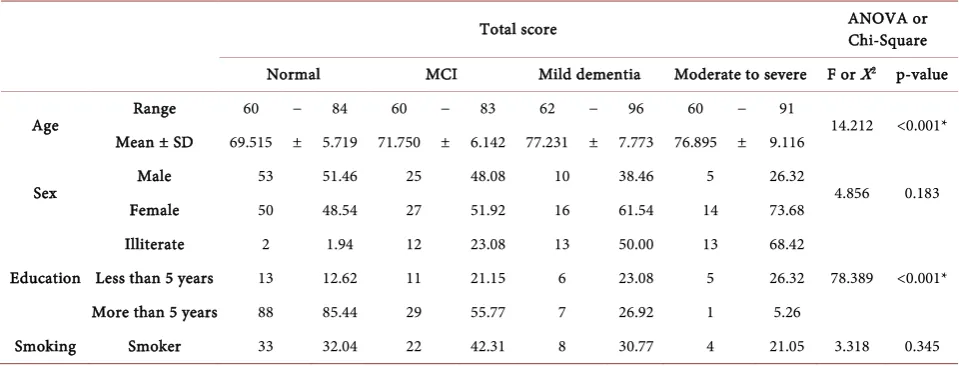
As regards cognitive function statistically significant correlation existed be-tween age and different grades of cognitive impairment (mild cognitive impair-ment, mild dementia, moderate to severe cognitive impairment) p value < 0.001.
Concerning cognitive impairment correlation to educational level a statisti-cally significant correlation existed in which it was more frequent in illiterate study subjects and least in study subjects having more than 5 years education (p value < 0.001)
Finally gender and smoking didn’t show any statistically significant correla-tion with grades of cognitive funccorrela-tional impairment (p values = 0.183, 0.345, consecutively).
As regards fine particulate matter and CAMOG test items and scoring level statistically significant correlation existed in language, Expression, recent mem-ory, Recall & memmem-ory, abstraction, CAMCOG score (p values = 0.018, <0.001, 0.001, <0.001, 0.002, 0.009, consecutively).
As regards lead and CAMOG test items and scoring level statistical significant correlation existed in, language, expression, recent memory, recall and memory, abstraction, CAMCOG score (p value = 0.030, <0.001, <0.001, <0.001, 0.002, 0.011, consecutively).
Concerning carbon monoxide and CAMOG test items and scoring level sta-tistically significant correlation existed in orientation, language, expression, re-cent memory, remote memory, attention, drawing, recall and memory, abstrac-tion, percepabstrac-tion, CAMCOG score (p value = 0.022, 0.002, <0.001, <0.001, 0.028, 0.032, <0.001, <0.001,0.006, <0.001, consecutively).
DOI: 10.4236/aar.2019.81001 5 Advances in Aging Research 0.006, 0.039, consecutively).
Statistical linear regression analysis revealed that fine particulate matter, car-bon monoxide, and nitric oxide have a statistically significant impact on cogni-tive function (p values < 0.001).
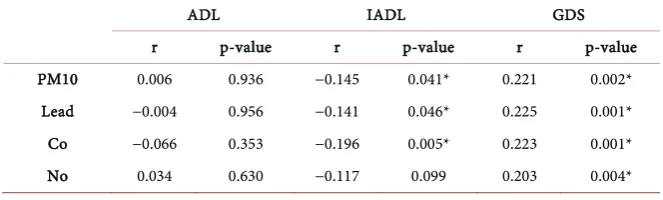
As regards Geriatric depression scale scoring and air pollutants components (fine particulate matter, lead carbon monoxide, nitric oxide) statistical signifi-cant correlation existed in all items (p values = 0.002, 0.001, 0.001, 0.004, conse-cutively), instrumental activities of daily living scale scoring and air pollutants components (statistical significant correlation existed in fine particulate matter, lead carbon monoxide, p values = 0.041, 0.046, 0.005, consecutively), regarding activities of daily living scale scoring and air pollutants components no statistical significant correlations existed.
5. Discussion
Cognitive impairment is a major health issue particularly with the increasing aging population. There are around 47.5 million dementia cases globally, newly diagnosed cases every year is about 7.7 million case. Dementia was ranked first among chronic non-communicable diseases in low and middle income nations. Within the next four decades, the prevalence of dementia is estimated to triple except protective measures are implemented. With increased levels of urbaniza-tion and road traffic expansion in various areas of the world, populaurbaniza-tion exposed to air pollution is raised particularly in older adults [1] [3] [6] [7].
Traffic air pollution issue is a chief environmental problem principally in the mega cities such as Cairo. It was considered as the 12th leading risk factor for disability in 2013 globally, causing about 3.3 million premature deaths each year [10] [13] [15].
The current research study was conducted to evaluate the correlation between cognitive impairment and traffic air pollution within elderly home residents in urban and rural areas.
The study recruited 200 elderly study subjects (60 years old and above), both males and females have been recruited from elderly home residents (100 from Cairo’s and 100 from EL-Gharbia’s elderly home residents).
In the current research study the research team the following results were ob-tained concerning fine particulate matter(shown in Table 1) statistical signifi-cant difference existed between Urban and Rural areas being higher in Urban areas (p value < 0.001). As regards lead statistical significant difference existed between Urban and Rural areas being higher in Urban areas (p value < 0.001). As regards carbon monoxide statistical significant difference existed between Urban and Rural areas being higher in Urban areas (p value < 0.001). Finally ni-tric oxide statistical significant difference existed between Urban and Rural areas being higher in Urban areas (p value < 0.001).
DOI: 10.4236/aar.2019.81001 6 Advances in Aging Research
Table 1. Differences between air pollutants level in urban and rural areas.
Air pollutants Area T-Test
Urban Rural T p-value
PM10 Range 269 − 275 202 − 212 166.687 <0.001* Mean ± SD 270.690 ± 2.343 207.430 ± 2.986
Lead Range 0.20 − 0.24 0.02 − 0.03 68.368 <0.001* Mean ± SD 0.209 ± 0.027 0.024 ± 0.005
Co Range 16 − 19 6 − 10 47.189 <0.001* Mean ± SD 17.320 ± 1.497 8.380 ± 1.162
No Range 4.9 − 5.1 0 − 0.2 375.824 <0.001* Mean ± SD 5.001 ± 0.100 0.048 ± 0.086
p value > 0.05: Non-significant; p value < 0.05: Significant; p value < 0.01: Highly significant.
with various research studies including a research study previously conducted by Apăscăriţei et al. research team of investigators in which they revealed that NO levels were ten times higher in urban than in rural area also CO levels were two times higher in urban area [18] [25] [27].
As regards the correlation between age, sex, educational level, smoking and cognition in all study cohort of the current research (revealed and displayed in Table 2) the following was revealed in which cognitive function there was a sta-tistically significant correlation that existed between age and different grades of cognitive impairment (mild cognitive impairment, mild dementia, moderate to severe cognitive impairment) p values < 0.001.
Concerning cognitive impairment correlation to educational level a statisti-cally significant correlation existed (shown in Table 2) in which it was more frequently observed in illiterate study subjects and least in study subjects having more than 5 years education (p value < 0.001). Finally gender and smoking didn’t show any statistical significant correlation with grades of cognitive func-tional impairment. (p values = 0.183, 0.345, consecutively).
These results and observations obtained are consistent with a research study performed by Ji et al., research team of investigators who revealed and displayed from their research data that the prevalence of cognitive impairment and de-mentia was 73.2% within the elderly individuals aged 80 years and older and the prevalence of dementia and Alzheimer’s disease within elderly individuals aged 60 years and older have been 7.7%. these findings were in harmony with the current research study. On the other hand Ji et al., research team revealed that the prevalence of cognitive impairment was 2.3-fold higher in females than in males and was raised by 1.8-fold in females than in males aged 80 years old and older, that contradicts with the current research in which no gender differences were observed among the cohort as regards cognitive impairment [2] [5] [12] [22].
DOI: 10.4236/aar.2019.81001 7 Advances in Aging Research
Table 2. Relation between age, sex, educational level, smoking and cognition in all study population.
Total score ANOVA or Chi-Square
Normal MCI Mild dementia Moderate to severe F or X2 p-value
Age Range 60 − 84 60 − 83 62 − 96 60 − 91 14.212 <0.001*
Mean ± SD 69.515 ± 5.719 71.750 ± 6.142 77.231 ± 7.773 76.895 ± 9.116
Sex Male 53 51.46 25 48.08 10 38.46 5 26.32 4.856 0.183
Female 50 48.54 27 51.92 16 61.54 14 73.68
Education
Illiterate 2 1.94 12 23.08 13 50.00 13 68.42
78.389 <0.001* Less than 5 years 13 12.62 11 21.15 6 23.08 5 26.32
More than 5 years 88 85.44 29 55.77 7 26.92 1 5.26
Smoking Smoker 33 32.04 22 42.31 8 30.77 4 21.05 3.318 0.345
by influences in the leukocytes functional performance and the antioxidant de-fense system that could predispose elderly individuals to inappropriate amount and harmful inflammatory pathological responses that have negative impact on cognitive function [15] [32] [34].
However, another research study by Bai et al., research team of investigators have revealed that cognitive levels of affection have not been to gender and that finding was similarly revealed by the current research study [30] [33].
As regards cognitive impairment correlation to educational level in the cur-rent research study a statistically significant correlation existed in which it was more frequent in illiterate study subjects and least in study subjects having more than 5 years education (p value < 0.001).
These findings are in harmony with a prior research study that revealed that the risk of cognitive impairment within elderly individuals with education levels of less than 6 years in comparison to those elderly individuals with education le-vels of 9 years or more, with a 3.8-fold increase in the illiterate research group and a 1.7-fold rise in those with 1 - 5 years of education.
Another research study conducted by Elwan et al. research team showed sim-ilar results to the current research as regards level of education in which the Illi-terate research group and the group with primary school level of education had a low scoring level concerning short term memory, psychomotor functional per-formance and perception than control research group that was highly educated. Smoking is a possible risk factor for dementia as it may increase free radicals generation but its impact could be underestimated within older adult due to the shorter life span of smokers [10] [16] [22].
The current research study revealed that there was no correlation between cognitive impairment levels and smoking within the elderly, no statistically sig-nificant difference existed between normal elderly and who had cognitive im-pairment as regard smoking habit.
DOI: 10.4236/aar.2019.81001 8 Advances in Aging Research that revealed that there was no correlation was observed between smoking and cognitive decline within elderly. On the other hand, another research study pre-viously performed displayed and revealed that current smoking raises the risk of cognitive decline and developing of dementia, and quitting smoking could re-duce the associated risk to levels comparable to those who have never smoked [25] [28] [33].
[image:8.595.209.539.430.723.2]Concerning the statistical correlation between items of CAMOG test compo-nents and air pollutants in study cohort (revealed and displayed in Table 3). As regards fine particulate matter and CAMOG test items and scoring level statis-tical significant correlation existed in language, Expression, recent memory, Re-call & memory, abstraction, CAMCOG score (p values = 0.018, <0.001, 0.001, <0.001, 0.002, 0.009, consecutively) (revealed and displayed in Table 3). As re-gards lead and CAMOG test items and scoring level statistical significant corre-lation existed in language, expression, recent memory, recall and memory, ab-straction, CAMCOG score (p value = 0.030, <0.001, <0.001, <0.001, 0.002, 0.011, consecutively). (Revealed and displayed in Table 3). Concerning carbon mo-noxide and CAMOG test items and scoring level statistical significant correla-tion existed in orientacorrela-tion, language, expression, recent memory, remote mem-ory, attention, drawing, recall and memmem-ory, abstraction, perception, CAMCOG score (p value = 0.022, 0.002, <0.001, <0.001, 0.028, 0.032, <0.001, <0.001, 0.006, <0.001, consecutively). (Revealed and displayed in Table 3). Concerning nitric
Table 3. Correlation between item of CAMOG test and air pollutants in all study
popula-tion.
Correlations
PM10 Lead Co No
r p-value R p-value r p-value R p-value Orientation −0.081 0.254 −0.102 0.152 −0.161 0.022* −0.048 0.500
DOI: 10.4236/aar.2019.81001 9 Advances in Aging Research oxide and CAMOG test items and scoring level statistically significant correla-tion existed in Expression, recent memory, praxis recall and memory, abstraccorrela-tion, CAMCOG score (p value = 0.001, 0.002, 0.021, 0.001, 0.006, 0.039, consecutively) (Revealed and displayed in Table 3). Therefore, in general air pollutants had a statistically significant impact on the scoring of CAMCOG test in both urban and rural research study cohort but its impact in urban research group was more than on rural research that revealed high cognitive impairment level than in ru-ral area (Table 4 & Table 5).
Contradicting to the current research study findings, a prior research per-formed which evaluated the cognitive impairment prevalence in the Portuguese population in both urban and rural areas, revealed and displayed that cognitive impairment levels within rural areas were higher than that in urban areas. This discrepancy between could be explained by difference in education levels and age not due to air pollution differences [14] [18] [20].
A study applied on urban population within Columbia revealed that air pollu-tion have harmful impact on health of elderly even when the level of pollutants is low, this finding contradicts with the current research results. However this finding could explained by the influence of other factors such as climate change and temperature [14] [18] [23].
[image:9.595.212.539.458.567.2]A prospective cohort research study of Wellenius et al., research team which observed an association between CO and immediate recall in 756 elderly women; however, there were no clear correlations with expression and orientation also
Table 4. Linear regression, and important variables on multivariate analysis were
intro-duced in stepwise linear regression model to detect effect of air pollutants on cognitive function in all study population.
Unstandardized Coefficients Standardized Coefficients
t p-value
B Std. Error Beta
PM10 0.191 0.023 6.112 8.256 <0.001*
Lead 1.497 2.934 0.143 0.510 0.611
Co 0.256 0.044 1.204 5.802 <0.001*
No −2.913 0.289 −7.267 −10.097 <0.001*
Dependent Variable: CAMCOG scores.
Table 5. Correlation between the function (ADL, IADL), depression (GDS) and air
pol-lutants in all study population.
ADL IADL GDS
r p-value r p-value r p-value
PM10 0.006 0.936 −0.145 0.041* 0.221 0.002* Lead −0.004 0.956 −0.141 0.046* 0.225 0.001* Co −0.066 0.353 −0.196 0.005* 0.223 0.001*
[image:9.595.208.540.627.727.2]DOI: 10.4236/aar.2019.81001 10 Advances in Aging Research found that closer proximity of residence to major roads was associated with poorer performance on several cognitive tests, especially that assess executive function, memory, verbal learning and language [30] [33].
Another research study evaluating impact of long-term exposure to fine par-ticulate matter cognition decline levels in elderly women in the United States found that a 10 μg/m3 increase in fine particulate matter has been linked to a 0.014 fall in verbal memory; 0.002 decrease in verbal fluency. A study of Schi-kowski et al., research team in harmony with the current research study results revealed that nitric oxide levels are correlated to a decrease in visuospatial abili-ties, naming and memory [10] [26].
6. Conclusion
The current study showed that traffic related air pollutants were strongly asso-ciated with cognitive impairment within elderly population in geriatric home residents in Egypt. Regarding to statistically significant difference in concentra-tion of traffic related air pollutants between urban and rural areas, urban areas were more polluted than rural areas. Air pollutants have a negative impact on recall, memory, expression and language, and minimal impact on attention, drawing, and perception and had no clear impact on orientation calculation, and registration.
Recommendations
Screening for cognitive impairment of all elderly persons attending health centers should be carried out. Continuation physical, mental, social activities and early detection and management of depression is required to reduce cog-nitive impairment in elderly. Improvements to air quality may be an important mechanism for reducing cognitive decline in elderly. Large scale research stu-dies both observational and interventional are required for additional evalua-tion of air polluevalua-tion impact on elderly within Egypt. Future research studies should be multicentric in fashion and put in consideration racial and ethnic differences.
Conflicts of Interest
The authors declare no conflicts of interest regarding the publication of this pa-per.
References
[1] Grandjean, P. and Landrigan, P.J. (2014) Neurobehavioral Effects of Developmental Toxicity. The Lancet Neurology, 13, 330-338.
https://doi.org/10.1016/S1474-4422(13)70278-3
DOI: 10.4236/aar.2019.81001 11 Advances in Aging Research
[3] Power, M.C., Weisskopf, M.G., Alexeeff, S.E., et al. (2011) Traffic-Related Air Pollu-tion and Cognitive FuncPollu-tion in a Cohort of Older Men. Environmental Health Perspectives,119, 682-627.
[4] Bennett, I.J. and Madden, D.J. (2014) Disconnected Aging: Cerebral WhiteMatter Integrity and Age-Related Differences in Cognition. Neuroscience, 276, 187-205. https://doi.org/10.1016/j.neuroscience.2013.11.026
[5] Jekel, K., Damian, M., Wattmo, C., et al. (2015) Mild Cognitive Impairment and Deficits in Instrumental Activities of Daily Living: A Systematic Review. Alzhei-mer’s Research & Therapy, 7, 17. https://doi.org/10.1186/s13195-015-0099-0
[6] Harada, C.N., Love, M.C. and Triebel, K.L. (2013). Normal Cognitive Aging. Clinics in Geriatric Medicine, 29, 737-752. https://doi.org/10.1016/j.cger.2013.07.002
[7] Davis, H.P., Klebe, K.J., Guinther, P.M., et al. (2013) Subjective Organization, Ver-bal Learning, and Forgetting Across the Life Span: From 5 to 89. Experimental Ag-ing Research, 39, 1-26.https://doi.org/10.1080/0361073X.2013.741956
[8] Rogalski, E., Stebbins, G.T., Barnes, C.A., et al. (2012) Age-Related Changes in Para hippocampal White Matter Integrity: A Diffusion Tensor Imaging Study. Neurop-sychologia,50, 1759-1765.https://doi.org/10.1016/j.neuropsychologia.2012.03.033
[9] Lin, J.S., O’Connor, E., Rossom, R.C., et al. (2013) Screening for Cognitive Impair-ment in Older Adults: A Systematic Review for the US Preventive Services Task Force. Annals of Internal Medicine, 159, 601-612.
https://doi.org/10.7326/0003-4819-159-9-201311050-00730
[10] Wisdom, N.M., Mignogna, J. and Collins, R.L. (2012) Variability in Wechsler Adult Intelligence Scale-IV Subtest Performance across Age. Archives of Clinical Neuro-psychology, 27, 389-397. https://doi.org/10.1093/arclin/acs041
[11] World Health Organization (2011) Urban Outdoor Air Pollution Database. Geneva. [12] Ramadan, I.M. and Rashwan, N.K. (2015) Calibration of Vehicle Emissions-Speed
Relationships for the Greater Cairo Roads. International Journal of Civil Engineer-ing and Technology, 7, 1.
[13] Shandilya, K.K. and Khare, M. (2012) Particulate Matter: Sources, Emission Rates and Health Effects. Advances in Environmental Research, 23, 265-322.
[14] Moawad, M.B., Youssief, A.A. and Madkour, K. (2017) Modeling and Monitoring of Air Quality in Greater Cairo Region, Egypt Using Landsat-8 Images, HYSPLIT and GIS Based Analysis. Climate Change Research at Universities, Springer Inter-national Publishing, 37-54, Berlin.
[15] Robaa, S.M. (2013) Some Aspects of the Urban Climates of Greater Cairo Region, Egypt. International Journal of Climatology, 33, 3206-3216.
https://doi.org/10.1002/joc.3661
[16] Kim, K.H., Jahan, S.A., Kabir, E. et al. (2013) A Review on Human Health Perspec-tive of Air Pollution with Respect to Allergies and Asthma. Environment Interna-tional, 59, 41-52. https://doi.org/10.1016/j.envint.2013.05.007
[17] Shah, A.S., Langrish, J.P., Nair, H., et al. (2013) Global Association of Air Pollution and Heart Failure: A Systematic Review and Meta-Analysis. The Lancet, 382, 1039-1048. https://doi.org/10.1016/S0140-6736(13)60898-3
[18] Burnett, R.T., Pope III, C.A., Ezzati, M., et al. (2014) An Integrated Risk Function for Estimating the Global Burden of Disease Attributable to Ambient Fine Particu-late Matter Exposure. Environmental Health Perspectives, 122, 397.
DOI: 10.4236/aar.2019.81001 12 Advances in Aging Research
Pollution Sources to Premature Mortality on a Global Scale. Nature, 525, 367-371.
https://doi.org/10.1038/nature15371
[20] Kelly, F.J. and Fussell, J.C. (2012) Size, Source and Chemical Composition as De-terminants of Toxicity Attributable to Ambient Particulate Matter. Atmospheric Environment, 60, 504-526.https://doi.org/10.1016/j.atmosenv.2012.06.039
[21] Zhang, J.J. and Samet, J.M. (2015) Chinese Haze versus Western Smog: Lessons Learned. Journal of Thoracic Disease, 7, 3-13.
[22] Cadelis, G., Tourres, R. and Molinie, J. (2014) Short-Term Effects of the Particulate Pollutants Contained in Saharan Dust on the Visits of Children to the Emergency Department Due to Asthmatic Conditions in Guadeloupe (French Archipelago of the Caribbean). PLoS ONE, 9, e91136.
https://doi.org/10.1371/journal.pone.0091136
[23] Esworthy, R. (2013) Air Quality: EPA’s 2013 Changes to the Particulate Matter (PM) Standard. Congressional Research Service, 7-5700.
[24] Perez, L., Tobías, A., et al. (2012) Saharan Dust, Particulate Matter and Cause-Specific Mortality: A Case-Crossover Study in Barcelona (Spain). Environment Internation-al, 48, 150-155.https://doi.org/10.1016/j.envint.2012.07.001
[25] Calderón-Garcidueñas, L., Leray, H.P., et al. (2016) Air Pollution, a Rising Envi-ronmental Risk Factor for Cognition, Neuroinflammation and Neurodegeneration: The Clinical Impact on Children and Beyond. Revue Neurologique, 172, 69-80.
https://doi.org/10.1016/j.neurol.2015.10.008
[26] Wohleb, E.S., McKim, Sheridan, J.F., et al. (2015) Monocyte Trafficking to the Brain with Stress and Inflammation: A Novel Axis of Immune-to-Brain Communication That Influences Mood and Behavior. Frontiers in Neuroscience, 8, 447.
https://doi.org/10.3389/fnins.2014.00447
[27] Rodrigues, R., Petersen, R.B. and Perry, G. (2014) Parallels between Major Depres-sive Disorder and Alzheimer’s Disease: Role of Oxidative Stress and Genetic Vulne-rability. Cellular and Molecular Neurobiology, 34, 925-949.
https://doi.org/10.1007/s10571-014-0074-5
[28] Heusinkveld, H.J., Wahle, T., Campbell, A., et al. (2016) Neurodegenerative and Neurological Disorders by Small Inhaled Particles. Neurotoxicology, 56, 94-106.
https://doi.org/10.1016/j.neuro.2016.07.007
[29] Steenhof, M., Janssen, N.A., Strak, M., et al. (2014) Air Pollution Exposure Affects Circulating White Blood Cell Counts in Healthy Subjects: The Role of Particle Composition, Oxidative Potential and Gaseous Pollutants—The RAPTES Project. Inhalation Toxicology, 26, 141-165. https://doi.org/10.3109/08958378.2013.861884
[30] Chiu, I.M., Von Hehn, C.A. and Woolf, C.J. (2012) Neurogenic Inflammation and the Peripheral Nervous System in Host Defense and Immunopathology. Nature Neuroscience, 15, 1063. https://doi.org/10.1038/nn.3144
[31] Mumaw, C.L., Levesque, S., McGraw, C., et al. (2016) Microglial Priming through the Lung-Brain Axis: The Role of Air Pollution-Induced Circulating Factors. The FASEB Journal, 30, 1880-1891. https://doi.org/10.1096/fj.201500047
[32] Ji, Y., Shi, Z., Zhang, Y., et al. (2015) Prevalence of Dementia and Main Subtypes in Rural Northern China. Dementia and Geriatric Cognitive Disorders, 39, 294-302.
https://doi.org/10.1159/000375366
DOI: 10.4236/aar.2019.81001 13 Advances in Aging Research
https://doi.org/10.3389/fnagi.2018.00062