2079
Towards Generating Long and Coherent Text
with Multi-Level Latent Variable Models
Dinghan Shen1⇤, Asli Celikyilmaz2, Yizhe Zhang2,
Liqun Chen1, Xin Wang3, Jianfeng Gao2, Lawrence Carin1
1Duke University 2Microsoft Research, Redmond 3 University of California, Santa Barbara
Abstract
Variational autoencoders (VAEs) have re-ceived much attention recently as an end-to-end architecture for text generation with la-tent variables. However, previous works typ-ically focus on synthesizing relatively short sentences (up to 20 words), and the
poste-rior collapse issue has been widely identified in text-VAEs. In this paper, we propose to leverage several multi-level structures to learn a VAE model for generatinglong, and coher-enttext. In particular, a hierarchy of stochas-tic layers between the encoder and decoder networks is employed to abstract more infor-mative and semantic-rich latent codes. Be-sides, we utilize a multi-level decoder ture to capture the coherent long-term struc-ture inherent in long-form texts, by generating intermediate sentence representations as high-levelplan vectors. Extensive experimental re-sults demonstrate that the proposed multi-level VAE model produces more coherent and less repetitive long text compared to baselines as well as can mitigate the posterior-collapse is-sue.
1 Introduction
The variational autoencoder (VAE) for text (
Bow-man et al.,2016) is a generative model in which a
stochastic latent variable provides additional infor-mation to modulate the sequential text-generation process. VAEs have been used for various text processing tasks (Semeniuta et al., 2017; Zhao
et al., 2017; Kim et al., 2018; Du et al., 2018;
Hashimoto et al.,2018;Shen et al.,2018a;Xu and
Durrett, 2018; Wang et al., 2019). While most
recent work has focused on generating relatively short sequences (e.g., a single sentence or multi-ple sentences up to around twenty words), gen-erating long-form text (e.g., a single or multiple
⇤This research was carried out during an internship at Microsoft Research.
flat-VAE(standard) multilevel-VAE(our model) i went here for a grooming and a dog
. it was very good . the owner is very nice and friendly.the owner is really nice and friendly. i don t know what they are doing .
i have been going to this nail salon for over a year now . the last time i went there . the stylist was nice . but the lady who did my nails . she was very rude and did not have the best nail color i once had .
the staff is very friendly and help-ful . the only reason ican t give them 5 stars .the only reason iam giving the ticket is because of the ticket . can t help butthe staff is so friendly and helpful .can t help butthe parking lot is just the same .
i am a huge fan of this place . my husband and i were looking for a place to get some good music . this place was a little bit pricey . but i was very happy with the service . the staff was friendly .
Table 1: Comparison of samples generated from two generative models on the Yelp reviews dataset. The standard model struggles with repetitions of the same context or words (inblue), yielding non-coherent text. A hierarhical decoder with multi-layered latent vari-ables eliminates redundancy and yields more coherent text planned around focused concepts.
paragraphs) with deep latent-variable models has been less explored.
Recurrent Neural Networks (RNNs) (Bahdanau
et al.,2015;Chopra et al.,2016) have mainly been
used for most text VAE models (Bowman et al., 2016). However, it may be difficult to scale RNNs forlong-formtext generation, as they tend to gen-erate text that is repetitive, ungrammatical, self-contradictory, overly generic and often lacking co-herent long-term structure (Holtzman et al.,2018). Two samples of text generated using standard VAE with an RNN decoder is shown in Table1.
RNN to capture such structure and learn to plan-ahead. To improve the model’s plan-ahead ca-pability for capturing long-term dependency, fol-lowing (Roberts et al.,2018), our first multi-level structure defines a hierarchical RNN decoder as the generative network that learns sentence- and
word-levelrepresentations. Rather than using the latent code to initialize the RNN decoder directly, we found it more effective when first passing the latent code to a higher-level (sentence) RNN de-coder, that outputs an embedding for the lower-level (word) RNN decoder that generates words. Since the low-level decoder network cannot fall back on autoregression, it gains a stronger reliance on the latent code to reconstruct the sequences.
Prior work has found that VAE training of-ten suffers from posterior collapse, in which the model ignores the latent code (Bowman et al., 2016). This issue is related to the fact that the decoder network is usually parametrized with an autoregressive neural network, such as RNNs with teacher forcing scheme (Bowman et al., 2016;
Yang et al., 2017;Goyal et al., 2017;Semeniuta
et al., 2017;Shen et al., 2018b). Several
strate-gies have been proposed (see optimization chal-lenges in Section4) to make the decoder less au-toregressive, so lesscontextual informationis uti-lized by the decoder network (Yang et al., 2017;
Shen et al.,2018b). We argue that learning more
informative latent codes can enhance the genera-tive model without the need to lessen the contex-tual information. We propose leveraging a hierar-chy of latent variables between the convolutional inference (encoder) networks and a multi-level re-current generative network (decoder). With multi-ple stochastic layers, the prior of bottom-level la-tent variable is inferred from the data, rather than fixed as a standard Gaussian distribution as in typ-ical VAEs (Kingma and Welling,2013). The in-ducedlatent code distribution at the bottom level can be perceived as a Gaussian mixture, and thus is endowed with more flexibility to abstract mean-ingful features from the input text. While recent work has explored structures for more informative latent codes (Kim et al., 2018; Gu et al., 2018),
ml-VAE is conceptually simple and easy to imple-ment.
We evaluateml-VAE on language modeling, un-conditional and un-conditional text generation tasks. We show substantial improvements against several baseline methods in terms of perplexity on lan-guage modeling and quality of generated samples
based on BLEU statistics and human evaluation. 2 Variational Autoencoder (VAE)
Letxdenote a text sequence, which consists ofL
tokens,i.e.,x1, x2, ..., xL. A VAE encodes the text xusing a recognition (encoder) model, q (z|x),
parameterizing an approximate posterior distribu-tion over a continuous latent variable z (whose
prior is typically chosen as standard diagonal-covariance Gaussian). zis sampled stochastically
from the posterior distribution, and text sequences
xare generated conditioned onz, via a generative
(decoder) network, denoted asp✓(x|z). A
varia-tional lower bound is typically used to estimate the parameters (Kingma and Welling,2013):
Lvae =Eq (z|x)
logp✓(x|z)p(z)
q (z|x) , (1) =Eq (z|x)[logp✓(x|z)] DKL(q (z|x)||p(z)),
This lower bound is composed of a reconstruction loss (first term) that encourages the inference net-work to encode information necessary to gener-ate the data and a KL regularizer (second term) to pushq (z|x)towards the priorp(z).
Although VAEs have been shown to be effec-tive in a wide variety of text processing tasks (see related work), there are two challenges associated with generating longer sequences with VAEs: (i)
they lack a long-term planning mechanism, which is critical for generating semantically-coherent
long texts (Serdyuk et al., 2017); and (ii) poste-rior collapseissue. Concerning (ii), it was demon-strated in (Bowman et al.,2016) that due to the au-toregressive nature of the RNN, the decoder tends to ignore the information fromzentirely, resulting
in an extremely small KL term (see Section4).
3 Multi-Level Generative Networks
3.1 Single Latent Variable (ml-VAE-S:)
Our first multi-level model improves upon
stan-dard VAE models by introducing a plan-ahead
ability to sequence generation. Instead of directly making word-level predictions only conditioned on the semantic information from z, a series of plan vectorsare first generated based uponzwith
… Word-Level
LSTM Decoder
Sentence Level LSTM Decoder
𝒛𝟏 𝒛𝟏 𝒛𝟐 𝒛𝟐
KL Losses
𝜇
𝜎
𝜇
𝜎
Lower Level CNN
I love this place. Lots of veggie options. Higher
Level CNN
𝒛𝟏 𝒛𝟏
𝒛𝟏
Generative (Decoder) Network Inference (Encoder) Network
… …
𝒉 𝒉
Try veggie quesadilla.
[image:3.595.83.521.66.158.2]I love this place. Lots of veggie options. Try veggie quesadilla.
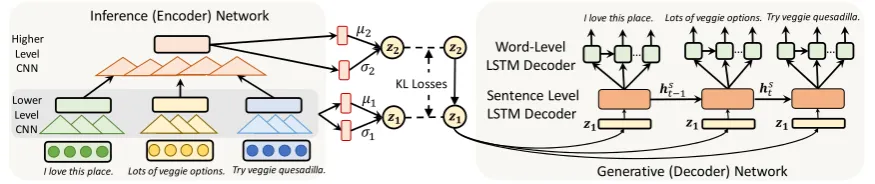
Figure 1: The proposedmulti-levelVAE withdoublelatent variables (ml-VAE-D).
both the words generated previously and from sentence-level representations.
An input paragraph consist ofMsentences, and
each sentencethasNtwords,t=1,. . . , M. To
gen-erate the plan vectors, the model first samples a la-tent codezthrough a one-layer multi-layered
per-ceptron (MLP), with ReLU activation functions, to obtain the starting state of the sentence-level LSTM decoder. Subsequent sentence representa-tions, namely theplan vectors, are generated with the sentence-level LSTM in a sequential manner:
hst =LSTMsent(hst 1,z), (2)
The latent code z can be considered as a
paragraph-level abstraction, relating to informa-tion about the semantics of each generated subse-quence. Therefore we inputzat each time step of
the sentence-level LSTM, to predict the sentence representation. Our single-latent-variable model sketched in Figure3of supplementary material.
The generated sentence-level plan vectors are then passed onto the word-level LSTM decoder to generate the words for each sentence. To generate each word of a sentencet, the correspondingplan vector,hst, is concatenated with the word
embed-ding of the previous word and fed to LSTMwordat
every time step1. Letw
t,idenote thei-th token of
thet-th sentence This process can be expressed as
(fort= 1,2, ..., M andi= 1,2,3, ..., Nt):
hwt,i =LSTMword(hwt,i 1,hst,We[wt,i 1]), (3)
p(wt,i|wt,<i,hst) =softmax(V hwt,i), (4)
The initial statehwt,0of LSTMwordis inferred from
the corresponding plan vector via an MLP layer.
V represents the weight matrix for computing
dis-tribution over words, and We are word
embed-dings to be learned. For each sentence, once the
special END token is generated, the word-level
1We use teacher-forcing during training and greedy
de-coding at test time.
LSTM stops decoding2. LSTMword decoder
pa-rameters are shared for each generated sentence.
3.2 Double Latent Variables (ml-VAE-D):
Similar architectures of our single latent vari-ableml-VAE-S model have been applied recently for multi-turn dialog response generation (Serban
et al., 2017; Park et al., 2018), mainly focusing
on short (one-sentence) response generation. Dif-ferent from these works, our goal is to generate
long textwhich introduces additional challenges to the hierarchical generative network. We hypothe-size that with the two-level LSTM decoder embed-ded into the VAE framework, the load of capturing global and local semantics are handled differently than theflat-VAEs (Chen et al.,2016). While the multi-level LSTM decoder can capture relatively detailed information (e.g., word-level (local) co-herence) via the word- and sentence-level LSTM networks, the latent codes of the VAE are encour-aged to abstract more global and high-level seman-tic features of multiple sentences of long text.
Our double latent variable extension, ml -VAE-D, is shown in Figure1. The inference network encodes upward through each latent variable to in-fer their posterior distributions, while the genera-tive network samples downward to obtain the dis-tributions over the latent variables. The distribu-tion of the latent variable at the bottom is inferred from the top-layer latent codes, rather than fixed (as in a standard VAE model). This also introduces flexibility to the model to abstract useful high-level features (Gulrajani et al.,2016), which can then be leveraged by the multi-level LSTM net-work. Without loss of generality, here we choose to employ a two-layer hierarchy of latent vari-ables, where the bottom and top layers are denoted asz1andz2, respectively, which can be easily
ex-tended to multiple latent-variable layers.
Another important advantage of multi-layer
tent variables in the VAE framework is related to the posterior collapse issue. Even though the single latent variable model (ml-VAE-S) defines a multi-level LSTM decoder, the posterior collapse can still exist since the LSTM decoder can still ignore the latent codes due to its autoregressive property. With the hierarchical latent variables, we propose a novel strategy to mitigate this problem, by making less restrictive assumptions regarding the prior distribution of the latent variable. Our model yields a larger KL loss term relative toflat -VAEs, indicating more informative latent codes.
The posterior distributions over the latent vari-ables are assumed to be conditionally independent given the inputx. We can represent the joint
pos-terior distribution of the two latent variables as3:
q (z1,z2|x) =q (z2|x)q (z1|x) (5)
Concerning the generative network, the latent vari-able at the bottom is sampled conditioned on the one at the top. Thus, we have:
p✓(z1,z2) =p✓(z2)p✓(z1|z2) (6)
DKL(q (z|x)||p(z)), the second term of the VAE
objective, then becomes the KL divergence be-tween joint posterior and prior distributions of the two latent variables. Under the assumptions of (5) and (6), the variational lower bound yields:
Lvae=Eq(z1|x)[logp(x|z1)]
DKL(q(z1,z2|x)||p(z1,z2)) (7)
Abbreviartingp✓andq withpandq, we get:
DKL(q(z1,z2|x)||p(z1,z2))
=
Z
q(z2|x)q(z1|x) log
q(z2|x)q(z1|x)
p(z2)p(z1|z2)
dz1dz2
=
Z
z1,z2
[q (z2|x)q (z1|x) log q (z1|x)
p✓(z1|z2)
+q(z2|x)q(z1|x) log
q(z2|x) p(z2)
]dz1dz2
=Eq(z2|x)[DKL(q(z1|x)||p(z1|z2))]
+DKL(q(z2|x)||p(z2)) (8)
The left-hand side of (8) is the abbreviation of
DKL(q (z1,z2|x)||p(z1,z2)). Given the Gaus-sian assumption for both the prior and posterior
3We assumez
1andz2to be independent on the encoder
side, since this specification will yield a closed-form expres-sion for the KL loss betweenp✓(z1,z2)andq (z1,z2|x).
distributions, both KL divergence terms can be written in closed-form.
To abstract meaningful representations from the input paragraphs, we choose a hierarchical CNN architecture for the inference/encoder networks for both single and double latent variable mod-els. We use sentence-level CNNs to encode each sentence into a fixed-length vector, which are then aggregated and send to paragraph-level CNN en-coder. The inference networks parameterizing
q(z1|x) and q(z2|x) share the same parameters as the lower-level CNN.
The single-variable ml-VAE-S model feeds the paragraph feature vector into the linear layers to infer the mean and variance of the latent variable
z. In the double-variable model ml-VAE-D, the
feature vector is transformed with two MLP lay-ers, and then is used to compute the mean and vari-ance of the top-level latent variable.
4 Related Work
VAE for text generation. VAEs trained
un-der the neural variational inference (NVI) frame-work, has been widely used for generating text se-quences: (Bowman et al.,2016;Yang et al.,2017;
Semeniuta et al.,2017;Miao et al., 2016;Serban
et al.,2017;Miao et al., 2017;Zhao et al.,2017;
Shen et al., 2017; Guu et al., 2018; Kim et al.,
2018;Yin et al.,2018;Kaiser et al.,2018;
Bahu-leyan et al.,2018;Chen et al.,2018b;Deng et al.,
2018;Shah and Barber,2018).
By encouraging the latent feature space to match a prior distribution within an encoder-decoder architecture, the learned latent variable could potentially encode high-level semantic fea-tures and serve as a global representation during the decoding process (Bowman et al.,2016). The generated results are also endowed with better di-versity due to the sampling procedure of the latent codes (Zhao et al.,2017). Generative Adversarial Networks (GANs) (Yu et al.,2017;Hu et al.,2017;
Zhang et al.,2017;Fedus et al.,2018;Chen et al.,
2018a), is another type of generative models that
are commonly used for text generation. However, existing works have mostly focused on generating one sentence (or multiple sentences with at most twenty words in total). The task of generating rel-atively longer units of text has been less explored.
Optimization Challenges. The “posterior
used two strategies,KL divergence annealingand
word dropout, however, none of them help to im-prove the perplexity compared to a plain neural language model. (Yang et al.,2017) argue that the small KL term relates to the strong autoregressive nature of an LSTM generative network, and they proposed to utilize a dilated CNN as a decoder to improve the informativeness of the latent variable.
(Zhao et al.,2018b) proposed to augment the VAE
training objective with an additional mutual infor-mation term. This yields an intractable integral in the case where the latent variables are continu-ous. Recent work (He et al.,2019;Fu et al.,2019) has shown that advanced scheduling can mitigate the posterior collapse issue. We instead introduce more flexible priors and hierarchical encoder and decoder structures to deal with posterior collapse.
Hierarchical Structures. Natural language is
inherently hierarchical (characters form a word, words form a sentence, sentences form a para-graph, paragraphs from a document,etc.).
Previ-ous work used multi-level LSTM encoders (Yang
et al.,2016) or hierarchical autoencoders (Li et al.,
2015a) to learn hierarchical representations for
long text or defined a stochastic latent variable for each sentence at decoding time (Serban et al., 2017). In contrast, our model encodes the entire paragraph into onesinglelatent variable. The la-tent variable learned in our model relates more to the global semantic information of a paragraph, whereas those in (Serban et al.,2017) mainly con-tain the local information of a specific sentence.
Park et al.(Park et al.,2018) introduced a
varia-tional hierarchical conversavaria-tional model (VHCR) with global and local latent variables. They gen-erate local/utterance variables condintioned on the global latent variable, assuming standard dialog-covariance Gaussian for both latent variables. In contrast, both our latent variables inml-VAE-D are designed to contain global information. ml-VAE learns the prior of the bottom-level latent variable from the data, yielding more flexible prior rela-tive to a fixed prior and promising results in miti-gating the issue of “posterior collapse” in the ex-periments. The responses in VHCR are generated conditionally on the latent variables and context,
while our ml-VAE-D model captures the
under-lying data distribution of the entire paragraph in the bottom latent variable (z1), so the global
la-tent variable contains more information.
5 Experiments
5.1 Experimental Setup
Datasets We conducted experiments on both
generic (unconditional) long-form text generation and conditional paragraph generation (with addi-tional text input as auxiliary information). For the former, we use two datasets: Yelp Reviews
(Zhang et al.,2015) and arXiv Abstracts. For the
conditional-generation experiments, we consider the task of synthesizing a paper abstract condi-tioned on the paper title (with the arXiv Abstracts dataset)4. Details on dataset statistics and model architectures are provided in the supplementary material.
Baselines We implement the following langauge
modeling baselines: language model with a flat
LSTM decoder (flat-LM), VAE with a flat LSTM
decoder (flat-VAE), and language model with a multi-level LSTM decoder (ml-LM)5.
For generic text generation, we build els using two recently proposed generative
mod-els as baselines: Adversarial Autoencoders
(AAE) (Makhzani et al.,2015) and Adversarially-Regularized Autoencoders (ARAE) (Zhao et al.,
2018a). Instead of penalizing the KL divergence
term, AAE introduces a discriminator network to match the prior and posterior distributions of the latent variable. AARE model extends AAE by in-troducing Wassertein GAN loss (Arjovsky et al., 2017) and a stronger generator network. We build two variants of our multi-level VAE models: sin-gle latent variable ml-VAE-S and double latent variableml-VAE-D. Our code will be released to encourage future research.
5.2 Language Modeling Results
We report negative log likelihood (NLL) and per-plexity (PPL) results on Yelp and arXiv datasets. Following (Bowman et al., 2016; Yang et al.,
2017;Kim et al.,2018), we use the KL loss term
to measure the extent of“posterior collapse”.
4Our goal is to analyze if the proposed architecture can
discover different concepts with the hierarchical decoding and latent code structures, thus we use the arxiv dataset with indicated domains for demonstration purposes. We leave the common summarization datasets for future research.
5We only experimented with state of the art models with
Model Yelp arXiv NLL KL PPL NLL KL PPL
flat-LM 162.6 - 48.0 218.7 - 57.6
flat-VAE 163.1 0.01 49.2 219.5 0.01 58.4
ml-LM 162.4 - 47.9 219.3 - 58.1
[image:6.595.319.512.69.170.2]ml-VAE-S 160.8 3.6 46.6 216.8 5.3 55.6 ml-VAE-D 160.2 6.8 45.8 215.6 12.7 54.3
Table 2: Language modeling results on Yelp and arXiv data. Upper block are baselines, and lower are our models.
As shown in Table2, the standardflat-VAE on Yelp dataset yields a KL divergence term very close to zero, indicating that the generative model makes negligible use of the information from
la-tent variable z. The flat-VAE model obtains
slightly worse NNL and PPL relative to a flat LSTM-based language model. With multi-level
LSTM decoder, our ml-VAE-S yields increased
KL divergence, demonstrating that the VAE model tends to leverage more information from the latent variable in the decoding stage. The PPL of ml -VAE-S is also decreased from 47.9 to 46.6 (com-pared to ml-LM), indicating that the sampled la-tent codes improve word-level predictions.
Our double latent variable model, ml-VAE-D,
exhibits an even larger KL divergence cost term (increased from3.6to6.8) than single latent
vari-able model, indicating that more information from the latent variable has been utilized by the genera-tive network. This may be due to the fact that the latent variable priors of theml-VAE-D model are inferred from the data, rather than a fixed standard Gaussian distribution. As a result, the model is endowed with more flexibility to encode informa-tive semantic features in the latent variables, yet matching their posterior distributions to the
cor-responding priors. ml-VAE-D achieves the best
PPL results on both datasets (on the arXiv dataset, our hierarchical decoder outperforms the ml-LM by reducing the PPL from58.1down to54.3).
5.3 Unconditional Text Generation
We evaluate the quality of generated paragraphs as
follows. We randomly sample 1000latent codes
and send them to all trained generative models to generate text. We use corpus-level BLEU score
(Papineni et al., 2002) to quantitatively evaluate
the generated paragraphs. Following strategy in
(Yu et al., 2017; Zhang et al., 2017) we use the
entire test set as the reference for each generated
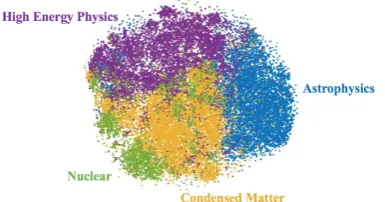
Figure 2: t-SNE visualization of the learned latent codes.
text, and get the average BLEU scores6over1000 generated sentences for each model.
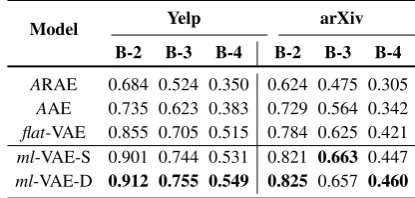
The results are in Table 3. VAE tends to be
a stronger baseline for paragraph generation, ex-hibiting higher corpus-level BLEU scores than both AAE and ARAE. This observation is consis-tent with the results in (C´ıfka et al., 2018) in Ta-ble3. The VAE with multi-level decoder demon-strates better BLEU scores than the one with a flat decoder, indicating that the plan-ahead mechanism associated with the hierarchical decoding process indeed benefits the sampling quality. ml-VAE-D exhibits slightly better results thanml-VAE-S. We attribute this to the more flexible prior distribution ofml-VAE-D, which improves the ability of infer-ence networks to extract semantic features from a paragraph, yielding more informative latent codes. We visualize the learnt latent variables to an-alyze if our models can extract global features. Using the arXiv dataset, we select the most fre-quent four article topics and re-train ourml -VAE-D model on the corresponding abstracts in an un-supervised way (no topic information is used). We sample bottom-level latent codes from the learned model and plot them witht-SNE in Figure2. Each point indicates one paper abstract and the color of each point indicates the topic it belongs to. The embeddings of the same label are very close in the 2-D plot, while those with different labels are relatively farther away from each other. The em-beddings of theHigh Energy PhysicsandNuclear
topic abstracts are meshed, which is expected since these two topics are semantically highly re-lated. The inference network can extract meaning-ful global patterns from the input paragraph.
In Table1two samples of generations fromflat
-VAE andml-VAE-D are shown. Compared to our
hierarchical model, a flat decoder with a flat VAE
6Being interested in longer text generation, we evaluate
[image:6.595.72.292.70.172.2]Model Yelp arXiv B-2 B-3 B-4 B-2 B-3 B-4
[image:7.595.75.283.69.168.2]ARAE 0.684 0.524 0.350 0.624 0.475 0.305 AAE 0.735 0.623 0.383 0.729 0.564 0.342 flat-VAE 0.855 0.705 0.515 0.784 0.625 0.421 ml-VAE-S 0.901 0.744 0.531 0.821 0.663 0.447 ml-VAE-D 0.912 0.755 0.549 0.825 0.657 0.460
Table 3: Evaluation results for generated sequences by our models and baselines on corpus-level BLEU scores (B-ndenotes the corpus-levelBLEU-nscore.)
exibits repetitions as well as suffers from uninfor-mative sentences. The hierarchical model gener-ates reviews that contain more information with less repetitions (word or semantic semantic repeti-tions), and tend to be semantically-coherent.
Diversity of Generated Paragraphs We
evalu-ate the diversity of random samples from a trained model, since one model might generate realistic-looking sentences while suffering from severe mode collapse (i.e., low diversity). We use three metrics to measure the diversity of generated para-graphs: Self-BLEU scores (Zhu et al., 2018), unique n-grams (Fedus et al., 2018) and the
en-tropy score (Zhang et al.,2018). For a set of sam-pled sentences, the Self-BLEU metric is the BLEU score of each sample with respect to all other sam-ples as the reference (the numbers over all samsam-ples are then averaged); the unique score computes the percentage ofuniquen-grams within all the
gener-ated reviews; and the entropy score measures how evenly the empiricaln-gram distribution is for a
given sentence, which does not depend on the size of testing data, as opposed to unique scores. In all three metrics, lower is better. We randomly
sam-ple1000reviews from each model.
The results are shown in Table5. A small self-BLEU score together with a large self-BLEU score can justify the effectiveness of a model, i.e., be-ing able to generate realistic-lookbe-ing as well as diverse samples. Among all the VAE variants,
ml-VAE-D shows the smallest BLEU score and
largest uniquen-grams percentage, demonstrating
the effectiveness of hieararhically structured gen-erative networks as well as latent variables. Even though AAE and ARAE yield better diversity ac-cording to both metrics, their corpus-level BLEU scores are much worse relative toml-VAE-D. We leverage human evaluation for further comparison.
we study the effect of disorder on the dynamics of a two-dimensional electron gas in a two-two-dimensional optical lat-tice , we show that the superfluid phase is a phase transi-tion , we also show that , in the presence of a magnetic field , the vortex density is strongly enhanced .
in this work we study the dynamics of a colloidal suspen-sion of frictionless , the capillary forces are driven by the UNK UNK , when the substrate is a thin film , the sys-tem is driven by a periodic potential, we also study the dynamics of the interface between the two different types of particles .
Table 4: Generated arXiv abstracts from ml-VAE-D model.
Model Yelp
B-2 B-3 B-4 2gr 3gr 4gr Etp-2
ARAE 0.725 0.544 0.402 36.2 59.7 75.8 7.551 AAE 0.831 0.672 0.483 33.2 57.5 71.4 6.767 flat-VAE 0.872 0.755 0.617 23.7 48.2 69.0 6.793 ml-VAE-S 0.865 0.734 0.591 28.7 50.4 70.7 6.843 ml-VAE-D 0.851 0.723 0.579 30.5 53.2 72.6 6.926
Table 5: Evaluation of diversity of 1000 generated sen-tences onself-BLEU scores(B-n),uniquen-gram per-centages(ngr),2-gram entropy score.
Human EvaluationWe conducted human
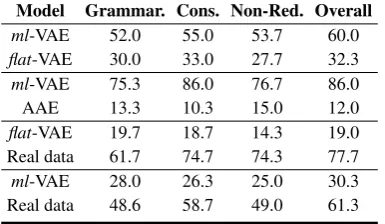
evalu-ations using Amazon Mechanical Turk to assess the coherence and non-redundancy properties of our proposed models. Given a pair of generated reviews, the judges are asked to select their prefer-ences (no difference between the two reviews is also an option) according to the following four evaluation criteria: fluency & grammar, consis-tency,non-redundancy, andoverall. We compare generated text from our ml-VAE-D againts flat-VAE, AAE and real samples from the test set. De-tails are provided in the supplementary material.
As shown in Table 7, ml-VAE generates supe-rior human-looking samples compared toflat-VAE on the Yelp Reviews dataset. Even though both models underperform when compared against the
ground-truth real reviews, ml-VAE was rated
ac-Title: Magnetic quantum phase transitions of the anti-ferromagnetic - Heisenberg model
We study the phase diagram of the model in the presence of a magnetic field, The model is based on the action of the Polyakov loop, We show that the model is consistent with the results of the first order perturbation theory.
Title:Kalman Filtering With UNK Over Wireless UNK Channels
[image:8.595.309.526.64.270.2]The Kalman filter is a powerful tool for the analy-sis of quantum information, which is a key component of quantum information processing, However, the effi-ciency of the proposed scheme is not well understood .
Table 6: Conditionally generated arXiv paper abstracts fromml-VAE-D model based on a given title.
Model Grammar. Cons. Non-Red. Overall
ml-VAE 52.0 55.0 53.7 60.0
flat-VAE 30.0 33.0 27.7 32.3
ml-VAE 75.3 86.0 76.7 86.0
AAE 13.3 10.3 15.0 12.0
flat-VAE 19.7 18.7 14.3 19.0
Real data 61.7 74.7 74.3 77.7
ml-VAE 28.0 26.3 25.0 30.3
Real data 48.6 58.7 49.0 61.3
Table 7: Human evaluations on Yelp Reviews dataset. Each block is a head-to-head comparison of two models on grammatically, consistency, and non-redundancy.
tually generating more coherent stories than the baseline models. We leave further evaluations us-ing embeddus-ing based metrics as a possible exten-sion to our work.
5.4 Conditional Paragraph Generation
We consider the task of generating an abstract of a paper based on the corresponding title. The same arXiv dataset is utilized, where when train-ing the title and abstract are given as paired text sequences. The title is used as input of the infer-ence network. For the generative network, instead of reconstructing the same input (i.e., title), the pa-per abstract is employed as the target for decoding.
We compare theml-VAE-D model againstml-LM.
We observe that theml-VAE-D model achieves a
test perplexity of55.7 (with a KL term of 2.57),
smaller that the test perplexity of ml-LM (58.1),
indicating that the information from the title is used by the generative network to facilitate the de-coding process. Generated abstract samples from
ml-VAE-D model are shown in Table6.
A the service was great, the receptionist was very friendly and the place was clean, we waited for a while, and then our room was ready .
• same with all the other reviews, this place is a good place to eat, i came here with a group of friends for a birthday dinner, we were hungry and decided to try it, we were seated promptly.
• this place is a little bit of a drive from the strip, my husband and i were looking for a place to eat, all the food was good, the only thing i didn t like was the sweet potato fries.
• this is not a good place to go, the guy at the front desk was rude and unprofessional, it s a very small room, and the place was not clean.
• service was poor, the food is terrible, when i asked for a refill on my drink, no one even acknowledged me, they are so rude and unprofessional.
[image:8.595.85.278.258.370.2]B how is this place still in business, the staff is rude, no one knows what they are doing, they lost my business .
Table 8: Intermediate sentences are produced from lin-ear transition between two points in the latent space and sending them to the generator network.
5.5 Analysis
The Continuity of Latent Space Following
(Bowman et al., 2016), we measure the
continu-ity of the learned latent space. We randomly sam-ple two points from the prior latent space (denoted
as A and B) and generate sentences based on
the equidistant intermediate points along the lin-ear trajectory betweenAandB. As shown in
Ta-ble8, these intermediate samples are all realistic-looking reviews that are syntactically and seman-tically reasonable, demonstrating the smoothness of the learned VAE latent space. Interestingly, we even observe that the generated sentences grad-ually transit from positive to negative sentiment along the linear trajectory. To validate that the sen-tences are not generated by simply retrieving the training data, we find the closest instance, among the entire training set, for each generated review. Details of the results can be found in the supple-mentary material (Table12).
Attribute Vector Arithmetic We conduct an
sen-Original: you have no idea how badly i want to like this place, they are incredibly vegetarian vegan friendly , i just haven t been impressed by anything i ve ordered there , even the chips and salsa aren t ter-ribly good , i do like the bar they have great sangria but that s about it .
Transferred: this is definitely one of my favorite places to eat in vegas , they are very friendly and the food is always fresh, i highly recommend the pork belly , everything else is also very delicious, i do like the fact that they have a great selection of salads .
Table 9: An example sentiment transfer result with at-tribute vector arithmetic. More examples can be found in the supplementary material (Table13).
timent and add the “sentiment attribute vector” to their latent codes. The manipulated latent vectors are then fed to the hierarchical decoder to produce the transferred sentences, hypothesizing that they will convey positive sentiment.
As shown in Table9, the original sentences have been successfully manipulated to positive senti-ment with the simple attribute vector operation. However, the specific contents of the reviews are not fully retained. One interesting future direction is to decouple the style and content of long-form texts to allowcontent-preservingattribute manipu-lation. We employed a CNN sentiment classifier to evaluate the sentiment of manipulated sentences. The classifier is trained on the entire training set and achieves a test accuracy of 94.2%. With this
pre-trained classifier,83.4%of the transferred re-views are predicted as positive-sentiment, indicat-ing that “attribute vector arithmetic” consistently produces the intended manipulation of sentiment.
6 Conclusion
We introduce a hierarchically-structured varia-tional autoencoder for long text generation. It con-sists of a multi-level LSTM generative network to model the semantic coherence at both the word-and sentence-levels. A hierarchy of stochastic lay-ers is employed, where the priors of the latent vari-ables are learned from the data. Consequently, more informative latent codes are manifested, and the generated samples also exhibit superior quality relative to those from several baseline methods.
References
Mart´ın Abadi, Paul Barham, Jianmin Chen, Zhifeng Chen, Andy Davis, Jeffrey Dean, Matthieu Devin, Sanjay Ghemawat, Geoffrey Irving, Michael
Is-ard, Manjunath Kudlur, Josh Levenberg, Rajat Monga, Sherry Moore, Derek Gordon Murray, Benoit Steiner, Paul A. Tucker, Vijay Vasudevan, Pete Warden, Martin Wicke, Yuan Yu, and Xiao-qiang Zhang. 2016. Tensorflow: A system for large-scale machine learning. InOSDI.
Martin Arjovsky, Soumith Chintala, and Lon Bot-tou. 2017. Wasserstein gan. arXiv preprint arXiv:1701.07875.
Dzmitry Bahdanau, Kyunghyun Cho, and Yoshua Ben-gio. 2015. Neural machine translation by jointly learning to align and translate. in international con-ference on learning representations. ICLR.
Hareesh Bahuleyan, Lili Mou, Olga Vechtomova, and Pascal Poupart. 2018. Variational attention for sequence-to-sequence models. InCOLING. Samuel R. Bowman, Luke Vilnis, Oriol Vinyals,
An-drew M. Dai, Rafal J´ozefowicz, and Samy Ben-gio. 2016. Generating sentences from a continuous space. InCoNLL.
Liqun Chen, Shuyang Dai, Chenyang Tao, Haichao Zhang, Zhe Gan, Dinghan Shen, Yizhe Zhang, Guoyin Wang, Ruiyi Zhang, and Lawrence Carin. 2018a. Adversarial text generation via feature-mover’s distance. InAdvances in Neural Informa-tion Processing Systems, pages 4671–4682.
Mingda Chen, Qingming Tang, Karen Livescu, and Kevin Gimpel. 2018b. Variational sequential label-ers for semi-supervised learning. InEMNLP. Xi Chen, Diederik P Kingma, Tim Salimans,
Yan Duan, Prafulla Dhariwal, John Schul-man, Ilya Sutskever, and Pieter Abbeel. 2016. Variational lossy autoencoder. arXiv preprint arXiv:1611.02731.
Sumit Chopra, Michael Auli, and Alexander M. Rush. 2016. Abstractive sentence summarization with at-tentive recurrent neural networks. NAACL.
Ondˇrej C´ıfka, Aliaksei Severyn, Enrique Alfonseca, and Katja Filippova. 2018. Eval all, trust a few, do wrong to none: Comparing sentence generation models. arXiv preprint arXiv:1804.07972.
Yuntian Deng, Yoon Kim, Justin Chiu, Demi Guo, and Alexander M. Rush. 2018. Latent alignment and variational attention. CoRR, abs/1807.03756. Jiachen Du, Wenjie Li, Yulan He, Ruifeng Xu, Lidong
Bing, and Xuan Wang. 2018. Variational autore-gressive decoder for neural response generation. In EMNLP.
Hao Fu, Chunyuan Li, Xiaodong Liu, Jianfeng Gao, Asli Celikyilmaz, and Lawrence Carin. 2019. Cycli-cal annealing schedule: A simple approach to miti-gate kl vanishing. NAACL.
Anirudh Goyal, Alessandro Sordoni, Marc-Alexandre Cˆot´e, Nan Rosemary Ke, and Yoshua Bengio. 2017. Z-forcing: Training stochastic recurrent networks. InNIPS.
Xiaodong Gu, Kyunghyun Cho, Jungwoo Ha, and Sunghun Kim. 2018. Dialogwae: Multimodal response generation with conditional wasserstein auto-encoder. arXiv preprint arXiv:1805.12352. Ishaan Gulrajani, Kundan Kumar, Faruk Ahmed,
Adrien Ali Taiga, Francesco Visin, David Vazquez, and Aaron Courville. 2016. Pixelvae: A latent variable model for natural images. arXiv preprint arXiv:1611.05013.
Kelvin Guu, Tatsunori B. Hashimoto, Yonatan Oren, and Percy Liang. 2018. Generating sentences by editing prototypes. TACL, 6:437–450.
Tatsunori B Hashimoto, Kelvin Guu, Yonatan Oren, and Percy S Liang. 2018. A retrieve-and-edit frame-work for predicting structured outputs. InAdvances in Neural Information Processing Systems, pages 10052–10062.
Junxian He, Daniel Spokoyny, Graham Neubig, and Taylor Berg-Kirkpatrick. 2019. Lagging inference networks and posterior collapse in variational au-toencoders. ICLR.
Ari Holtzman, Jan Buys, Maxwell Forbes, Antoine Bosselut, David Golub, and Yejin Choi. 2018. Learning to write with cooperative discriminators. ACL.
Zhiting Hu, Zichao Yang, Xiaodan Liang, Ruslan Salakhutdinov, and Eric P. Xing. 2017. Toward con-trolled generation of text. InICML.
Lukasz Kaiser, Aurko Roy, Ashish Vaswani, Niki Par-mar, Samy Bengio, Jakob Uszkoreit, and Noam Shazeer. 2018. Fast decoding in sequence models using discrete latent variables. InICML.
Yoon Kim, Sam Wiseman, Andrew C. Miller, David A Sontag, and Alexander M. Rush. 2018. Semi-amortized variational autoencoders. InICML. Diederik P. Kingma and Jimmy Ba. 2014. Adam:
A method for stochastic optimization. CoRR, abs/1412.6980.
Diederik P Kingma and Max Welling. 2013. Auto-encoding variational bayes. arXiv preprint arXiv:1312.6114.
Jiwei Li, Minh-Thang Luong, and Daniel Jurafsky. 2015a. A hierarchical neural autoencoder for para-graphs and documents. InACL.
Jiwei Li, Thang Luong, and Dan Jurafsky. 2015b. A hierarchical neural autoencoder for paragraphs and documents. InACL, volume 1, pages 1106–1115. Alireza Makhzani, Jonathon Shlens, Navdeep Jaitly,
and Ian Goodfellow. 2015. Adversarial autoencoder. CoRR.
Yishu Miao, Edward Grefenstette, and Phil Blunsom. 2017. Discovering discrete latent topics with neural variational inference. InICML.
Yishu Miao, Lei Yu, and Phil Blunsom. 2016. Neural variational inference for text processing. InICML, pages 1727–1736.
Kishore Papineni, Salim Roukos, Todd Ward, and Wei-Jing Zhu. 2002. Bleu: a method for automatic eval-uation of machine translation. In Proceedings of the 40th annual meeting on association for compu-tational linguistics, pages 311–318. Association for Computational Linguistics.
Yookoon Park, Jaemin Cho, and Gunhee Kim. 2018. A hierarchical latent structure for variational conversa-tion modeling. InNAACL-HLT.
Adam Roberts, Jesse Engel, Colin Raffel, Curtis Hawthorne, and Douglas Eck. 2018. A hierarchical latent vector model for learning long-term structure in music.arXiv preprint arXiv:1803.05428. Stanislau Semeniuta, Aliaksei Severyn, and Erhardt
Barth. 2017. A hybrid convolutional variational au-toencoder for text generation. InEMNLP.
Iulian Serban, Alessandro Sordoni, Ryan Lowe, Lau-rent Charlin, Joelle Pineau, Aaron C. Courville, and Yoshua Bengio. 2017. A hierarchical latent variable encoder-decoder model for generating dialogues. In AAAI.
Dmitriy Serdyuk, Nan Rosemary Ke, Alessandro Sor-doni, Christopher Joseph Pal, and Yoshua Bengio. 2017. Twin networks: Using the future as a regular-izer. CoRR, abs/1708.06742.
Harshil Shah and David Barber. 2018. Genera-tive neural machine translation. arXiv preprint arXiv:1806.05138.
Dinghan Shen, Qinliang Su, Paidamoyo Chapfuwa, Wenlin Wang, Guoyin Wang, Lawrence Carin, and Ricardo Henao. 2018a. Nash: Toward end-to-end neural architecture for generative semantic hashing. InACL.
Dinghan Shen, Yizhe Zhang, Ricardo Henao, Qinliang Su, and Lawrence Carin. 2018b. Deconvolutional latent-variable model for text sequence matching. In AAAI.
Nitish Srivastava, Geoffrey E. Hinton, Alex Krizhevsky, Ilya Sutskever, and Ruslan Salakhutdi-nov. 2014. Dropout: a simple way to prevent neural networks from overfitting. Journal of Machine Learning Research, 15:1929–1958.
Wenlin Wang, Zhe Gan, Hongteng Xu, Ruiyi Zhang, Yingxu Wang, Dinghan Shen, Changyou Chen, and Lawrence Carin. 2019. Topic-guided variational au-toencoders for text generation. NAACL.
Jiacheng Xu and Greg Durrett. 2018. Spherical la-tent spaces for stable variational autoencoders. In EMNLP.
Zichao Yang, Zhiting Hu, Ruslan Salakhutdinov, and Taylor Berg-Kirkpatrick. 2017. Improved varia-tional autoencoders for text modeling using dilated convolutions. InICML.
Zichao Yang, Diyi Yang, Chris Dyer, Xiaodong He, Alex Smola, and Eduard Hovy. 2016. Hierarchi-cal attention networks for document classification. InProceedings of the 2016 Conference of the North American Chapter of the Association for Computa-tional Linguistics: Human Language Technologies, pages 1480–1489.
Pengcheng Yin, Chunting Zhou, Junxian He, and Gra-ham Neubig. 2018. Structvae: Tree-structured latent variable models for semi-supervised semantic pars-ing. InACL.
Lantao Yu, Weinan Zhang, Jun Wang, and Yong Yu. 2017. Seqgan: Sequence generative adversarial nets with policy gradient. InAAAI.
Xiang Zhang, Junbo Zhao, and Yann LeCun. 2015. Character-level convolutional networks for text clas-sification. InNIPS, pages 649–657.
Yizhe Zhang, Michel Galley, Jianfeng Gao, Zhe Gan, Xiujun Li, Chris Brockett, and Bill Dolan. 2018. Generating informative and diverse conversational responses via adversarial information maximization. InNIPS.
Yizhe Zhang, Zhe Gan, Kai Fan, Zhi Chen, Ricardo Henao, Dinghan Shen, and Lawrence Carin. 2017. Adversarial feature matching for text generation. In ICML.
Junbo Jake Zhao, Yoon Kim, Kelly Zhang, Alexan-der M. Rush, and Yann LeCun. 2018a. Adversari-ally regularized autoencoders. InICML.
Tiancheng Zhao, Kyusong Lee, and Maxine Eskenazi. 2018b. Unsupervised discrete sentence representa-tion learning for interpretable neural dialog genera-tion. arXiv preprint arXiv:1804.08069.
Tiancheng Zhao, Ran Zhao, and Maxine Esk´enazi. 2017. Learning discourse-level diversity for neural dialog models using conditional variational autoen-coders. InACL.