http://dx.doi.org/10.4236/am.2012.330206 Published Online October 2012 (http://www.SciRP.org/journal/am)
Non-Frobenius Spectrum-Transformation Method
Albert Iskhakov1, Vladimir Pospelov2, Sergey Skovpen3
1Department of Management, Concern Morinformsystem-Agat, Joint Stock Company, Moscow, Russia 2Department of Management, Military-Industrial Commission of the Russian Federation, Moscow, Russia 3Department of Automatics, Institute of Shipbuilding and Marine Arctic Equipment, Severodvinsk, Russia
Email: [email protected], [email protected], [email protected] Received July 10, 2012; revised August 10, 2012; accepted August 17, 2012
ABSTRACT
A method allowing a desirable matrix spectrum to be constructed as an alternative to the method using matrix transfor-mation to the Frobenius form is stated. It can be applied to implement control algorithms for technical systems without executing the variables transformation procedures that are needed for deriving a Frobenius matrix. The method can be used for simulation of systems with different spectrums for choosing an alternative that satisfies to the distinct demands.
Keywords: Matrix Spectrum; Modal Control; Spectrum Transformation; Frobenius Matrix; Linear Spectral
Transformation; Non-Frobenius Transformation
1. Introduction
A number of mathematical problems deal with changes of a matrix spectrum [1,2]. It can be changed by various methods, for example, in computing problems, a multi-plication to other matrix is used. In control problems, to change a spectrum, a matrix is added with some other matrix derivated by a feedback, which forms a linear function of variables. This approach is known as modal control [3,4] or spectrum control [5].
To solve the above problems and to obtain a matrix with required eigenvalues a matrix is reduced to the Fro-benius form. This transformation called here FroFro-benius, has a clear foundation and it is widely applied as theo-retical tool. However, an attempt to use this approach for practical control problems with implementation of con-trol algorithms by concrete technical devices has shown that such method is of limited application.
The matter is that in technical systems so-called physi-cal variables are used. These latter characterize energy storage units, in particular, a velocity of a moving mass, a solenoid coil current, a voltage of a capacitor and simi-lar. The values of physical variables are gained from sen-sors. In order to obtain a Frobenius matrix it is necessary to transform physical variables of feedback loop. In this case the transformation is double, because just a combi-nation of physical variables must goes to the input. To execute such transformations it is required an additional either hardware expenditures or time delays in program implementation.
In this paper, the method of obtaining a desirable spec-trum without resort to a Frobenius matrix is stated. It also can be used for calculating the feedback coefficients of a
control system for the purpose to derive a desirable spec-trum. It enables one to solve the control problems by simulating a system behavior with different spectrums for searching a comprehensible alternative. Among them the most demanded for practical applications it is possi-ble to consider the spectrum correction propossi-blem, when it is required to determine parameters of a feedback for altering a part of a spectrum.
2. Description of the Method
2.1. Informative Side
The Frobenius transformation is based on the relationship between eigenvalues and coefficients of a characteristic polynomial of a matrix in which a row is formed from these coefficients. The additive action of the feedback confirming an operation of summing the elements of a row with the elements of the feedback changes a row and a spectrum as well. The feedback elements are computed evidently as the differences between elements of a Fro-benius matrix row and the coefficients of a polynomial of a matrix having a given spectrum.
The presented method is based on a relation between elements and eigenvalues of a matrix. For identity of system with the numbers that do not belong to a matrix spectrum, some of the elements are replaced by the un-knowns. Solving a system of equations for unknowns one gives a desired spectrum of a matrix.
2.2. Purpose Statement
Let A
ai j, be a given real k by k matrix, where i, j
1,
i ,
u , where
1,l
2
, c,bk c
2 2
, , k
is the given set of l real numbers, and k≥l≥ 1.
A matrix having a spectrum that in full or in part coin-cides with Λ, obtained by replacing some of its elements we denote by Аx. For two alternatives of the spectrum
setting we have:
1) l < k is a part of a spectrum, 2) l = k is whole spectrum.
The goal is to find the replaced elements.
2.3. The Non-Frobenius Transformation of a Matrix Spectrum
For the matrix А we write the equalities
1 1
b c b2 k,
,
(1) where bi is the sum of all main minors of i order, and ci
are the coefficients of a characteristic polynomial.
Definition 1. Changeover the element аi,j in matrix A
by the unknown elements xi,j is called the replacement, xi,j
is the replaced element, the matrix having l replaced elements is called the replaced matrix and it is denoted by Аx.
Definition 2. The non-Frobenius transformation of a
matrix spectrum, further the spectral transformation, is called the substitution of any its l elements by the result of a solution of the system (1) for the replaced matrix
1 1 k
g d g d g d (2) concerning replaced elements, where gi has the same
sense as coefficient bi, the coefficient di is derivated from
l numbers of the set Λ and from (k− l) unknowns of a spectrum.
For l < k the equalities (2) become a system of equa-tions for l replaced elements and (k− l) unknowns of a spectrum. A solution of this system enables one to spec-ify them in the form of a function of the remaining ele-ments of the matrix A and the elements of the set Λ.
Definition 3. The spectral transformation for l < k is
called the incomplete one.
An example of the incomplete spectral transformation for l < k is resulted in Appendix A. Further the case with
l = k is observed as more demanded for practical applica-tions. In this case the spectral transformation enables one to change certain eigenvalues, while the remaining part of a spectrum is unchanged, otherwise, such transforma-tion control over a spectrum.
Let’s collect the elements xi,j into the vector x.
Gener-ferent rows and columns, as it is shown in an example for replaced matrix
11 12 1
1 1,2 1,
1 2
...
, ...
...
k x
i i i k
k k kk
a x a
A
x a a
a x x
(4)
the system is reduced to a solution of the equation of a degree from 2-nd to k-th, thus a degree of the equation is equal to a maximum number of the replaced elements in the addends of the last row of the system (3).
Definition 4. The Equation (3) is called the system of
spectral transformation of i-th order, where i is a maxi-mum number of replaced elements in the addends of the last row.
Definition 5. The system of spectral transformation of
the first order is called the linear, and the transformation is called the linear spectral transformation (LST).
Definition 6. The system of spectral transformation
above the first order is called the nonlinear, and trans-formation is called nonlinear spectral transtrans-formation (NST).
Theorem. If solution of the system (3) exists than
Ax .
Proof. With substitution of solution of the Equation (3)
into the matrix Аx the coefficients of its characteristic
polynomial become equal to values of combinations of numbers of the given set Λ spotted by a right side of the system (2), which left side is identical. This completes the proof.
Further we consider that replaced elements make a row or column in replaced matrix. The LST is illustrated by numerical examples in Appendices A, B, and C.
2.4. The Row LST
For replacing row i of the matrix A the replaced vector х
is denoted by ni. The replaced matrix takes the form
11 12 1
1,1 1,2 1,
1 2
1,1 1,2 1,
1 2
...
...
... .
...
...
k
i i i k
in i i ik
i i i k
k k kk
a a a
a a a
A n n n
a a a
a a a
1473
by the row i, and the condition
,
detAi k 0, (7) is called the condition of existence of the LST matrix A
by the row i.
If the condition (7) is satisfied than
Ai n, , i.e.the replaced matrix (5) with the solution of system (6)
1,
i i k i n
n A d a
, (8)
acquires a spectrum that is equal to the given set Λ. The fulfillment of (7) for i
1,k enables one to find kvectors of ni.
Definition 8. The matrix N involving the all rows
of (8) is called the summary matrix of rows of the LST, the matrix G = N−A is called the summary matrix of the complements of rows of the LST.
T i
n
Spectrums of all matrixes derivated by replacement of an arbitrary row of the matrix A by the row of the matrix
N, and also by addition of an arbitrary row of the matrix
A with row having the same number of the matrix G are equal.
2.5. The Column LST
Let the elements of the vector x replace the column number j in the matrix A. This vector is denoted by mj.
The replaced matrix has the form
11 1, 1 1, 1, 1 1
,
1 , 1 , , 1
... ...
.
... ...
j j j k
m i
k k j k j k j k
a a m a a
A
a a m a a
k
,
(9)
For the matrix (9) we construct the LST system
, ,
k j j m j
A m d a (10)
where Аk,j is a matrix, and аm,j is a vector.
Definition 9. The matrix Аk,jis called the LST matrix
by the column j, and the condition
,
detAk j 0, (11) is called the condition of existence of the LST matrix A
by the column j.
If the condition (11) is satisfied than
Am j, , i.e.the replaced matrix (9) with the solution of system (10)
1
, ,
j k j m j
m A d a (12) acquires a spectrum that is equal to the given set Λ. The fulfillment of (11) for j
1,k enables one to find kvectors of mj.
Definition 10. The matrix M involving the all columns
T j
m of (12) is called the summary matrix of columns of
the LST, the matrix H = M−A is called the summary matrix of the complements of columns of the LST.
Spectrums of all matrixes derivated by replacement of an arbitrary column of the matrix A by a column with the same number of the matrix M, and also by addition of arbitrary column of the matrix A by the column with the same number of the matrix Н are equal.
2.6. Remarks
In spite of formal equivalence of row and column alter-natives of the LST, their practical significance is not equal. The matter is that control systems have the single input into which the linear combination of all variables arrives that corresponds to additive action of row vector. Therefore the row alternative of the LST has a greater potential for applications in solutions of control prob-lems.
3. Conclusion
In this paper, we proposed a new spectrum-transforma- tion method, which enables a desirable matrix spectrum to be obtained without recourse to deriving a Frobenius matrix. Because of this the method was called the non- Frobenius transformation. The linear spectral transforma-tion was described in detail and illustrated by the exam-ples of spectrum transformation for matrices of the 2nd, 3rd, and 4th order. Finally, in Appendix D, we show how the LST can be used for solving a modal control problem in terms of changing matrix eigenvalues for system with unique control input.
REFERENCES
[1] R. Gabasov and F. M. Kirillova, “Mathematical Theory of Optimal Control. Results of Since and Engineering,”
Mathematical Analysis, Vol. 16, 1979, pp. 55-97. [2] G. G. Islamov, “On the Control of a Dynamical System
Spectrum,” Differential Equations, Vol. 23, No. 8, 1987, pp. 1299-1302.
[3] N. T. Kuzovkov, “Modal Control and Observe Devices,” Mashinostroenie, Moscow, 1976.
[4] A. A. Krasovsky, “Control Theory Reference Book,” Nauka, Moscow, 1987.
[5] G. A. Leonov and M. M. Shumafov, “The Methods for Linear Controlled System Stabilization,” St.-Petersburg University Publisher, St.-Petersburg, 2005.
[6] V. V. Voevodin and Y. A. Kuznetsov, “Matrices and Calculations,” Nauka, Moscow, 1984.
[7] R. Isermann, “Digital Control Systems,” Springer-Verlag, New York, 1996
Appendix A
Case k = 2. Let’s set up the system
11 22 1, 11 22 12 21 2.
a a c a a a a c (13) We illustrate incomplete LST for l = 1. Denoting the unknown eigenvalue by ω11, from (13) we obtain the
system
11 22 11, 11 22 12 21 11.
x a x a a a
. We rewrite this system in the normal form
11 11 22, 22 11 11 12 21
x a a x a a (14)
For λа22, the solution of (14) is given by
11 22 12 21 22
11 22 22 12 21 22
, ,
x a a a a
a a a a a
(15)
By replacing other elements, we get the solutions in a similar way:
22 11 12 21 11
22 11 11 12 21 11
12 11 22 11 22 21
12 11 22
21 11 22 11 22 12
21 12
, , , ,
, .
x a a a a
a a a a a
x a a a a a
a a
x a a a a a
For а11 = 3, а12 = 4, а21 = 7, а22 = 6, Σ = {–1, 10}, and λ = 2, from (15), we obtain:
11 11 12 12
21 21 22 22
9, 13, 0.571, 7,
1, 7, 30, 31.
x x
x x
(16)
So, the required eigenvalue for incomplete LST de-pends on choosing the replaced element.
Now we explain how to determine whole spectrum. In row LST for the replaced matrices (5)
11 12 11 12
1, 2,
21 22 21 22
,
n n
n n a a
A A
a a n n
(17)
the systems (2) are given by
11 22 1 11 22 1
11 22 12 21 2 11 22 12 21 2
, ,
, ,
n a d a n d
n a n a d a n a n d
(18)
where d1 = λ1 + λ2, d2 = λ1λ2.
The systems (18) expressed in the form (6) are
If the condition (7) −а21 0 and а12 0 is satisfied for
each system, then these systems have the solutions
1
1 11 12 1, 1,
1
2 21 22 2, 2,
,
.
T
k n
T
k n
n n n A d a
n n n A d a
(20)
For replaced matrices (17) whose solutions are (20) the following conditions satisfy
A1,n A2,n
1, 2
. (21)
Iterating the LST for the matrices with replaced col-umns
11 12 11 12
,1 ,2
21 22 21 22
, ,
n n
m a a m
A A
m a a m
m
(22)
we write the systems (2) as
11 22 1 11 22 1
11 22 12 21 2 11 22 21 12 2
, ,
, .
m a d a m d
m a a m d a m a m d
(23)
In the form (10) the systems (23) are
,1 1 ,1, ,2 2 ,2,
k m k
A m d a A m d a (24)
where 22
,1 ,1
22 12
1 0
, ,
0
k m
a
A a
a a
11
,2 ,2
21 11
0 1
, and .
0
k m
a
A a
a a
Under conditions а21 0 and а12 0 the systems (24)
have the solutions
1
1 11 21 ,1 ,1
1
2 12 22 ,2 ,2
,
.
T
k m
T
k m
m m m A d a
m m m A d a
(25)
With solutions (25) the replaced matrices (22) gain the required spectrum
An,1 An,2
1, 2
. (26)
Using the numerical data from example, we generate a spectrum that is different from Σ = {−1, 10} by the number λ2 = 1. We calculate
1 1 2 2 1 2
1 2
1, 22
2, 11
0, 1,
[ ] [0 1] ,
[ 0] [6 0] , [ 0] [3 0] ,
T T
T T n
T T n
d d
d d d
a a
a a
1475
1 11 21 2 12 22
6 8.75 , 1.143 3 .
T T
T T
m m m
m m m
n
The replacement matrices (17) and (22) gain the fol-lowing spectrum
1, 2, ,1
,2 1, 1
n n
n
A A A
A
that is different from spectrum of the matrix А by a sin-gle number.
Appendix B
Case k = 3. From the equalities (1)
11 22 33 1
11 22 12 21 11 33 13 31 22 33 23 32 2
11 22 33 12 23 31 13 21 32 12 21 33 11 23 32
13 22 31 3
,
,
,
a a a c
a a a a a a a a a a a a c
a a a a a a a a a a a a a a a
a a a c
we set up the LST systems (6) and (10)
, , , , ,
i k i i n k j j m j
A n d a A m d a , (27)
where
1 11 12 13 2 21 22 23 3 31 32 33 1 11 21 31
2 12 22 32 3 13 23 33
1 2 3 1 1 2 3
2 1 2 1 3 2 3 3 1 2 3
? ? , , , , , , Т Т Т Т T T T
n n n n n n n n
n n n n m m m m
m m m m m m m m
d d d d d
d d
1, 22 33 21 31
22 33 23 32 23 31 21 33 21 32 22 31
1 0 0
,
k
A a a a a
a a a a a a a a a a a a
22 33
1, 22 33 23 32 ,
0
n
a a
a a a a a
2, 12 11 33 32
13 32 12 33 11 33 13 31 12 31 11 32
0 1 0
,
k
A a a a a
a a a a a a a a a a a a
11 33
2, 11 33 13 31 ,
0
n
a a
a a a a a
3, 13 23 11 22
12 23 13 22 13 21 11 23 11 22 12 21
0 0 1
,
k
A a a a a
a a a a a a a a a a a a
11 22
3, 11 22 12 21 ,
0
n
a a
a a a a a
,1 22 33 12 13
22 33 23 32 13 32 12 33 12 23 13 22
1 0 0
,
k
A a a a a
a a a a a a a a a a a a
,1 1, ,
m n
a a
,2 21 11 33 23
23 31 21 33 11 33 13 31 13 21 11 23
0 1 0
,
k
A a a a a
a a a a a a a a a a a a
,2 2, ,
m n
a a
,3 31 32 11 22
21 32 22 31 12 31 11 32 11 22 12 21
0 0 1
,
k
A a a a a
a a a a a a a a a a a a
and am,3a3,n.
If both (7) and (11) conditions satisfy for all i and j, then the solutions of the systems (7) are
1 1
1 1, 1, 2 2, 2,
1
3 3, 3,
1 1
1 ,1 ,1 2 ,2 ,2
1
3 ,3 ,3
, ,
,
, ,
.
k n k n
k n
k m k m
k m
n A d a n A d a
n A d a
m A d a m A d a
m A d a
After calculating the eigenvalues of the replaced ma-trices
11 12 13 11 12 13
1, 21 22 23 2, 21 22 23
31 32 33 31 32 33
11 12 13 11 12 13
3, 21 22 23 ,1 21 22 23
31 32 33 31 32 33
11 12 13 ,2 21 22 23
31 3 , , , , n n n m m
n n n a a a
A a a a A n n n
a a a a a a
a a a m a a
A a a a A m a a
n n n m a a
a m a
A a m a
a m
11 12 13 ,3 21 22 23
2 33 31 32 33
, m
a a m
A a a m
a a a
m (28)
one obtains the required set Λ:
1, 2, 3, ,1 ,2
,3 1, 2, 3 .
n n n m m
m
A A A A A
A ,
We write the summary matrices of rows and the com-plements of rows
11 12 13
21 22 23
31 32 33
,
n n n
N n n n G N A
n n n
and also the summary matrices of columns and the com-plements of columns
11 12 13
21 22 23
31 32 33
, .
m m m
M m m m H M A
m m m
n
n
n
a
(30)
Let’s observe matrices for which LST by different rows and columns exists, Λ = {1, 0, −1}.
1) LST exists by all rows and columns. For the matrix
1 2 3 4 5 6 , 7 8 9 A
from (27), we find
1 0, 2 1, 3 0,
d d d
1, 1,
2, 2,
3, 3,
1 0 0 14
14 4 7 , 3 ,
3 6 3 0
0 1 0 10
2 10 8 , 12 ,
6 12 6 0
0 0 1 6
3 6 6 , 3 ,
3 6 3 0
k n
k n
k n
A a
A a
A a
,1 ,1 1,
,2 ,2 2,
,3 ,3 3,
1 0 0
14 2 3 ,
3 6 3
0 1 0
4 10 6 , ,
6 12 6
0 0 1
7 8 6 , .
3 6 3
k m
k m
k m
A a
A a a
A a
a
(31)
The matrices (31) are nonsingular; therefore all of systems (27) have the solutions
1
1 1, 1,
1
2 2, 2,
1
3 3, 3,
14 16.444 18.889 ,
8.167 10 11.833 ,
3.333 4.667 6 ,
T k n
T k n
T k n
n A d a
n A d a
n A d a
14 1,
15 2,
15 3,
14 ,1
14 ,2
15 ,3
1, 1, 1.516 10 ,
1, 8.847 10 , 1 ,
1, 2.044 10 , 1 ,
1, 1, 5.437 10 ,
1, 1, 2.421 10 ,
1, 2.8763 10 , 1 .
n n n m m m
A
A
A
A
A
A
The summary matrices of rows and the complements of rows (29) are
14 16.444 18.889 8.167 10 11.833 ,
3.333 4.667 6
15 18.444 21.889 12.167 15 17.833 , 10.333 12.667 15 N
G
and the summary matrices of columns and the comple-ments of columns (30) are
14 4.5 1.273 30 10 3.636 ,
46 15.5 6
15 6.5 4.273 14 15 9.636 .
53 23.5 15
M
H
2) LST exists by certain rows and columns. 2.1) LST by three columns and two rows. For the matrix
1 2 30 1 0
2 2 2 , 6, 0, 1 , 1, 0, 0,
3 5 3
A d
d d
(32)
1, 1,
2, 2,
1 0 0 5
5 2 3 , 4
4 0 4 0
0 1 0 3
1 3 5 , 0 ,
3 0 3 0
0 0 1 2
k n
k n
A a
A a
,
1477
,2 ,2 2,
,3 ,3 3,
0 1 0
2 3 2 , ,
0 0 0
0 0 1
3 5 2 , and
4 3 2
k m
k m
A a
.
n
n
a
A a a
The matrix Аk,2 is singular. The solutions of the
sys-tems (27) are
1 2
3
1
3
6 8 6 , 2 4 2 ,
3 4 3 ,
6 34 63 ,
0.545 1.273 3 .
T T
T T
T
n n
n m
m
.
d
.
n
n
n
a
a
Calculating the eigenvalues of the replaced matrices one gives the required set:
15 7 15
1,
7
8 8
2,
8 8
3,
8 8
,1
8 8
,3
3.125 10 1.142 10 , 3.125 10
1.142 10 , 1 ,
1, 2.944 10 , 2.944 10 ,
1, 4.133 10 , 4.133 10 ,
3.88 10 , 3.88 10 , 1 ,
1, 3.269 10 , 3.269 10 .
n
n n m m
A i
i
A
A
A
A i i
The summary matrices of rows and the complements of rows (29) are
6 8 6 6 9 6
2 4 2 , 4 6 4
3 4 3 6 9 6
N G
2.2) LST by two columns and two rows. For the matrix
1 2 3
1, 1,
2, 2,
3, 3,
0 1 0
1 2 2 , {3, 0, 1}, 0, 1, 0,
0 1 0
1 0 0 2
2 1 0 , 2 ,
2 0 1 0
0 1 0 0
1 3 2 , 0 ,
0 0 0 0
0 0 1 2
0 2 2 , 1 ,
2 0 1 0
k n
k n
k n
A d d
A a
A a
A a
,1 ,1 1,
,2 ,2 2,
,3 ,3 3,
1 0 0
2 1 0 , ,
2 0 2
0 1 0
1 3 2 , ,
0 0 0
0 0 1
0 1 2 , and
1 0 1
k m
k m
k m
A a
A a
A a a
The matrices А2,k and Аk,2 are singular. The solutions
of the systems (27) are
1 3
1 3
2 5 4 , 1 2 2 ,
2 5 2 , 2 4 2
T T
T T
n n
m m
.The eigenvalues of the replaced matrices have the re-quired set:
1, 3,
15
,1 ,3
1, 0, 1 , 1, 1, 0 ,
1, 2.148 10 , 1 , 1, 1, 0 .
n n
m m
A A
A A
2.3) We cite the matrices (without calculations), which suppose
a) two LST:
1 2
3 4
1 1 1 0 0 0
1 1 0 , 1 0 0 ,
0 0 1 0 1 0
1 1 0 1 1 1
1 1 0 , 1 1 1 ,
1 1 1 0 0 1
A A
A A
А1 for row 3 and column 2, А2 for row 1 and column 3, А3 for rows 1 and 2, and А4 for columns 1 and 2.
b) single LST:
5 6
1 0 1 0 1 1
1 1 1 , 0 1 0 ,
0 0 0 0 0 0
A A
А5 for row 3, and А6 for column 1.
c) the following matrices do not have the LST:
7 8
1 0 0 0 0 1
0 1 0 , 0 1 0 ,
0 0 1 1 0 0
A A
9 10
0 1 1 0 1 0
0 1 1 , 1 0 0 .
0 0 0 0 0 0
A A
Appendix C
Case k = 4.Passing over the equalities (1), we write the LST system (6) by first row at once
1,k i 1,n.
A n c a (33)
where 21 21 31 41
1,
31 32 33 34
41 42 43 44
1 0 0 0
,
k
r a a a
A
r r r r
r r r r
,
1 11 12 13 14
1, 21 31 41
1 2 3 4
1 1 2 3 4
2 1 2 1 3 1 4 2 3 2 4 3 4
3 1 2 3 1 3 4 1 3 4 2 3 4
4 1 2 3 4 1 22 33 23 32
2 22 44 24 42 3 33 44 34 43
4 21 33 2
,
0 , , ,
, ,
, ,
,
T T n
T
n n n n n
a r r r
c c c c c
c c c
c d a a a a
d a a a a d a a a a
d a a a
3 31 5 21 44 24 41
6 21 32 22 31 7 31 44 34 41
8 21 42 22 41 9 31 43 33 41
10 32 44 34 42 11 32 43 33 42
12 31 42 32 41 21 22 33 44
31 1 2 3
32 4 5 33 6 7 34 8
, , , , , ,
, ,
a d a a a a
d a a a a d a a a a
d a a a a d a a a a
d a a a a d a a a a
d a a a a r a a a
r d d d
r d d r d d r d
9
41 22 3 23 10 24 11
42 21 3 23 7 24 9
43 21 10 22 7 24 12
43 21 11 22 9 23 12
, ,
, ,
and .
d
r a d a d a d
r a d a d a d
r a d a d a d
r a d a d a d
, , , , ,
For the replaced matrix
11 12 13 14 21 22 23 24 1,
31 32 33 34 41 42 43 44
,
n
n n n n
a a a a
A
a a a a
a a a a
(34)
the condition σ(А1,n) = Λ satisfies.
We consider the matrix 1 0 0 1
1,
1 0 0 0
2 1 0 1
, 10 35 50 24
0 1 1 2
1 1 1 1
T k
A c
1, 2 0 1 0 .
T n
a
With replacement vector
1
1 1, 1, 8 0 13 19
T k n
n A c a
8 0 13 19
, the matrix (34)1,
2 1 0 1
0 1 1 2
1 1 1 1
n
A
(35)
gains a spectrum with the required set
A1,n
1, 2, 3, 4
.
All calculations were yielded in Mathcad.
Appendix D
LST Application to the Modal Control Problem
Here, we compare the stated method to the known alter-native of modal control. First of all, we recall that in ac-cordance with up-to-date concepts of modal control, change the matrix eigenvalues independently of each other can be implemented only by separate action on the con-trol input associated with a given eigenvalue. Thus, to implement a modal control, a system should have the number of inputs that is equal to the system order. This demand, as it is cited in a number of sources, for exam-ple, in [7], is seldom fulfilled, that is a significant con-straint of the up-to-date method of modal control. The vast majority of multivariable control systems have a unique control input.
The stated transformation method allows eigenvalues to be changed independently by action to a unique input. It is possible to call this alternative method as a one-input modal control.
To compare these approaches, the simplified block diagram taken from [7] is shown in Figure 1. The
func-tions of the blocks are clear from the scheme. The basic
Iz–1 B
B–1T–1 A
Modal
xn+1 xn
[image:8.595.56.283.126.697.2] [image:8.595.318.529.601.718.2]1479
n
relationships given below were taken from [7].
The system is described by the following difference equation
1 ,
n n
x Ax Bu (36) where xn, un, А, and В are k-size state vector, control
vector, system matrix, and input matrix, respectively, n = 0, 1, 2, ···
A transformation with the help of a nonsingular matrix
T
,
t n n
x Tx (37)
gives Equation (36) in the form
, 1 , , ,
t n t n t t n
x x B u (38) where Λ = ТАТ–1, u
t,n = Вtun, and Вt = ТВ, with a
diago-nal matrix.
Constructing the control in the form of a feedback on a vector of variables with a diagonal matrix
, ,
t n t t n
u K x, (39) performed by the modal analyzer, one leads to the ho-mogeneous equation
, 1 ,
t n t t n
x K x (40)
with a diagonal matrix. This enables one to control each of eigenvalues by means of changing a one element of the matrix (39).
A modal synthesizer rebuilds the real control vector according to the Equations (38) and (39)
1 1 1
, , .
n t t n t n
u B u B T u
The method offered here, as well as the Frobenius transformation, allows a separate eigenvalue to be con-trolled by changing not a single but all of k elements in row or column, and also if they are arbitrarily selected.
As it was noted, practical interest is the case of change in row elements. This case belongs to the class of the most widespread control systems with a unique control input.
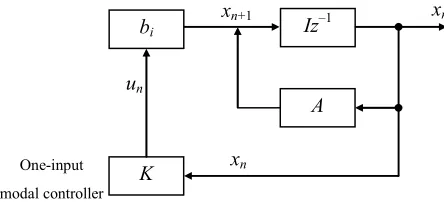
The block diagram of a modal control system with a unique input shown in Figure 2 does not include blocks
providing a transformation of variables. Here, the modal controller represents a set of two-input products, each of which performs multiplication of a state variable by a feedback coefficient. The sum of multiplication results goes to the input.
In this case, Equation (36) takes the form
1 ,
n n i n
x Ax b u (41) where bi is a vector with all zero elements except i-th
element that is a one. This element defines the input number.
The feedback xn, where K is a vector of
coef-ficients, gives the equation in the form of (40)
T n
u K
1 T .
n i n
x A b K x (42)
The row KT is calculated as the i-th row of a summary
matrix G of the row supplements of the LST. As a result, we obtain a matrix in (42) with a desirable spectrum.
Iz–1 bi
K
A
One-input modal controller
xn+1 xn
un
[image:9.595.311.533.372.473.2]xn