Proceedings of the 57th Annual Meeting of the Association for Computational Linguistics, pages 2464–2474 2464
Cross-Domain NER using Cross-Domain Language Modeling
Chen Jia†‡, Xiaobo Liang3∗and Yue Zhang‡§ †Fudan University, China
‡School of Engineering, Westlake University, China
3Natural Language Processing Lab, Northeastern University, China §Institute of Advanced Technology, Westlake Institute for Advanced Study
{jiachen,zhangyue}@westlake.edu.cn,[email protected]
Abstract
Due to limitation of labeled resources, cross-domain named entity recognition (NER) has been a challenging task. Most existing work considers a supervised setting, making use of labeled data for both the source and target do-mains. A disadvantage of such methods is that they cannot train for domains without NER data. To address this issue, we consider using cross-domain LM as a bridge cross-domains for NER domain adaptation, performing cross-domain and cross-task knowledge transfer by designing a novel parameter generation net-work. Results show that our method can effec-tively extract domain differences from cross-domain LM contrast, allowing unsupervised domain adaptation while also giving state-of-the-art results among supervised domain adap-tation methods.
1 Introduction
Named entity recognition (NER) is a fundamen-tal task in information extraction and text under-standing. Due to large variations in entity names and flexibility in entity mentions, NER has been a challenging task in NLP. Cross-domain NER adds to the difficulty of modeling due to the difference in text genre and entity names. Existing meth-ods make use of feature transfer (Daum´e III,2009;
Kim et al.,2015;Obeidat et al.,2016;Wang et al.,
2018) and parameters sharing (Lee et al., 2017;
Sachan et al.,2018;Yang et al.,2017;Lin and Lu,
2018) for supervised NER domain adaptation. Language modeling (LM) has been shown use-ful for NER, both via multi-task learning (Rei,
2017) and via pre-training (Peters et al.,2018). In-tuitively, both noun entities and context patterns can be captured during LM training, which ben-efits the recognition of named entities. A natu-ral question that arises is whether cross-domain
∗
Work done when visiting Westlake University.
W
News Domain Target Domain
NER Task
LM Task
ner src,
tgt,ner
lm , tgt
lm
src,
V
er
tic
al
T
ran
sfe
r
V
er
tic
al
T
ran
sfe
r
Horizontal Transfer
T ner
I
T lm
I
D src
I D
tgt
[image:1.595.339.496.219.362.2]I
Figure 1: Overview of the proposed model.
LM training can benefit cross-domain NER. Fig-ure 1 shows one example, where there are rela-tively large training data in the news domain but no data or a small amount of data in a target domain. We are interested in transferring NER knowledge from the news domain to the target domain by con-trasting large raw data in both domains through cross-domain LM training.
Naive multi-task learning by parameter sharing (Collobert and Weston, 2008) does not work ef-fectively in this multi-task, multi-domain setting due to potential conflict of information. To achieve cross-domain information transfer as shown in the red arrow, two types of connections must be made: (1) cross-task links between NER and LM (for ver-tical transfer) and (2) cross-domain links (for hor-izontal transfer). We investigate a novel parame-ter generator network to this end, by decomposing the parameters θ of the NER or LM task on the source or target text domain into the combination
θ=f(W,ID
d,ITt)of a set of meta parametersW,
In Figure 1, the values ofW, {ITt}, {IDd} and the parameter generation network f(·,·,·) are all trained in a multi-task learning process optimiz-ing NER and LM trainoptimiz-ing objectives. Through the process, connections between the sets of param-etersθsrc,ner, θsrc,lm,θtgt,ner andθtgt,lm are de-composed into two dimensions and distilled into two task embedding vectorsITner,ITlmand two do-main embedding vectors IDsrc, IDtgt, respectively. Compared with traditional multi-task learning, our method has a modular control over cross-domain and cross-task knowledge transfer. In addition, the four embedding vectors ITner, ITlm, IDsrc and IDtgt
can also be trained by optimizing on only three datasets forθsrc,ner,θsrc,lmandθtgt,lm, therefore achieving zero-shot NER learning on the target do-main by derivingθtgt,nerautomatically.
Results on three different cross-domain datasets show that our method outperforms naive multi-task learning and a wide range of domain adap-tation methods. To our knowledge, we are the first to consider unsupervised domain adapta-tion for NER via cross-domain LM tasks and the first to work on NER transfer learning be-tween domains with completely different entity types (i.e. news vs. biomedical). We released our data and code athttps://github.com/ jiachenwestlake/Cross-Domain_NER.
2 Related Work
NER. Recently, neural networks have been used for NER and achieved state-of-the-art results.
Hammerton (2003) use a unidirectional LSTM with a Softmax classifer. Collobert et al.
(2011) use a CNN-CRF architecture. Santos and Guimar˜aes(2015) extend the model by using char-acter CNN. Most recent work uses LSTM-CRF (Lample et al., 2016; Ma and Hovy, 2016; Chiu and Nichols,2016;Yang et al.,2018). We choose BiLSTM-CRF as our method since it gives state-of-the-art resutls on standard benchmarks.
Cross-domain NER. Most existing work on
cross-domain NER investigates the supervised set-ting, where both source and target domains have labeled data. Daum´e III (2009) maps entity la-bel space between the source and target domains.
Kim et al.(2015) andObeidat et al.(2016) use la-bel embeddings instead of entities themselves as the features for cross-domain transfer.Wang et al.
(2018) perform label-aware feature representation transfer based on text representation learned by
BiLSTM networks.
Recently, parameters transfer approaches have seen increasing popularity for cross-domain NER. Such approaches first initialize a target model with parameters learned from source-domain NER (Lee et al.,2017) or LM (Sachan et al.,2018), and then fine-tune the model using labeled NER data from the target domain. Yang et al.(2017) jointly train source- and target-domain models with shared pa-rameters,Lin and Lu(2018) add adaptation layers on top of existing networks. Except for Sachan et al. (2018), all the above methods use cross-domain NER data only. In contrast, we lever-age both NER data and raw data for both do-mains. In addition, our method can deal with a zero-shot learning setting for unsupervised NER domain adaptation, which no existing work con-siders.
Learning task embedding vectors. There has
been related work using task vector representa-tions for multi-task learning.Ammar et al.(2016) learn language embeddings for multi-lingual pars-ing. Stymne et al. (2018) learn treebank embed-dings for cross-annotation-style parsing. These methods use “task” embeddings to augment word embedding inputs, distilling “task” characteris-tics into these vectors for preserving word em-beddings. Liu et al. (2018) learn domain em-beddings for multi-domain sentiment classifica-tion. They combine domain vectors with domain-independent representation of the input sentences to obtain a domain-specific input representation. A salient difference between our work and the methods above is that we use domain and task em-beddings to obtain domain and task-specific pa-rameters, rather than input representations.
Closer in spirit to our work, Platanios et al.
(2018) learn language vectors, using them to gen-erate parameters for multi-lingual machine trans-lation. While one of their main motivation is to save the parameter space when the number of langauges grows, our main goal is to investigate the modularization of transferable knowledge in a cross-domain and cross-task setting. To our knowledge, we are the first to study “task” embed-dings in a multi-dimensional parameter decompo-sition setting (e.g. domain + task).
3 Methods
com-Source Domain
LM Task Target
Domain
NER Task
Input Texts Word Rep.
LSTM Hidden
T ner
I D src
I
W ner
src,
LSTM
[image:3.595.80.281.73.256.2]
Figure 2: Model architecture.
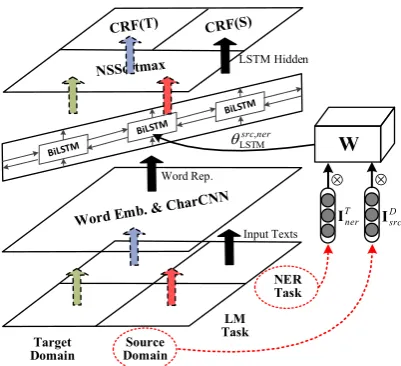
bination of two domains and two tasks. Given an input sentence, word representations are first cal-culated through a shared embedding layer (Sub-section 3.1). Then a set of task- and domain-specific BiLSTM parameters is calculated through a novel parameter generation network (Subsection 3.2), for encoding the input sequence. Finally, re-spective output layers are used for different tasks and domains (Subsection 3.3).
3.1 Input Layer
FollowingYang et al.(2018), given an inputx = [x1, x2, . . . , xn]from a source-domain NER
train-ing set Sner = {(xi, yi)}mi=1 or target-domain
NER training setTner = {(xi, yi)}ni=1, a
source-domain raw text set Slm = {(xi)}pi=1 or
target-domain raw text setTlm = {(xi)}qi=1, each word xi is represented as the concatenation of its word
embedding and the output of a character level CNN :
vi= [ew(xi)⊕CNN(ec(xi))], (1)
where ew represents a shared word embedding
lookup table and ec represents a shared charac-ter embedding lookup table. CNN(·) represents a standard CNN acting on a character embedding sequenceec(xi)of a wordxi.⊕represents vector
concatenation.
3.2 Parameter Generation Network
A bi-directional LSTM layer is applied to v = [v1,v2, . . . ,vn].
To transfer knowledge across domains and tasks, we dynamically generate the parameters
of BiLSTM using aParameter Generation Net-work(f(·,·,·)). The resulting parameters are de-noted as θd,tLSTM, where d ∈ {src, tgt} and t ∈ {ner, lm} represent domain label and task label, respectively. More specifically:
θLSTMd,t =W⊗IDd ⊗ITt, (2)
where W ∈ RP(LSTM)×V×U
represents a set of meta parameters in the form of a 3rd-order ten-sor andIDd ∈ RU , ITt ∈ RV represent domain
embedding and task embedding, respectively. U,
V represent domain and task embedding sizes, re-spectively.P(LSTM)is the number of BiLSTM pa-rameters.⊗refers to tensor contraction.
Given the inputvand the parameterθd,tLSTM, the hidden outputs of a task and domain-specific BiL-STM unit can be uniformly written as:
− →
hd,ti = LSTM(−→hd,ti−1,vi, − →
θd,tLSTM)
←−
hd,ti = LSTM(←h−d,ti+1,vi,
←−
θd,tLSTM),
(3)
for the forward and backward directions, respec-tively.
3.3 Output Layers
NER. Standard CRFs (Ma and Hovy, 2016) are used as output layers for NER. Givenh= [−→h1⊕
←−
h1, . . . , − →
hn⊕
←−
hn], the output probabilityp(y|x)
over label sequencey=l1, l2, . . . , liproduced on
input sentencexis:
p(y|x) = exp{
P
i(wCRFli ·hi+b (li−1,li) CRF )}
P
y0exp{
P
i(w l0i
CRF·hi+b (l0i−1,l0i)
CRF )} , (4)
where y0 represents an arbitary labal sequence, andwli
CRFis a model parameter specific toli, and b(li−1,li)
CRF is a bias specific toli−1andli.
Considering that the NER label sets across domains can be different, we use CRF(S) and CRF(T) to represent CRFs for the source and tar-get domains in Figure 2, respectively. We use the first-order Viterbi algorithm to find the high-est scored label sequence.
Language modeling. A forward LM (LMf)
uses the forward LSTM hidden state −→h = [−→h1, . . . ,
− →
hn] to compute the probability of
next word xi+1 given x1:i, represented as pf(xi+1|x1:i). A backward LM (LMb) computes pb(xi−1|xi:n) based on backward LSTM hidden
state←h−= [←−h1, . . . ,
←−
Considering the computational efficiency, Neg-ative Sampling Softmax (NSSoftmax) (Mikolov et al.,2013;Jean et al.,2014) is used to compute forward and backward probabilities, respectively, as follows:
pf(xi+1|x1:i) = 1
Z exp{w
>
#xi+1 − →
hi+b#xi+1}
pb(xi−1|xi:n) = 1
Z exp{w
>
#xi−1
←−
hi+b#xi−1},
(5)
where #x represents the vocabulary index of the target word x. w#x and b#x are the target word
vector and the target word bias, respectively. Zis the normalization item computed by
Z = X
k∈{#x∪Nx}
exp{w>khi+bk}, (6)
whereNxrepresents the nagative sample set of the target word x. Each element in the set is a ran-dom number from 1 to the cross-ran-domain vocab-ulary size. hi represents
− →
hi inLMf and
←−
hi in LMb, respectively.
3.4 Training Objectives
NER.Given a manually labeled dataset Dner =
{(xn,yn)}N
n=1, the sentence-level negative
log-likehood loss is used for training:
Lner =− 1
|Dner|
N X
n=1
log(p(yn|xn)) (7)
Language modeling.Given a raw data setDlm =
{(xn)}N
n=1,LMf andLMbare trained jointly
us-ing Negative Samplus-ing Softmax. Negative sam-ples are drawn based on word frequency distribu-tion inDlm. The loss function is:
Llm=− 1
2|Dlm| N X
n=1 T X
t=1
{log(pf(xnt+1|xn1:t))
+ log(pb(xnt−1|xnt:T))} (8)
Joint training.To perform joint training for NER
and language modeling on both the source and tar-get domains, we minimize the overall loss:
L= X
d∈{src,tgt}
λd(Ldner+λtLdlm) +λ 2kΘk
2, (9)
where λd is a domain weight and λt is a task
weight. λis theL2regularization parameters and Θrepresents the parameters set.
Algorithm 1Multi-task learning
Input: training data{Sner,Tner∗ }and{Slm,Tlm}
Parameters:
- Parameters Generator:W,{IDd},{ITt}
- Output layers:θcrfs,θcrft
∗ ,θnss
Output: Target model
1: whiletraining steps not enddo
2: split training data into minibatches:
Bners,Bnert∗,Blms,Blmt 3: #source-domain NER
4: θLSTMsrc,ner←f(W,IDsrc,ITner)
5: ∆W,∆ID
src,∆ITner,∆θcrfs← train(B ners) 6: #source-domain LM
7: θLSTMsrc,lm←f(W,ID src,ITlm)
8: ∆W,∆ID
src,∆ITlm,∆θnss← train(B lms)
9: ifdo supervised learningthen
10: #target-domain NER
11: θLSTMtgt,ner←f(W,ID tgt,ITner)
12: ∆W,∆IDtgt,∆InerT ,∆θcrft← train(B nert)
13: end if
14: #target-domain LM
15: θtgt,lmLSTM←f(W,IDtgt,ITlm)
16: ∆W,∆IDtgt,∆ITlm,∆θnss← train(B lmt) 17: UpdateW,{ID},{IT},θcrfs,θcrft
∗,θ
nss
18: end while
Note:* means none in unsupervised learning
3.5 Multi-Task Learning Algorithm
We propose a cross-task and cross-domain joint training method for multi-task learning. Algo-rithm 1 provides the training procedure. In each training step (line 1 to 18), minibatches of the 4 tasks in Figure 1 take turns to train (lines 4-5, 7-8, 11-12 and 15-16, respectively). Each task first generates the parametersθLSTMd,t usingWand their respective IDd, ITt , and then compute gra-dients forf(W,IDd,ITt)and domain-specific out-put layer (θcrfs,θcrft orθnss). In the scenario of
unsupervised learning, there is no training data of the target-domain NER, and lines 11-12 will not be executed. At the end of each training step, pa-rameters of f(·,·,·) and private output layers are updated together in line 17.
4 Experiments
4.1 Experimental Settings
Data. We take the CoNLL-2003 English NER
data (Sang and Meulder, 2003) as our source-domain data. In addition, 377,592 sentences from the Reuters are used for source-domain LM train-ing in unsupervised domain adaptation. Three sets of target-domain data are used, including two publicly available biomedical NER datasets, BioNLP13PC (13PC) and BioNLP13CG (13CG)
1 and a science and technology dataset we
col-lected and labeled. Statistics of the datasets are shown in Table 1.
CoNLL-2003 contains four types of enti-ties, namely PER (person), LOC (location), ORG (organization) and MISC (miscellaneous). BioNLP13CG consists of five types, namely CHEM(Chemical), CC(cellular component), G/p (gene/protein), SPE (species) and CELL (cell), BioNLP13PC consists of three types of those en-tities: CHEM, CC and G/P. We use text of their training sets for language modeling training2.
For the science and technology dataset, we col-lect 620 articles from CBS SciTech News3, man-ually labeling them as a test set for unsupervised domain adaptation. It consists of four types of en-tities following the CoNLL-2003 standard. The numbers of each entity type are comparable to the CoNLL test set, as listed in Table 2. The main difference is that a great number of entities in the CBS News dataset are closely related to the do-main of science and technology. In particular, for the MISCcategory, more technology terms such as Space X, bitcoin and IP are included, as compared with the CoNLL data set. Lack of such entities in the CoNLL training set and the difference of text genre cause the main difficulty in domain transfer. To address this difference, 398,990 unlabeled sen-tences from CBS SciTech News are used for LM training. We released this dataset as one contribu-tion of this paper.
Hyperparameters. We choose NCRF++ (Yang
and Zhang,2018) for developing the models. Our hyperparameter settings largly follow (Yang et al.,
2018), with the following exceptions: (1) The batch size is set to 30 instead of 10 for shorter training time in multi-task learning; (2) RMSprop with a learning rate of 0.001 is used for our
Sin-1
https://github.com/cambridgeltl/MTL-Bioinformatics-2016
2
We tried to use a larger number of raw data from the PubMed, but this did not improve the performances.
3https://www.cbsnews.com/
Dataset Type Train Dev Test
CoNLL Sentence 15.0K 3.5K 3.7K Entity 23.5K 5.9K 5.6K
BioNLP13PC Sentence 2.5K 0.9K 1.7K Entity 7.9K 2.7K 5.3K
BioNLP13CG Sentence 3.0K 1.0K 1.9K Entity 10.8K 3.6K 6.9K
CBS News Sentence - - 2.0K
[image:5.595.311.524.62.183.2]Entity - - 4.1K
Table 1: Statistic of datasets.
Dataset PER LOC ORG MISC
CoNLL
Train 6,600 7,140 6,321 3,438 Dev 1,842 1,837 1,341 922 Test 1,617 1,668 1,661 702
CBS News Test 1,660 629 1,352 497
Table 2: Entity numbers of the CoNLL dataset and the CBS SciTech News dataset.
MultiTask -Target
Figure 3: Development results on 13CG.
gle Task Model (STM-TARGET) for the strongest baseline according to development experiments, while the multi-task models use SGD with a learn-ing rate of 0.015 as (Yang et al., 2018). We use domain embeddings and task embeddings of size 8 to fit the model in one GPU of 8GB memory. The word embeddings for all models are initial-ized with GloVe 100-dimension vectors ( Penning-ton et al., 2014) and fine-tuned during training. Character embeddings are randomly initialized.
4.2 Development Experiments
We report a set of development experiments on the biomedical datasets 13PC and 13CG.
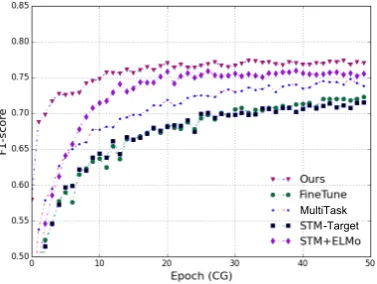
Learning curves. Figure 3 shows the F1-scores
[image:5.595.323.512.328.470.2]Figure 4: Joint training in multi-task learning.
using the source-domain training data Sner and
then fine-tuned using the target-domain dataTner; MULTITASKsimultaneously trains source-domain NER and target-domain NER followingYang et al.
(2017). For STM+ELMO, we mix the source- and
target-domain raw data for training a contextual-ized ELMo representation (Peters et al., 2018), which is then used as inputs to an STM-TARGET
model. This model shows a different way of trans-fer by using raw data, which is diftrans-ferent from FINETUNEand MULTITASK. Note that due to dif-ferences in the label sets, FINETUNEand MUL
-TITASK both share parameters between the two models except for the CRF layers.
As can be seen from Figure 3, the F1 of all mod-els increase as the number of training iteration in-creases from 1 to 50, with only small fluctuations. All of the models converge to a plateau range when the iteration number increases to 100. All transfer learning methods outperform the STM -TARGET method, showing the usefulness of
us-ing source data to enhance target labelus-ing. The strong performance of STM+ELMO over FINE -TUNE and MULTITASK shows the usefulness of
raw text. By simultaneously using source-domain raw text and target-domain raw text, our model gives the best F1 over all iterations.
Effect of language model for transfer. Figure
4 shows the results of source language modeling, target language modeling, source NER and tar-get NER for both development datasets when the number of training iterations increases. As can be seen, multi-task learning under our framework brings benefit to all tasks, without being negatively influenced by potential conflicts between tasks (Bingel and Søgaard,2017;Mou et al.,2016).
Methods Datasets
13PC 13CG
Crichton et al.(2017) 81.92 78.90 STM-TARGET 82.59 76.55 MULTITASK(NER+LM) 81.33 75.27 MULTITASK(NER) 83.09 77.73 FINETUNE 82.55 76.73 STM+ELMO 82.76 78.24
CO-LM 84.43 78.60
CO-NER 83.87 78.43 MIX-DATA 83.88 78.70
FINAL 85.54† 79.86†
Table 3: F1-scores on 13PC and 13CG.†indicates that the FINALresults are statistically significant compared to all transfer baselines and ablation baselines withp < 0.01by t-test.
4.3 Final Results on Supervised Domain
Adaptation
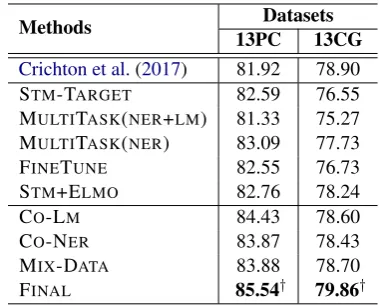
We investigate supervised transfer from CoNLL to 13PC and 13CG, comparing our model with a range of baseline transfer approaches. In partic-ular, three sets of comparisons are made, includ-ing (1) a comparison between our method with other supervised domain adaptation methods, such as MULTITASK(NER)4and ELMo, (2) a compar-ison between the use of different subsets of data for transfer under our own framework and (3) a comparison with the current state-of-the-art in the literature for these datasets.
(1) Comparison with other supervised
trans-fer methods. We compare our method with
STM-TARGET, MULTITASK(NER), FINETUNE
and STM+ELMO. The observations are simi-lar to those on the development set. Note that FINETUNE does not always improve over STM
-TARGET, which shows that the difference between the two datasets can hurt naive transfer learning, without considering domain descriptor vectors.
ELMo. The ELMo methods use raw text
via language model pre-training, which has been shown to benefit many NLP tasks ( Pe-ters et al., 2018). In our cross-domain setting, STM+ELMOgives a significant improvement over STM-TARGET on the 13CG dataset, but only a
small improvement on the 13PC dataset. The over-all improvements are comparable to that of MUL
-TITASKonly using the raw data. We also tried to
use the ELMo model (Original) released byPeters
4Here M
[image:6.595.78.285.61.187.2]Source Domain NER
Target Domain NER
Source Domain LM
Target Domain LM
Co-NER
Co-LM Mix-Data
[image:7.595.326.501.73.210.2]Final
Figure 5: Ablations of the model.
et al.(2018)5, which is trained over approximately 800M tokens. The results are 84.08% on 13PC and 79.57% on 13CG, respectively, which are lower compared to 85.54% and 79.86% by our method, respectively, despite the use of much larger ex-ternal data. This shows the effectiveness of our model.
Multi-task of NER and LM.We additionally
compare our method with the naive multi-task learning setting (Collobert and Weston, 2008), which uses shared parameters for the four tasks but use the exact same data conditions as the FINAL model. which is shown in the MULTI
-TASK(NER+LM) method in Table 3. The method gives an 81.33% F1 on 13PC and 75.27% on 13CG, which is much lower compared with all baseline models. This demonstrates the chal-lenge of the cross-domain and cross-task setting, which contains conflicting information from dif-ferent text genres and task requirements.
(2) Ablation experiments. Now that we have
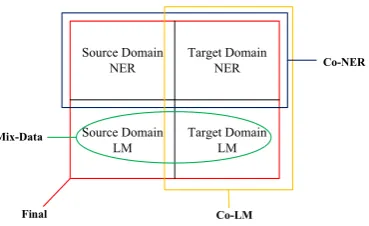
compared our method with baselines utilizing sim-ilar data sources, we turn to investigate the influ-ence of data sources on our own framework. As shown in Figure 5, we make novel use of 4 data sources for the combination of two tasks in two domains. If some sources are removed, our set-tings fall back to traditional transfer learning. For example, if the LM task is not considered, then the task setting is standard supervised domain adapta-tion.
The baselines include (1) CO-LM, which rep-resents our model without source-domain tasks, joint training the target-domain NER and language modeling, transferring parameters as: θLSTMt = W⊗ITt,(t∈ {ner, lm}). (2) CO-NER, deleting tasks, jointly training source- and target-domain
5https://allennlp.org/elmo
Figure 6: Influence of target-domain data.
NER, transferring parameters as: θdLSTM =W⊗ IDd,(d∈ {src, tgt}). (3) MIX-DATA, which uses the same NER data in source- and target-domain as FINAL, but also uses combined raw text to train source- and target-domain language models.
Our method outperforms all baselines signifi-cantly, which shows the importance of using rich data. A contrast between our method and MIX
-DATA shows the effectiveness of using two dif-ferent language models across domains. Even through MIX-DATA uses more data for training
language models on both the source and target do-mains, it cannot learn a domain contrast since both sides use the same mixed data. In contrast, our model gives significantly better results by glean-ing such contrast.
(3) Comparison with current state-of-the-art.
Finally, Table 3 also shows a comparison with a state-of-the-art method on the 13PC and 13CG datasets (Crichton et al., 2017), which leverages POS tagging for multi-task learning by using co-training method. Our model outperforms their re-sults, giving the best results in the literature.
Discussion. When the number of target-domain
[image:7.595.92.277.79.192.2]show-MultiTask MultiTask -Target -Target
Figure 7: Fine-grained comparisons on 13PC and 13CG.
ing the effectiveness of LM in knowledge transfer. Figure 7 shows fine-grained NER results of all available entity types. In comparison to STM-TARGET, FINETUNEand MULTITASK, our
method outperforms all the baselines on each en-tity type, which is in accordance with the conclu-sion of development experiments.
4.4 Unsupervised Domain Adaptation
For unsupervised domain adaptation, many set-tings in Subsection 4.2 do not hold, including STM-TARGET, FINETUNE, MULTITASK, CO
-LM and CO-NER. Instead, we add a naive baseline, STM-SOURCE, which directly applies a model trained on the source-domain CoNLL-2003 data to the target domain. In addition, we com-pare with models that make use of source NER, source LM and target LM data, including SELF
-TRAIN, which improves a source NER model on target raw text (Daum´e III, 2008). STM-ELMO, which uses ELMo embeddings trained over com-bined source- and target-domain raw text for STM -SOURCE, STM-ELMO(SRC), which uses only the source-domain raw data for training ELMo, STM
-ELMO(TGT), which uses only the target-domain raw text for training ELMo, and DANN (Ganin et al., 2016), which performs generative adver-sarial training over source- and target-domain raw data.
Final results. The final results are shown in
Ta-ble 4. SELF-TRAIN gives better results compared with the STM-SOURCE baseline, which shows the effectiveness of target-domain raw data. Ad-versarial training brings significantly better im-provements compared with naive self-training. Among ELMo methods, the model using both the source-domain raw data and target-domain raw data outperforms the model using only the source-or target-domain raw data. ELMo also
outper-Methods P R F1
STM-SOURCE 63.87 71.28 67.37 SELF-TRAIN 62.56 75.04 68.24 DANN(Ganin et al.,2016) 65.14 73.84 69.22 STM+ELMO(SRC) 65.43 70.14 67.70 STM+ELMO(TGT) 67.78 72.73 70.17 STM+ELMO 67.19 74.93 70.85
Ours 68.48 79.52 73.59†
[image:8.595.76.287.64.196.2]Table 4: Three metrics on CBS SciTech News. We use the CoNLL dev set to select the hyperparameters of our models. ELMo and Ours are given the same over-all raw data, SELF-TRAINand DANNuse the selected raw data from overall raw data for better performances. †indicates that our results are statistically significant compared to all baselines withp <0.01by t-test.
Figure 8: Amount of raw data.
forms DANN, which shows the strength of LM pre-training. Interestingly, ELMo with target-domain raw data gives similar accuracies to ELMo with mixed source- and target-domain data, which shows that target-domain LM is more useful for the pretraining method. It also indicates that our method makes better use of LMs over two differ-ent domains. Compared with all baseline mod-els, our model gives a final F1 of 73.59, signifi-cantly better than the best result of 70.85 obtained by STM+ELMO, demonstrating the effectiveness
of parameter generation network for cross-task, cross-domain knowledge transfer.
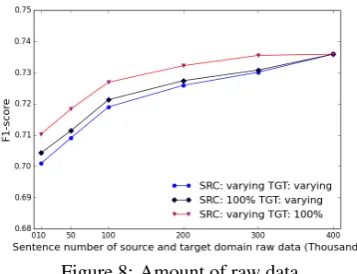
Influence of raw text.For zero-shot learning,
[image:8.595.325.504.277.414.2]Entity Type Correct Num ∆ STM Ours
PER 1,501 1,569 +4.10%
LOC 469 512 +6.84%
ORG 941 1,050 +8.06% MISC 134 193 +11.87%
Total 3,045 3,324 +6.74%
Table 5: Growth rate of correctly recognized enetity number in comparison with the STM-SOURCE.∆ rep-resents the growth with respect to the total number of entities in the CBS SciTech News test set.
Sentence Brittany Kaiser spoke to “CBS This Morning”
[image:9.595.92.274.61.150.2]co-host John Dicherson for her first U.S. broadcast network interview. STM-SRC Brittany Kaiser ORGspoke to “ CBS ORGThis Morning” ... DANN Brittany Kaiser PERspoke to “ CBS This Morning ORG” ... Ours Brittany Kaiser PERspoke to “ CBS This Morning MISC” ...
Table 6: Example. Red and green represent incorrect and correct entities, respectively.
NER, which demonstrates effective use of raw data by our method. The lines “SRC: 100%; TGT: varying” and “SRC: varying; TGT: 100%” show to alternative measures by fixing the source-and target-domain raw text to 100% of our data, and then varying only the other domain text. A comparison between the two lines shows that the target-domain raw data gives more influence to the domain adaptation power, which conforms to intu-ition.
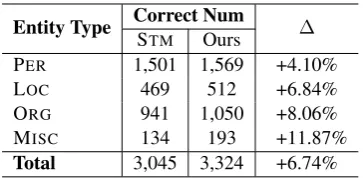
Discussion. Table 5 shows a breakdown for the
improvement of our model over STM-SOURCEby different entity types. Compared with PER, LOC
and ORGnames, our method brings the most im-provements over MISCentities, which are mostly types that are specific to the technology domain (see Subsection 4.1). Intuitively, the amount of overlap is the weakest for this type of entities be-tween raw text from source and target domains. Therefore, the results show the effectiveness of our method in deriving domain contrast with respect to NER from cross-domain language modeling.
Table 6 shows a case study, where “Brittany Kaiser” is a personal name and “CBS This Morn-ing” is a programme. Without using raw text, STM-SOURCE misclassifies “Brittany Kaiser” as
ORG. Both DANNand our method give the correct results because the name is mentioned in raw text, from which connections between the pattern “PER
spoke” can be drawn. With the help of raw text, DANN and our method can also recognize “CBS This Morning” as a entity, which has a common
pattern of consecutive capital letters in both source and target domains.
DANN misclassifies “CBS This Morning” as ORG. In contrast, our model can classify it cor-rectly as the category of MISC, in which most en-tities are specific to the target domain (see Subsec-tion 4.1). This is likely because adversarial train-ing in DANN aims to match feature distributions between source and target domains by mimicing the domain discriminator, which can lead to centration on domain common features but con-fusion about such domain-specific features. This demonstrates the advantage of our method in de-riving both domain common and domain-specific features.
5 Conclusion
We considered NER domain adaptation by extract-ing knowledge of domain differences from raw text. For this goal, cross-domain language mod-eling is conducted through a novel parameter gen-eration network, which decomposes domain and task knowledge into two sets of embedding vec-tors. Experiments on three datasets show that our method is highly effective among supervised do-main adaptation methods, while allowing zero-shot learning in unsupervised domain adaptation.
Acknowledgments
The three authors contributed equally to this work. Yue Zhang is the corresponding author. We grate-fully acknowledge funding from NSFC (grant #61572245). We also thank the anonymous re-viewers for their helpful comments and sugges-tions.
References
Waleed Ammar, George Mulcaire, Miguel Ballesteros, Chris Dyer, and Noah A. Smith. 2016. Many lan-guages, one parser. Transactions of the Association for Computational Linguistics, 4:431–444.
Joachim Bingel and Anders Søgaard. 2017. Identify-ing beneficial task relations for multi-task learnIdentify-ing in deep neural networks. InProceedings of the 15th Conference of the European Chapter of the Associ-ation for ComputAssoci-ational Linguistics (Short Papers), volume 2, pages 164–169. Association for Compu-tational Linguistics.
[image:9.595.73.293.221.275.2]Ronan Collobert and Jason Weston. 2008. A unified architecture for natural language processing: Deep neural networks with multitask learning. In Pro-ceedings of the 25th International Conference on Machine Learning, pages 160–167.
Ronan Collobert, Jason Weston, L´eon Bottou, Michael Karlen, Koray Kavukcuoglu, and Pavel Kuksa. 2011. Natural language processing (almost) from scratch. Journal of Machine Learning Research, 12(1):2493–2537.
Gamal Crichton, Sampo Pyysalo, Billy Chiu, and Anna Korhonen. 2017. A neural network multi-task learn-ing approach to biomedical named entity recogni-tion.BMC Bioinformatics, 18(1):368.
Hal Daum´e III. 2009. Frustratingly easy domain adap-tation. In Proceedings of the 45th Annual Meet-ing of the Association of Computational LMeet-inguistics, pages 256–263. Association for Computational Lin-guistics.
Hal Daum´e III. 2008. Cross-task knowledge-constrained self training. InProceedings of the Con-ference on Empirical Methods in Natural Language Processing, volume 1, pages 680–688. Association for Computational Linguistics.
Yaroslav Ganin, Evgeniya Ustinova, Hana Ajakan, Pascal Germain, Hugo Larochelle, Franc¸ois Lavi-olette, Mario Marchand, and Victor Lempitsky. 2016. Domain-adversarial training of neural net-works. Journal of Machine Learning Research, 17(1):2096–2030.
James Hammerton. 2003. Named entity recognition with long short-term memory. In Proceedings of the 7th Conference on Natural Language Learning at HLT-NAACL, volume 4, pages 172–175. Associa-tion for ComputaAssocia-tional Linguistics.
S´ebastien Jean, Kyunghyun Cho, Roland Memise-vic, and Yoshua Bengio. 2014. On using very large target vocabulary for neural machine transla-tion. InProceedings of the 53rd Annual Meeting of the Association for Computational Linguistics and the 7th International Joint Conference on Natural Language Processing, pages 1–10. Association for Computational Linguistics.
Young-Bum Kim, Karl Stratos, Ruhi Sarikaya, and Minwoo Jeong. 2015. New transfer learning tech-niques for disparate label sets. InProceedings of the 53rd Annual Meeting of the Association for Compu-tational Linguistics and the 7th International Joint Conference on Natural Language Processing (Long Papers), volume 1, pages 473–482. Association for Computational Linguistics.
Guillaume Lample, Miguel Ballesteros, Sandeep Sub-ramanian, Kazuya Kawakami, and Chris Dyer. 2016.
Neural architectures for named entity recognition. InProceedings of the 2016 Conference of the North American Chapter of the Association for Computa-tional Linguistics: Human Language Technologies,
pages 260–270. Association for Computational Lin-guistics.
Ji Young Lee, Franck Dernoncourt, and Peter Szolovits. 2017. Transfer learning for named-entity recognition with neural networks. Computing Re-search Repository, arXiv:1705.06273. Version 1.
Bill Yuchen Lin and Wei Lu. 2018. Neural adaptation layers for cross-domain named entity recognition. In Proceedings of the 2018 Conference on Empiri-cal Methods in Natural Language Processing, pages 2012–2022. Association for Computational Linguis-tics.
Qi Liu, Yue Zhang, and Jiangming Liu. 2018.Learning domain representation for multi-domain sentiment classification. InProceedings of the 2018 Confer-ence of the North American Chapter of the Associ-ation for ComputAssoci-ational Linguistics: Human Lan-guage Technologies (Long Papers), volume 1, pages 541–550. Association for Computational Linguis-tics.
Xuezhe Ma and Eduard Hovy. 2016. End-to-end se-quence labeling via bi-directional lstm-cnns-crf. In Proceedings of the 54th Annual Meeting of the As-sociation for Computational Linguistics (Long Pa-pers), volume 1, pages 1064–1074. Association for Computational Linguistics.
Tomas Mikolov, Ilya Sutskever, Kai Chen, Greg S Cor-rado, and Jeff Dean. 2013. Distributed representa-tions of words and phrases and their compositional-ity. InAdvances in Neural Information Processing Systems, pages 3111–3119.
Lili Mou, Zhao Meng, Rui Yan, Ge Li, Yan Xu, Lu Zhang, and Zhi Jin. 2016. How transferable are neural networks in nlp applications? InProceedings of the 2016 Conference on Empirical Methods in Natural Language Processing, pages 479–489. As-sociation for Computational Linguistics.
Rasha Obeidat, Xiaoli Fern, and Prasad Tadepalli. 2016.Label embedding approach for transfer learn-ing. InInternational Conference on Biomedical On-tology and BioCreative.
Jeffrey Pennington, Richard Socher, and Christo-pher D. Manning. 2014. Glove: Global vectors for word representation. In Proceedings of the 2014 Conference on Empirical Methods in Natural Lan-guage Processing, volume 4, pages 1532–1543. As-sociation for Computational Linguistics.
Emmanouil Antonios Platanios, Mrinmaya Sachan, Graham Neubig, and Tom M. Mitchell. 2018. Con-textual parameter generation for universal neural machine translation. In Proceedings of the 2018 Conference on Empirical Methods in Natural Lan-guage Processing, pages 425–435. Association for Computational Linguistics.
Marek Rei. 2017. Semi-supervised multitask learn-ing for sequence labellearn-ing. In Proceedings of the 55th Annual Meeting of the Association for Compu-tational Linguistics (Long Papers), volume 1, pages 2121–2130. Association for Computational Linguis-tics.
Devendra Singh Sachan, Pengtao Xie, and Eric P. Xing. 2018. Effective use of bidirectional language mod-eling for medical named entity recognition. Pro-ceedings of Machine Learning Research, 85:1–19.
Erik F. Tjong Kim Sang and Fien De Meulder. 2003. Introduction to the conll-2003 shared task: Language-independent named entity recognition. In Proceedings of the Seventh Conference on Natu-ral Language Learning at HLT-NAACL 2003, pages 142–147. Association for Computational Linguis-tics.
Cicero Nogueira dos Santos and Victor Guimar˜aes. 2015. Boosting named entity recognition with neu-ral character embeddings. In Proceedings of the Fifth Named Entity Workshop, joint with 53rd ACL and the 7th IJCNLP, pages 25–33. Association for Computational Linguistics.
Sara Stymne, Miryam de Lhoneux, Aaron Smith, and Joakim Nivre. 2018. Parser training with heteroge-neous treebanks. InProceedings of the 56th Annual Meeting of the Association for Computational Lin-guistics (Short Papers), pages 619–625. Association for Computational Linguistics.
Zhenghui Wang, Yanru Qu, Liheng Chen, Shen Jian, Weinan Zhang, Shaodian Zhang, Yimei Gao, Gen Gu, Ken Chen, and Yu Yong. 2018. Label-aware double transfer learning for cross-specialty medi-cal named entity recognition. In Proceedings of NAACL-HLT 2018, pages 1–15. Association for Computational Linguistics.
Jie Yang, Shuailong Liang, and Yue Zhang. 2018. De-sign challenges and misconceptions in neural se-quence labeling. InProceedings of the 27th Inter-national Conference on Computational Linguistics, pages 3879–3889.
Jie Yang and Yue Zhang. 2018. Ncrf++: An open-source neural sequence labeling toolkit. In Proceed-ings of the 56th Annual Meeting of the Association for Computational Linguistics-System Demonstra-tions, pages 74–79. Association for Computational Linguistics.