Clustering-based Stratified Seed Sampling for Semi-Supervised Relation
Classification
Longhua Qian
Guodong Zhou
Natural Language Processing Lab Natural Language Processing Lab School of Computer Science and Technology School of Computer Science and Technology
Soochow University Soochow University
1 Shizi Street, Suzhou, China 215006 1 Shizi Street, Suzhou, China 215006
[email protected] [email protected]
Abstract
Seed sampling is critical in semi-supervised learning. This paper proposes a clustering-based stratified seed sampling approach to semi-supervised learning. First, various clus-tering algorithms are explored to partition the unlabeled instances into different strata with each stratum represented by a center. Then, diversity-motivated intra-stratum sampling is adopted to choose the center and additional instances from each stratum to form the unla-beled seed set for an oracle to annotate. Fi-nally, the labeled seed set is fed into a bootstrapping procedure as the initial labeled data. We systematically evaluate our stratified bootstrapping approach in the semantic rela-tion classificarela-tion subtask of the ACE RDC (Relation Detection and Classification) task. In particular, we compare various clustering algorithms on the stratified bootstrapping per-formance. Experimental results on the ACE RDC 2004 corpus show that our clustering-based stratified bootstrapping approach achieves the best F1-score of 75.9 on the sub-task of semantic relation classification, ap-proaching the one with golden clustering.
1
Introduction
Semantic relation extraction aims to detect and classify semantic relationships between a pair of named entities occurring in a natural language text. Many machine learning approaches have been pro-posed to attack this problem, including supervised (Miller et al., 2000; Zelenko et al., 2003; Culotta and Soresen, 2004; Kambhatla, 2004; Zhao and
Grishman, 2005; Zhou et al., 2005; Zhang et al., 2006; Zhou and Zhang, 2007; Zhou et al., 2007; Qian et al., 2008; Zhou et al., 2010), semi-supervised (Brin, 1998; Agichtein and Gravano, 2000; Zhang, 2004; Chen et al., 2006; Qian et al., 2009; Zhou et al., 2009), and unsupervised meth-ods (Hasegawa et al., 2004; Zhang et al., 2005; Chen et al., 2005).
Current work on relation extraction mainly adopts supervised learning methods, since they achieve much better performance. However, they normally require a large number of manually la-beled relation instances, whose acquisition is both time consuming and labor intensive. In contrast, unsupervised methods do not need any manually labeled instances. Nevertheless, it is difficult to assess their performance due to the lack of evalua-tion criteria. As something between them, semi-supervised learning has received more and more attention recently. With the plenitude of unlabeled natural language text at hand, semi-supervised learning can significantly reduce the need for la-beled data with only limited sacrifice in perform-ance. For example, Abney (2002) proposes a bootstrapping algorithm which chooses the unla-beled instances with the highest probability of be-ing correctly labeled and add them in turn into the labeled training data iteratively.
This paper focuses on bootstrapping-based semi-supervised learning in relation extraction. Since the performance of bootstrapping depends much on the quality and quantity of the seed set and researchers tend to employ as few seeds as possible (e.g. 100 instances) to save time and labor, the quality of the seed set plays a critical role in bootstrapping. Fur-thermore, the imbalance of different classes and
the inherent structural complexity of instances will severely weaken the strength of bootstrapping and semi-supervised learning as well. Therefore, it is critical for a bootstrapping procedure to select an appropriate seed set, which should be representa-tive and diverse. However, most of current semi-supervised relation extraction systems (Zhang, 2004; Chen et al., 2006) use a random seed sam-pling strategy, which fails to fully exploit the affin-ity nature in the training data to derive the seed set. Alternatively, Zhou et al. (2009) bootstrap a set of weighted support vectors from both labeled and unlabeled data using SVM and feed these instances into semi-supervised relation extraction. However, their seed set is sequentially generated only to en-sure that there are at least 5 instances for each rela-tion class. Our previous work (Qian et al., 2009) attempts to solve this problem via a simple strati-fied sampling strategy for selecting the seed set. Experimentation on the ACE RDC 2004 corpus shows that the stratified sampling strategy achieves promising results for semi-supervised learning. Nevertheless, the success of the strategy relies on the assumption that the true distribution of all rela-tion types is already known, which is impractical for real NLP applications.
This paper presents a clustering-based stratified seed sampling approach for semi-supervised rela-tion extracrela-tion, without the assumprela-tion on the true distribution of different relation types. The motiva-tions behind our approach are that the unlabeled data can be partitioned into a number of strata us-ing a clusterus-ing algorithm and that representative and diverse seeds can be derived from such strata in the framework of stratified sampling (Neyman, 1934) for an oracle to annotate. Particularly, we employ a diversity-motivated intra-stratum sam-pling scheme to pick a center and additional in-stances as seeds from each stratum. Experimental results show the effectiveness of the clustering-based stratified seed sampling for semi-supervised relation classification.
The rest of this paper is organized as follows. First an overview of the related work is given in Section 2. Then, Section 3 introduces the stratified bootstrapping framework including an intra-stratum sampling scheme while Section 4 describes various clustering algorithms. The experimental results on the ACE RDC 2004 corpus are reported in Section 5. Finally we conclude our work and indicate some future directions in Section 6.
2
Related Work
In semi-supervised learning for relation extraction, most of previous work construct the seed set either randomly (Zhang, 2004; Chen et al., 2006) or se-quentially (Zhou et al., 2009). Qian et al. (2009) adopt a stratified sampling strategy to select the seed set. However, their method needs a stratifica-tion variable such as the known distribustratifica-tion of the relation types, while our method uses clustering to divide relation instances into different strata.
In the literature, clustering techniques have been employed in active learning to sample representa-tive seeds in a certain extent (Nguyen and Smeulders, 2004; Tang et al., 2002; Shen et al., 2004). Our work is similar to the formal frame-work, as proposed in Nguyen and Smeulders (2004), in which K-medoids clustering is incorpo-rated into active learning. The cluster centers are used to construct a classifier and which in turn propagates classification decision to other exam-ples via a local noise model. Unlike their probabil-istic models, we apply various clustering algorithms together with intra-stratum sampling to select a seed set in discriminative models like SVMs. In active learning for syntactic parsing, Tang et al. (2002) employ a sampling strategy of “most uncertain per cluster” to select representa-tive examples and weight them using their cluster density, while we pick a few seeds (the number of the sampled seeds is proportional to the cluster density) from a cluster in addition to its center. Shen et al. (2004) combine multiple criteria to measure the informativeness, representativeness, and diversity of examples in active learning for named entity recognition. Unlike our sampling strategy of clustering for representativeness and stratified sampling for diversity, they either select cluster centroids or diverse examples from a pre-chosen set in terms of some combined metrics. To the best of our knowledge, this is the first work to address the issue of seed selection using clustering techniques for semi-supervised learning with dis-criminative models.
3
Stratified Bootstrapping Framework
as usual, plus a clustering-based stratified seed sampler.
3.1 Underlying Supervised Learner
Due to recent success in tree kernel-based relation extraction, this paper adopts a tree kernel-based method in the underlying supervised learner. Fol-lowing the previous work in relation extraction (Zhang et al., 2006; Zhou et al., 2007; Qian et al., 2008), we use the standard convolution tree kernel (Collins and Duffy, 2001) to count the number of common sub-trees as the structural similarity be-tween two parse trees. Besides, to properly repre-sent a relation instance, this paper adopts the Unified Parse and Semantic Tree (UPST), as pro-posed in Qian et al. (2008). To our knowledge, the USPT has achieved the best performance in rela-tion extracrela-tion so far on the ACE RDC 2004 cor-pus.
In particular, we use the SVMlight-TK1 package
as our classifier. Since the package is a binary clas-sifier, we adapt it to the multi-class tasks of rela-tion extracrela-tion by applying the one vs. others
strategy, which builds K binary classifiers so as to separate one class from all others. The final classi-fication decision of an instance is determined by the class that has the maximal SVM output margin.
3.2 Bootstrapping Algorithm
Following Zhang (2004), we have developed a baseline self-bootstrapping procedure, which keeps augmenting the labeled data by employing the models trained from previously available labeled data, as shown in Figure 1.
Since the SVMlight-TK package doesn’t output any probability that it assigns to the class label on an instance, we devise a metric to measure the con-fidence with regard to the classifier’s prediction. Given a sequence of output margins of all K binary classifiers at some iteration, denoted as {m1,m2,…mK} with mi the margin for the i-th clas-sifier, we compute the margin gap between the largest and the mean of the others, i.e.
) 1 /( ) max (
max
1 1
1 − − −
=
= =
= m
∑
m m KH K
i i K
i i i
K
i (1)
Where K denotes the total number of relation classes, and mi denotes the output margin of the i
1 http://ai-nlp.info.uniroma2.it/moschitti/
Require: labeled seed set L Require: unlabeled data set U Require: batch size S Repeat
Train a single classifier on L Run the classifier on U
Find at most S instances in U that the classifier has the highest prediction confidence
Add them into L
Until: no data points available or the stoppage
condition is reached
Algorithm self-bootstrapping
Figure 1: Self-bootstrapping algorithm
th classifier. Intuitively, the bigger the H, the greater the difference between the maximal margin and all others, and thus the more reliably the classi-fier makes the prediction on the instance.
3.3 Clustering-based Stratified Seed Sampler Stratified sampling is a method of sampling in statistics, in which the members of a population are grouped into relatively homogeneous subgroups (i.e. strata) according to one certain property, and then a sample is selected from each stratum. This process of grouping is called stratification, and the property on which the stratification is performed is called the stratification variable. Previous work justifies theoretically and practically that stratified sampling is more appropriate than random sam-pling for general use (Neyman, 1934) as well as for relation extraction (Qian et al., 2009). However, the difficulty lies in how to find the appropriate stratification variable for complicated tasks, such as relation extraction.
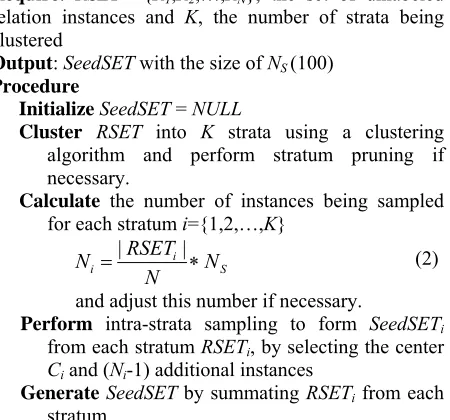
The idea of clustering-based stratification cir-cumvents this problem by clustering the unlabeled data into a number of strata without the need to explicitly specify a stratification variable. Figure 2 illustrates the clustering-based stratified seed sam-pling strategy employed in the bootstrapping pro-cedure, where RSET denotes the whole unlabeled data, SeedSET the seed set to be labeled and |RSETi| the number of instances in the i-th cluster2
RSETi. Here, a relation instance is represented us-ing USPT and the similarity between two instances is computed using the standard convolution tree
2 Hereafter, when we refer to clusters from the viewpoint of
kernel, as described in Section 3.1 (i.e., both the clustering and the classification adopt the same structural representation, since we want the repre-sentative seeds in the clustering space to be also representative in the classification space). After clustering, a certain number of instances from every stratum are sampled using an intra-stratum scheme (c.f. Subsection 3.4). Normally, this num-ber is proportional to the size of that stratum in the whole data set. However, in case this number is 0 due to the rounding of real numbers, it is set to 1 to ensure the existence of at least one seed from that stratum. Furthermore, to ensure that the total num-ber of instances being sampled equals the pre-scribed NS, the number of seeds from dominant strata may be slightly adjusted accordingly. Finally, these instances form the unlabeled seed set for an oracle to annotate as the input to the underlying supervised learner in the bootstrapping procedure.
3.4 Intra-stratum sampling
Given the distribution of clusters, a simple way to select the most representative instances is to choose the center of each cluster with the cluster prior as the weight of the center (Tang et al., 2002; Nguyen and Smeulders, 2004). Nevertheless, for the complicated task of relation extraction on the ACE RDC corpora, which is highly skewed across different relation classes, only considering the cen-ter of each cluscen-ter would severely under-represent the high-density data. To overcome this problem, we adopt a sampling approach, in particular strati-fied sampling, which takes the size of each stratum into consideration.
Given the size of the seed set NS and the number of strata K, a natural question will arise as how to select the remaining (NS-K) seeds after we have extracted the K centers from the K strata. We view this problem as intra-stratum sampling, which is required to choose the remaining number of seeds from inside individual stratum (excluding the cen-ters themselves).
At the first glance, sampling a certain number of seeds from one particular stratum (e.g., RSETi), seems to be the same sampling problem as we have encountered before, which aims to select the most representative and diverse seeds. This will natu-rally lead to another application of a clustering al-gorithm to the stratification of the stratum RSETi.
Require: RSET ={R1,R2,…,RN}, the set of unlabeled relation instances and K, the number of strata being clustered
Output: SeedSET with the size of NS (100)
Procedure
Initialize SeedSET = NULL
Cluster RSET into K strata using a clustering
algorithm and perform stratum pruning if necessary.
Calculate the number of instances being sampled
for each stratum i={1,2,…,K}
S i
i N N
RSET
N =| |∗ (2)
and adjust this number if necessary.
Perform intra-strata sampling to form SeedSETi from each stratum RSETi, by selecting the center
Ci and (Ni-1) additional instances
[image:4.612.318.543.64.274.2]GenerateSeedSET by summating RSETi from each stratum
Figure 2: Clustering-based stratified seed sampling Nevertheless, remember the fact that, this time for the stratum RSETi, the center Ci has been chosen, so it may not be reasonable to extract additional centers in this way. Therefore, in order to avoid recursion and over-complexity, we employ a diver-sity-motivated intra-stratum sampling scheme (Shen et al., 2004), called KDN (K-diverse neighbors), which aims to maximize the training utility of all seeds from a stratum. The motivation is that we prefer the seeds with high variance to each other, thus avoiding repetitious seeds from a single stratum. The basic idea is to add a candidate instance to the seed set only if it is sufficiently dif-ferent from any previously selected seeds, i.e., the similarity between the candidate instance and any of the current seeds is less than a threshold β. In this paper, the threshold β is set to the average pair-wise similarity between any two instances in a stratum.
4
Clustering Algorithms
This section describes several typical clustering algorithms in the literature, such as K-means, HAC, spectral clustering and affinity propagation, as well as their application in this paper.
4.1 K-medoids (KM)
particular, the center is the average of all the in-stances in the cluster, i.e., with its coordinates the arithmetic means for each dimension separately over all the instances in the cluster.
One problem with K-means is that it does not yield the same result with each run while the other problem is the requirement for the concept of a mean to be definable, which is unfortunately not available in our setting (we employ a parse tree representation for a relation instance). Hence, we adopt a variant of K-means, namely, K-medoids, where a medoid, rather than a centroid, is defined as a representative of a cluster. Besides, K-medoids has proved to be more robust to noise and outliers in comparison with K-means.
4.2 Hierarchical Agglomerative Clustering (HAC)
Different from K-medoids, hierarchical clustering creates a hierarchy of clusters which can be represented in a tree structure called a dendrogram. The root of the tree consists of a single cluster containing all objects, and the leaves correspond to individual object.
Typically, hierarchical agglomerativeclustering (HAC) starts at the leaves and successively merges two clusters together as long as they have the shortest distance among all the pair-wise distances between any two clusters.
Given a specified number of clusters, the key problem is to determine where to cut the hierarchi-cal tree into clusters. In this paper, we generate the final flat cluster structures greedily by maximizing the equal distribution of instances among different clusters.
4.3 Spectral Clustering (SC)
Spectral clustering has become more and more popular recently. Taking as input a similarity matrix between any two instances, spectral clustering makes use of the spectrum of the similarity matrix of the data to perform dimensionality reduction for clustering in fewer dimensions.
Compared to the “traditional algorithms” such as K-means or HAC, spectral clustering has many fundamental advantages. Results obtained by spectral clustering often outperform the traditional approaches. Furthermore, spectral clustering is very simple to implement and can be solved
efficiently using standard linear algebra methods (von Luxburg, 2006).
4.4 Affinity Propagation (AP)
As a new emerging clustering algorithm, affinity propagation (AP) (Frey and Dueck, 2007) is basi-cally an iterative message-passing procedure in which the instances being clustered compete to serve as cluster exemplars by exchanging two types of messages, namely, “responsibility” and “availability”. After the procedure converges or has repeated a finite number of iterations, each cluster is represented by an exemplar. AP was re-ported to find clusters with much lower error than those found by other methods.
For our application, affinity propagation takes as input a similarity matrix, whose elements represent either the similarity between two different in-stances or the preference (a real number p) for an instance when two instances are the same. One problem with AP is that the number of clusters cannot be pre-defined, which is indirectly deter-mined by the preference as well as the convergence procedure itself.
5
Experimentation
This section systematically evaluates the boot-strapping approach using clustering-based strati-fied seed sampling, in the relation classification (i.e., given the relationship already detected) sub-task of relation extraction on the ACE RDC 2004 corpus.
5.1 Experimental Setting
The ACE RDC 2004 corpus3 is gathered from
various newspapers, newswire and broadcasts. It contains 451 documents and 5702 positive relation instances of 7 relation types and 23 subtypes be-tween 7 entity types. For easy reference with re-lated work in the literature, evaluation is done on 347 documents (from nwire and bnews domains), which include 4305 relation instances. Table 1 lists the major relation types and subtypes, including their corresponding instance numbers and ratios in our evaluation set. One obvious observation from the table is that the numbers of different relation types is highly imbalanced. These 347 documents are then divided into 3 disjoint sets randomly, with
Types Subtypes # %
Located 738 17.1
Near 87 2.0
PHYS
Part-Whole 378 8.8
Business 173 4.0
Family 121 2.8
PER-SOC
Other 55 1.3
Employ-Executive 489 11.4
Employ-Staff 539 12.5
Employ-Undeter. 78 1.8
Member-of-Group 191 4.4
Subsidiary 206 4.8
Partner 12 0.3
EMP-ORG
Other 80 1.9
User-or-Owner 200 4.6
Inventor-or-Man. 9 0.2
ART
Other 2 0.0
Ethnic 39 0.9
Ideology 48 1.1
OTHER-AFF
Other 54 1.3
Citizen-or-Resid. 273 6.3
Based-In 215 5.0
GPE-AFF
Other 39 0.9
DISC 279 6.5
[image:6.612.71.294.52.426.2]Total 4305 100.0
Table 1: Relation types and their corresponding instance numbers and ratios in the ACE RDC 2004 corpus
10% of them (35 files, around 400 instances) held out as the test data set, 10% of them (35 files, around 400 instances) used as the development data set to fine-tune various settings and parame-ters, while the remaining 277 files (over 3400 in-stances) used as the training data set, from which the seed set will be sampled.
The corpus is parsed using Charniak’s parser (Charniak, 2001) and relation instances are gener-ated by extracting all pairs of entity mentions oc-curring in the same sentence with positive relationships. For easy comparison with related work, we only evaluate the relation classification task on the 7 major relation types of the ACE RDC 2004 corpus. For the SVMlight-TK classifier, the training parameters C (SVM) and λ (tree kernel) are fine-tuned to 2.4 and 0.4 respectively.
The performance is measured using the standard P/R/F1 (Precision/Recall/F1-measure). For each
relation type, P is the ratio of the true relation in-stances in all the relation inin-stances being identified, R is the ratio of the true relation instances being identified in all the true relation instances in the corpus, and F1 is the harmonic mean of P and R. The overall performance P/R/F1 is then calculated using the micro-average measure over all major class types.
5.2 Experimental Results
Comparison of various seed sampling strategies without intra-stratum sampling on the devel-opment data
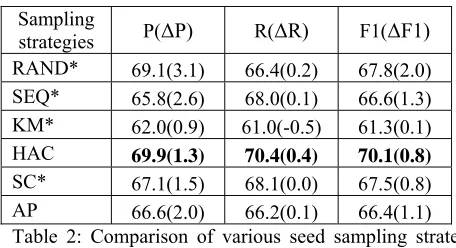
Table 2 compares the performance of bootstrap-ping-based relation classification using various seed sampling strategies without intra-stratum sampling on the development data. Here, the size of the seed set L is set to 100, and the top 100 in-stances with the highest confidence (c.f. Formula 1) are augmented at each iteration. For sampling strategies marked with an asterisk, we performed 10 trials and calculated their averages. Since for these strategies the seed sets sampled from differ-ent trials may be quite differdiffer-ent, their performance scores vary in a great degree accordingly. This ex-perimental setting and notation are also used in all the subsequent experiments unless specified. Be-sides, two additional baseline sampling strategies are included for comparison: sequential sampling (SEQ), which selects a sequentially-occurring L
instances as the seed set, and random sampling (RAND), which randomly selects L instances as the seed set.
Table 2 shows that
1) RAND outperforms SEQ by 1.2 units in F1-score. This is due to the fact that the seed set via RAND may better reflect the distribution of the whole training data than that via SEQ, nev-ertheless at the expense of collecting the whole training data in advance.
Sampling
strategies P(ΔP) R(ΔR) F1(ΔF1) RAND* 69.1(3.1) 66.4(0.2) 67.8(2.0)
SEQ* 65.8(2.6) 68.0(0.1) 66.6(1.3)
KM* 62.0(0.9) 61.0(-0.5) 61.3(0.1)
HAC 69.9(1.3) 70.4(0.4) 70.1(0.8)
SC* 67.1(1.5) 68.1(0.0) 67.5(0.8)
[image:7.612.66.294.52.176.2]AP 66.6(2.0) 66.2(0.1) 66.4(1.1)
Table 2: Comparison of various seed sampling strate-gies without intra-stratum sampling on the development data
3) All the performance improvements from boot-strapping largely come from the improvements in precision. While the bootstrapping procedure makes the SVM classifier more accurate, it lacks enough generalization ability.
To explain above special phenomena, we have a look at the clustering results. Our inspection re-veals that most of them are severely imbalanced, i.e., some clusters are highly dense while others are extremely sparse. This indicates that merely select-ing the centers from each cluster cannot properly represent the overall distribution. Moreover, the centers with high density lack the generalization ability due to its solitude in the cluster, leading to less performance enhancement than expected.
The only exception is HAC, which much outper-forms RAND by 2.3 in F1-score, although HAC is usually not considered as an effective clustering algorithm. The reason may be that HAC creates a hierarchy of clusters in the top-down manner by cutting a cluster into two.Therefore, the centers in the two sibling clusters will be closer to each other than they are to the centers in other clusters. Be-sides, the final flat cluster structures given a spe-cial number of clusters are generated greedily from the cluster hierarchy by maximizing the equal dis-tribution of instances among different clusters. In other words, when the cluster number reaches a certain threshold, the dense area will get more seeds represented in the seed set. As a consequence, the distribution of all the seeds sampled by HAC will approximate the distribution of the whole training data in some degree, while the seeds sam-pled by other clustering algorithm are kept as far as possible due to the objective of clustering and the lack of intra-stratum sampling.
These observations also justify the application of the stratified seed sampling to the bootstrapping procedure, which enforces the number of seeds
sampled from a cluster to be proportional to its density, presumably approximated by its size in this paper.
Comparison of different cluster numbers with intra-stratum sampling on the development data
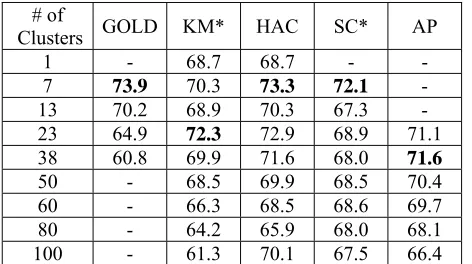
In order to fine-tune the optimal cluster numbers for seed sampling, we compare the performance of different numbers of clusters for each clustering algorithm on the development data set and report their F-scores in Table 3. For reference, we also list the F-score for golden clustering (GOLD), in which all instances are grouped in terms of their annotated ground relation major types (7), major types considering relation direction (13), subtypes (23), and subtypes considering direction (38). Be-sides, the performance of clustering-based semi-supervised relation classification is also measured over other typical cluster numbers (i.e., 1, 50, 60, 80, 100). Particularly, when the cluster number equals 1, it means that only diversity other than representativeness is considered in the seed sam-pling. Among these clustering algorithms, one of the distinct characteristics with the AP algorithm is that the number of clusters cannot be specified in advance, rather, it is determined by the pre-defined preference parameter (c.f. Subsection 4.4). There-fore, we should tune the preference parameter so as to get the pre-defined cluster number. However, sometimes we still couldn’t get the exact number of clusters as we expected. In these cases, we use the approximate cluster numbers for AP instead.
Table 3 shows that
# of
Clusters GOLD KM* HAC SC* AP
1 - 68.7 68.7 - -
7 73.9 70.3 73.3 72.1 -
13 70.2 68.9 70.3 67.3 -
23 64.9 72.3 72.9 68.9 71.1
38 60.8 69.9 71.6 68.0 71.6
50 - 68.5 69.9 68.5 70.4
60 - 66.3 68.5 68.6 69.7
80 - 64.2 65.9 68.0 68.1
[image:8.612.311.543.53.174.2]100 - 61.3 70.1 67.5 66.4
Table 3: Performance in F1-score over different cluster numbers with intra-stratum sampling on the develop-ment data
2) Golden clustering achieves the best performance of 73.9 in F1-score when the cluster number is set to 7, significantly higher than the perform-ance using other cluster numbers. Interestingly, this number coincides with the number of major relation types needed to be classified in our task. This is reasonable since the instances with the same relation type should be much more similar than those with different relation types and it is easy to discriminate the seed set of one relation type from that of other relation types.
3) Among the four clustering algorithms, HAC achieves best performance over most of cluster numbers. This further verifies the aforemen-tioned analysis. That is, as a hierarchical clus-tering algorithm, HAC can sample seeds that better capture the distribution of the training data.
4) For KM, the best performance is achieved around the number of 23 while for both HAC and SC, the optimal cluster number is consis-tent with GOLD clustering, namely, 7. For AP, the optimal cluster number for AP is 38. This is largely due to that we fail to cluster the training data into about 7 and 13 groups no matter how we vary the preference parameter.
Final comparison of different clustering algo-rithms on the held-out test data
After the optimal cluster numbers are determined for each clustering algorithm, we apply these num-bers on the held-out test data and report the per-formance results (P/R/F1 and their respective improvements) in Table 4. For easy reference, we also include the performance for GOLD, RAND, and SEQ sampling strategies.
Sampling
strategies P(ΔP) R(ΔR) F1(ΔF1) GOLD 79.5(7.8) 72.7(2.1) 76.0(4.8)
RAND* 71.9(3.7) 69.7(0.1) 70.8(1.8)
SEQ* 71.9(2.6) 65.2(0.1) 69.3(1.3)
KM* 73.6(2.1) 72.3(0.3) 72.9(1.2)
HAC 79.0(10.2) 73.0(1.1) 75.9(5.6)
SC* 72.3(2.1) 72.1(0.4) 72.2(1.2)
[image:8.612.68.304.54.186.2]AP 75.7(2.5) 72.0(0.4) 73.7(1.4)
Table 4: Performance of various clustering-based seed sampling strategies on the held-out test data with the optimal cluster number for each clustering algorithm
Table 4 shows that
1) Among all the clustering algorithms, HAC achieves the best F1-score of 75.9, significantly higher than RAND and SEQ by 5.1 and 6.6 re-spectively. The improvement comes not only from significant precision boost, but also from moderate recall increase. This further justifies the merits of HAC as a clustering algorithm for stratified seed sampling in semi-supervised re-lation classification.
2) HAC approaches the best F1-score of 76.0 for golden clustering. Obviously, this doesn’t mean HAC performs as well as golden clustering in terms of clustering quality measures, rather it does imply that HAC achieves the performance improvement by making the seed set better rep-resent the overall distribution over inherent structure of relation instances, while golden clustering accomplishes this using the distribu-tion over reladistribu-tion types. Since the distribudistribu-tion over relation types doesn’t always conform to that over instance structures, and for a statistical discriminative classifier, often the latter is more important than the former, it will be no surprise if HAC outperforms golden clustering in some real applications, e.g. clustering-based stratified sampling.
6
Conclusion and Future Work
employed to sample additional instances from within each stratum besides its center. We compare the effect of various clustering algorithms on the performance of semi-supervised learning and find that HAC achieves the best performance since the distribution of its seed set better approximates that of the whole training data. Extensive evaluation on the ACE RDC 2004 benchmark corpus shows that our clustering-based stratified seed sampling strat-egy significantly improves the performance of semi-supervised relation classification.
We believe that our clustering-based stratified seed sampling strategy can not only be applied to other semi-supervised learning tasks, but also can be incorporated into active learning, where the in-stances to be labeled at each iteration as well as the seed set could be selected using clustering tech-niques, thus further reducing the amount of in-stances needed to be annotated.
For the future work, it is possible to adapt our one-level clustering-based sampling to the multi-level one, where for every stratum it is still possi-ble to divide it into lower sub-strata for further stratified sampling in order to make the seeds bet-ter represent the true distribution of the data.
Acknowledgments
This research is supported by Projects 60873150, 60970056, and 90920004 under the National Natu-ral Science Foundation of China.
References
S. Abney. 2002. Bootstrapping. ACL-2002.
E. Agichtein and L. Gravano. 2000. Snowball: Extract-ing relations from large plain-text collections. In
Proceedings of the 5th ACM international Conference
on Digital Libraries (ACMDL 2000).
S. Brin. 1998. Extracting patterns and relations from the world wide web. In WebDB Workshop at 6th Interna-tional Conference on Extending Database Technol-ogy (EDBT 98).
E. Charniak. 2001. Intermediate-head Parsing for Lan-guage Models. ACL-2001: 116-123.
M. Collins and N. Duffy. 2001. Convolution Kernels for Natural Language. NIPS 2001: 625-632.
J.X. Chen, D.H. Ji, C.L. Tan, and Z.Y. Niu. 2005. Un-supervised Feature Selection for Relation Extraction.
CIKM-2005: 411-418.
J.X. Chen, D.H. Ji, and C. L. Tan. 2006. Relation Ex-traction using Label Propagation Based Semi super-vised Learning. ACL/COLING-2006: 129-136.
A. Culotta and J. Sorensen. 2004. Dependency tree ker-nels for relation extraction. ACL-2004: 423-439. B.J. Frey and D. Dueck. 2007. Clustering by Passing
Messages between Data Points. Science, 315: 972-976.
T. Hasegawa, S. Sekine, and R. Grishman. 2004. Dis-covering Relations among Named Entities from Large Corpora. ACL-2004.
N. Kambhatla. 2004. Combining lexical, syntactic and semantic features with Maximum Entropy models for extracting relations. ACL-2004(posters): 178-181. S. Miller, H. Fox, L. Ramshaw, and R. Weischedel.
2000. A novel use of statistical parsing to extract in-formation from text. In Proceedings of the 6th Ap-plied Natural Language Processing Conference. J. Neyman. 1934. On the Two Different Aspects of the
Representative Method: The Method of Stratified Sampling and the Method of Purposive Selection.
Journal of the Royal Statistical Society, 97(4): 558-625.
H.T. Nguyen and A. Smeulders. 2004. Active Learning Using Pre-clustering, ICML-2004.
L.H. Qian, G.D. Zhou, Q.M. Zhu, and P.D. Qian. 2008. Exploiting constituent dependencies for tree kernel-based semantic relation extraction. COLING-2008: 697-704.
L.H. Qian, G.D. Zhou, F. Kong, and Q.M. Zhu. 2009. Semi-Supervised Learning for Semantic Relation Classification using Stratified Sampling Strategy.
EMNLP-2009: 1437-1445.
D. Shen, J. Zhang, J. Su, G. Zhou and C. Tan. 2004. Multi-criteria-based active learning for named entity recognition. ACL-2004.
M. Tang, X. Luo and S. Roukos. 2002. Active Learning for Statistical Natural Language Parsing. ACL-2002. U. von Luxburg. 2006. A tutorial on spectral clustering.
Technical report, Max Planck Institute for Biological Cybernetics.
D. Zelenko, C. Aone, and A. Richardella. 2003. Kernel Methods for Relation Extraction. Journal of Machine Learning Research, (2): 1083-1106.
M. Zhang, J. Su, D. M. Wang, G. D. Zhou, and C. L. Tan. 2005. Discovering Relations between Named Entities from a Large Raw Corpus Using Tree Simi-larity-Based Clustering. IJCNLP-2005: 378-389. M. Zhang, J. Zhang, J. Su, and G.D. Zhou. 2006. A
Composite Kernel to Extract Relations between Enti-ties with both Flat and Structured Features.
ACL/COLING-2006: 825-832.
Z. Zhang. 2004. Weakly-supervised relation classifica-tion for Informaclassifica-tion Extracclassifica-tion. CIKM-2004.
S.B. Zhao and R. Grishman. 2005. Extracting relations with integrated information using kernel methods.
G.D. Zhou, J. Su, J. Zhang, and M. Zhang. 2005. Ex-ploring various knowledge in relation extraction.
ACL-2005: 427-434.
G.D. Zhou, L.H. Qian, and J.X. Fan. 2010. Tree kernel-based semantic relation extraction with rich syntactic and semantic information. Information Sciences, (179): 1785-1791.
G.D. Zhou, L.H. Qian, and Q.M. Zhu. 2009. Label propagation via bootstrapped support vectors for se-mantic relation extraction between named entities.
Computer Speech and Language, 23(4): 464-478. G.D. Zhou and M. Zhang. 2007. Extraction relation
information from text documents by exploring vari-ous types of knowledge. Information Processing and Management, (42):969-982.
G.D. Zhou, M. Zhang, D.H. Ji, and Q.M. Zhu. 2007. Tree Kernel-based Relation Extraction with Context-Sensitive Structured Parse Tree Information.