Ames Laboratory Conference Papers, Posters, and
Presentations Ames Laboratory
4-2011
Making Stuff Outreach at the Ames Laboratory and Iowa State University
Katherine Ament
Iowa State University
Steven R. Karsjen
Adah Leshem-Ackerman
Iowa State University, [email protected]
Alexander H. King
Iowa State University, [email protected]
Follow this and additional works at: http://lib.dr.iastate.edu/ameslab_conf Part of the Materials Science and Engineering Commons
This Article is brought to you for free and open access by the Ames Laboratory at Iowa State University Digital Repository. It has been accepted for inclusion in Ames Laboratory Conference Papers, Posters, and Presentations by an authorized administrator of Iowa State University Digital Repository. For more information, please [email protected].
Recommended Citation
Ament, Katherine; Karsjen, Steven R.; Leshem-Ackerman, Adah; and King, Alexander H., "Making Stuff Outreach at the Ames Laboratory and Iowa State University" (2011). Ames Laboratory Conference Papers, Posters, and Presentations. 2.
http://lib.dr.iastate.edu/ameslab_conf/2
Making Stuff Outreach at the Ames Laboratory and Iowa State University
Abstract
The U. S. Department of Energy’s Ames Laboratory in Ames, Iowa was a coalition partner for outreach activities connected with NOVA’s Making Stuff television series on PBS. Volunteers affiliated with the Ames Laboratory and Iowa State University, with backgrounds in materials science, took part in activities including a science-themed Family Night at a local mall, Science Cafés at the Science Center of Iowa, teacher
workshops, demonstrations at science nights in elementary and middle schools, and various other events. We describe a selection of the activities and present a summary of their outcomes and extent of their impact on Ames, Des Moines and the surrounding communities in Iowa.
In Part 2, results of a volunteer attitude survey are presented, which shed some light on the volunteer experience and show how the volunteers’ participation in outreach activities has affected their views of materials education.
Disciplines
Materials Science and Engineering
This article is available at Iowa State University Digital Repository:http://lib.dr.iastate.edu/ameslab_conf/2
Making Stuff Outreach at the Ames Laboratory and Iowa State University
Journal: 2011 MRS Spring Meeting Manuscript ID: Draft
Manuscript Type: Symposium SS Date Submitted by the
Author: n/a
Complete List of Authors: Ament, Katherine; The Ames Laboratory
Karsjen, Steve; The Ames Laboratory, Public Affairs and Education Programs
Leshem-Ackerman, Adah; The Ames Laboratory, Education Programs
King, Alexander; The Ames Laboratory Keywords: education
Making Stuff Outreach at the Ames Laboratory and Iowa State University Katherine A. Ament
1, Steve Karsjen
1, Adah Leshem-Ackerman
1, Alexander King
11
The Ames Laboratory, Ames, IA 50011, U.S.A.
ABSTRACT
The U. S. Department of Energy’s Ames Laboratory in Ames, Iowa was a coalition partner for outreach activities connected with NOVA’s Making Stuff television series on PBS.
Volunteers affiliated with the Ames Laboratory and Iowa State University, with backgrounds in materials science, took part in activities including a science-themed Family Night at a local mall, Science Cafés at the Science Center of Iowa, teacher workshops, demonstrations at science nights in elementary and middle schools, and various other events. We describe a selection of the activities and present a summary of their outcomes and extent of their impact on Ames, Des Moines and the surrounding communities in Iowa.
In Part 2, results of a volunteer attitude survey are presented, which shed some light on the volunteer experience and show how the volunteers’ participation in outreach activities has affected their views of materials education.
PART 1: SUMMARY OF EVENTS 1. Overall Program
Making Stuff, NOVA’s television mini-series and outreach program provided the basis from which an outreach coalition was constructed at the U.S. Department of Energy’s Ames Laboratory. With assistance from our partners, we were able to reach an estimated 1,050 people
1and share with them the excitement of Materials Science. Thirty-four volunteers participated in 25 events which took place across central Iowa from December 2010 to April 2011.
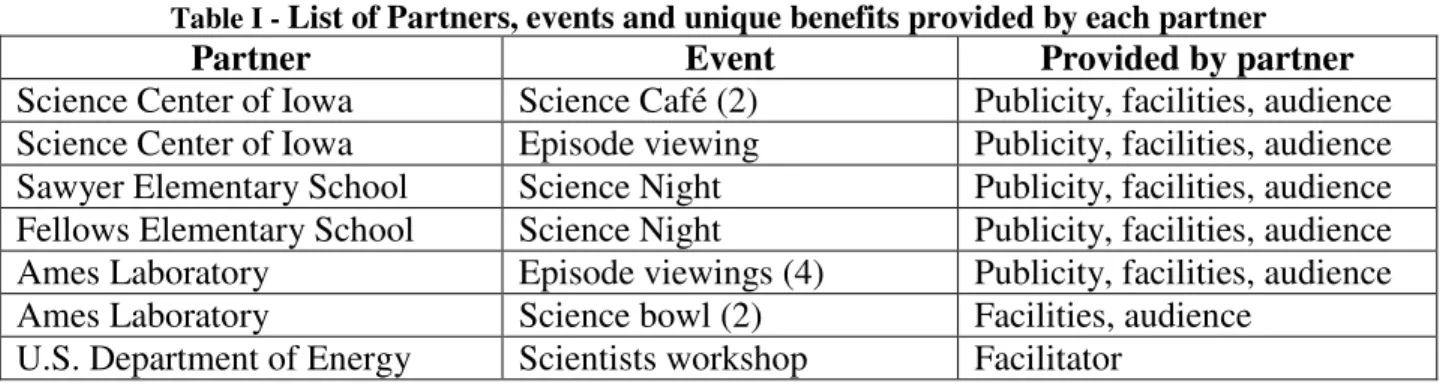
We were able to reach out to the community through mutually beneficial partnerships catalyzed by this program. Table I includes a comprehensive list of our partners and the benefits they provided.
Table I -
List of Partners, events and unique benefits provided by each partner
Partner Event Provided by partner
Science Center of Iowa Science Café (2) Publicity, facilities, audience Science Center of Iowa Episode viewing Publicity, facilities, audience Sawyer Elementary School Science Night Publicity, facilities, audience Fellows Elementary School Science Night Publicity, facilities, audience Ames Laboratory Episode viewings (4) Publicity, facilities, audience Ames Laboratory Science bowl (2) Facilities, audience
U.S. Department of Energy Scientists workshop Facilitator
1 An event occurring after the publication of this paper is expected to reach an additional 500 people. This estimate does not include students in the classrooms of fifty teachers who received activity guides and outreach toolkit information.
Page 1 of 6
Science Bound/Institute for Physical Research and Technology (IPRT)
Science Fair (2) Facilities, audience
Science Bound/IPRT 8
thgrade workshop Facilities, audience NSF Engineering Research
Center for Biorenewable Chemicals
Teacher workshop Facilities, audience
Iowa State University Physics Department
Teacher workshop and High School workshop
Facilities, audience
Valley West Mall Family Night Publicity, facilities, audience Ames Public Library Episode viewings and
activities (4)
Publicity, facilities, audience Clive Public Library Elementary-Middle School
workshop
Publicity, facilities, audience
Material Advantage club volunteers
Materials Research Society club volunteers
Three groups benefitted from this outreach coalition: the audience, the volunteers, and the partnering organizations, including the Ames Laboratory. The audience was composed of many groups: the general public; elementary, middle, and high school students; and middle and high school science teachers. The benefits provided to the audience were both exposure to materials science and a closer connection to science professionals through interaction with students and scientists. Volunteers also benefitted from the activities through improved confidence in their ability to communicate effectively with their audience, as described in Part 2. Through this outreach program the Ames Laboratory benefitted by increased visibility and was able to fulfill a portion of its value statement, Inspiration, training the next generation of scientists and engineers by sparking interest in science. Fulfilling this value is of benefit to the Ames Laboratory, the Department of Energy and the nation.
2. Selected Events
Our outreach coalition presented two science cafés, two educators’ presentations, one science communication/training workshop, and 20 outreach events, which incorporated episode viewings and interactive demonstrations.
Two science cafés were presented in Des Moines, Iowa, in partnership with the Science Center of Iowa. The Ames Laboratory provided the scientists who led discussions on the topics of “Rare Earths: What’s the Attraction?” which introduced rare earth materials, specifically magnets, and “Bizarre Guitars”, which brought to light the different materials used in construction of guitars over the years. Making Stuff information and other materials were distributed at these events.
The educator presentations were 90-minute experiences, which were centered around the following ideas: what is materials science?, what is Making Stuff?, and hands-on experience with selected demonstrations. Through an interactive format containing Making Stuff video clips, teachers answered those questions and had a chance to try some demonstrations themselves.
Teachers were given access to the outreach toolkit online and also given a paper copy of the
Page 2 of 6
Activity Guide which contained four 45-minute classroom activities that they could take back to their classrooms.
A science communication workshop was presented to Ames Laboratory scientists, students and staff. The Director of Communications for the U.S. Department of Energy Chicago office presented a seminar on communicating science to the public.
An outreach event, where an activity table and demonstrations were the primary focus, was held at the Science Center of Iowa to kick off an advance showing of the first Making Stuff episode, “Stronger” which was provided by Iowa Public Television. Following the episode, the
“Testing Tensile Strength” activity was performed with an eager group of young scientists.
In partnership with Science Bound, Iowa State University students travelled outside of Ames to present Making Stuff activities to eighth grade students involved in a program focused on getting underrepresented students into a science-centered college program.
A four-part Saturday series at the Ames Public Library was presented during the month of March. Each Saturday session included an episode viewing followed by related activities.
Making Stuff activities utilized included the “Spoon Drop Strength Test”, “Magnetic Microbots”,
“Nanowires and the Ever-Shrinking Microchip”, “Instant Cheese Bioplastic”, and “Shape Shifters”.
PART 2: Making Stuff outreach events - Effects on volunteers
Outreach is a powerful means of recruiting future students to fulfill the need for qualified science and engineering professionals. Although many outreach programs rely heavily on volunteers, most studies on outreach focus on the benefits of the events on recruiting potential students, not on the benefits of the experiences of the volunteers themselves. Because volunteers are also affected by participating in the experience, they deserve attention too. This study seeks to identify the impact of the Making Stuff outreach events on the participating volunteers.
1. Method
a. Participants
Participants in this study consisted of undergraduate and graduate students, and scientists from a materials science and engineering (MSE) program at a large, midwestern university.
Participants volunteered to assist with a Making Stuff outreach event through solicitation by a MSE graduate student who was the program coordinator. Thirty-one volunteers completed both the pre- and post-event surveys. Occasionally participants skipped a question, so response totals vary from question to question. Two additional volunteers completed the pre-survey but not the post-survey, so their data were not included for analysis.
b. Procedure
Volunteers attended a pre-event briefing session where their volunteer role in the Making Stuff outreach event was explained. During the pre-event session, the participants were asked to fill out a short paper survey, which assessed participant classification, previous volunteer
experience, activity preparedness, whether participants thought their views of the importance of materials science outreach would change, the value of such outreach events for volunteers and for the community, and expectations for participating in the event. Immediately following the
Page 3 of 6
event, participants were asked to complete a second paper survey, which assessed their post- event attitude in the same categories.
c. Data Analysis
Data were analyzed using SPSS (Statistical Package for the Social Sciences). Multiple choice data were evaluated for frequency information and percentages, and when appropriate, means and standard deviations were determined. When a question from the pretest survey was replicated on the posttest survey, a paired t-test was used to calculate whether change had occurred in participants’ viewpoints. Open-ended responses were coded using NVivo, a software program designed for qualitative analysis.
2. Results
Most of the participants in the study were either undergraduate students (13) or graduate students (13). In addition, there were scientists/professors (2) and other (2). Most had previously participated in 1-2 materials science outreach events, although 10% of participants indicated this was the first time they had participated in any type of materials science outreach event (Table II).
For over 90% of participants, the event was the first outreach event they had participated in with Making Stuff.
Table II. How many materials science education outreach events have you volunteered for prior to this Making Stuff event?
Number of events n %
0 3 9.7
1-2 16 51.6
3-5 4 12.9
6-10 5 16.1
More than 10 3 9.7
Prior to the event, participants on average indicated feeling prepared to do the activity with some (55%) or a little help (36%), while 3% of participants felt confident in doing the activity with no help at all. After the event, participants on average indicated that they were more prepared than they had originally estimated (t = -3.165, p < .05), and 25% of participants now claimed that they felt confident enough to do the activity with no help at all (Tables III and Table IV).
Table III. Pre-Post: How prepared do/did you feel for this event?
Pretest Posttest
n % n %
Not prepared at all 1 3.2 0 0.0
Prepared to do the activity with significant help 1 3.2 3 9.7 Prepared to do the activity with some help 17 54.8 8 25.8 Prepared to do the activity with little help 11 35.5 12 38.7
Prepared to do the activity with no help 1 3.2 8 25.8
Page 4 of 6
Table IV. Comparing feelings of preparedness before and after the outreach event.
Mean Standard Deviation
Pretest preparedness 3.32 0.748
Posttest preparedness 3.81 0.946
Paired samples t-test t = 3.165 Significance = 0.004
Before the Making Stuff event, participants indicated believing that either the event would not change their views (31%), or that it would change their views positively (69%). After the event, participants were asked how their views actually changed. No significant posttest change was revealed (t = 0.722, p > .05), likely due to ceiling effects. Open-ended comments about how the event changed the volunteer’s views were more revealing. Many participants indicated being very impressed by how excited the audience was about science, and stated that they enjoyed sharing their passions and knowledge with others.
During the pretest, most participants believed that materials science outreach events are valuable (41%) or very valuable (52%) for the community (Table V) and valuable (52%) or very valuable for the volunteers who participate (31%) (Table VI). As part of the posttest,
participants rated the value of the Making Stuff event for the community and for themselves as volunteers. Paired samples t-tests revealed no significant changes in either participant’s opinions about value to the community (t = 1.876, p > .05) or value for the volunteers (t = 0.000, p > .05).
Table V: Pre-Post: How valuable do you think materials science outreach events are for the community/how valuable was this event for the community?
Pretest Posttest
n % n %
Not at all valuable 0 0.0 0 0.0
A little valuable 1 3.4 0 0.0
Somewhat valuable 1 3.4 5 17.2
Valuable 12 41.4 14 48.3
Very valuable 15 51.7 10 34.5
Table VI: Pre-Post: How valuable do you think materials science outreach events are for volunteers like yourself/how valuable do you think this event was for you as a volunteer?
Pretest Posttest
n % n %
Not at all valuable 1 3.4 0 0.0
A little valuable 0 0.0 1 3.3
Somewhat valuable 4 13.8 5 16.7
Valuable 15 51.7 14 50.0
Very valuable 9 31.0 9 30.0
Before the event, participants were asked about their expectations for participating in the event, and given the chance to write an open-ended response. Many participants indicated that they wanted “to have fun” and to teach about and create an interest in materials science. Some participants commented that they were interested in learning new things themselves or that they were unsure of what to expect. After the event, participants were asked to discuss their “most
Page 5 of 6
positive memory of the event”. Many of the participants indicated they enjoyed watching children become excited about science, and many gave specific examples of children who stuck out to them. Many other participants enjoyed teaching, and watching children learn about and participate in science. Selected responses are listed below.
Pretest: What are your expectations for participating in this event?
Theme 1: To have fun
- To have fun and good times.
- Having fun!
- To have a fun time volunteering.
Theme 2: Teaching about and creating interest in materials science
- I expect that it will be a fun experience to teach kids about materials science and why it’s important.
- Interact with students regarding science, and explain to them about Iowa State and what materials science is.
Posttest reflection: What was your most positive memory of this outreach experience?
Theme 1: Watching children become excited about science
- Seeing how excited the kids were and hopefully wanting to be materials scientists and engineers.
- There was a girl with a notebook writing down all her scientific observations for the stronger demonstration!
- Happy, excited kids learning, asking questions, interacting with science and scientists.
Theme 2: Children learning about and participating in science - Little kids learning.
- Watching some of the kids attempt to make the 'transistors' on the blocks.
Theme 3: Teaching
- Helping the kids see that Kevlar was stronger than steel with the tensile test.
- Getting to use my knowledge of materials engineering to inspire others to be engineers.
- To remember to think about opportunities to teach kids about materials during everyday activities.
CONCLUSIONS
Individuals who choose to volunteer believe that outreach has value and is important to them and the community; and participation in outreach does not significantly change these views. Volunteers are more prepared than they originally assume. Outreach events provide volunteers with an opportunity to recognize their potential as communicators of science.
ACKNOWLEDGMENTS
We would like to thank Mari Kemis and Brandi Geisinger at the Research Institute for Studies in Education at Iowa State University for assistance with the volunteer survey. Work at the Ames Laboratory was supported by the Department of Energy under Contract No. DE-AC02- 07CH11358.
Page 6 of 6