ISSN 0015–5659 www.fm.viamedica.pl
Address for correspondence: K. Palus, Department of Clinical Physiology, Faculty of Veterinary Medicine, University of Warmia and Mazury,
Co-localisation of cocaine- and amphetamine-
-regulated transcript peptide and vasoactive
intestinal polypeptide in the myenteric plexus
of the porcine transverse colon
K. Palus, L. Rytel
Department of Clinical Physiology, Faculty of Veterinary Medicine, University of Warmia and Mazury, Olsztyn, Poland
[Received 18 April 2013; Accepted 24 May 2013]
Cocaine- and amphetamine-regulated transcript peptide (CART) is a substance, which can play the role of neuromediator and/or neuromodulator in nerve structu-res within the gastrointestinal tract. However knowledge concerning its functions and co-localisation with other neuronal factors is rather scarce.
During the present investigation the co-localisation of CART and vasoactive inte-stinal polypeptide (VIP) in the neurons of meyenteric plexus within the porcine transverse colon was studied using double immunofluorescence technique and semiquantitative arbitrary scale of the frequency of presence CART+/VIP+, CART+/VIP– and CART–/VIP+ neuronal cells. The most often (+++) CART–/VIP+ neurons were encountered, neurons simultaneously immunoreactive to CART and VIP were observed somewhat rarer (++) and only single (+) CART+/VIP– perikarya were visible. The present study reports for the first time on the co-localisation of CART and VIP in myenteric neurons of the porcine transverse colon. (Folia Morphol 2013; 72, 4: 328–332)
Key words: cocaine- and amphetamine-regulated transcript (CART), vasoactive intestinal polypeptide (VIP), transverse colon,
immunofluorescence, pig
INTRODUCTION
It is well known that the gastrointestinal (GI) tract is controlled both by the enteric nervous system (ENS) located in the wall of stomach and intestines
[12, 15] as well as by extrinsic autonomic innervation
[21, 23, 29].
The ENS in the large intestine of humans and big mammals (such as pig) is organised into 3 intramural
ganglionated plexuses: the myenteric plexus (MP)
— located between the longitudinal and circular
muscle layers, the outer submucous plexus — near
the circular muscle layer and the inner submucous
plexus — between the muscularis mucosa and
lami-na propria. These plexuses comprise wide range of
neurons which can have various functions, contain different neurotransmitters and/or neuromodulators and can change their chemical coding under various pathological factors [8–11].
One of neuronal factors, which has been observed
in enteric neurons, is cocaine- and amphetamine--regulated transcript peptide (CART). This peptide was
discovered in 1981 in ovine hypothalamus [24] and till now it has been described in various parts of the ENS in numerous mammals, including humans [27].
Localisation of CART-like immunoreactive nervous
structures — mainly in the MP and circular muscle layers suggests that this peptide is involved in the regulation of intestinal motility. Previous studies also show that CART can take part in the inhibition of feeding [20], reduction of gastric acid secretion [22],
exacerbation of colonic motility [25], but mentioned
above functions are likely realised via regulatory cir
-cuits located within the central nervous system. It
has been confirmed by investigations on the motor
activity of isolated wall fragments of stomach, small
and large intestine, where the contractile or relaxatory activity of CART was not been observed [6].
Previous investigations also described changes
in the number of CART-positive nervous structures
in the ENS under various pathological factors [14], what may suggest neuroprotective functions of CART in the digestive system.
The one of investigatory methods on putative CART functions within the GI tract is study concerning
the co-localisation of this peptide with other, better
known, neuronal factors. During present investigation
the co-localisation of CART and vasoactive intestinal
polypeptide (VIP), which is known as a potential me -diator of smooth muscle relaxation, the stimulator of intestinal fluid secretion and the regulator of blood flow in the GI tract [1] has been studied within the
MP of the porcine transverse colon.
MATERIALS AND METHODS
The present study was performed on 5 immature
female pigs of the Large White Polish breed (appro -ximately 8 weeks old), which were kept in standard
laboratory conditions with admission to species --specific feed and water ad libitum. All experimental
procedures were carried out in compliance with the instructions of the Local Ethical Committee in Olsztyn (Poland), with special attention paid to minimising any stress reaction during and after the surgery.
The animals were euthanised by an overdose of sodium thiopental (Thiopental, Sandoz, Kundl --Rakúsko, Austria; given intravenously) and then
perfused transcardially with 4% buffered paraform
-aldehyde (pH 7.4) prepared ex tempore. The same fragments (ca. 1 cm long) of the cranial transverse colon located near the border between the ascending and transverse colon were collected. Then they were
post-fixed by immersion in the same fixative, rinsed
in 0.1 M phosphate buffer (pH 7.4, 4ºC) for several
hours and, finally, stored in 18% buffered sucrose
at least 7 days. Next samples were sectioned into 10 μm-thick cryostat sections, which were then subje-cted to routine double-labelling immunofluorescence as described previously by Gonkowski et al. [15], using
combinations of antisera raised in different species and directed towards CART (mouse monoclonal; R&D
System, Minneapolis, MN, USA, cat. no. MAB 163;
working dilution 1:1000) and VIP (rabbit polyclonal;
Biomol, Hamburg, Germany, cat. no. VA1285; wor-king dilution 1:6000). Primary antisera were visualised by species-specific secondary antisera conjugated to
FITC or biotin (all from Jackson Immunochemicals, USA, in a working dilution of 1:800). The latter an -tibodies were then visualised by a streptavidin-CY3 complex (Jackson, 1:8000). Standard controls, i.e. pre-absorption of the neuropeptide antisera with
appropriate antigen, omission and replacement of
primary antisera by non-immune sera were performed to test the antibodies and specificity of the method. The pre-absorption test was performed as follows:
sections were incubated with “working” dilutions of primary antibodies directed toward CART and VIP, which had been preabsorbed for 18 h at 37ºC with
20 μg of appropriate protein CART (003-63, Phoenix Pharmaceuticals) or VIP (064-24, Phoenix
Pharma-ceuticals). These procedures completely eliminated
specific stainings.
Myenteric plexus in 6 sections per animal were
estimated. Labelled perikarya (only neurons with
clearly-visible nucleus were included) were evaluated under an Olympus BX51 microscope equipped with epi-fluorescence and appropriate filter sets. To
pre-vent double observations, the sections were located at least 100 µm apart from each other.
Three various populations of myenteric neu
-rons were studied: CART+/VIP+, CART+/VIP– and
CART–/VIP+. For the semiquantitative evaluation of the frequency of particular populations of neuronal
cells an arbitrary scale was used, where (–) means the absence of neurons, (+) — single neurons, (++) — rare cell bodies, (+++) — depicts a common occurrence of perikarya.
RESULTS
The majority of myenteric ganglia of the porcine
transverse colon observed during present investiga
-tion was devoid of neurons immunoreactive to CART and/or VIP but the dense of meshwork CART– and/or
VIP-positive intraganglionic nerve fibres were present
appearance of CART and VIP co-localisation between
particular animals were not observed.
DISCUSSION
In the present investigation, CART-like
immunore-active neurons was observed in the MP of the porcine transverse colon, what is in accordance with previo -us studies, where expression of CART was noted in
different parts of the GI tract in various species [13, 28]. The presence of CART in the nerve structures populations studied were observed. The most often
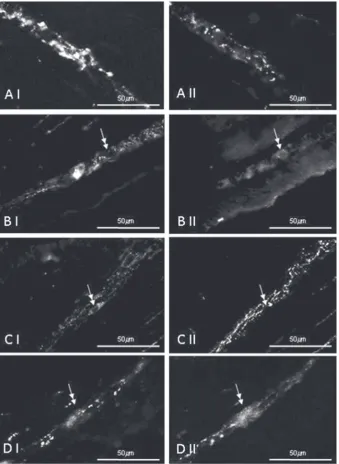
(+++) CART–/VIP+ neurons were encountered. In the view of individual ganglia 1 or 2 such cell bodies
were visible (Fig. 1B). Neurons co-localising CART
and VIP were observed somewhat rarer (++) and most often one such cell was visible in the view of
particular plexus (Fig. 1D). CART+/VIP– perikarya were
observed the least often. Only single such cells (+) in the small number of MP was noted (Fig. 1C). In the
present study visible differences in the frequency of
Figure 1. Co-localisation of cocaine- and amphetamine-regulated transcript (CART) (I) and VIP (II) in the myenteric plexus of the porcine transverse colon; A. Plexus with a dense meshwork of CART- and VIP-positive nerves; B. Neurons CART–/VIP+ (double arrow);
disorders, neuronal stress or injury. This supposition is
strongly supported by previous studies, where patho -logical factors increased CART-like immunoreactivity in the intestinal nervous structures [16] as well as
by data showing that CART is able to promote the survival of rodent enteric neurons in vitro.
CONCLUSIONS
To sum up, the obtained results show that CART
is present and co-localises with VIP in neuronal cells
within MP of porcine transverse colon, what suggest coherent functions of both substances. However CART still remains an obscure neuropeptide and further
investigations are necessary to explanation in detail
its functions within the GI tract in physiology and during pathological processes.
REfERENCES
1. Andersson PO (1984) Vascular control in the colon and rectum. Scan J Gastroenterol Suppl, 93: 67–78.
2. Arciszewski MB, Sand E, Ekblad E (2008) Vasoactive in -testinal peptide rescues cultured rat myenteric neurons from lipopolysaccharide induced cell death. Regul Pept, 146: 218–223.
3. Bellinger DL, Lorton D, Brouxhon S, Felten S, Felten DL (1996) The significance of vasoactive intestinal polypeptide (VIP) in immunomodulation. Adv Neuroimmunol, 6: 5–27. 4. Brenneman DE, Philips TM, Hauser J, Hill JM, Spong CY,
Gozes I (2003) Complex array of cytokines released by vasoactive intestinal peptide. Neuropeptides, 37: 111–119. 5. Burleigh DE, Banks MR (2007) Stimulation of intestinal
secretion by vasoactive intestinal peptide and cholera toxin. Auton Neurosci Bas Clin, 133: 64–75.
6. Ekblad E, Kuhar MJ, Wierup N, Sundler F (2003) Cocaine- and amphetamine-regulated transcript distribution and function in rat gastrointestinal tract. Neurogastroenterol Motil, 15: 545–557.
7. Furness JB (2000) Types of neurons in the enteric nervous system. J Auton Nerv Syst, 81: 87–96.
8. Gonkowski S, Calka J (2010) Changes in the somatostatin (SOM)-like immunoreactivity within nervous structures of the porcine descending colon under various pathological factors. Exp Mol Pathol, 88: 416–423.
9. Gonkowski S, Calka J (2012) Changes in pituitary adenylate cyclase-activating peptide 27-like immunoreactive nervous structures in the porcine descending colon during selected pathological processes. J Mol Neurosci, 48: 777–787. 10. Gonkowski S, Kaminska B, Bossowska A, Korzon M,
Landowski P, Majewski M (2003) The influence of exper-imental Bacteroides fragilis infection on substance P and somatostatin-immunoreactive neural elements in the porcine ascending colon: a preliminary report. Folia Morphol, 62: 455–457.
11. Gonkowski S, Burlinski P, Calka J (2009) Proliferative ente -ropathy (PE)-induced changes in galanin-like immunorea-ctivity in the enteric nervous system of the porcine distal colon. Acta Vet Beograd, 59: 321–330.
within the MP suggest that this peptide is involved
in the intestinal motility regulatory processes. Not-withstanding, the exact functions of CART in the ENS remain unexplained. On the one hand CART has
been previously described as an inhibitor of gastric
acid secretion [22], a reducer of colonic motility [25] and inhibitor of nitric oxide — mediated relaxation
in the colon, but on the other hand the studies on the motor activity of stomach and small intestine did
not show any contractile or relaxatory actions of this peptide [6]. Moreover, some previous studies, which described changes in the number of CART-positive
nervous structures in the ENS under various patho
-logical processes of GI tract in humans and pigs [17], can suggest neuroprotective functions of CART in the digestive system.
During the present study, the co-localisation of
CART and VIP was observed in the MP both in cell bo -dies and intraganglionic nerve fibres. Obtained data show that not all VIP-positive neurons are immuno-reactive to CART, but the vast majority of CART+ cell bodies were simultaneously VIP-like immunoreactive.
These results, together with previous studies, where CART+/VIP+ nerve structures were describe in the GI
tract [26], may suggest that functions of CART and
VIP can be similar, especially that it is well known that
substances which co-localise in 1 neuron of the ENS
often play similar roles [7].
VIP is above all known as an inhibitory neurotrans
-mitter and/or neuromodulator, which causes the mu -scle hyperpolarsation and relaxation [19]. Moreover, VIP takes part in the blood flow regulation [18] and
alters secretory actions of the GI tract. Namely, this
peptide increases the production of intestinal juice
and bile, but suppresses the production of hydro -chloric acid in the stomach [5]. VIP also is involved in
the regulation of immunological processes [3] and is known as one of the important neuroprotective factor within the ENS. Previous studies have shown that this peptide can enhance the survival of neurons after
axotomy and during lipopolysaccharide cell death [2] and this action of VIP is based on the influence
of this peptide on glial cells cytokine production [4].
The co-localisation of CART and VIP, observed
during the present investigation can suggest that at least some of mentioned above functions of VIP can be also realised by CART within the porcine trans
12. Gonkowski S, Kaminska B, Landowski P, Skobowiat C, Burlinski P, Majewski M, Calka J (2009) A population of zinc transporter 3-like immunoreactive neurons is present in the ganglia of human descending colon. Adv Clin Eexp Med, 18: 243–248.
13. Gonkowski S, Burlinski P, Skobowiat C, Majewski M, Arciszewski MB, Radziszewski P, Calka J (2009) Distribution of cocaine- and amphetamine-regulated transcript-like immunoreactive (CART-LI) nerve structures in the porcine large intestine. Acta Vet Hung, 57: 509–520.
14. Gonkowski S, Kaminska B, Burlinski P, Kroll A, Calka J (2009) The influence of drug-resistant ulcerative colitis on the number of cocaine- and amphetamine-regulated transcript peptide-like immunoreactive (CART-LI) mucosal nerve fibres of the descending colon in children. Przegl Gastroenterol, 4: 147–151.
15. Gonkowski S, Burlinski P, Skobowiat C, Majewski M, Calka J (2010) Inflammation- and axotomy-induced changes in galanin-like immunoreactive (GAL-LI) nerve structures in the porcine descending colon. Acta Vet Hung, 58: 91–103. 16. Gonkowski S, Burlinski P, Szwajca P, Calka J (2012) Changes
in cocaine- and amphetamine-regulated transcript-like immunoreactive (CART-LI) nerve structures of the porcine descending colon during proliferative enteropathy. Bull Vet Inst Pul, 56: 199–203.
17. Gunnarsdóttir A, Wierup N, Larsson LT, Kuhar MJ, Ekblad E (2007) CART-peptide immunoreactivity in enteric nerves in patients with Hirschsprung’s disease. Eur J Pediatr Surg, 17: 184–189.
18. Henning RJ, Sawmiller DR (2001) Vasoactive intestinal peptide: cardiovascular effects. Card Res, 49: 27–37. 19. Kasparek MS, Fatima J, Iqbal CW, Duenes JA, Sarr MG
(2007) Role of VIP and Substance P in NANC innervation in the longitudinal smooth muscle of the rat jejunumin-fluence of extrinsic denervation. J Surg Res, 141: 22–30. 20. Kristensen P, Judg ME, Thim L, Ribel U, Christjansen KN, Wulff BS, Clausen JT, Jensen PB, Madsen OD, Vrang N, Larsen PJ, Hastrup S (1998) Hypothalamic CART is a new anorectic peptide regulated by leptin. Nature, 393: 72–76. 21. Majewski M, Bossowska A, Gonkowski S, Wojtkiewicz J,
Brouns I, Scheuermann DW, Adriaensen D, Timmermans JP
(2002) Neither axotomy nor target-tissue inflammation changes the NOS- or VIP-synthesis rate in distal bowel--projecting neurons of the porcine inferior mesenteric ganglion (IMG). Folia Histochem Cytobiol, 40: 151–152. 22. Okumura T, Yamada H, Motomura W, Kohgo Y (2000)
Cocaine- amphetamine-regulated transcript (CART) acts in the central nervous system to inhibit gastric acid secretion via brain corticotrophin-releasing factor system. Endocri-nology, 141: 2854–2860.
23. Skobowiat C, Gonkowski S, Calka J (2010) Phenotyping of sympathetic chain ganglia (SChG) neurons in porcine colitis. J Vet Med Sci, 72: 1269–1274.
24. Spiess J, Villarreal J, Wale W (1981) Isolation and sequence analysis of a somatostatin-like polypeptide from ovine hypothalamus. Biochemistry, 20: 1982–1988.
25. Tebbe JJ, Ortmann E, Schumacher K, Mönnikes H, Kobelt P, Arnold R, Schäfer MK (2004) Cocaine- and amphetamine--regulated transcript stimulates colonic motility via cen-tral CRF receptor activation and peripheral cholinergic pathways in fed conscious rats. Neurogastroenterol Motil, 16: 489–496.
26. Wierup N, Gunnarsdóttir A, Ekblad E, Sundler F (2007) Characterisation of CART-containing neurons and cells in the porcine pancreas, gastro-intestinal tract, adrenal and thyroid glands. BMC Neurosci, 8: 1471–2202.
27. Wojtkiewicz J, Gonkowski S, Bladowski M, Majewski M (2012) Characterization of cocaine and amphetamine- regulated transcript-like immunoreactive (CART-LI) enteric neurons in the porcine small intestine. Acta Vet Hung, 60: 371–881.
28. Wojtkiewicz J, Gonkowski S, Rowniak M, Crayton R, Majewski M, Jalynski M (2012) Neurochemical characteri-zation of zinc transporter 3-like immunoreactive (ZnT3(+)) neurons in the intramural ganglia of the porcine duode -num. J Mol Neurosci, 48:766–776.