199
Volume 8, Number 3, September 2017
General Issue • Editorial by Jo Mynard (199-202)
Learning Spaces
• Learners’ Work in a SALC: A Longitudinal Study by G. Victoria Madrid Durazo and E. Desirée Castillo Zaragoza (203-222)
• A Survey of Self-Access Foreign Language Centres in UK Higher Education Institutions: Format, Practices and Challenges in 2016 by Marion Krauthaker (223-234)
• Social Language Learning Spaces: Globalization Glocalized by Garold Murray, Mariko Uzuka, and Naomi Fujishima (235-246)
Supporting Learners
• How to Support Students in Selecting Graded Readers by Amber Barr and Phoebe Lyon (247-254)
• Peer Tutoring: Active and Collaborative Learning in Practice
by Rachael Ruegg, Taku Sudo, Hinako Takeuchi, and Yuko Sato (255-267) Professional Development for Learning Advisors
• Professional Development for Language Learning Advisors by Saki Inoue (268-273)
• Effects of Drawing and Sharing a ‘Picture of Life’ in the First Session of a Mentoring Program for Experienced Learning Advisors by Satoko Kato (274-290)
Upcoming Events
• Japan Association for Self-Access Learning (JASAL) Annual conference, Chiba, Japan. December, 2017.
• Psychology of Language Learning Conference (PLL3), Tokyo, Japan. June, 2018.
• Independent Learning Association (ILA) Conference, Kobe, Japan. September 2018.
200
Editorial
Jo Mynard, Kanda University of International Studies, Japan
Welcome to the 30th issue of SiSAL Journal which is Issue 8, Volume 3. This is a general issue, but I organised it into three key themes: learning spaces (three papers), supporting learners (two papers), and professional development for learning advisors (two papers). There are also details three relevant events coming up within the next year.
Learning spaces, is a good theme to start with and the first paper is a research paper contributed by G. Victoria Madrid Durazo and E. Desirée Castillo Zaragoza from the Universidad de Sonora in Mexico. The authors describe a qualitative longitudinal research project which was carried out in the SAC at their institution. The purpose of the research was to understand learners’ performance as they direct their own learning in a SAC. The authors focus on learning experiences, activities, and materials in order to present some interesting results showing learners’ understandings of the language learning process due to working in a SAC.
The second paper takes us to the United Kingdom, where Marion Krauthaker from the University of Leicester provides a report on the observations and conclusions based on a project which assessed self-access foreign language centres (SALCs) in UK higher education institutions between 2014 and 2016. Drawing on data collected from in-depth interviews with stakeholders at 12 institutions, the author suggests that the findings reveal challenges related to resources and support which need to addressed in the coming years.
In the third paper, Garold Murray, Mariko Uzuka, and Naomi Fujishima draw upon data collected during a five-year ethnographic study conducted at a self-access facility at a large national university in Japan. The focus of the paper is on the experiences and voices of international students studying at the university. Based on the findings, the authors suggest that we reflect on the role of social learning spaces and how they support the process of glocalization by contributing to the globalization of facilities in Japan.
201
such as these can be daunting to learners, but making such choices undoubtedly contributes to the development of their autonomy. Drawing on data collected from surveys, the authors summarise some factors that affected learners’ initial and subsequent book choices which give an insight into some of the issues and dilemmas facing learners.
The second paper in this theme was contributed by Rachael Ruegg, Taku Sudo, Hinako Takeuchi, and Yuko Sato and was the result of an evaluation of a peer tutoring programme operating at a university in Japan. One interesting aspect of this paper is that it was written as a collaboration between a faculty member and three student tutors, surely an excellent example of engaging learners in the learning, writing, and researching process. The aim of the paper is to provide an overview of the tutoring programme for others interested in setting up a similar service. It gives insights into features of running a centre along with some details of successes and challenges.
The final two papers relate to the theme of ‘professional development for learning advisors’. I have witnessed an increase in papers exploring the nature, roles, and features of advising in the past few years. As the field develops, it seems appropriate that more attention is given to how learning advisors are trained, supported, and mentored. Saki Inoue, a learning advisor and coordinator based at Kanazawa University in Japan summarises an overview of an ongoing training and professional development programme for language learning advisors. Drawing on reflections contributed by eight advisors the author indicates areas where the professional development programme could be enhanced.
Finally, Satoko Kato, an experienced advisor and advisor educator based at Kanda Institute of Foreign Studies in Japan presents research which draws upon the life narrative approach as a way of tapping into the personal constructs of experienced learning advisors. The study investigates the effects of drawing a ‘picture of life’ (PL) at the beginning of a six-month mentoring programme by looking into mentees’ views and also features that indicate the development of the mentoring relationship and how the PL promoted deeper connections.
Upcoming Events
202
International Studies in Chiba Japan on 16th December. Details are available on the JASAL website https://jasalorg.com/.
There are two other events that might be of interest to colleagues based both within and outside Japan as they are part of international organisations who happen to be hosting events in Japan in 2018. The first is the Psychology of Language Learning Conference. PLL3 is the official event associated with the International Association of the Psychology of
Language Learning. Previous conferences were in Finland (2016) and Austria (2014). PLL3 will be held at Waseda University in Tokyo from June 7-10. The call for papers closes on December 11th. More details are available on the website http://www.pll3-tokyo2018.com/
Finally, the Independent Learning Association has been running for many years and has hosted conferences in Australia (2003), New Zealand (2005 and 2012), Japan (2007), Hong Kong (2009), Thailand (2014) and China (2016). Next year, it returns to Japan and will take place at Konan Women’s University in Kobe on September 5-8. The theme is Whose Autonomy? Voices and Agency in Language Learning and the call for papers closes on December 31st.
Acknowledgments
As always, I am grateful to members of the review and editorial boards for their help with producing this issue and to the authors for choosing to publish with us.
Notes on the Editor
203
Learners’ Work in a SAC: A Longitudinal Study
G. Victoria Madrid Durazo, Universidad de Sonora, Mexico
E. Desirée Castillo Zaragoza, Universidad de Sonora, Mexico
Abstract
Self-access centers (SACs) became popular in Mexico in the 1990s with the purpose of allowing learners to make decisions about how to learn languages. The following study is qualitative and longitudinal and was carried out in the SAC at the University of Sonora in Mexico. It was designed with the purpose of understanding learners’ performance as they direct their own learning in a SAC. By focusing on learning experiences, activities, and materials, the results show that learners understand the idea of language learning in SACs in a limited way. However, the participants view learning in a SAC to be an effective approach to learning languages due to the progress and growth they noticed.
Key words: self-directed language learning, self-access center, learning experience
Self-access centers (SACs) provide learners with opportunities to experience language
learning in a unique way. Such experiences are shaped by the learners’ decision-making in the
SAC regarding the determination of objectives and the activities to be carried out, the selection of
materials needed and the appropriate way to use them. With this in mind, having a better
understanding of the learners’ practices in SACs is necessary to comprehend their language
learning process.
This project was designed to increase knowledge about SAC learners’ performance,
investigating how they adapt to self-directed learning, the activities they carry out, and the
materials they use. The article presents the learning experiences of five SAC learners, through the
analysis of the aspects mentioned above.
Literature Review
Language learning in self-access centers
Self-access centers were first established with the idea of promoting learning autonomy in
the language learning context; learner autonomy is a notion by which learners develop the
204
decisions regarding objectives and content, methodology and strategies, as well as monitoring
and evaluation. According to Holec (2017), SACs are facilities where different resources and
services are offered to learners in order to help them learn languages in a self-directed way. SACs
are likely to contain a wide range of materials, and provide learning to learn workshops, advising
programs, conversation groups, among other services. Based on Gardner and Miller (1999),
SACs offer a learning environment in which every learner develops in a particular way. As they
pointed out, language learning in SACs involves “an integration of a number of elements which
combine to provide a learning environment. Each learner interacts with the environment in a
unique way” (Gardner & Miller, 1999, p. 8).
A SAC as a learning environment
According to Gardner and Miller (1999), elements of a SAC create a learning
environment that increases the possibilities for learning opportunities. As self-directed language
learning is promoted in SACs, learning experiences may develop once learners begin to freely
interact in such spaces through the carrying out of different activities and the use of the materials
and resources offered to them (Domínguez, 2012). In this sense, learners explore new learning
experiences (Croker & Ashurova, 2012) by which they become more involved in their learning
process and start to adapt to a different way of learning (Herrera, 2012).
In order to provide learners with a more effective way to work in a SAC, the center may
offer the help of advisors. They will help learners to reflect on their own learning and develop
their capacity to learn (Gremmo, 1995; Mozzon-McPherson, 2001, 2007; Victori, 2007). In this
sense, the role of advisors is extremely important in a SAC (Gremmo & Riley, 1995).
Based on the previous information in this project, the learning experience in a SAC refers
to that unique way in which every learner interacts with the environment to make decisions
regarding their learning.
SAC context in Mexico
205
Education, started to take measures. One of these was the training of FL teachers, particularly in English, which, at the time resulted in a large number of BA English Language Teaching
programs that are now offered all over the country (Castillo Zaragoza, 2006). The second measure was the introduction of SACs for language learning in every state university of the country, which meant that 32 SACs were established in order to start providing Foreign Language Learning services. In tripartite agreements, the ministry initiated the following: 1) funding was provided in order to set up the SACs, 2) teachers were trained, and 3) state universities provided the facilities. As a result, there are currently over 250 self-access centers across the country, suggesting that SACs are an important element of the Mexican university context.
Research in Mexico regarding language learning in SACs has covered different aspects, such as ideologies about the setting up of SACs (Castillo Zaragoza, 2006); the advisor’s role and training (Clemente, 2003; Contijoch Escontria, 2000; Fabela Cárdenas, 2012); the characteristics of learners who visit SACs (Bufi Zanón & Chávez Sánchez, 2000); material development in the SAC (Groult Bois, 2000); plurilingualism by the advisor (Castillo & Gremmo, 2003; Gremmo & Castillo, 2006) and the learner (Castillo Zaragoza, 2011; Castillo Zaragoza & Pamplón Irigoyen, 2013); and learning experiences in SACs (Castillo Zaragoza, 2011, 2014; Domínguez Gaona, 2013; Herrera, 2012). As rich and varied as research in Mexico has been, there is a need to continue researching learners’ decisions regarding their learning and actual performance in a SAC.
Recent studies on SACs
Recent studies related to language learning in SACs have been developed in the Asian, American and European continents in countries such as Japan, Mexico, France, Germany and Turkey. For the most part, these studies are framed on a qualitative approach and have employed data collection instruments that include semi-structured interviews, questionnaires or surveys, observations, and analysis of documents such as portfolios, diaries or attendance registers.
The research developed has focused on different aspects including:
• Advising in SACs (Harootian, 2015; Kato & Mynard, 2015; Morrison & Navarro,
2012; Mynard & Carson, 2012; Mynard & Navarro, 2010; Tweed, 2016; Uzun,
206
• SAC users’ motivation (Castillo Zaragoza, 2011; Croker & Ashurova, 2012; Gillies, 2010);
• Development of communities of practice and social interaction in SACs (Acuña,
Avila, & Holmes, 2015; Allhouse, 2014; Gardner & Miller, 2014; Noguchi, 2015);
• Learning experiences in SACs (Castillo Zaragoza, 2011, 2014; Domínguez Gaona, 2013; Herrera, 2012).
It is worth mentioning that the studies in the latter category were all developed in Mexico and are closely related to the purpose of the present study. They served as a reference because they paid attention to the individual and their lived experiences in the SAC, providing a deeper view of the SAC learner and the learning taking place. Nonetheless, as mentioned before, more investigation is needed regarding the actual work people do when they are in the SAC on their own. Therefore, the present research attempts to close the gap and to help build a better understanding of the learners’ development in SACs.
Method
Context
The study was developed at the Centro deAutoaprendizaje de Lenguas Extranjeras
(CAALE), a SAC located in the Foreign Languages Department (FLD) at the University of
Sonora in northern Mexico, where different language courses are offered to the local and
university community. The SAC is available for the people registered in one of the mentioned
courses, as well as to people not taking any language classes. According to the FLD’s website
(Foreign Languages Department, 2014), CAALE is a place where people can learn and practice
languages, it has a variety of materials and resources accessible for its users, and overall, it
represents an alternative for those who have a difficulty attending classes on a regular basis, want
to work at their own pace, or wish to prepare for an official test. The resources and materials
included at CAALE support learners of Arabic, Chinese, English, French, German, Italian,
Japanese, Portuguese, Russian and Spanish. Additionally, CAALE offers advising sessions to
guide users in the development of a working plan, learning strategies, available materials, and the
different ways to use them.
207
The purpose of this project was to obtain data that would lead to a better understanding of
the SAC users and the work they carry out. This information was based on the analysis of the
activities learners carried out, the materials and resources they selected and how they used them.
In other words, the objective was to obtain knowledge about the users’ language learning
experience in CAALE as they adapted to the environment and a self-directed learning process.
The research questions on which the study focused were:
• How do the participants learn in the SAC?
• What materials and resources do the participants select, why do they choose them, how do they work with them and why?
• How do they adapt to the SAC environment?
Research methods
Considering that qualitative research is preferred for describing and interpreting a
phenomenon, as well as the meaning of it to those involved within its natural context (Cresswell,
2007; Denzin & Lincoln, 2005; Glesne, 2011), this study was designed as qualitative and
longitudinal. Therefore, it was done within the learners’ environment. Data collection methods
included two interviews, observations, and the analysis of learning diaries. Finally, it was
conducted over a two-semester period, which allowed the researcher to familiarize with the
SAC’s functioning (during the first semester of the study) and to give the opportunity to the
learners to develop and interact in the SAC environment (during the second semester of the
study) 1
.
The project is characterized by the development of a case study that focused on the
description and interpretation of the activities carried out in the SAC by five participants. The
decision was made because case studies enable the exploration of an individual’s meaning to a
particular situation (Yin, 2003). Each case study described the learners’ perspective about their
own particular learning process in CAALE.
Research scheme and data collection
208
Considering the project’s characteristics and aims, data was collected through observations,
two semi-structured interviews with each participant, and learning diaries written by them:
- The researcher carried out random observations during a two-semester period. During the
first one, observations were focused on obtaining detailed information about the SAC
environment. And in the second one, the focus was on the participants’ activities and their
learning decisions in the center, taking into account the material selection and the way
they use them. In order to document the information collected, notes were taken during
every observation carried out.
- Two semi-structured interviews were conducted by the researcher with each of the
participants, one at the beginning of the second semester and the other one at the end. The
aim was to gather information regarding participants’ motives, goals, feelings, and
decisions about the experience of learning languages in the SAC.
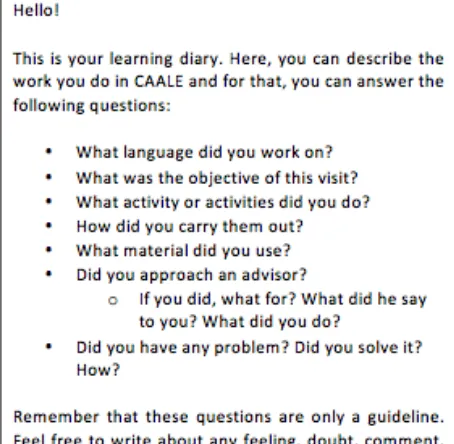
- Participants were asked to keep a learning diary in which they wrote their own reflections
regarding the languages they worked on, the activities, the materials, and the challenges
faced, among other things. In order to do so, learners were given a notebook and a series
of questions in Spanish that served as a guideline (see Figure 1); nonetheless, they were
invited to openly write about any reflection, feeling, or comment they wished to express.
The objective was to have more information about their decision-making and to have a
209
Figure 1. Learning Diary Guidelines
Participants
The selection criterion was open and inclusive, considering men and women willingly
attending the SAC, from different age groups and backgrounds. Also, it was not a requirement to
be registered in any language course or to be learning one specific language, or more than one.
With this in mind, five SAC learners, three women and two men, were asked by the
researcher to be part of the study and voluntarily agreed to participate. The selection was made
considering the regularity of their visits to CAALE. Their ages ranged between 20 and 30 years
and had different professional and academic backgrounds (See Table 1). They were asked to
regularly attend CAALE without a set schedule, participate in two interviews, and keep a
learning diary of every visit to the center for a one-semester period. Participants accepted to be
210
Table 1. Participants Characteristics
Results
The following results were obtained based on the information gathered by 27 random
observations, the two semi-structured interviews, and the analysis of the learning diaries written
by each participant of the project. The analysis was done with a matrix developed on the data
collected (Miles & Huberman, 1994) and later interpreted by the researcher. The results presented
focus on the participants and the similarities and differences among them.
Participants
The information regarding the participants and their work in CAALE is briefly presented
211
Table 2. General Information about Participants
Similarities and differences among the participants The learning experience in CAALE
As previously mentioned, in this project, the learning experience in a SAC refers to the
unique and particular interaction between the learners and the center. This is shaped by the
learners’ decisions regarding their learning within the environment. The outcomes of this
experience can be seen in their increased language performance and their personal growth.
The information obtained in the interviews, especially the second one conducted at the
end of the project, suggested that for the participants, learning languages in CAALE was
effective. Despite the feeling that it is necessary to continue working towards reaching their
212
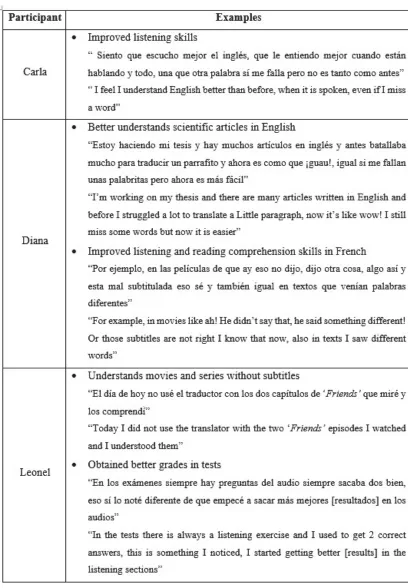
Vanessa, Marco and Leonel were able to identify situations in which they confirmed the
work done in the SAC was effective. For instance, as they commented in the interviews, they
obtained better grades in their classes, understood articles related to their area of studies more
easily and stopped using a translator to understand movie scenes (See Table 3 for examples of
increased language performance). For such reasons, they pointed out their interest in continuing
studying languages in the SAC in addition to their language courses, since they considered it a
213
214
Working at CAALE not only allowed the participants to advance in their language
learning, but according to their responses, it motivated them to personally grow by developing a
sense of independence. Diana and Leonel considered that it contributed to help them focus on
their objectives and on what is needed to achieve them. Moreover, they felt that the experience
helped them realize the importance of continued study as expressed by Leonel in the following
comments:
"Viniendo al CAALE también sentí como que como que más importancia al estudiar en
autodidacta y no solamente para el inglés también para mi carrera"
“Coming to CAALE I also felt like it is important to study in a autodidactic way and not
only to learn English but also for my career.”
"Como que estar en el ambiente aquí otra vez de que todos estén también aprendiendo
215
como que mayor compromiso más compromiso para seguir para aplicarme más en el
estudio"
“[It’s] like, being in this environment here again and everyone is also learning another
language besides English makes me feel a greater commitment to continue to focus more
on studying”
Regarding the adaptation process to the SAC environment and self-directed learning, all
of the learners pointed out that it was difficult to adjust at the beginning but after a while they felt
comfortable as they related to the rest of the users. This can be seen in the following comments
made by Leonel and Marco respectively:
“Quizás la primera semana pero te das cuenta que todos vienen igual que tú no nada más
no precisamente vienen con alguien viene solos normalmente o la mayoría y te das cuenta
que muchos están solos haciendo su propio trabajo y ahí fue cuando me di cuenta es como
cuando dicen sí tu haces algo tú sólo diferente pues te sientes extraño te califican de loco
peor cuando muchos hacen la misma cosa diferente ya como que te sientes más cómodo"
“Maybe the first week but then you realize that everybody is here just like you, they
normally come alone and they are doing their own work, and that’s when I realized that it
is like when you do something different alone you feel weird but when more people do it
then you feel comfortable”
"Al principio sí se me hizo medio batalloso pero ya después como que ya le agarré la onda
que es lo que tenía que hacer y ya se me hizo más fácil"
“At the beginning it was difficult but a while after I got the idea of what I had to do and
then it was easier”
The opinion of all the participants about CAALE was positive. When asked about ways to
216
books. Lastly, they suggested promoting the center to the rest of the university and the local
community as they thought it was a helpful and effective tool to learn languages.
The activities and materials used
Each of the participants involved in this study carried out diverse activities which varied
depending on: 1) the language they focused on, i.e. they did different tasks with every language
they studied; 2) the particular objective. Since they had various goals, the participants worked in
a way they thought would be convenient to reach them. Despite this, there were similarities in
their performance in the SAC. For example, the most frequent activities were:
- completing exercises linked to their language classes and preparing for tests,
- watching movies and sitcoms, primarily in English with the purpose of improving their
listening skills, was a common practice,
- reading magazines (authentic material) about diverse topics such as technology,
entertainment, etc.,
- working with songs, translating articles or song lyrics, answering grammatical exercises
in textbooks and websites, vocabulary searching in dictionaries and online translators, as
well as playing board games with other users.
According to Carla and Leonel, the conversation clubs were of great help because they
allowed them to improved their speaking and listening abilities. Besides, their confidence when
using the language was boosted as they felt secure while they expressed themselves during the
sessions. In contrast, for Marco, who concentrated on his reading comprehension in English, it
was common for him to work with textbooks and magazines containing exercises.
Based on the participants’ comments, working on these activities contributed to improved
performance in their language courses resulting in better grades. Similarly, they enhanced their
comprehension of spoken and written language since learners reduced the use of translation
methods as they continued carrying out these tasks.
The materials were selected depending on the type of activity carried out. Participants
used written and digital resources to accomplish their objectives such as the textbook used in
their languages classes, books and magazines designed for the reading comprehension
217
using authentic materials, they tended to work with audiovisual and written ones such as different
genre movies and series, recent magazines and newspapers, in addition to novels and short
stories. Participants also used the available resources in the SAC, for instance, the television and
DVD players, worktables, reading spaces and the cubicles where the conversation clubs take
place.
The selection of materials and resources implied an understanding of their purpose and
use, as they were used appropriately. Nonetheless, it was constrained primarily to textbooks,
movies, and reading materials, which suggests little knowledge of the possibilities offered in the
SAC, as well as the different ways to use them to achieve a variety of objectives. Finally, it is
relevant to mention that the participants did not request guidance of an advisor at any moment. It
is considered that this lack of advising during the project played an important role in the learners’
development and limited usage of the materials.
Discussion
This research aimed at providing answers regarding the way SACs learners work when
they are in such centers and the way they start to direct their learning process, considering their
interaction with the SAC elements, specifically, the activities carried out and the materials and
resources used.
The results obtained from the study suggest that participants have a reasonable
understanding of how to develop in the SAC environment, as they actively decided on the tasks
to be done and the materials to be used. However, as identified in the learning diary entries and
their comments in the interviews regarding advising, they did not make use of such services. In
this sense, they worked on a ‘no-help’ view that limited the variety of activities done and the
materials or resources used, since they commonly performed the same activities and did not
diversify much. In their study, Domínguez-Gaona, López-Bonilla and Englander (2012) found a
similar behavior in learners, in the sense that they did not seek out advising either, based on the
idea that working autonomously meant developing without the help of others.
Participants also explained that the work done in the center helped them progress in their
language learning since they got better grades in their language classes and understood spoken
and written texts more easily. Language learning in SACs is considered, as expressed by
218
language classes. In her study Herrera (2012) concludes that students partially accept self-access
language learning because they still prefer to attend classes. This may suggest that there is a lack
of learner formation in what the language learning in SACs implies, as well as, in learning to
learn.
In regards to the adaptation process to the SAC environment and the self-direction of their
learning, as noted in the learners’ comments in the interviews, the beginning of the experience
was difficult. Their perspective changed as soon as they grasped the purpose of a SAC and felt
connected to the rest of the users.
Conclusion
This project was designed to describe, through five case studies, how learners in SACs
work and their learning experience, considering how they adjust to the working mode, the
activities done and the materials employed. The information obtained is based on a two-semester
period, one of observations in the SAC about its functioning and another one following the
performance of five participants learning different languages at the SAC of the University of
Sonora. The results suggest that there seems to be an adaptation process by which the learner
understands the working mode and starts making decisions regarding his or her own learning.
However, more research about the transition from a formal class mode to SAC language learning
is needed, with respect to the factors that influence the adjustment and the effects on the learners’
performance.
As learners tend to behave in a similar way on every visit to the center and their use of the
services, materials, and resources available is limited, it would be relevant to carry out research
about the actual learner training in SACs and how it affects their development in the centers.
Nonetheless, the outcomes of this study should not be generalized due to its particular design.
Notes on the contributors
Victoria Madrid is a Masters in Humanities student in the area of Foreign Language Teaching in
the Universidad de Sonora. She also holds a BA in English Language Teaching from the same
institution. Her research interests include learning autonomy, self-directed learning, and language
219
E. Desirée Castillo Zaragoza is an Associate Professor at the Foreign Language Department of
the Universidad de Sonora, Mexico. She received her PhD in Language Sciences at the
Université de Lorraine, France. Her main research interests and publications are related to
self-access centers, self-directed learning and multilingualism of learners working in Mexico.
References
Acuña González, E., Avila Pardo, M., & Holmes Lewendon, J. E. (2015). The SAC as a
community of practice: A case study of peer-run conversation sessions at the Universidad del Caribe. Studies in Self-Access Learning Journal, 6(3),313-321. Retrieved from https://sisaljournal.org/archives/sep15/acuna-et-al/
Allhouse, M. (2014). Researching the new Room 101: “A safe haven for me to learn.” Studies in Self-Access Learning Journal, 5(4), 466-479. Retrieved from
https://sisaljournal.org/archives/dec14/allhouse/
Benson, P. (2011). Teaching and researching autonomy in language learning (2nd
ed.). London, UK: Pearson Education.
Bufi Zanón, S., & Chávez Sánchez, M. (2000). Proyecto: estudio exploratorio de los usuarios de la mediateca (quiénes son y cómo estudian). Reporte de resultados de una muestra inicial. [Project: An exploratory study of the users of the Mediateca (who they are and how they study). Report on the results of an initial sample]. Estudios de Lingüística Aplicada, 30/31, 295-306
Castillo, D., & Gremmo, M. (2003). Autodirection, plurilinguisme, interdisciplinarité: conseiller dans un centre de ressources multilingue [self-direction, plurilingualism,
interdisciplinarity: Counselors in a multilingual resource center]. In S. Carton & P. Riley (Eds.), Le Français dans le Monde: Vers une compétence plurilingue [French in the World: Towards a plurilingual competence] (pp. 178-192). Recherches et applications, juillet. Paris, France: CLE International.
Castillo Zaragoza, E. D. (2006). Centres de ressources pour l’apprentissage de langues au Mexique: Représentations et pratiques déclarées de conseillers et d’apprenants [Language Learning Resource Centers in Mexico: Representations and Declared Practices of Counselors and Learners]. Unpublished PhD Thesis. Université Nancy 2, France.
220
Castillo Zaragoza, E. D. (2014). Autonomy: Four case studies in a Mexican SAC. In G. Murray (Ed.) Social dimensions of learner autonomy (pp. 192-210). Basingstoke, UK: Palgrave MacMillan.
Castillo Zaragoza, E. D., & Pamplón Irigoyen, E. N. (2013). Mexican plurilingual learners’ representations about language and language learning. In E. Ruíz-Esparza Barajas & E. D. Castillo Zaragoza (Eds.), Beliefs about language teaching and learning. Different contexts and perspectives (pp. 89-112). Naucalpan, Mexico: Pearson.
Clemente, M. (2003). Learning cultures and counselling: Teacher/learner interaction within a self-directed scheme. In D. Palfreyman & R. Smith (Eds.), Learner autonomy across cultures (pp. 201-219). London, UK: Palgrave Macmillan.
Contijoch Escontria, M. (2000). Formación de asesores de la mediateca del CELE: Reporte del diseño de un seminario de preparación para profesores interesados en trabajar en una mediateca [Formation of advisers of the CELE mediateca: Report on the design of a training seminar for teachers interested in working in a mediateca. Estudios de Lingüística Aplicada, 30/31, 145-158.
Cresswell, J. W. (2007). Qualitative inquiry and research design: Choosing among five approaches (2nd ed.). Thousand Oaks, CA: Sage.
Croker, R., & Ashurova, U. (2012). Scaffolding students’ initial self-access language centre experiences. Studies in Self-Access Learning Journal, 3(3), 237-253. Retrieved from https://sisaljournal.org/archives/sep12/croker_ashurova/
Denzin, N. K., & Lincoln, Y. S. (2005). The Sage handbook of qualitative research (3rd ed.). Thousand Oaks, CA: Sage.
Domínguez-Gaona, M., López-Bonilla, G., & Englander, K. (2012). Self-access materials: Their features and their selection in students’ literacy practices. Studies in Self-Access Learning Journal, 3(4),465-481. Retrieved from
https://sisaljournal.org/archives/dec12/dominguez-gaona_lopez-bonilla_englander/
Domínguez Gaona, M. R. (2013). El centro de autoacceso de la facultad de idiomas Tijuana: Sus recurso y eventos de literacidad [The self-access centre of the Tijuana Faculty of
Languages: Its resources and literacy events]. Unpublished PhD Thesis. Universidad Autónoma de Baja California. Ensenada, Mexico.
Fabela Cárdenas, M. A. (2012). The impact of teacher training for autonomous learning. Studies in Self-Access Learning Journal, 3(3), 215-236. Retrieved from
https://sisaljournal.org/archives/sep12/fabela-cardena/
Foreign Languages Department (2014). University of Sonora, Mexico (2014). Retrieved from http://www.lenguasextranjeras.uson.mx/
221
Gardner, D., & Miller, L. (2014). The professional identity of SALL practitioners. In R. Watson-Todd (Ed.), Proceedings of the DRAL2/ILA Conference (pp. 106-114). Bangkok,
Thailand: King Mongkut University of Technology Thonburi.
Gillies, H. (2010). Listening to the learner: A qualitative investigation of motivation for embracing or avoiding the use of self-access centres. Studies in Self-Access Learning Journal, 1(3), 189-211. Retrieved from https://sisaljournal.org/archives/dec10/gillies/
Glesne, C. (2011). Becoming qualitative researchers: An introduction (4th ed.). Boston, MA: Pearson.
Gremmo, M-J. (1995). Conseiller n’est pas enseigner: Le role du conseiller dans l’entretien de conseil [Advising is not teaching: The role of the advisor in an advising session].
Mélanges Pédagogiques, 22, 33-61.
Gremmo, M-J., & Riley, P. (1995). Autonomy, self-direction and self-access in language
teaching and learning: The history of an idea. System, 23(2), 151–164. doi:10.1016/0346-251x(95)00002-2
Gremmo, M., & Castillo, D (2006). Advising in a multilingual setting: New perspectives for the role of the advisor. In T. Lamb & H. Reinders (Eds.) Supporting independent language learning: Issues and options (pp. 21-35) Bern, Switzerland: Peter Lang.
Groult Bois, N. (2000). Elaboración de materiales para el desarrollo y seguimiento del proceso metacognoscitivo en aprendizaje autodirigido [Elaboration of materials for the
development and monitoring of the metacognitive process in self-directed learning].
Estudios de Lingüística Aplicada, 30/31, 307-311.
Harootian, D. P., & O’Reilly, E. N. (2015). Supporting learners and advisors: An advising interview protocol for intensive language programs. Studies in Self-Access Learning Journal, 6(1), 86-96. https://sisaljournal.org/archives/mar15/harootian_oreilly/
Herrera, L. (2012) Self-access language learning: Students’ perceptions of and experiences within this new mode of learning. Profile, 14, 113-127.
Holec, H. (1981). Autonomy and foreign language learning. Oxford, UK: Pergamon.
Holec, H. (1995). Avant-propos. Mélanges Pédagogiques, 22, 3-4. Retrieved from http://www.atilf.fr/spip.php?article3494
Holec, H. (1996). Self-directed learning: An alternative form of training. In H. Holec, D. Little & R. Richterich (Eds.), Strategies in language learning and use (pp. 77-132). Strasbourg, France: Conseil de l’Europe.
222
Kato, S., & Mynard, J. (2015). Reflective dialogue: Advising in language learning. New York, NY: Routledge.
Miles, M. B., & Huberman, A. M. (1994). Qualitative data analysis (2nd ed.).Thousand Oaks, CA: Sage.
Morrison, B. R., & Navarro, D. (2012) Shifting roles: From language teachers to learning advisors. System, 40(3), 349-359. doi:10.1016/j.system.2012.07.004
Mozzon-McPherson M. (2001). Language advising: Towards a new discursive world. In M. Mozzon-McPherson & R. Vismans (Eds.), Beyond language teaching towards language advising (pp. 7–22). London, UK: CILT.
Mozzon-McPherson, M. (2007). Supporting independent learning environments: An analysis of structures and roles of language learning advisers. System, 35(1), 66-92.
doi:10.1016/j.system.2006.10.008
Mynard, J., & Carson, L. (Eds.) (2012). Advising in language learning: Dialogue, tools and context. Harlow, UK: Longman.
Mynard, J., & Navarro, D. (2010). Dialogue in self-access learning. In A. M. Stoke (Ed.),
JALT2009 Conference Proceedings. Tokyo, Japan: JALT. Retrieved from http://jalt-publications.org/recentpdf/proceedings/2009/E008.pdf
Saldaña, J. (2003). Longitudinal qualitative research: Analyzing change through time. New York, NY: Altamira Press.
Tweed, A. D. (2016). Implementing a language learning advising service at a self-access center in Cambodia. Studies in Self-Access Learning Journal, 7(1), 96-109. Retrieved from https://sisaljournal.org/archives/mar16/tweed2/
Uzun, T., Karaaslan, H., & Şen, M. (2016). On the road to developing a learning advisory program (LAP). Studies in Self-Access Learning Journal, 7(1), 84-95.Retrieved from https://sisaljournal.org/archives/mar16/uzun_karaaslan_sen/
223
A Survey of Self-Access Foreign Language Centres in UK Higher
Education Institutions: Format, Practices and Challenges in 2016
Marion Krauthaker, The University of Leicester, UK. Abstract
This article reports on the observations and conclusions derived from a project which assessed self-access foreign language centres (SALCs) in UK higher education institutions between 2014 and 2016. The objective was to obtain a comprehensive picture of their structure, format and practices and uncover their current and anticipated challenges. The latter point was of particular interest in order to provide various stakeholders with useful pointers to accompany their potential reflections on SALCs and their future. The first stage was to conduct a field investigation of eleven facilities consisting of a visit of the structure and an in-depth interview of the managing staff. The data comparison and analysis then identified a number of emerging key points, such as space, equipment, staffing, mission, activities, financial resources and current arising issues. The findings presented here confirm the very uneven format of these facilities and reveal that, although their pedagogical benefits are widely accepted, SALCs currently encounter major challenges in terms of resources and support. This report can be of interest for a variety of stakeholders looking at the current position of SALCs in UK
universities or having to reflect on the development or future of a facility.
Key words: self-access, higher education, survey
The idea to carry out a survey of self-access language centres (SALCs) in the UK arose from the observation that, in the second decade of the 21st century, great imbalances exist between these facilities in higher education institutions. While a handful of universities market state-of-the-art facilities, most SALCs seem to be found in the form of a couple of study rooms fitted with PCs or a few shelves and tables in the corner of a university library. In places, they simply do not exist at all or anymore. Research on SALCs has already explained this imbalance by the fact that self-access learning does not have the same seal of approval as classroom teaching and therefore lacks consistent backing (Gardner & Miller, 1999).
224
The Project: Investigating a Range of Facilities
The methodology adopted was to carry out field investigations and conduct interviews to collect quantitative and qualitative data which would then be compared and analysed. From a simple Google search, I browsed over twenty UK modern languages departments and self-access foreign language facilities websites and selected a total eleven SALCs.1 This sample aimed to reflect the variety of facilities identified by Gardner and Miller in their typology and therefore ranges from “large scale” (full dedicated buildings) to “small scale” (a few
dedicated shelves in a library), as well as “controlled” (manned) and “uncontrolled” (unstaffed) facilities (Gardner & Miller, 1999, p. 65; p. 20). In the following report, these facilities will be referred to as SALC 1 to SALC 11 to preserve confidentiality. I visited each SALC and conducted an in-depth interview with the manager or person in charge. An
interview with the former manager of a discontinued SALC was also carried out, which brought the number of interviews up to twelve. I then analysed and compared the collected data, extracted key elements, and, where necessary, contacted the managers by email for follow-up conversations or to clarify and develop some information.
In their typology of self-access, Gardner and Miller indicate that self-access is very flexible and therefore all facilities unique as they exit in a variety of environments and systems which suit their particular context (Gardner and Miller, 1999). Predictably, the visits confirmed that considerable variations in format exist between SALCs in UK universities. SALC 8, the smallest facility takes the form of shelves dedicated to language resources in a section of the main library demarcated by a different colour carpet. This reduced space contrasts greatly with that of SALC 3 which occupies an entire building and offers a series of activity rooms, language laboratories, classrooms, offices and social areas. SALC 5 also represents the other end of the scale as a full building with a large open space designed in corners and booth on the ground floor and with offices, classrooms and more specialised activity rooms adjacent and on the upper floors. The other facilities visited vary in size from a single medium size room (SALCs 4, 7 and 10), a series of rooms of various sizes (SALCs 1 and 11), large open halls (SALC 6) and large open spaces with adjacent small rooms (SALCs 2 and 9). In terms of staffing, apart from the uncontrolled facility (SALC 10) which has no staff, the facilities can be run by one single staff and by teams of up to twelve people.
225
The visits allowed me to identify what can be considered as the ‘basic equipment’ offered by all eleven facilities (top part of Table 1). The management and maintenance of the basic equipment and resources, usually obtained as part of an internal or external start-up fund, is in all cases left to the appreciation of each manager. Because local decisions tend to be very different in each institution (depending on budget allocation, departmental structure, priority areas, languages catered for), a large variety of additional equipment and spaces can then be found in each facility (bottom part of Table 1). While some SALCs provide support solely for the languages taught as part of their degree (French, Italian and Spanish only for SALC 10 for instance), others cater for more than fifteen languages and are open to obtaining the necessary resources on demand for new languages (SALC 6). The supplementary
equipment both reflects the focus of each facility and makes its originality.
226
Table 1. A summary of Facilities and Support in the SALCs Surveyed
SALC 1 2 3 4 5 6 7 8 9 10 11
Bas ic Eq u ip me n t Computer/Laptop cluster Study area
Printed resources (textbooks, dictionaries, newspapers, journals, magazines)
Audio resources Video resources Catalogue of resources Virtual extension (VLE site, Moodle or online presence)
A d d iti on al E q u ip me n t
Language lab/ area equipped with Sanako (software with various interactive tools for individual and group practice language)
Foreign channels (satellite, cable or internet)
language software and programmes
Staffed entrance or desk Separate group and individual study rooms/booths
Social areas or separate rooms Separate library room/area Listening, speaking
room/booth/area
Interpreting room/suite Separate television room/area Cinema/film room
227
Environment and Activities: Creating a Community of Language Learners
Some of the facilities work actively on creating a language learning community within their walls to encourage students to spend more quality time within their walls. The literature on community-based access confirms the importance of this focus and attributes the rise in the number of regular users and an increase in achievement to “the staff’s success in providing a relaxed and supportive atmosphere” and “creating a community of practice” (Thornton, 2016, p. 298). Following the social learning movement which places great importance on
interdependence and interactions (Murray, 2017) and therefore the role of SALC as a “social learning space” beyond the access to physical resources (Allhouse, 2015; Murray &
Fujishima, 2016), different strategies are indeed used to make the visited SALC an attractive educational and social hub that language learners become more and more eager to visit.
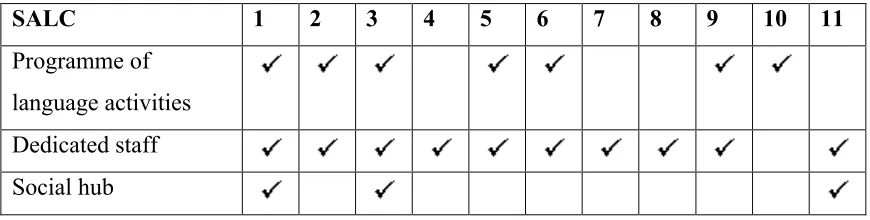
The first strategy used by the majority of centres concerns setting and location. Although this option is subject to building and space restrictions, seven of the centres visited have managed to gather all language related activities, people and spaces within the same area. Having a clearly demarcated ‘language zone’ on campus - whether on the same floor, building or within the same area – allows them to create a defined microcosm where the language is spoken, heard, read and written.
The second strategy observed is to tighten the links with the learners through the presence of dedicated staff. Although restricted by budget, all but one of the SALCs visited employ at least one member of staff whose role is to welcome and guide learners. In the smallest facilities, the same member of staff sometimes doubles up as language advisor, a role which, as mentioned in the previous section, is considered as crucial for the success of SALC facilities (Carson, 2015; Gardner & Miller, 1999; Thornton, 2016). More generally, case studies have stressed that the main issue to consider for the success of SALC as a learning space is institutional approval to ensure the funding for full-time academic staffing (Carson, 2015). The visits confirmed that it is indeed an absolute priority for ten of the centres who make no compromise on this and guarantee that their learners are always welcomed by approachable staff at all time.
228
contribute in making language learning fun and, even more importantly, fostering connections between learners: ‘the students come here to meet their friends too and, to me, the fact that they do other things here than learning a language is a success in itself’ (SALC 3). To
enhance the attractiveness of the facility, three SALCs provide students with additional social zones. These take the forms of rooms (SALCs 1 and 11) and open areas (SALC 3) with equipment such as coffee machines, kitchenettes, pool table, table tennis table or even board games. One of the managers notices how ‘students hang out here and the place is just more alive. It is obvious to see that they enjoy coming here and find other things than just
educational support’ (SALC 11).
Table 2. Facilities Fostering a Community of Learners
SALC 1 2 3 4 5 6 7 8 9 10 11
Programme of language activities Dedicated staff Social hub
Mission and Values: A Strong Pedagogical Rationale
When the number of language students increased in the 1990s, SALCs became one of the responses to the resourcing difficulties by providing mass learners with the opportunities and skills traditionally available to smaller groups of learners. By encouraging student
resilience and independence, SALCs promote the development of personal learning strategies and metacognitive knowledge (White, 2008) and cater for a greater variety of learners’ needs (Esch, 1994). The uncontrolled facility notwithstanding, all ten managers of a controlled facility state that their main objective is to support students in practicing and taking control of their language learning. In their own words, they all describe their centre as a dedicated and specialised environment where language is practiced among a physical community of learners and with specialised technologies, material and guidance. Through a SALC, students have more regular contact with the language and develop their own learning strategies with various degrees of independence. One of the managers explains that ‘the centre recreates more
authentic and playful possibilities to listen, speak and practice written language and gives confidence and regular practice to students’ (SALC 5). The fact that SALCs give more
229
up by an investigation carried out at the Chinese University of Hong-Kong, which found that ‘there is a need for learners to come to a certain time, to a certain room’ in order to practice and study their target language (Fung-Kuen Lai, 1994). The social interactions made possible by the SALC environment are also shown to constitute the ‘right mix of linguistic,
sociolinguistic, sociocultural and strategic competences’ needed for proficiency to take place (Alvarez & Garrido, 2001). Although SALCs are not authentic native environments, they undeniably constitute an immersive space where language linguistic, cultural and social encounters can happen.
Arising Challenges
The first noteworthy issue arising from the in-depth interviews is that of the place and running of the facility within the home institution. Six of the centres visited function
independently from the language unit of their institution. It is surprising to see that the majority of SALCs do not function in liaison with the institution’s language degree provider, but this confirms that there is a “particular philosophy within language departments which does not count language teaching among its main concerns” (Ife, 1994, p. 69). Three of the managers expressed a desire to work on closer pedagogical links with their language department and yet only three of the facilities work in full connection with their language department. SALC 1 is for instance in charge of delivering the credit-bearing language classes of the modern language department. SALC 7 is fully integrated in the language degree
curricula through summative independent work to be carried in the centre. This work is set through a system of compulsory hour of SALC attendance towards the completion of assessed language portfolio. Students are familiarised with the use and benefits of SALC 7 during induction sessions in year 1. Thereafter, the centre becomes a key place where they carry out independent or guided work, submit their language work, take their oral and aural tests and work in connection with the language counsellor.
230
investment in the facility’ (SALC 2). Latest research on the management of SALCs has indeed pinpointed the inconsistency between the recognition of the pedagogical importance of language centres and the minimal effort made to define and provide training for the
management (Gardner & Miller, 2014). A prime example of this is SALC 10 which was abandoned after a start-up grant helped set it up and has since run as an unmanned facility receiving no internal funding. The mission, pedagogical use, and potential future of SALC 10 have not been identified at any level, and yet the home language unit markets the facility as a key space for language studies during open days. Behind the scenes, this uncontrolled facility is surviving thanks to the good will and time of some of the languages tutors who organise its running with the help of students and try to place funding bids to maintain or improve the facility.
Overall, only three of the managers express that they feel confident that their facility will continue to exist and run in the future. SALC 3 is an unusual case in that it has benefitted from the full financial and moral support of its institution from the very start. The manager admits that this support is down to the individuals currently in charge in the immediate hierarchy, and explains that since they obtained a substantial start-up grant in the 2000s, the centre has been given a full dedicated building and ongoing funds to maintain it and employ staff on a permanent basis. Although the manager of SALC 3 has to make a case for
additional one-off expenses, they usually obtain the funds needed to upgrade the facility according to learners’ needs and wellbeing. For instance, expensive soundproof glass doors have recently been installed to create a sense of space and harmony between the various activity rooms, while preserving the confines of each one. This is a rare case where a UK institution fully supports a SALC. Indeed, other facilities are supported in spirit, but have a lot more trouble justifying their legitimacy. SALC 5 also runs with confidence in their future but has gone through a long series of steps to become an independent accredited business. It now runs semi-independently from its institution, a necessary step to secure its autonomy.
In comparison to the support of facilities which encourage autonomous
experimentation and learning in other disciplines (such as labs in science departments), facilities such as SALCs in humanities disciplines struggle to convince and ensure their maintenance. All the facilities visited have had to find creative ways to ensure their
231
non-credited language classes and embark on advertising campaigns to ensure that students keep coming through their doors.
Because they do not benefit from central or national regulations, the majority of SALCs currently survive because they are backed by some individuals in the internal hierarchy. They are therefore at the mercy of restructuring. Changing institutional and planning priorities currently translate into the loss of valuable physical space and staff. The managers of four SALCs are concerned that this results in ‘unstable and precarious positions’ which are described as ‘a day to day preoccupation for most of the staff employed’ (SALC 4). The language advisor and sole remaining staff of SALC 8 feel that they still have a sense of identity as a language resource area, but explain that their facility was reduced over time as part of the institution’s strategy to ‘enhance the student experience’. Similarly, the former manager of a now disappeared structure indicates that ‘financial reasons, and by that I mean the university wanting to cut costs on non-recruiting areas’ (SALC 12) was the key reason to discontinue the facility.
In this context, accountability is a key challenge for structures whose mission is not to increase the student population but to support the learning of existing students. All the
facilities have to demonstrate at institutional level that “the resources (both human and
material) are being well used and that results are being achieved” (Gardner & Miller, 1999, p. 80). Four of the facilities visited conduct regular evaluations by seeking staff and users’ feedback, keeping learners’ profiles and tracking progress records. They do so not only to assess and adapt to learners’ changing demands, but also to record and provide evidence of their achievements. As suggested by the former manager of a now disappeared centre, this is a way to claim the ‘maybe invisible and yet very real role we play[ed] in giving students their confidence back and certainly in preventing them from falling behind’ (SALC 12).
Even for the facilities which are not threatened by a reduction of their space, keeping a physical presence is becoming a challenge at a time where e-learning fosters radical changes. Most managers agree that they ‘must participate in learners’ training to use new technologies’ (SALC 1) and that ‘virtual extensions will widen the access and efficiency of the physical space’ (SALC 2). Undeniably, SALCs must participate in training learners to use new technologies; however, they are aware that ‘an online extension which makes sense
232
because many pedagogical outcomes could not be obtained by a sole virtual space’ (SALC 5). Making the case for the maintenance of a comfortable physical SALC is consequently a great challenge when institutions prioritise other areas and push towards the virtualisation of SALC on grounds that are often not pedagogical.2
Conclusions
From eleven visits and twelve in-depth interviews, this project has allowed me to better grasp the current landscape of SALCs and to identify the current challenges
encountered by these facilities. SALCs are varied and pedagogically meaningful facilities: they constitute a dedicated and safe physical environment where students can study and practice a foreign language. By offering specialised technologies, resources, human guidance and a variety of learning methodologies they adapt to a wider-range of students and can be seen as champions for learning accessibility. They also have a strong cultural, intercultural and social role to play and have the potential to enhance a variety of personal and transferable skills for students. However, these units do not add to the student population. Their principal challenge currently lies in the uncertainty of their future or, at the very least, the energy to be spent in a constant battle to justify their existence. By exposing an urgent need to research, rethink and claim the values of SALC, this project hopes to become a useful starting point for further research on SALC. It should also be of interest for a variety of stakeholders looking at the current position of SALC in UK universities or having to reflect on the development or future of a particular facility.
Notes on the Contributor
Marion Krauthaker is a Lecturer in French and Francophone Studies. Originally specialising in gender studies and literature, her position of Languages Coordinator at the University of Leicester led her investigate Modern Languages as a discipline and, in particular, pedagogical issues linked with the learning of a language in the current neoliberal educational and political UK context.
233
References
Allhouse, M. (2015). Room 101: A movement towards social learning spaces? A survey of SAC managers in UK higher education. Studies in Self-Access Learning Journal, 6(1), 124-137. Retrieved from https://sisaljournal.org/archives/mar15/allhouse/
Alvarez, I., & Garrido, C. (2001). Strategies for the development of multicultural competence in language learning. In J. A. Coleman, D. Ferney, D. Head, & R. Rix (Eds.),
Language learning futures: Issues and strategies for modern language provision in
Higher Education (pp. 150-163). London, UK: CILT.
Carson, L. (2015). Human resources as a primary consideration for learning space creation. Studies in Self-Access Learning Journal, 6(2), 245-253. Retrieved from https://sisaljournal.org/archives/jun15/carson/
Esch, E. (1994). Self-Access and the adult language learner. London: CILT.
Fung-Kuen Lai, E. (1994). Keeping contact with learners. In E. M. Esch (Ed.), Self-access
and the adult learner (pp.146-151). London, UK: CILT.
Gardner, D., & Miller, L. (1999). Establishing self-access. Cambridge, UK: Cambridge University Press.
Gardner, D., & Miller, L. (2014). Managing self-access language learning. Hong Kong: City University of Hong Kong Press.
Ife, A. (1994). From continuing to higher education: Open-access learning at Anglia
Polytechnic University. In E. M. Esch (Ed.), Self-access and the adult learner (pp. 68-72). London, UK: CILT.
Murray, G. (2017). Autonomy and complexity in social learning space management. Studies
in Self-Access Learning Journal, 8(2), 183-193. Retrieved from
https://sisaljournal.org/archives/jun2017/murray2/
Murray, G., & Fujishima, N. (2016). Social spaces for language learning: Stories from the L-café. Basingstoke, UK: Palgrave.
Mynard, J. (2012). Does “self-access” still have life in it?: A response to Reinders (2012).
ELTWorldOnline. Retrieved from
https://blog.nus.edu.sg/eltwo/files/2015/10/0411-Does-Self-Access-Still-Have-Life-in-It-v570id.pdf
Mynard, J., & Carson, L. (Eds.). (2012). Advising in language learning: Dialogue, tools and
context. Harlow, UK: Longman.
Reinders, H. (2012). The end of self-access? From walled garden to public park.
ELTWorldOnline. Retrieved from
234
Thornton, K. (2016). Promoting engagement with language learning spaces: How to attract users and create a community of practice. Studies in Self-Access Learning Journal, 7(3), 297-300. Retrieved from https://sisaljournal.org/archives/sep16/thornton/
White, C. (2008). Language learning strategies in independent language learning: An overview. In T. W. Lewis & M. S. Hurd (Eds.), Language learning strategies in
independent settings (pp. 3-24). Clevedon, UK: Multilingual Matters.
Yamashita, H., & Mynard, J. (2015). Dialogue and advising in self-access learning:
235
Social Language Learning Spaces: Globalization Glocalized
iGarold Murray, Okayama University, Japan
Mariko Uzuka, Okayama University, Japan
Naomi Fujishima, Okayama University, Japan
Abstract
In this era of globalization, Japanese universities will have to accommodate an increasing number of local students wishing to learn foreign languages and they will also have to welcome more international students to their campuses. While
universities will undoubtedly take steps to ensure that both groups have positive educational and intercultural experiences, we contend that it is also incumbent upon them to implement measures designed to facilitate the adaptation of international students to Japanese society. In this article, we examine the role social learning spaces can play in helping universities respond to these challenges. We argue that these facilities can make an invaluable contribution by supporting language learning and cross-cultural acclimatization for both international and Japanese students. The term social learning spaces refers to places where students can come together in an informal or quasi-formal environment in order to learn from and with each other. To illustrate our points, we draw on the data from a five-year ethnographic inquiry carried out at one such facility on the campus of a large national university. After describing the social learning space, outlining the study, and tracing the theoretical orientation guiding the interpretation of the data, we focus on the benefits social learning spaces can afford international students wishing to improve their language skills and adapt to Japanese society. To conclude, we reflect on how social learning spaces can support the process of glocalization by making local universities more globalized places.
Keywords: Affordances, complex systems, emergence, glocalization, Japanese as a foreign language, social learning spaces
236
Social learning spaces are places where learners can come together to learn with and from each other. In the case of social learning spaces for language learning on the campuses of Japanese universities, they are places where Japanese and
international students can meet, make friends, practice their target languages and gain firsthand knowledge about other cultures and their people. They are important
because they embody globalization being realized through action on a local level, a unique form of glocalization.
Over a five-year period, we carried out an ethnographic inquiry into a social learning space, the L-café – and its predecessor, the English Café – located on the campus of a large national university in Japan. We have been investigating this environment by conducting interviews with students, administrators and teachers, and by having senior students trained as research assistants carry out participant
observation. As a result, our data consists of roughly 150 interview transcripts and reports documenting over 1000 hours of participant observation. The results of a thematic analysis of this data has served as the basis for numerous conference presentations and publications in which we examined how the learning opportunities available in this environment benefitted Japanese who wanted to learn to speak English (Murray & Fujishima, 2013; Murray, Fujishima & Uzuka, 2014; Murray, Fujishima & Uzuka, forthcoming). In this article we focus on how participation in the social learning space can benefit international students wishing to improve their Japanese language skills. However, we begin by describing the learning space and discussing some of the theoretical notions that guided our interpretation of the data. To conclude, we consider the possible implications for language learning on
campuses in Japan and the globalization of Japanese universities.
The L-café