www.ijsernet.org Page 26
URBAN TOURISM DEVELOPMENT: NAIROBI DESTINATION CHOICE
ATTRIBUTES
1. Muhoro, Grieveesbon Mwangi, Department of Hospitality and Tourism Management,
Technical University of Mombasa
2. Okello, Moses. M., School of Field Studies, Amboseli
3. Wishitemi, Bob E.L., Deprtment of Tourism, Moi university
ABSTRACT
There are dynamic changes in the world of travel; visitors are continually seeking for new and exciting vacations. Decision to visit on destination is shaped by a variety of factors including their safety. Thus there is need to study vacation traveller behaviour, including where individuals travel on vacation and what travel mode they use to get there. The paper builds on existing literature on some of the key destination choice attributes and how they shape travellers. Results indicate that visitors were satisfied with the wellness and conference offer. The empirical results indicate not only the important of the effects of age, visitation frequency, average number of nights in Nairobi and the cost of the destination but the results have important policy implications not only for Nairobi, but within the region
Key words: Urban Tourism, Development, Destination Choice Attributes
Introduction
Jafari (1989) pointed out that there are two major components of tourism in destinations, that is tourism destinations which comprise of the attractions, local transport, accommodation sector, accessibility and the visitors (tourist) themselves. Both tourism destinations and visitors influence each other, especially in the context of choosing a tourist destination. The choice of any tourist destination be it urban or coastal is determined by two factors, namely pull factors and push factors (Pikkemart in Cakici & Harman, 2007:134). Pull factor mainly composed of attributes associated with the destination, they emerge due to the attractiveness of a destination, including beaches, recreation facilities and cultural attractions (Uysal and Jurowski, 1994). Push factors on the other hand consist of personal characteristic Ritchie and Crouch, (2003), they are intrinsic motivators, such as the desire for escape, rest and relaxation, prestige, health and fitness, adventure and social interaction
www.ijsernet.org Page 27 Richards, 1995). Core to the understanding of destination choice by visitors is the search for those personal stimulus/internal factors (psychographic; socio-demographic) and destination attributes (product-related; geographic) which tourism destination suppliers should use to help better define, describe and target current and potential visitor trends and buying behaviours (Godfrey, 1998).
Kenya’s economy expanded by 4.9 per cent in 2017 compared to a revised growth of 5.9 per cent in 2016, this was largely due to the tourism sector (KNBS, 2018). Despite the prolonged electioneering period and negative travel advisories issued by some countries in 2017, tourism was the most resilient recording improvements. Tourism earnings increased by 20.3 per cent from KSh 99.7 billion in 2016 to KSh 119.9 billion in 2017. The number of international visitor arrivals increased by 8.1 per cent to 1,448.8 thousand in 2017 (KNBS, 2018).
According to MasterCard (2016), the top three destinations in Africa are Johannesburg and Cape Town in South Africa and Casablanca in Morocco. Johannesburg received 4.3 million international overnight tourists in 2014. Johannesburg tops international visitor expenditure in Africa, with visitors spending a considerable amount in excess of US$3.2 billion in 2014, as compared to US$3.06 billion in 2013 (MasterCard, 2014). International visitor expenditure could be attributed to continued high demand for concentration in air travel, for both personal and business motivations.
Nairobi destination has been receiving a proportionate number of visitors due to the rich cultural, wildlife and leisure offers in the destination. The numbers have been relatively low since 2013 (Figure 1) due to British and USA travel advisories to the country, the Al-Shabaab attack on Westgate mall on 21st September 2013 and the deteriorating economy after an electioneering period earlier in March 2013. Nairobi, destination received 618,506 international visitors in 2014, an 8.1 percent increase from 2013‘s 568,266 visitors. Travelers to Nairobi spent US$ 317 million in 2014, compared to US$281 million in 2013 (MasterCard, 2014).Visitors‘ numbers also fell in 2015 also due to insecurity concerns in the country, with the Garissa University College being attacked in April 2015.
Figure 1: JKIA departure trends for the last 8 years
Year 2010 2011 2012 2013 2014 2015 2016 2017
No. Of Tourists
1.06 M 1.03M 1.05M 900,000 743,674 662,789 781,400 863,900
KNBS (2014; 2015; 2017; 2018)
www.ijsernet.org Page 28 different attractions in destinations and specifically Nairobi. However, those studies have not given urban destination a keen look on how destination attributes interact to create a satisfying, and remarkable experience. A small number of destination studies have focused specifically on Nairobi and none has analysed the destination appeal of Nairobi as a tourism destination from an urban tourism perspective. Therefore, this study underscores the need to investigate how existing and potential tourists perceive Kenya and specifically Nairobi as a vacation destination. The current study sought to find out while informing stakeholders and tourism planners on how destination choice attributes interact to create a satisfying urban experience.
Literature review
The organization of urban tourism environment
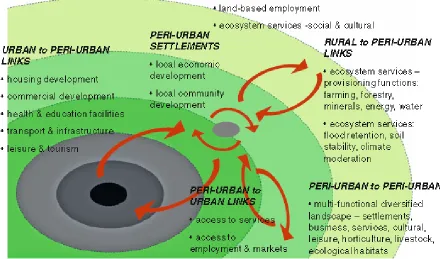
Urban destinations are at the center of a new association linking them to sectors such as culture and creative industries, tourism, cultural tourism and in general urban tourism. The rise and importance of urban tourism are structured/organized around the interlocking themes namely the core, periphery and peri-urban (figure 2). A keen understanding of destination choice attributes must be thought from the three interlocking themes. Adapted from Nielsen, Ravetz & Fertner (2013)
Figure 2. Concept of peri-urban areas
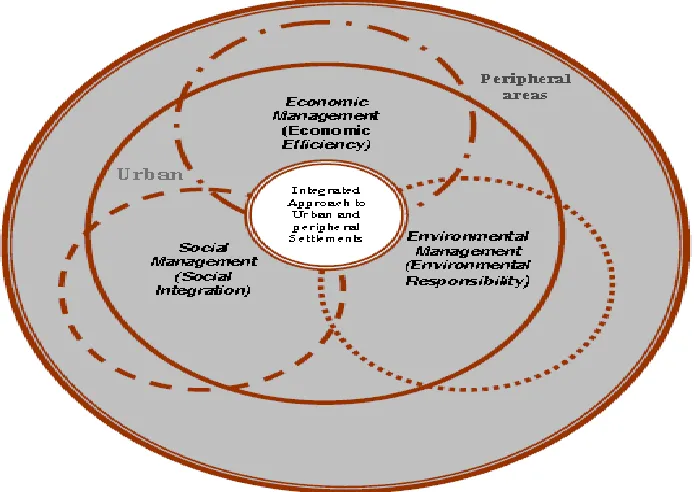
www.ijsernet.org Page 29 essential casinos and nightlife within the CBD. Urban development in the last decades has not only altered the position of urban cores but has resulted in an innovative urban landscape with regional hubs and a modern culture. Urban periphery, on the other hand, is a zone surrounding the central built-up areas (core). The periphery is characterized by an inferior population density, although part and parcel of the urban area (core). The periphery is inclusive of smaller settlements, industrialized areas, and other urban land-uses with an environment agriculture and related land use programmes (Nielsen, Ravetz, & Fertner, 2013). Peri-urban areas may perhaps then be seen as the new tourism locations, rather than those “areas on edge of the core.” The urban-periphery interactions affect the socio-cultural, economic and environmental condition (Figure 3). Nairobi city periphery areas are those within its edges or those outside the CBD. Such landscapes include the only national park in the city Nairobi National Park (NNP), leisure sites such as Ngong Forest, Karura Forest, and cultural sites such as Bomas of Kenya (BoK) among others. Urban-periphery areas surrounding Nairobi city carry the bulk of attractions that are chosen by international visitors within the research area.
Figure 3: Integrated policy in urban centers and peripheral settlements
Adapted from Taherkhani, Eftekhari & Taghvaee (2009)
www.ijsernet.org Page 30 planning. Peri-urban’ or peri-urbanization definitions are frequently used to illustrate newly urbanized areas at the outer edge of cities. This common reference is especially in developing countries, which also refers the areas as ‘peri-urban interface’ (McGregor, Simon, & Thompson, 2006). The peri-urban area is when the urban area extends into the rustic rural countryside so that it can be an important territory in the area. Thus, the peri-urban area must be understood further in the context of the broader extension between thick urban core and rural countryside while at the same time examining the area in the framework of the more large city area or the larger rural-urban region (Nielsen, Ravetz, & Fertner, 2013). These rural-urban frameworks which take place outside the urban cores can be termed as peri-urbanization. This peri-urbanization includes other transformations, such as movements for commuting or recreation as well as other behavioral changes. These movements cause behavioral changes by old as well as new countryside residents. These behavioral changes cause further assimilation of the rural area in the system of an urban district. Thus, peri-urban change is as a result of direct urban expansion (Figure 4).
Figure 4: Dynamics of the Peri-urban and urban expansion
Adapted from Nielsen, Ravetz & Fertner (2013)
www.ijsernet.org Page 31 rural countryside include recreation & tourism and environment that include socio-cultural services. Services such as aesthetics, amenity, recreation and cultural identity are socio-cultural. In the local community, there are relationships of investment, access to services and employment. The consumption of culture affects the character and perceptions of peri-urban areas through recreation, leisure, and tourism (Nielsen, Ravetz, & Fertner, 2013).
Peri-urban large areas are open to a variety of possible exploitations including – sightseeing for tourists, real estate housing, business sites, agribusinesses, ecosystem conservation, flood mitigation and/or power production and supply. In peri-urban areas, there are also historical, residential, economic, and ecological attributes competing with each other together with urban residents. These interactions seek to preserve their value of existence by restricting further expansion which will affect their environment negatively (Nielsen, Ravetz, & Fertner, 2013).
Urban destination attributes
Reutsche (2006) analyzed the relationship between urban destinations and tourism. The author made a distinctive difference between the primary (core), secondary (supporting) and additional attributes of the urban tourism (Figure 2.1). The primary attributes characterize the fundamental reasons that draw visitors towards the cities. Primary elements include 1) the core attractions and activities in an urban setting that includes a) cultural amenities and services: museums and art galleries; theatres and movie business places; as well as other related attractions; b) sports activities: indoor or outdoor; and c) entertainment activities: casinos and lotteries; organized cultural events; festivals. 2) It also includes places for the passing of recreation and leisure time: historical places; old and new buildings; old statues and monuments; parks and reserved areas; waterways.
Primary and secondary attributes increase the curiosity of tourists to visit cities and they play an essential role in increasing tourism attractiveness (Gârbea, 2013). In a city, one can distinguish a series of primary and secondary attributes. Primary attributes consist of a combination of attraction considered distinctive that belong to the public realm. These primary attributes are the underlying motivation of visitors to visit in urban areas. In this regard, they can be said to include cultural and creative activities, sporting activates, cultural festivals and events planned for entertainment and leisure activates.
www.ijsernet.org Page 32 Figure 5: The tourist city
Adapted from Van den Berg, Van Der Borg, & Van Der Meer (1995)
www.ijsernet.org Page 33 do clear signage, clear maps, and legibility. v) Image – the image of any given city is of considerable influence to tourist psychological factors when visitors decide where to visit urban destinations (Urry, 1999). Tourists to urban destinations will almost certainly prefer a destination with a good favorable image.
Methods and materials
Nairobi destination is suitable for both business and pleasure since numerous activities and experiences would suit any visitor. It is commonly referred to as the safari capital in a world which is in tune with nature. There are diverse attractions in Nairobi destination including but not limited to religious facilities such as mosques, gurdwaras, temples, and churches within the city. Further, Nairobi is house to diverse monuments, sites museums, plus magnificent hotels ranging from the luxury 5 star to the unrated hotels, to provide for all diverse visitors (Magical Kenya, 2014). Nairobi County is a key center of urban tourism within the region. Its comparative closeness to majority tourist attractions both in Kenya and in the EAC region creates a resource base and is of great significance in the tourism industry. As the capital City of Kenya and commercial center, it attracts many international people in business and leisure tourists (bleisure tourists). Bleisure is a new trend and is a situation where visitors are adding personal leisure days to his or her business trip. According to Hobson & Ciobanu (2016) every year since 2011, 20% of business travelers worldwide take bleisure trips, accounting for 7% of all business trips. A bleisure 2014 report indicates that 83% of respondents use times on business trips to explore the city they are visiting while most popular bleisure activates include dining, arts/culture, and sightseeing (Bridgestreet Global Hospitality, 2014).
The subjects of interest in this study for consisted of departing tourists through JKIA; departing tourists have divergent views, experiences and satisfaction rates about urban attractions. The choice of departing visitors through JKIA is also crucial because of JKIA as the chief point of entry to Kenya by air is found in the County (NCC, 2014). The population under study was defined by the tourists who selected urban destination attractions in Nairobi County and at least spent one night in the destination. All tourists who stayed in Nairobi from January to June 2017 and departed through JKIA from 10am to 12pm were included in the study. The population under study was poised to be infinite as the numbers of visitors entering the country are uncertain, but projections of an imaginary population were used in the research.
Results and discussion
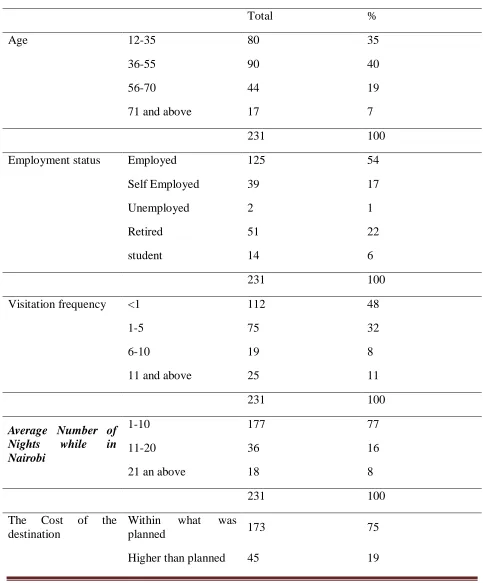
www.ijsernet.org Page 34 Table 1: demographic information
Total %
Age 12-35 80 35
36-55 90 40
56-70 44 19
71 and above 17 7
231 100
Employment status Employed 125 54
Self Employed 39 17
Unemployed 2 1
Retired 51 22
student 14 6
231 100
Visitation frequency <1 112 48
1-5 75 32
6-10 19 8
11 and above 25 11
231 100
Average Number of
Nights while in
Nairobi
1-10 177 77
11-20 36 16
21 an above 18 8
231 100
The Cost of the
destination
Within what was
planned 173 75
www.ijsernet.org Page 35
Lower than planned 13 6
231 100
Visitors were requested to indicate their frequency in the destination, majority 48% indicated that it was their first time to be in the destination, while 75 respondents indicated they have been to Nairobi between 1 to 5 times in the past. KNBS (2018) shows that the average number of nights while in Kenya was 13 days, the study sought to find out the average number of days while in Nairobi. The majority of visitors were in Nairobi between 1-10 days (77%), while 8% stayed for more than 21 days. The research also sought to find out from the visitors the cost of the destination, 75% indicated that the cost was within what they had planned while 6% felt that the cost was lower than what they had planned.
Destination Choice attributes
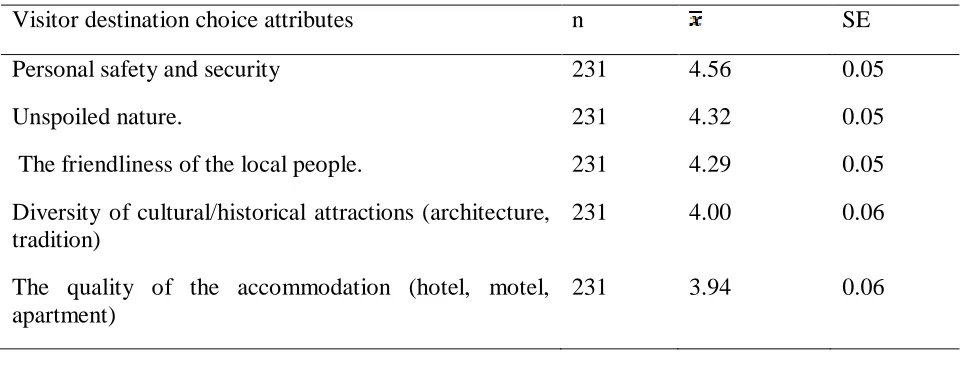
On a scale of 5 respondents were asked to rate destination choice attributes before visiting Nairobi destination. The destination attributes were measuring how important the 19 statements were important to the respondents (Table 2). Among the lowest destination attributes expected before the visitors visited the destination included ‘Casino and gambling offer ( =2.34, SE = 0.12) despite the destination having over 50% of casinos in the country, conference offer ( = 2.87, SE = 0.12) yet the destination is known for MICE and business travel, thermal spa offer (this is when visitors want to achieve better health while on holiday through relaxation, exercise or visits to spas, including thermal spas, that of also known as medical tourism) ( = 2.66, SE =0.11) and wellness offer (Travel for the reason of encouraging health and well-being through physical, psychological, or spiritual activities such as yoga) ( = 2.87, SE = 0.11). The highest rated attributes include personal safety and security ( = 4.56, SE = 0.55), unspoilt nature ( = 4.32, SE = 0.05) and friendliness of the local people ( = 4.29, SE = 0.05)
Table 2: Destination choice attributes
Visitor destination choice attributes n SE
Personal safety and security 231 4.56 0.05
Unspoiled nature. 231 4.32 0.05
The friendliness of the local people. 231 4.29 0.05
Diversity of cultural/historical attractions (architecture, tradition)
231 4.00 0.06
The quality of the accommodation (hotel, motel, apartment)
www.ijsernet.org Page 36
The overall cleanliness of the destination. 231 3.92 0.06
Climate conditions. 231 3.90 0.06
Local cuisine. 231 3.85 0.06
The destination can be easily reached. 231 3.81 0.06
The organization of the local transportation services. 231 3.80 0.07
The offer of cultural and other events. 231 3.78 0.08
Opportunity for rest. 231 3.66 0.07
The availability of sports facilities and recreational activities.
231 3.32 0.10
Shopping facilities. 231 3.10 0.08
Night life and entertainment. 231 2.97 0.10
Conference offer 231 2.87 0.12
Wellness offer. 231 2.87 0.11
Thermal spa offer. 231 2.66 0.11
Casino and gambling offer. 231 2.34 0.12
Author (2017)
www.ijsernet.org Page 37 These results are supported by WEF (2017) report on T&T competitiveness. Kenya was placed at position 80 in T&T competitive economy out of 136 economies. Kenya’s security was ranked the poorest with the index of terrorism incidence, and business cost of terrorism ranked 123rd and 135th respectively. General environmental sustainability in the country was ranked 26th, while natural resources were ranked in 15th place. Cultural resources and business travel were ranked relatively at number 77th. The ranking of position 80th shows that the country needs to improve its security to improve T&T attractiveness and competitiveness in the country. The country has made great strides in environmental sustainability and its natural resources. However, some improvements need to be done in the cultural and business travel.
On the other hand, visitors never expected to find a well articulated and defined nightlife as well as good elaborate entertainment while in the destination. The conference facility offered to respondents was not of such a priority since it was rated poorly. Wellness offer, thermal spa and casino and gambling offer were rated as their least priority index while at the destination. The poor rating on wellness, thermal and gambling showed that visitors expected very little about their offer while in the destination.
Nairobi destination choice attributes
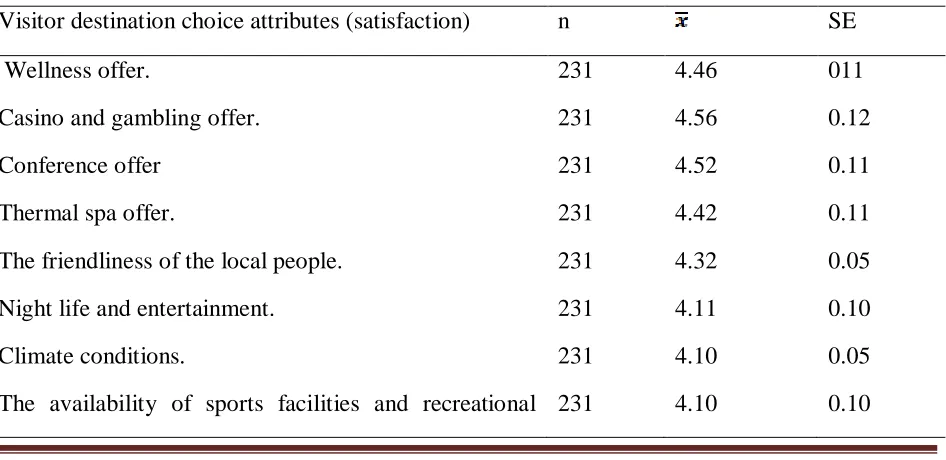
These attributes were measuring visitor satisfaction levels after visiting Nairobi destination. It sought to find out their satisfaction levels about destination attributes. For example, the top five destination choice attribute after visitation were wellness offer, casino and gambling offer, conference facilities, thermal spas and friendliness of local people. The least rated top five destination attributes were as follows the organization of the local transportation services, the overall cleanliness of the destination, personal safety and security, un-spoilt nature and accessibility of the destination.
Table 3: Nairobi destination choice attributes
Visitor destination choice attributes (satisfaction) n SE
Wellness offer. 231 4.46 011
Casino and gambling offer. 231 4.56 0.12
Conference offer 231 4.52 0.11
Thermal spa offer. 231 4.42 0.11
The friendliness of the local people. 231 4.32 0.05
Night life and entertainment. 231 4.11 0.10
Climate conditions. 231 4.10 0.05
www.ijsernet.org Page 38 activities.
The offer of cultural and other events. 231 4.06 0.10
The quality of the accommodation (hotel, motel, apartment)
231 3.97 0.06
Diversity of cultural/historical attractions (architecture, tradition)
231 3.93 0.07
Local cuisine. 231 3.90 0.18
Opportunity for rest. 231 3.83 0.08
Shopping facilities. 231 3.81 008
The destination can be easily reached. 231 3.71 0.06
Unspoiled nature. 231 3.65 0.07
Personal safety and security 213 3.47 0.07
The overall cleanliness of the destination. 231 3.23 0.07
The organization of the local transportation services. 231 3.10 0.09
Author (2017)
Nairobi destination choice attributes were testing how visitors felt after visit ing the destination. Among the 19 statements, the highest rated attributes were ‘Casino and gambling offer ( = 4.56, SE = 0.12) despite being the lowest rated attribute before travel to the destination. Visitors who visited the destination found casino and gambling offer to be readily available and within the hotels they were residing in. The second highest attribute was conference offer ( = 4.52, SE = 0.11) despite being the last fourth rated attribute by visitors before visiting the destination. This shows that business visitors were satisfied by the conference offer while in the destination. The third highest rated attribute was wellness offer ( = 4.46, SE = 0.11), this attribute was rated the third lowest attribute by visitors before visiting the destination. This implies that visitors visiting Nairobi are aware and make choices towards a healthy and fulfilling life and that the destination promotes physical, mental and social wellbeing through promotion of wellness foods such as eating more vegetables
www.ijsernet.org Page 39 rated 6th before visitors toured the destination. This was reinforced by a study conducted by Tabaijuki (2007) titled ‘Nairobi and its environs’ found out that the major challenges faced by Nairobi city and its residents include rapid urbanization, informal settlements, air and water pollution, water supply and sanitation, and solid-waste management. The third lowest attribute was on spoilt nature ( = 3.65, SE = 0.07). This also reflected by Tabaijuki (2007) who also noted that Nairobi’s physical development has come at the cost of the natural environment. The spread of urban development through the construction of expansion roads and other city infrastructure has resulted in the loss of land cover and other natural areas, such as mixed rangeland and bush lands.
Of the 19 attributes, only 6 attributes destination choice attributes were rated below visitors’ importance levels at Nairobi destination. They include personal safety and security at ( = 3.47), while visitors importance level was at ( = 4.56), the destination can be easily reached ( = 3.71) while visitors importance level was at ( = 3.81), overall cleanliness of the destination ( = 3.23) while visitors importance level was at ( = 3.92). Nairobi destination can be said to meet and exceed visitors’ expectation levels, because their expectations on destination attributes are met and exceeded.
These results show that visitors visiting Nairobi destination have little or no information about the destination. The Kenyan destination has always been known for wildlife and safari tours. Visitors were not sure of the security, environment, friendliness of local people, diversity o f cultural and historical attractions and the quality of accommodation. However, visitors were impressed once they came to the destination and found other attributes that were far much better than the marketed and known attributes. In addition, all the lowest rated destination choice attributes that is gambling and casino, thermal and spa, wellness, conference and entertainment and nightlife were rated very positively by the tourists. The reasons that could have influenced a change in the perceptions is that (1) Half of the Casinos in the country are found in Nairobi (2) After 2016 classification Nairobi has eight the 5-star hotels and eight 4-star hotels has a combined bed capacity of 5,700 beds and 122 unclassified hotels offering diverse services (3) the diverse hotels offer conferencing facilities on top of KICC. There are nine facilities that can accommodate 1,000 to 2,500 delegates in one sitting (Conference Place, 2018)
Conclusion
www.ijsernet.org Page 40 References
Bridgestreet Global Hospitality. (2014). The bleisure report 2014 . Retrieved 3 9, 2018, from bridgestreet.com : https://skift.com/wp-content/uploads/2014/10/BGH-Bleisure-Report-2014.pdf
Calantone, R. and Johar, J. (1984) ‘Seasonal Segmentation of the tourism market using a benefit segmentation framework’, Journal of Travel Research, Vol. 23, No. 2, pp. 14–24;
Chang, C., Milne, T. S., Fallon, D., & Pohlmann, C. (1996). Urban heritage tourism: The Global-local nexus. Annals of Tourism Research, 23, 284-305.
Conference Place. (2018). Conference .Place. Retrieved 3 9, 2018, from
http://www.conference.place/tafuta/?d=grid&l=nairobi&c=1000 Conforti, J. M. (1996). Ghettos as tourism attractions. Annals of Tourism Research, 23, 830-842.
Gârbea, V. R. (2013). Urban Tourism Between Content And Aspiration For Urban Development. Management&Marketing, 9 (1), 193-201.
Godfrey, K.B (1998) attributes of destination choice: British skiing in Canada. Journal of Vacation Marketing, vol. 5, No.1, pp 18-30
Hobson, R., & Ciobanu, C. (2016, July). A Quantitative look at the bleisure phenomenon. .
Retrieved 3 9, 2018, from CWT solution group :
https://www.carlsonwagonlit.com/content/dam/cwt/pdf/insights/20160712-solutions-group-white-paper-bleisure.pdf
Hunt, J. (1975) ‘Image as a factor in tourism development’, Journal of Travel Research, Vol. 13, No. 3, pp. 1–7;
Judd, D. R. (1995). Promoting tourism in US cities. Tourism Management, 16, 175–187. KNBS. (2018). Economic Survey 2018. Nairobi: KNBS.
Law, C. (2002). Urban Tourism – The Visitor Economy and the Growth of Large Cities. EMEA: Thomson Learning.
Magical Kenya. (2014). 48 hours in Nairobi. Nairobi: Margical Kenya.
MasterCard. (2016). Global Destinations Cities Index. Mastercard worldwide insights.
MasterCard. (2014). MasterCard 2015 Global Destinations Cities Index. Mastercard worldwide insights.
McCarthy, J. (2005). Cultural quarters and regeneration: The case of Wolverhampton. Planning, Practice & Research, 20, 297-311.
McGregor, D., Simon, D., & Thompson, D. (2006). The peri-urban interface: approaches to sustainable natural and human resource use. London: Earthscan.
Montgomery, J. (2003). Cultural quarters as mechanisms for urban regeneration: Conceptualising cultural quarters. Planning, Practice & Research, 18, 293–306.
Montgomery, J. (2004). Cultural quarters as mechanisms for urban regeneration: Areview of four quaters in the UK, Ireland and Australia. Planning, Practice & Research, 19, 3-31. Mullins, P. (1991). Tourism urbanization. International Journal of Urban and Regional
Research, 15, 326-342.
www.ijsernet.org Page 41 Nielsen, S. T., Ravetz, J., & Fertner, C. (Eds.). (2013). Peri-urban futures: Scenarios and models
for land use change in Europe. Berlin Heidelberg: Springer-Verlag.
Page, S., & Hall, C. (2002). Managing urban tourism: themes in tourism. Harlow: Prentice. Popescu, I. (2008). Promoting the urban touring destinations by implementing the total quality
Maagement. Transylvanian Magazine of Administrative Scences, 1 (21), 105-124. Reutsche, J. (2006). Urban Tourism: What Attracts Visitors to Cities? Let`s Talk Business , Issue
11 7 May 2006.
Richards, G. (1995b) ‘The UK Ski Market: determinants of destination choice and skilled consumption’, in D. Leslie (ed) Tourism and Leisure: Towards the Millennium, Vol. 1, Leisure Studies Association Publications, No. 51, pp. 193–210.
Richards, G., & Wilson, J. (2007). Tourism, creativity and development. London: Routledge. Spirou, C. (2011). Urban tourism and urban change : cities in a global econom. Routledge:
Taylor & Francis.
Tibaijuka, A. (2007). Nairobi City Development Strategy Top Priority for 21st Century Future of the Kenyan Capital. Retrieved September 02, 2017, from United Nations Environment Programme:
http://www.unep.org/documents.multilingual/default.asp?documentid=504&articleid=5 564&l=en
Taherkhani, M., Eftekhari, A. R., & Taghvaee, A. A. (2009). Analysis on Effects of Urban Centers on Peripheral Settlements in Iran. International Journal of Humanities , 16 (2), 129-146.
Urry, J. (1999). Sensing the city. In D. R. Judd, & S. S. Fainstein (Eds.), The Tourist City (pp. 71–88). New Haven: Yale University Press.
Van den Berg, L., Van Der Borg, J., & Van Der Meer, J. (1995). Urban Tourism: Performance
and Strategies in Eight European Countries. Rotterdam: Hampshire/Erasmus
University.