Manar M., et al…. -
208-STUDY OF TOXIC EFFECT OF METHIMAZOLE ON THE CORTICAL
STRUCTURE OF ADULT MALE ALBINO RATS KIDNEYS AND THE
AMELIORATED EFFECT OF THYROXIN
Manar Mohammadi Khatab, Mohey Al Said Hulail, Abdelmonem Awad Hegazy, Heba Osama Mohammed*
Anatomy and Embryology Department, Faculty of Medicine, Zagazig University
ABSTRACT
Kidney and thyroid functions interact with each other. Drugs used in treatment of any of them could have side reactions on any other organ. The effects of antithyroid medications on extrathyroidal organs could be due to oxidative stress and to damage in the renal cells.
Aim: This work is designed to demonstrate the role of T4 in protection against the increase in oxidative stress caused by methimazole, and to detect if antithyroid drug-induced hypothyroidism (methimazole) or removal of thyroid by surgery causes damage of kidney cells or not.
Methods: Twenty-five healthy adult male albino rats were used in the study. The animals were randomly separated into groups. Each group contained five rats: Group I (control group): This group received no drugs or treatment. Group II included rats with false thyroidectomy. Group III included thyroidectomized albino rats. Group IV included methimazole-induced hypothyroidism albino rats through receiving 60 mg/kg/day of methimazole in drinking water. Group V were administered methimazole (60 mg/kg/day) and l-thyroxine (T4) subcutaneous injection (20 μg/kg/day).The animals were anasethized and their abdomens were opened and both kidneys were removed, and immediately processed for histological & immunohistochemical study. Also oxidative enzymes were estimated.
Rresults:Light microscopic examination of H&E stained sections showed marked damage of the structure of renal cortex in methimazole induced hypothyroidism group. This damage was concomitant with a decrease in kidney antioxidant enzymes. This damage was less pronounced in group of rats administrated T4 in association with methimazole. The cortex of kidney in rats of thyroidectomized group did not show any alterations in its micro structure.
Conclusion:Methimazole causes both of hypothyroidism and alteration of the kidney cortex. This alteration is not noticed in case of surgical thyroidectomy inducing hypothyroidism. L-Thyroxine (T4) could decrease the effect of methimazole on kidney cortex.
Keywords:Methimazole, hypothyroidism, thyroidectomy, kidney cortex.
*Corresponding author: Heba Osama Mohammed
E-mail:[email protected]
INTRODUCTION
he kidney is an important organ with great complexity in its structure and functional variety. It gets ride of nitrogenous waste and keeps the volume, composition, pressure of the blood, and the density of the bones [1].
Hormones of thyroid gland have a vital role in the physiology, differentiation and development of any organism [2].
There are interactions between renal and thyroidal functions [3]. Dysfunction of thyroid results in disturbance of kidney functions and development, while renal disease can cause dysfunction of thyroid. Renal disorders and thyroid dysfunction may coexist with same causes [4]. Moreover they add that decrease of thyroid hormones can disturb blood pressure and is accompanied with decrease in glomerular filtration, hyponatremia, and
change in the excretion of water. Thionamides are antithyroid drugs which are simple molecules and have a thiourea moiety and a sulfhydryl group within a heterocyclic structure. Their main function is to inhibit synthesis of thyroid hormone by interacting with vital step in triiodothyronine and thyroxine synthesis which is iodination of tyrosine in thyroglobulin [5].
This antithyroid drug may cause antioxidant imbalance [6]. Moreover, methimazole increases free radicals production and decrease the capacity of the antioxidative protection, so it is accompanied with oxidative stress [7, 8].
Manar M., et al…. - 209-proteins, and DNA fragmentation are caused
by activated oxidant system [9, 10].
Antithyroid drugs produce ROS and reactive nitrogen species such as peroxynitrite (ONOO–) which may cause injury of kidney
[11, 12].Such drugs also cause elevation of
malondialdehyde which are significantly less in rats with low thyroid hormones than with normal level of thyroid hormones [13].
The protective role of hypothyroidism against kidney injury is clear. The increased release of antioxidant enzymes as superoxide dismutase (SOD), glutathione peroxidase (GPx), and catalase (CAT) has been found to decrease kidney damage [14, 5].
The thyroid hormones have role on the control of the cell cycle, so that in methimazole treated rats in combination with T4, the injury of renal cortex is less pronounced [15]. So, this work was designed to demonstrate the role of T4 in protection against the increase in oxidative stress caused by methimazole, and to detect which of hypothyroidism induced by drugs or by surgery can cause injury of renal cortex cells.
MATERIALS AND METHODS
Drugs
The drugs used in the present study were: Methimazole (pharmaceutical company,
Egypt) with dose (60 mg per kilogram per day in drinking water) [16].
T4 injection (Sigma Chemical Co., UK) with dose (20 ug/kg/d sc) [7].
Experimental animals
Twenty five healthy adult male albino rats weighting 180-200gm were got from the Laboratory Animals’ Unit at the Faculty of Medicine, Zagazig University were used in this study. All animals were kept under hygienic conditions. Standard food and water were allowed. All rats were handled in accordance to the standard guideline for the care and use of laboratory animal. We separated the rats randomly into five groups:
Group I (control group) (n=5): no drugs
were given.
Group II (n=5): it underwent false
thyroidectomy and received post-operative treatment.
Group III (n=5): Animals underwent into
thyroidectomy to induce hypothyroidism, Thyroidectomy was done on rats after giving
sodium pentobarbital intraperitoneal (35 mg/kg body weight) [17]. We cut the sternothyroid muscle and expose the trachea then we located parathyroid gland and isolated them from the thyroid gland, and implanted into the surrounding muscle. We dissected out the thyroid gland gently to be careful of laryngeal nerve. After the operation, ketolac (50 mg/kg i.m.) and gentamicin (10 mg/kg) were given to rats for five days to relieve pain and protect against infection [17].
Group IV (n=5): it had rats with
hypothyroidism induced by methimazole, as they were given methimazole in dose of 60 mg/kg/day for 4 weeks.
Group V (n=5): It had rats which were given
l- thyroxine (T4) injection (20μg/kg/day, subcutaneous) and methimazole (60 mg/kg/day) for 4 weeks.
We measured the serum level of the thyroid hormones (T3 and T4) at the end of the treatment to confirm the hypothyroid state. The samples were taken from retroorbital venous plexus and the serum was separated and kept at-40 until measuring which was done by enzyme immunoassay.
Methods
At the end of every stage of the experiment which extended for four weeks, all animals were sacrificed by decapitation, their abdominal cavities were opened both kidneys were removed and immediately processed for light microscopic study.
Measuring the activities of the antioxidant system
A sample from the renal tissue from each animal was homogenized in a polytron (Model PT 2000; Brinkmann, Westbury, New York, USA) for 10 s in cold 50 mmol/l potassium phosphate 0.1% triton X-100 (pH=7.0). The homogenate was centrifuged at 19000g at 4°C for 30 min and the supernatant was separated to measure the activities of the antioxidant enzymes [17, 18].
Light microscopy technique
Manar M., et al…. - 210-um thicknesses were cut by a standard
microtome then stained with H&E. Immunohistochemical technique
Immunohistochemical reactions were carried out on sections of the kidney using 8-Hydroxydeoxyguanosine (8-OHdG) Monoclonal antibody.8-OhdG is an oxidized derivative of deoxyguanosine which considered a major product of oxidation of DNA. Concentrations of 8-oxo-dG inside the cell are indicator of oxidative stress. Paraffin blocks were cut by a microtome at four micron thickness. Sections were mounted on glass slides then processed [20].
Image analysis and morphometric study Stained sections with H&E were analyzed morphometrically using image analyzer computer system. The data were collected using Leica Qwin 500 image analyzer computer system in the image analysis unit in Histology and Cell Biology Department, Faculty of Medicine, Cairo University.
1- The thickness of Bowman's space of
corpuscles the kidney per 200 high power
fields:
Using the measuring field menu, in slides stained with haematoxylin and eosin, in random areas under 200 high power fields of light microscope. A mean of fifteen readings was measured from five different sections from slides of each animal in each group. 2- The diameter of the convoluted tubules per 200 high power fields:
Using the measuring field menu, the diameter of the convoluted tubules was measured in slides stained with haematoxylin and eosin in random areas under 200 high power fields of light microscope. A mean of fifteen readings was estimated from five different sections from slides of each animal in each group.
Statistical analysis
The obtained data were analyzed statistically by SPSS program (Statistical Package for Social Science) version 18.0. Quantitative data were expressed as mean ± SD (Standard deviation).ANOVA F-test test was used to calculate difference between quantitative variables in more than two groups in normally distributed data.
The significance level of all previous tests was done. The level of significance was fixed at 5% level (P-value).
*P value of >0.05 indicated non-significant results.
*P value of <0.05 indicated significant results. *P value of <0.01 indicated highly significant results.
RESULTS
Histological Examination
Hematoxylin and eosin (H&E) stained
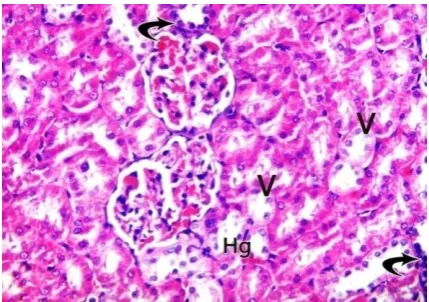
sections examination of kidney cortex of the control and thyroidectomized groups revealed that the cortex of kidney was formed of renal tubules and renal corpuscles. Each renal corpuscle consisted of a glomerulus containing tuft of capillaries and encircled by parietal and visceral layers of Bowman's capsule which were separated by Bowman's space. The outer parietal layer was formed of flat cells while the inner visceral layer was closely related to the glomerular capillaries. The cortical renal tubules were formed mainly of proximal and distal convoluted tubules. They were lined with simple cuboidal epithelium with central rounded nuclei. The lumen of the proximal tubules was irregular and narrower than the distal ones (Figs. 1,2). In methimazole treated group of renal cortex revealed some dilated tubules with flattened epithelium and some of the lining tubular cells showed vacuolation of the cytoplasm and darkly stained nuclei. In addition, the glomeruli appeared shrunken with widened Bowman's space (Figs. 3,4). Some tubules exhibited intra-luminal eosinophilic homogenous material (Fig. 5). Excess inflammatory cells between tubules (Fig. 4) and excess hemorrhage between tubules (Fig. 5)
were also seen. These changes are less pronounced in rats which received methimazole in combination with thyroxin. There was decrease of vaculation of the tubular cells with hemorrhage and inflammatory cells in between tubules (Fig. 6).
Manar M., et al…. - 211-reaction is less noticed in rats which received
methimazole in combination with thyroxin
(Fig. 10).
Fig. (1): A photomicrograph of cortex of a kidney in rats of control group showing a glomerulus (G) encircled by parietal (arrow) and visceral layers (arrow head) of Bowman’s capsule, separated by renal space (S). Proximal convoluted tubule (P) and distal convoluted tubule (D) are also seen .(H&E ×400)
Fig. (2): A photomicrograph of cortex of a kidney in rats of methimazole treated group showing a glomerulus (G) encircled by parietal (arrow) and visceral (arrow head) layers of Bowman’s capsule, separated by renal space (S). Proximal (P) and distal (D) convoluted tubules are also seen. (H&E ×400)
Fig. (3): A photomicrograph ofcortex of a kidney in rats of methimazole treated group showing a corpuscle with shrunken glomerulus (G) and widened Bowman's space (S). The cells which lines the tubules exhibit marked rarefaction and vacuolation (V) of the cytoplasm; darkly stained nuclei (N). Many tubules show dilated tubules (T) with flattened epithelium (F). (H&E ×400)
Fig. (4): A photomicrograph of cortex of a kidney in rats of methimazole treated group showing dilated renal tubules (T) with flattened epithelium (f) and area of hemorrhage (Hg) between renal tubules and inflammatory cell infiltration (Curved arrow). (H&E ×400)
Fig. (5): ): A photomicrograph of cortex of a kidney in rats of methimazole treated group showing many tubules with intra-luminal eosinophilic homogenous material (star) and cytoplasmic vacuoles (V) of their lining tubular cells. Congested glomeruli (G) are also seen. (H&E ×400)
Manar M., et al…. -
Fig. (7): A photomicrograph of cortex of a kidney in rats of control group showing some positive immunoreactive nuclei (N) among the normal cells lining the tubules and the glomerului (green arrow). (8-OhdG immunostaining ×400)
Fig. (8): A photomicrograph of kidney cortex of thyroidectomized adult male albino rat showing some positive immunoreactive nuclei (N) among the normal cells lining the tubules and the glomerului (green arrow). (8-OhdG immunostaining ×400)
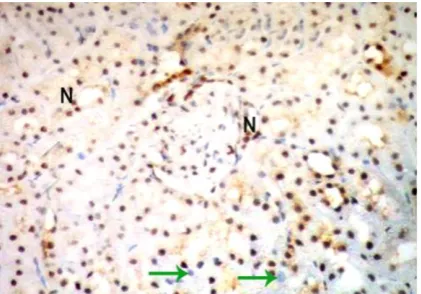
Fig. (9): A photomicrograph of cortex of a kidney in rats of methimazole treated group showing excessive positive immunoreactive nuclei (N) among few normal cells lining the tubules and the glomeruli (green arrow). (8-OhdG immunostaining ×400)
Fig. (10): A photomicrograph of kidney cortex of methimazole co-treated with T4 group showing immunohistochemical stained sections revealed some immunoreacive nuclei (N) among normal cell lining the tubules and glomeruli (green arrow). (8-OhdG immunostaining ×400)
Statistical analysis
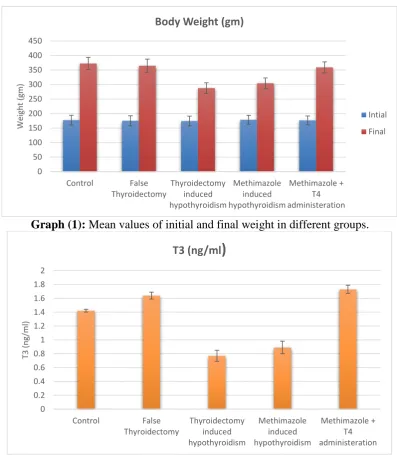
There were statistical significance differences between the studied groups in the weight. There was statistically significant difference between control group and methimazole with thyroxin administration group (Table 1; Graph 1). Also, statistical analysis of the T3 and T4 levels in the studied groups revealed that there were significant decrease in their levels in thyroidectomized and methimazole treated groups. (Table1;
Graphs 2,3). Also, there was statistical
significant decrease in both methimazole treated and methimazole with thyroxin administration groups in antioxidant enzymes (catalase (CAT), glutathione peroxidase (GPx), and superoxide dismutase (SOD) level.
(Table 1; Graph 4). In addition, there were
Manar M., et al…. - 213-Table (1): Initial and final Body weight, T3, T4, antioxidant, diameter of convoluted tubules and
thickness of Bowman’s space among the different studied groups: Variable Control
(n=5)
False Thyroidectomy
(n=5)
Thyroidectomy induced hypothyroidism
(n=5)
Methimazole induced hypothyroidism
(n=5)
Methimazole + T4 administration
(n=5)
Initial BW (gm) Final BW (gm)
177.32±16.55a 372.5±20.74a
175.16 ± 17.5a 364.81 ± 22.75a
174.36 ± 16.89a 287.9 ± 18.52 b
178.56 ± 15.22a 304.12 ± 18.57 b
176.61 ± 15.24a 359.11 ± 19.01a T3 (ng/ml)
T4 (ug/dl)
1.42 ± 0.02a 6.91 ± 0.43a
1.64 ± 0.05a 7.43 ± 0.51a
0.77 ± 0.08 b 3.57 ± 0.79 b
0.89 ± 0.09 b 3.82 ± 0.42b
1.73 ± 0.06a 7.17 ± 0.49 a Antioxidant(Mm/l 1.67 ± 0.22a 1.46 ± 0.20a 1.53 ± 0.34a 0.64 ± 0.21 b 0.86 ± 0.23 c Diameter(μm)
Bowman(μm)
59.58±9.84a 24.31±3.99a
67.87 ± 21.22a 29.36 ± 2.39a
62.73 ± 10.2a 39.11 ± 8.03b
147.39 ± 9.45 b 91.62 ± 20.22 c
100.02 ± 13.66 c 70.54 ± 7.44 d Data expressed as mean ± SD, Groups with different letters are statistically significant (P<0.05)
Graph (1): Mean values of initial and final weight in different groups.
Graph (2): Mean values of T3 level in different groups.
0 50 100 150 200 250 300 350 400 450
Control False Thyroidectomy
Thyroidectomy induced hypothyroidism
Methimazole induced hypothyroidism
Methimazole + T4 administeration
W
ei
gh
t
(g
m)
Body Weight (gm)
Intial
Final
0 0.2 0.4 0.6 0.8 1 1.2 1.4 1.6 1.8 2
Control False Thyroidectomy
Thyroidectomy induced hypothyroidism
Methimazole induced hypothyroidism
Methimazole + T4 administeration
T3
(n
g/ml)
Manar M., et al…. -
214-Graph (3): Mean values of T4 level in different groups.
Graph (4): Mean values of antioxidant enzymes level in different groups
Graph (5): Mean values of convoluted tubulesdiameter in different groups
0 1 2 3 4 5 6 7 8 9
Control False Thyroidectomy
Thyroidectomy induced hypothyroidism
Methimazole induced hypothyroidism
Methimazole + T4 administeration
T4
(u
g/d
l)
T4 (ug/dl)
0 0.2 0.4 0.6 0.8 1 1.2 1.4 1.6 1.8 2
Control False Thyroidectomy
Thyroidectomy induced hypothyroidism
Methimazole induced hypothyroidism
Methimazole + T4 administeration
A
n
ti
o
xi
d
an
t
(mM/L
)
Antioxidant (mM/L)
0 20 40 60 80 100 120 140 160 180
Control False Thyroidectomy
Thyroidectomy induced hypothyroidism
Methimazole induced hypothyroidism
Methimazole + T4 administeration
Di
amet
er
o
f
co
n
vo
lu
te
d
tu
b
u
le
Manar M., et al…. -
215-Graph (6): Mean values of thickness of bowman space in different groups.
DISCUSSION
In this study, the rat was chosen as it is one of the most widely used research animal especially for the urinary physiology [21]. They are initially used for experimental purposes since the half of the nineteenth century. Adult male albino rats were chosen in this work because it could be housed, bred and handled without difficulties. In addition, they had a long life span and it was relatively disease free.
The present study showed marked alterations in the structure of kidney cortex of the rat after intake of the drug which induced
hypothyroidism (methimazole).
Hypothyroidism caused by methimazole was associated with marked lowering in the level of T3 and T4 in serum. A dose of 20 μg T4/kg body weight per day was needed to make the serum T3 levels approximately normal. So the dose of T4 was taken to prove if the injury of the kidney cortex which is caused by methimazole would be prevented by T4 or not.
In present study, examination of haematoxylin and eosin stained sections of the kidney cortex of the control animals showed that the kidney cortex was formed of tubules and renal corpuscles. The corpuscle was composed of glomerulus encircled by Bowman’s capsule. Distal convoluted tubules had wider lumen than proximal convoluted tubules. Proximal convoluted tubules had narrow lumen. The normal present results were similar to that identified before [22, 23].
Our result agreed with Basuony [24] who registered that the distal convoluted tubule is fewer in number and may be known by the pale cuboidal epithelial cells and with William
et al., [25] who claimed that the distal
convoluted tubules have a smooth internal surface, and not have brush border.
In this work, the immune-stained sections examination of the control group revealed some positive immunoreactive nuclei among the normal cells lining the tubules and the glomerului.
Our results showed that the analysis of histological and immunohistochemical results of the thyroidectomized groups were the same as the results of the control group. This agreed with Gazia [26] who reported that, H&E stained sections of the kidney cortex of both groups showed the presence of kidney tubules and corpuscles. Each corpuscle was composed of a glomerulus encircled by double layers of Bowman’s capsule with a filtration space between them. The outer layer was composed of a single layer of simple squamous cells, and the inner layer was composed of podocytes which had oval large nuclei. The glomerulus had tufts of capillaries lined by flat endothelial cells. There were proximal convoluted tubules, distal convoluted tubules, and collecting ducts around the renal corpuscles. The amount of renal interstitium was few. In addition, the author reported that examination of the immune-stained sections of the control and thyroidectomized groups showed negative 0
20 40 60 80 100 120
Control False Thyroidectomy
Thyroidectomy induced hypothyroidism
Methimazole induced hypothyroidism
Methimazole + T4 administeration
Bo
w
man
Manar M., et al…. - 216-immunostaining reaction in the convoluted
tubules and glomeruli.
Furthermore, Tenorio-Velázquez et al.,
2005 [17] added in case of hypothyroidism
induced by thyroidectomy with parathyroid implant, no kidney tissue damage was detected. This agreed with our work.
Allen and Rana [27] and Isman et al.,
[28] reported that the protective role of
hypothyroidism caused by thyroidectomy against kidney cellular injury in the thyroidectomized group was in agreement with the protective role of hypothyroidism against nitrosative stress, oxidative stress, , and cellular alterations in different experimental models.
In addition, Halestrap et al., [29]
reported that the hypothyroidism which was caused by thyroidectomy might have protective effect as that mitochondria was known to have an important effect on the pathways of cell death by activating permeability of mitochondrial transition pores and causing the production of cytochrome c and proapoptotic factors, as well as Ca++ overload, which caused nonselective permeability of the inner membrane. Also,
Jena et al., [30] explained that there were
molecular mechanisms by which it might cause a protected state, as decreasing the activity of enzyme associated with mitochondrial respiratory chain rendered mitochondria resistant to the opening of membrane permeability transition pores.
Moreover, Franco et al., 2011 [31]
reported that hypothyroidism also could increase the formation of polyunsaturated fatty acids which in turn changed plasma membrane composition. Isman et al. [28] and Hataya et
al., [32] were in agreement with that
explanation and reported that this change of lipid composition caused lipid peroxidation sensitivity in rats membranes with hypothyroidism and could decrease the vulnerability to oxygen radical which caused cell injury. In contrast to this, Shin et al. [33] reported that the state of hypothyroidism predisposed kidney damage due to an increase in synthesis of polyunsaturated fatty acid, which were vulnerable to peroxidation and the decrease of kidney proliferation.
In the present study, light microscopic examination H&E stained sections of group III showed widened Bowman’s space, congestion of glomeruli, abnormal shape of glomeruli, and area of hemorrhage in the interstitium between tubules. Kidney tubules appeared with dilated lumen and degenerated epithelium. Some kidney tubules had cytoplasmic vaculations in the cells of lining and hyaline casts in lumen of a lot of tubules. Inflammatory cells in the interstitium between tubules also appeared. In addition, this effect was accompanied with oxidative stress, which was detected by the immunohistochemical stain which showed strong positive immune reaction for 8-OHdG in the renal cells. These changes did not occur in other groups.
These results were the same as the results concluded by Gazia [26].
Calanas-Continente et al., [34] reported that five
percent of hyperthyroidism patients treated with antithyroid medications were had damage in their kidneys. These results were observed in animals and humans. According to Becker
et al., [35] two of twelve cats studied suffered
from azotemia after intake of methimazole. These results were in consistent with
Angermüller et al., [36] who reported that
methimazole could cause damage of cells by many ways as chemical structure or because of the interaction between the physiological changes caused by the hypothyroidism and such chemical structure. Under physiological conditions the presence of antioxidant enzymes, in particular peroxidases and dismutases, prevented oxidative stress and tissue damage.
Bandyopadhyay et al., [37] were in
accordance with this explanation and stated that some medications as methimazole, affected the physiological state harmfully, change the interior environment of cells, and caused injury of cells because of oxidant generation and reactive oxygen species (ROS); as, lipid peroxidation was not neutralized completely by the decrease of antioxidant system. Methimazole caused inactivation of various peroxidases with a heme group at the active center irreversibly.
Furthermore, Basu and Mohapatra et
al., [3] explained that methimazole could
Manar M., et al…. - 217-group involved in scavenging H2O2, as CAT
(catalase; antioxidant) was one of the most essential peroxidases that hindered the metabolism-enhanced H2O2 and CAT inactivation caused high levels of H2O2. The decrease in the antioxidant system might result in an elevation in oxidation reaction and injury of cells because H2O2 participated in the cells that produce it, could cross the plasma membrane, and affected adjacent cells.
In our work, examination of Haematoxylin and eosin (H&E) stained sections of methimazole co-treated with T4 group revealed decrease of vaculation of the tubules with hemorrhage and inflammatory cells between tubules. Immunohistochemical stained sections revealed some immunoreactive nuclei among the tubular lining cells and in the glomeruli. These results were in accordance with Gazia. [26] who reported such changes are less evoked in rats with hypothyroidism and received T4 .Also,
Puzianowska-Kuznicka et al [15] reported
that in rats administrated methimazole with T4 supplementation, the changes were incompletely prevented in the renal cortex. This effect was caused by the effect of thyroid hormones on the cell cycle regulation.
In the current study, T3 and T4 concentration decreased in hypothyroidism induced by thyroidectomy and methimazole treated group compared with the euthyroid group. This agreed with Gazia [26], Cano-
Europ et al., [38] and Cano- Europa et al.,
[39] who reported that the concentration of T3
and T4 decreased in the thyroidectomized group and methimazole-treated group.
In this work, at the end of treatment, the hypothyroidism induced by methimazole caused reduction of the body weight. The thyroidectomized group and the group treated with methimazole and T4 showed differences in the body weight in comparison with the control group. This agreed with Gazia [26]
and Sur [40] who reported that in methimazole treated group there is significant decrease in the body weight.
Statistical analysis of our result showed that there were statistical significance differences between the studied groups in the thickness of Bowman’s space and the diameter of the tubules. There was increase in the
thickness of Bowman’s space and the diameter of the tubules in group III. In addition, group IV showed statistical significance differences Compared with group I. However, there were no change in group I and II. This was proved
by Gazia [26] who reported that sections in
the group treated with methimazole showed some glomeruli with Bowman’s space widening, and the kidney tubules with a dilated lumen and degeneration of its lining. Some tubules revealed marked necrosis while others showed defect in cellular continuity, pyknosis of nuclei of tubular cells, and disintegration of cellular content. Kidney tubules lined with vacuolated cells, and hyaline casts in lumen of many tubules were also detected. These changes were less evoked in rats with hypothyroidism and received thyroxine (T4), whereas some tubules showed the vacuolated cells in their lining and hyaline casts in tubular lumen.
The statistical analysis of activity of renal antioxidant enzymes in the studied groups showed that no significant change between the control and thyroidectomized groups, while treatment with methimazole caused decrease in antioxidant enzymes levels. This decrease in the renal antioxidant enzyme levels was not prevented by T4 in the group administrated methimazole with T4. This agreed with Gazia
[26] who registered that there was significant
decrease in the activity of antioxidant enzymes in the group treated with methimazole.
Sarandol et al., [41] reported that the decrease
of the antioxidant enzymes levels which detected in the methimazole-induced hypothyroidism group might be due to the oxidant reaction that causes oxidative stress and damage of cells.
There is a proof of extrathyroidal effects of antithyroid drugs, such as thionamides, in animals and humans Bandyopadhyay et al.,
[37]. One of these effects of thionamides is a
Manar M., et al…. - 218-glutathionylation of proteins and
fragmentation of DNA [9,10].
In conclusion, methimazole causes hypothyroidism and damage in the kidney cortex. This damage is not caused by hypothyroidism induced by surgical thyroidectomy. L-Thyroxine (T4) could decrease the effect of methimazole on renal cortex.
REFERENCES
1- Little, M.H.; and McMahon, A.B.: Mammalian Kidney Development: Principles, Progress and Projections; 2012; 4(5):1-18. 2- Hulbert, A.J.: Thyroid hormones and their
effects: a new perspective. Biol Rev Cambridge Philos Soc; 2000; 75:519–631. 3- Basu, G.; and Mohapatra, A.: Interactions
between thyroid disorders and kidney disease. Indian J Endocrinol Metab; 2012; 16:204– 213.
4- Mariani, L.H.; and Berns, J.S.: The Renal Manifestations of Thyroid Disease. J Am Soc Nephrol; 2012; 23: 22–26.
5- Cooper, D.S.: Antithyroid Drugs. N Engl J Med; 2005; 352.
6- Alturfan, A.A.; Zengin, E.; Dariyrli, N.; Alturfan, E.E.; Gumustas, M.K.; Aytac, E.; Balkis, N.; Aksu, A.; Yigit, G.; Uslu, E.; and Kokoglu, E. : Investigation of zinc and copper levels in methimazole-induced hypothyroidism: relation with the oxidant-antioxidant status. Folia Biol; 2007; 53:183– 188.
7- Cano-Europa, E.; Perez-Severiano, F.; Vergara, P.; Ortiz-Butron, R.; Rios, C.; Segovia, J.; and Pacheco-Rosado, J. : Hypothyroidism induces selective oxidative stress in amygdala and hippocampus of rat. Metab Brain Dis; 2008; 23:275–87.
8- Ben Amara, I.; Fetoui H.; Guermazi F.; and Zeghal N.: Dietary selenium addition improves cerebrum and cerebellum impairments induced by methimazole in suckling rats. Int J Dev Neurosci; 2009;27:719–726.
9- Halliwell, B.; and Gutteridge, J.M.C. : Free radicals in biology and medicine.4 th edition, Oxford University Press, Oxford, 2007; 230-240.
10- Valko, M.; Leibfritz, D.; Moncol, J.; Cronin, M.T.; Mazur, M.; and Telser, J.: Free radicals and antioxidants in normal physiological functions and human disease. Int J Biochem Cell Biol; 2007; 39:44–84.
11- Nath, K.A.; Norby, S.M.: Reactive oxygen species and acute renal failure. Am J Med; 2000; 109:665–678.
12- Pedraza-Chaverrí ,J.; Barrera, D.; Medina-Campos, O.N.; Carvajal, .C.;Hernández-Pando, R.; Macías-Ruvalcaba, N.A., et al.: Time course study of oxidative and nitrosative stress and antioxidant enzymes in K2Cr2O7-induced nephrotoxicity. BMC Nephrol; 2005; 6:4.
13- Yin, M.; Wheeler, M.D.; Connor, H.D.; Zhong, Z.; Bunzendahl, H.; Dikalova, A.; et al:.Cu/Zn-superoxide dismutase gene attenuates ischemia-reperfusion injury in the rat kidney. J Am Soc Nephrol 2001; 12:2691– 2700.
14- Zhong ,Z.; Connor, H.D.; Yin, M.; Wheeler, M.D.; Mason, R.P.; Thurman, R.G.: Viral delivery of superoxide dismutase gene reduces cyclosporine A-induced nephrotoxicity. Kidney Int 2001; 59:1397– 1404.
15- Puzianowska-Kuznicka, M.; Pietrzak, M.; Turowska, O.; and Nauman, A. : Thyroid hormones and their receptors in the regulation of cell proliferation. Acta Biochim Pol 2006; 53(4):641-50.
16- Ortiz-Butron, R.; Pacheco-Rosado, J.; Hernández-Garcia, A.; Briones-Velasco, M.; and Rocha, L.: Mild thyroid hormones deficiency modifies benzodiazepine and mu-opioid receptor binding in rats. Neuropharmacology 2003; 44:111–116. 17- Tenorio-Velázquez, V.M.; Barrera, D.;
Franco, M.; Tapia, E.; Hernández-Pando, R.; Medina-Campos, O.N.; and Pedraza-Chaverri, J.: Hypothyroidism attenuates protein tyrosine nitration, oxidative stress and renal damage induced by ischemia and reperfusion: effect unrelated to antioxidant enzymes activities. BMC Nephrol 2005; 6:12.
18- Yilmaz, S.; Ozan, S.; Benzer, F.; and Canatan, H.: Oxidative damage and
antioxidant enzymes activeties in experimental hypothyroidism. Cell Biochem
Funct; 2003;21:325–330.
19-Bancroft, J.D.; Layton, C.: The hematoxylin and eosin, connective and
mesenchymal tissues with their stains. In: Suvarna SK, Layton C, Bancroft JD editors. Bancroft’s theory and practice of histological techniques. 7th ed. Philadelphia: Churchill Livingstone 2013; pp. 173–212.
Manar M., et al…. - 219-:Bax to Bcl-2 ratio and Ki-67 index are useful
predictors of neoadjuvant chemoradiation therapy in bladder cancer. Japanese jornal of clinical oncology 2004; 34(3), 124-130. 21- Pannabecker, T.L.; Abbott, D.E.; and
Dantzler, W.H. : Three-dimensional Functional reconstruction of inner medullar thin limbs of Henle’s loop. Am. J. Physiol. Renal Physiol 2004; 286: 38-45.
22- Guyton, A.; and Hall, J.: Textbook of Medical physiology10th edition 2000; pp:1820-1833. 23- Bhat, H.K.; Calaf, G.; Hei, T.K.; Loya, T.;
and Vadgama, J.V.: Critical role of oxidative stress in estrogen-induced carcinogenesis. Proceedings in the National Academy of Sciences 2003; 100(7):3913-3918.
24- Basuony, M.I.: Ecological variability and kidney structure of eight rodents. Egypt. J. Histol 1997; 20:417-434
25- William, J.B.; and Linda, M.B.: Color atlas of veterinary histology 2nd edition, 2000.
26- Gazia, M.A.: Antithyroid drug or hypothyroidism causes cellular damage in the renal cortex of adult male albino rats: a histological and immunohistochemical study. The Egyptian Journal of Histology 2013; 36(3): 636-645.
27- Allen, T.; and Rana, S.V.S.: Oxidative stress by inorganic arsenic: modulation by thyroid hormones in rat. Comp Biochem Physiol C Toxicol Pharmacol 2003; 135:157–162. 28- Işman, C.A.; Yeğen, B.C.; and Alican, I.:
Methimazole-induced hypothyroidism in rats ameliorates oxidative injury in experimental colitis. J Endocrinol 2003; 177:471–476. 29- Halestrap, A.P.; Clarke, S.J.; and Javadov,
S.A.: Mitochondrial permeability transition pore opening during myocardial reperfusion-A target for cardioprotection. Cardiovasc Res 2004; 61:372–385.
30- Jena, S.; Chainy, G.B.; and Dandapat, J.: Hypothyroidism modulates renal antioxidant gene expression during postnatal development and maturation in rat. General and Comparative Endocrinology 2012; 178:8–18. 31- Franco, M.; Chavez, E.; and Pérez-Méndez,
O.: Pleiotropic effects of thyroid hormones: learning from hypothyroidism. J Thyroid Res 2011; ID 321030,17.
32- Hataya, Y.; Igarashi, S.; Yamashita, T.; and Komatsu, Y.: Thyroid hormone replacement therapy for primary hypothyroidism leads to significant improvement of renal function in chronic kidney disease patients. Clin Exp Nephrol 2012; p1–7.
33- Shin, D.H.; Lee, M.J.; Kim, S.J.; Oh, H.J.; Kim, H.R.; Han, J.H.; Koo, H.M.; Doh, F.M.; Park, J.T.; Han, S.H.; Yoo, T.H.; and Kang, S.W.: Preservation of renal function by thyroid hormone replacement therapy in chronic kidney disease patients with subclinical hypothyroidism. J Clin Endocrinol Metab 2012; 97:2732–2740.
34- Calanas-Continente, A.; Espinosa, M.; Manzano-Garcia, G.; Santamaria, R.; Lopez-Rubio, F.; Aljama, P.: Necrotizing glomerulonephritis and pulmonary hemorrhage associated with carbimazole therapy. Thyroid 2005; 15:286-8.
35- Becker, T.J.; Graves, T.K.; Kruger, J.M.; Braselton, W.E.; and Nachreiner, R.F.: Effects of methimazole on renal function in cats with hyperthyroidism. J Am Anim Hosp Assoc 2000; 36:215-223.
36- Angermüller, S.; Islinger, M.; and Völkl, A.: Peroxisomes and reactive oxygen species, a lasting challenge. Histochem Cell Biol 2009; 131:459–463.
37- Bandyopadhyay, U.; Biswas, K.; and Banerjee, R.K.: Extrathyroidal actions of antithyroid thionamides. Toxicol Lett 2002; 128:117–127.
38- Cano-Europa, E.; Blas-Valdivia, V.; Lopez-Galindo G.E.; Franco-Colin, M.; Pineda-Reynoso, M.; Hernandez-Garcia, A.; Ortiz-Butron, R.: Methimazole-induced hypothyroidism causes alteration of the REDOX environment, oxidative stress, and hepatic damage; events not caused by hypothyroidism itself. Ann Hepatol; 2010:80- 8
39- Cano-Europa, E.; Blas-Valdivia, V.; Franco-Colin, M.; Gallardo-Casas, C.A.; Ortiz-Butrón, R.: Methimazole-induced hypothyroidism causes cellular damage in the spleen, heart, liver, lung and kidney. Acta Histochem 2011; 113(1):1-5.
40- Sur, D.: Methimazole-induced hypothyroidism in rats: effects of methimazole-induced cellular damage on heart, lung and ovary. International Journal of Applied and Natural Sciences (IJANS) 2014; 3(4) 21–28.