Rural Development Programmes and Transaction Effects: Reflections on
Maltese and English Experience
Janet Dwyer and John Powell1
[Original submitted February 2015, Revision received July 2015, Accepted October 2015 subject to revisions. Final version submitted and accepted 25 March 2016]
Abstract
New institutional economics, and transaction effects in particular, are highly relevant to public policy performance. The evolution of EU rural development policy has generated both increasing complexity and increased transaction costs. However, this policy evolution also creates opportunities for improvement of policy process management. The paper considers these opportunities in the case of Rural Development Programmes (RDPs) under Pillar 2 of the CAP. We examine the influence of transaction effects on RDP performance, based on direct experience of RDP review and planning in England and Malta, where qualitative evidence of ‘transaction benefits’ is identified. Benefits occur when exchange processes are designed in ways that generate positive returns beyond the immediate transaction, which can outweigh short-term costs. We conclude that more attention to these aspects of policy design is warranted in future rural development programming and evaluation.
Keywords EU Rural Development Programmes, England, Malta, transaction costs, transaction benefits, policy performance, policy design, policy implementation, new institutional economics
JEL Classification: Q18, P48, H11.
1. Introduction
Economics is based on the analysis of market exchange as a fundamental transaction of human and societal development. Standard market analyses tend to concentrate on the outcomes of
1 Janet Dwyer, Director of CCRI and Professor of Rural Policy, University of Gloucestershire, UK.
[email protected]. John Powell, Senior Research Fellow, CCRI, University of Gloucestershire, UK.
We are grateful to the Ministry of Rural Affairs, Malta, and to Defra, UK, for the opportunity to study their respective RDPs, enabling this analysis. However, views expressed in this paper remain solely the authors’.
.
exchange – the balance between supply and demand, and the comparative statics of changing equilibrium conditions. Less attention has been devoted to the processes of exchange, and the effects these might have on outcomes. The emergence of institutional economics as a significant strand in the discipline (North, 1990a, Williamson, 1975, 1996) has stimulated greater consideration of processes and governance in markets, and of the costs associated with transactions between individuals and between and within organisations. More recently, research has developed around transaction costs in rural policies, where policy makers seek to influence behaviour using a variety of mechanisms including financial incentives (grants, taxes and subsidies), information, and advice. This paper explores the institutional and transaction effects in the programming and disbursement of significant sums of money under the Common Agricultural Policy’s second pillar: the Rural Development Programmes (RDPs). The RDPs have increased significantly in scale and scope since their initial constitution in 2000, growing from €5.75bn of EU spend in 2001 (European Commission, 2007) to €14.5bn in just over a decade (European Commission, 2012), and now accounting for one-third of the total CAP budget. RDPs are seven-year funding programmes composed of suites of different measures including investment aids, annual management payments, and funding for planning, training and advice (European Commission, 2005). All Member States are obliged to design and implement programmes tailored to their own specific rural needs and opportunities, while pursuing EU-level strategic priorities for agriculture and rural development that embrace economic, social and environmental goals (Dwyer et al., 2012a). In the 2007-2013 period, common EU-level priorities were built into three different ‘Axes’ of each programme, with each axis pursuing a different goal (primary sector competitiveness, environmental protection and rural quality of life, respectively), using a suite of specific measures2. For 2014-2020, the axes have been replaced
with six Strategic Priorities and each one can be pursued using a mix of measures as selected by Member States and/or their regions.
Detailed empirical work to support RDP planning and implementation in Malta (Dwyer et al., 2012b; Government of Malta, 2014), and evaluation of elements of the 2007-13 RDP for England, UK (Powell and Courtney, 2013) have provided insights into the significance of transaction processes and institutional economics in rural programme delivery in two very
2 A fourth Axis was methodological, supporting the use of the LEADER approach (EC, 2005).
different EU Member States (MS). Using this experience, the paper examines the organizational and institutional nature of RDP design and delivery, and explores the potential for improving RDP performance through a more explicit recognition of transaction processes.3 The paper is
structured as follows. Section 2 reviews the concept and theoretical treatment of transaction costs, including previous coverage in analyses of public policies for rural development. Section 3 briefly describes RDPs, noting their increasing significance within the Common Agricultural Policy and summarising documented concerns about their performance which can be linked to transaction effects. Section 4 explores evidence concerning transaction processes and their costs and benefits in RDP case studies in England and Malta. Section 5 discusses how a stronger focus upon the explicit management of transactions could enhance RDP design and delivery, offering the prospect of enhanced EU rural policy.
2. Transaction costs in public policy for agriculture and rural areas
2.1 The concept
The concept of transaction costs was developed in the 1930s, when Hicks and Coase explored factors that influenced ‘efficient’ economic production (Williamson, 1981). There has been continual disagreement since then on the nature and origin of transaction costs, leading to a multitude of definitions (Williamson, 1981 and 1985; Musole, 2009). Commons (1931), for example, focusing on property rights, identified three main types of transaction which give rise to costs: bargaining; managerial; and rationing. These categories are linked to different governance arrangements; i.e. whether the transaction is between two parties with ability to negotiate, or takes place in a strictly hierarchical, and typically contractual, relationship where one party instructs another.
Others, in particular Hicks (1935), have viewed transaction costs as ‘friction’ arising from ‘the cost of transferring assets from one form to another’. Transaction costs arise where any public or private asset is transferred between parties. Initial interest was focused on the friction inherent in the private sector where institutional arrangements affect the resources necessary to ensure
3 Here, we use the terms ‘organization’ and ‘institution’ in their new institutional economics meanings: “organization” is the structure of relations among actors, and “institutions” are the rules, codes and habits of behaviour governing socio-economic relations (North, 1990; Williamson, 1975, 1996)
successful exchange between and within firms. Transaction costs can also occur when government policies affect the behaviour and exchanges of individuals and businesses (Van Huylenbroeck, et al., 2005). In a public policy context we can approach transactions as activities that involve the deliberate transfer of resources (expertise, personnel, funding, assets) from one agent to another in order to achieve a policy goal4. This can include public-private (e.g. grants),
private-public (taxes, property rights) or public-public transfers (delegated resources, powers to plan or regulate). More recently Coggan et al (2010), in a review of environmental policy literature, classify transaction costs by reference to when they occur in the policy process and what generates the costs, creating seven categories: knowledge and information; perception and understanding; application (e.g. for policy support); negotiating contracts; management requirements; monitoring and evaluation; and compliance. For all these categories, costs are experienced by public administrators and by the beneficiaries of policy during the transaction process, but in different ways and to varying extent.
Transaction costs are both context-specific and perspective-dependent: what may be considered as a cost by one participant in the process, may not be seen in the same manner when viewed from a wider perspective (Schmid, 2004; Musole, 2009; Schlag, 1989). The more traditional view of a transaction impact is a negative one (as a cost), but Schmid (2004) argues that, in many circumstances, the activities associated with a transaction can also be viewed as opportunities enabling investments to achieve more efficient outcomes. Actions such as information gathering, meetings, drawing up contracts, monitoring, and ensuring compliance, can produce benefits beyond the immediate transaction, for example, through increased trust between actors, potentially resulting in quicker, cheaper and/or increased exchanges in the future. The resources invested in developing relationships and understanding as part of a transaction may yield benefits which outweigh the direct costs of such an investment.
The design and management of transactions is especially significant in the public sector, where policies create programmes that run over a number of years, disbursing large amounts of public funding. A limited number of studies have examined transaction costs in respect of rural policy
4 Although others e.g. Harvey (2008) argue for a still broader definition whereby transactions and their nature are viewed as central to all forms of social evolution, a focus upon transfer as a key policy activity and stimulus for transactions seems pertinent to our sphere of analysis.
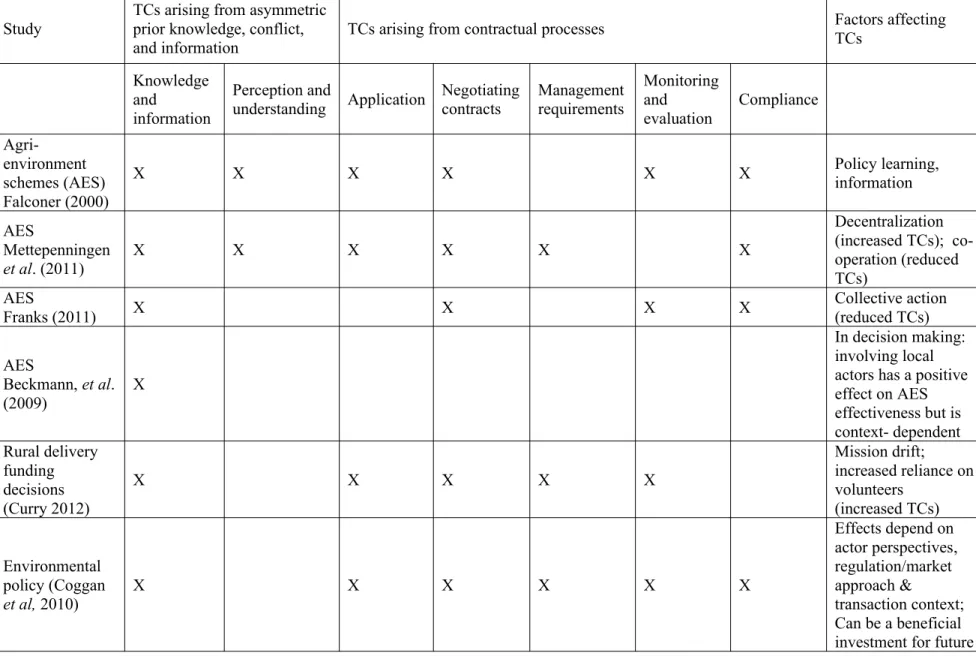
initiatives, most notably Agri-Environment Schemes (AESs) (Falconer and Whitby, 1999, Falconer, 2000; Franks, 2011, Mettepenningen et al., 2011), and the delivery of rural services (Curry, 2012). Table 1 summarises some features of this literature, using the process classification developed in Coggan et al. (2010). The studies identify in particular the transaction costs associated with establishing frameworks for exchange of knowledge and information, and for carrying out contract negotiations. There has been much less focus on examining the costs arising from asymmetries in perception and understanding of programmes, although Falconer and Whitby (1999) note how administrative transaction costs from some early AESs arose due to ‘asymmetry of information between land holders and public agencies’.
In these studies, some potential for positive outcomes resulting from better design processes is identified. Mettepingen et al (2011) suggest that measures designed and delivered in close exchange with farmers’ associations, and those focused upon reducing the negative externalities of farming, had relatively low transaction costs compared to measures designed without involving beneficiaries, and those focused on stimulating positive externalities. Falconer and Whitby (1999) found evidence in the early implementation of the Countryside Stewardship Scheme in the UK suggesting that transaction costs would decrease over time due to increasing trust between parties, as well as management experience and better conservation knowledge (i.e. organisational learning). They also identified a ‘positive role’ for programme administrative costs, suggesting the focus of effective scheme design should be ‘to maximise conservation outputs per unit of expenditure’ rather than to reduce immediate transaction costs. In this context, ‘transaction benefits’ were cited, incorporating positive aspects arising from implementation such as the provision of conflict resolution mechanisms where markets have not been efficient. They concluded that more complex administration may be needed in order to ensure value for money in the delivery of longer-term environmental benefits.
Table 1. Transaction costs (TCs) as covered in studies on rural development policies (after Coggan et al, 2010)
Study
TCs arising from asymmetric prior knowledge, conflict, and information
TCs arising from contractual processes Factors affecting
TCs Knowledge and information Perception and understanding Application Negotiating contracts Management requirements Monitoring and evaluation Compliance Agri-environment schemes (AES) Falconer (2000)
X X X X X X Policy learning,
information
AES
Mettepenningen et al. (2011)
X X X X X X
Decentralization (increased TCs); co-operation (reduced TCs)
AES
Franks (2011) X X X X
Collective action (reduced TCs)
AES
Beckmann, et al. (2009)
X
In decision making: involving local actors has a positive effect on AES effectiveness but is context- dependent Rural delivery
funding decisions (Curry 2012)
X X X X X
Mission drift; increased reliance on volunteers
(increased TCs)
Environmental policy (Coggan et al, 2010)
X X X X X X
Effects depend on actor perspectives, regulation/market approach & transaction context; Can be a beneficial investment for future
Beckman et al. (2009) examining AESs in nine member states, found an increase in administrative transaction costs as a result of decentralization, but also potential for improved scheme effectiveness due to higher levels of local participation enabling improved tailoring of delivery approaches.
3. Rural Development Programmes and Transaction Costs
Evaluation of rural development programmes within the CAP has become an increasing challenge for Member States and for the EU. Despite only one programme period (2000-2006) being fully evaluated5, operation of programmes over more than a decade has raised expectations
about the capacity to draw meaningful conclusions regarding performance. Reflecting this situation, the formal evaluation process has been paralleled by a number of studies undertaken for the European Commission and by the European Court of Auditors, NGOs and other policy actors, notably the European Network for Rural Development (ENRD)6. These studies and the
official meta-evaluations of Programmes (ex-post evaluation in 2008 for the 2000-2006 RDPs, and mid-term evaluation in 2011 for the 2007-2013 Programmes), have noted that RDPs show many weaknesses in performance, falling short of achieving significant impact in economic, environmental and/or social terms (see, for example, Schuh et al, 2012). Issues identified in these evaluation studies as contributing to poor performance include several that can be recognized from the transaction costs literature discussed in Section 2, including:
low rates in the uptake of certain measures, usually arising from lack of clarity in procedures, and administrative delays in launching calls and awarding contracts, which seems linked to insufficient knowledge, understanding and information gaps within the public administration (Schuh et al., 2012);
inefficiencies in delivery, in application processes and the negotiation of contracts because of lengthy chains of command and/or significant requirements for accompanying paperwork to provide an audit trail (ENRD, 2011);
low levels of beneficiary interest, particularly in new member countries and especially in relation to complex actions and measures, as potential beneficiaries and/or supporting 5 At the time of writing (March 2016), RDP 2007-13 ex-post evaluation is now underway within the member
agents are put off by what they perceive as costly application, negotiation or management processes (e.g. AESs, Leader (RuDI, 2010));
high levels of deadweight for some of the largest-spending measures in RDPs, where the projects most likely to secure funding are projects offering low additionality, but greater ease of administration. In these cases, it is suggested that public agencies seek to minimize their immediate transaction costs and in so doing, significantly reduce the added-value of the programme (e.g. Erjavec, 2012);
insufficient targeting due to a lack of understanding of local context – for instance, in territories characterized by multiple small and semi-subsistence farms, where the relative incentive to engage with funding is limited by scale, but the cost of preparing and submitting applications is relatively high (Davidova et al., 2013).
These points suggest that an analysis of RDP processes from a perspective which considers the nature of transactions and the resulting balance of costs and benefits, could be a useful way to identify options for improvement.
4. Experience in respect of RDPs in England and Malta
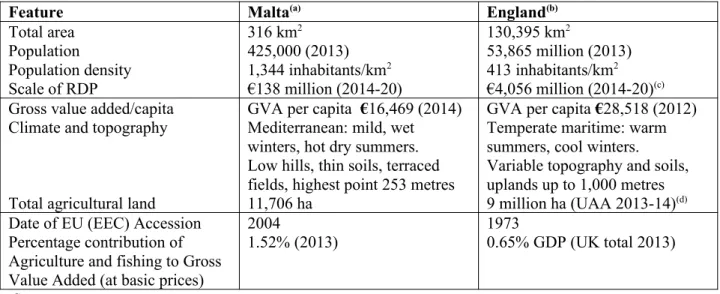
Table 2: Comparison of some basic characteristics of England and Malta
Feature Malta(a) England(b)
Total area Population
Population density Scale of RDP
316 km2
425,000 (2013)
1,344 inhabitants/km2
€138 million (2014-20)
130,395 km2
53,865 million (2013)
413 inhabitants/km2
€4,056 million (2014-20)(c)
Gross value added/capita Climate and topography
Total agricultural land
GVA per capita €16,469 (2014)
Mediterranean: mild, wet winters, hot dry summers. Low hills, thin soils, terraced fields, highest point 253 metres 11,706 ha
GVA per capita €28,518 (2012)
Temperate maritime: warm summers, cool winters.
Variable topography and soils, uplands up to 1,000 metres
9 million ha (UAA 2013-14)(d)
Date of EU (EEC) Accession Percentage contribution of Agriculture and fishing to Gross Value Added (at basic prices)
2004
1.52% (2013)
1973
0.65% GDP (UK total 2013)
Sources:
(a) Malta in figures, National Statistical Office, Valetta, Malta (b) UK Office for National Statisitics (http://ons.gov.uk/ons) (c) Factsheet on 2014-2020 Rural Development Programme of England (d) Defra Farming Statistics, Final Land Use, Livestock Populations and Agricultural Workforce, National Statistics Office.
4.1 Evaluating the England RDP, 2007-13
England is the largest of the UK’s four Regions, with more than twenty years’ experience of designing and delivering EU-funded rural programmes7. The 2007-13 rural development
programme for England (RDPE) was characterized by two distinct parts: the ‘socio-economic’ elements of the RDP (Axes 1 and 3) were delivered separately from the much larger agri-environmental element (Axis (2). The socio-economic axes, seeking to improve primary sector competitiveness and rural economic diversification and quality of life respectively, were subject to two distinct phases of delivery: from 2007 to 2010 they were designed in outline by the Managing Authority (Defra – the government Department for Environment, Food and Rural Affairs) but tailored and delivered by eight Regional Development Agencies (RDAs) and the Forestry Commission’s regional offices in England. Regional Implementation Plans (RIPs) set out specific aims and targets for each region but also had to meet key national RDPE strategic goals which prioritised growth and job creation. Following a change of government in May 2010 the RDAs were dismantled, so from 2011 all the Axis 1 and 3 funding schemes were redesigned and run centrally by Defra, although regionally-based delivery staff were used to support project
implementation, particularly where contracts for sub-regional delivery were already in operation. These changes allow for a ‘before and after’ comparison of how the different approaches, with contrasting transaction processes, influenced programme outcomes in England.
In 2012, the authors were involved in an evaluation of Axes 1 & 3 of the 2007–13 RDPE (Powell and Courtney, 2013). Performance was examined through mixed-methods analysis combining secondary data, stakeholder interviews and focus groups, and a detailed beneficiary survey in four regions (North-west, South-west, East Midlands, and East of England) selected in order to capture contrasting geographical characteristics as well as the regional differences in RDP design and delivery. Evaluation was carried out using an SROI8 approach which places emphasis upon
measuring a wide range of programme outcomes (as opposed to outputs). Outcome indicators for each RDP measure were identified, and the extent to which they were achieved was assessed through analysis of expenditure data, monitoring information, and relevant stakeholder interviews at local, regional and national levels. Indicators were assigned monetary values (using market values where available and proxies from the literature for the non-market public goods produced). Total outcomes were aggregated over the programme period and for five years into the future using discounted values, taking into account stakeholder estimates of attribution, displacement, and deadweight effects. The total value of programme outcomes (realised and forecast) was compared to expenditure, providing a measure of the return on investment.
The evaluation found marked differences between the selected regions in the scale and number of projects funded under each axis and measure. This reflected a conscious decision by some RDAs to spend time at the start of the programme building inter-sectoral partnerships among local stakeholder organisations to design and bid for large initiatives (confusingly also called ‘programmes’) integrating the delivery of a number of measures. In South-West England, for example, four large ‘regional scale programmes’ effectively dominated the RDP spending; while in the North-West region a single initiative, the North West Livestock Programme (NWLP), integrated advice, support and small-scale grants to improve animal health and welfare, resource efficiency (water, energy and fertilisers) and nutrient management. For the RDAs, the advantages of integrated schemes included: absorption of a large portion of RDP funding;
savings provided by joint delivery of several measures which also made it easier for participants to access a wide range of support; and a reduced administrative burden (for example, once a farmer had applied for one element of an integrated scheme, his/her business details were retained centrally to enable speedier subsequent applications).
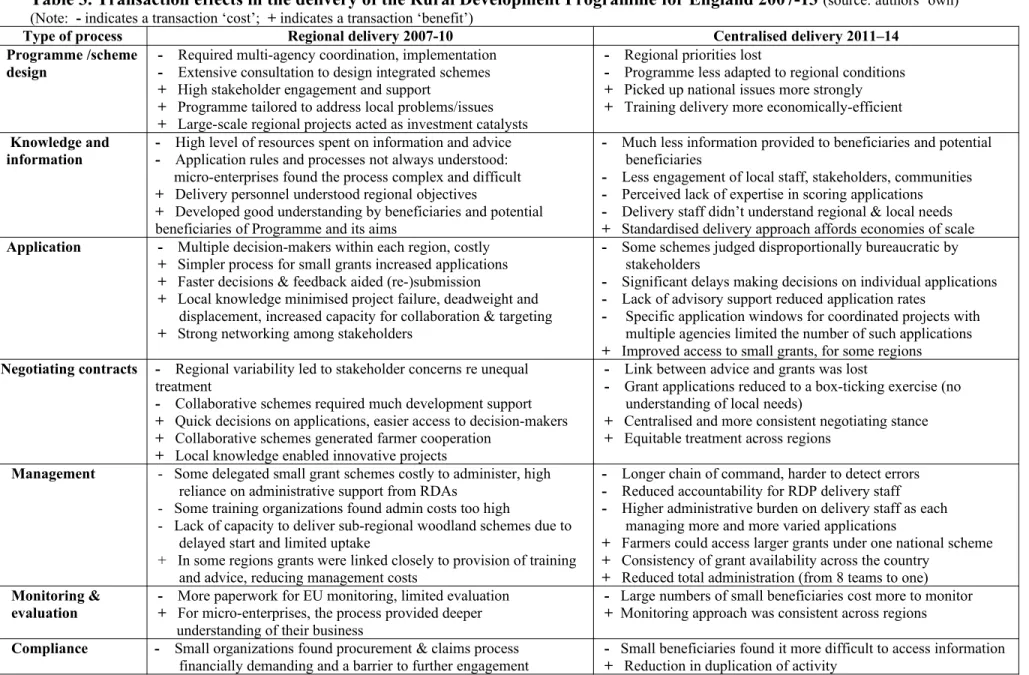
Table 3 highlights the range of attributes associated with programme delivery (for more detail, see Powell and Courtney, 2013). Both the pre-2010 regional and post-2010 centralised delivery approaches had a mix of negative (costs) and positive (benefits) resulting from transaction processes. Regional delivery, for example, resulted in higher total administration costs, as regions tended to provide more advisory support to applicants and because administrative and decision-making processes were duplicated eight times (i.e. within each region), rather than being performed centrally. The move to centralised delivery in 2010 undoubtedly reduced this form of transaction cost. However, the ‘savings’ must be set against negative aspects of centralization such as reduced ability to tailor funds to local needs and conditions. The evaluation found that the local knowledge available in regional delivery resulted in selection processes that reduced the risk of deadweight, displacement, and project failure, thus increasing cost-effectiveness. Regional delivery also enabled support and encouragement for integrated projects, such as those focused on improving specific supply chains (e.g. wood fuel), which require good understanding of local business operations and the ability to bring people together. Integrated programmes of delivery also reduced management costs in some cases by combining several activities (e.g. training, advice and grant support) into a single application process.
Table 3. Transaction effects in the delivery of the Rural Development Programme for England 2007-13 (source: authors’ own) (Note: - indicates a transaction ‘cost’; + indicates a transaction ‘benefit’)
Type of process Regional delivery 2007-10 Centralised delivery 2011–14
Programme /scheme design
- Required multi-agency coordination, implementation
- Extensive consultation to design integrated schemes
+ High stakeholder engagement and support
+ Programme tailored to address local problems/issues
+ Large-scale regional projects acted as investment catalysts
- Regional priorities lost
- Programme less adapted to regional conditions
+ Picked up national issues more strongly
+ Training delivery more economically-efficient
Knowledge and
information - - Application rules and processes not always understood: High level of resources spent on information and advice micro-enterprises found the process complex and difficult
+ Delivery personnel understood regional objectives
+ Developed good understanding by beneficiaries and potential beneficiaries of Programme and its aims
- Much less information provided to beneficiaries and potential beneficiaries
- Less engagement of local staff, stakeholders, communities
- Perceived lack of expertise in scoring applications
- Delivery staff didn’t understand regional & local needs
+ Standardised delivery approach affords economies of scale
Application - Multiple decision-makers within each region, costly
+ Simpler process for small grants increased applications
+ Faster decisions & feedback aided (re-)submission
+ Local knowledge minimised project failure, deadweight and displacement, increased capacity for collaboration & targeting
+ Strong networking among stakeholders
- Some schemes judged disproportionally bureaucratic by stakeholders
- Significant delays making decisions on individual applications
- Lack of advisory support reduced application rates
- Specific application windows for coordinated projects with multiple agencies limited the number of such applications
+ Improved access to small grants, for some regions
Negotiating contracts - Regional variability led to stakeholder concerns re unequal treatment
- Collaborative schemes required much development support
+ Quick decisions on applications, easier access to decision-makers
+ Collaborative schemes generated farmer cooperation
+ Local knowledge enabled innovative projects
- Link between advice and grants was lost
- Grant applications reduced to a box-ticking exercise (no understanding of local needs)
+ Centralised and more consistent negotiating stance
+ Equitable treatment across regions
Management - Some delegated small grant schemes costly to administer, high
reliance on administrative support from RDAs
- Some training organizations found admin costs too high
- Lack of capacity to deliver sub-regional woodland schemes due to delayed start and limited uptake
+ In some regions grants were linked closely to provision of training and advice, reducing management costs
- Longer chain of command, harder to detect errors
- Reduced accountability for RDP delivery staff
- Higher administrative burden on delivery staff as each managing more and more varied applications
+ Farmers could access larger grants under one national scheme
+ Consistency of grant availability across the country
+ Reduced total administration (from 8 teams to one)
Monitoring &
evaluation -+ More paperwork for EU monitoring, limited evaluation For micro-enterprises, the process provided deeper understanding of their business
- Large numbers of small beneficiaries cost more to monitor
+ Monitoring approach was consistent across regions
Compliance - Small organizations found procurement & claims process
particular, the large integrated projects secured in some regions, scored highest in respect of overall impacts and value for money. A distinguishing feature of these large projects was the emphasis that they gave to investment in local partnerships involving stakeholder bodies, which took on some of the burden of ensuring appropriate beneficiary selection and support. This enabled quicker delivery of funding to individual beneficiaries and simpler monitoring and control than under alternative approaches. This example provides evidence that a significant up-front investment in understanding the conditions for RDP transactions, and working to create conditions favouring lower transaction costs as the programme is rolled out, can pay dividends in respect of the effectiveness of RDP impacts.
4.2 Reviewing and developing the Malta RDP (from 2007-13 to 2014-2020)
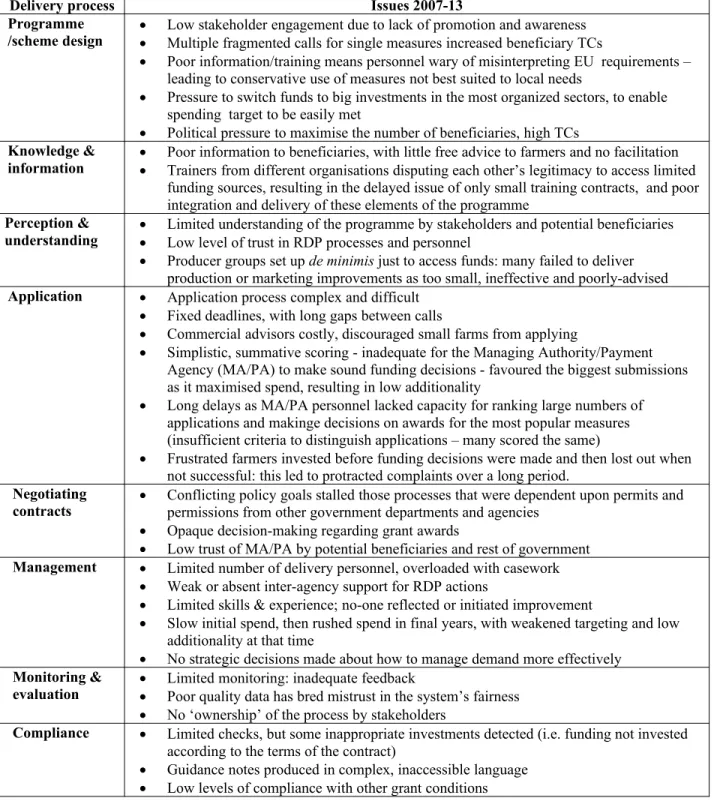
Malta joined the EU relatively recently (acceding in 2004) and, like many smaller Member States, it has faced challenges of limited capacity for full engagement with EU policy requirements. Early experience with RDP design and delivery was disappointing. At mid-term (by 2010), the Maltese RDP 2007-2013 recorded the lowest proportionate expenditure among all member states’ programmes (Schuh et al, 2012), which was a significant cause for concern within the Maltese Managing Authority (MA). Shortly after completion of the mid-term evaluation of its 2007-2013 programme (Cordina et al, 2010), in which many problems were identified,the MA decided to invest in a more strategic review and development process, focused particularly on stronger stakeholder engagement. This provided an opportunity for direct hands-on learning and engagement with RDP development, for the study team.
Table 4. Malta: Transaction costs in delivery of the RDP 2007-13 (source: authors’ own)
Delivery process Issues 2007-13
Programme
/scheme design Low stakeholder engagement due to lack of promotion and awarenessMultiple fragmented calls for single measures increased beneficiary TCs
Poor information/training means personnel wary of misinterpreting EU requirements – leading to conservative use of measures not best suited to local needs
Pressure to switch funds to big investments in the most organized sectors, to enable spending target to be easily met
Political pressure to maximise the number of beneficiaries, high TCs
Knowledge &
information Poor information to beneficiaries, with little free advice to farmers and no facilitationTrainers from different organisations disputing each other’s legitimacy to access limited funding sources, resulting in the delayed issue of only small training contracts, and poor integration and delivery of these elements of the programme
Perception &
understanding Limited understanding of the programme by stakeholders and potential beneficiariesLow level of trust in RDP processes and personnel
Producer groups set up de minimis just to access funds: many failed to deliver production or marketing improvements as too small, ineffective and poorly-advised
Application Application process complex and difficult
Fixed deadlines, with long gaps between calls
Commercial advisors costly, discouraged small farms from applying
Simplistic, summative scoring - inadequate for the Managing Authority/Payment Agency (MA/PA) to make sound funding decisions - favoured the biggest submissions as it maximised spend, resulting in low additionality
Long delays as MA/PA personnel lacked capacity for ranking large numbers of applications and makinge decisions on awards for the most popular measures (insufficient criteria to distinguish applications – many scored the same)
Frustrated farmers invested before funding decisions were made and then lost out when not successful: this led to protracted complaints over a long period.
Negotiating
contracts Conflicting policy goals stalled those processes that were dependent upon permits and permissions from other government departments and agencies
Opaque decision-making regarding grant awards
Low trust of MA/PA by potential beneficiaries and rest of government
Management Limited number of delivery personnel, overloaded with casework
Weak or absent inter-agency support for RDP actions
Limited skills & experience; no-one reflected or initiated improvement
Slow initial spend, then rushed spend in final years, with weakened targeting and low additionality at that time
No strategic decisions made about how to manage demand more effectively
Monitoring &
evaluation Limited monitoring: inadequate feedbackPoor quality data has bred mistrust in the system’s fairness
No ‘ownership’ of the process by stakeholders
Compliance Limited checks, but some inappropriate investments detected (i.e. funding not invested
according to the terms of the contract)
Guidance notes produced in complex, inaccessible language
Low levels of compliance with other grant conditions
inter-departmental communication significantly hindered RDP success (e.g. where investments required prior planning permission but planning authorities were insufficiently informed or in agreement concerning RDP goals). Delivery costs were high, and outcomes limited due to high deadweight and displacement.
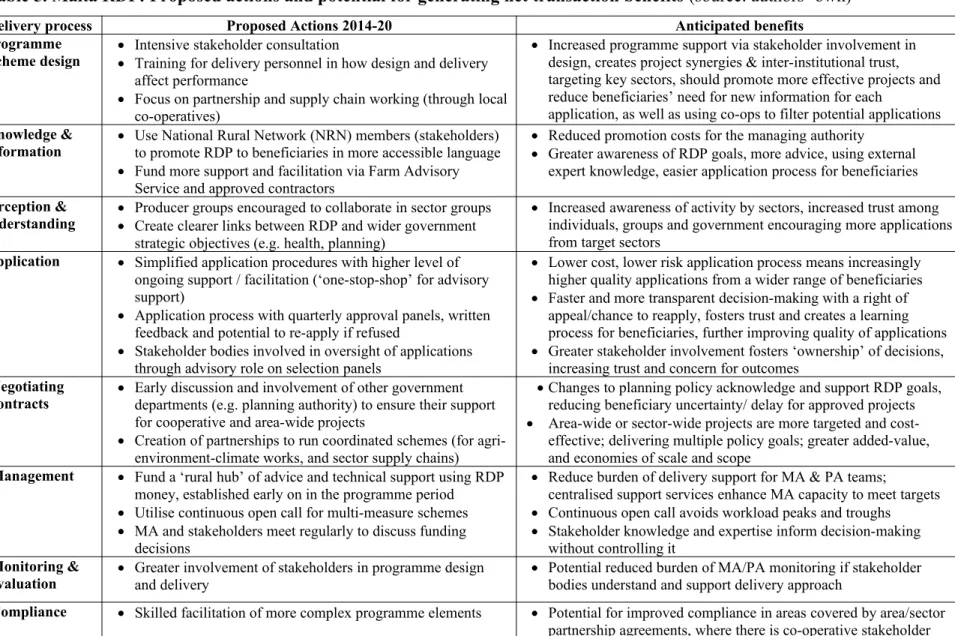
The analysis was used to develop a more inclusive approach to RDP design and development for the 2014-20 programme. This involved more than 40 bilateral meetings with stakeholder bodies and several larger meetings with farmers and stakeholders, to discuss and identify RDP priorities, between October 2011 and November 2013. In addition, six facilitated working groups of farmers and other relevant interests met monthly over a period of 8 months, to identify needs, actions and priorities in more detail, also considering how these might relate to delivery. Parallel work involved gathering and analyzing a range of relevant sector and contextual data to help inform, validate or challenge participants’ views, and thus support the learning process. The approach represented a conscious public investment aimed at enhancing RDP performance, principally by seeking to improve consensus around programme priorities and the balance of costs and benefits in transactions.
Table 5. Malta RDP: Proposed actions and potential for generating net transaction benefits (source: authors’ own)
Delivery process Proposed Actions 2014-20 Anticipated benefits
Programme
/scheme design Intensive stakeholder consultationTraining for delivery personnel in how design and delivery affect performance
Focus on partnership and supply chain working (through local co-operatives)
Increased programme support via stakeholder involvement in design, creates project synergies & inter-institutional trust, targeting key sectors, should promote more effective projects and reduce beneficiaries’ need for new information for each
application, as well as using co-ops to filter potential applications
Knowledge &
information Use National Rural Network (NRN) members (stakeholders) to promote RDP to beneficiaries in more accessible language
Fund more support and facilitation via Farm Advisory Service and approved contractors
Reduced promotion costs for the managing authority
Greater awareness of RDP goals, more advice, using external expert knowledge, easier application process for beneficiaries
Perception &
understanding Producer groups encouraged to collaborate in sector groupsCreate clearer links between RDP and wider government strategic objectives (e.g. health, planning)
Increased awareness of activity by sectors, increased trust among individuals, groups and government encouraging more applications from target sectors
Application Simplified application procedures with higher level of
ongoing support / facilitation (‘one-stop-shop’ for advisory support)
Application process with quarterly approval panels, written feedback and potential to re-apply if refused
Stakeholder bodies involved in oversight of applications through advisory role on selection panels
Lower cost, lower risk application process means increasingly higher quality applications from a wider range of beneficiaries
Faster and more transparent decision-making with a right of appeal/chance to reapply, fosters trust and creates a learning process for beneficiaries, further improving quality of applications
Greater stakeholder involvement fosters ‘ownership’ of decisions, increasing trust and concern for outcomes
Negotiating
contracts Early discussion and involvement of other government departments (e.g. planning authority) to ensure their support for cooperative and area-wide projects
Creation of partnerships to run coordinated schemes (for agri-environment-climate works, and sector supply chains)
Changes to planning policy acknowledge and support RDP goals, reducing beneficiary uncertainty/ delay for approved projects
Area-wide or sector-wide projects are more targeted and cost-effective; delivering multiple policy goals; greater added-value, and economies of scale and scope
Management Fund a ‘rural hub’ of advice and technical support using RDP
money, established early on in the programme period
Utilise continuous open call for multi-measure schemes
MA and stakeholders meet regularly to discuss funding decisions
Reduce burden of delivery support for MA & PA teams; centralised support services enhance MA capacity to meet targets
Continuous open call avoids workload peaks and troughs
Stakeholder knowledge and expertise inform decision-making without controlling it
Monitoring &
evaluation Greater involvement of stakeholders in programme design and delivery
Potential reduced burden of MA/PA monitoring if stakeholder bodies understand and support delivery approach
Compliance Skilled facilitation of more complex programme elements Potential for improved compliance in areas covered by area/sector
The new Malta RDP 2014-2020 was approved but barely operational at the time of writing (March 2016). It is therefore too early to know whether Malta will prove able to implement all these changes to good effect. Challenges include new EU requirements for monitoring, evaluation and compliance where officials anticipate an increased burden in respect of learning and applying new systems, generating significant new transaction costs, with few readily apparent transaction benefits. Within the Maltese administration, there is limited evidence of investment in training and skills development among the key personnel who will be closely involved in programme delivery (e.g. in the Farm Advisory Service, the Managing Authority and Paying Agency). The plan for a Rural Hub and the decision to encourage new collective agri-environment and supply chain projects are written into Malta’s RDP, but without greater skills and knowledge within the MA and PA, successful delivery will be compromised. There is a risk that as RDP drafting and EC approval has delayed its implementation by a year the MA will choose to prioritise speed of spend over effectiveness of spend in order to ensure that all monies are disbursed before 2020. The outcome may be a postponment of improvements to scrutiny, scoring and approvals mechanisms for fear of delays arising simply from the time and resources needed to undertake these changes. Nevertheless, the high level of stakeholder engagement during the RDP preparation should have some lasting impact on the transaction processes, and benefits are expected in respect of encouraging a higher quality and quantity of applications, as well as greater trust in the programme’s objectives and spending priorities.
5. Discussion
The two case studies illustrate ways in which programme design choices and tactics can influence the transaction costs and benefits associated with RDP delivery, in contrasting conditions. They also indicate how a more thorough consideration of transaction costs and benefits might contribute to improved design in future, enhancing performance.
new EU Member States initial RDP development costs may be high, as the agencies involved climb steep learning curves. Over time these costs would be expected to decline as organisations develop their own particular understandings and characteristic modes of operation. This may result in a reduction in administrative costs as agencies learn how to achieve programme objectives more efficiently (Whitby, 2000), but it may also foster ‘path dependency’ (North, 1990b), where the learning experiences unduly bias the future appraisal of, and response to, new policy challenges. This can be a particular problem for small states with limited human capital and resources with consequences for transaction processes and programme effectiveness. Among rural policy-makers more widely there is concern to contain the administrative costs of RDPs (i.e. the explicit public transaction costs that accompany implementation), but there appears little recognition that this may not represent the most cost-effective strategy.
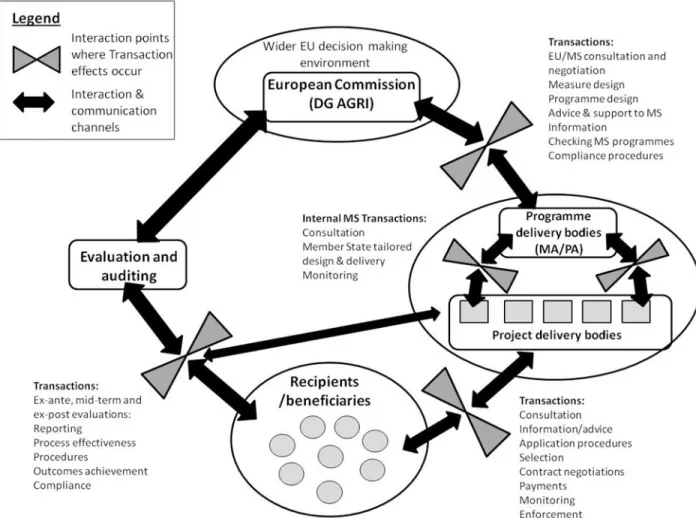
The RDP policy process (Figure 1) entails five critical nodes generating transaction challenges:
At EU level, the European Commission precedes each programming period by agreeing objectives for rural areas across the Union, with the Member States. It then establishes a framework for complex, multi-measure and multi-objective programmes to distribute public funds, involving significant consultation and negotiation between EU bodies and Member State governments.
At Member State level, there must be agreement on the sequence of actions, processes, and interactions between institutions charged with different elements of RDP delivery and oversight (e.g. Managing Authorities and Paying Agencies, tourism and environmental authorities).
At the level of final beneficiaries, the provision of support and advice to raise awareness and help beneficiaries prepare and submit applications, can be vital in ensuring effective use of funding.
Appraisal, selection, approval and agreement of project funding with beneficiaries all requires time and effort.
Figure 1. Critical transaction nodes in the RDP policy cycle (Source: authors’ own)
Member State level asymmetries are also apparent, particularly between Managing Authorities, Paying Agencies and beneficiary groups. For instance, beneficiaries may not understand the desired outcomes of RDP funding, and public officials are unlikely to know the constraints and cost-bases facing all the different target groups that they seek to support.
In addition there are capacity shortfalls. Beneficiaries frequently lack the skills to fulfill some of the basic conditions of applying for funding (e.g. the requirement for business plans, to justify farm investment aid). The costs of acquiring assistance may discourage applications from certain social groups, reducing uptake and/or lowering the additionality associated with contracts. Conversely, where MAs lack resources (including human and social capital) to respond effectively to Commission requirements in respect of auditing, accounting, monitoring and control, they may simplify or reduce the ambition or scope of programmes primarily to render them more feasible to operate, rather than designing first and foremost to meet needs.
In view of the scale, duration and significance of the RDPs in current EU policy, closer attention to the nature and balance of the transactions upon which they rely is warranted. The challenge for public authorities is to look beyond a short-term desire to reduce the immediate costs arising from individual transaction processes and instead consider how transactions can become generators of net benefit through investment in alternative approaches, even though these may initially be more costly to establish. We accept that assessing net benefits in practice is not a simple task, and that many design and delivery features recommended by the analysis covered in this paper cannot yet be thoroughly tested. Nonetheless, stakeholders and delivery agencies in both Malta and England recognised and responded positively to these suggestions.
and exchanges between authorities and stakeholders (e.g. farmers being brought together to exchange views and experiences, officials exchanging experience with other government departments and with beneficiary groups), encourages more awareness of RDP goals and opportunities, greater policy learning, and thus potential for faster and more effective decision-making. Finally, when these factors are combined, greater trust is fostered between authorities and beneficiary groups, which increases the likelihood of beneficiary compliance with funding conditions, potentially reducing the costs of monitoring and enforcement.
Nevertheless, better collective understanding does not always generate improvement because RDPs are subject to a wider range of socio-political pressures and priorities. In England, for example, the centralisation of programme delivery, with its negative impact upon RDP performance, occurred as part of a wider political agenda to reduce the presence and perceived costs of regional governance. In Malta, many of the lessons of the RDP development process remain to be implemented. We identify multiple pressures at the present time for authorities across the EU to prioritise short-term administrative efficiency over capacity-building as a combined result of economic austerity and fear of audit control and disallowance. The challenge is therefore to maintain an agenda of continuous improvement in programme design and delivery for the longer term, in the pursuit of sustainable rural development.
References
Beckmann, V., Eggers, J., and Mettepenningen, E. ‘Deciding how to decide on
agri-environment schemes: the political economy of subsidiarity, decentralization and participation in the European Union’. Journal of Environmental Planning and Management, Vol. 5, (2009), pp.689-716.
Carnegie UK Trust. A Charter for Rural Communities. The final report of the Carnegie Commission for rural community development. (2007) Available at:
http://www.carnegieuktrust.org.uk
Coggan, A., Whitten, S., and Bennett, J. ‘Influences of transaction costs in environmental policy’. Ecological Economics, Vol. 69, (2010) pp. 1777-1784.
Commons, John R. ‘Institutional Economics’. American Economic Review, Vol. 21, (1931) pp. 648-657.
Curry, N. ‘Transactions costs in rural decision-making: the case of funding and monitoring in rural development in England’. Public Administration, Vol. 90 (3), (2012) pp. 622-641.
Davidova, S., Bailey, A., Dwyer, J., Erjavec, E., Gorton, M. and Thomson, K. Study: Semi-subsistence farming - value and directions of development. IP/B/AGRI/IC/2012-65, (2013). European Parliament, Brussels.
Dwyer, J., Buckwell, A., Hart, K., Menadue, H., Mantino, F., Erjavec, E. and Ilbery, B. Study: How to improve the sustainable competitiveness and innovation of the agriculture sector. IP/B/AGRI/IC/2011-100. (2012a). At www.europarl.europa.eu/studies
Dwyer, J., Powell, J., Lewis, N., Courtney, P., Mallia, S., Muscat, R., Cordina, G. A new approach to Malta’s RDP. Report submitted to the Maltese government. (2012b) CCRI, University of Gloucestershire.
European Commission (2005) Council Regulation (EC) No 1698/2005 of 20 September 2005 on support for rural development by the European Agricultural Fund for Rural Development (EAFRD). Commission of the European Communities, Brussels.
European Commission. Rural development in the European Union: Statistical and Economic Information, (2007). Commission of the European Communities, Brussels.
European Commission. 6th financial report from the Commission to the European Parliament and the Council on the European Agricultural Fund for Rural Development (EAFRD): 2012 financial year. {swd(2013) 409 final}(2012) Commission of the European Communities, Brussels.
European Network for Rural Development. Thematic Working Group 4. Delivery mechanisms of rural development policy: final report. ENRD, Brussels (2011). Available at:
http://enrd.ec.europa.eu/enrd-static/fms/pdf/D44FCDEB-C1DC-3F8B-8EDE-B5C89302360C.pdf Accessed 6 February 2015.
European Network for Rural Development. European Conference on
“Unlocking the Potential of the RDPs”1st January 2016, Brussels. (2016) ENRD, Brussels. Available at: http://enrd.ec.europa.eu/sites/enrd/files/rdp1_full-conference_report.pdf Accessed 21 March 2016.
Falconer, K. and Whitby, M. Transactions and administrative costs in Countryside Stewardship policies: an investigation for eight European member states. Centre for Rural Economy
Research Report, University of Newcastle upon Tyne (1999).
Falconer, K. ‘Farm-level constraints on agri-environmental scheme participation: a transactional perspective’. Journal of Rural Studies, Vol. 16, (2000) pp.379-394.
Government of Malta. Partnership Agreement. Published online by the European Commission at: www.ec.europa.eu (2014). Commission of the European Communities, Brussels.
Hicks, J. (1935) ‘A Suggestion for Simplifying the Theory of Money’. Economica, Vol 2, (1935) pp. 1-19.
Mantino, F. ‘What is going to change in EU rural development policies after 2013? Main implications in different national contexts’. Bio-Based and Applied Economics, Vol. 2, (2013) pp.191-206.
Mettepenningen, E., Beckmann, V., and J. Eggers. ‘Public transaction costs of agri-environmental schemes and their determinants – analysing stakeholders’ involvement and perceptions’. Ecological Economics, Vol.70, (2011) pp.641-650.
Moseley, M., Derounian, J., and Lewis, N. Rural Community Development Policy and Funding in the UK and Ireland. Scoping Paper for the Carnegie UK Trust, Countryside and Community Research Unit (2004). CCRI, University of Gloucestershire, Gloucester.
Musole, M. ‘Property rights, transaction costs and institutional change: conceptual framework and literature review’. Progress in Planning, Vol.71, (2009) pp.43-85.
National Council for Voluntary Organisations. ‘A Little bit of Give and Take: Voluntary Sector Accountability within cross-sectoral partnerships’. Perspectives on Public Policy. (2004) NCVO, London.
Goodspeed, T., Lawlor, E., Neitzert, E., and Nicholls, J. A guide to Social Return on Investment.(2009) New Economics Foundation. Available at:
North, D. Institutions, Institutional Change and Economic Performance. (1990a) Cambridge University Press, Cambridge.
North, D. A transaction cost theory of politics. Journal of Theoretical Politics, Vol.2, (1990b) pp.355-367.
Powell, J. and Courtney, P. Evaluation of the socio-economic measures in the England RDP, 2007-2013. (2013). CCRI, University of Gloucestershire, Gloucester.
RuDI. Rural Development Impacts: Extended Policy Brief. (2010) RuDI Framework 7 project funded by the European Commission. Available at: www.rudi-europe.net . Accessed 23 March 2016.
Schlag, P. ‘The problem of transaction costs’. Southern California Law Review, vol.62, (1989) University of Colorado Law School Legal Studies Research Paper Series. Available at SSRN:
http://ssrn.com/abstract=1026662 Accessed 23 March 2016.
Schmid, A. A. Conflict and co-operation: institutional and behavioural economics (2004). Blackwell, Oxford.
Schuh, B., Beiglböck, S.,Novak, S. Panwinkler, T., Tordy, J., Fischer, M., Zondag, M-J., Dwyer, J., Banski, J. and Saraceno, E. Synthesis of Mid-Term Evaluations of Rural Development Programmes 2007-2013. Final Report to DG Agriculture and rural development (2012). Commission of the European Communities, Brussels. Available at:
http://ec.europa.eu/agriculture/evaluation/rural-development-reports/synthesis-mte-2007-2013_en.htm
Accessed 23 March 2016.
Whitby, M. Challenges and options for the UK agric-environment: Presidential Address. Journal of Agricultural Economics, Vol.51 (2000) pp.317-332.
Williamson, O.E., Markets and Hierarchies: Analysis and Antitrust Implications. (2005) Free Press, New York.
Williamson, O.E. The Mechanisms of Governance. (1996) Oxford University Press, New York.
Williamson, O. E. ‘The economics of organization: the transaction cost approach’. The American Journal of Sociology, Vol.87 (1981) pp.548-577.