Pharmaceutical Society of South Africa
PSSA Conference 2018
Highlights from the conference
Part 2
We continue with our journey through the topics discussed at conference
Session – Hiking the legislative mountain
1. Recent or proposed legislation – Lorraine Osman
While pharmacists would prefer to focus their energy on their daily professional commitments, they are surrounded by legislative requirements which can be daunting. In addition to acts that are currently in place, they are bound to regulations, rules, guidelines and must always be aware of the possible implications of draft legislation.
The highest mountain that health professions face at present is obviously national health insurance. The PSSA has commented on all documents published for public comment and has taken steps to prepare for its introduction by co-founding and participating in the NHI Pharmacy Stakeholders Forum.
A number of issues have recently been addressed in terms of the Pharmacy Act. The PSSA continues to monitor the implementation of community service for pharmacists and assists when possible. Pharmacists are reminded that learner pharmacist’s assistants, both basic and post basic, must complete their learnerships as soon as possible because the qualifications are soon to expire. The recent introduction of competency standards will inform the development of the new B Pharm qualification.
The PSSA remains committed to assisting pharmacists to hiking the legislative mountain that looms ahead of them.
2. The influence of corporatisation on the professional identity of community pharmacists – Dr Nomachina Kubashe
A recent qualitative study examined the influence that corporatisation has had on the professional identity of community
pharmacists practising in the Nelson Mandela metropole. The perception regarding the community pharmacist’s professional identity was explored through interviews with 16 pharmacists and 32 consumers.
Results suggest that it is the perception of community pharmacists that with the introduction of legislative changes, specifically corporatisation, their professional skills have been undermined. This threatens the
valuable contribution that they can make by appropriately and efficiently assisting in preventing, managing and reducing the disease burden in South Africa.
Community pharmacists should in fact, capitalise on the development of their clinical skills as these are a tool that will allow pharmacists to make a meaningful transition to being real contributors of primary health care in the transition to national health insurance.
3. The importance of bioethics and health law in a pharmacist’s line of duty – Captain Precious Ncayiyana
Bioethics and health law form an integral part of what pharmacists do in all their spheres. Bioethics explores moral and ethical questions surrounding life, health, science, medicine, and the environment. With the rising levels of patient awareness about their consumer rights and recourse, it is fast becoming complex administering healthcare to patients. The laws exist to protect both the patients and the healthcare professionals. However, health law education has mainly focused on medical doctors even though pharmacists and other healthcare professionals are also likely to face increased litigation. Hence the need to create awareness about bioethics and health law amongst pharmacists.
Lorraine Osman
Precious Ncayiyana presented the results of a study in which existing case studies and the application of health laws were analysed. An important question asked was: how does one draw a line where ambiguities exist? The results showed a lack of basic understanding by pharmacists of how courts, judges, lawyers, and law work. This was found to be the main contributor to omissions that were classified as “negligence”. Omissions
included poorly constructed informed consent. This contributed to increased successful litigation by patients. It was also found that through the application of bioethics, healthcare workers can influence common law and can reduce the number of successful litigations against healthcare workers.
The study showed the importance of the role that can be played by pharmacists in both public and private sector in minimising unnecessary litigation.
It is important for pharmacists to have a basic understanding of bioethics and health law. Pharmacists and doctors working as a team could lead to reduced omissions and litigations, as well as ensuring that patients get the highest quality of care possible.
4. Complaints … a pharmacist’s response – Gary Black
Gary Black, Cape Western Province branch director, deals with complaints on a daily base, to such an extent that he has paraphrased Benjamin Franklin’s famous quotation “in this world nothing can be said to be certain except death and taxes…” in Gary’s words, taken from his Little Black Book of Pharmacy Practice, “in the world of pharmacy practice, nothing can be said to be certain, except mistakes and complaints.”
After discussing the legislative environment in which pharmacy is practiced, Gary explored the right of the user of pharmacy services to complain, both as a patient ad as a consumer. There is a reasonable expectation to receive good quality personalised service, and to complain when it is not received or when mistakes happen.
Aki Kalliatakis, who runs a business focused on customer loyalty, offered this advice:
“treat all complaints like treasures, with the respect they deserve. After all, every complaint gives us an opportunity to correct perceptions, eliminate problems, and add even more value to the customer’s experience.”
In terms of the Good Pharmacy Practice rules, all responsible pharmacists are required to develop and implement a quality
improvement plan, which must identify quality standards for pharmacy services. Pharmacy management should monitor and assess client satisfaction, as well as instituting complaints mechanisms.
Session – turning the table – supporting
pharmacy support personnel
1. Supporting pharmacist’s assistants in the workplace – Jack Mosehla
Jack, a pharmacist’s assistant post basic, shared his journey through the world of pharmacy, starting as a medical representative, working as an auxiliary service officer in a public sector hospital, while beginning his training as a pharmacist’s assistant, through the medical supplies depot, and finally ending up at the city of Tshwane.
The most supportive pharmacists that Jack has encountered during his
career have given similar support in important areas, such as: • Orientation,
• Technical support, • Organisational support, • Communication skills, • Attitude, and
• Personal development.
In the public sector, training is ongoing and depends on the needs of the facility. Working under direct supervision in a hospital, Jack found that training focused on both team work and on operational needs, such as conflict management, time management, customer services and stock control. Working in distribution, different knowledge and skills were needed, such as supply chain, cold chain and medicine supply management.
Precious Ncayiyana
Gary Black Jack Mosehla
He also had some experience in community pharmacy, where support and training were heavily dependent on the attitude and willingness of the pharmacist on duty. Knowledge transfer took place daily, with an emphasis on people skills, over the counter products, side effect and medication interactions.
Working under indirect supervision in a primary healthcare clinic and running a dispensary brought Jack to a new level of responsibility. Continuing training focused on attitude, taking responsibility and accountability, with technical, organisational, communication and personal development, including rational medicine use, medicine supply management, SOPs, ISO2008:9001 and presentation skills.
2. Supporting pharmacist interns during the internship – Marisha Gordon
Marisha is currently completing her internship in a community pharmacy. She has found that her studies equipped her with the facts needed but the internship has taught her how and when to apply this knowledge. Tutors play an important role in ensuring the standard and quality of future pharmacists. It’s a daunting task because the tutor must act as the professional role model and mentor in all aspects of pharmacy. The tutor
is required to motivate and encourage the intern to identify and correct problems that may arise. It’s a full time commitment because the tutor must give guidance to enable the development of an independent, responsible decision-maker.
Marisha’s transition from university to pharmacy was made easier by discussing important matters with her tutor:
• Her previous experience • Her responsibilities
• Establishing aspects and areas where special focus was needed • The goals and outcomes of the internship
• Importance of the assessments required by the pharmacy council
• A description of the work area
• Applicable standard operating procedures (SOPs) in use in the pharmacy
During orientation, she was also introduced to general rules of employment:
• Work hours and remuneration • Time and methods of payment • Expectations of conduct
• Expectations regarding appearance and dress code requirements
• Absenteeism and the obligations of the intern • General housekeeping rules, e.g. refreshment breaks
Marisha’s experience as an intern
• Marisha realised that internship is the process of gaining knowledge, skills and experience from practice
• Tutors play an integral role in supporting an intern’s professional development
• Workplace-based learning and assessment are essential components of a young pharmacist’s development
• A team approach helps embed a culture of learning and support across the organisation
• Tutors contribute to the future of the profession by mentoring the next generation of pharmacists
• The tutor can inspire and encourage a culture of professional learning and development
• Appropriate encouragement and support by the tutor can produce pharmacists who become leaders driven to improve science, practice and patient outcomes
3. Design principles for a preceptor-based experiential learning programme and preparing for the preceptor role – Dr Lia Kritiotis
The concept of using a preceptor to train pharmacy students during their experiential learning is relatively unknown in South African pharmacy but may offer a more structured and uniform approach. The preceptor has a pre-arranged role with the responsibility of fostering and building core professional skills in the student.
Lia Kritiotis set out to determine the characteristics of an effective
preceptor-based experiential learning programme in community pharmacy. She applied a design research approach, which is appropriate in situations where there are no well-defined guidelines. The design research approach involves “evolutionary prototyping” by a research team, which allows perpetual
Marisha Gordon
improvement of successive prototypes, which allows for programme optimisation.
Some general principles emerged to guide the development of the programme.
• Literature must be consulted, e.g. SAPC practice and education standards
• Use the professional competencies to guide the design • Encourage both pharmacist and student participation • Base student tasks on previously acquired theory • Create opportunities for multidisciplinary engagement Preceptors also need guidance and support. It is important to have module objectives and expectations well-articulated and preceptors must be trained in assessment.
The use of committed preceptors in a structured programme can make the work integrated learning component of a student’s academic life achieve better results.
Session – Primary Health Care (PHC) – really
re-engineered?
1. Translating policy into healthcare delivery – Trudy Leong
Trudy Leong, of the National Department of Health spoke on some of the steps that the department has undertaken in order to ensure that the principles of the National Drug Policy, 1996, could be put into practice in healthcare.
The National Drug Policy (NDP), 1996, aimed to minimise disparities between public and private sectors through equitable quality health care for all. In order to standardise
treatment for conditions seen in primary healthcare (PHC) facilities, South Africa’s Standard Treatment Guidelines (STGs) and Essential Medicines List (EML) for PHC were introduced in 1996. In keeping with the concept of universal health coverage, PHC forms the backbone of a stable and effective public healthcare
system underpinned by core principles: first contact, continuous, comprehensive, and a coordinated continuum of care. With each edition of the PHC STGs and EML, the process has strengthened to effectively implement evidence-base medicine policies into practice.
Over time, the evolution of the PHC STGs and EML, by virtue of an iterative evidence based development process has supported PHC re-engineering.
Since the first edition of the 1996 PHC STGs and ENL, the selection process of essential medicines has become more robust, utilising an objective, methodological approach. This includes the assessment of local prevalence and epidemiological data and the application of evidence based medicine principles graded by the strength of recommendation taxonomy (SORT) approach. In addition, technical reviews are undertaken to determine the safety and efficacy of a medicine for inclusion on the EML and draft chapters of the STGs are subject to extensive external peer review, open to all health care professionals in South Africa. Increased transparency of the rationale used for decision-making, collaboration with National Department of Health programmes to decentralise health services (where relevant) and budget impact analyses to assess affordability are standard practice.
The STGs and EML are key to guiding rational medicine use. Dissemination of information and practical implementation strategies using various platforms, are key to ensure that policy translates into clinical practice. Monitoring and evaluation of the uptake of these guidelines is used to determine compliance.
The PHC STGs and EML, 2014 version, was disseminated on the National Department of Health website with supporting implementation slide decks providing the rationale for decisions. In addition, rapid dissemination through the mobile platform (EML Clinical Guide application) ensures ready access to the STGs and EML translating into consistent patient care. This application also has features to further strengthen clinical practice by making body mass index calculator, the Framingham cardiovascular event risk tool and ICD10 code look up accessible as additional resources to healthcare workers.
The PHC STGs and EML also contributed to the medicines, supplies and laboratory services component of the ideal clinic realisation and maintenance (ICRM) programme. This programme was designed to address deficiencies in the quality of primary care services which is fundamental to the implementation of universal health cover in South Africa.
The PHC STGs and EML also recommend the medicines that may be prescribed by various disciplines with respect to their scope of practice. This includes the primary care drug therapy (PCDT) permit for pharmacists, section 56(6) permit by nurse prescribers and midwives’ permit. To date, 123 PCDT permits have been issued by the National Department of Health.
Key learning points
During the PHC STGs and EML review cycles it has been identified that misalignment with national department of health programme guidelines are common, indicating that collaboration needs to be strengthened. Furthermore, guideline implementation, monitoring and evaluation is an area that requires consideration. Ideally, assessment of clinical outcomes of patients managed through these guidelines would provide an effective measure of the impact of the PHC STGs and the EML. In conclusion, the PHC STGs and EML are critical for the implementation of universal health coverage through national health insurance. Pharmacists have the opportunity to participate in the evidence-based peer review. Effective translation of policy into clinical practice and adequate measurement of impact is essential and does require strengthening.
2. Understanding the concept of multidisciplinary practices – Blenn Eagar
Blenn explained the importance of having a primary health care team in order to provide integrated services to the patient.
Multidisciplinary care is possible when professionals from a range of disciplines with different but complementary skills work together to deliver comprehensive healthcare aimed at providing the best possible outcome for the physical and psychosocial needs of a patient. This
takes place in collaboration with the patient and the patient’s family.
Several disciplines have been identified to act within a multidisciplinary team,
• Nurse • Pharmacist
• Pharmacist’s assistant/pharmacy technician • Primary care drug therapy (PCDT) pharmacist • General practitioner
Difficulties experienced under current circumstances
• The Ethical Rules of Conduct for practitioners registered under the Health Professions do not permit medical practitioners to form a partnership or association with or employ any healthcare professional who is not registered with the Health Professions Council. This is effectively a barrier to form a multidisciplinary practice with medical practitioners and other healthcare professionals, such as pharmacists and nurses. • There is often a lack of adequate record keeping
• Many pharmacists lack basic skills in primary healthcare services
• There is a limited scope of practice for pharmacists not licensed as PCDT pharmacists
• Nurses have a limited scope of practice and may identify treatable conditions but are unable to initiate treatment themselves
• There is generally a lack of qualified dispensing nurses, PCDT pharmacists and medical practitioners
• The costs involved in setting up a clinic for primary healthcare (PHC)
There are 2 possible approaches to PHC in the pharmacy:
• The first contact approach (bottom-up approach) mostly used for new patients and acute conditions, e.g. flu, diarrhoea, immunisation
• The second patient monitoring approach (top-down approach) used for chronic condition patient care
In both approaches, the pharmacist plays an integral role and may refer patients to either the nurse or medical practitioner when appropriate.
The future of the pharmacist in PHC
• Failing to prepare for multidisciplinary approach to primary healthcare is preparing for NHI to fail.
• The multidisciplinary approach to healthcare is the future of fast and effective primary healthcare to patients.
• Pharmacists have a potentially pivotal role to play in primary healthcare.
• Pharmacists’ ability to be flexible makes the changing face of pharmacy an opportunity to play a significant role in primary healthcare.
• Community pharmacies have always been a primary entry point in primary healthcare – this enhances patients’ lives and makes a difference.
3. Delivery of pharmaceutical services and care at primary healthcare clinics with different dispensing models –where should the pharmacist be? – Amy Bobbins
Since 1994, many attempts have been made to transform South Africa’s fragmented healthcare system into one unified system with the intention of arriving at Universal
Blenn Eagar
Health Coverage (UHC) implementation, funded by a National Health Insurance (MH). PHC re-engineering is a major focus in health system restructuring, as the development of sustainable PHC is a major pillar of the healthcare system. Since the Alma Ata declaration, PHC has been the cornerstone of strengthening and expanding health systems in low- and middle- income countries, with the ability to improve health system objectives in line with the millennium development goals and the sustainable development goals.
The pharmacist’s role within the PHC setting under the NHI remains vague, with the PHC team envisaged to include a doctor, PHC nurse, nurse, pharmacist’s assistant and a counsellor. The shortage of human resources for health in South Africa is a major challenge that requires the need for the empowerment of support personnel to compensate for the shortage of highly-skilled health care professionals in South Africa. Pharmacy is no different, with the empowerment of pharmacy workforce cadres being integral in the delivery of pharmaceutical services and care to reach all communities in all provinces. This may be a cost-effective solution to aid in increasing access to health services; however, the effects of this process in pharmacy remain largely unstudied. There is little known about the difference in the availability and quality of pharmaceutical service delivery and pharmaceutical care provision by pharmacist-based, pharmacist-assistant based and nurse-based staffing models at public PHC clinics in South Africa. A project was undertaken to explore pharmacist-based, pharmacist assistant-based and nurse-based dispensing models through experiences of quality and availability of pharmaceutical services and care provided at three public sector PHC clinics in the Nelson Mandela Bay health district.
In order to gain insight into the availability and quality of pharmaceutical services at each PHC clinic included in the project, an audit was carried out according to a formulated checklist that integrates aspects of the Good Pharmacy Practice (GPP) rules and the ideal clinic guidelines. The audit was carried out within the pharmacy dispensary or medicine room, where storage and/or dispensing takes place.
Although this research is not yet complete, it is already obvious that several deficiencies exist and commitment to correcting them is essential.
4. The role of a pharmacist in the analysis of adherence rates and associated factors in HIV-patients registered on centralised chronic medicines dispensing and distribution (CCMDD) programme in the public health sector of South Africa – Dr Lucky Norah Katende-Kyenda
Over the past decade, South Africa experienced an unpredicted growth in patients requiring access to long term therapies. Not only has South Africa introduced universal access to antiretroviral therapy (ART) for patients living with HIV and AIDS but there has also been a steady increase in the proportion of the population with non-communicable diseases (NCDs) requiring therapy. This change in the epidemiological profile has led the country to
extend the public sector health care facilities, placing enormous strain on availability resources and contributing towards medicine shortages declining the quality of care.
The CCMDD programme was rolled out in 2014 in the national health insurance (NHI) districts as a pilot study for NHI implementation in South Africa. This is also a business model for private sector involvement in the provision of health care services in the
public sector. Initially CCMDD focused primarily on the provision of ARVs, fixed-dose combination (FDC) in particular, to stable HIV patients. It was later extended to other chronic conditions whose management consists of bi-annual clinic visits and check-ups. More than 260 000 patients are registered on the CCMDD programme, which has helped to improve access to chronic medications and reduction of waiting times, thus improving on the quality of care.
A study was performed to analyse adherence rates and associated factors in HIV patients registered on the CCMDD in a public primary health care setting.
Data were collected from 100 HIV-infected patients during a descriptive cross-sectional study using a standardised-questionnaire and face-to-face-exit interviews. Pill-counts technique was performed and an adherence-rate of 95% was considered acceptable. Data were analyzed using SPSS 22.0. Univariate-factors associated with poor-adherence to HAART were assessed using ANOVA and p ≤ 0.05 was considered statistically significant.
Results
Of 100 HIV-infected patients, 74 females and 26 males enrolled on HAART for more than 36 months. Of these, 26 and 36 were on WHO stages 2 and 3 respectively. Adherence-rate computed from 76 patients revealed 43 (56.6%) having a poor adherence-rate. Of the demographic factors analysed, age and educational background had an influence on adherence rates with p = 0.087 and 0.097 respectively. Other factors associated with non-adherence were: WHO staging (p = 0.016), recent CD4 count (p = 0.07), adverse effects (p = 0.073) and stigma (p = 0.027). Waiting times at facilities varied.
Conclusions and recommendation
Pharmacists as custodians of medicines and important primary health care providers need to collaborate with other stakeholders in order to educate patients on CCMDD and the importance of ARV adherence so as to avoid complications and improve on the quality of care. Issues related to waiting times must be tackled seriously for this programme to be successful. Systemic challenges like late / non deliveries, lack of data at facility level, lack of patient and parcel tracking need attention.
5. Primary care drug therapy pharmacist – value added option! – Frans Landman
Frans Landman is a PCDT pharmacist with a clinic in his pharmacy. On average, he sees about 800 patients a month. The services provided in the clinic include attending to minor ailments, immunisation, family planning and wellness screening.
The PCDT qualification and permit have added value to his practice as there is a great deal of satisfaction
to be gained from diagnosing and prescribing medicines in accordance with the STGs for PHC and the EML.
Additional income is derived from a professional fee which is not linked to a product.
From the point of view of the consumers in his area, many have relied on public health services, which has cost them time and money, as they need to wait for long periods of time, during which they cannot work so they are not paid.
The PCDT model is a viable option for both pharmacist and patient because it offers:
• Physical accessibility to patients • Convenient location
• Ideal trading hours
• Shorter waiting times than local public sector health clinics Frans concluded by sharing some case studies, which showed that his interventions had saved the patient from serious illness, and possibly death.
Session – where will the
money come from?
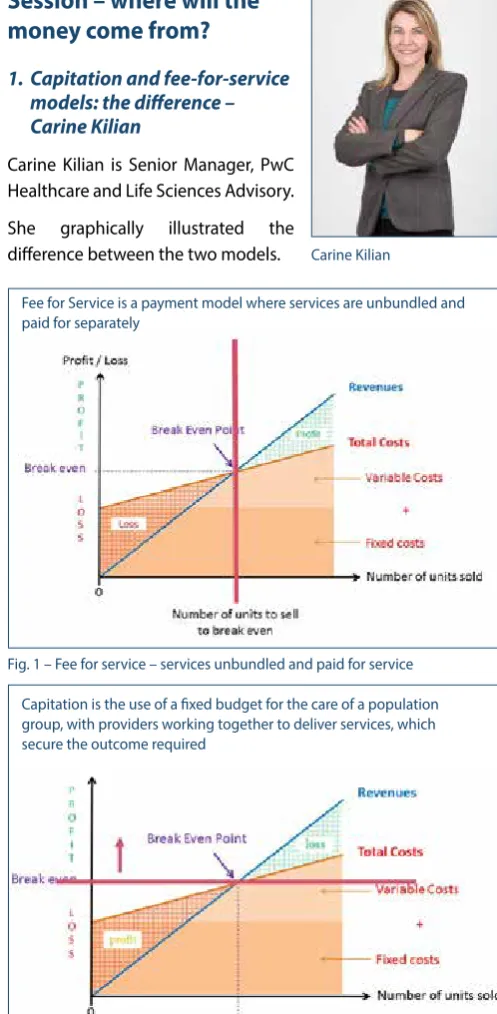
1. Capitation and fee-for-service models: the difference – Carine Kilian
Carine Kilian is Senior Manager, PwC Healthcare and Life Sciences Advisory. She graphically illustrated the difference between the two models.
Benefits of capitation
1. Providers receive a fixed payment regardless of whether services are rendered.
2. Payments are received before services are even rendered. Carine asked, and answered the question, “Why do we need to change?”
Outcome based healthcare transformation is necessary to secure the future sustainability of the healthcare system, in order to raise the quality levels and deliver the outcomes that matter to the patients.
Hilton Stevens with Frans Landman
Carine Kilian
Time is money!
Fee for Service is a payment model where services are unbundled and paid for separately
Fig. 1 – Fee for service – services unbundled and paid for service
Capitation is the use of a fixed budget for the care of a population group, with providers working together to deliver services, which secure the outcome required
Obviously, many factors need to be considered. E.g. 1. No one size fits all
2. It depends on the level of care 3. Depends on the health care system 4. Maturity on evaluation of outcome 5. Various factors that need to be considered
3. Financing NHI – Dondo Mogajane, Director General: National Treasury
Dondo Mogajane emphasised the principles of National Health Insurance, viz.
• There will be a public purchaser of all healthcare services.
• Healthcare will be provided by accredited public and private sector providers.
• It must be affordable and sustainable.
• Primary healthcare must be the portal to all healthcare.
• Wide coverage and equitable access to affordable medicines must be provided.
• Chronic medicines delivery programme, currently funded through indirect NHI grant, is already dispensing medicines through private pharmacies and has potential for expansion and broadening.
Public and private health spending as percentage of GDP
The total health expenditure in South Africa ranges from 8-9% of Gross Domestic Product. Public health spending is currently about 4.1% of GDP, i.e. R 210 billion in 2018/19. Public expenditure on health under NHI is envisaged to increase from 4% to 6% of GDP over a 15-20 year period.
Health spending, public and private
Health spending overall in South Africa is estimated to be around R 447 billion in 2018/19, and is projected to increase to R 507 billion by 2020/2021.
It is anticipated that the public sector will spend around R 210 billion, R 190 billion of which will be in the provinces, while the medical schemes will spend around R 188 billion.
Objectives of the NHI indirect grant budget 2018
• To create an alternative track to improve spending, performance as well as monitoring and evaluation on infrastructure in preparation for NHI;
• To enhance capacity and capability to deliver infrastructure for NHI;
• To accelerate the fulfilment of the requirements of Occupational Health and Safety;
• To expand the alternative models for the dispensing and distribution of chronic medication;
• To fund the development of and roll-out of new Hospital Information Systems in preparation for NHI;
• To develop a risk-adjusted capitation model for the reimbursement of primary health care;
• To enable the health sector to address the deficiencies in the primary health care facilities systematically to yield fast results; • To expand the healthcare service benefits through the
strategic purchasing of services from healthcare providers; • Additional allocations into NHI indirect grant in Budget 2018 • Total indirect NHI conditional grant R2.3 billion in 18/19,
R3 billion and R3.7 billion respectively over the Medium Term Expenditure Framework;
• Centralised chronic medicines dispensing programme (mainly pilot districts to date; includes private pharmacies) R360 million in 18/19, R420 million, R476 million (popular programme, spending escalating rapidly);
• Allocations for medicines stock management information systems (under-spending in 17/18);
• Most general practitioner pilot studies up to 17/18 have been in public facilities;
• From 18/19 new component to contract GPs in own facilities using predominantly capitation as reimbursement
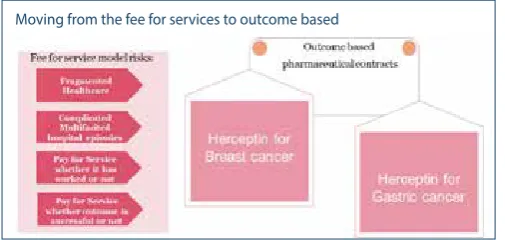
Moving from the fee for services to outcome based
Fig. 3 – The fee for service risks vs outcome based pharmaceutical contracts
Fig. 4 – Clearly there are both opportunities and risks involved. It’s important to ensure that the choice yields both the desired therapeutic outcomes and the continued viability of the service provider
mechanism. Working with NDoH to find a way that patients registered with these doctors under NHI can access medicines.
Components of the indirect NHI grant and other allocations to DOH
• Personal health services
▫ Health professional contracting (current model)
▫ GP contracting – capitation
▫ Psychiatric mental health (post Life Esidemeni)
▫ School health services (e.g. referrals for optometry, occupational therapy)
▫ Priority benefits (cancer) • Non-personal health services
▫ Chronic medicine dispensing
▫ Ideal clinic
▫ Information systems: medicine stock management system, electronic patient registration system
▫ Development of capitation model • Hospital revitalisation
• National DoH
▫ Chronic disease prevention
▫ Interim NHI Fund and structures
▫ Health Technology Assessment
Financing options for NHI
Several specific financing options have been explored, such as a surcharge on personal income tax, new payroll tax and an increase in VAT.
However since this was initiated, the fiscal space has become more limited, because increases in personal income tax and VAT have become necessary just to balance the national fiscus.
This makes it more difficult to further increase taxes in the near term and continuing to use general taxes as a source of health financing is another important option.
Access to medicines
Access to medicines is very important for NHI. South Africa has already made good progress with respect to medicine pricing: tenders in public sector, single exit prices regulated by Health Minister for private sector.
Both originator and brand medicines are seen as important in this country. South Africa has not used Trade-Related Aspects of Intellectual Property Rights (TRIPS) flexibilities to date. This is because it has sought to work collaboratively with pharmaceutical manufacturers and there have been many examples of successful negotiation to bring down prices and improve access, e.g. ARV medications, new generation child vaccines.
As NHI unfolds, ways to widen affordable medicines access to those covered by the NHI must be found. This means that there must be new ways of tendering when the NHI purchases medicines for all those covered by the NHI, regardless of provider.
Evolution of NHI likely to be slow but steady
The NHI Bill has been approved by Cabinet, as has the establishment of the NHI Fund.
Shifting of funds from provinces to NHI Fund is not easy. Pooling reforms with respect to medical schemes is likely to be gradual, and it may be difficult to make major changes until citizens trust the new system.
Fiscal constraints and other expenditure pressures must be taken into account, e.g. fees must fall, public sector wages.
Given the fiscal constraints, reforms to the medical scheme tax subsidy were used to finance new allocations for NHI in Budget 2018, including expanding chronic medicines dispensing programme.
Medicine access and affordability remain a high priority.
The PSSA/Alpha Pharm distance learning
programme 2018
The PSSA/Alpha Pharm Distance Learning Programme continues to offer pharmacists useful, practical, up-to-date information that enables them to provide optimal pharmaceutical care to their patients.
Module 5, 2018 – An update on atopic
dermatitis (eczema)
Atopic dermatitis (also termed atopic eczema), is a chronic, highly pruritic, inflammatory skin condition. Atopic dermatitis occurs most frequently in children, but also affects adults.
The rash is intolerably itchy. It produces considerable insomnia, which has an effect not only on the patient, but also on the family.
The physical, psychological and economic burdens that atopic dermatitis places on patients and their families can be substantial. Several studies have linked the incidence and severity of atopic dermatitis during childhood with subsequent development of allergic rhinitis and asthma. Collectively, these three disorders are often referred to as the ‘allergic march’.
This Module reviews what is currently known about atopic dermatitis, its pathophysiology and the approaches to symptom management and discusses how different immune modulating treatments may modify the course of the disease.
For more information about this programme contact Gill or Glynis at Insight Medicine Information on 011 706 6939 or email: [email protected]
The PSSA/Alpha Pharm clinical education
programme 2018 for pharmacy staff
The PSSA/Alpha Pharm Pharmacy Staff Clinical Education Programme continues to offer front-shop assistants or pharmacist’s assistants up-to-date information that enables them to provide optimal pharmaceutical care to their patients. All pharmacy staff need to be familiar with the use of unscheduled medicines and should be reminded of when it is necessary to refer the patient to the pharmacist.
Module 5, 2018 – Eczema
Eczema is an extremely common skin condition that causes dry, itchy, scaly, red and inflamed skin. It may start at any age but occurs most commonly in children.
Eczema usually presents with a patchy or widespread itchy rash and is often seen in children who have a family history of allergic conditions, such as hay fever or asthma.
This module will enable the front shop member of staff to: • Have a good understanding of eczema - its causes, symptoms
and prevention.
• Understand how patients can reduce their risk of a having a flare-up of their eczema.
• Know what patients can do to manage symptoms such as itching and dry skin.
• Be able to recommend products suitable for skin hydration in patients with eczema.
• Be familiar with the recommended treatment of mild eczema • Have identified the role that he/she can play in helping
patients and caregivers living with or caring for patients with eczema.