Inflation and Inflation Uncertainty in Iran: An Application of GARCH-in-Mean Model with FIML Method of Estimation
Hassan Heidari∗ Sahar Bashiri∗∗
Abstract
This paper investigates the relationship between inflation and inflation uncertainty for the period of 1990-2009 by using monthly data in the Iranian economy. The results of a two-step procedure such as Granger causality test which uses generated variables from the first stage as regressors in the second stage, suggests a positive relation between the mean and the variance of inflation. However, Pagan (1984) criticizes this two-step procedure for its misspecifications due to the use of generated variables from the first stage as regressors in the second stage. This paper uses the Full Information Maximum Likelihood (FIML) method to address this issue. The estimates we gathered with the new set of specifications suggest that inflation causes inflation uncertainty, supporting the Friedman–Ball hypothesis.
Keywords: Inflation Uncertainty, GARCH models, FIML, Iran JEL Classification: C22, E31
1. Introduction:
The relationship between inflation and inflation uncertainty has been the matter of interest among economists in recent decades. As the impact of inflation and inflation uncertainty on growth and welfare are significant (see e.g. Ma, 1998; Vale, 2005; Fountas & Kraranasos, 2006; Wilson, 2006; Hwang, 2007; Fang, et. Al, 2008), determining the direction of the causality between inflation and inflation uncertainty can help the policy makers to make appropriate decisions. Friedman (1977) points out the potential of increased inflation to crate nominal
∗ Assistant professor of Economics - Urmia University, Iran
uncertainty, which adversely affect real economic activity as inflation uncertainty reduces the information content of prices, distorts relative prices, and therefore lowers economic efficiency (welfare and output growth). Ball (1992) formalizes and supports Friedman’s hypothesis in a game theoretical framework. Cukierman and Meltzer (1986) and Cukierman (1992), on the other hand, argue that increases in inflation uncertainty raise the optimal inflation rate by increasing the incentive for the policy maker to create inflation surprises in a game theoretical framework.
On the empirical side of the inflation uncertainty literature, the results are mixed (see e.g. Golob, 1995; Baillie et al., 1996; Crawford and Kasmovich, 1996; Joyce, 1997; Grier and Perry, 1990, 1998, 2000; Davis and Kanago, 2000; Perry and Tevfik, 2000; Fountas, 2001; Fountas, et. al. 2001; Hwang, 2001; Berument and Yuksel, 2002; Fountas, et. al. 2002; Bhar and Hamori, 2004; Kontonikas, 2004; Berument and Nargez Dincer, 2005; Conrad and Karanasos, 2005; Vale, 2005; Artan, 2006; Caporale and Kontonikas, 2006; Grier and Grier, 2006; Thornton, 2007; Heidari and Montakhab, 2008; Heidari and Bashiri, 2009; Jafari Samimi and Motameni 2009; Berument, et al, 2009; Jiranyakul and Opiela, 2010).Heidari and Montakhab (2008); Heidari and Bashiri (2009); and Jafari Samimi and Motameni (2009) investigate the relationship between inflation and inflation uncertainty with Iranian data. Their results are in line with others around world, supporting Friedman’s hypothesis.
This paper examines the relationship between inflation and inflation uncertainty with Iranian data for the period of 1990 to 2009 and FIML method of estimation. The paper contributes to the literature in several respects: First, we employ monthly Iranian data, a country that has experienced significant uncertainty in inflation over the last 40 years. Second this paper estimates inflation uncertainty by assuming that uncertainty is due to the shocks of inflation, and therefore measures inflation uncertainty by using the conditional variance of inflation. In this method, various GARCH models are applied to estimate a time-varying conditional residual variance, as a standard measure of inflation uncertainty. Third the novelty of the paper with Iranian data is that the causality between inflation and inflation uncertainty is tested by using the FIML method of estimation. The estimates with the new set of specification system confirm our results from Granger causality tests, supporting the Friedman-Ball hypothesis.
The rest of the paper is organized as follows: Section 2 introduces the model. Section 3 discusses the data. In section 4, the estimation results are presented and finally, section 5 concludes.
2. The Model
The general GARCH specification, which is used for inflation and time-varying residual variance as a measure of inflation uncertainty, is as follows:
(1)
(2)
Where
π
tis the inflation,ε
tis the residual of equation (1),σ
εt2 is the
conditional variance of the residual term taken as inflation uncertainty at time t, and n is the lag length. Equation.(1) is an autoregressive
representation of inflation, and equation.(2) is a GARCH(1,1)
representation of conditional variance.
t n
i
i t i
t β βπ ε
π = +
∑
+=1 −
0
2 1 2 2
1 1 0 2
−
− +
+
= t t
t ε
ε α αε α σ
Although most empirical studies with Iranian data, used this general GARCH model to investigate the relationship between inflation and inflation uncertainty, they make use of a two-stage procedure.1 For example, Jafari Samimi and Motameni (2009) estimate the conditional variance of inflation by GARCH(1,1) and Exponentiol GARCH (EGARCH) models in the first step, and then perform the Granger causality tests between these generated conditional variance and inflation in the second step. However, Pagan (1984) criticises this two-step procedure and Pagan and Ullah (1988) suggest using the FIML method of estimation to address the misspecifications of using two-step procedure. As Berument and Narrgiz Dincer (2005) mentions, if the inflation affects the inflation uncertainty, and the inflation uncertainty affects the inflation, then the inflation variable and the inflation uncertainty needs to include in the inflation uncertainty (variance equation) and inflation (mean equation) specifications, respectively. Thus the alternative specification for the equations (1) and (2) are:
Following Pagan and Ullah (1988) we estimate equations (3) and (4) jointly using the FIML method of estimation. In this model the value of
0
f
ρ shows that inflation uncertainty increases as inflation rises. Hence a positive and significant ρ can be considered as confirmation of Friedman-Ball hypothesis and also means that inflation uncertainty is a cost of inflation. However,
λ
in the mean equation could be positive or negative. A positiveλ
means that inflation uncertainty has a positive effect on the level of inflation, but a negativeλ
means that inflation uncertainty has a negative impact on the level of inflation which can be explained by the stabilization motive of policy makers.
1 Heidari, et. Al. (Forthcoming). Employs a Quesi Maximum Likelihood
t t n
i t i
t β βπ λσ ε
π = +
∑
+ ε += −
2
1 1
0 (3)
1 2
1 1 0 2
−
− +
+
= t t
t α ασ ρπ
3. Data
The paper uses monthly Consumer Price Index (CPI) inflation, taken from the Central Bank of Iran for the period of 1990–2009. Inflation is the annualized monthly difference of the log of the CPI: (see, e.g. Asteriou, 2006).
Figure (1) shows the inflation rate in the Iranian economy during 1990-2009.
Figure 1. Inflation Rate in the Iranian Economy
-40 -20 0 20 40 60 80 100
90 92 94 96 98 00 02 04 06 08
As Figure 1 shows the Iranian economy has experienced high and volatile inflation rate during last two decades.
The summary statistics for the data is given in Table (1). The large value of the Jargue- Bera statistic implies a deviation from normality.
Table 1. Summary statistics for Iranian inflation
Mean Median Maximum Minimum Std. Dev. Skewness Kurtosis Jargua-Bera Probability 17.7015 15.4840 89.4030 -24.7431 16.6848 1.21719 6.13495 150.3212 0.0000
1200 ) ln
(ln − 1 ×
= t t−
t cpi cpi
3.1 Unit Root Test:
In order to investigate the stationary of the data, the paper uses the Augmented Dickey-Fuller (ADF), Philips-Perron(PP) and Kwiatkowski, Phillips, Schmidt, and Shin (KPSS) tests. Table (2) shows the ADF, PP and KPSS tests results for the Iranian inflation.
Table 2. ADF, PP and KPSS tests results for the Iranian inflation
Include in test
equation Statistic Critical 10% level values values 5% level Critical Critical values 1% level Intercepet -9.733669*** -2.573502 -2.874029 -3.45893 trend and
intercepet -9.998044*** -3.138345 -3.429657 -3.998815 ADF
none -0.760497 -1.615725 -1.942296 -2.575662 Intercepet -9.704863*** -2.573502 -2.874029 -3.458973 trend and
intercepet -9.955510*** -3.138345 -3.429657 -3.998815 PP
none -5.686860*** -1.615772 -1.942224 -2.575144 Intercepet 0.512000** 0.347000 0.463000 0.739000 KPSS
trend and
intercepet 0.131385* 0.119000 0.146000 0.216000
Note: * denotes significance at the 10 % level, ** denotes significance at the 10%, 5 % level *** denotes significance at the 10%, 5%, 1 % level.
As can be seen from Table (2), the inflation rate is stationary.
3-2 Test of Structural Breaks in the Mean of Iranian Inflation:
To carry out a test of no structural break against an unknown number of breaks in the Iranian inflation, this paper uses the endogenously determined multiple break test developed by Bai and Perrron (1998). This method tests for the presence of breaks when neither the number nor the timing of breaks is known aprior. This approach allows us to test for the presence of m breaks in the mean of
inflation rate at unknown times using the following model:
) 1 ( , , 2 ,
1 +
= m
j K
j
j T
T
t= −1+1,K,
t j t µ η
Where
π
t is the inflation, µj is the regime-specific mean inflation rate,and
η
t is an error term, and T0 =0 and Tm+1 =T.Bai and Perron (1998) introduced two tests of the null hypothesis of no structural break against an unknown number of breaks given some upper bound (for most empirical applications this bound is 5, see, e.g., Bai and Perron, 2003). These tests are called Double Maximum tests (Dmax). The first is an equal weighted (we set all weights equal to
unity) labeled by UDmax. The second test, WDmax, applies weights to
the individual tests such that the marginal p−values are equal across the
values of breaks. In both of these tests, break points are estimated by using the global minimization of the sum of squared residuals (for more details see, Bai and Perron, 1998 and 2003).
Table 3. UDmaxand WDmaxtests results
Tests UDmax WDmax
Values 5.6793 5.6793
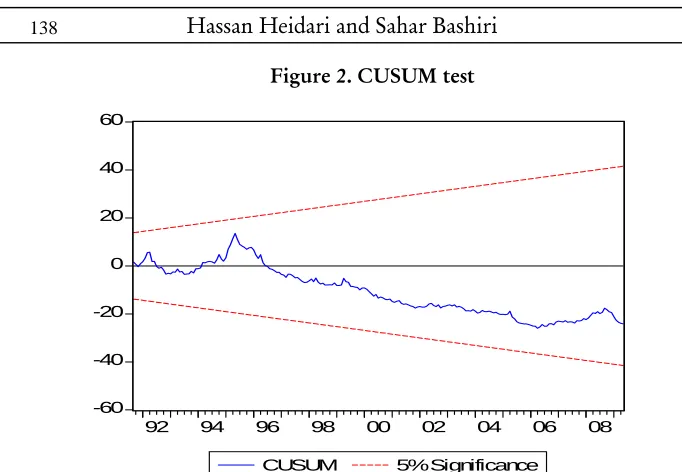
Table (3) presents results of Dmax tests. These tests show that we have
no break in the mean of the Iranian inflation. These results are strongly supported by the SupFT(m) test introduced by Andrews (1993) and CUSUM test.
Figure 2. CUSUM test
-60 -40 -20 0 20 40 60
92 94 96 98 00 02 04 06 08
CUSUM 5% Significance
4. Estimates
We find that the best fitting time series model for the Iranian inflation includes 1, 11, 12 of its lages. The results from estimation of this model are as follow: (t-statistics are in paranthesses)
t t t
t
t
π
π
π
ε
π
=5.159789+0.326384 −1+0.149431 −11+0.242599 −12+(2.97) (5.36) (2.34) (3.70)
In order to find out whether the residuals are serialy correlated, we use Breush-Godfrey serial correlation Lagrange Multiplier (LM) Test.
t t t
t
t β βπ β π β π ε
Table 4. Breush-Godfrey Serial Correlation LM Test
0.736441 Probability
0.611851 LM test
The Table (4) shows that the test does not reject the hypothesis of no serial correlation and so indicate that the residuals are not serialy correlated.
More ever to test whether there are any remaining ARCH effects in the residuals, we use the LM test for ARCH in the residuals (see, e.g. Engle 1982). The results of the ARCH-LM test in Table (5) expresses that the hypothesis of no remaining ARCH effects in the residuals can not be rejected. Thus, there is ARCH effect in the residuals.
Table 5. ARCH LM Test
0.000022 Probability
18.02908 LM test
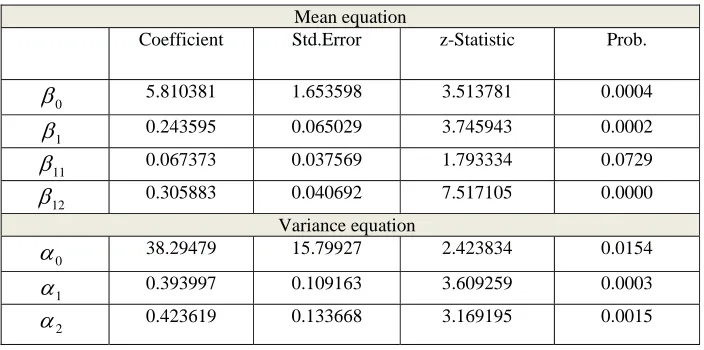
Since higher order ARCH indicates persistence in the conditional variance, the model is estimated as a GARCH(1,1) process. This resultes are reported in Table (6).
Table 6. GARCH(1,1) model estimation results
The results in Table (6) show that in the mean and variance equation, all coefficients are highly significant.
Table (7) reports the result of Granger Causality test between inflation and inflation uncertainty. In fact, in this table we repeated the analysis of two-step procedure which is done in Heidari and Montakhab (2008) and Jafari Samimi and Motameni (2009), among others.
Table 7. Granger Causality Tests
Probability F-Statistic
Null Hypothesis
5.4E-13 32.4027
Inflation does not Granger Cause inflation uncertainty
0.17786 1.74102
Inflation uncertainty does not Granger Cause inflation
These results suggest that inflation Granger-causes inflation uncertainty, supporting the Friedman–Ball hypothesis, that high inflation is associated with more variable inflation.
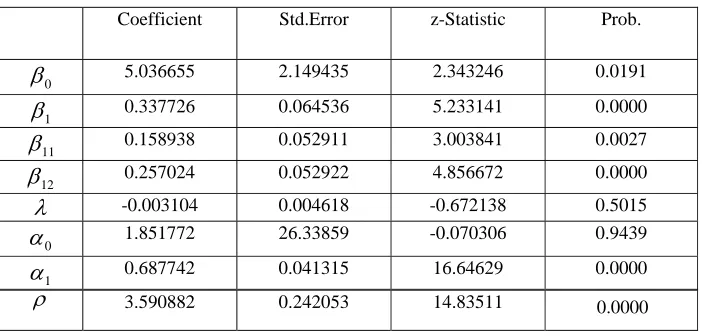
The novelty of the paper is setting up a system of equation and estimate the new set of specification using FIML method of estimation. Table (8) presents jointly estimation result of equations (4) and (5) using FIML method. As excluding further lags of inflation and inflation uncertainty measure from the system would lead to biased estimates of parameters, we include further lags of these variables in the system.
Table 8. The estimation result of the system by using FIML
Prob. z-Statistic Std.Error Coefficient 0.0191 2.343246 2.149435 5.036655 0
β
0.0000 5.233141 0.064536 0.337726 1 β 0.0027 3.003841 0.052911 0.158938 11 β 0.0000 4.856672 0.052922 0.257024 12 β 0.5015 -0.672138 0.004618 -0.003104λ
0.9439 -0.070306 26.33859 1.851772 0α
0.0000 16.64629 0.041315 0.687742 1 αOur results of Table (8) express that the coefficient of lagged inflation in the variance equation (ρ) is positive and highly significant. This supports the Friedman-Ball hypothesis that inflation increases that inflation uncertainty, and is in line with Heidari and Montakhab (2008) and Jafari Samimi and Motameni (2009). However, the coefficient of conditional variance in the mean equation is insignificant, which means that inflation uncertainty doesn't affect the level of inflation. This result is robust to the different order of lags of inflation uncertainty.
5. Conclusion
References:
1- Andrews, D. (1993). Tests for Parameter Instability and Structural Changes with Unknown Change Point. Econometrica, 61, 821-856. 2- Artan, S. (2006). Inflation, Inflation uncertainty and Growth in Turkey, Turkiye Ekonomi Kurumu Dergisi, 14, 3-17.
3- Asteriou, D. (2006). Applied Econometrics, A modern approach using Eviews and Microfit, Palgrave Macmillan, New York, USA.
4- Bia, J. and Perron, P. (1998). Estimating and testing linear models with multiple structural changes. Econometrica, 66, 47-78.
5- Bia, J. and Perron, P. (2003). Computation and analysis of multiple structural change models, Journal of Applied Econometrics,18, 1-22. 6- Ball, L. (1992). Why dose high inflation raise inflation uncertainty? Journal of Monetary Economics, 29, 371-388.
7- Baillie, R., Chung, C. & Tieslau, M. (1996). Analysing inflation by the fractionally integrated ARFIMA-GARCH model, J.Appl. Econom.11, 23-40.
8- Berument, H. and N., Nergiz Dincer (2005). Inflation and inflation uncertainty in the G-7 countries, Physica A, 348, 371-370.
9- Berument, H. and Yuksel, Mutlu (2002). Temporal ordering of inflation and inflation uncertainty: Evidence from United Kingdom, Department of Economics, Bilkent Univercity.
10- Berument, H., Yalcin, Y. and Yildirim, J (2009). The effect of inflation uncertainty on inflation: Stochastic volatility in mean model within a dynamic framework. Economic Modeling, 26, 1201-1207.
11- Bhar, R. and Hamori, S. (2004). The link between inflation and inflation uncertainty evidence from G7 countries, Empirical Economics, 29, 825-853.
13- Conrad, C. and M., Karanasos (2005). On the inflation–uncertainty hypothesis in the USA, Japan and the UK: a dual long memory approach. Japan and the world Economy, 17, 327-343.
14- Crawford, A. and Kasmovich, M. (1996). Does inflation uncertainty vary with the level of inflation? Bank of Canada, Ottawa Ontario Canada K1A 0G9.
15- Cukierman, A and A. Meltzer, (1986). A theory of ambiguity, credibility, and inflation under discretion and asymmetric information, Econometrica, 54, 1099-1128.
16- Cukierman, A. (1992). Central Bank Strategy, Credibility and Independence, MIT press, Cambridge, MA.
17- Davis,G. and B. Kanago, (2000). The level and uncertainty of inflation: results from OECD forecasts, Economic Enquiry, 38, pp. 58-72. 18- Emami, K and Salmanpour, A. (2006). Inflation and Inflation Uncertainty in Iran: a new approach. Journal of Economics and Management. 69, pp. 53-67. (in Persian)
19- Fang, W.; S., Miller, and C. Lee (2008). Cross-Country evidence on output growth volatility: Nonstationary variance and GARCH models. Scottish Journal of Political Economy, Vol. 55(4), pp. 509-541.
20- Fang, W.; S., Miller, and C. Lee (2009). Modeling the volatility of real GDP growth: The case of Japan revisited.
21- Farzinvash, A and Abbasi, M. (2005). The relationship between Inflation and Inflation Uncertainty in Iran, Evidence from GARCH and State-Space Modeling (1961-2003). Journal of Economic Research, 74, 25-55. (in Persian)
22- Fountas, S. (2001). The relationship between inflation and inflation uncertainty in the UK: 1885-1998. Economics Letters, 74, 77-83.
24- Fountas, S., Karanasos, M. and Karanassou, M. (2001). A GARCH model of inflation and inflation uncertainty with simultaneous feedback, University of York Discussion Papers 2000y24.
25- Fountas, S., Karanasos, M. & Kim, J. (2002). Inflation and output Growth Uncertainty and their Relationship with Inflation and output Growth, Economics Letters, 75, 293-301.
26- Fountas, S, Ioannidis, A. and M., Karanasos. (2003). Inflation, inflation uncertainty, and a common European monetary policy, Manchester School, 72, 221-242.
27- Friedman, M. (1977). Inflation and unemployment, Journal of Political Economy, 85, 451-472.
28- Golob, John E. (1994). Does inflation uncertainty increase with inflation? Federal Reserve Bank of Kansas City Economic Review 79, 27-38.
29- Grier, R. and Grier, K. (2006). On the real effects of inflation and inflation uncertainty in Mexico, Journal of Development Economics, 80, 478-500.
30- Grier, K. and Perry, M. (1990). Inflation, inflation uncertainty and relative price dispersion: evidence from bivariate GARCH-M models, Journal of Monetary Econ, 38, 391-405.
31- Grier, K. and Perry, M. (1998). On inflation and inflation uncertainty in the G7 countries, Journal of International Money and Finance, 17, 671-689.
32- Grier, K. and Perry, M. (2000). The effects of real and nominal uncertainty on inflation and output growth: some GARCH-M evidence. Journal of Applied Econometrics, 15, 45-58.
34- Heidari, H. and Montekhab, H. (2008). Inflation and Inflation Uncertainty in Iran, ICSS, Izmir, Turkey.
35- Heidari, H., Parvin, S, Shakery, A. and Feizi Yengjeh, S. (Forthcoming). Economic growth and GDP variability in Iran: Some evidence from GARCH models. Quarterly Iranian Economic Research (In Persian)
36- wang, Y. (2001). Relationship between inflation and inflation uncertainty. Economics Letters, 73, 179-186.
37- Hwang, Y. (2007). Causality between inflation and real growth, Economic Letters, 94, 146-153.
38- Jafari Samimi, A. and Motameni, M. (2009). Inflation and Inflation uncertainty in Iran. Australian Journal of Basic and Applied Sciences, 3(3): 2935-2938.
39- Jiranyakul, K and Opiela, T. (2010). Inflation and Inflation uncertainty in the ASEAN-5economies.Journal of asian Economics, 21, 105-112.
40- Joyce, M. (1997). Inflation and inflation uncertainty. Bank of England Quarterly Bulletin, 37, 285-290.
41- Kontonikas, A. (2004). Inflation and inflation uncertainty in the United Kingdom, evidence from GARCH modelling, Economic modelling, 21, 521-543.
42- Ma, H. (1998). Inflation, Uncertainty, and Growth in Colombia, IMF Working Paper, WP/98/161, 1-28.
43- Pagan, A. (1984). Econometrics issues in the analysis of regressions with generated regressors. International Economic Review. 25, 221-247. 44- Pagan, A. and Ullah, A. (1988). The econometric analysis of models with risk terms. J. Appl. Econom.3, 87-105.
46- Tashkini, A. (2006). Does inflation uncertainty vary with inflation? Journal of Economic Research, 73, 193-210. (in Persian)
47- Thornton, J. (2007). Inflation and inflation uncertainty in Argentina 1810- 2005, Economics Letters, 93, 247-252.
48- Thornton, J. (2007). The relationship between inflation and inflation uncertainty in Emerging Market Economies, Southern Economic Journal, Volume 73, Issue 4, pp. 858-870.
49- Vale, S. (2005). Inflation, Growth and Real and Nominal Uncertainty: Some Bivariate GARCH-in-Mean Evidence for Brazil, RBE, 59(1), pp. 127-145.
50- Wilson, B. (2006). The link between inflation, inflation uncertainty and output growth: New time series evidence from Japan. Journal of Macroeconomics, Vol. 28, pp. 609-620.