I J H S
9 | International Journal of Health Studies 2019;5(2)
Original Article
International Journal of Health Studies
Comparison between the Acute Effects of Intermittent Hypoxia and Aerobic Exercise on
the Nitric Oxide Value, Blood Pressure, and the Respiratory Function in Apnea
Ronak Latifnezhad1*, Ali Younesian1, Vahid Tadibi2
1 Faculty of Physical Education and Sports Sciences, Shahrood University of Technology, Shahrood, Iran. 2 Faculty of Physical Education and Sports Sciences, Razi University, Kermanshah, Iran.
Received: 29 April 2019 Accepted: 4 November 2019
Abstract
Background: Apnea is a common disorder in the community. The aim of the study was to compare the acute effects of activity and periodic hypoxia on the nitric oxide, blood pressure, and the pulmonary function in apnea.
Methods: The study was as a clinical, pretest, and posttest intervention. A total of 11 males enrolled in the study and completed at least four options of the STOP-Bang inventory. They performed aerobic exercise on a treadmill with intensity of 70 0/0 heart rate reserve, during 40 minutes in intermittent hypoxia. The subjects inhaled intermittently 5 minutes normoxic and hypoxic (11%) air at sitting position for 1 hour. Nitric oxide, blood pressure, and lung function were measured before and after interventions. SPSS22 was
used to analyze the collected data. Kolmogorov-Smirnov, ANOVA, and Pearson correlation tests were used. The significance level was set at 0.05.
Results: Significantly elevated nitric oxide and reduced systolic blood pressure were observed at 40, 50 and 60 minutes in the intermittent aerobic exercise (Pvalue ≤ 0.05). We found a significant relationship between reduction in systolic blood pressure at 50 minutes and PEF in post 30 and 60 minutes. The results revealed heightened serum nitric oxide after aerobic exercise sessions and diminished systolic blood pressure. However, there was no difference in the lung function factors before and after the interventions.
Conclusions: Aerobic exercise increases the nitric oxide better than hypoxia does and reduces blood pressure. Thus, it can be used in patients with obstructive sleep apnea.
Keywords: Nitric oxide, Acute training, Lung function, Apnea.
*Corresponding to: R Latifnezhad, Email: [email protected]
Please cite this paper as: Latifnezhad R, Younesian A, Tadibi V. Comparison between the acute effects of intermittent hypoxia and aerobic exercise on the nitric oxide value, blood pressure, and the respiratory function in apnea. Int J Health Stud 2019;5(2):9-13.
I
ntroduction
Obstructive sleep Apnea (OSA) is a common chronic disorder characterized by repetitive collapses of the upper airway during sleep and is associated with snoring, disrupted sleep, and intermittent hypoxia (IH).1 The apnea
pathophysiology is multi-dimensional, but the most important factor is obesity which causes obstruction of the upper air ways.2
Most researchers have reported that chronic aerobic exercise is one of the non-pharmacological strategies to treat apnea. According to author's information, previous studies have been based on chronic aerobic exercise.3,4 Thus, the studies
examining the acute aerobic exercise on apnea were not observed. Previous studies have shown other exercises used to reduce obstructive sleep apnea including intermittent hypoxia
performed in studies on the treatment of pulmonary diseases such as chronic obstructive pulmonary disease.5 In some
studies, complications were not related to exposure IH. In addition, slight IH causes complications associated with apnea. The basis of studies between humans and animals is intensity of IH. In addition, beneficial results at cell level have been reported in previous studies.6 The basic assumption is suitable
dose and according to our search until now we have not seen study done with the protocol of this study.
Nitric oxide (NO) is a gas with a short half-life and different physiological effects. Nitric oxide has different physiological effects which acts through the production of cyclic guanosine monophosphate. It is synthesized via nitric oxide and L-Arginine amino acid. One of the roles of nitric oxide is in the respiratory system operation which acts as a vascular relaxant, neurotransmitter, and blood clotting agent in the body. In diseases with hypoxia, no distribution diminishes in cells. It has been shown that creating a relative equilibrium of oxygen and nitric oxide improves the performance of nitric oxide.7 Previous studies have shown the significant effect of
the aerobic exercise protocol on nitric oxide level. However, only one study in apnea showed that acute aerobic exercise on nitric oxide reduced.6 Furthermore, only one research
investigated the effect of hypoxia with moderate intensity on apnea which observed negative effects on nighttime sleep as compared to control group.8 Therefore, further research is
required in this regard.
Hypertension refers to sustained elevated blood pressure levels. Following obesity, it is the second most common chronic widespread disease in the united states. Approximately 60% of people over 20 years of age have a high blood pressure or hypertension.9 A small increase in blood pressure is known
as pre-hypertensive blood pressure; at this stage, people's blood pressure is higher than normal and below the level of high blood pressure.10 Recent studies have shown that the aerobic
exercise is a non-pharmacological strategy against hypertension. It inhibits the sympathetic system and reduces vascular resistance.11 Intermittent hypoxia is another strategy
that would reduce blood pressure with sympathetic-adrenal suppression and angiotensin-renin system at high altitudes.12
Some studies have investigated the effects of aerobic exercise on lowering blood pressure by increasing nitric oxide.13,14,15 Nevertheless, according to our search, no study
Physical activity is one of the factors affecting pulmonary function and quality of sleep. However, no information is available about the effects of exercise on changes in respiratory parameters associated with sleep quality. Reports suggest that increased or improved respiratory function along with more exercise would reduce resistance and increase the diameter of the airways. It strengthens the respiratory system and improves the elasticity of the lungs and chest.16 According to our search,
only one study has investigated the effect of high intensity acute aerobic exercise on obese people.17 Also, only one study
of chronic intermittent hypoxia examined mountaineers, which only significantly increased the PEF in the experimental group compared to control. Other parameters, including FEV1 and FEF 25-75%, FVC, MVV, VC, were not significantly altered.18
Due to the lack of research on the effects of acute periodic hypoxia and aerobic exercise on nitric oxide levels, blood pressure, and lung function, the present study was conducted to inspect the effects of the above-mentioned factors on blood pressure and lung function.
Materials and Methods
This is a semi-experimental study with pretest and posttest intervention. We enrolled 11 male volunteers with obstructive sleep apnea (24.54 ± 10.24 years old, 134.81 ± 6.41sys blood pressure, 83.81 ± 7.16 dias blood pressure) who were admitted to the Razi university and completed at least four options of STOP-Bang inventory from health behavior association. The STOP-Bang questionnaire consists of 8 questions about snoring, fatigue, blood pressure, BMI, age, sleep apnea, gender, and neck size. Note that all of them have limitations for evaluation including BMI above 35 kg/m2, age greater than 50
years, neck size larger than 43 cm for men and greater than 41 cm for women. In terms of scoring, 0-2 positive factors mean a low risk of apnea, 3-4 positive items represent “intermediate risk”, and 5-8 positive items indicate a “high risk”. It is an easy-to-use screening tool for OSA which has 84-100% sensitivity and 37-56% of specificity.19
Initially, the subjects filled out the questionnaires anonymously as the participation in the study was voluntary. Accordingly, each subject was informed of the experimental procedures and the possible risks involved in the study, and informed consent was subsequently obtained. They were randomly divided into hypoxia group and aerobic group. The subjects with cardiovascular disease, addiction, prescription drugs, and tobacco smokers were excluded from the study. None of the cases had hospitalization in three months prior to starting the study and had daily activity without absolute resting. Demographic data including sex, age and BMI were gathered from the patients’ records. The study was performed on two separate days and at least prolonged three days and interventions performed randomly.
During intermittent hypoxia session, performed by a hypoxia catcher (GO2 Altitude, Australia), at first they sat down and rested for at least 30 minutes. Next, 5-minute hypoxic air (11% oxygen) and 5-minute normoxic air (room air) were inhaled intermittently at a sitting position for 1 hour. The subjects were allowed to take off their mask and inhale the room air when they felt uncomfortable or dizzy.
They performed an aerobic exercise involving 40 minutes running on a treadmill (h/p/Cosmos, Germany). Firstly, they performed warm-up for10 minutes consisting of fast walking
and stretching exercises. Next, they did aerobic exercise with intensity of 70% heart rate reserve as they fasten (polar pulmonary, Finland) to the lower abdomen and lower back. Finally, they cooled down for 10 minutes by walking. We used Karvonen formula to measure 70% heart rate reserve.
Karvonen formula = [(max HR − resting HR) × 70% Intensity] + resting HR example
Blood samples (5 cc) were collected to analyze nitric oxide immediately before and after each intervention from the brachial vein. In the first collection, after fasting for a minimum of 8 h, venous blood samples were obtained from the antecubital veins of all participants in a sitting position. Blood specimens were centrifuged at 3000 g for 20 min at room temperature to separate the serum. Aliquots of the serum were transferred into citrate tubes and utilized in the analysis of biochemical factors. The samples were stored at − 20°C until the nitric oxide was analyzed by Elisa kit (Nitric oxide (Zell Bio GmbH) in the laboratory.
The evaluation of blood pressure was conducted 20 minutes after the subjects were in the laboratory. Then, the practice time was measured every 10 minutes to an hour, in each testing session. Both systolic and diastolic blood pressures were measured using digital barometer automatic blood pressure monitor (Beure 20 BM model). Participants were asked to sit and remain seated with their feet on the ground and their arms resting at the heart level. Two blood pressure measurements were performed on the arms and wrist with at least a 10-min pause between the measurements. Standard spirometry pulmonary function tests were performed prior to as well as half an hour to an hour after each session by a portable spirometer (Germany). The patients were studied in a sitting posture while wearing a nose clip using standard methodology. Forced vital capacity (FVC), forced expiratory volume in the first second (FEV1), peak expiratory flow rate (PEFR), tidal volume (TV), and the (FEV1/FVC) ratio were measured. The research ethics committee of sport sciences research institute approved the study. It was also according to the ethical standards in research of the ministry of science, research and technology (code IR.SSRI.REC.1397.369). The ethics identity IR.SSRC.REC.1397.016 of this document is also visible in the national ethics system website (IRCT20190718044267N1).
Kolmogorov-Smirnov, repeated measures analysis of variance (ANOVA), and Pearson correlation tests were used. The collected data were analyzed using software SPSS version 22. The significance level was set at 0.05 in all tests.
Results
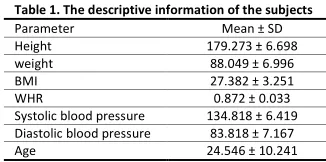
The subjects were divided into two groups, with their descriptive information being presented in table 1.
Table 1. The descriptive information of the subjects
Mean ± SD Parameter
179.273 ± 6.698 Height
88.049 ± 6.996 weight
27.382 ± 3.251 BMI
0.872 ± 0.033 WHR
134.818 ± 6.419 Systolic blood pressure
83.818 ± 7.167 Diastolic blood pressure
24.546 ± 10.241 Age
after 40 minutes (Pvalue = 0.031); blood pressure was significantly reduced after 40, 50, and 60 minutes (Pvalue = 0.014); and FVC was significantly in time and group (Pvalue = 0.49). Table 2 shows the results.
Table 2. Results of repeated measures ANOVA to investigate the effect of interventions Time. group Time Factors 0.654 0.031 NO 0.552 0.014 Systolic BP 0.079 0.799 Diastolic BP 0.049 0.571 FVC 0.257 0.255 FEV1 0.300 0.244 FEV1/VC 0.696 0.919 TV 0.217 0.518 PEF
Considering other lung function factors (FEV1, FEV1/FVC, TV and PEF) and diastolic blood pressure, no significant changes were observed in time and time-and-group comparisons.
we used to pair t test to detect the intragroup changes from pretest to posttest. The results are shown in table 3.
Table 3. The results of student t-test in interventions
Hypoxia Exercise Factors Pvalue Mean Pvalue Mean 0.480 -42.613 0.246 -28.636
NOpre and post
0.563 1.909 0.742
1.545 Systolic BP 10 min
0.304 128.455 0.173
129.364 Systolic BP 20 min
0.401 4.636 0.456
3.455 Systolic BP 30 min
0.240 13.091 0.660
6.000 Systolic BP 40 min
0.320 98.182 0.560
3.727 Systolic BP 50 min
0.260 11.000 0.870
0.545 Systolic BP 60 min
0.184 0.368 0.176
-0.587 FVC pre and after 30 min
0.258 0.196 0.949
0.008 FVC pre and after 60 min
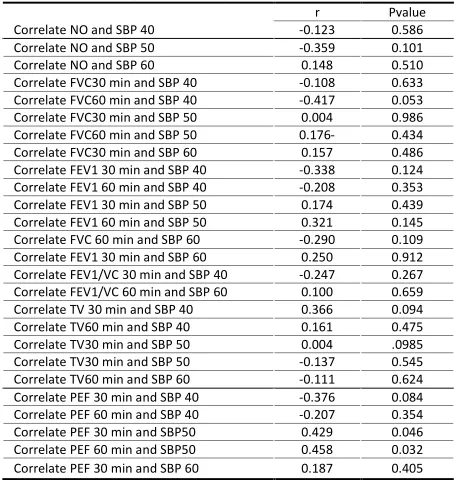
To investigate the relationship between the desired change in some variables, Pearson correlation was used. Reduction in systolic blood pressure at 50 minutes significantly correlated with the PEF post 30 (Pvalue = 0.429) and 60 (Pvalue = 0.458) minutes. No correlation was observed in the other variables (table 4).
Table 4. Investigating the relationship of variables
Pvalue r
0.586 -0.123
Correlate NO and SBP 40
0.101 -0.359
Correlate NO and SBP 50
0.510 0.148
Correlate NO and SBP 60
0.633 -0.108
Correlate FVC30 min and SBP 40
0.053 -0.417
Correlate FVC60 min and SBP 40
0.986 0.004
Correlate FVC30 min and SBP 50
0.434 0.176-
Correlate FVC60 min and SBP 50
0.486 0.157
Correlate FVC30 min and SBP 60
0.124 -0.338
Correlate FEV1 30 min and SBP 40
0.353 -0.208
Correlate FEV1 60 min and SBP 40
0.439 0.174
Correlate FEV1 30 min and SBP 50
0.145 0.321
Correlate FEV1 60 min and SBP 50
0.109 -0.290
Correlate FVC 60 min and SBP 60
0.912 0.250
Correlate FEV1 30 min and SBP 60
0.267 -0.247
Correlate FEV1/VC 30 min and SBP 40
0.659 0.100
Correlate FEV1/VC 60 min and SBP 60
0.094 0.366
Correlate TV 30 min and SBP 40
0.475 0.161
Correlate TV60 min and SBP 40
.0985 0.004
Correlate TV30 min and SBP 50
0.545 -0.137
Correlate TV30 min and SBP 50
0.624 -0.111
Correlate TV60 min and SBP 60
0.084 -0.376
Correlate PEF 30 min and SBP 40
0.354 -0.207
Correlate PEF 60 min and SBP 40
0.046 0.429
Correlate PEF 30 min and SBP50
0.032 0.458
Correlate PEF 60 min and SBP50
0.405 0.187
Correlate PEF 30 min and SBP 60
Discussion
In general, it can be concluded that an aerobic exercise protocol in hypoxia periodic activity improves nitric oxide and blood pressure systolic in patients with obstructive sleep apnea. Systolic blood pressure after 50 minutes with indicator PEF half an hour after exercise represented improved distention lung after workout. Practically, it seems that 40 minutes of aerobic exercise at 70% heart rate reserve act as a major factor in response to nitric oxide, blood pressure after exercise. This method has less limitations in comparison with regular exercise at the same time and expected to fulfill the aim for a wider range of people, including the sick, disabled, and older subjects with regular exercise.
Our results showed a significant increase in the level of nitric oxide during aerobic training. This research is in line with Farahati (2013),20 Tanaka et al. (2015),13 and Masaki
(2014),21 but is not in line with the results of Reboul et al
(2005)22 and Serebrovska et al. (2002).23 Reboul and his
colleagues observed that hypoxia exposure caused diminished endothelium-dependent dilation aorta in sedentary and practicing rats. As a result, acclimatization at high altitudes may limit NO homeostasis.
Hypothyroidism is probably one of the circumstances in which tissues face impaired nitric oxide production as thyroid hormone has a stimulatory effect on nitric oxide production. In hypothyroidism, the reduction of synthesis and release of nitric oxide has been reported. In this study, systolic blood pressure dropped significantly at minutes 40, 50 and 60, with elevated noradrenaline levels being likely the reason for this reaction.
Blood accumulation in active muscle tissues could reduce overall blood pressure, causing vasodilatation depending on the type and intensity of exercise. This study intended to examine the acute effects of aerobic exercise and periodic hypoxia on blood pressure in patients with apnea. The findings of this study showed that systolic blood pressure in both interventions was reduced in aerobic exercise after 40, 50, and 60 minutes. However, diastolic blood pressure reduction was not significant in any of the interventions. The results of this study were not in line with the results obtained by Amosov (1989),12 Tadibi
(2015),15 Luo (2014),24 Haider (2009),25 while being in line
with Ladage (2012).26
After the activity in hypoxia, the reduction in blood pressure was not significant. Probably the exercise was run early in the morning as blood pressure is high after waking up early in the morning. At noon and afternoon, the blood pressure falls naturally. In contrast, Ladage (2012) reported high blood pressure in patients with diabetes mellitus after exercise in hypoxia. In this study, diastolic blood pressure was not significantly reduced. Other indicators were not significant in any of the interventions (time and time-group). The results are in line with Feridun-fara (2011)18 and Moradi (2012),27 while
being incongruent with Tartibian (2013).
Feridun-fara (2011)18 investigated the influence of
due to the exercise protocol and time measurement of spirometry indices in two studies. Tartibian’s (2013)16 research
on respiratory and sleep quality indices in active and inactive men showed that increased levels of physical activity have a favorable effect on the performance and some of the values and capacity of the respiratory system thus improving the quality of sleep. Physical activity levels showed a favorable effect on some of the values of PFTs thereby improving the quality of sleep. No significant relationship was observed between FVC and systolic or diastolic blood pressure at significant times. Systolic blood pressure and PEF index showed a positive relationship at 50 minutes during half an hour and 1-hour post intervention. Fesharaki28 studied aerobic and aerobic-resistance
training in patients with asthma; in line with this research, no increase was observed in the lung function through aerobic exercise. Note that measuring disease severity with FEV1 is not the primary determinant of the patient's fitness level. In addition, different exercise protocols, different times and different patients with severe disease may also explain the differences. As suich, in this case, further research is required.26
It is recommended that in future research, subjects be tested using standard diagnostic polysomnography tests. Although STOP-Bang questionnaire has also been reported as the best diagnostic tool after polysomnography, more accurate information can be reported in the polysomnography method.
Since one of the limitations of the study was to assess the periodic hypoxic apnea after aerobic activity, therefore it is recommended that in future research, the apnea be re-evaluated after the intervention to see the direct effects of interventions.
Since apnea is associated with regional life styles, the effects of these interventions should also be checked in other areas of the world.
Acknowledgement
We are sincerely grateful to the staff at university of Razi and faculty of physical education and sport science for their collaboration.
Conflict of Interest
The authors declare that they have no conflict of interest.
References
1. Ortaç Ersoy E, Fırat H, Akaydın S, Özkan Y, Durusu M, Darılmaz Yüce G, et al. Association of obstructive sleep apnea with homocystein, nitric oxide and total antioxidant capacity levels in patients with or without coronary artery disease. Tuberk Toraks 2014;62:207-14.
2. Barazesh SH, Mohammadi A, Borumand B. Relationship between sleep quality, quality of life and many blood factors in patients undergoing hemodialysis maintenance. Journal of University of Medical Sciences Shahre Kord 2007;9:67-74. [Persian].
3. Servantes DM, Pelcerman A, Salvetti XM, Salles AF, de Albuquerque PF, de Salles FC, et al. Effects of home-based exercise training for patients with chronic heart failure and sleep apnoea: a randomized comparison of two different programmes. Clin Rehabli 2011;26: 45-57.doi:10.1177/0269215511403941
4. Mendelson M, Borowik A, Michallet AS, Perrin C. Monneret D, Faure P, et al. Sleep quality, sleep duration and physical activity in obese adolescents: effects of exercise training. Pediater Obes 2016;11:26-32.doi:10.1111/ijpo.12015
5. Tryfon S, Stanopoulos I, Dascalopoulou E, Argyropoulou P, Bouros D, Mavrofridis E. Sleep apnea syndrome and diastolic blood pressure elevation during exercise. Respiration 2004;71:499-504.doi:10.1159/000080635
6. Mateika JH, Komenov D. Intermittent hypoxia initiated plasticity in humans: a multipronged therapeutic approach to treat sleep apnea and overlapping co-morbidities. Exp Neurol 2017;287:113-29.doi:10.1016/j.expneurol.2016.05.011
7. Mirzaei F, Khazaei M. Role of nitric oxide in biological systems: a systematic review. J Mazandaran Univ Med Sci 2017;27:192-222. [Persian].
8. Morrison SA, Pangerc A, Eiken O, Mekjavic IB, Dolenc-Groselj L. Effect of exercise on night periodic breathing and loop gain during hypoxic confinement. Respirology 2016;21:746-53. doi:10.1111/resp.12722
9. Wang Y, Wang QJ. The prevalence of prehypertension and hypertension among US adults according to the new joint national committee quidelines. new challenge of the old problem. Arch Intern Med 2004;164:2126-34. doi:10.1001/archinte.164.19.2126
10. Chobania AV, Bakris GL, Black HR and .et al. The seventh report of the joint national committee on prevention detected evaluation and treatment of high blood pressure. The JNC 7 Report 2003;289:2560-71.doi:10.1001/jama.289.19.2560
11. Paulo G, Anunciacao M, Doederleine P. Post-exercise hypotension in hypertensive indevididuals. ARP Bars Cardio 2011;96:109-10.
12. Amosov IS, Korobchenko ZA, Nikitina RG, Ikonnikov AI, Kuz'mina NS. [Myocardial reaction and lung ventilation response to inhalation of the gaseous hypoxic mixture GGS-10 in patients with rheumatoid arthritis]. Ter Arkh 1989;61:62-4.
13. Tanaka LY, Bechara LR, dos Santos AM, Jordão CP, de Sousa LG, Bartholomeu T, et al. Exercise improves endothelial function: a local analysis of production of nitric oxide and reactive oxygen species. Nitric Oxide 2015;45:7-14.doi:10.1016/j.niox.2015.01.003
14. Abdi Z, Tadibi V, Behpur N. Acute effects of intermittent hypoxia and acute aerobicExercise on Orexin-A level and blood pressure in pre hypertensive Patients. J Kermanshah Univ Med Sci 2015;19:128-35. [Persian].
15. Amraei S, Tadibi V, Behpur N. Effects of high intensity intermittent activity and resistance training on nitric oxide and blood pressure levels in women with high pre-hypertension [dissertation]. Kermanshah: Razi Univ; 2015.
16. Tartibeian B, Yaqubnezhad B. Comparison of respiratory indices and sleep quality in active and non-active young men The association of respiratory indices with sleep quality. Scientific Journal of Razi medical science 2012;117. [Persian].
17. Ghanbarzadeh M, Habibi A, Aidani A. Study of some spirometric indices before and after an exhaustive exercise session in obese and non-athletic boys in Shahid Chamran University of Ahwaz [dissertation]. Ahwz: Shahid Chamran Univ; 2012.
18. Feridun-fara KH, Behpur N. The effects of intermittent hypoxia on lung function parameters of mountaineers. Querterly Journal of Sport Sciences Research 2011:1. [Persian].
19. Federico B, Shuangjiang L, Wang S, Sigua NL, Manchanda S. Preoperative stratification for postoperative delirium: obstructive sleep apnea is a predictor, the STOP-Bang Surgary 2019;106:966-72.
20. Farahati S, Attarzadeh S. The effect of aerobic exercise on plasma levels of nitrite oxide and vascular endothelium in menopausal women. Journal of Razi medical science 2013;20:78-88. [Persian].
21. Mizuno M, Iwamoto GA, Vongpatanasin W, Mitchell JH, Smith SA. Exercise training improves functional sympatholytic in spontaneously hypertensive rats through a nitric oxide-dependent mechanism. Am J Physiol Heart Circ Physiol 2014;307:H242-51.doi:10.1152/ajpheart.00103.2014
22. Reboul C, Tangue S, GibaultA, DauzatM, Obert P. Chronic hypoxia exposure depresses aortic endothelium-depended vaso relaxation in both sedentary and terrain rats: involvement of L-arginine. J Appl Physiol (1985)
2005;99:1029-35. doi:10.1152/japplphysiol.01122.2004
23. Serebrovs'ka TV, Kurgaliuk NM, Nosar VI, Kolesnikova IeE. Intermittent hypoxic training with exogenous nitric oxide improves rat liver mitochondrial oxidation and phosphorylation during acute hypoxia.Fiziol Zh 2001;47:85-92
25. Haider T, Casucci G, Linser T, Faulhaber M, Gatterer H, Ott G, et al. Interval hypoxic training improves autonomic cardiovascular and respiratory control in patients with mild chronic obstructive pulmonary disease. J Hypertens 2009;27:1648-54.doi:10.1097/HJH.0b013e32832c0018
26. Ladage D, Braunroth C, Lenzen E, Berghofer S, Graf C, Bloch W, et al. Influence of intermittent hypoxia interval training on exercise-dependent erythrocyte NOS activation and blood pressure in diabetic patient. Can J Physiol Pharmacol 2012;90:1591-8.doi:10.1139/y2012-138
27. Moradi M. Study of some spirometric indices before and after an exhaustive activity session in obese and non-athletic boys in Shahid Chamran University of Ahwaz. [Dissertation]. Ahvaz: shahid chamran Univ; 2001.