JIEMS
Journal of Industrial Engineering and Management Studies
Vol. 2, No. 2, pp. 13-25
www.jiems.icms.ac.ir
A reactive bone route algorithm for solving the traveling salesman
problem
N. Mahmoodi Darani1, A. Dolatnejad2, M. Yousefikhoshbakht3,*
Abstract
The traveling salesman problem (TSP) is a well-known optimization problem in graph theory, as well as in operations research that has nowadays received much attention because of its practical applications in industrial and service problems. In this problem, a salesman starts to move from an arbitrary place called depot and after visits all of the nodes, finally comes back to the depot. The objective is to minimize the total distance traveled by the salesman. Because this problem is a non-deterministic polynomial (NP-hard) problem in nature, it requires a non-polynomial time complexity at runtime to produce a solution. Therefore, a reactive bone route algorithm called RBRA is used for solving the TSP in which several local search algorithms as an improved procedure are applied. This process avoids the premature convergence and makes better solutions. Computational results on several standard instances of TSP show the efficiency of the proposed algorithm compared to other meta-heuristic algorithms.
Keywords: Reactive Bone Route Algorithm, Traveling Salesman Problem, local search algorithms, NP-hard Problems.
Received: July 2015-28
Revised:August 2015-25
Accepted: December 2015 -10
1.
Introduction
The traveling salesman problem (TSP) is one of the most studied problems in combinatorial optimization problems which is concerned with searching for the minimum Hamiltonian cycle in a network of nodes with some additional constraints (Chen, et al., 2012). In literature, this minimum Hamiltonian cycle means the closed walk that traverses every vertex once and only once in a graph traversing the minimum path in terms of the length of the edges. This closed walk starts from a fixed vertex, to which it also returns after the walk. Their importance relies upon the fact that they are difficult to be solved but are intuitively used for modeling several real world problems (Yousefikhoshbakht, et al., 2014).
* Corresponding Author.
The first instance of the TSP was from Euler in 1759 whose problem was to move a knight to every position on a chess board exactly once. The TSP first gained fame in a book written by German salesman BF Voigt in 1832 on how to be a successful traveling salesman (Michalewicz, 1994). He mentions the TSP, though not by that name, by suggesting that to cover as many locations as possible without visiting any location twice is the most important aspect of the scheduling of a tour. The origins of the TSP in mathematics are not really known all we know for certain is that it happened around 1931.
In practice, the basic TSP is extended with constraints, for instance, on the allowed capacity of the salesman, the length of the route, arrival, departure and service time, the time of collection and delivery of goods. It should be noted that the main goal in all TSP problems is to obtain the minimal transportation cost. In another view, there are several reasons for choosing the TSP as the problem to examine the efficiency of new algorithm:
1) It is an important NP-hard optimization problem (Ahmadvand, et al., 2012) like the n-queens problem (Masehian, et al., 2014), k-sat (Jaafar and Samsudin, 2013) and maximum propositional satisfiability problem (Bachir Menai and Batouche, 2005) that arises in several applications including the computer wiring, sequencing job, designing hardware devices and radio electronic devices, communications, architecture of computational networks, etc.
2) It is a problem to which new algorithms are easily applied (Barketau and Pesch, 2015).
3) It is easily understandable, since the algorithm behavior is not obscured by too many technicalities (Yang, et al., 2015).
4) It is a standard test bed for new algorithmic ideas. A good performance of the TSP is often taken as a proof of their usefulness (Xiao and Nagamochi, 2016).
The TSP belongs to NP-hard problems. This means that a polynomial time algorithm does not exist for it and the computational attempt required to solve this problem increases exponentially with the size of the problem. These kinds of problems are regularly solved by heuristic and metaheuristic techniques. Therefore, an efficient adaptive memory based algorithm equipped with diversification and intensification mechanisms is proposed in this paper in which a reactive bone route algorithm is combined with some local search algorithms. In this work, a new solution from a component of the other solutions is produced while using new diversification and intensification mechanisms. Some test problems of TSPLIB are considered and results of RBRA are compared to the several metaheuristic algorithms. The proposed algorithm in comparison with these algorithms can provide better solutions.
In the following parts of this paper, background and literature review is presented in Section 2. In Section 3, the proposed idea is explained in details. In Section 4, the RBRA is compared with some of the metaheuristic algorithms on standard TSP problems. Finally in Section 5, the conclusions are presented.
2.
Background and literature review
algorithms that generate both a lower and an upper bound on the true minimum value of the problem instance. If the upper and lower bound coincide, a proof of optimality is achieved. There have been many papers proposing exact algorithms for solving the TSP. These algorithms are based on Lagrangean relaxation (Yadlapalli, et al., 2009), branch-and-cut method (Cordeau, et al., 2010), branch and bound (Carpaneto and Toth, 1980), etc.
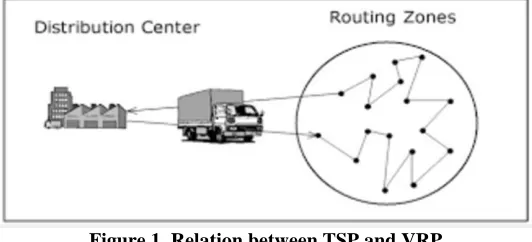
Figure 1. Relation between TSP and VRP
Although optimal solutions can be obtained using exact methods, the computational time required to solve adequately large problem instances is still prohibitive. For this reason, the focus of most researchers is given to the design of heuristic and metaheuristic approaches capable of producing high quality near optimum solutions with reasonable computational time. The proposed heuristics can be separated into three categories: tour construction heuristics, tour improvement heuristics and composite heuristics. The composite heuristics serve both purposes of the first two kinds of heuristics. Typical tour construction heuristics are fragment-growing methods whereas tour-growing heuristics are cross-products of certain selection rules (e.g. farthest, nearest, and random) and expansion rules (e.g. addition and insertion). The sweep algorithm (Gillett and Miller, 1974), partitioning approach (Karp, 1977) and saving algorithm (Clarke and Wright, 1964) are some important tour construction heuristics. On the other hand, an improvement heuristic starts with an initial solution and then provides a scheme for iteratively obtaining an improved solution until reaching stopping criteria. These algorithms for the TSP are based on simple route modifications and may operate together. For the tour improvement heuristics, variant employments of local search (Bianchi, et al., 2005), 3-opt heuristics (Lin, 1965) and Lin-Kernighan (Karapetyan and Gutin, 2011) are probably the most significant methods because they are the most frequently adopted improvement tools by tour construction heuristics and some composite heuristics.
As the TSP is NP-complete, great effort has been devoted to metaheuristics that produce a good, if not optimal, tour. Johnson and McGeoch in 2002 conclude that, for practical instances, these algorithms can provide remarkably good results in reasonable amounts of time. Before this term was widely adopted, metaheuristics were often called modern heuristics (Reeves, 1998). Since the meta-heuristic approaches are very efficient for escaping from local optimum, they are one of the best algorithms for solving combinatorial optimization problems. That is why the recent publications are more based on meta-heuristic approaches such as gravitational emulation search (Balachandar and Kannan, 2007), neural network (Thiago, et al., 2009), ant colony optimization (ACO) (Yousefikhoshbakht, et al., 2013), african buffalo optimization (Odili and Mohmad Kahar, 2016), recurrent neural network (Tarkov, 2015), imperialist competitive algorithm (Yousefikhoshbakht and Sedighpour, 2012) and particle Swarm optimization (Anantathanavit and Munlin, 2015).
2009), ACO with Sweep algorithm (Yousefikhoshbakht and Sedighpour, 2013), threshold accepting and edge recombination (Liu, 2007), particle swarm optimization and local search (Shi, et al., 2007), variable neighborhood descent search and GRASP (Hernandez-Perez, et al., 2009) have greater ability for finding an optimal solution, they have been considered to solve complex problems. For example, (Wang, 2010) presented a hybrid algorithm in which GA, ACO and a new strategy called GSA was proposed aiming at the key link in the algorithm. This algorithm converts the genetic solution from GA into information pheromone to distribute in ACO. Furthermore, GSA takes a new matrix which is formed by the combination of the former 90% of individual from genetic solution and 10% of individual by random generation as the basis of the transformation of pheromone value. The best combination of genetic operators in GA was also discussed. Besides, (Weber, 2006) proposed a distributed algorithm in which ant colonies and genetic algorithms work independently of each other and only communicate when better solutions are discovered. Ant colonies are used to explore the solution space, while genetic algorithms are used to improve the convergence rate of the search.
3.
Proposed algorithm
An important research topic in the research area of computational intelligence is swarm intelligence which consists of a population of artificial agents mimicking the animals’ behavior in the real world. Each agent follows some simple rules and interacts with the others to share information to lead the behavior to convergence. It should be noted that the proposed algorithm is a method producing a new solution out of components of routes called the bones of previous solutions. This component of used routes is sequences of nodes. In other words, the fact behind the bone route is to extract bone nodes with predefined size and frequency of the adaptive memory (AM). Then the bones will be used to construct new solutions. The size and frequency specified by the algorithm-designer restrict the number of nodes in a bone (bone-size) and the minimum number of stored routes in the AM that must include a bone (bone-freq-min). In our approach, we have made two main modification respects to the Bone Route method:
1- Value of bone-size systematically changes during run time.
2- In order to extract the bones from AM, they must satisfy an additional criterion that specifies the maximum number of stored routes in the AM that must include a bone (bone-freq-max).
The rationale behind changing mentioned parameters is that the value of the bone-freq-max and bone-size express the degree of similarity among the new constructed solution and the previously stored solutions in the AM. Therefore, the new solution is more similar to other solutions in AM, whenever their value is high. In the proposed RBRA, n different diversified initial solutions are generated randomly. The goal of building multiple initial solutions is to spread the search in order to explore different regions of the solution space of the problem (diversification strategy). After producing n solutions, the AM is Constructed using improved solutions of previous step in which their routes are sorted by increasing costs of relative solutions. In each iteration, the s randomly detects bone-like sequences of a predetermined number of nodes using the nearest neighborhood heuristic. Then bone sequences are used to construct a new solution. It is noted that selected bones must not contain common nodes between them. In order to avoid this, the bones are selected that belong to the high quality solution. Furthermore, if those solutions have the same cost, that one is choosing with the highest frequency. Then, new solutions are generated by combining the extracted bones.
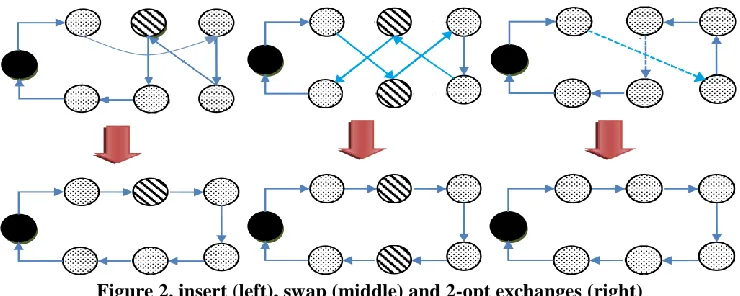
three different neighborhood operators are considered in the proposed algorithm including insert, swap and 2-opt algorithms in this step (Figure 2). In insert move a node from its position is changed to another position. In the swap move, two nodes from the route are changed. In 2-opt move, two non-adjacent edges are replaced by two other edges. These algorithms lead to improve the new constructed solution generated in the previous step and set as the best solution if it is better than the previous elite solution. It should be noted that there are several routes for connecting nodes in order to produce the tour again, but a state that satisfies the problem’s constraints is acceptable. As a result, the new tour will be accepted only if, first, the above constraints are not violated and, second, the new tour produces a better value for the problem than the previous solution.
Figure 2. insert (left), swap (middle) and 2-opt exchanges (right)
If AM is not full, the AM is updated and the new improved solution is added, Otherwise AM is updated by inserting the routes of new improved solution and removing routes that belong to the worst solution when the new improved solution is better than the low quality solution in AM. If the best solution of algorithm in current iteration has been improved, the search process is intensified in neighborhood of current solutions by applying these local search algorithms again. Then replace the new solution in this procedure instead of the best solution in AM if it has higher quality. This technique leads to increase the convergence of the algorithm to the best solution.
1: Generate n initial solutions randomly and determine the best solution.
2: Construct the Adaptive Memory (AM) and sort the routes by increasing the costs of their relative solutions.
Repeat
3: Extract the promising bone sequences of nodes according to some selection criteria. 4: Extract the selected bones from the AM, according to the values of the bone-size and bone-freq-min.
5: Generate n new solutions using the extracted bones.
6: Improve the quality of the new constructed solution generated in Step 6 by local search algorithms and obtain the best current solution.
7: update AM.
8: if the best solution until now is improved, apply local search algorithms on that solution and then update AM(If necessary)
9: update parameter
Until the best solution has not been changed for 20 iterations;
Figure 3: Outline of the RBRA
4. Experiments and computational results
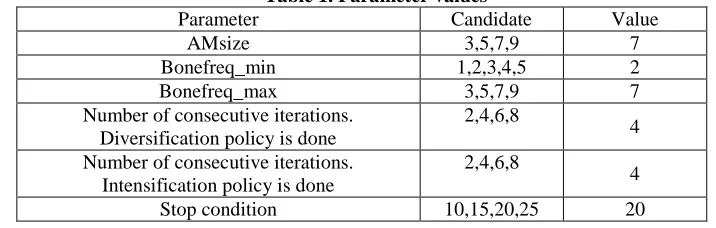
The RBRA was implemented on two sets of symmetric and Euclidean TSP datasets from 24 to 1655 cities from TSPLIB95 (Reinelt, 2012). The word ‘‘symmetric’’ means that the travel cost from city A to city B is the same as the travel cost from city B to city A. The first experiment was concerned with the comparison of the performance of RBRA in small TSP instances with the results obtained from several algorithms involving GR24, Bayg29, GR48, ATT48, Eil51, Berlin52, St70, Eil76, KroA100, KroB100, KroC100, KroD100, KroE100, Eil101, Lin105, KroA150, KroB150, KroA200, and KroB200 in Table 2. The second set of experiments was concerned with testing RBRA’s performance with another recently published study on KroE100, Pr152, Gil262, Rd400, Rat575, Rat783, Pr1002, D1291, Rl1323 and Dl1655. The algorithm was implemented in C and implemented on a Pentium 4, 3 GHZ (2 GB RAM) PC with windows XP. Like every meta-heuristic algorithm, the quality solutions produced by the proposed algorithm have been dependent on the seed used to generate the sequence of pseudo-random numbers and on the different values of the parameters. Therefore, a number of different alternative values were tested and the ones selected are those that gave the best computational results concerning both the quality of the solution. Although the results confirm that our parameters setting worked well, it is also possible that the better solutions may exist. Thus, the selected parameters are given in Table 1. All of the parameter values have been determined on the Eil51 by the numerical experiments. Furthermore, the proposed algorithm stops after no improvements are found for 20 iterations. To reveal the variety of the RBRA's performance from one run to another, 10 runs are carried out for each instance with different random numbers.
Table 1. Parameter values
Parameter Candidate Value
AMsize 3,5,7,9 7
Bonefreq_min 1,2,3,4,5 2 Bonefreq_max 3,5,7,9 7 Number of consecutive iterations.
Diversification policy is done
2,4,6,8
4
Number of consecutive iterations. Intensification policy is done
2,4,6,8
4
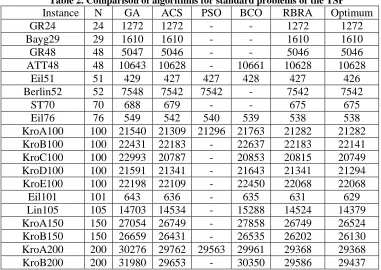
In the first set of problems shown in table 2, the algorithm was tested on a set of 19 Euclidean sample problems with sizes ranging from 24 to 200 nodes. The sets of data used for the experiment are TSP instances available on the TSPLIB (Gutin and Punnen, 2002). In Table 2, the first column shows the name of the instance and the second column specifies the instance’s size referenced. Moreover, the third, fourth, fifth and sixth columns show the four meta-heuristic algorithms including genetic algorithm (GA), ant colony system (ACS), particle swarm optimization (PSO) (Zhong, et al., 2007) and bee colony optimization (BCO) (Wong, et al., 2008). Finally, the seventh column presents the best solution of the proposed algorithm through 10 independent runs and the best solutions published in the literature and also on the web (BKS) are presented in eighth column.
Table 2. Comparison of algorithms for standard problems of the TSP
Instance N GA ACS PSO BCO RBRA Optimum
GR24 24 1272 1272 - - 1272 1272
Bayg29 29 1610 1610 - - 1610 1610
GR48 48 5047 5046 - - 5046 5046
ATT48 48 10643 10628 - 10661 10628 10628
Eil51 51 429 427 427 428 427 426
Berlin52 52 7548 7542 7542 - 7542 7542
ST70 70 688 679 - - 675 675
Eil76 76 549 542 540 539 538 538
KroA100 100 21540 21309 21296 21763 21282 21282 KroB100 100 22431 22183 - 22637 22183 22141 KroC100 100 22993 20787 - 20853 20815 20749 KroD100 100 21591 21341 - 21643 21341 21294 KroE100 100 22198 22109 - 22450 22068 22068
Eil101 101 643 636 - 635 631 629
Lin105 105 14703 14534 - 15288 14524 14379
KroA150 150 27054 26749 - 27858 26749 26524 KroB150 150 26659 26431 - 26535 26202 26130 KroA200 200 30276 29762 29563 29961 29368 29368 KroB200 200 31980 29653 - 30350 29586 29437
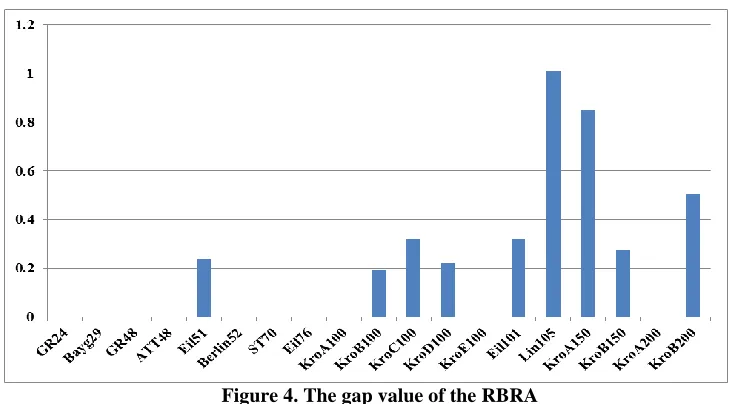
Besides, Figure 4 shows the gap value of the RBRA, where the gap is defined as the percentage of
deviation from the best known solution in the literature. The gap is equal to100[ (c s* *)c s( )] / ( )* c s* , where s** is the best solution found by the algorithm for a given instance, and s* is the overall best
Figure 4. The gap value of the RBRA
The results also show that the RBRA has the ability to escape from local optimum and find the best solutions for most of the instances. The results of this comparison show that the proposed algorithm gains equal solutions to the GA in GR24 and Bayg29, and it gains better solutions than the GA in other problems from Gr48 to KroB200. Furthermore, the results indicate that although the ACS gives an equal solution to the proposed algorithm for 9 instances, this algorithm cannot gain optimal solutions for others and yields worse solutions than the proposed RBRA algorithm. Besides, in general the proposed algorithm gives better results compared to other two algorithms including PSO and BCO algorithms in terms of the solution’s quality. The performance Comparison of results shows that the proposed algorithm method clearly yields better solutions than the BCO. Moreover, Computational results of the RBRA and PSO shows that these algorithms have a close competition and the proposed algorithm gives better 4 solutions than PSO. In other words, the performance of the proposed algorithm is better in reaching the sub-optimal solution than the PSO. As a result, the proposed algorithm yields better solutions than the GA, PSO, ACS, and BCO.
In addition, in order to demonstrate the efficiency of the RBRA, two of the solutions found for the examples in table 2 are presented in Figure 5. It should be noted that in two examples presented this figure, the RBRA has been able to find the best solution ever found.
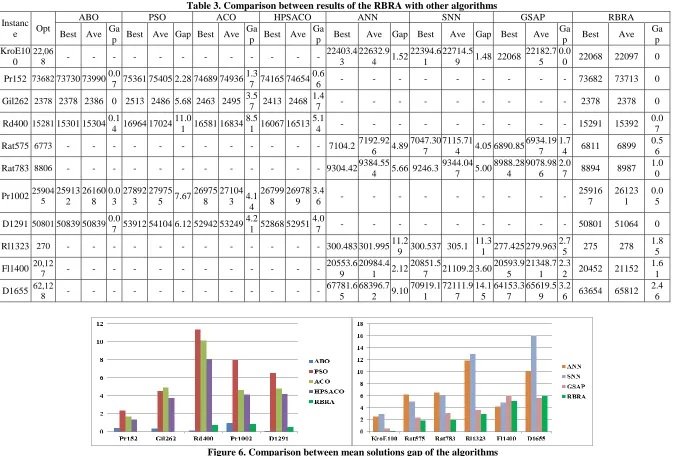
In table 3, 11 large-scale problems of the TSP are considered in which the number of customers ranges in size from 100 to 1655. Each problem exhibits a geometric symmetry which allows us to visually estimate a solution. In all of these instances, the vertices are taken to be points located in the Euclidean plane and the cost of an edge is then taken to be equal to the Euclidean distance between its end-vertices computed with real numbers. In this table, some of the characteristics of these problems are described. The first column includes the instance name and the second column shows the best know solution for each instance. The objective of the computational experiments is to compare the performance of the proposed algorithm with several famous metaheuristic algorithms. For achieving this goal, seven different metaheuristic approaches given in the literature for the TSP such as ABO (Odili, Mohmad Kahar, 2016), PSO, ACO and HPSACO (Jia, 2015), ANN (Cochrane, Beasley, 2003), SNN (Masutti, Castro, (2009) and GSAP (Chen, Chien, 2011) are considered in columns 3 to 9. Finally, results of the proposed RBRA is shown in the last column. In this table, three sub-columns which include the best gained solution, average solutions and Gap of the best obtained solution compared with BKS are allocated to each algorithm. To measure the efficiency and the quality of an algorithm, a simple criterion is to compute the number of optimal solutions found in specific benchmark instances by algorithm. As it can be seen from this table, the proposed algorithm RBRA finds the optimal solution for 4 out of 11 problem instances and these solutions have been published in the literature. Moreover the PSO, ACO, HPSACO, ANN, SNN, ABO and GSAP have been able to find 0,0,0,0,0,1 and 1 optimal solutions from among these instances. These results indicate that the proposed algorithm is a competitive approach compared to mentioned algorithms and the results are much better than the ones found by these algorithms. As it is shown in (Tarantilis et al. 2008), direct comparisons of the required computational times cannot be conducted as they closely depend on various factors such as the processing power of the computers, the programming languages, the coding abilities of the programmers, the compilers and the running processes on the computers.
Table 3. Comparison between results of the RBRA with other algorithms
Instanc e Opt
ABO PSO ACO HPSACO ANN SNN GSAP RBRA
Best Ave Ga
p Best Ave Gap Best Ave Ga
p Best Ave Ga
p Best Ave Gap Best Ave Gap Best Ave Ga
p Best Ave Ga
p KroE10
0
22,06
8 - - - -
22403.4 3
22632.9 4 1.52
22394.6 1
22714.5
9 1.48 22068 22182.7
5 0.0
0 22068 22097 0 Pr152 73682 73730 73990 0.0
7 75361 75405 2.28 74689 74936 1.3
7 74165 74654 0.6
6 - - - 73682 73713 0 Gil262 2378 2378 2386 0 2513 2486 5.68 2463 2495 3.5
7 2413 2468 1.4
7 - - - 2378 2378 0 Rd400 15281 15301 15304 0.1
4 16964 17024 11.0
1 16581 16834 8.5
1 16067 16513 5.1
4 - - - 15291 15392 0.0
7 Rat575 6773 - - - 7104.2 7192.92
6 4.89 7047.30
7
7115.71
4 4.05 6890.85 6934.19
7 1.7
4 6811 6899 0.5
6 Rat783 8806 - - - 9304.42 9384.55
4 5.66 9246.3 9344.04
7 5.00 8988.28
4
9078.98 6
2.0
7 8894 8987 1.0
0
Pr1002 25904
5 25913 2 26160 8 0.0 3 27892 3 27975 5 7.67
26975 8
27104 3 4.1
4 26799 8 26978 9 3.4
6 - - - -
25916 7 26123 1 0.0 5
D1291 50801 50839 50839 0.0
7 53912 54104 6.12 52942 53249 4.2
1 52868 52951 4.0
7 - - - 50801 51064 0 Rl1323 270 - - - 300.483 301.995 11.2
9 300.537 305.1 11.3
1 277.425 279.963 2.7
5 275 278 1.8
5 Fl1400 20,12
7 - - - -
20553.6 9
20984.4 1 2.12
20851.5
7 21109.2 3.60 20593.9
5
21348.7 1
2.3
2 20452 21152 1.6
1 D1655 62,12
8 - - - -
67781.6 5
68396.7 2 9.10
70919.1 1 72111.9 7 14.1 5 64153.3 7 65619.5 9 3.2
6 63654 65812 2.4
6
5.
Acknowledgment
The authors would like to acknowledge the Young Researchers And Elite club, Robatkarim Branch, Islamic Azad University, Robatkarim, Iran for the financial support of this work.
6.
Conclusions
In this paper, a reactive bone route algorithm which uses several local search algorithms for improvement procedure was proposed for solving the TSP as an example application problem. Experiments are implemented to evaluate the algorithm’s performance on some test instances of TSPLIB. Computational results demonstrate that our algorithm is effective for solving TSP. As shown, in most cases of instances, the best results can be obtained by our algorithm and in cases, the Gap between the BKS reported and the solution found by the proposed algorithm for most of the instances is very satisfied. Using this proposed algorithm for other versions of the TSP and also applying this method in other combinational optimization problems including the vehicle routing problem, School bus routing problem and the sequencing of jobs are suggested for future research.
References
Ahmadvand, M., YousefiKhoshbakht, M. and Mahmoodi Darani, N. 2012, “Solving the Traveling Salesman Problem by an Efficient Hybrid Metaheuristic Algorithm”, Journal of Advances in Computer Research, 3(3), 75-84.
Anantathanavit, M. and Munlin, M. 2015, “Using K-means Radius Particle Swarm Optimization for the Travelling Salesman Problem”, IETE Technical Review, 1-9.
Bachir Menai, M. E. and Batouche M. 2005, “Solving the maximum satisfiability problem using an evolutionary local search”, The International Arab Journal of Information Technology, 2(2), 154-161.
Balachandar S. R. and Kannan K. 2007, “Randomized gravitational emulation search algorithm for symmetric traveling salesman problem”, Applied Mathematics and Computation, 192 (2), 413-421.
Barketau, M. and Pesch, E. 2015, “An approximation algorithm for a special case of the asymmetric travelling salesman problem”, International Journal of Production Research, DOI: 10.1080/00207543.2015.1113327.
Bianchi L., Knowles, J. and Bowler, N. 2005, “Local search for the probabilistic traveling salesman problem: Correction to the 2-p-opt and 1-shift algorithms”, European Journal of Operational Research, 162(1), 206-219.
Carpaneto G. and Toth P. 1980, “Some new branching and bounding criteria for the asymmetric travelling salesman problem”, Management Science, 26, 736-743.
Chen, S. M. and Chien, C. Y. 2011, “Solving the traveling salesman problem based on the genetic simulated annealing ant colony system with particle swarm optimization techniques”, Expert Systems with Applications, 38(12), 14439-14450.
Chen, X., Tan, Z., Yang, G. and Cheng, W. 2012, “A hybrid algorithm to solve traveling salesman problem, In Advances in Electronic Engineering”, Communication and Management, 1, 99-105. Springer Berlin Heidelberg.
Clarke, G. and Wright, J.W., 1964, ‘Scheduling of vehicles from a central depot to a number of delivery points’, Operations Research, 12, 568-581.
Cochrane, E. M. and Beasley, J. E., 2003, “The co-adaptive neural network approach to the Euclidean traveling salesman problem”, Neural Networks, 16(10), 1499–1525.
Cordeau J. F., Dell’Amico, M. and Iori, M., 2010, “Branch-and-cut for the pickup and delivery traveling salesman problem with FIFO loading”, Computers & Operations Research, 37(5), 970-980.
Créput, J. C, and Koukam, A., 2009, “A memetic neural network for the Euclidean traveling salesman problem”, Neurocomputing, 72(4-6), 1250-1264.
Garey, M.R. and Johnson, D.S., 1979, “Computers and intractability: A guide to the theory of NP-completeness”, San Francisco: W.H. Freeman.
Gillett, B.E. and Miller, L.R., 1974, “A heuristic algorithm for the vehicle dispatch problem”, Operations Research, 22, 340-349.
Gutin, G. and Punnen, A., 2002, “The Traveling Salesman Problem and its Variations”, Kluwer Academic Publishers, Dordrecht.
Hernandez-Perez, H., Rodríguez-Martín, I. and Salazar-Gonzalez, J. J., 2009, “A hybrid GRASP/VND heuristic for the one-commodity pickup-and-delivery traveling salesman problem”, Computers & Operations Research, 36(5), 1639-1645.
Jaafar, A. and Samsudin, A., 2013, “An Improved Version of the Visual Digital Signature Scheme”, The International Arab Journal of Information Technology, 10(6), 20-32.
Jia, H., 2015, “A novel hybrid optimization algorithm and its application in solving complex problem”,
International Journal of Hybrid Information Technology, 8(1), 1–10.
Johnson D.S. and McGeoch L.A., 2002, “Experimental analysis of heuristics for the STSP, in G. Gutin and A.P. Punnen (eds.)”, The Traveling Salesman Problem and Its Variations, Kluwer Academic Publishers, The Netherlands, 369–443.
Karapetyan D. and Gutin, G., 2011, “Lin-Kernighan Heuristic Adaptations for the Generalized Traveling Salesman Problem”, European Journal of Operational Research, 208 (3), 221–232.
Karp, R. M., 1997, “Probabilistic analysis of partitioning algorithms for the traveling salesman problem in the plane”, Mathematics of Operations Research, 2, 209-224.
Lin S., 1965, “Computer solutions of the traveling salesman problem”, Bell System Technical Journal, 44, 2245-2269.
Liu Y. H., 2007, “A hybrid scatter search for the probabilistic traveling salesman problem”, Computers & Operations Research, 34(10), 2949-2963.
López-Ibáñez M. and Blum C., 2010, “Beam-ACO for the traveling salesman problem with time windows”,
Computers & Operations Research, 37(9), 1570-1583.
Masehian, E., Akbaripour H. and Mohabbati-Kalejahi N. 2014, “Solving the n-Queens Problem using a Tuned Hybrid Imperialist Competitive Algorithm”, The International Arab Journal of Information Technology, 11(6).
Masutti, T. A. S. and Castro, L. N. D., 2009, “A self-organizing neural network using ideas from the immune system to solve the traveling salesman problem”, Information Sciences, 179(10), 1454–1468.
Masutti, T. A. S. and Castro, L. N., 2009, “Neuroimmune approach to solve routing problems”,
Neurocomputing, 72, 2189–2197.
Michalewicz, Z., 1994, “Genetic Algorithms + Data Structures = Evolution Programs”. Springer-Verlag, 2nd edition.
Odili, J. B. and Mohmad Kahar, M. N., 2016, “Solving the Traveling Salesman’s Problem Using the African Buffalo Optimization”. Computational Intelligence and Neuroscience, 2016
Reeves C. R., 1993, editor. “Modern Heuristic Techniques for Combinatorial Problems”, Blackwell Scientific Publishing, Oxford, England.
Reinelt, G., 2012, “Tsplib95”, 1995, http://comopt.ifi.uni-heidelberg. de/software/TSPLIB95.
Shi X. H., Liang Y. C., Lee H. P., Lu C. and Wang, Q.X., 2007, “Particle swarm optimization-based algorithms for TSP and generalized TSP”, Information Processing Letters, 103(5), 169-176.
Tarantilis, C.D., Zachariadis, E. and Kiranoudis, C., 2008, “A guided Tabu search for the heterogeneous vehicle routing problem”, Journal of the Operational Research Society, 59, 1659-1673.
Tarkov, M. S., 2015, “Solving the traveling salesman problem using a recurrent neural network”, Numerical Analysis and Applications, 8(3), 275-283.
Thiago A.S., Masutti L. and Castro N., 2009, “A self-organizing neural network using ideas from the immune system to solve the traveling salesman problem”, Information Sciences, 179(10), 1454-1468.
Yadlapalli S., alik W.A., Darbha S. and Pachter M., 2009, “A Lagrangian-based algorithm for a Multiple Depot”, Multiple Traveling Salesmen Problem, Nonlinear Analysis: Real World Applications, 10(4), 1990-1999.
Yang, J., Ding, R., Zhang, Y., Cong, M., Wang, F. and Tang, G., 2015, “An improved ant colony optimization (I-ACO) method for the quasi travelling salesman problem (Quasi-TSP)”, International Journal of Geographical Information Science, 29(9), 1534-1551.
Yousefikhoshbakht M., Didehvar F. and Rahmati, F., 2013, “Modification of the Ant Colony Optimization for Solving the Multiple Traveling Salesman Problem”, Romanian Journal of Information Science and Technology, 16(1), 65-80.
Yousefikhoshbakht, M., Didehvar, F., & Rahmati, F., 2014, “Solving the heterogeneous fixed fleet open vehicle routing problem by a combined metaheuristic algorithm”, International Journal of Production Research, 52(9), 2565-2575.
Yousefikhoshbakht M. and Sedighpour M., 2013, “New Imperialist Competitive Algorithm to solve the travelling salesman problem”, International Journal of Computer Mathematics, 90 (7), 1495-1505.
Yousefikhoshbakht, M. and Sedighpour, M., 2012, “A Combination of Sweep Algorithm and Elite Ant Colony Optimization for Solving the Multiple Traveling Salesman Problem”, Proceedings of the Romanian academy A, 13(4), 295-302.
Wang C., 2010, “A hybrid algorithm based on genetic algorithm and ant colony optimization for Traveling Salesman Problems”, Information Science and Engineering 2nd International Conference on Date of Conference, 4257 – 4260.
Weber B., 2006, “Distributed Hybrid Metaheuristics for Optimization”, Work paper, 1-12.