This is a peer-reviewed, post-print (final draft post-refereeing) version of the following published document, This article is © Emerald Group Publishing and permission has been granted for this version to appear here http://dx.doi.org/10.1108/TLO-04-2015-0026. Emerald does not grant permission for this article to be further copied/distributed or hosted elsewhere without the express permission from Emerald Group Publishing Limited. and is licensed under All Rights Reserved license:
Rezaei Zadeh, Mohammad and Darwish, Tamer K (2016) Antecedents of Absorptive Capacity: A New Model for Developing Learning Processes. Learning Organization, 23 (1). pp. 77-91. ISSN 0969-6474
Official URL: http://dx.doi.org/10.1108/TLO-04-2015-0026 DOI: http://dx.doi.org/10.1108/TLO-04-2015-0026
EPrint URI: http://eprints.glos.ac.uk/id/eprint/2916 Disclaimer
The University of Gloucestershire has obtained warranties from all depositors as to their title in the material deposited and as to their right to deposit such material.
The University of Gloucestershire makes no representation or warranties of commercial utility, title, or fitness for a particular purpose or any other warranty, express or implied in respect of any material deposited. The University of Gloucestershire makes no representation that the use of the materials will not infringe any patent, copyright, trademark or other property or proprietary rights.
The University of Gloucestershire accepts no liability for any infringement of intellectual property rights in any material deposited but will remove such material from public view pending investigation in the event of an allegation of any such infringement.
This is a peer-reviewed, post-print (final draft post-refereeing) version of the following published document:
Rezaei Zadeh, Mohammad and Darwish, Tamer
K (2016).
Antecedents of Absorptive Capacity: A
New Model for Developing Learning Processes.
The
Learning Organization, 23 (1). ISSN 0969-6474
Published in The Learning Organization, and available online at: http://www.emeraldinsight.com/doi/full/10.1108/TLO-04-2015-0026 We recommend you cite the published (post-print) version. The URL for the published version is
http://www.emeraldinsight.com/doi/full/10.1108/TLO-04-2015-0026
Disclaimer
The University of Gloucestershire has obtained warranties from all depositors as to their title in the material deposited and as to their right to deposit such material.
The University of Gloucestershire makes no representation or warranties of commercial utility, title, or fitness for a particular purpose or any other warranty, express or implied in respect of any material deposited.
The University of Gloucestershire makes no representation that the use of the materials will not infringe any patent, copyright, trademark or other property or proprietary rights.
The University of Gloucestershire accepts no liability for any infringement of intellectual property rights in any material deposited but will remove such material from public view pending investigation in the event of an allegation of any such infringement.
1
Antecedents of Absorptive Capacity: A New Model for Developing Learning Processes
Mohammad Rezaei Zadeh and Tamer K. Darwish
Abstract
Purpose: The purpose of this paper is to provide an integrated framework to indicate which antecedents of absorptive capacity (AC) influence its learning processes, and to propose testing of this model in future work.
Design/Methodology/Approach: Relevant literature into the antecedents of AC was critically reviewed and analysed with the objective of categorising and explaining the influence of AC on learning processes, including exploratory, transformative and exploitative learning.
Findings: By considering the level of learning, the proposed model demonstrates that the antecedents of AC vary, comprising exploratory, transformative and exploitative learning processes. Moreover, this study reveals the complex interplay between the antecedents of AC.
Research Limitations/Implications: The proposed model was developed theoretically, thus pending further empirical validation according to environmental turbulence, knowledge characteristics and modes of governance. This study also urges researchers to explore whether or not the antecedents of AC differ based on organisational outcomes.
Practical Implications: The model can be put into a testable template for use by researchers. It further guides managers in developing effective processes for learning to use external knowledge.
Originality/Value: It is the first work to schematically bring together and discuss the antecedents of AC and its influence on learning processes, and further provides a framework capable of facilitating the empirical testing of this nexus.
Keywords: Absorptive capacity, Exploratory learning, Transformative learning, Exploitative learning.
2 Introduction
Modern organisations rely increasingly on external knowledge for enhancing innovation and performance (Chesbrough, 2003; Cohen and Levinthal, 1990). Notably, organisations’ ability to acquire and use external knowledge is known as absorptive capacity (AC). It is suggested that AC is positively associated with innovation and performance (see, for example, Zahra and George, 2002; Lane et al., 2006; Volberda et al., 2010); hence, to develop AC, organisations invest in their R&D, networks, systems and employees.
There is extensive research into the antecedents of AC. However, it is not clear-cut which of the antecedents have the greatest impact on AC (Volberda et al., 2010). Developing AC involves cost; therefore, organisations should invest optimal capital in developing this capability (Volberda et al., 2010). To evaluate the optimal level of investment, we suggest that researchers should firstly investigate the influence of the antecedents of AC on each component of it. Whilst the components of AC processes require different management styles (see Cepeda-Carrion et al., 2012), some of the antecedents of AC may arguably have greater impact on developing its components.
We therefore aim to develop a model to show which antecedents of AC facilitate the development of its components in order to contribute to the understanding of such a nexus, and further establish directions for future research. Notably, this will allow us to fulfil two core objectives. The first is to develop a comprehensive categorisation of the antecedents of AC, which, in turn, will allow us to develop a conceptual framework to discuss the influence of antecedents of AC. This will pave the way to achieving the second objective: to establish whether or not the influence of the antecedents of AC varies across the processes of AC, thus allowing us to realise which antecedents have an impact on the development of the components of AC.
The rest of this paper is structured as follows: first, we define AC in order to understand the nature of this construct; we then discuss key theoretical strands and current understanding regarding its antecedents; based on the discussion, we categorise the antecedents of AC and develop our model; and, finally, we move on to drawing our conclusions, discussing their broad relevance, and drawing out the implications for theory and practice.
3 An Overview of AC
Foundations of AC
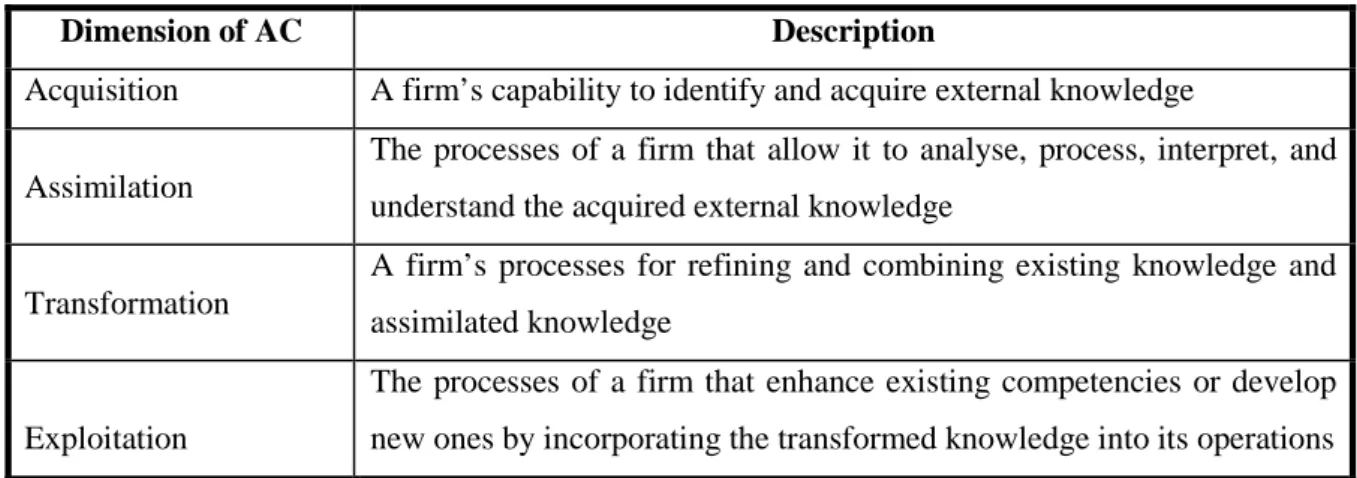
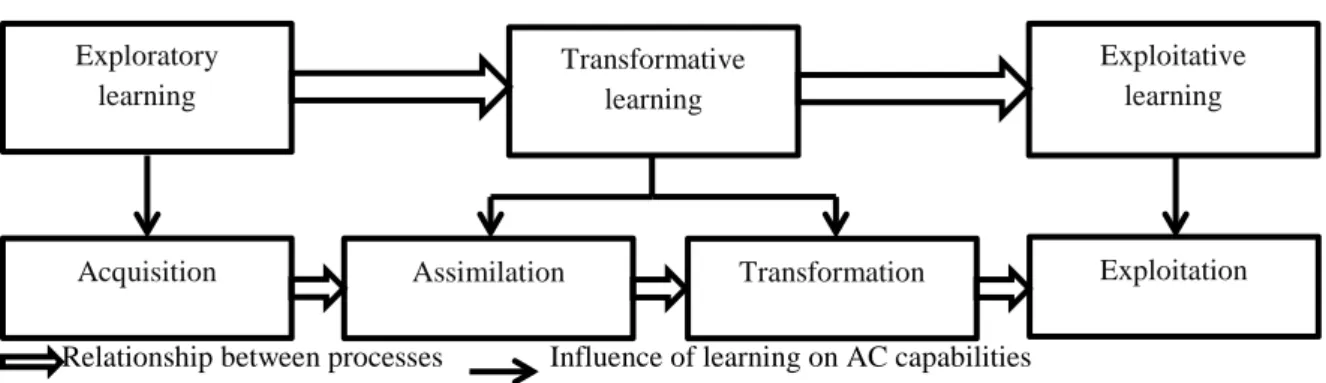
AC is first defined by Cohen and Levinthal in 1990 and there is general agreement amongst researchers with their definition (Lane et al. 2006). They define AC as the organisational ability to value, acquire, assimilate and exploit external knowledge to achieve organisational outcomes. This definition shows that AC is accomplished through processes. Existing literature assumes AC to be either dynamic capability, where the focus is placed on organisational routines in accordance with environmental turbulence, or learning processes. On the one hand, Zahra and George (2002) identify the processes of AC as four sequential and interrelated capabilities, comprising acquisition, assimilation, transformation and exploitation (see Table 1). However, this linear assumption is criticised by Todorova and Durisin (2007), who suggest that the transformation process is not followed by the assimilation process, but, rather, that they can substitute for each other. On the other hand, Lane et al. (2006) and Lichtenthaler (2009) consider AC to be based on three types of learning process, namely exploratory, transformative and exploitative learning processes. An exploratory learning process is the organisational ability to value and acquire external knowledge; the transformative learning process is centred on the ability to assimilate knowledge; and the exploitative learning process enables organisations to implement knowledge. To comprehend the foundations of AC, we suggest integrating Zahra and George’s (2002) work with Lane at al.’s (2006) model (see Figure 1).
Table 1: Definitions of four interrelated capabilities
Dimension of AC Description
Acquisition A firm’s capability to identify and acquire external knowledge
Assimilation
The processes of a firm that allow it to analyse, process, interpret, and understand the acquired external knowledge
Transformation
A firm’s processes for refining and combining existing knowledge and assimilated knowledge
Exploitation
The processes of a firm that enhance existing competencies or develop new ones by incorporating the transformed knowledge into its operations Source: Zahra and George (2002)
4
Figure 1: Incorporating absorptive capacity definitions
Relationship between processes Influence of learning on AC capabilities
Source: Adapted and modified from Zahra and George (2002), Lane et al. (2006) and Sun and Anderson (2010)
Sun and Anderson (2010) established the interplay between the dynamic capability perspective of AC proposed by Zahra and George (2002) and four types of learning: intuiting, interpreting, integrating and institutionalising. Crossan et al. (1999) define intuiting as recognition of patterns in a preconscious way, based on individuals’ experience; interpreting as developing language amongst individuals with which they describe their ideas or insights to each other; integrating as establishing shared understanding between group members in order to enable joint actions; and institutionalising as ensuring that organisations’ routinised actions are performed. Therefore, organisational learning depends to great extent on its individuals.
Argyris and Schön (1978) suggest that individual learning contributes to organisational learning through single- or double-loop learning. Singe-loop learning allows individuals to determine errors in organisational routines and take corrective actions, while double-loop learning questioning the underlying assumptions about the organisational activities. Accordingly, single-loop learning refers to incremental changes and double-loop learning is about radical changes. However, single- and double-loop learning does not explain how individual, group and organisational learning are related. We expand our argument beyond the work of Argyris and Schön (1978) to discuss how individual learning can be translated into organisational learning in further details.
The individual’s intuition facilitates the exploratory learning process – either by valuing external knowledge based on past patterns or by seeking new opportunities through
Acquisition Assimilation Transformation Exploitation Exploratory learning Transformative learning Exploitative learning
5
divergence from current beliefs (Sun and Anderson, 2010). Then, individual intuition should take effect at the group level through the exchange of ideas and knowledge (Nonaka and Takeuchi, 1995). Therefore, group learning and transformative learning process rely on communication between individual. Teamwork and cooperation enhance the communication between individuals and they are essential part of group learning (Goh, 1998) because they increase knowledge sharing between organisational members. As a result of such discussion, shared understanding of knowledge develops between group members (Sun and Anderson, 2010). Transferring knowledge from group to organisational level is achieved through the transformation capability, where the organisation communicates and interacts continually to achieve shared practices (Crossan et al., 1999). Accordingly, the transformative learning process influences the interpretation and integration of learning by refining and combining external knowledge with existing organisational knowledge.
Exploitation capability allows organisations to continually exploit external knowledge (Zahra and George, 2002; Sun and Anderson, 2010). Similar to the exploitative learning process, institutionalisation learning enables organisations to develop routines for reusing external knowledge. Therefore, we suggest that the exploratory learning process increases acquisition capability, the transformative learning process enhances assimilation and transformative capabilities, and the exploitative learning process facilitates exploitation capability.
We further justify the relationship between the learning processes of AC and its capability-based definition by referring to Winter (2003), who mention that organisational learning facilitates the development of dynamic capabilities. In order to integrate dynamic capability and learning perspectives of AC, Lane et al.’s definition is adopted, as this perspective addresses the influence of individuals, groups and organisations on AC. Moreover, the learning processes of AC enable organisations to develop their capabilities to acquire, assimilate, transform and exploit external knowledge. By adopting Lane et al.’s definition, we seek to explain which antecedents of AC influence the development of the learning processes of AC. The research to date faces various drawbacks concerning the antecedents of AC and its learning processes, which raise some concerns and questions regarding the applicability of the findings.
6 Antecedents of AC: Two Drawbacks
Numerous studies investigate the antecedents of AC; however, there are two drawbacks that researchers must manage. The first drawback is that scholars study the antecedents at different levels. Most of the studies focus on the organisational level, and accordingly identify different antecedents including, but not limited to, prior organisational knowledge (Cohen and Levinthal, 1990; Van den Bosch et al., 1999; Zahra and George, 2002), experience of knowledge search (Fosfuri and Tribó, 2008), formalisation (Vega-Jurado et al., 2008) and combinative capabilities (Van den Bosch et al., 1999; Jansen et al., 2005; Vega-Jurado et al., 2008). Others, such as Lane and Lubatkin (1998), investigate the antecedents of AC at dyad level and found that similarities between knowledge bases, organisational structures, compensation policies and dominant logic between organisations enhance learning processes. Researching AC at organisation and dyad levels shows the multidimensional structure of its antecedents. Surprisingly, the multilevel aspects of the AC have not received much attention.
Whilst the antecedents of AC vary, the existing literature pays less attention to distinguishing between them. Some researchers have only investigated the relationship with a particular process or capability: for example, Enkel and Heil (2014) investigate the antecedents of potential AC for innovation. Notably, potential AC refers to organisational capability to acquire and assimilate external knowledge (Zahra and George, 2002). The drawback with such studies is that they fail to demonstrate whether or not the antecedents of AC are different. Jansen et al.’s (2005) and Volberda et al.’s (2010) studies are exceptional in that they highlight the difference between the antecedents of AC. Despite the contributions of these two works, Volberda et al. (2010) do not distinguish between the impact of the antecedents of AC on the its learning processes. Similarly, Jansen et al. (2005) focus on the capability aspect of the AC – not on its process perspective. Therefore, further investigation is needed to identify which antecedents of AC, if any, have more impact on the development of each learning process of AC.
Similar to the aforementioned argument, a meta-analysis – notably conducted by Wijk et al. (2008) – revealed that the organisational antecedents of AC have not received adequate attention; hence, we consider how focusing on only one particular level could enable us to
7
develop AC effectively. We therefore suggest categorising the antecedents of AC in order to facilitate further improvement of this construct in its multilevel aspects.
An Integrative Framework of the AC Learning Processes
Absorptive capacity has three levels, namely individual, collective and interorganisational
(Matusik and Heeley, 2005). Cohen and Levinthal (1990) suggested focusing on the
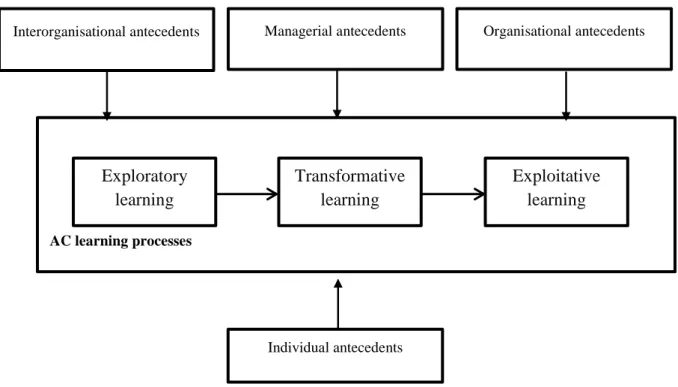
individual and organisational levels of AC as the impact of the antecedents of AC on its constructs, namely its learning processes, could be arguably different. It is therefore suggested that the development of AC constructs requires various competing and contradictory strategies (Cepeda-Carrion et al., 2012). Whilst AC occurs at three levels, comprising individual, group and organisational levels (see Sun and Anderson, 2010), and in order to build on the work of Volberda et al., (2010), we suggest organisational, interorganisational, managerial and individual antecedents, to discuss their influence on the learning processes of AC (see Figure 2). Since organisational knowledge reflects itself in its processes, structures, technologies and so on, we consider it a component of organisational antecedents. It should be noted that Volberda et al. (2010) identify the components of managerial, interorganisational and organisational antecedents. The components of individual antecedents are personality, habits and beliefs/experience (see Nonaka and Tachaouchi, 1995; Crossan et al., 1999).
Figure 2: Categorising the antecedents of the AC learning process
Exploratory learning Transformative learning Exploitative learning AC learning processes Interorganisational antecedents Individual antecedents
8
Source: Adopted and modified from lane et al. (2006) and Volberda et al. (2010)
Managers facilitate the development of AC by searching and transferring external knowledge (Lenox and King, 2004). Managers’ experiences/cognition define the locus of search in the external environment for acquiring and assimilating knowledge (Zahra and George, 2002). Their cognition also influences the assimilation and implementation of external knowledge (Augier and Teece, 2009). Moreover, their capabilities impact on the development, extension and modification of their organisational knowledge (Adner and Helfat, 2003; Haak-Saheem and Darwish, 2014). Managerial antecedents such as leadership influence the development of AC (see Flatten et al., 2015). It is suggested that the managers’ leadership styles influence the learning processes of AC. For example, Sun and Anderson (2012) argue that a transformational leadership style of managers facilitates exploratory learning, while a transactional leadership style enables the exploitative learning process. Therefore, managers’ cognition, abilities and leadership styles directly influence the learning processes of AC (Crossan et al., 1999; Flatten et al., 2015). It should also be noted that other individuals
influence AC, particularly through the exploratory learning process. Individuals’ skills,
education and motivation facilitate the acquisition of external knowledge (see Minbaeva et al., 2014), which relies on their cognition and experiences (intuitive learning). Therefore, managers can improve an individual’s overall capabilities by enhancing their skills and motivation.
Recipient organisations comprehend acquired knowledge effectively when there are similarities between its structures, routines and policies and those of sender organisations (Lane and Lubatkin, 1998); therefore, interorganisational factors facilitate the acquisition of knowledge. Meanwhile, the relationship between sender and recipient may be maintained for external knowledge assimilation and transformation when the knowledge cannot be easily articulated and implemented (see Nonaka and Takeuchi, 1995). Managers influence interorganisational antecedents because they are means of contact with external knowledge source senders (Zahra and George, 2002) and without their willingness knowledge cannot be acquired.
Organisational antecedents also influence AC; examples of organisational antecedents are organisational cultures, structures and communication systems (Van Den Bosch et al., 1999). These antecedents enhance transformative and exploitative learning processes. For instance, enhancing communication facilitates the interpretation and transfer of external knowledge
9
across organisations, which enhances transformative learning processes. On the other hand, the exploitative learning process relies on mechanistic organisational structure (see Cepeda-Carrion et al., 2012) in order to ensure the reuse of external knowledge. Managers have an impact on developing and managing organisational structure and processes, which enhance the development of AC (Van den Bosch et al., 1999); hence, it can be argued that managerial factors influence all other antecedents of AC.
Discussion: Systematising Antecedents of AC for Future Research Directions
We develop and propose our conceptual framework in this part. A conceptual framework contains of its constructs and the relationship among these constructs (Miles and Huberman, 1994). Whetten (1989) explained four criteria for developing a conceptual framework; (1) identifying the constructs or variables; (2) describing how the constructs are related; (3) describing the assumption(s) behind the proposed conceptual framework; (4) explaining the limitation of the proposed conceptual model. We meet the first two criteria by adopting and modifying the work of Lane et al. (2006) and Volberda et al. (2010) because these two works are widely recognised as reliable and comprehensive sources for studying the antecedents of AC. We meet the third criteria by referring to the leaning processes of AC. Absorptive capacity involves different types of learning which occur differently at individual, group and organisational level (Cepeda-Carrion et al., 2012). Therefore, it raised the questions of which of the antecedents of AC influence exploratory, transformative and exploitative learning processes. Finally, we identify the limitation of our conceptual framework to set the directions for future research.
Interrelating Antecedents of AC
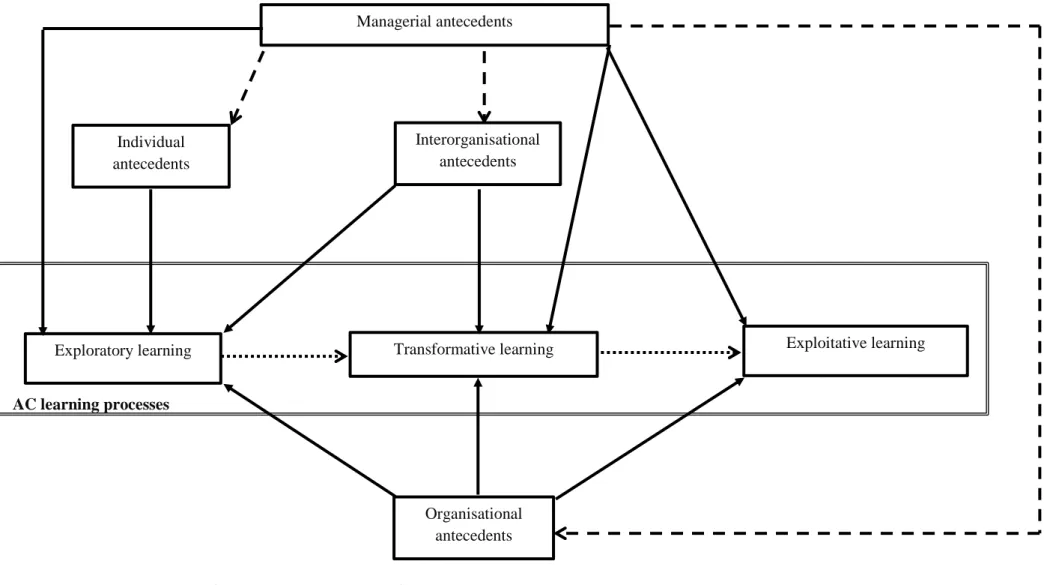
We demonstrate the complex interplay between and amongst the antecedents of AC (see Figure 3). Managerial antecedents not only influence all the learning processes of AC but also influence individual, interorganisational and organisational antecedents of AC. In our proposed model, we put managerial antecedents above other antecedents to show their direct and indirect influence on AC.
10
Figure 3: The interplay between antecedents of AC and learning processes
Direct influence; Indirect influence; Stages of learning; Source: Adapted from Lane et al. (2006) and Volberda et al. (2010)
AC learning processes Managerial antecedents Individual antecedents Interorganisational antecedents
Exploratory learning Transformative learning Exploitative learning
Organisational antecedents
11 Antecedents of the Exploratory Learning Process
Individuals play a key role in valuing and acquiring external knowledge. Individuals with greater knowledge are more capable of identifying new sources of knowledge (Lane et al., 2006). Knowledge at the individual level relies on the belief and commitment of people (Nonaka, 1994), which in turn influences pattern recognition or intuiting. It is argued that intuiting facilitates the exploratory learning process, which fits past patterns of knowledge search (Crossan et al., 1999). Similarly, several authors, including Van den Bosch (1999) and Zahra and George (2002), highlight path dependency when searching for knowledge; however, some individuals may start looking for completely new knowledge and experiences as they face an unfamiliar situation (Crossan et al., 1999). Therefore, the individual’s personality and, particularly, their level of experience affect the way individuals seek new knowledge.
Individuals’ experiences lead to the development of mental models which reflect the way individuals value and comprehend new knowledge (Kim, 1993). It is suggested that mental models not only influence the way individuals see the world, but also affect their understanding of new knowledge (Senge, 1990). Therefore, individuals’ memories play a role in developing mental models. Memory allows individuals to retain their knowledge and make judgments based on it (Kim, 1993). In other words, individuals’ past experience and knowledge have an impact on their intuiting of new ideas and their search for new external knowledge.
Organisational components affect the exploratory learning process. Individual learning is influenced by organisational memories (Crossan et al., 1995). Organisational memories develop over time and it resides itself in their systems, structures and procedures (Crossan et al., 1995). Therefore, organisational memories can impede or facilitate the exploratory learning. Where organisations encourage communications and flexibility, individual can facilitates identifying and acquiring external knowledge; while adopting mechanistic structure impedes individual learning (Cepeda-Carrion et al., 2012). Moreover, valuing the external knowledge resides in organisational systems and procedure where they determine which information individual should capture (Crossan et al., 1995).
Another antecedent that influences the exploratory learning process is that of interorganisational factors. Although the valuing of new external knowledge can be identified
12
at an individual level, the acquisition of the knowledge also relies on the ability of sender organisations to transfer knowledge. Lichtenthaler and Lichtenthaler (2010) present the concept of desorptive capacity, which refers to the sender organisation’s capability to transfer knowledge. Moreover, similarities between two organisations’ structures, policies and knowledge structures enable recipients to absorb senders’ knowledge effectively (Lane and Lubatkin, 1998).
Organisations seek to acquire and use external knowledge when they do not have sufficient knowledge (Laursen and Salter, 2006). On the other hand, sender organisations share their knowledge only when they can benefit from it (Spender, 1996). The challenge here for receiver organisations is to select appropriate knowledge senders. In other words, the relationships between receiver and sender organisations facilitate the valuing and acquisition of external knowledge. To develop such relationships, receiver organisations should consider the signal that sender organisations send via their corporate images, product demonstrations, conferences and so on to communicate the value of their knowledge (Lin et al., 2005).
Managerial antecedents also influence the exploratory learning process both directly and indirectly. It is widely cited that developing AC relies to a great extent on managers (e.g. Van den Bosch et al., 1999; Zahra and George, 2002). They influence AC through their cognition. It is noted that cognition relies on individuals’ prior knowledge and experiences (Cohen and Levinthal, 1990). Rezaei-Zadeh and Patel (2012) reported that managers use past experiences to introduce new knowledge to organisations. Similarly, Van den Bosch et al. (1999) provide evidence on the role of managers in developing AC in accordance with environmental turbulence.
Aside from managers’ role in valuing external knowledge, they have two other roles. The first is acting as enablers of exploratory learning. It is suggested that managers play a significant role in enabling organisations to access new knowledge (Van den Bosch et al., 1999; Zahra and George, 2002). This role of managers allows them to facilitate the flow of knowledge from an external source. The second role is developing individual ability in the search for knowledge. Managers can implement mechanisms such as cross-functional interfacing and job rotation in order to facilitate the focus and efficiency of an individual (Jansen et al., 2005).
13 Antecedents of the Transformative Learning Process
The transformative learning process interrelates group- and organisational-level learning (Sun and Anderson, 2010). A common understanding of the acquired knowledge develops, and it is transferred across organisations during the transformative learning process. We therefore suggest three antecedents: interorganisation, managerial and organisational. There is a relationship between the mode of cooperation and gaining of external knowledge. Understanding complex knowledge is achievable through close interaction between sender and recipient organisations (Lane and Lubatkin, 1998). On the other hand, articulated external knowledge can be gained from consultants without requiring close relationships between firms. As a recipient firm aims to exploit complex knowledge outside its boundary, increasing its ties with the source of knowledge is inevitable. Accordingly, under certain circumstances such as complexity of external knowledge the recipient firm relies on cooperation with the knowledge sender in order to enhance the transformative learning process. Effective communication between sender and receiver facilitates the comprehension and implementation of complex external knowledge.
Lin et al. (2005) provide a sender–receiver model of communication. Adopting Lin et al.’s model, we suggest that effective communication occurs when the sender has information completeness (known as sender-advantage mode). Lane and Lubatkin (1998) mention the importance of the interactive mode of learning for transferring complex knowledge in order to build new and valuable capabilities. The interactive mode of learning requires close relationship and mutual communication between the knowledge sender and knowledge receiver organisations in order to facilitate the receiver's understanding of the sender’s social context, which makes it hard for other organisations to imitate its knowledge. Therefore, we suggest that more complex knowledge requires a receiver organisation to maintain its close relationship with the knowledge sender in order to assimilate external knowledge.
The other factor influencing the understanding of knowledge is that of organisational characteristics, such as organisational structures, policies, routines, and prior related knowledge (Van den Bosch, 1999; Volberda et al., 2010). Individual AC can be turned into organisational AC through routines, structures and processes because they facilitate communication, and the sharing and transfer of individual knowledge (Cohen and Levinthal,
14
1990). Organisational features, such as structures and routines, positively influence a common understanding and the development of knowledge (Matusik and Heeley, 2005).
Managers affect the development of AC both directly and indirectly. They increase AC by providing and communicating information (Lenox and King, 2004). They also have a significant role to play in terms of developing a shared understanding of knowledge across their organisations. For instance, Jones (2006) report that newly recruited middle management act as change agents for expanding the transformative learning process by leading other employees to gain insight into the benefit of implementing acquired knowledge in a new way. On the other hand, the indirect influence of managers comes from their influence on organisational mechanisms to develop a common understanding of knowledge, i.e. developing a ‘knowledge-sharing’ culture and human resource practices. One of the main human resource practices is that of incentives and rewards, which is known to influence AC and knowledge-sharing. Nevertheless, there is a difference between the impacts of formal and informal managerial incentives on employees’ motivation to develop a shared understanding of acquired knowledge (Volberda et al., 2010).
Antecedents of the Exploitative Learning Process
The exploitative learning process enables organisations to reuse external knowledge. To reuse the knowledge, organisations develop routines (Zahra and George, 2002), which means carrying out activities in a similar fashion and on a repeated basis (Feldman, 2000). There are two sets of factors facilitating the exploitative learning process, namely organisational and managerial antecedents.
Organisational antecedents are different within the transformative and exploitative learning process. Organisations should impose a greater degree of control over the routines in the exploitative learning process, whilst adopting a more flexible structure in order to enhance creative problem-solving in the transformative learning process (Cepeda-Carrion et al., 2012). It is suggested that organisations manage their activities or routines effectively when they centralise power and information (Argyris and Schön, 1978). Hence, organisations adopt a more formal structure and more formalised procedures in order to ensure that employees follow routines. Applying such a formal and centralised structure also facilitates the transfer of knowledge to employees across the organisations (Matusik and Heeley, 2005).
15
Focusing on centralised structure demonstrates the role of control in developing the exploitative learning process. In this respect, managers have a significant role to play. Imposing control reassures management that the acquired knowledge is implemented both continually and successfully (Sun and Andersen, 2012). It is clearly difficult to change or modify the processes and routines at this learning stage, which reflects the transactional role of management (Sun and Anderson, 2012; Rezaei-Zadeh and Patel, 2012).
One of the behaviours of transactional managers is that they financially reward those who properly perform the given tasks, and punish those who fail to comply with the required procedures. It is recommended that encouragement from managers for employees’ actions is positively associated with organisational outcomes – particularly in the case of knowledge-related behaviours (King and Marks, 2008), i.e. developing AC. In an effort to foster the exploitative learning process, managers reward employees who follow the routines in order to ensure the reuse of knowledge. Therefore, we argue that managers promote organisational routines and processes through rewarding employees and imposing control.
Research Implications and Directions for Future Research
The above discussion reveals the need for further empirical investigations into the antecedents of AC. The interdependency between and amongst the antecedents of AC and its learning processes is not fully examined; the proposed conceptual framework is theoretical pending empirical testing. Empirical investigation is necessary to examine the influence of managerial antecedents on building the related antecedents of AC, including interorganisational, organisational and individual factors. We urge researchers to test our proposed conceptual model in different environmental dynamics. It is, notably, argued that uncertainty in the environment would have an impact on AC (see Van den Bosch et al., 1999; Zahra and George, 2002; Lichtenthaler, 2009; Volberda et al., 2010).
Future research could also validate the proposed conceptual model in light of several mediating factors, such as the type of knowledge and its characteristics, in order to evaluate whether or not the impact of antecedents of AC on the learning processes of AC would be different. Types of knowledge affect the antecedents of AC (Volberda et al., 2010). Knowledge characteristics, including codifiability, teachability, complexity, system
16
dependence and product observability, all influence the absorption of external knowledge (Zander and Kogut, 1995).
The relationship between the partners could differ according to the type of knowledge they aim to absorb (see Chen, 2004); hence, the type of cooperation between firms could also affect the antecedents of AC. Research from social capital theory indicates that the type of network influences the knowledge transfer between organisations and further affects the relationship between social actors. For example, the success of knowledge transfer in strategic alliances depends on the relationship between firms, whilst in the industrial district the influence, to a great extent, depends on the individual (Inkpen and Tsang, 2005). Therefore, including the type of cooperation highlights those antecedents that play a greater role in knowledge transfer or on the exploratory learning process.
Consideration of the different levels involved in AC indicates that not all antecedents have the same impact on AC. A better understanding of the impact of the antecedents of AC can be achieved by considering organisational outcomes. Whilst different organisational outcomes may require different managerial approaches (Sirmon et al., 2011), future research could also examine which antecedents have the greatest impact on developing the learning processes of AC in relation to different organisational outcomes, which will increase our understanding of whether or not there is a relationship between organisational outcomes and the antecedents of AC.
Conclusion
The field of AC still needs further development concerning its antecedents. This study contributes to the existing body of knowledge by providing a conceptual model, which explains the ways in which the learning processes of AC can be developed effectively. This work contributes to the literature on AC by showing which antecedents of AC could have greater impact on the development of its learning processes. Whilst the existing literature does not distinguish between the antecedents of AC, our proposed conceptual model reveals the difference between the effects of the antecedents of AC on development of its constructs, namely its learning processes. We demonstrated that managerial antecedents have an impact directly and indirectly on the learning processes of AC. Nevertheless, the influence of other antecedents was limited to certain learning processes of AC. By distinguishing between the antecedents of AC, managers can benefit from the proposed conceptual model by becoming
17
directly involved in different stages of the AC processes and facilitating learning in order to acquire, assimilate, transform and implement external knowledge more effectively. The proposed model could further assist managers to decide how to invest in the different antecedents of AC.
Acknowledgment: The authors are indebted to the Editor of this Journal and two anonymous referees whose detailed constructive comments and suggestions helped us improve the paper. All shortcomings are ours.
References
Adner, R. and Helfat, C. E. (2003), “Corporate effects and dynamic managerial capabilities”, Strategic Management Journal, Vol. 24 No. 10, pp. 1011–1025.
Argyris, C. and Schön, D. A. (1978), Organizational learning: A theory of action perspective, Addison-Wesley, Reading.
Augier, M. and Teece, D. J. (2009), “Dynamic capabilities and the role of managers in business strategy and economic performance”, Organization Science, Vol. 20 No. 2, pp. 410–421.
Cepeda-Carrion, G., Cegarra-Navarro, J. G. and Jimenez-Jimene, D. (2012), “The effect of absorptive capacity on innovativeness: Context and information systems capability as catalysts”, British Journal of Management, Vol. 23 No. 1, pp. 110-129.
Chen, C. (2004), “The effects of knowledge attributes, alliance characteristics, and absorptive capacity on knowledge transfer performance”, R&D Management, Vol. 34 No. 3, pp. 311-321.
Chesbrough, H. (2003), Open innovation: The new imperative for creating and profiting from technology, Harvard Business School Press, Boston.
Cohen, W. M. and Levinthal, D. A. (1990), “Absorptive capacity: A new perspective on learning and innovation”, Administrative Science Quarterly, Vol. 35 No. 1, pp. 128–152. Crossan, M. M., Lane, H. W. and White, R. E. (1999), “An organizational learning
framework: From intuition to institution”, Academy of Management Review, Vol. 24 No. 3, pp. 522–537.
Crossan, M. M., Lane, H. W., White, R. E. and Djurfeldt, L. (1995), “Organizational learning: Dimensions for a theory”, The International Journal of Organizational Analysis, Vol. 3 No. 4, pp. 337-360.
Dyer, J. H., Kale, P. and Singh, H. (2004), “When to ally and when to acquire”, Harvard Business Review, Vol. 82 No. 7-8, pp. 108–115.
Feldman, M. S. (2000), “Organizational routines as a source of continuous change”, Organization Science, Vol. 11 No. 6, pp. 611-629.
Flatten, T., Adams, D. Brettel, M. (2015), “Fostering absorptive capacity through leadership: A cross-cultural analysis”, Journal of World Business, Vol. 50 No. 3, pp. 519-534. Fosfuri, A. and Tribó, J. A. (2008), “Exploring the antecedents of potential absorptive
capacity and its impact on innovation performance”, Omega: The International Journal of Management Science, Vol. 36 No. 2, pp. 173-187.
18
Goh, S. C. (1998), “Toward a learning organization: The strategic building blocks”, S.A.M. Advanced Management Journal, Vol. 63, No, 2, pp. 15-20.
Haak-Saheem, W. and K. Darwish, T. (2014), “The role of knowledge management in creating a culture of learning: The case of Dubai Municipality”, Management Decision, Vol. 52 No. 9, pp. 1611-1629
Inkpen, A. C. and Tsang, E. W. K. (2005), “Social capital, networks, and knowledge transfer”, Academy of Management Review, Vol. 30 No. 1, pp. 146-165.
Jansen, J. J. P., Van den Bosch, F. A. J. and Volberda, H. W. (2005), “Managing potential and realized absorptive capacity: How do organizational antecedents matter?”, Academy of Management Journal, Vol. 48 No. 6, pp. 999-1015.
Jones, O. (2006), “Developing absorptive capacity in mature organizations: The change agent’s role”, Management Learning, Vol. 37 No. 3, pp. 355–376.
Kim, D. H. (1993), “The link between individual and organisational learning”, Sloan Management Review, Vol. Fall, pp. 37–50.
King, W. R. and Marks, P. V. (2008), “Motivating knowledge sharing through a knowledge management system”, Omega: The International Journal of Management Science, Vol. 36 No. 1, pp. 131-146.
Lane, P. J. and Lubatkin, M. (1998), “Relative absorptive capacity and interorganizational learning”, Strategic Management Journal, Vol. 19 No. 5, pp. 461-477.
Lane, P. J., Koka, B. R. and Pathak, S. (2006), “The reification of absorptive capacity: A critical review and rejuvenation of the construct”, Academy of Management Review, Vol. 31 No. 4, pp. 833–863.
Laursen, K. and Salter, A. J. (2006), “Open for innovation: The role of openness in explaining innovative performance among UK manufacturing firms”, Strategic Management Journal, Vol. 27 No. 2, pp. 131–150.
Lenox, M. and King, A. (2004), “Prospects for developing absorptive capacity through internal information provision”, Strategic Management Journal, Vol. 25 No. 4, pp. 331–45.
Lichtenthaler, U. (2009), “Absorptive capacity, environmental turbulence, and the complementarity of organisational learning processes”, Academy of Management Journal, Vol. 52 No. 4, pp. 822–846.
Lichtenthaler, U. and Lichtenthaler, E. (2010), “Technology transfer across organizational boundaries: Absorptive capacity and desorptive capacity”, California Management Review, Vol. 53 No. 1, pp. 154-170.
Lin, L., Geng, X. Whinston, A. B. (2005), “A sender-receiver framework for knowledge transfer”, MIS Quarterly, Vol. 20 No. 2, pp. 197-219.
Marabelli, M. and Newell, S. (2014), “Knowing, power and materiality: A critical review and reconceptualization as absorptive capacity”, International Journal of Management Reviews, Vol. 16 No. 4, pp. 479-499.
Matusik, S. F. and Heeley, M. B. (2005), “Absorptive capacity in the software industry: Identifying dimensions that affect knowledge and knowledge creation activities”, Journal of Management, Vol. 31 No. 4, pp. 549–572.
Miles M. and Huberman A. (1994), Qualitative data analysis: An expanded sourcebook, Sage, London.
Minbaeva, D., Pedersen, T., Björkman, I., Fey, C. F. and Park. H. J. (2014), “MNC knowledge transfer, subsidiary absorptive capacity, and HRM”, Journal of International Business Studies, Vol. 45 No. 1, pp. 586–599.
Murovec, N. and Prodan, I. (2009), “Absorptive capacity, its determinants, and influence on innovation output: Cross-cultural validation of the structural model”, Technovation, Vol. 29 No. 12, pp. 859-872.
19
Nonaka, I. (1994), “A dynamic theory of organizational knowledge creation”, Organization Science, Vol. 5 No. 1, pp. 14-37.
Nonaka, I. and Takeuchi, H. (1995), The Knowledge-Creating Company, Oxford University Press, New York.
Rezaei-Zadeh, M. and Patel, N. V. (2012), “The effect of absorptive capacity on product innovation: A leadership perspective”, 8th European Conference on Management Leadership and Governance, Cyprus, 2012, Academic Publishing International Limited, Reading, pp. 366-371.
Senge, P. M. (1990), The Fifth Discipline: The Art and Practice of the Learning Organisation, Century Business, London.
Sirmon, D. G., Hitt, M. A., Ireland, R. D. and Gilbert, B. A. (2011), “Resource orchestration to create competitive advantage: Breadth, depth, and life cycle effects”, Journal of Management, Vol. 37 No. 5, pp. 1390-1412.
Spender, J. C. (1996), “Organizational knowledge learning and memory: three concepts in search of a theory”, Journal of Organizational Change Management, Vol. 9 No. 1, pp. 63-78.
Sun, P. Y. T. and Anderson, M. H. (2010), “An examination of the relationship between absorptive capacity and organizational learning, and proposed integration”, International Journal of Management Reviews, Vol. 12 No. 2, pp. 130–150.
Sun, P. Y. T. and Anderson, M. H. (2012), “The combined influence of top and middle management leadership styles on absorptive capacity”, Management Learning, Vol. 43 No. 1, pp. 25–51.
Todorova, G. and Durisin, B. (2007), “Absorptive capacity: Valuing reconceptualization”, Academy of Management Review, Vol. 32 No. 3, pp. 774–786.
Van den Bosch, F. A. J., Volberda, H. W. and Boer, M. (1999), “Coevolution of firm absorptive capacity and knowledge environment: Organizational forms and combinative capabilities”, Organizational Science, Vol. 10 No. 5, pp. 551–568.
Vega-Jurado, J., Gutiérrez-Gracia, A. and Fernández-de-Lucio, I. (2008), “Analyzing the determinants of firm’s absorptive capacity: Beyond R&D”, R&D Management, Vol. 38 No. 4, pp. 392-405.
Volberda, H. W., Foss, N. J. and Lyles, M. A. (2010), “Absorbing the concept of absorptive capacity: How to realize its potential in the organization field”, Organization Science, Vol. 21 No. 4, pp. 931-951.
Whetten, D. A. (1989), “What constitutes a theoretical contributions?”, Academy of Management Review, Vol. 4 No. 4, pp. 490-495.
Wijk, R. V., Jansen, J. J. P. and Lyles, M. A. (2008), “Inter- and intra-organizational knowledge transfer: A meta-analytic review and assessment of its antecedents and consequences”, Journal of Management Studies, Vol. 45 No. 4, pp. 830-853.
Winter, S. G. (2003), “Understanding dynamic capabilities”, Strategic Management Journal, Vol. 24 No. 10, pp. 991–995.
Zahra, S. A. and George, G. (2002), “Absorptive capacity: A review, reconceptualization, and extension”, Academy of Management Review, Vol. 27 No. 2, pp. 185–203.
Zander, U. and Kogut, B. (1995), “Knowledge and the speed of the transfer and imitation of organizational capabilities: An empirical test”, Organization Science, Vol. 6 No. 1, pp. 76-92.