Research Collection
Journal Article
Criteria for effective zero-deforestation commitments
Author(s):
Garrett, Rachael D.; Levy, S.; Carlson, Kimberly M.; Gardner, Toby A.; Godar, Javier; Clapp, Jennifer;
Dauvergne, Peter; Heilmayr, Robert; le Polain de Waroux, Yann; Ayre, Ben; Barr, Robin; Døvre, Barbro;
Gibbs, Holly K.; Hall, Simon; Lake, Sarah; Milder, Jeffrey C.; Rausch, Lisa L.; Rivero, Rosanna; Rueda,
Ximena; Sarsfield, Ryan; Soares-Filho, Britaldo; Villoria, Nelson
Publication Date:
2019
Permanent Link:
https://doi.org/10.3929/ethz-b-000359672
Originally published in:
Global Environmental Change 54,
http://doi.org/10.1016/j.gloenvcha.2018.11.003
Rights / License:
Creative Commons Attribution-NonCommercial-NoDerivatives 4.0 International
This page was generated automatically upon download from the ETH Zurich Research Collection. For more
information please consult the Terms of use.
Contents lists available atScienceDirect
Global Environmental Change
journal homepage:www.elsevier.com/locate/gloenvchaCriteria for effective zero-deforestation commitments
R.D. Garrett
a,⁎, S. Levy
a, K.M. Carlson
b, T.A. Gardner
c, J. Godar
c, J. Clapp
d, P. Dauvergne
e,
R. Heilmayr
f, Y. le Polain de Waroux
g, B. Ayre
h, R. Barr
i, B. Døvre
h, H.K. Gibbs
j, S. Hall
k, S. Lake
h,
J.C. Milder
l,m, L.L. Rausch
n, R. Rivero
b, X. Rueda
o, R. Sarsfield
p, B. Soares-Filho
q, N. Villoria
r aDepartment of Earth and Environment and Global Development Policy Center, Boston University, Boston, MA, USAbDepartment of Natural Resources and Environmental Management, University of Hawai’i, Honolulu, HI, USA cStockholm Environment Institute, Stockholm, Sweden
dSchool of Environment, Resources and Sustainability, University of Waterloo, Waterloo, ON, Canada eDepartment of Political Science, University of British Columbia, Vancouver, BC Canada
fEnvironmental Studies Program Bren School of Environmental Science & Management, University of California, Santa Barbara, CA, USA gInstitute for the Study of International Development and Department of Geography, McGill University, Montreal, Quebec, Canada hGlobal Canopy, Oxford, UK
iN. America Office of The Forest Trust (TFT), Seattle, USA
jDepartment of Geography and Nelson Institute for Environmental Studies, University of Wisconsin, Madison, WI, USA kNational Wildlife Federation, National Advocacy Center, Washington, DC, USA
lRainforest Alliance, New York, NY, USA
mDepartment of Natural Resources, Cornell University, Ithaca, NY, USA
nNelson Institute for Environmental Studies, University of Wisconsin, Madison, WI, USA oSchool of Management, Universidad de Los Andes, Colombia
pGlobal Forest Watch, World Resources Institute, Washington, DC, USA
qCentro de Sensoriamento Remoto, Universidade Federal de Minas Gerais, Belo Horizonte, Brazil rDepartment of Agricultural Economics, Kansas State University, Manhattan, KS, USA
A R T I C L E I N F O Keywords: Agriculture Forestry Supply chain Conservation
Voluntary environmental policies Sustainability standards
A B S T R A C T
Zero-deforestation commitments are a type of voluntary sustainability initiative that companies adopt to signal their intention to reduce or eliminate deforestation associated with commodities that they produce, trade, and/ or sell. Because each company defines its own zero-deforestation commitment goals and implementation me-chanisms, commitment content varies widely. This creates challenges for the assessment of commitment im-plementation or effectiveness. Here, we develop criteria to assess the potential effectiveness of zero-deforestation commitments at reducing deforestation within a company supply chain, regionally, and globally. We apply these criteria to evaluate 52 zero-deforestation commitments made by companies identified by Forest 500 as having high deforestation risk. While our assessment indicates that existing commitments converge with several criteria for effectiveness, they fall short in a few key ways. First, they cover just a small share of the global market for deforestation-risk commodities, which means that their global impact is likely to be small. Second, biome-wide implementation is only achieved in the Brazilian Amazon. Outside this region, implementation occurs mainly through certification programs, which are not adopted by all producers and lack third-party near-real time deforestation monitoring. Additionally, around half of all commitments include zero-net deforestation targets and future implementation deadlines, both of which are design elements that may reduce effectiveness. Zero-net targets allow promises of future reforestation to compensate for current forest loss, while future implementation deadlines allow for preemptive clearing. To increase the likelihood that commitments will lead to reduced deforestation across all scales, more companies should adopt zero-gross deforestation targets with immediate implementation deadlines and clear sanction-based implementation mechanisms in biomes with high risk of forest to commodity conversion.
https://doi.org/10.1016/j.gloenvcha.2018.11.003
Received 3 July 2018; Received in revised form 19 October 2018; Accepted 5 November 2018
⁎Corresponding author at: 685 Commonwealth Ave., Boston, MA 02215.
E-mail address:[email protected](R.D. Garrett).
Available online 18 December 2018
0959-3780/ © 2018 The Authors. Published by Elsevier Ltd. This is an open access article under the CC BY-NC-ND license (http://creativecommons.org/licenses/BY-NC-ND/4.0/).
1. Introduction
In the last decade, most tropical deforestation has been driven by the expansion of a handful of land-based commodities including palm oil, soybeans, beef, and wood products (Curtis et al., 2018;Gibbs et al., 2010;Henders et al., 2015). Many remaining forest areas have incurred substantial degradation from selective logging for timber, pulp, and paper (Pearson et al., 2014). Rapid expansion of these “forest-risk” commodities within tropical regions has been driven by increases in demand from population growth, changing consumer preferences, and to a lesser extent government biofuel policies (Alexander et al., 2015; Defries et al., 2010;Lambin and Meyfroidt, 2011). Forest conversion and logging for agriculture and timber production are associated with substantial negative socio-environmental impacts, including land con-flict, increased rural income inequality, greenhouse gas emissions, biodiversity loss, and hydrological changes (Carlson et al., 2013; Carlson and Garrett, 2018;Garrett and Rausch, 2015;Pearson et al., 2014;Spera et al., 2016;Whitworth et al., 2018).
A relatively small number of large companies handle most trans-portation, processing, and distribution of these forest-risk commodities (Hoffman, 2013). Since the early 2000s many of these companies have experienced increased scrutiny regarding their sourcing practices, in-cluding pressure from civil society and governments. Examples include Greenpeace’s name and shame campaigns (e.g.Greenpeace, 2006) and the efforts of public prosecutors in Brazil to enforce domestic con-servation regulation compliance on companies operating in the Amazon (Gibbs et al., 2015;Merry and Soares-Filho, 2017). In response to this pressure, many large companies have made public pledges to exclude commodities produced by suppliers that have recently cleared or are actively clearing land. These pledges are known as “zero-deforestation commitments” (ZDCs) (Lambin et al., 2018). By 2017, at least 477 companies in forest risk-commodity supply chains had made a ZDC (Donofrio et al., 2017).
ZDCs are voluntary sustainability initiatives that signal a company’s intention to eliminate deforestation from its supply chain (Lambin et al., 2018), and may aim to fill gaps in public forest governance (Prakash and Potoski, 2007). Research on ZDC effectiveness is still sparse, but a systematic review of work to date suggests that existing ZDCs have had only limited success (Garrett et al., 2018). Companies rarely report their progress and there have already been several high profile cases of non-compliance by committed companies (Cuff, 2016). Meanwhile, tropical deforestation continues at high rates (Hansen et al., 2013).
A systematic assessment of these commitments and the conditions of their implementation is urgently needed to improve their effectiveness and capitalize on momentum among consumer goods companies (Dauvergne, 2017). Well-designed and -implemented ZDCs could play an important role in protecting native habitats given the limited ability of individual companies or governments to affect global deforestation levels due to leakage and other spillover effects. Thus, defining general principles that may improve expected outcomes of ZDCs for both forests and supply chain actors is essential. Such principles can be applied to guide case study diagnoses of impacts and shortcomings of existing agreements within individual regions and company supply chains, and inform future synthetic research (e.g.Lambin et al. (2018)).
WhileJopke and Schoneveld (2018)developed a set of indicators to evaluate current ZDCs, no deductive approach has been used to provide a theoretical framework that identifies the factors which are most likely to generate commitments that achieve progress toward zero-defor-estation at the global scale. Previous theoretical and empirical research on voluntary sustainability initiative effectiveness has focused on cer-tification programs (e.g.Auld et al., 2008b;Bush et al., 2013;Garrett et al., 2016;Gulbrandsen, 2004). ZDCs differ from certification systems in that they establish a company’s intention to reduce deforestation, but do not always elaborate specific criteria, implementation mechanisms, or third party assurances that are features of certification approaches
(Haupt et al., 2018;Lambin et al., 2018). A “middle range” theory of effectiveness for ZDCs (one that provides general theory bounded by particular contexts) (Meyfroidt et al., 2018) and associated assessment criteria to evaluate the likely effectiveness of an individual pledge would aid existing efforts to monitor company progress toward zero-deforestation goals (e.g., Forest 500, SPOTT, Supply Change)(Milder et al., 2015) and in efforts to standardize future commitments around agreed upon characteristics (e.g., The Accountability Framework ( ac-countability-framework.org)).
Here we develop a framework to assess the potential effectiveness of ZDCs in terms of their conservation outcomes: i) within individual supply chains at the regional level, ii) across all sectoral actors at the regional level, and iii) across all actors at the global level. In developing this framework we draw on literature that describes the factors that influence the effectiveness of any voluntary sustainability initiative (Auld et al., 2008b,2008a;Borck and Coglianese, 2009;Clapp, 2017; Clapp and Thistlethwaite, 2012;van der Ven et al., 2018). Within this general framework, we elaborate specificassessment criteriaby which to evaluate expected commitment effectiveness across these three scales. Finally, we evaluate the 52 existing commitments from the 250 com-panies tracked by the Forest 500 project (www.forest500.org) using these assessment criteria. In our discussion, we expose tensions between commitments that are most likely to result in reduced deforestation at the global level, and commitments that are most likely to be agreeable and/or technically implementable by companies.
2. Methods
We began our development of a conceptual framework of commit-ment effectiveness as part of an interdisciplinary meeting of scientists and practitioners engaged in the study and governance of food supply chains held in November 2016 at the National Socio-Environmental Synthesis Center (SESYNC) in Annapolis, United States. We then refined this framework through literature review and in follow-up discussions among this group, including a second meeting at SESYNC in June 2018. The composition of our group was 50% from academia (US, Canada, and Brazil), 44% from civil society (conservation NGOs and non-profit research institutions), and 6% from the private sector (one major commodity trader/processor). Through this process, we agreed upon a framework that identified eleven criteria that are likely to play an im-portant role in determining ZDC effectiveness.
We applied our criteria to empirical zero-deforestation commitment data from the Forest 500 project (Global Canopy Programme, 2016). This project uses trade, customs and market research data to purpose-fully sample the 250 ‘powerbrokers’ who are likely to be most influ-ential in reducing deforestation globally. Companies are included in the Forest 500 project based on their risk of being linked to tropical de-forestation and the volume of product that they produce and/or source (Global Canopy Programme, 2015). The Forest 500 project conducts assessments of company websites, including websites of subsidiaries, to identify information on internal sustainability procedures related to forest safeguards. Assessment items included overall forest policy, commodity specific policies, operations, and reporting and transpar-ency (Global Canopy Programme, 2015). We then matched, wherever possible, the Forest 500 assessment items to the criteria included in our conceptual framework of commitment effectiveness.
3. What makes a zero-deforestation commitment effective? Companies make ZDCs for several reasons, including demonstrating corporate social responsibility to protect market shares and reducing the risk of potentially catastrophic reputational harm and supply dis-ruptions (Rueda et al., 2017). Such benefits may be realized even if commitments do not lead to stated goals or if goals are unverifiable (i.e., green-washing). We defineindividual supply chain effective-ness of ZDCs as elimination of deforestation among the company’s
direct and indirect suppliers.
While a company’s ZDC typically focuses on “cleaning” its own supply chain, conservation activists hope that ZDC fulfillment generates regional or global forest protection. We defineregional effectiveness as eliminating deforestation among all producers of that
com-modity in the region.Net global effectiveness of ZDCs is achieved
when deforestation is eliminated in the regions where the
com-mitment is applied without increasing deforestation elsewhere. In
other words, a commitment is only regionally and globally effective if avoided deforestation in the target supply chain is not displaced to other actors, regions, times, or commodities (le Polain de Waroux et al., 2017). For instance, if implementation of commitments pushes pro-duction to areas with lower yields where more total land is required to meet demand, or regions with higher conservation value, ZDCs could cause greater damage than business as usual land cover change in the original location (Carrasco et al., 2014). Additionally, a commitment should not lead to pre-emptive clearing in expectation of future policy adoption (Carlson et al., 2018).
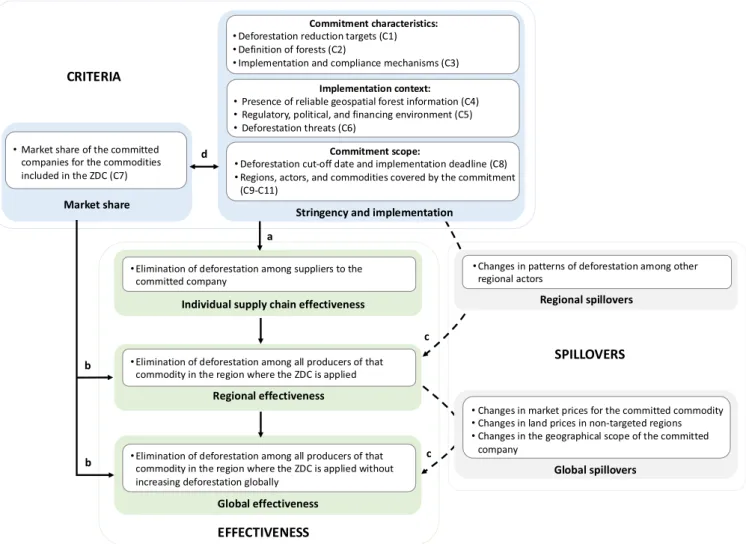
Individual supply chain ZDC effectiveness is likely to be affected by a policy’s stringency, contextual factors in the region of implementa-tion, and the life cycle of the targeted commodity (Auld et al., 2008b; Clapp, 2017;Garrett et al., 2016;Rueda et al., 2017;van der Ven et al., 2018)(Fig. 1a). Policy stringency is determined by the commitment content, including its deforestation reduction targets and the ‘forest’ definitions specified, and by commitment implementation, including
the degree of realization and type of mechanism. Contextual factors include existing incentives for deforestation in the target supply chain and the presence of reliable deforestation monitoring mechanisms for suppliers, which are both influenced by the regulatory, political, and financing environment in the region where the commitment is im-plemented. Commodity life cycles differ substantially between live-stock, crop, and timber. For instance, livestock are often born, reared, and finished in different locations, involving trade between two or more producers before being supplied to a committed company, which makes it more difficult to trace a livestock product than a crop product to its origin.
Regional and net global effectiveness is affected by the level of participation of firms and their combined market share (Clapp, 2017; Clapp and Thistlethwaite, 2012;van der Ven et al., 2018)(Fig. 1b), the geographical reach of committed companies, and the negative and positive spillovers arising from their commitments at the regional or global scale (Fig. 1c). The extent of deforestation spillovers (effects on non-targeted regions, actors, commodities, etc.), depends on the re-gions, actors, and commodities covered by the commitment, com-pliance cut-off dates, the fungibility of capital and labor markets, technological responses to ZDC implementation, impacts of the com-mitment on income, and the temporal and spatial implementation pattern (Wunder, 2008). All factors that influence individual supply chain ZDC effectiveness may impact regional and global effectiveness through ripple effects on commodity and land markets (Atmadja and
Fig. 1.Framework for understanding the expected effectiveness of ZDCs. Green boxes indicate three scales at which effectiveness can be defined. Blue boxes indicate criteria important for commitment effectiveness. Grey boxes highlight types of spillovers that can occur. Letters (a–d) focus on interactions between the boxes (criteria, effectiveness, and spillovers), as referenced in the main text. (For interpretation of the references to colour in this figure legend, the reader is referred to the web version of this article).
Verchot, 2012), just as regional effectiveness will influence global ef-fectiveness.
Importantly, our framework recognizes the interaction between the stringency of voluntary sustainability initiatives and the level of parti-cipation by firms (Borck and Coglianese, 2009)(Fig. 1d). Some firms may be more likely to adopt a less stringent ZDC that they can apply globally (Auld et al., 2008b), while other firms may be more likely to adopt a more stringent ZDC that applies to a single region. A less stringent ZDC that applies globally and reduces spillovers could have more or less net global effectiveness as a ZDC that is more stringent in the region where it is applied and leads to deforestation spillovers in other regions (Borck and Coglianese, 2009).
Our definition of ZDC effectiveness builds on definitions used in related work about voluntary sustainability initiatives (e.g.,Auld et al., 2008b;Borck and Coglianese, 2009) by differentiating three scales of effectiveness: individual, regional and global. This is necessary because of the diverse goals of the actors undertaking and negotiating ZDCs and because it allows us to separate out the effects of market shares and spillovers on effectiveness at broader scales from the issue of effec-tiveness within individual supply chains. Nonetheless, our concept of individual supply chain effectiveness is similar to the concept of “direct effects” proposed inAuld et al. (2008b)and “average effect by parti-cipant” in Borck and Coglianese (2009). Regional and global supply chain effectiveness incorporate the “number of participants” and “spillovers” (Borck and Coglianese, 2009), or whatAuld et al. (2008b) refer to as “broader implications”.
4. Conceptual framework
This section explains in more detail how the various factors in-troduced in section3(andFig. 1) influence the individual supply chain, regional, and net global effectiveness of ZDCs. Resulting criteria for effective commitment design, numberedCX,are presented in bold at the conclusion of each section.
4.1. Stringency and implementation factors that influence individual supply chain effectiveness (Fig. 1a)
4.1.1. Commitment characteristics
Deforestation reduction targets: ZDCs describe deforestation in several ways, including zero-net, zero-gross,and zero-illegal deforesta-tion, each of which has different implications for forests (Brown and Zarin, 2013;Lambin et al., 2018). A zero-net commitment allows re-forestation to compensate for forest loss, such that there is no overall change in the amount of forest. In contrast, a zero-gross commitment prohibits all deforestation. These two targets may sometimes exceed public legal frameworks and enforcement mechanisms, while a zero-illegal deforestation commitment would merely better align the com-pany’s activities with existing government regulations.
In theory, zero-net deforestation mechanisms could enable compa-nies to clear forests with low carbon or biodiversity but high potential for agricultural production in exchange for forest restoration in lower productivity lands or those where restoration could yield substantial conservation benefits. In practice, however, commitments to zero-net deforestation rarely include rigorous mechanisms to ensure that off-setting generates these ecological benefits and are likely to lead to a delay in potential forest sparing benefits (van der Ven et al., 2018). Furthermore, zero-net deforestation approaches can mask loss of nat-ural ecosystems due to failure to monitor or maintain transparent re-gistries, or when they lead to a transition towards planted forests with low ecological integrity (Brown and Zarin, 2013;Tropek et al., 2014). A zero-illegal deforestation target is likely to be the least stringent, since few jurisdictions fully prohibit deforestation (Garrett et al., 2016). Zero-illegal targets are also, by definition, unlikely to lead to any ad-ditional conservation in regions where laws are already well enforced. Notably, none of these targets require the demonstration of
“additionality” in reduced deforestation. That is, a company is not re-quired to prove that they reduced deforestation beyond what would have occurred under business as usual practices, either regionally or globally.
C1: ZDCs with a zero-gross deforestation target are more likely to be effective.
Definition of forests: How forests are defined in ZDCs can be highly contentious, because this affects the lands available for expansion and the costs of monitoring for compliance (Romijn et al., 2012;Sasaki and Putz, 2009). By implicitly or explicitly excluding certain types of eco-systems in their discussions of forests, civil society, states, and com-panies can influence which locations and land uses are targeted by “deforestation” commitments. Partly due to this lack of consensus, various definitions of deforestation – or no definition at all – are used in international conservation discussions (Chazdon et al., 2016). If a forest definition is limited, for example, to vegetation with more than 30% canopy cover, then it will protect a smaller area than if a more com-prehensive definition were used, which can undermine the broader global effectiveness. Specifically, it may fail to cover other areas that still have high conservation value and high carbon stocks, such as de-forested peatlands, agroforests, savannas, dry forests, and heavily logged forests (Garrett et al., 2016). Nevertheless, using a less inclusive forest definition may encourage earlier and more widespread partici-pation in ZDCs, because it reduces adoption costs (Clapp and Thistlethwaite, 2012).
In response to specific concerns about conservation of ecosystem function and carbon sequestration, formal procedures have been de-veloped for designating places as “High Conservation Value” (HCV) or “High Carbon Stock” (HCS) (Table S1). These designations, particularly HCV, are more inclusive than a definition that focuses only on canopy cover. HCV measures conservation value based on the ecosystem’s biological, ecological, social, or cultural values. These values may favor large landscape-level areas of forest, but also protect rare species and habitats and high concentrations of wildlife, even if the area is small or has limited canopy cover (Edwards and Laurance, 2012). HCS distin-guishes forests with high carbon and biodiversity value from degraded lands based on vegetation class, validated by above ground biomass measurements and field observations, but does not include social, cul-tural, or biodiversity criteria.
C2: ZDCs with more inclusive forest definitions, such as those defined by High Conservation Value and High Carbon Stock, are more likely to be effective.
Implementation and compliance mechanisms: Regional effective-ness depends on a functional system of monitoring and verification of compliance at a manageable spatial unit, whether it be a property, cooperative, or jurisdiction. Attributes of functional monitoring and verification include traceability mechanisms, near real-time deforesta-tion detecdeforesta-tion, and a record of infracdeforesta-tions that can be checked at point of sale (Haupt et al., 2018). Traceability mechanisms link suppliers to a specific place. An example is the Brazilian public Rural Environmental Registry (CAR) (Roitman et al., 2018). Near real-time deforestation monitoring is the ability to map changes in agreed upon definitions of forest area within a matter of weeks (Reiche et al., 2015). Databases or lists recording deforestation infractions by suppliers or potential sup-pliers must be accessible at the point of sale for the buyer to verify that suppliers have not deforested after the agreed upon cutoff date. Com-pliance system establishment is influenced by the existence of private or collective property rights and by the ability of producers to map and register their properties (Gaveau et al., 2017;L’Roe et al., 2016). Even when clear property rights exist, compliance mechanisms can suffer from loopholes, such as ownership of multiple properties under dif-ferent names, strategic registration of only parts of properties, defor-estation monitoring only on the part of the property that produces the product in question, and renting land for production (L’Roe et al., 2016;
Rausch and Gibbs, 2016).
Implementation and compliance mechanisms for ZDCs include in-centive- and sanction-based standards (Garrett et al., 2018; Lambin et al., 2018). Incentive-based standards are industry-wide protocols, such as certification programs, which aim to provide a benefit to in-dividual producers for reducing deforestation (e.g., price premium, enhanced market access). Sanction-based standards (e.g., bans, mor-atoria) target individual properties or entire jurisdictions and establish a penalty for deforestation, typically by way of market exclusion. The leading incentive-based standards used for the implementation of palm oil, soy, timber, and pulp and paper ZDCs are the Roundtable on Sus-tainable Palm Oil (RSPO), Round Table on Responsible Soybeans (RTRS), Forest Stewardship Council (FSC), and Programme for the Endorsement of Forest Certification (PEFC) (Table S1). These standards may be adopted by individual farms and plantations and actors further down the supply chain to certify the entire “chain of custody”. Promi-nent examples of private, sanction-based, commodity standards include Brazil’s Soy Moratorium and G4 Cattle Agreement, and the Chilean Joint Solutions Project (for timber), which have been adopted by tra-ders and processers (including slaughterhouses and mills).
The Soy Moratorium and the G4 Cattle Agreement in the Brazilian Amazon offer the most robust systems of monitoring and verification of deforestation activities by suppliers. They rely heavily on the CAR, which enables near real-time deforestation monitoring systems to link deforestation events to individual property owners that can be verified at the point of sale (Azevedo et al., 2017;Garrett et al., 2013). How-ever, these mechanisms currently only allow verificaiton of deforesta-tion activities by direct suppliers to the grain or cattle traders and processers. This creates opportunities for laundering (obscuring the origin of a product) and continued deforestation among indirect sup-pliers (Klingler et al., 2018;Rausch and Gibbs, 2016). Near real-time monitoring and verification are not yet implemented within most cer-tification systems and as a result put the burden for proving compliance on producers, a process which can be influenced by local institutions (see C5) (Dauvergne, 2018). Selection bias, or adoption by producers that have already achieved desired changes in practices, is another important challenge for certification programs and other implementa-tion mechanisms that rely on voluntary adopimplementa-tion by producers (Lambin et al., 2018).
C3: ZDCs with a functional, transparent system of compliance monitoring and verification for direct and indirect suppliers are more likely to be effective.
4.1.2. Implementation context
Presence of reliable geospatial forest information:As mentioned above, monitoring and verifying deforestation requires an agreed-upon defi-nition and map of changes in forest area. Annual maps of forest cover and deforestation with sufficient accuracy to discern deforestation from other types of tree cover loss are only now becoming available for many parts of the tropics (Hansen et al., 2013; Romijn et al., 2015). Me-chanisms for near real-time detection of deforestation and methods for detecting selective logging and degradation are becoming more common, but they are not yet linked with land registries, which inhibits detection of culpableparties. Committed companies are often able to overcome public deforestation data limitations by working with NGOs and private consultancies to monitor deforestation in high risk areas. But these monitoring systems, arising from outside the public govern-ance sphere, may have less political legitimacy than public or hybrid efforts.
C4: ZDCs that target a region with reliable geospatial forest information are more likely to be effective.
Regulatory, political, and financing environment: Producers are more likely to comply with a downstream commitment when the dis-incentives (penalties) for non-compliance exceed the costs of
compliance, or when the incentives (payments or rewards) for com-pliance exceed the benefits of non-comcom-pliance (Börner et al., 2015). The degree to which a commitment results in changes in deforestation in-centives is influenced by the regional regulatory, political, and finan-cing environment (Lambin et al., 2014;Lambin and Thorkalson, 2018). If a government provides additional disincentives for deforestation, such as jail time, financial penalties, credit restrictions for non-com-pliant individuals and companies, and credit restrictions for whole re-gions with high deforestation rates, these actions can have a synergistic effect with the policies of private companies (Nepstad et al., 2014). Synergistic public policies can improve the likelihood that a company will meet its own deforestation targets, but overlap with existing public protections may reduce commitment additionality (Garrett et al., 2016). Governments can create policies that are openly contradictory to ZDCs (e.g., by requiring land leases to be developed via land clearing), creating conflicts for their implementation in certain regions (Lambin and Thorkalson, 2018).
Changing policies and inconsistent enforcement in the regions where ZDCs are adopted will also affect the abilities of companies = to successfully implement their commitments (Gnych et al., 2015;Rausch and Gibbs, 2016). Corruption and patrimonialism can undermine the reliability of information, statistics, and claims. Such issues may pollute certification standards, where governments and NGOs certify illegal commodities as “sustainable” using forged documents, as has occurred for palm oil (Dauvergne, 2018). In these political contexts, reported data on supplier compliance may be inaccurate or misleading.
C5: ZDCs that target a region with mutually reinforcing reg-ulatory, political, and financing conditions, such as additional disincentives for deforestation, are more likely to be effective. Deforestation threats:The additional impact of a voluntary sus-tainability initiative in conserving forests beyond business as usual trends is likely to be higher when it targets a region with high forest-to-agriculture conversion rates (Wunder, 2005;Wunder et al., 2008). If a commitment is targeted at a place with low rates of deforestation for agricultural expansion, it may succeed in eliminating deforestation lo-cally, but have little impact on global deforestation (Garrett et al., 2016). Due to the size of the threat in these regions, net post-inter-vention deforestation may remain higher than other regions. On the other hand, ZDCs that only target regions with high forest-to-agri-culture conversion rates are more likely to result in leakage of defor-estation activities to other ecosystems, especially if the targeted region contributes substantially to global production (or production growth) (le Polain de Waroux et al., 2017).
C6: ZDCs that target a region with high forest-to-agriculture conversion rates are more likely to be effective.
Considering the full implementation context, the presence of reli-able geospatial forest information, and synergistic regulatory, political, and financing conditions are likely to co-occur. However, there may be an inverse relationship between and these two criteria and high existing forest-to-agriculture conversion rates. Though the Brazilian Amazon is an example of a region where all three conditions co-occur (Garrett et al., 2016). To increase additionality and global effectiveness, ZDCs should prioritize areas that are most under threat of deforestation, while working with countries in the regions of implementation to achieve reliable geospatial information and synergistic regulatory, po-litical, and financing conditions. This may make implementation of the ZDC more challenging in the short-run, but will ultimately improve both private and public deforestation governance capacity.
4.2. Market share of ZDCs and its influence on regional and global effectiveness (Fig. 1b)
Civil society pressure to adopt commitments has focused on firms that handle the greatest proportions of major deforestation-linked
commodities (e.g., ADM, Cargill, IOI, Wilmar, Bunge) under the as-sumption that commitments from such companies are likely to have the largest direct impact on deforestation and could pressure other com-panies to follow suit. This is particularly the case in commodity chains where traders, processors, and retailers have a strong influence over producers (i.e., buyer-driven or bilateral oligopoly chains) (Gereffi et al., 2005;Lee et al., 2012).
Low market share is often given as a primary reason why voluntary sustainability initiatives have failed to slow global deforestation (Clapp, 2017;van der Ven et al., 2018). Yet, as the proportion of the market affected by commitments grows, the likelihood that it will affect global supply and alter commodity prices increases. Particularly, if the costs of complying with commitments are high, it could generate a switch to-wards producing substitute commodities, particularly if they are highly fungible (van der Ven et al., 2018). If higher costs lead to a decline in global production (or a decline in production growth relative to de-mand growth), it could result in higher global prices for the target commodity, incentivizing farming of that commodity in new areas where it was previously unprofitable (Villoria and Hertel, 2011). Leakage will be only be minimized once the entire global market for a particular commodity and its substitutes in consumption are fully covered by ZDCs with comparable levels of implementation and com-pliance (Garrett et al., 2017).
C7: ZDCs are more likely to be effective when adopted by companies that collectively have a large global market share, though risks of leakage may increase until the entire market is covered by commitments.
4.3. Stringency and implementation factors that influence spillovers (Fig. 1c)
Deforestation cut-off dates and implementation deadlines: Deforestation “cut-off dates” and implementation deadlines vary widely across voluntary sustainability initiatives (Potts et al., 2014). The fur-ther into the future that a deforestation cut-off date is established or a commitment is implemented, the more likely the commitment will re-sult in a surge in deforestation prior to the cut-off date or im-plementation deadline (Carlson et al., 2018; Jopke and Schoneveld, 2018). Even immediate cut-off dates and implementation deadlines are not without issues, as they offer amnesty for past deforestation and/or illegality, which may undermine other actors’ motivation to conserve (Pasiecznik and Savenije, 2017;Roriz et al., 2017). Immediate cut-off dates may also result in the exclusion of suppliers who could have been persuaded to stop clearing. Immediate exclusion from the committed company’s supply chain may incentivize these actors to continue clearing and to sell to uncommitted buyers, creating a twin-track marketplace. Given this tension, it may be more beneficial to set im-mediate deadlines for implementation, but work with potentially marginalized suppliers to achieve short-term, rather than immediate deforestation cut-off dates, so long as those actors demonstrate a clear plan for eliminating deforestation by the target date.
C8: ZDCs with immediate implementation deadlines and that work with suppliers to establish immediate deforestation cut-off dates or a clear plan for eliminating deforestation are more likely to be effective.
Regions covered by the commitment: Commitments that target small areas may be effective regionally, since corporations with pledges could theoretically direct more resources to enforcing compliance in that place versus spreading resources across many locations. However, regional effectiveness may generate displacement of deforestation to other actors or regions without ZDCs. If alternative suitable areas for the commodity exist, and capital is mobile across borders, then activity leakage between regions is more likely (le Polain de Waroux et al., 2017).
In the past, many state and voluntary sustainability initiatives, particularly in South America, have been biased toward intact humid tropical forest ecosystems (i.e., “rainforests”) (Brannstrom, 2009). As a result, past agricultural expansion is thought to have been deflected to other ecosystems or “sacrifice zones”, including savannas and wood-lands (Oliveira and Hecht, 2016), but this type of leakage has not yet been identified empirically (le Polain de Waroux et al., 2017). Simi-larly, some ZDCs or the companies implementing such commitments cover only specific biomes, countries, or administrative regions. When a company with global operations only implements a commitment within a single region, this decision is may be a reaction to pressure from civil society (e.g., the response of soy traders to Greenpeace’s name and shame campaigns in the Brazilian Amazon).
C9: ZDCs that include all biomes at risk of deforestation are
more likely to be effective.This criterion is inherently related to
C2, which calls for more inclusive forest definitions.
Supply chain actors covered by the commitment: Commitments that cover only direct suppliers to a trader or processing facility may create opportunities and incentives for indirect suppliers to deforest. For example, a commitment that pertains only to cattle fattening op-erations may allow for continued deforestation among calf producers that sell to fattening operations (Alix-Garcia and Gibbs, 2017). Some crops (e.g., oil palm) might be more difficult to trace from location of production to point of sale due to losses of genetic information and the degree to which products from various origins are mixed at the pro-cessing stage (Pasiecznik and Savenije, 2017). The application of standards to the primary source of a supply chain thus requires use of comprehensive traceability mechanisms that track the product from its origin to point of sale to the final point of retail or consumption (Bosona and Gebresenbet, 2013;Gardner et al., 2018).
C10: ZDCs that include responsibility for deforestation among indirect suppliers and monitoring and traceability to the point
of origin are more likely to be effective. This criterion is
in-herently related to C3, which calls for a functional, transparent system of compliance monitoring and verification among suppliers. Commodities covered by the commitment: Spillovers between supply chains for different commodities can result from commitments that do not cover potential substitutes that are linked through demand or land markets. For example, commitments limited to oil palm could lead to increases in the price of vegetable oil and enhance the incentives to expand other oilseed crops with potentially lower yields at the ex-pense of forests in other regions. Alternatively, a commitment limited to soy products, for example, could incentivize a producer to grow soy-bean on part of the property that was cleared prior to the deforestation cut-off date, while continuing to produce other commodities, such as beef cattle or maize, on more recently cleared land (Rausch and Gibbs, 2016).
C11: ZDCs that cover more forest-risk commodities, including oil palm, soybean, beef and leather, timber, and pulp and
paper, are more likely to be effective.
4.4. Interactions between stringency, implementation, the footprint of all participants, and spillovers (Fig. 1a-d)
The impact of an individual zero-deforestation commitment, which influences individual supply chain effectiveness, and the market share of all commitments, which influences regional effectiveness, affect the likelihood of spillovers between actors, supply chains, and regions. If a committed actor sources from a limited geographical region but con-trols a large share of the market in that region, then its commitment may be highly effective in conserving forests regionally. However, this limited geographic extent also increases the likelihood of deforestation spillovers to other regions (Atmadja and Verchot, 2012;Henders and
Ostwald, 2012;le Polain de Waroux et al., 2017). Conversely, an actor may have a large geographical reach, but control very little of any given regional market. In this situation, a zero-deforestation commitment could be easily implemented within that company’s individual supply chain if they source only from buyers occupying previously cleared lands. Yet, if the other actors in the region do not adopt the commit-ment simultaneously, then the actors who continue to clear land can sell their product to other companies, undermining both regional and global effectiveness.
5. How do current commitments align with these criteria? To evaluate the potential effectiveness of current commitments and areas in need of improvement, we examine Forest 500′s 2016 assess-ment of the 250 most influential companies in the deforestation economy (Global Canopy Programme, 2016, 2015). Specifically, we assess how these companies’ commitments compare with our proposed criteria for evaluating expected effectiveness. Our findings are sum-marized with respect to each criterion in Fig. 2 andTable 1, while summary statistics for the commitment data are presented in Table S1. In 2016, only 21% of the 250 companies tracked by Forest 500 (52 companies) had made a ZDC. Companies with commitments were predominantly publically traded (79%) and larger than those without commitments (median USD$ 14.8 billion for committed, USD$ 9.3 billion for uncommitted). Collectively, the value of committed compa-nies was USD $1.3 trillion, 27% of the value of all compacompa-nies tracked. Most of the companies with ZDCs (77%) were incorporated in the United States or Europe.
5.1. Stringency and implementation factors that influence individual supply chain effectiveness
Deforestation reduction targets (C1):Of the companies with a ZDC, 56% had committed to zero-gross deforestation, while 44% of com-mitments utilize a zero-net target. Breaking this into commitment type, 48% of ZDCs that pertain to all commodities handled by a company set a zero-gross target, while 52% set a zero-net target. All palm and beef specific ZDCs set zero-gross targets (Fig. 2). Data on the use of zero-illegal deforestation targets was not captured in the 2016 Forest 500 assessment.
Definition of forests (C2):Nearly all ZDCs (94%) had some defi-nition of deforestation, with most relying on HCV (89% of ZDCs) and HCS (64% of ZDCs) designations to define areas that cannot be cleared (Table 1). The two beef specific commitments, which are constrained to the Brazilian Amazon, did not use HCV designations to define areas that cannot be cleared. HCV and HCS methodologies require on-the-ground expert assessments to correctly identify set-aside areas and therefore do not enable remote identification, and a lack of adequate mapping in-hibits monitoring of changes in designated HCV and HCS areas (Carlson et al., 2018).
Implementation and compliance mechanisms (C3):Most commit-ments (88%) referenced incentive-based sectoral standards (i.e., certi-fication programs) that have a historical cutoff date for deforestation (Table S1) as their approach for implementation. All oil palm specific commitments (n = 6) stated that they will use RSPO to implement their commitment, but neither of the two beef specific commitments re-ference certifications. Only 3% of the non-commodity specific com-mitments reference sanction-based sectoral standards (i.e., market
Fig. 2.Commitment attributes by “type” (palm or beef specific or universal) for the companies tracked by Forest 500 with ZDCs (n = 52) as of 2016. These 52 companies comprise 21% of the 250 companies tracked by Forest 500. Most of the ZDCs (n = 44) are not commodity specific (i.e. “universal”). There were six palm oil specific commitments and two beef specific commitments. All palm oil and beef specific commitments set a zero-gross deforestation target (a), while just over half (52%) of universal commitments set a zero-net target (b). Most commitments, except for beef specific commitments, have global coverage (c), implement through existing certification programs (g), and use HCV to identify areas not to be cleared (e). Aside from the two beef specific commitments, few commitments have immediate implementation deadlines (d). Conversely, most commitments except the beef commitments, include all suppliers (h).
Table 1 Convergence of existing commitments vis-à-vis the assessment criteria identified by this study that influence effectiveness for the 250 companies tracked by Forest 500. Assessment criteria (ZDCs are most likely to be effective when they…) Description Status (justification of low, moderate, or high convergence with criteria) C1: include a zero-gross deforestation target Across all commodities, 56% of 52 companies with ZDCs committed to zero-gross deforestation, while 44% of commitments utilized a zero-net target. Forest 500 did not collect data on whether companies made zero-illegal deforestation commitments. Moderate (zero-gross deforestation targets provide more protection than zero-net targets, but only half of commitments have these targets) C2: have more inclusive forest definitions About 89% of the ZDCs rely on HCV and 64% on HCS. HCV provides systemic and inclusive definitions of multiple ecosystem types, but is not equivalent to forests and is more difficult to map and monitor with remote sensing. High (HCV is more inclusive than definitions based on canopy cover or carbon stocks) C3: specify a functional, transparent system of compliance monitoring and verification among direct and indirect suppliers 88% of ZDCs rely on certification systems to help verify compliance. Most certification programs offer both physical tracking and certificate-based supply chain models. Three percent of ZDCs use the Soy Moratorium or G4 Agreement to implement their commitment in the Brazilian Amazon. Moderate (due to primary reliance on certifications that lack third party near-real time deforestation monitoring systems) C4: target a region with reliable geospatial forest information 91% of non-commodity specific ZDCs and 100% of palm specific ZDCs were global in scope. The two beef specific commitments were limited to the Amazon. The Brazilian Amazon is the clearest target region for soy and cattle commitments via reference to the Soy Moratorium and G4 Cattle Agreement, while most RSPO certifications occur in Indonesia and Malaysia. Timber certification programs are concentrated in North America and Europe. Moderate (while the Brazilian Amazon and Cerrado have high near-real time monitoring capacity via public agencies, other regions rely on civil society and academic resources) C5: target a region with mutually reinforcing regulatory, political, and financing conditions Moderate (ranges from low for palm oil to high for soy and cattle products) C6: target a region with high forest-to-agriculture conversion rates Moderate (ranges from low for timber and pulp and paper to high for palm oil, soy, and cattle products) C7: are adopted by companies that collectively have a large global market share Precise market share data in forest risk regions for companies with zero-gross and zero-net commitments was not available. Estimates of relative production volumes handled by companies with any type of deforestation policy range from 11/12% for soy, cattle products, and pulp and paper to 65% for palm oil. Low (volumes handled by committed companies are < 12% for most commodities and, though committed palm oil companies comprise a majority of the market, their implementation mechanism -RSPO -only covers 20% of oil palm area) C8: have earlier deforestation cut-off dates and implementation deadlines and work with suppliers to establish an immediate deforestation cut-off dates or a clear plan for eliminating deforestation Few ZDCs have been adopted with an immediate target date for implementation, but most rely on certifications that have a historical cut-off date for deforestation. Moderate (historical cut-off dates enhance effectiveness, but future implementation deadlines undermine effectiveness) C9: include all biomes at risk of deforestation 91% of committed companies set a target that spans the entire globe, but the Brazilian Amazon is the only region where biome-wide implementation mechanisms exist. Low (most regions lack clear protection via existing implementation mechanisms) C10: include responsibility for deforestation among indirect suppliers and monitoring and traceability to the point of origin Most ZDCs mentioned that their commitment would cover their whole supply chain, but ZDCs that do not primarily implement via certifications (i.e., beef specific commitments) may lack mechanisms to trace products to the point of origin. High (commitment to full supply chain coverage indicates high convergence, but implementation of this commitment is not yet possible for beef supply chains) C11: cover more forest-risk commodities Around 85% of ZDCs apply to all commodities handled by a firm. High (most commitments pertain to all forest risk commodities) *Note: The justifications and descriptions captured in this table are summaries of more extensive information provided in the main text.
exclusion mechanisms) - the Soy Moratorium or the G4 Cattle Agreement - as their method for implementation and these specific mechanisms are only used in the Brazilian Amazon.
Implementation context: While 91% of non-commodity specific ZDCs and 100% of palm specific ZDCs were global in scope, their im-plementation is limited to places where committed actors source forest-risk products and where functional monitoring and verification me-chanisms to implement the commitment exist. Since existing ZDCs have not yet been mapped it is not possible to fully assess their im-plementation context. However, it is clear from the imim-plementation mechanisms represented in existing commitments covered by Forest 500 that the first regions targeted include Indonesia and Malaysia for palm oil (where most RSPO certified area occurs) and the Brazilian Amazon for soy and cattle products (the current scope of the Soy Moratorium and G4 Cattle Agreement). The focal region for timber and pulp and paper is less clear, since FSC and PEFC certified lands are primarily located in North America and Europe (84% of FSC certified land) and occur throughout the tropics (∼25 million hectares certified across Latin and South America, Africa, and Asia as of 2012) (FSC, 2012). Other sanction-based sectoral standards in the timber sector (e.g. the Joint Solutions Projects in both Chile and British Columbia) have had a similar geographic bias towards temperate forests (Heilmayr and Lambin, 2016).
Reliable geospatial information (C4):Deforestation control in the Brazilian Amazon and Cerrado is aided by highly-regarded geospatial information on forest area and near real time detection of potential deforestation using MODIS data (a system called DETER), as well as additional less frequent monitoring to, higher-accuracy systems that track deforestation, selective logging, and degradation (Diniz et al., 2015;INPE, 2018;Rajão et al., 2017). National forest monitoring and reporting has also improved substantially in other tropical geographies since 2005 (Romijn et al., 2015). Annual forest cover monitoring, as well as high-frequency deforestation alert systems, now exist via the University of Maryland GLAD Forest Alert system linked to Global Forest Watch (https://glad.umd.edu/dataset/glad-forest-alerts). How-ever, these systems differ widely in their public acceptance and formal integration into government enforcement. In contrast to most other deforestation detection and monitoring systems, Brazil’s DETER stands out for being able to provide a commonly agreed upon baseline against which violations of both public and private policies can be assessed.
Mutually reinforcing regulatory, political, and financing condi-tions (C5):Policies, politics, and financing in the Amazon tend to be synergistic with voluntary sustainability initiatives, while conditions in Indonesia are antagonistic (Lambin et al., 2014;Nepstad et al., 2014). Through the Brazilian Forest Code and Plan for the Prevention and Control of Deforestation in the Amazon, the Brazilian government has established restrictions on deforestation on private properties and vastly increased the scope of public land in protected areas and mon-itoring and enforcement of deforestation on private properties (le Polain de Waroux et al., 2017). Though there are limits to its effec-tiveness, the Brazilian deforestation control system is implemented through a property registration system, near real-time deforestation tracking, and credit restrictions (Azevedo et al., 2017; Gibbs et al., 2015; Nepstad et al., 2014). In Indonesia, recent legislation requires that oil palm companies develop all available land within their plan-tations (Ruysschaert and Salles, 2014), which may force oil palm growers to choose between achieving legality and meeting their com-mitments. In temperate countries forest protections on private lands tend to be low, but are not necessarily antagonistic to ZDCs (Garrett et al., 2016;McDermott et al., 2010).
High forest-to-agriculture conversion rates (C6):For decades the Brazilian Amazon has had very high forest-to-agriculture conversion rates, though these rates declined in 2005, while Indonesia and Malaysia have had high forest to oil palm conversion rates (Curtis et al., 2018;Garrett et al., 2016). Examinations at the producer level suggest that oil palm certification is adopted mostly in places cleared for
agriculture long ago (Carlson et al., 2018). In North America and Europe forest-to-plantation conversion rates tend to be low, but forestry is the leading driver of deforestation (Curtis et al., 2018).
5.2. Market share of all participants, which influences regional supply chain effectiveness
Market share (C7):The Forest 500 program targets larger compa-nies. Yet precise data on each company’s market share for specific commodities in forest risk regions is lacking across all known reporting initiatives (CDP Forests Program, Forest 500, SPOTT, Supply Change, and UCS and WWF Scorecards). Climate Focus used data on company handled volumes of palm oil, soy, and cattle that was self-reported to CDP in 2017 and pulp and paper volumes reported by RISI and by companies in their public reports to assess the total volume of each major forest risk commodity handled by companies who have any type of deforestation policy (NYDF Assessment Partners (2018), Personal Communication with Climate Focus). They then used global production volumes reported by the United States Department of Agriculture and United Nations Food and Agriculture Organization to assess the pro-portion of global production covered by companies with any defor-estation policy. This includes a commitment ‘to reduce or remove de-forestation and forest degradation from the company's direct operations and/or supply chains’ for soy, palm and cattle. For pulp and paper, it pertains to broader commitments that include ‘not sourcing from HCV’, ‘sourcing certified material’ and also ‘zero-deforestation and degrada-tion’.
In 2017, for the 64 palm oil companies that reported their volumes, 83% had some deforestation policy and handled 65% of total global production. For soy, out of 30 companies, 63% had some deforestation policy and accounted for 11% of total global soy production. For cattle products, 18 of 25 companies (72%), controlling 11% of total global cattle meat production, had some deforestation policy. For paper and pulp, Climate Focus assessed 20 of the largest companies with opera-tions in Asia and Latin America. Out of 20 companies, 70% controlled 12% of global production and had some deforestation policy. The market shares for oil palm, soy, and cattle are the amount of product handled by the company globally - not the amount handled in estation risk regions and pertain to companies with any type of defor-estation policy - not just companies with zero-gross or zero-net com-mitments. Thus, they are likely overestimates of zero-gross and zero-net commitment coverage for these three commodities in forest risk re-gions. Pulp and paper estimates were constrained to Asia and Latin America and thus may be underestimates of commitment coverage.
The Transparency for Sustainable Economies Initiative of the Stockholm Environment Institute and Global Canopy (www.trase.earth) has compiled municipal level data on the amount of soy exported from Brazil by companies with a ZDC, including signatories to the Soy Moratorium. In 2016, 28 million tons - 42.2% of all soy exports from Brazil - were covered by ZDCs made by soy traders, including both company specific commitments and the Soy Moratorium. RSPO, the leading implementation mechanism for Palm Oil commitments (as re-ported above), covers around 20% of global oil palm production in 2018 (www.rspo.org). RTRS is estimated to cover less than 2% of the global soybean market (www.responsiblesoy.org).
5.3. Stringency and implementation factors that influence spillovers
Deforestation cut-off dates and implementation deadlines (C8): One hundred percent of beef specific commitments and roughly half of non-commodity specific commitments made by 2016 stated an im-mediate (2016 or 2017) target date for implementation. Palm specific commitments had the fewest ZDCs with immediate implementation dates, while 50% of these ZDCs specified 2020 and 17% did not specify a date. Forest 500 did not collect data on whether or not a deforestation cut-off date for suppliers was specified in the commitment, but dates
can be inferred by the cut-off date in the implementation mechanisms mentioned in the commitment text (described in Table S1). RSPO sets a cutoff date for HCV clearing of 2005, RTRS of 2009, and FSC of 1994. The Soy Moratorium sets a cutoff date for forest clearing of 2008, the G4 Cattle Agreement of 2009, the Joint Solutions Project of 2001. PEFC does not specify a cutoff date.
Regions covered by the commitment (C9): Ninety-one percent of non-commodity specific ZDCs and all six palm specific ZDCs were global in scope. The two beef specific commitments were limited to the Amazon. Yet, regional coverage is limited by the current scope of the implementation mechanisms. For soy and cattle commitments, there is large-scale coverage in the Brazilian Amazon via implementation through the Soy Moratorium and G4 Cattle Agreement. 100% of palm specific ZDCs rely on RSPO certification, with most coverage in Indonesia and Malaysia (Garrett et al., 2016). Most timber and pulp and paper companies implement their commitment through the FSC and PEFC certification programs, which have the greatest coverage in North America and Europe (FSC, 2012;McDermott et al., 2010).
Supply chain actors covered by the commitment (C10): Most commitments claim to cover every node of the supply chain, but some sanction-based implementation mechanisms lack the ability to trace suppliers to the farm level. The two beef specific commitments do not specify responsibility for farms that provide calves or stockers to cattle finishing operations. They only cover direct suppliers.
Commodities covered by the commitment (C11):Most ZDCs (85%) set a deforestation target that applies to all commodities that the company handles (sources or trades), but few firms handle more than one major tropical risk commodity. Of the 44 ZDCs that cover all commodities, only four (2%) are by companies that handle all five forest risk commodities (palm, soy, beef, timber, and pulp), nine (20%) are by companies that handle palm and soy, seven (16%) are by com-panies that handle soy and beef, and six (14%) are by comcom-panies that handle timber and pulp. There were only eight ZDCs that were limited to a single commodity (six for palm oil and two for beef).
6. Discussion
6.1. Existing zero-deforestation commitments show only moderate convergence with effectiveness criteria and have substantial room for improvement
Existing ZDCs have, on average, moderate convergence with the effectiveness criteria identified by this study (high convergence - 3 criteria, moderate - 6, and low - 2) (Table 1). They align the most in terms of their pledged geographical scope, accountability for indirect suppliers, and inclusiveness of multiple forest-risk commodities. Areas of moderate convergence include: i) deforestation targets - only half of ZDCs set zero-gross deforestation targets; ii) cut-off dates and im-plementation deadline - most ZDCs rely heavily on existing certification programs or market exclusion mechanisms with immediate or historic deforestation cutoff dates, but lack immediate implementation dead-lines; iii) implementation mechanisms - biome-wide implementation exists only in the Brazilian Amazon for soy and beef cattle; and iv) implementation context - only a few of the initial implementation re-gions include ecosystems with high forest-to-agriculture conversion rates (Brazilian Amazon, Indonesia, and Malaysia) and reliable geos-patial forest information linked to a property registry and additional disincentives for deforestation (Brazilian Amazon).
Existing ZDCs have low convergence in terms of current market share and their references to biome-wide implementation mechanisms. Volumes handled by committed companies are < 12% of the global market for most commodities. Though committed palm oil companies comprise a majority of the global market, their implementation me-chanism - RSPO - only covers 20% of oil palm area. Most commitments rely on certifications for implementation, which lack third party near-real time deforestation monitoring systems and put the burden for
proving compliance on producers. Adoption of zero-deforestation cer-tifications is very low for soy and adoption of timber, pulp, and paper certification is skewed toward temperate regions with lower rates of forest conversion. Though most ZDCs include accountability for indirect suppliers, a major gap in beef commitments is the failure to develop a functional compliance system for indirect suppliers (Alix-Garcia and Gibbs, 2017;Klingler et al., 2018).
Companies that rely on previously established market exclusion mechanisms to implement their pledges within the Brazilian Amazon comprise a special case among the existing ZDCs. In these situations, relatively strong public governance has enabled a level of ZDC im-plementation that conforms with many of our effectiveness criteria. The Soy Moratorium and G4 Cattle Agreement tackle the two biggest de-forestation-risk commodities in the region, have zero-gross deforesta-tion targets and funcdeforesta-tional systems for ensuring compliance among direct suppliers, and are targeted at a region with synergistic political conditions, good geospatial forest information, and high forest-to-agriculture conversion. Specifically, the establishment of the Soy Moratorium and G4 Cattle Agreement are unique in the degree to which pressure on companies by civil society to reduce deforestation aligned with efforts to improve public forest governance from 2004 to 2015, including increases in fines, monitoring, and enforcement of defor-estation on private properties through the establishment a property registration, real-time deforestation tracking, and credit restrictions (Gibbs et al., 2015;le Polain de Waroux et al., 2017; Nepstad et al., 2014). Market coverage is also high within the biome, covering up to 100% of the market in most Amazonian municipalities (SEI, 2018).
Existing evidence indicates that the Soy Moratorium, alongside these complementary changes in public governance, did contribute to reduced deforestation outside of public settlements within the Amazon (Assunção and Gandour, 2013;Börner et al., 2015;Gibbs et al., 2015; Hargrave and Kis-Katos, 2013). Many farmers have already exceeded the forest clearing allowed under the national Forest Code, and com-plying with company ZDCs is less onerous than meeting public reg-ulations in these cases (Azevedo et al., 2015). Evidence of the effec-tiveness of the G4 Cattle Agreement is more uncertain; it is likely undermined by on-going deforestation by indirect cattle suppliers ( Alix-Garcia and Gibbs, 2017;Klingler et al., 2018). Yet, even companies that have had success in eliminating deforestation within soybean supply chains in the Amazon may not be contributing to broader reductions in deforestation globally due to leakage of deforestation activities to other regions (le Polain de Waroux et al., 2017).
In contrast to the Brazilian Amazon, public regulations in Indonesia create conditions that reduce the regional effectiveness of ZDCs (Carlson et al., 2018;Lambin et al., 2018). Recent legislation requires that oil palm companies develop all available land within their plan-tations (Ruysschaert and Salles, 2014), which may force oil palm growers to choose between achieving legality and meeting their com-mitments. If market exclusion mechanisms such as the Soy Moratorium and G4 Cattle Agreement cannot be replicated outside of Brazil due to a lack of property level deforestation monitoring and verification me-chanisms, reliance on voluntary certifications where farmers “opt-in” to verifying their compliance to maintain their status will be required. However, differences in certification uptake in some sectors, as noted above, highlights the fragility of commitments that implement through this mechanism.
We found large differences in the commitment characteristics and scope of palm specific and universal ZDCs, relative to beef specific ZDCs, that highlight the complementarities between different criteria outlined here. Palm specific and universal ZDCs are largely global and thus rely more heavily on certification systems, including HCV, as globally adaptable tools for implementing their commitment and dis-tinguishing areas that cannot be cleared. The low adoption of certifi-cation relative to market share of committed companies, and lack of available HCV maps, explain why few palm specific and universal ZDCs have immediate implementation deadlines. In contrast, the two beef