Battery Eggs Sale
and Production
Commonwealth of Australia 1998
ISBN
This work is subject to copyright. Apart from any use as permitted under the Copyright
Act 1968, the work may be reproduced in whole or in part for study or training
purposes, subject to the inclusion of an acknowledgment of the source. Reproduction for commercial use or sale requires prior written permission from AusInfo. Requests and inquiries concerning reproduction and rights should be addressed to the Manager, Legislative Services, AusInfo, GPO Box 1920, Canberra, ACT, 2601.
Inquiries:
Media and Publications Productivity Commission Locked Bag 2
Collins Street East Post Office Melbourne VIC 8003
Tel: (03) 9653 2244
Fax: (03) 9653 2303
Email: [email protected]
An appropriate citation for this paper is:
Productivity Commission 1998, Battery Eggs Sale and Production in the ACT, Research Report, AusInfo, Canberra.
The Productivity Commission
The Productivity Commission was established in April 1998 as the Government’s principal microeconomic research and advisory body. It undertakes analysis of a broad range of social and economic issues affecting Australia as a whole. For example, it has recently reported into private charities, public housing, government assistance to industry, health insurance and ecologically sustainable land management.
The Commission provides independent analysis and advice, using processes that are open and public and driven by concern for the well-being of the community as a whole.
Information on the Productivity Commission and its current work program can be found on the World Wide Web at http://www.pc.gov.au or by contacting Media and Publications.
Foreword
This report has been prepared for the ACT Government. It follows a request to the Commonwealth Treasurer that the Commission undertake public benefit tests on ACT legislation banning the production and sale of battery eggs and requiring specific labelling of eggs. These tests are required under the Competition Principles Agreement for any legislation that restricts competition.
Public benefit tests require an assessment of all the costs and benefits of a regulation. In the case of battery hen regulation in the ACT, the costs largely stem from higher egg prices for ACT consumers and the costs of adjustment in production, both of which can be quantified. The benefits are much more complex, however, as they relate to expected changes in hen welfare and the effect of such changes on the wider community.
This report investigates these matters in detail, drawing on a wide literature and extensive public consultations, and provides a framework for assessing whether the benefits exceed the costs. It does not, however, attempt an overall judgment on this matter, given the inherent subjectivity and ethical considerations in some elements of the benefit calculation. These will ultimately require an exercise of judgment by the ACT community’s elected representatives.
The Commission would like to thank all of those organisations and individuals who contributed to the study.
Gary Banks Chairman October 1998
Contents
Foreword III
Main abbreviations X
Summary XI
1 Introduction 1
1.1 Background to the debate 1
1.2 Why is a public benefit test needed? 4
1.3 What is a public benefit test? 5
1.4 What is the scope of the public benefit test? 5
1.5 Consultative processes 7
1.6 Structure of the report 7
2 A framework for analysis 9
2.1 Introduction 9
2.2 Key issues 11
3 Effectiveness of the ACT legislation 15
3.1 Section 69 challenge 15
3.2 Differential labelling provisions 16
3.3 Purchase of eggs from interstate 17
3.4 Eggs imported from other countries 18
3.5 Substitution effects 18
3.6 Enforcement 18
3.7 Summary 19
4 Animal welfare issues 21
4.1 What is meant by animal welfare? 21
4.2 The hen 27
4.3 What is the life cycle of hens in intensive farming systems? 28
4.5 Current approaches to hen welfare 33
4.6 Impacts on welfare of the different systems 36
4.7 Non-scientific aspects of animal welfare 48
4.8 Conclusion 50
5 Impacts on producers and jobs 53
5.1 Industry structure 53
5.2 Costs of egg production 60
5.3 Impact of the ban on producers 65
5.4 Employment impacts 69
5.5 Concluding comments 70
6 Impacts on the ACT community 73
6.1 Introduction 73
6.2 The ACT market 74
6.3 What are retail prices now and what will happen to them? 76
6.4 Impact of the ban on the demand for eggs 79
6.5 What are the welfare impacts of the ban on ACT consumers? 80
6.6 Limitations of consumers’ apparently revealed preferences when
measuring costs 87
6.7 Stepping outside individual consumer preferences 95
7 Other issues 99
7.1 Introduction 99
7.2 Human health 99
7.3 Environmental matters 102
7.4 Occupational Health and Safety 102
7.5 Administration, enforcement and compliance costs 103
7.6 Summing up 105
8 Policy options 107
8.1 Introduction 107
8.2 Alternative policy options 107
8.3 Weighing up the ACT proposals 113
Appendices
A Ministerial correspondence 119
Terms of Reference 123
B Public participation 125
C What other countries do 131
D Costs to consumers 135
D.1 Framework 135
D.2 Production costs 136
D.3 Retail prices 139
D.4 Market shares 139
D.5 Egg consumption in the ACT 141
D.6 Costs to consumers — direct consumption of eggs 142
D.7 Costs to consumers — indirect consumption of eggs 143
D.8 Retailers’ and wholesalers’ margins 143
D.9 Total costs to consumers and intermediate users 144
E Retail prices in the ACT 147
F The expected lifespan of hens 149
References 151
Boxes
1.1 Relevant ACT legislation relating to eggs from battery caged hens 3
4.1 The battery cage system 30
4.2 An Australian barn-lay system 32
4.3 The Senate Select Committee’s animal welfare ‘freedoms’ 34
4.4 ANZFAS approach to evaluating animal welfare 34
4.5 The Brambell floor 44
4.6 Extracts from submissions supporting the ACT ban 45
4.7 What the scientists say about the battery system 47
6.1 A UK survey of consumer valuation of hen welfare 93
Figures
1.1 Interactions between relevant legislation 6
2.1 Framework for assessing the costs versus benefits 12
4.1 Framework for evaluating animal welfare 23
5.1 Egg output prices and main input price indicators, 1987–88 to
1997–98 56
5.2 Volume and value of commercial egg production, Australia, 1983–84
to 1996–97 59
6.1 Eggs directly and indirectly consumed in the ACT 76
6.2 Projected direct costs for households for ten years after the ban 82
6.3 Overall ratings given to different housing systems 89
D.1 Costs for consumers from the ban 136
D.2 Projected farm production costs, barn-lay and battery cages 138
Tables
4.1 Aspects of animal welfare 27
4.2 Mortality rates in hens in different housing systems 37
4.3 Expected life of hens with different annual mortality rates 38
4.4 Aspects of animal welfare in battery cage and barn-lay systems 39
5.1 Number of farms and egg producing birds, March 1996 58
5.2 Relative cost of inputs for egg production in battery cage systems 61
5.3 One producer’s relative costs per egg for different production
systems 62
5.4 Production costs in different egg production systems 63
5.5 Egg production costs in different systems: SVC results 64
6.1 Estimated egg consumption in the ACT, 1987–88 to 1998–99 74
6.2 Disposal of egg industry output by value, Australia 75
6.3 Market share of eggs by production system, ACT, 1998 77
6.4 Indication of prices by egg type by points in the distribution chain,
ACT, September 1998 78
6.5 Price elasticity estimates for commercially produced shell eggs 80
6.6 Summary of costs for the ACT community of the ban 83
6.7 Expenditure on eggs by income quintile, Canberra, 1993–94 85
6.8 Impacts of the ban by income quintile, 1993–94 prices 86
6.9 Net income effect of the ban as a share of income by household type
B.1 Submissions received 126
B.2 Visits and discussions 129
D.1 Costs to consumers (standard parameter settings) 145
D.2 Costs to consumers (under alternative assumptions) 146
E.1 Regression model of ACT egg prices per kilogram 148
Main abbreviations
ABARE Australian Bureau of Agricultural and Resource Economics
ABS Australian Bureau of Statistics
ACT Australian Capital Territory
AEIA Australian Egg Industry Association
ANZFS Australian & New Zealand Federation of Animal Societies
CPA Competition Principles Agreement
DPIT Department of Primary Industry (Tasmania)
EU European Union
IC Industry Commission
NFA NSW Farmers’ Association
NRAAVC National Registration Authority for Agricultural and
Veterinary Chemicals
MRA Mutual Recognition Act
ORR Office of Regulation Review
R & D Research & Development
RSPCA Royal Society for the Prevention of Cruelty to Animals
SVC (EU) Scientific Veterinary Committee
TTMRA Trans-Tasman Mutual Recognition Arrangement
Summary
In September 1997, the ACT Legislative Assembly passed legislation to:
• ban the production and sale in the ACT of eggs produced by hens housed in
battery cages; and
• require the labelling of egg cartons sold in the ACT to indicate the production system used to produce the eggs.
One effect of the legislation would be to restrict competition in the supply of eggs to the ACT. This triggers the Competition Principles Agreement, which requires governments to undertake public benefit tests of legislation which restricts competition, to assess whether the community benefits associated with the restrictions outweigh the costs.
This study follows the Treasurer’s agreement to an ACT Government request that the Commission carry out these public benefit tests on its behalf.
The framework for undertaking public benefit tests requires that all relevant factors — not just economic benefits and costs — be taken into account. This is important because the proposed ACT ban on battery eggs involves consideration of ethical issues associated with the welfare of layer hens.
Hen welfare
Governments throughout Australia (and elsewhere) commonly use legislation to prescribe minimum standards of animal care. Such legislation is often generic in character. However, animal welfare concerns arising in particular industries are often addressed in codes of practice developed jointly by government and the industry.
Animal-specific legislation to ban particular animal housing or husbandry practices is less common. In the context of layer hens, a number of European countries have recently contemplated, or are presently considering, banning the use of battery cage systems. One country — Switzerland — has already effectively banned battery egg production.
Assessing the animal welfare effects of different egg production systems is far more difficult than is popularly conceived. For instance, all commercial systems — not just battery cage systems — have some adverse welfare effects (eg beak trimming is common to all systems, as is the practice of disposing of birds at around 72 weeks of age). A number of other factors add to the complexity of the task, leading to very different views about the overall effect on hen welfare of the three major egg production systems (battery cage, barn-lay and free-range).
It is clear that different egg production systems have a variety of subtle and complex influences on the physical and behavioural aspects of hen welfare. It is also evident that one key determinant of animal welfare is not related to the housing system at all, but to the standards of animal husbandry practised by farm managers. Some of the major advantages and disadvantages for hen welfare of the battery cage system and its main commercial alternative — the barn-lay system — are shown in the box below.
Animal welfare: battery cage and barn-lay systems
Main advantages Main disadvantages
Battery cage • Relatively low mortality
• Cannibalism and sickness is relatively low
• Better environment in terms of temperature control and low dust levels
• Space restrictions prevent expression of natural behaviours such as dust bathing, perching, nesting, wing stretching and exercising
• Feather pecking and fracture rates are relatively high
Barn-lay • Space and facilities to allow exercise and natural behaviours that are not possible in cages
• Mortality is higher than in cages, in part reflecting higher levels of cannibalism and disease
• Higher skill level needed for good husbandry
In assessing hen welfare, the Commission has drawn on international and Australian studies and on information provided by participants in this study. This evidence suggests that, on balance, a move away from the use of battery cage systems would lead to some improvement in hen welfare, particularly in the longer term (chapter 4). This mainly reflects the fact that alternative systems allow greater expression of behaviours which experts in the field agree are important to hens — such as dust bathing, nesting and perching.
Economic costs
The economic costs of the ban would largely be reflected in higher egg prices faced by households that presently buy battery eggs. Consumers of goods produced in the ACT that use fresh shell eggs (such as restaurants and fast food outlets) would also experience small price increases.
The annual costs to consumers of these increases is estimated to peak at about $900 000 in the year after the ban, and then fall steadily in subsequent years. Initially, this implies an increase in retail egg prices of around $0.40 per dozen. The annual savings (the perpetuity) needed to pay for these price increases is estimated to be around $650 000 (commencing in 2005–06 — the likely year when the ban would be implemented) (chapter 6). This estimate reflects a number of assumptions including:
• an increase in the supply of eggs produced in barn-lay systems, but not
necessarily in systems identical to those that presently meet RSPCA standards;
• a fall in the price differential between battery eggs and other eggs;
• a decrease in the retail margin on barn-lay eggs as they become the predominant type of egg consumed in the ACT after the ban comes into effect;
• the maintenance of the current trend in consumer preferences towards
non-battery eggs; and
• a continuation of the present fall in per capita egg consumption.
Other significant costs are one-off adjustment costs experienced by producers (including the premature retirement of productive assets) and employees. These costs depend largely on:
• the present value of the assets specific to battery egg production of Barrter Parkwood — the predominant producer in the ACT;
• whether or not these assets could be used elsewhere; and
• the extent, if any, of future activity at the Parkwood site.
Based on Barrter’s statement that it would cease business in the ACT and independent asset valuations provided by the company, the adjustment costs are estimated to be no more than $4.4 million. The annual perpetuity needed to meet this cost is around $290 000 (chapter 5).
To the extent that there is surplus capacity in the industry, the early retirement of Parkwood’s assets could lead to the use of otherwise unused (or under-utilised)
capacity elsewhere in the industry. In this circumstance, the adjustment costs — from the community’s viewpoint — would be less.
Implementation of the ban and the labelling requirement would increase ACT Government administration and enforcement costs (chapter 7). Some would be ‘one-off’ establishment costs (eg creating the prescribed expressions for egg cartons). Some costs will be on-going (eg measures to limit the scope for battery eggs to be misrepresented as barn-lay or free-range eggs). However, administration and enforcement costs would be small relative to the consumer and adjustment costs.
Commercial egg production can give rise to adverse environmental, consumer health and occupational health and safety outcomes. However, poor performance in these areas has seldom been a serious problem in the past. The Commission does not consider that the ACT legislative amendments would have any significant effect on the likelihood of these problems occurring in the future.
Overall, the major economic costs are those that would be experienced by consumers and adjustment costs. These are estimated to be equivalent to an annual perpetuity of no more than $940 000.
Weighing up the benefits and costs
The major benefits accruing to the community from the ban are related to the improvement in hen welfare and the lower egg prices that would, in time, be enjoyed by current ACT consumers of barn-lay eggs.
While the available information suggests that, on balance, the ban would make some improvement to hen welfare, the Commission cannot reliably assess in quantitative terms the extent of the associated community benefits. If the benefits are to outweigh the costs, they would need to exceed the cost associated with an annual perpetuity of around $940 000. The Government of the ACT — the residents of which will bear most of the costs stemming from the ban — will have to judge whether the benefits outweigh these costs.
The requirement to label egg cartons to clearly indicate the manner in which the eggs have been produced is more straight-forward. The provision of this additional information could benefit a significant proportion of consumers with little or no addition to producers’ costs. The benefits would be larger if the ACT Government were able to obtain an exemption from the Mutual Recognition Act to make it compulsory for interstate producers to label eggs they sell in the ACT.
Alternative action
The Commission examined a number of alternative policy options. None of the alternatives would be likely to achieve the intended objectives of the proposed ban in a cost-effective manner. However, the implementation of the ban will require the unanimous agreement of Heads of Government to an exemption to the Mutual Recognition Act. If this is judged unlikely, the ACT Government should consider the option of improving hen welfare by seeking to better inform ACT consumers about the animal welfare effects of different egg production systems.
As some battery eggs would still be sold in the ACT, this option would reduce the number of hens kept in battery cages (and the accompanying benefits) by a smaller amount than would a ban. However, it would avoid the costs associated with a ban (eg an increase in retail egg prices and the premature retirement of some Parkwood assets). Implementation may also be easier (even though an exemption to the Mutual Recognition Act would still be needed to make this option fully effective) (chapter 8).
Key findings
1. The ACT legislative amendments would lead to some improvement in layer hen welfare, particularly in the longer term. The extent of the improvement, and the benefits that would be derived by the ACT community and other Australians, are not amenable to reliable measurement. This, in part, reflects the fact that the proposed ban on battery eggs raises ethical, as well as economic issues.
2. The implementation of a ban on the production and sale of battery hen eggs in the ACT would give rise to two significant economic costs:
• costs borne by consumers because of higher egg prices are estimated to be the equivalent of an annual perpetuity of about $650 000; and
• adjustment costs resulting from the premature retirement of productive assets are estimated to be the equivalent of an annual perpetuity of no more than $290 000.
There would also be a minor increase in ACT Government administration and enforcement costs.
3. The ban on battery hen eggs could result in the closure of the major egg producer in the ACT and an increase in egg production in New South Wales. This would be reflected in higher employment in the New South Wales egg industry and a fall in the ACT. Overall, there could be a small increase in aggregate employment in the industry because of the higher labour intensity of alternative egg production systems compared with battery cage systems.
4. Any consumer health, environmental or occupational health and safety effects stemming from the ban would be negligible.
5. As most of the costs are borne by the ACT, it is appropriate for the ACT Government to judge whether the community benefits from banning the production and sale of battery eggs outweigh the costs. The benefits associated with the restriction to competition resulting from the legislative amendment could be viewed as outweighing the costs if they are assessed to exceed the cost of an annual perpetuity of approximately $940 000.
6. Many consumers have a poor understanding of the animal welfare implications of the different egg production systems. Labelling of egg cartons to indicate the manner in which the eggs have been produced would benefit some of these consumers. The extent of this benefit cannot be quantified. However, the associated costs are likely to be negligible. The Commission considers that the benefits of the legislative amendments relating to labelling outweigh the costs.
The Commission draws attention to its comments on the desirability of the ACT Government:
• pursuing its layer hen welfare objectives by providing consumers with
information about the effects of different egg production systems on hen welfare if the granting of an exemption to the Commonwealth’s Mutual Recognition Act
1992 for the ban is considered problematic, or if the community benefits of a ban
are perceived to be insufficient to outweigh the estimated costs (chapter 8);
• if a ban is introduced, considering complementary measures — such as
reviewing codes of practice and coordinating relevant research — to maximise the potential for improvements in hen welfare stemming from the ban (chapter 4); and
• seeking to have Section 24A (1) of the Food Amendment Act 1997 added to the
permanent exemptions listed at Schedule 2 of the Commonwealth’s Mutual
1
Introduction
This report has been prepared for the ACT Government. It follows the Commonwealth Treasurer’s approval of a request by the ACT Government for the Commission to undertake public benefit tests of legislation relating to the production and sale of battery eggs in the ACT. In keeping with the functions set out in its Act, the Commission’s role is limited to that of an advisory body — decisions about future action are the prerogative of government. Ministerial correspondence and the terms of reference are provided in appendix A.
The report examines the costs and benefits of:
• a ban on the sale and production of eggs from battery caged hens in the ACT;
and
• a requirement that egg cartons be labelled to indicate how the eggs were
produced.
The study takes account of the impacts of the legislative amendments on animal welfare, as well as on consumers and producers. It also addresses the question of whether a ban is the most appropriate regulatory response, and what substitute and complementary measures might be appropriate to meet the objectives of the ACT legislation.
This chapter looks at the background to the study and the nature of the proposed legislation. It also outlines the consultative processes used in the study and the report structure.
1.1
Background to the debate
In Australia, three major systems are used in commercial production of eggs:
• the battery cage system (birds are housed in small wire cages, typically with several other birds);
• the barn-lay system (birds are housed in barns, which have provision for nesting boxes and perches); and
• the free-range system (birds have access to open air and sunlight, as well as shelter with nesting boxes and perches).
There is debate about how these different systems affect animal welfare, including over what constitutes an admissible indicator of animal welfare. Some evidence points to adverse outcomes for hens housed in battery cages. This mainly reflects the restriction on movement and the inability of birds to perform some normal behaviours, such as dust-bathing and nesting (see chapter 4). Both nationally and internationally, concern about the welfare of battery caged hens has led to calls by animal welfare groups for greater consumer awareness about the conditions of battery caged hens, stricter codes to alleviate perceived cruelty to layer hens and, in some cases, the abolition of the intensive battery cage system.
On the other hand, not all aspects of hen welfare are improved in alternative systems. For instance, mortality rates tend to be higher and egg production — seen by some as an indicator of animal welfare — tends to be lower in non-cage systems. Importantly, some animal welfare concerns are common to all of the three main types of egg production systems currently in use in Australia — for example, culling of males in hatcheries, beak trimming, shortened bird lives and large flock sizes.
While some changes in husbandry practices can improve both animal welfare and reduce production costs and prices to consumers, there is often a trade-off between animal welfare and costs. Diverging attitudes about the nature and appropriate size of the trade-off have influenced the policy viewpoints of different interest groups.
Around the world, many jurisdictions have entertained controls on battery hens. However, governments have been concerned that, in the absence of import restrictions, prohibition of battery cage egg production would merely shift supply to those jurisdictions which continued to permit cheaper battery cage production. In many instances, import restrictions are either not feasible (because such powers do not reside with lower levels of government) or, at the national level, conflict with trade agreements or risk retaliation by trading partners. The only effective ban exists in Switzerland (appendix C).
On 19 September 1997, the ACT Legislative Assembly passed the Animal Welfare
(Amendment) Act 1997 and the Food (Amendment) Act 1997 — see box 1.1. The
legislation is intended to:
• prohibit the sale of eggs from battery caged hens in the ACT (whether produced in the ACT or imported from other jurisdictions);
• prohibit the production of eggs from battery caged hens in the ACT; and
• introduce a labelling requirement that all eggs originating in the ACT indicate the conditions under which the hens produced the eggs (for example, by barn-lay, free-range or other production methods).
The ban on the sale of battery eggs does not apply to semi-processed egg products (eg egg powder) or to products incorporating battery eggs (eg pastry and biscuits) ‘imported’ from other states.
Box 1.1 Relevant ACT legislation relating to eggs from battery caged
hens
1. Abolition of the sale and production of eggs from battery caged hens
Subsection 24A(1) of the Food (Amendment) Act 1997 states ‘A person shall not sell eggs produced by a hen kept in a manner that constitutes an offence against a law of the Territory or that would constitute such an offence if the hen were so kept in the Territory’. Section 9A of the Animal Welfare (Amendment) Act 1997 states ‘A person shall not keep hens for the purpose of egg production in a battery cage system’. A definition of ‘battery cage system’ is provided in the Code of Practice for the Welfare of Animals: Domestic Poultry.
Subsection 24A(2) of the above act exempts a product where eggs are an ingredient in the product sold.
To give egg producers time to adjust to these changes, the Animal Welfare (Amendment) Act 1997 also stipulates that the prohibition on the production of eggs using a battery cage system only comes into force six years after the date on which Section 24A(1) of the Food (Amendment) Act 1997 is added to the Permanent Exemptions listed at Schedule 2 of the Commonwealth’s Mutual Recognition Act 1992.
2. Labelling
Subsection 24B of the Food (Amendment) Act 1997 requires that all egg cartons displayed or sold in the ACT be labelled in such a way that users will be aware of the general conditions under which the hens produced the eggs.
The ACT Government recently deferred the implementation of the new provision for a period of up to 12 months. This followed the refusal of the Australia and New Zealand Food Standards Council to agree to an ACT proposal for the adoption of a national standard of egg packaging. The Government is currently preparing the labelling expressions in consultation with relevant stakeholders.
1.2
Why is a public benefit test needed?
The ACT is bound by the Mutual Recognition (Commonwealth) Act 1992 (MRA)1
and is a signatory to the Competition Principles Agreement (CPA).
Under the MRA, a good that may legally be sold in one state or territory may be sold in any other, despite different requirements applying in the second jurisdiction. Such differences may apply to packaging, labelling, testing or restrictions on the product itself.
On its own, the MRA means that a ban on the sale of eggs from battery caged hens in the ACT would only affect the sale of eggs produced in the ACT — it could not prevent the sale of eggs in the ACT produced by battery hens in other states. The possibility of ‘imports’ would clearly undermine the intent of the amended legislation. However, the MRA includes provision for exemptions. Exemptions have been granted in a number of instances, such as a Tasmanian law relating to the sale of crayfish and a South Australian law relating to beverage containers. The ACT will seek an exemption under the MRA for section 24A(1) of the Food
(Amendment) Act 1997 (box 1.1).
However, an exemption under the MRA has the impact of reducing competition because it would prevent producers in neighbouring states selling battery eggs in the
ACT.2 This restriction on competition invokes the Competition Principles
Agreement — to which the Commonwealth and all State and Territory Governments committed to in 1995 — and the requirement for a public benefit test.
Notably, the ACT Government is not seeking an exemption under the MRA for the new labelling requirements (Section 24B of the Food (Amendment) Act 1997). This implies that egg producers outside the ACT will be able to sell eggs in the ACT without having to label them in the prescribed way. However, in the six year period prior to the implementation of the ban, any ACT producers, most notably the major ACT egg producer — Bartter Enterprises’ property ‘Parkwood’ — will be required to label its eggs. For example, Parkwood would be required to indicate that its eggs
1 The mutual recognition of regulations — introduced by Australian governments in March 1993 — aims to remove regulatory barriers to the free flow of goods and labour between Australian states and territories. It involves each jurisdiction recognising the regulations established by other jurisdictions, even if they are different from their own rules and regulations. While the Mutual Recognition Act is a Commonwealth Act, it is binding because each state and territory have passed Acts which either refer to or duplicate the Commonwealth Act. The relevant Act for the ACT is the Mutual Recognition (ACT) Act of 21 December 1992. See ORR (1997) for further details. 2 There is also a question of whether the proposed legislation breaches section 92 of the
Constitution, which requires that trade, commerce and intercourse amongst the states be absolutely free. This issue is discussed in chapter 3.
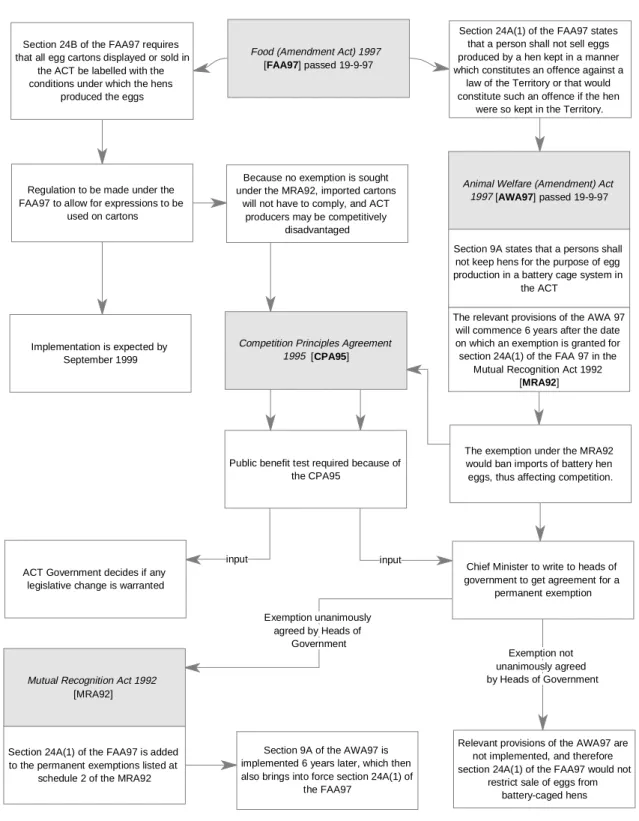
are produced by battery caged hens. Because the labelling requirement will not apply to ‘imported’ eggs, labelled Parkwood eggs may be at a competitive disadvantage relative to any unlabelled imported eggs. The potential impact on competition again invokes the CPA and a requirement for an appraisal of the benefits and costs of the legislative change. Figure 1.1 shows how the recent ACT legislative amendments interact with the CPA and the MRA.
1.3
What is a public benefit test?
A guiding principle of the CPA (Governments of Australia 1995, p. 8) is that legislation enacted by Australian governments should not restrict competition, unless it can be demonstrated that:
• the benefits of the restriction to the community as a whole outweigh the costs; and
• the objectives of the legislation can only be achieved by restricting competition.
This constitutes the public benefit test. The terms of reference (appendix A) set out in greater detail some of the important features of such a test, though it does not limit the matters which may be taken into account. The terms of reference also state that the Commission “... shall not be limited to benefits and costs arising within the ACT only”.
It should be noted that the test does not represent an imposition of the Commonwealth or other states on the ACT, but rather an agreed process which all Australian heads of government have endorsed, on behalf of their constituents. The outcome of the public benefit test is only one input into the process of law-making and review (figure 1.1). Australian heads of government decide whether to grant an exemption under the MRA, and the ACT Government decides whether any further amendment of the labelling requirement under section 24B of the Food
(Amendment) Act 1997 is required.
1.4
What is the scope of the public benefit test?
In the case of the exemption under the MRA, the test relates to the public benefit of that exemption, not to the original legislative amendment passed by the ACT Legislative Assembly. However, this amounts to the same thing.
Figure 1.1 Interactions between relevant legislation
Food (Amendment Act) 1997 [FAA97] passed 19-9-97 Section 24B of the FAA97 requires
that all egg cartons displayed or sold in the ACT be labelled with the conditions under which the hens
produced the eggs
Section 24A(1) of the FAA97 states that a person shall not sell eggs produced by a hen kept in a manner which constitutes an offence against a
law of the Territory or that would constitute such an offence if the hen
were so kept in the Territory.
Animal Welfare (Amendment) Act 1997 [AWA97] passed 19-9-97
Public benefit test required because of the CPA95
The relevant provisions of the AWA 97 will commence 6 years after the date on which an exemption is granted for section 24A(1) of the FAA 97 in the
Mutual Recognition Act 1992 [MRA92]
Section 9A states that a persons shall not keep hens for the purpose of egg production in a battery cage system in
the ACT
Chief Minister to write to heads of government to get agreement for a
permanent exemption The exemption under the MRA92 would ban imports of battery hen eggs, thus affecting competition.
Section 24A(1) of the FAA97 is added to the permanent exemptions listed at
schedule 2 of the MRA92
Section 9A of the AWA97 is implemented 6 years later, which then also brings into force section 24A(1) of
the FAA97
Relevant provisions of the AWA97 are not implemented, and therefore section 24A(1) of the FAA97 would not
restrict sale of eggs from battery-caged hens Implementation is expected by
September 1999
ACT Government decides if any legislative change is warranted
Competition Principles Agreement 1995 [CPA95]
Mutual Recognition Act 1992 [MRA92]
Regulation to be made under the FAA97 to allow for expressions to be
used on cartons
Because no exemption is sought under the MRA92, imported cartons
will not have to comply, and ACT producers may be competitively
disadvantaged Exemption not unanimously agreed by Heads of Government Exemption unanimously agreed by Heads of Government input input
Source: Based on information provided by the ACT Government.
This is because, in the absence of an exemption under the MRA, the Animal
Welfare (Amendment) Act 1997 will not be implemented. That, in turn, changes the
offence. If the exemption is not granted, battery egg production and sale would continue to be legal in the ACT. Accordingly, the public benefit tests can effectively be seen as tests of the original legislative amendments.
1.5
Consultative processes
The study commenced in early August 1998 to run for about ten weeks. The Commission advertised the study and sought public submissions by 9 September 1998. Over 100 submissions were received (appendix B). Major submissions were distributed for comment to all organisations that made a submission.
The Commission held discussions with many of the key stakeholders including representatives of animal welfare groups, relevant ACT and Commonwealth government officials, scientists with expertise in the area and producers (appendix B). It also inspected farm enterprises operating each of the three main egg production systems.
1.6
Structure of the report
Chapter 2 sets out a framework for examining how the legislation affects the interests of animals, producers and consumers. The following chapter considers factors which could influence the effectiveness of the legislation. The likely impacts of the legislation on animal welfare, producers and consumers are assessed in chapters 4 to 6. Chapter 7 briefly explores a range of other issues relevant to the public benefit tests. Finally, chapter 8 sets out the conclusions for public policy.
2
A framework for analysis
2.1
Introduction
The broad framework for undertaking public benefit tests is set out in the Competition Principles Agreement (Subclause 1 (3)) and replicated in the terms of reference for this study. In brief, factors which, where relevant, should be taken into account include:
• government legislation and policies relating to ecologically sustainable
development;
• social welfare and equity considerations;
• government legislation and policies relating to matters such as occupational
health and safety, industrial relations and access and equity;
• economic and regional development, including employment and investment
growth;
• the interests of consumers;
• the competitiveness of Australian businesses; and
• the efficient allocation of resources.
It is important to recognise that these factors require consideration of issues far broader then those that are commonly perceived as being addressed in ‘economic’ assessments. For example, they call for consideration of environmental matters and social welfare and equity issues. Indeed, as far as possible, the public benefit test should consider all relevant factors.
The need to consider all factors — not just economic benefits and costs — is reinforced by the study’s terms of reference. These specifically request that account also be taken of:
• the social benefits and costs of different egg production systems; and
• the environmental benefits and costs of different egg production systems.
In the context of this study, it is essential that a broadly based test be applied, particularly to the more complex and significant of the two public benefit tests
undertaken in this study — the ACT ban on the production and sale of eggs from battery hens. This involves consideration of ethical questions concerning animal welfare, about which some in the community hold passionate views.
It seems likely that most people — including animal welfare groups — are prepared to accept that is it appropriate to rear animals for commercial use, including for human consumption. But, for many, this ‘trade-off’ is conditional on appropriate ‘housing’ and sound animal husbandry practices to ensure that the animals do not suffer unduly. However, there are quite divergent views about where the boundaries lie. For instance:
• the concerns of some vary according to the type of animal (eg between
kangaroos and hens);
• there are differing perceptions about animal rights;
• views vary on how welfare can be best assessed; and
• there are large differences in the level of understanding of different people about the impacts of various husbandry practices on animal welfare.
This latter difference is not unexpected given the complexities and uncertainties involved in assessing animal welfare. For instance, Baxter (1994, p. 614) comments:
The welfare of animals is an intrinsically difficult subject to study scientifically. The central issue in animal welfare is to determine what the animal itself is experiencing ... something that scientists cannot at present (and probably will never be able to) measure directly.
Despite such information deficiencies, it is important that existing information be drawn upon to arrive at some understanding of these inherently complex issues. Although there are obvious difficulties in assessing the analytical rigour and the relevance of the findings of the numerous (often conflicting) studies which examine factors pertinent to this study, the Commission has tried to set out the relevant benefits and costs in a systematic and objective fashion. To this end, the study seeks to distinguish between ‘facts’ and popular ‘myths’, and between factors which are common to all egg production systems and those peculiar to particular systems, in part by consulting with a representative range of stakeholders and, as far as possible, pursuing transparent processes.
The following section briefly identifies the key issues that are important for assessing whether the ACT legislative amendments are likely to yield net public benefits.
2.2
Key issues
The legislative amendments applying to the production, sale and labelling of eggs passed by the ACT Legislative Assembly have been outlined in chapter 1. Underpinning the amendments are some hypotheses which clarify the main issues. These imply that:
• the legislative changes are legally and administratively feasible (ie the intent of the legislative changes — an effective ban on battery egg sales and a change in labelling — cannot be undermined by loopholes in the legislation or changes in the behaviour of producers or consumers);
• hen welfare would be improved in non-battery alternatives;
• any gains from improved hen welfare achieved by implementing the ban
outweigh the costs;
• no alternative actions would achieve better outcomes; and
• consumers would more often freely choose non-battery alternatives (with
resulting improvements in animal welfare) if they were better informed about the production system used to produce the various brands and types of eggs available to them. This implies that consumers cannot reliably infer this information from existing labelling.
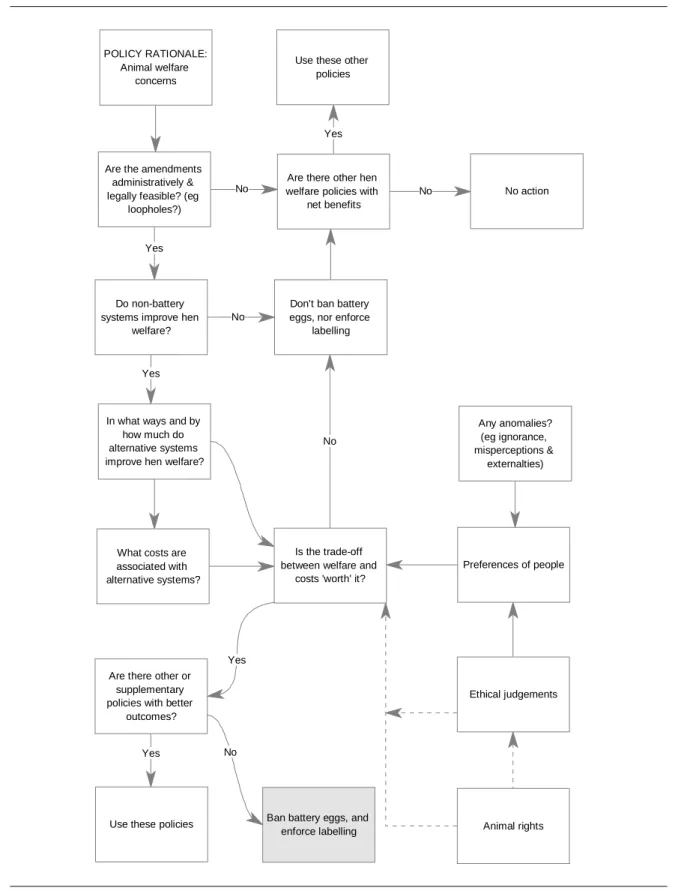
These hypotheses — and the policy implications that follow from their analysis — are set out diagrammatically in figure 2.1. The figure necessarily simplifies the policy decision making process — for instance, by assuming the availability of sufficient information to say ‘yes’ or ‘no’ to the major questions. This framework suggests that, as a starting point, the legal and administrative effectiveness of a ban should be appraised, for example, to examine the risk of loopholes (chapter 3). If the intent of the legislation could not be achieved, this would suggest further amendments or the adoption of other policies.
Presuming the amendments are legally and administratively effective, the next step is to define and measure animal welfare and appraise how welfare is affected in different egg production systems (chapter 4). If there were no apparent increase in animal welfare from banning battery cage systems, then the regulation would have failed its most essential criterion.
Figure 2.1 Framework for assessing the costs versus benefits
POLICY RATIONALE: Animal welfare
concerns
Are there other hen welfare policies with
net benefits
What costs are associated with alternative systems?
Is the trade-off between welfare and
costs ’worth’ it? Don’t ban battery eggs, nor enforce
labelling Any anomalies? (eg ignorance, misperceptions & externalties) Ethical judgements In what ways and by
how much do alternative systems improve hen welfare?
Do non-battery systems improve hen
welfare?
Preferences of people Use these other
policies
No
Yes
No
Animal rights Ban battery eggs, and
enforce labelling
No action
Are there other or supplementary policies with better
outcomes?
Use these policies Are the amendments
administratively & legally feasible? (eg
loopholes?) Yes No Yes No Yes No Yes
If the ban does achieve some improvements in animal welfare, some assessment is needed of the costs and benefits of these improvements. The major cost factors are relatively easy to identify (eg higher egg prices for some domestic and commercial users, capital costs borne by Parkwood (the major ACT producer), possible job losses and additional administration costs (chapters 5, 6 and 7)). With the available information, it is possible to obtain reasonable estimates of some of these costs. On the other hand, assessing the extent and value of the benefits stemming from animal welfare improvements is extremely complex. This is because people’s preferences for animal welfare may be partly masked by misperceptions and poor information (which provides the rationale for the labelling provisions). As well, animal welfare is an ethical concern, and this suggests that community standards and animal rights, rather than consumer preferences, may be an appropriate basis on which to judge what is ‘right’ (or in the public interest).
Even if it appears that excluding battery hen eggs from the ACT market is in the public interest, this does not address the question as to whether a legislative ban is the best policy response — alternative and supplementary policies should be examined to see if they could produce a similar, or better, outcome (chapter 8).
EFFECTIVENESS OF THE ACT
15
3
Effectiveness of the ACT legislation
It is important to consider whether the legislation passed in the ACT would be effective in achieving its stated goals, or whether actions by producers, other players in the supply chain or consumers could undermine its effectiveness. To this end, this chapter discusses the likely effects of a range of possible responses.
3.1
Section 69 challenge
Section 92 of the Australian Constitution provides for free trade between States, but does not apply to trade between a State and a Territory. However, Section 69 of the
Australian Capital Territory (Self Government) Act 1988 applies the intent of
Section 92 to the ACT. It states that:
... trade, commerce and intercourse between the Territory and a State, and between the Territory and the Northern Territory, the Jervis Bay Territory, the Territory of Christmas Island or the Territory of Cocos (Keeling) Islands, shall be absolutely free. (Section 69 (1))
In the light of these provisions, it needs to be considered whether an interstate producer could challenge the ACT legislation on the grounds that it is contrary to the Self Government Act. If this were the case, the ACT legislative amendments would not be effective in preventing the sale of eggs from battery cage hens — it would merely result in the ACT demand for such eggs being satisfied entirely by interstate producers rather than by a mixture of interstate and local sources as happens at present.
Legal advice supplied to the Commission draws on a 1988 decision by the High Court concerning Tasmanian legislation which specified the minimum size of crayfish that could be bought or sold in the State (Cole v. Whitfield (1988)) and the underlying intent of Section 92 of the Constitution. This advice suggests that the resolution of this issue hinges on whether the ACT legislation can be characterised as ‘protectionist’.
The legal advice concludes that the ACT legislation could be viewed as representing a burden on trade (because it bans ‘imports’ of battery eggs), but that it is not discriminatory in the sense that it does not differentiate between producers in the ACT and those located in other jurisdictions. Hence, the advice suggests that the
ACT legislation could not be characterised as ‘protectionist’ — the restrictions are necessary if the legislation is to achieve its intended goals.
In the absence of a case testing the legislation in the courts, it is not possible to assert that ACT legislation is immune from legal challenges. Nonetheless, on the basis of the information currently available, this seems likely.
3.2
Differential labelling provisions
As noted in chapter 1, the ACT Government’s proposal for a national standard for egg packaging was not agreed to by the Australia and New Zealand Food Standards Council. In addition, the ACT Government has not sought an exemption under the Mutual Recognition Act (MRA) for the labelling amendments. Consequently, the requirement to label all egg cartons displayed or sold in the Territory with the conditions under which the hens produced the eggs would not apply to eggs imported from other jurisdictions.
Presuming the MRA exemption for the ban is granted, in the period between the introduction of the labelling requirement and the time the Animal Welfare Act comes into force (six years after the granting of the exemption), interstate producers would be able to sell battery eggs in the ACT that are not identified as such.
In practice, some interstate suppliers may elect to comply with the ‘spirit’ of the law and label their battery eggs accordingly. In that event, any effects that labelling has in reducing the share of the ACT egg market supplied by battery hens would be spread evenly over all suppliers of battery eggs. On the other hand, the absence of a legal obligation to label their eggs may provide interstate producers with a commercial advantage over Parkwood (who would be obliged to comply with the labelling requirements). As a result, some interstate suppliers of battery eggs may not label their eggs. This could have two effects:
• sales of battery hen eggs would be higher than would be the case if all eggs were labelled; and
• interstate producers of unlabelled battery eggs may gain market share at the
expense of Parkwood.
In the latter circumstances, the effectiveness of the ACT legislation would be reduced by the sale of unlabelled imported battery hen eggs. However, this would not be a longer term problem because, once the six year transition period ends (and again presuming an MRA exemption is gained), the sale of all battery hen eggs in the ACT will be prohibited. Consequently, the only unlabelled eggs that could be
EFFECTIVENESS OF THE ACT
17 legally sold in the ACT would be non-battery eggs sourced from interstate producers. In this situation, it is likely that interstate suppliers of such eggs would label them (as they currently do) because they may otherwise be at a disadvantage relative to sellers of labelled eggs. However, irrespective of whether interstate producers label or do not label their eggs, the ACT labelling amendments would not materially detract from the Government’s objective to ban the sale of battery eggs in the Territory once the six-year transitional period has expired.
3.3
Purchase of eggs from interstate
If the ban comes into place, some domestic and commercial consumers might choose to buy eggs in New South Wales. To the extent that this occurred, the ACT ban would merely alter the locations from which eggs are purchased, and have no impact on total sales of battery eggs or the number of hens housed in battery cage systems.
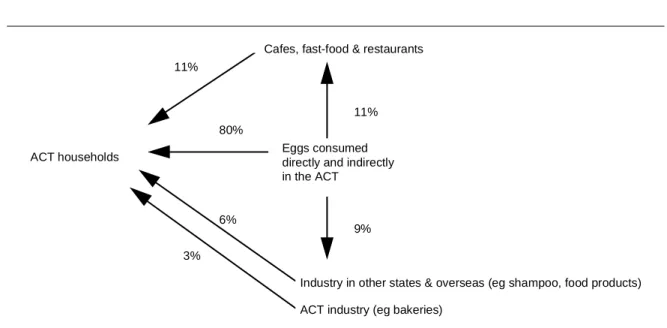
As discussed in chapter 6, the majority of egg consumption in the ACT — around 80 per cent — is consumed directly by households. The remainder is consumed indirectly — via purchases of goods that incorporate eggs (eg restaurant meals and bakery products).
For domestic egg users, changes in shopping patterns would be most likely for those residents of Queanbeyan and other border towns that usually shop in the ACT. For these consumers, the inconvenience of buying eggs in (say) Queanbeyan may be minor compared to the potential savings. In the case of Canberra residents, the savings are unlikely to outweigh the inconvenience of shopping interstate, except for a relatively small number of users (eg consumers of large numbers of eggs and/or those living or working close to an interstate seller).
The trade-off between convenience and savings would also be relevant for some commercial users (eg fast food outlets, clubs and restaurants). However, many of the largest ACT commercial users — such as bakeries and cake producers — already buy eggs in forms which are unaffected by the proposed ban (eg dehydrated or liquid egg).
Overall, it seems probable that some consumers will avoid the ban by purchasing battery eggs interstate. However, these sales are likely to represent only a very small proportion of total ACT sales.
3.4
Eggs imported from other countries
The ACT is a signatory to the Trans-Tasman Mutual Recognition Arrangement (TTMRA) which came into operation on 1 May 1998. This provides for the extension of the mutual recognition principle to goods of New Zealand origin. As a consequence of the TTMRA, the ACT Government contended that:
... New Zealand produced battery hen eggs that could be sold in New Zealand could also be sold in the ACT, even if Section 24A(1) of the Food (Amendment) Act 1997 was added to the Permanent Exemptions Schedule to the Mutual Recognition Act 1992. That is, while Australian produced battery hen eggs would be banned in the ACT, New Zealand produced battery hen eggs could still be sold in the ACT. (sub. 74, p. 4)
The ACT Government did not suggest that, in practice, there would be a likelihood of New Zealand egg imports. This may reflect the fact that, at present, quarantine restrictions prohibit the importation of fresh eggs into Australia
Even if it were possible to import fresh eggs from New Zealand, it is not clear that this would be a commercially attractive proposition. Transport could pose some difficulties. First of all there is the cost. Eggs are a relatively bulky, low value product. Thus, transport costs — in New Zealand, for the cross-Tasman leg and in Australia — would be significant. The reliability of transport services would also be a factor. As eggs have a limited shelf life, the capacity to use locally held inventories to ensure ongoing supplies in the face of hold-ups in the transport chain would be less than that for many other products.
3.5
Substitution effects
Some large commercial users who presently use fresh battery hen eggs may be able to switch to egg products made from battery eggs which are exempt from the ACT ban (eg dehydrated egg). There is little information available to assess the likelihood and extent of this. However, as noted above, many large commercial users already use egg derivatives. For some other commercial users (such as fast food outlets), substitution may not be viable. The possibility of substitution for households is also low. Accordingly, substitution between battery hen eggs and egg products unaffected by the ban (eg egg powder) would be minor.
3.6
Enforcement
An egg produced by a battery hen is no different in appearance to an egg produced by a hen housed in any other egg production system. This raises an important
EFFECTIVENESS OF THE ACT
19 enforcement issue — it is conceivable that, in the event of a ban, some eggs produced in battery cage systems could be misrepresented as non-battery eggs.
There are, of course, risks involved for those who are prepared to engage in such illegal activities. For the large retail chains — that collectively account for the majority of domestic egg sales in the ACT — the risks are almost certainly too high. If they were implicated in any illegal actions, the damage to their reputation (and sales) would considerably outweigh the potentially higher returns on egg sales. Similar considerations apply to large egg producers.
Small producers and small retailers may face lower risks. Nonetheless, financial penalties and/or the loss of business would undoubtedly loom large in the minds of most small players.
The probability of illegal activity being detected will, in part, depend upon the enforcement strategies pursued by the ACT Government. Given the significant financial advantage that could be gained if battery hen eggs were sold in the ACT as non-battery eggs, illegal suppliers would also risk being reported to the authorities by competitors in the market who would feel ‘cheated’ by such illegal activities.
In summary, some eggs from battery hens may be misrepresented and sold in the ACT market as non-battery eggs if the proposed ban comes into play. However, in the Commission’s view, illegal activities will largely be confined to the market fringes, and are unlikely to represent a very significant proportion of total ACT egg sales.
3.7
Summary
In common with most regulations, some of the parties affected by the ACT legislative amendments will have incentives to organise their affairs so that they can avoid the ban altogether or, alternatively, minimise any adverse effects on them.
Some legal responses — such as purchasing eggs interstate and switching to the use of battery eggs in a form unaffected by the ban (eg dehydrated egg) — and illegal responses (misrepresenting battery eggs) could undermine the intent of the ACT legislative amendments. However, the Commission considers such activities are not likely to pose a significant threat to the underlying objectives of the ACT legislative amendments.
4
Animal welfare issues
The underlying objective of the ACT legislative changes is to improve the welfare of hens. This suggests a number of issues:
• what is meant by ‘animal welfare’?
• what are appropriate measures of animal welfare?
• what are the characteristics of hens and how do they affect assessments of
welfare?
• what is the nature of existing egg production systems and what will replace
battery egg production if the ban is implemented? Do they increase or decrease hen welfare?
• what is the nature and adequacy of existing approaches to animal welfare, such as codes of conduct?
• are economic incentives for producers likely to lead to good animal welfare
outcomes? and
• what is the relevance of ‘cruelty’ to the proposed ban?
Each of these issues is explored in turn. 1
4.1
What is meant by animal welfare?
The concept of animal welfare
Animal welfare is an elusive concept. This reflects the concept’s numerous dimensions, the fact that welfare has a mental as well as a physical aspect, the importance of people’s subjective evaluations and its historical roots. For example, the French philosopher, René Descartes, with a perspective quite foreign to current community standards, saw animals as ‘mechanical robots’ without feelings or pain
1 There is a massive amount of research into layer hens and their welfare. People who are interested in quickly discovering more about the complex issues may want to examine the following references: Temple (1994), Appleby et al (1992) and Dawkins (1980). They provide an unbiased and scientific account of the relevant welfare issues.
sensation. He marvelled that these automatons “could give such a realistic illusion of agony.”2 In the late 18th century, Jeremy Bentham argued that animal welfare was a legitimate concern because animals could suffer — starting the modern scientific (and ethical) consideration of animal welfare. In the 1960s, as intensive farming grew to ascendancy, there was increasing public concern about the impacts of farming practices on animal welfare. The Brambell Report (1965) into animal welfare in the UK was the precursor to many other examinations of the impacts of intensive livestock husbandry systems on animals — and established a framework for looking at such animal welfare issues. Bowling (1989) described some of the historical aspects of the development of animal welfare as a popular public concern in Australia.
To make assessments of animal welfare, some tools for thinking about and measuring animal welfare are needed. It is particularly important to separate scientific assessments of welfare from attitudes and moral judgements about what is appropriate. Two leading UK researchers note:
We should use the word “welfare” in a scientific way so that it is useful when considering animal management or when phrasing legislation. Welfare is a characteristic of an animal, not something given to it, and can be measured using an array of indicators. (Broom 1991, p. 4174)
... if people feel that it is important to try to change the laws about the treatment of animals, they must have more to go on than just their intuition. ‘Suffering’ must be recognisable in some objective way. Otherwise the laws which emerge are almost bound to be arbitrary and might even fail to improve the lot of animals much, if at all. (Dawkins 1980, p. 2)
A framework for analysis
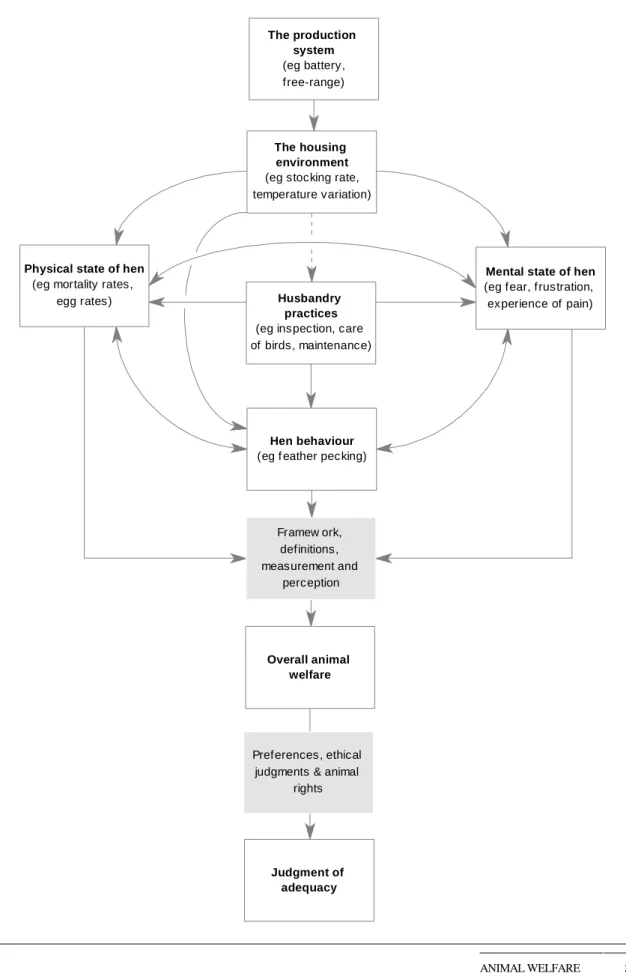
The framework for gauging and valuing animal welfare is outlined in figure 4.1. Since the objective of this chapter is to compare the impacts of different egg production systems on the welfare of layer hens, the logical starting point for such an analysis is to objectively describe and measure the physical environment of each system. Coupled with other factors, including the birds’ genetic make-up and age, the physical environment elicits physical, behavioural and mental responses from hens. These responses tend to interact with each other.
Figure 4.1 Framework for evaluating animal welfare
The housing environment
(eg stocking rate, temperature variation)
The production system
(eg battery, free-range)
Physical state of hen
(eg mortality rates, egg rates)
Hen behaviour
(eg f eather pecking)
Mental state of hen
(eg fear, frustration, experience of pain) Overall animal welfare Judgment of adequacy Preferences, ethical judgments & animal
rights Framew ork, definitions, measurement and perception Husbandry practices
(eg inspection, care of birds, maintenance)
The current scientific approach to measuring animal welfare is to use a variety of measures (Dawkins 1980, pp. 2–3; Hemsworth and Barnett 1993, p. 101 and Broom 1991, p. 4168) to build up an overall picture of welfare. There is now broad agreement on the dimensions of hen welfare, such as mortality, adequate nutrition, rates of feather pecking, fear responses and the ability to undertake behaviours that
hens value. There is also strong (but not complete3) agreement about what
constitutes a better welfare outcome for each of the dimensions. Moreover, there is also a growing, though still deficient4, body of literature which measures particular aspects of welfare in different systems. The greatest difficulty is assembling the various indicators into a summary measure of hen welfare:
Although the welfare difference between some systems may be unequivocal it will be less clear in other comparisons because there are advantages to a system in some aspects and disadvantages in others. A problem then is the weighing of advantages and disadvantages. (Scientific Veterinary Committee 1996, p. 99)
Even if people agree on the objective state of hen welfare in any one system, their judgement about whether that state is acceptable or not will vary, depending on ethical values and preferences.
Finally, the Commission notes that animal husbandry practices — briefly reviewed in the next sub-section — are relatively weakly influenced (hence the dotted line in figure 4.1) by the type of housing system, but play a critical role in determining the welfare of hens.
The importance of husbandry
During discussions with both producers and animal welfare experts, the Commission was told of the crucial importance of appropriate animal husbandry to animal welfare. As the Standing Committee on Agriculture and Resource Management (1995, p. 1) indicates:
The importance of good stockmanship in animal welfare cannot be over-emphasised. Persons responsible for the care of poultry should be well trained, experienced and dedicated.
3 For example, it has been claimed that increases in floor space in cages may allow greater exercise, but may also increase aggressive pecking in White Leghorns (Working Group of the National Layer Hen Housing Review 1994, p. 147).
4 The Working Group of the National Layer Hen Housing Review (1994, p. 64 and p. 131) argued that there was a range of, sometimes severe, shortcomings of poultry science in guiding policy for preferred housing systems.
This includes practices which minimise fear in birds, appropriate maintenance of the sheds and feeding and watering systems, diligent inspection of birds, appropriate removal of spent hens, attention to cleanliness and a range of other factors. For example:
• Fear — Barnett, Hemsworth and Newman (1992) found that hens’ fear of
people explained a high proportion of the variation in the egg productivity of hens. Hemsworth et al (1993) found that small differences in the behaviour of people entering housing systems had a significant impact on the fear levels of hens. Barnett et al (1993 and 1994) found that birds were much less fearful of people in all sorts of contexts if they were familiar with people. Birds with a lack of familiarity with people had lower productivity and higher stress hormone levels when they experienced human contact.
• Fractures — Gregory et al (1992) found that removing birds from cages by both
legs reduced femur breakages from 7.4 per cent to just below 1 per cent.
Appropriate animal husbandry practices are essential to good animal welfare outcomes in all systems of production. Different systems require different practices and the development of different bodies of knowledge — underlining the importance of research if systems of production are changed significantly. Moreover, different systems may affect some aspects of husbandry, although the links from production systems to management are weak. However:
• elevated dust and ammonia levels and the risk of falling faeces in some multi-level non-battery alternatives may discourage staff from entering the sheds to undertake sufficiently frequent and careful inspection and maintenance;
• staff to bird ratios are higher in non-battery systems (due to lower stocking densities) — which may increase hens’ familiarity with humans (thus reducing fear);
• multi-tier cages in a modern cage system can have very high and very low cages which are difficult to inspect without bending or straining by staff, affecting the extent of diligent inspection (Farm Animal Welfare Council 1997, p. 20). As well, immobile sick and dead birds may be more easily detected in barn and free-range systems than in battery cage systems. On the other hand, individual inspection of mobile birds is difficult in non-battery systems; and
• there are a wider repertoire of tasks for staff caring for hens in alternative systems. Floor eggs need to be collected, pecked birds need treatment and outbreaks of cannibalism managed or avoided.
Overall, the less automated and controlled nature of non-battery systems requires greater husbandry skills (and more labour) than the battery cage system. These
greater requirements are included as an additional cost of production in chapter 5. It would be important to ensure appropriate husbandry after any changes in legislation or codes of practice. Assuming that these take place, husbandry can be ignored when comparing the different housing systems.
The role of physical versus other indicators
Most scientists and animal welfare groups argue that physical indicators, such as mortality, sickness, stress hormone levels, immuno-suppression and egg production rates per bird, are, all other things being equal, important barometers of bird welfare. While there is agreement on many of these measures of welfare, there is divergent interpretation of some. For example, a hen may show heightened stress hormone levels in some production systems, but it is unclear whether this is ‘good’ or ‘bad’ stress (Temple 1994, p. 14). Similarly, egg production per bird, combined with mortality, defines the ‘biological fitness’ of a hen, but it may not correspond to a higher rate of mental or physical well-being.
It is now generally recognised that physically manifested welfare indications are only part of the story, and that it is important to use scientific experiments to try to
infer the ‘mental’ and ‘motivational’ states of hens.5 A major challenge for
scientists has been to impute the elusive underlying mental state of animals (and their preferences) from their behaviour.
Some of the major questions about this aspect of the welfare of hens relevant to the comparison of battery cage versus alternative systems are:
• how important is it that birds be able to perform natural behaviours, such as dust-bathing, pecking, perching and nesting?
• what are the behavioural indications of stress, fear, boredom and frustration in layer hens, and how do these signs vary by type of production system?
• how important do birds find access to natural light, and to freedom to walk
around outside?
• what are the trade-offs between physical and mental welfare of hens?
A problem in inferring the mental state of hens from their behaviour is one of interpretation. Different people may interpret the same behavioural evidence differently. For example, layer hens in cages sometimes engage in ‘vacuum bathing’
5 For example, this has been acknowledged by Dawkins 1980, Broom 1991, the [EC] Scientific Veterinary Committee 1996, the [Australian] Working Group of the National Layer Hen Housing Review 1994 and the [UK] Farm Animal Welfare Council 1997.